

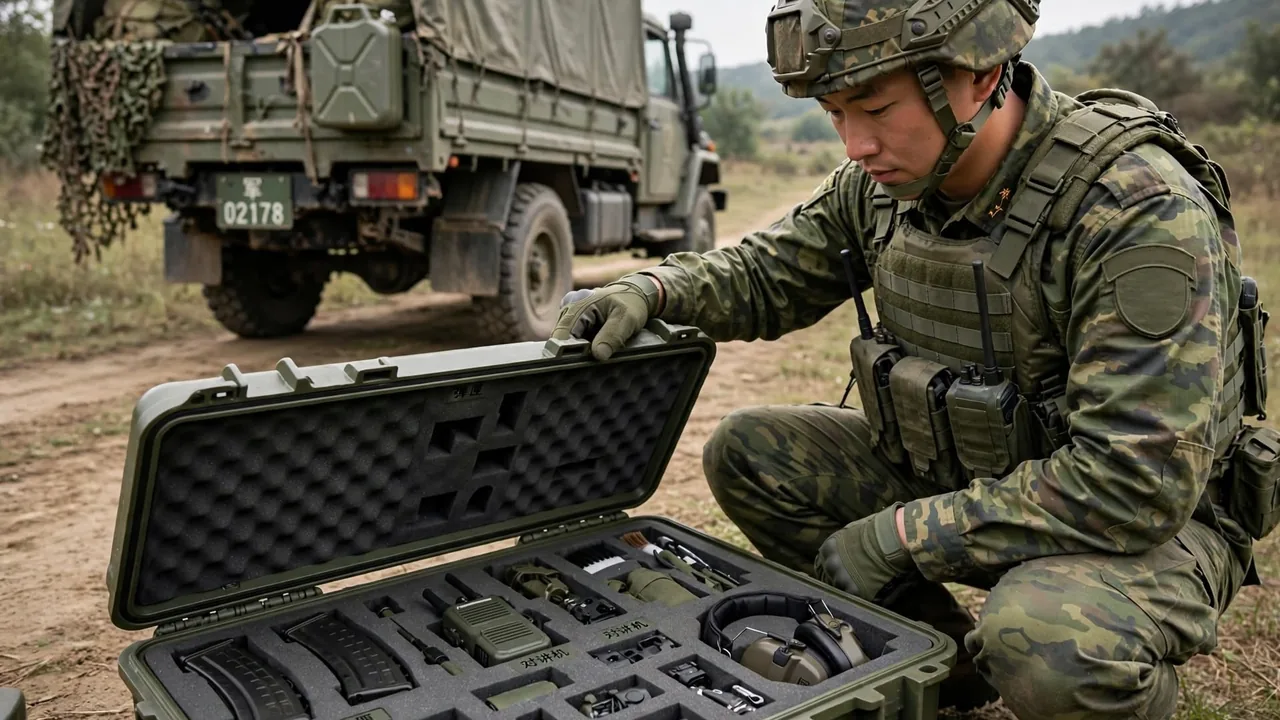
The part of a tool box that meets the worst conditions is not the base but the top, which faces sunlight, rain, falling dust, stacking pressure and occasional foot traffic all at once. Engineering answers this with two quite different solutions. One is to fit a cover over the box, wrapping all or most of it in flexible or semi-rigid material. The other is to build the top of the box as an opening lid and close the aperture with structure, sealing and clamping. The cover emphasises isolation from the outside environment and cost control; the lid emphasises airtightness, rigidity and operating convenience.
This article deals only with these two components: their materials, structural forms, sealing interfaces, clamping methods, weathering behaviour, condemnation and replacement criteria, and the inspection and procurement points that surround them. Where protection ratings and test methods appear, the treatment is an engineering one, and the applicable criteria follow the contract and local regulations.
Tool Box Cover and Lid: Two Different Protection Problems
Separate the two concepts first. A tool box cover is a covering component. It carries no structural load; its task is to isolate the outside environment from the box surface, blocking rain, dust and ultraviolet radiation, reducing the temperature rise caused by direct sun, and protecting coating and markings in dusty or oily environments. A tool box lid is part of the box itself. It carries structural load and participates in sealing; its task is to close the aperture and, once the latch is tightened, to form a continuous sealing boundary.
This distinction drives completely different evaluation criteria. A cover is judged on weathering, water shedding, tear resistance, fixing reliability and ease of fitting and removal. A lid is judged on stiffness, fit accuracy, gasket compression and the cycle life of hinge and latch. Confusing the two produces predictable failures: demanding an airtight rating from a box that only has a cover, or adding a cover over a box that already has a lid without providing ventilation, which is difficult to accept in the first case and traps moisture in the second. The first step in selection is therefore to decide whether the duty requires keeping the outside out, sealing the inside in, or both.
Cover Formats: Soft, Semi-Rigid and Fully Enveloping
By stiffness, covers divide into three formats. A soft cover is sewn from coated fabric: foldable, light and inexpensive, suited to dust and sun protection during idle storage or short outdoor periods. Its weaknesses are poor shape stability and an anti-lift capability that depends on straps and fasteners, with both fabric and stitching ageing under prolonged sunlight. A semi-rigid cover uses a thin sheet, corrugated board or formed plastic panel as a frame, wrapped in a waterproof facing layer, which balances shape retention with low weight and suits applications that are repeatedly fitted and removed but need a defined outline. A fully enveloping cover is formed to roughly follow the box profile, offering the most complete protection and the tidiest appearance at the cost of tooling, volume and awkward fitting.
Three questions decide the format: does the cover stay on the box permanently or only during storage; will the operator be wearing gloves or working at height; and does the interior need ventilation. Permanent coverage with a need for ventilation should be designed with vents from the outset. Frequent fitting and removal with one-handed operation calls for the minimum number of fasteners and a quick-release design. Work at height demands limited unit weight and fixing methods that cannot be lifted by wind.
Cover Materials: Fabric, Coating and Weathering Treatment
Soft cover performance comes from three elements: base fabric, coating and stitching. Base fabrics are usually polyester or nylon, the former better for weathering and dimensional stability, the latter stronger and more abrasion resistant. The coating carries the water and weather resistance, most commonly polyvinyl chloride, polyurethane or polyolefin. PVC coatings shed water well, cost little and can be applied thickly, but they stiffen and embrittle in the cold, and plasticiser in some formulations migrates under prolonged sunlight, leaving a tacky surface. PU coatings feel better and perform better in the cold, with good flexibility, but hydrolysis resistance depends on formulation and degradation can appear in hot humid conditions. Polyolefin coatings are light, water repellent and easier to recycle, which suits medium-duty applications.
Stitching is often a greater source of failure than the material itself. Needle holes in ordinary seams are ready-made water paths, so seams need taped sealing or a heat-welded construction. A seam that sits in a water-collecting area may de-bond even with tape if it stays wet for long periods. Contact points between facing layer and box should carry a soft liner so that box corners cannot abrade through the fabric. Material selection and weathering treatment should follow the same environmental isolation logic used for the box itself, as set out in outdoor cases dealing with rain and humidity.
Lid Construction Types: Flat, Recessed and Clamped
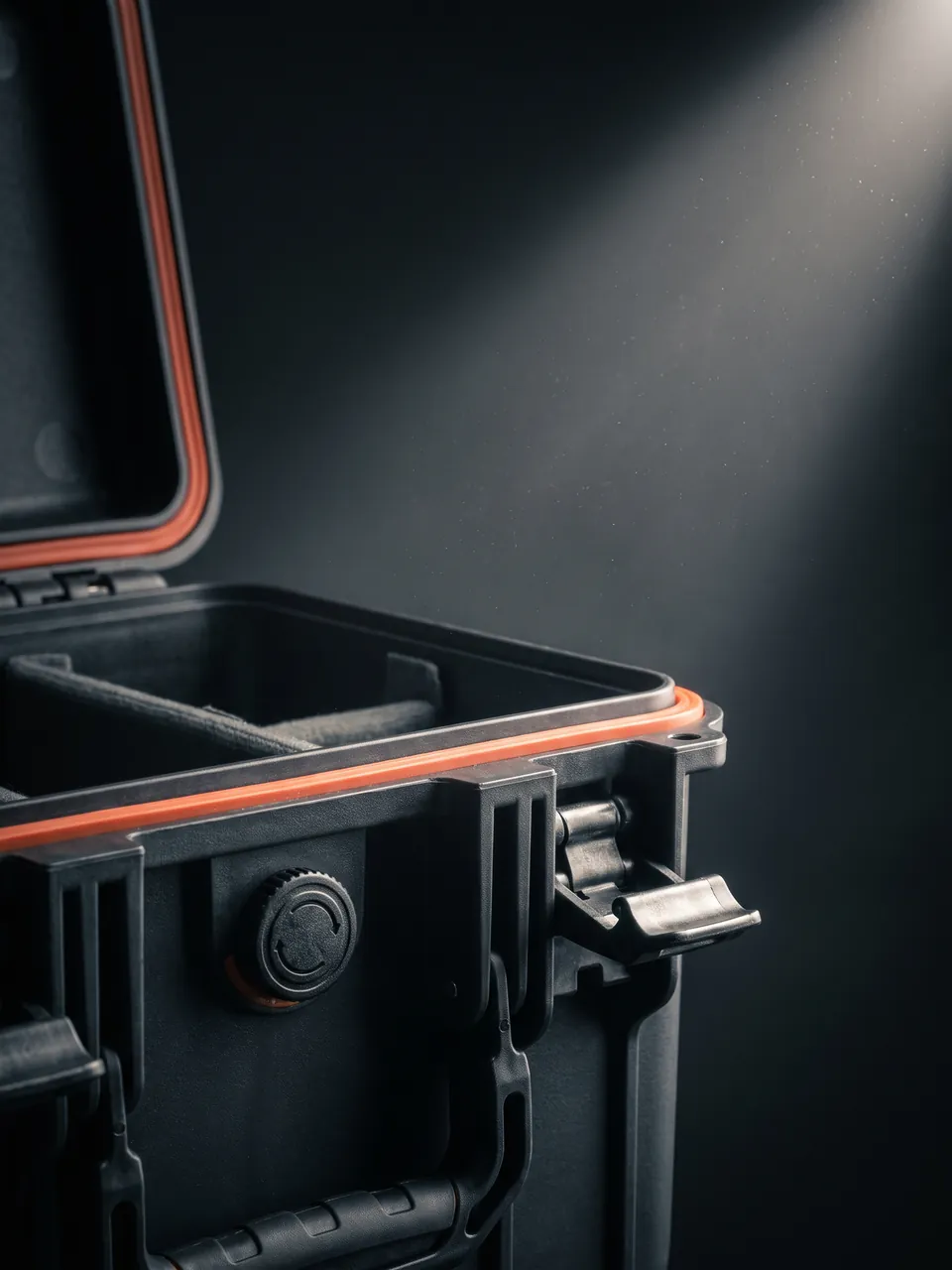
Lids divide into three types by how they mate with the box. A flat lid simply rests on the box mouth. It is simple and easy to open and suits indoor duties with modest protection needs, but its location depends entirely on hinge and latch, so a slightly distorted mouth immediately produces a gap. A recessed lid adds a mating spigot and groove between lid rim and mouth, forming a labyrinth path that markedly improves dust and splash resistance, at the price of tighter requirements on mouth flatness. A clamped lid builds on the recessed form with uniform peripheral compression, in which the latch compresses the gasket to its design value; this is the format capable of higher protection ratings, at the cost of greater opening effort and strict requirements on latch count and distribution.
Several details belong on the drawing for the mating faces: spigot insertion depth, mating clearance, lead-in angle and the position of the compression stop. Too little insertion depth gives insufficient resistance to lateral displacement; too little clearance makes assembly difficult and causes scuffing, while too much loses the labyrinth effect; the lead-in angle decides whether the lid centres easily, with too steep an angle binding and too shallow an angle weakening location. The compression stop prevents over-travel and protects the gasket from being crushed, and it is frequently omitted, with the result that an over-strong latch destroys the gasket ahead of schedule.
Sealing Is the Lid's Core Function
The reason a lid exists, at root, is to provide a boundary that can be compressed. The governing parameters of seal design are compression volume and clamping uniformity. Compression volume is the proportion by which the gasket is compressed after closing, usually expressed as a percentage, and the value balances two things: too little compression leaves microscopic paths between sealing faces through which water and dust migrate, while too much holds the rubber at high stress and accelerates permanent set and ageing. Clamping uniformity decides whether sealing works around the whole perimeter, and it is governed by the stiffness of mouth and lid rim, the number and position of latches, and the consistency of the gasket section.
The most common failure in practice is not a failed gasket but a pattern of tight ends and a loose middle. When there are too few latches or the mouth lacks stiffness, the actual compression between two latches is far below the design value, and water enters through that segment during spray testing. Three responses exist: increase latch count or move to a linked locking bar, add ribs inside the mouth to raise local stiffness, or specify a harder gasket that depends less on clamping force. Each has a cost, so they are usually combined. The wider comparison of gasket materials and selection dimensions is covered in protective case seal materials.
Gasket Materials and Replacement Criteria
Common gasket materials are nitrile rubber, EPDM, silicone and thermoplastic elastomer. Nitrile resists oil well and suits boxes that contact lubricating or hydraulic oil. EPDM excels in weathering, water and ozone resistance and is the conventional choice for outdoor boxes. Silicone has the widest temperature range and stays flexible in the cold, which suits large temperature swings, though oil resistance is moderate and cost is higher. Thermoplastic elastomer is convenient for over-moulding with the shell, reducing assembly steps, but takes a relatively high compression set after long loading.
Replacement criteria should be functional rather than time based. Four practical checks apply. Is the gasket surface slimy, hard, cracked or permanently flattened? Does the section fail to recover its shape shortly after removal? Does closing require noticeably more force in some segments than others? And does spray or immersion verification show leakage? Any single failure justifies replacement, rather than waiting until water visibly enters. The most common mistake during replacement is fitting a similar but not identical section, because compression volume was designed around the original height, so a substitute of the same material can still under- or over-compress. Replacement practice and substitute comparison are described in how to replace a protective case gasket.
Hinges and Latches: Opening and Clamping the Lid
Lid usability is decided jointly by hinge and latch, yet their design goals differ. The hinge provides rotation and travel limitation: it must hold a stable axis without developing lateral play over years of opening, and it must limit how far the lid folds back so it cannot crush fittings behind the box. The latch provides clamping and retention: it must deliver a stable compression force after closing and must not release itself under vibration and thermal cycling.
The key hinge metrics are cycle life, pin wear resistance and how the hinge mount is fixed. A mount held only by self-tapping screws in a thin wall enlarges its holes under sustained load, which shows up as a loose lid and uneven shut lines; a mount with metal inserts, or one that spreads load into the wall through a thickened zone, is far more dependable. Latch selection turns on compression travel, retention force and adjustability. Compression travel must cover the design gasket compression plus dimensional tolerance; retention force must resist transport vibration; and adjustability lets the user maintain clamping after the gasket has taken a slight permanent set, instead of replacing it immediately. Hinge replacement and upgrade paths are described in selecting and replacing case hinges.
How Protection Ratings Are Defined and Verified
A protection rating uses two digits: the first for solid particle ingress and the second for water. For a cover, the concept of a protection rating usually does not apply directly, because there is no continuous sealing face between cover and box; its performance is closer to a rain and dust barrier of fabric, and the relevant metrics are hydrostatic head, time to water penetration and resistance to wind lift. For a lid, a rating can be verified by standard methods, with three caveats: verification is conducted statically and therefore does not cover transport vibration or structural distortion; the object verified is the complete box system rather than the lid alone; and gasket condition affects the result, so passing when new does not guarantee passing three years later.
A sound verification plan therefore combines standard testing with engineering validation. Standard testing gives comparable, repeatable metrics; engineering validation uses spray combined with vibration, re-measurement after thermal cycling, and verification under realistic loading to cover the actual duty. It is worth stating clearly that citing the test methods of MIL-STD-810H or an equivalent standard means only that the methods have been referenced; it does not mean the product holds any military certification. Standard applicability and acceptance criteria follow the contract, and export scenarios follow local regulation and export control requirements.
Dust, Rain and Condensation: Three Different Problems
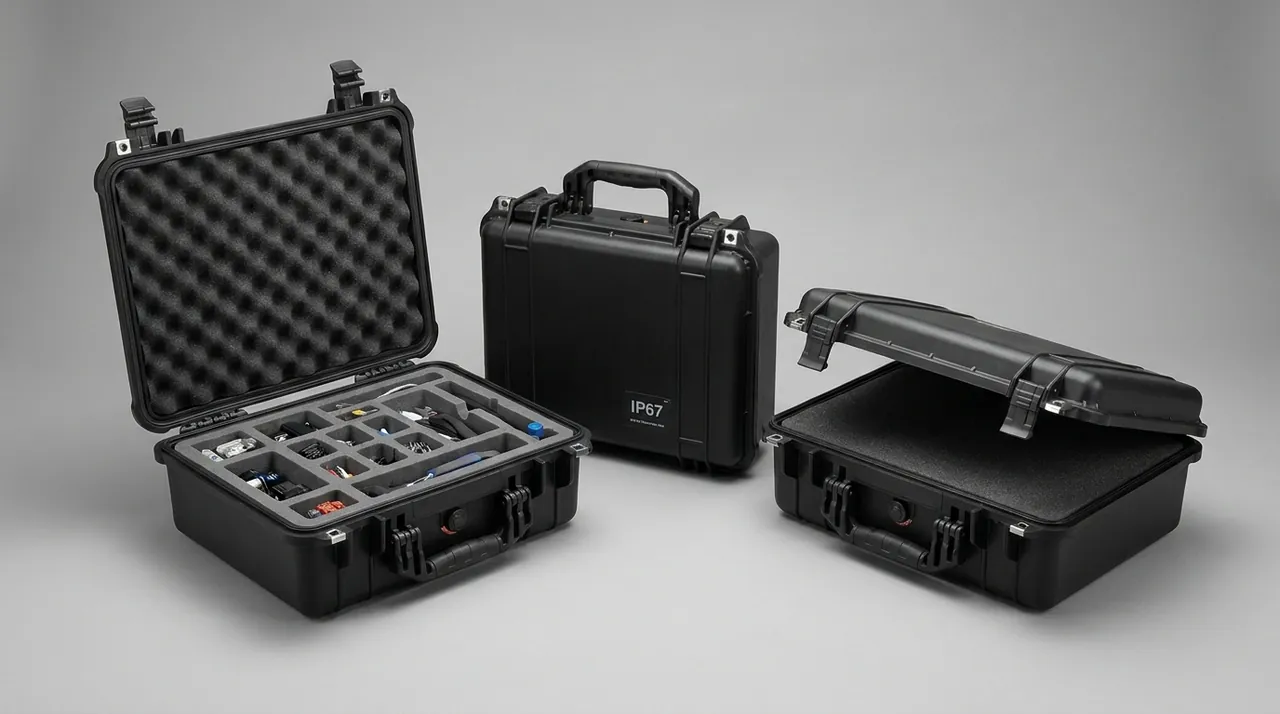
The three environmental threats work by different mechanisms and need different countermeasures. Dust involves solid particles and is handled mainly by labyrinth mating, filter media and sensible opening positions; the finer the particle, the harder it is to exclude, so openings should avoid facing upwards or should carry a replaceable filter element. Rain involves liquid water impact and accumulation, handled by a continuous sealing face, drainage geometry and shapes that do not collect water; recesses on the top, bolt counterbores and handle roots are classic water traps.
Condensation is different again: it is not external ingress but water vapour inside the box condensing on internal surfaces when there is a temperature difference. It cannot be solved by blocking, only by three routes: limiting the humid air that enters, giving moisture a way out, and preventing the inner surface from being the coldest face. Many cases of a box that never took on water yet still rusted trace back to condensation rather than leakage. The pressure equalisation valve plays a dual role in this system, balancing pressure and allowing limited moisture exchange, and its selection points are covered in what a pressure equalisation valve does.
Long-Term Effects of Ultraviolet Radiation and Temperature
Long outdoor exposure attacks cover and lid differently. On a cover, ultraviolet radiation mainly attacks coating and stitching: the coating may chalk, crack or turn tacky, and stitching loses strength before the fabric does, so the cover tears open under wind load. On a lid, ultraviolet radiation attacks plastic surfaces and coatings, showing as colour shift, loss of gloss and surface embrittlement, while repeated thermal cycling creates differential expansion between plastic lid and metal inserts, which over time can crack around the insert or distort the gasket groove.
Temperature also acts at both extremes. In the cold, soft cover coatings stiffen and embrittle, cracking during folding and fitting; in the heat, thermoplastic materials soften, the lid creeps under stacking pressure, and the gasket ages faster. Weathering design must therefore address both long-term trends and extreme events, and acceptance documents should distinguish two categories of evidence: trend data from accelerated ageing tests, and pass-fail evidence under extreme conditions such as low-temperature impact and high-temperature stacking. The two serve different purposes and cannot substitute for each other.
Replacement Points: Condemning a Cover and Repairing a Lid
Cover replacement criteria are comparatively simple. Any of the following justifies retirement: widespread coating flaking or chalking with obvious light transmission through the fabric; large-scale de-bonding of seam tape or broken stitching; failed straps, fasteners or hook-and-loop closures that cannot be replaced individually; and dimensional relaxation after repeated fitting so that the cover no longer follows the box profile. A cover is a low-value consumable, so condemnation criteria should be generous, since extending its life at the expense of protection is a poor trade.
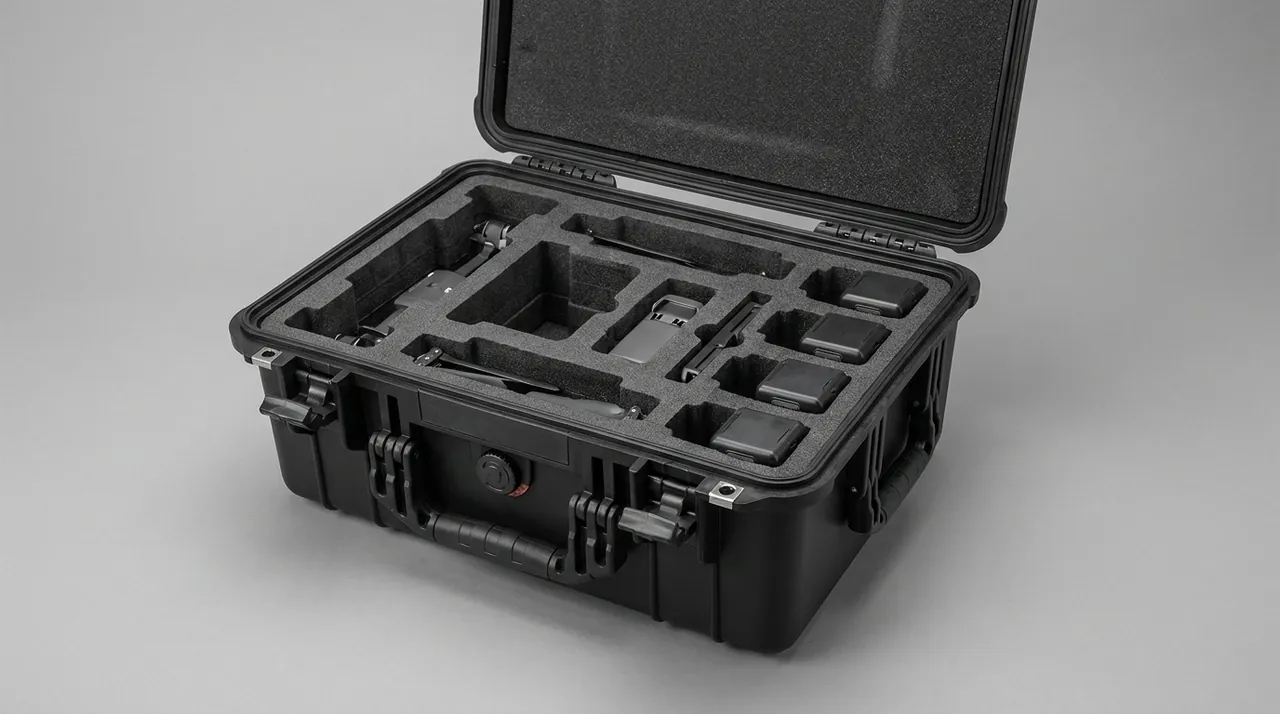
Lid replacement and repair need more care, because the lid is part of the structure. Work that can be done on site includes replacing the gasket, replacing or adjusting latches, tightening hinge screws and inspecting inserts, and repairing local coating damage or rust spots. Work requiring return to the factory or a complete lid replacement includes through-cracks or large-scale distortion of the lid panel; damage to the gasket groove that prevents the gasket from locating; cracking of the material around hinge or latch mounts; and mating face wear so severe that no adjustment restores clamping. The key judgement is to distinguish a failed replaceable part from a failed structural body, because continuing to use the latter only moves the problem elsewhere. How to handle an aged gasket is covered in what to do when a case gasket ages.
Stacking, Transport and Load on Cover and Lid
Stacking and transport add two classes of load. The first is static stacking: when boxes are stacked, the weight of the upper box passes through the contact face into the lid below, and a lid with insufficient stiffness gradually dishes under sustained load, reducing gasket compression until sealing fails after some weeks. The stacking load-bearing face of a lid should therefore be designed separately from the sealing face, so that load travels through the structure rather than through the gasket.
The second class is dynamic shock and wind load. Vibration in transit causes relative movement between lid and body, and repeated movement can loosen latches and wear hinge pins, while a cover that is not firmly fixed is slapped by wind until it tears at the fasteners. Countermeasures include additional lashing across the lid during transport, fixing points for the cover verified against the maximum wind condition, and avoiding thin cord-type fixings between box and cover that chafe through. Stacking verification methods, including loading and acceptance criteria, follow the workflow in stacking load testing for protective cases.
Markings, Vents and Accessories
Accessories on cover and lid look secondary but decide how easy the product is to maintain. On markings, the lid is the best place for asset numbers, warnings and inspection labels, because it stays visible in use. Markings on a cover must be weathering resistant; ordinary silk screening fades within months outdoors, so in-mould labels or high-durability inks are preferable. On ventilation, where a cover stays fitted for long periods in a location with temperature swings, provide low and high level vents to create natural convection and prevent a sealed moisture pocket, with insect mesh fitted and openings kept from facing upwards.
Other common accessories include handles, buckles, viewing windows and tool pockets. The design principle is that every accessory should be individually replaceable and its fixing should not damage the cover or lid body. Where a metal fastener passes through fabric, add a reinforcement patch and seal the penetration, so it does not become a new leak path and tear origin. Where desiccant or humidity indicator cards must be placed inside a cover, provide a dedicated access port so that checking does not require removing the whole cover.
Inspection, Acceptance and Procurement Pitfalls
Cover acceptance should check four things: facing and coating appearance, uniform with no pinholes or scratches; seams fully taped with no skipped stitches; fastener and strap strength and operating feel; and dimensional fit to the box profile with no sagging water traps. Lid acceptance should check four things: sinks, warpage and flash on the panel; uniform mating clearance with no visible gap around the perimeter after closing; latch compression reaching the stop with reasonable opening effort; and gasket continuity with uniform compression and no locally crushed areas.
Five procurement pitfalls deserve attention. First, do not accept waterproof as an adjective; cover and lid water resistance must come with verifiable metrics and test conditions. Second, do not use a cover as a substitute for a lid, because the protection mechanisms differ and a cover will not solve an airtightness requirement. Third, do not omit ventilation to save cost, since long-term coverage without vents leads to condensation and mould. Fourth, do not neglect spares: gaskets, latches, hinges and cover bodies should all be purchasable separately with defined lead times. Fifth, do not treat a standard number as a certification outcome, because referencing a test method and holding a certificate are two different things.
Closing Perspective: Treating Cover and Lid as Independent Protection Components
The value of a tool box cover or lid is not how tidy it looks but whether it holds its protective capability near the design value through sun, rain, dust, stacking and repeated opening. For a cover, the core is material and fixing method. For a lid, the core is the mating face, the gasket and the clamping system. Designing and verifying the two against separate criteria, and leaving a replacement path for gasket, latch and hinge, is what allows real protection life to match what the specification promised. For buyers, defining the duty, quantifying the metrics and retaining spare-part clauses are the three steps that turn cover and lid from accessories into controllable costs.
Frequently Asked Questions
Q: What is the difference between a tool box cover and a tool box lid, and can one replace the other? A: Their protection mechanisms and evaluation criteria are entirely different. A cover is a covering component that carries no structural load; its task is to isolate the outside environment from the box surface, and it is judged on weathering, water penetration resistance, tear resistance and ease of fitting. It is typically made from coated fabric or a thin panel wrap. A lid is part of the box, carrying structural load and participating in sealing; its task is to close the aperture and form a continuous sealing boundary, and it is judged on stiffness, fit accuracy, gasket compression and hinge and latch cycle life. Neither can substitute for the other. Using a cover to solve an airtightness requirement generally fails, because there is no continuous sealing face between cover and box; conversely, specifying a high protection rating for a box that only needs dust and sun protection spends money in the wrong place. Begin by deciding whether the duty needs to keep the outside out, seal the inside in, or both, then choose cover, lid or a combination, with separate acceptance criteria for each.
Q: Which scenarios suit soft, semi-rigid and fully enveloping covers? A: A soft cover is sewn from coated fabric: foldable, light and inexpensive, suited to dust and sun protection during idle storage and short outdoor periods, but its shape stability is poor and its resistance to being lifted by wind depends on straps and fasteners, with fabric and stitching ageing under prolonged sunlight. A semi-rigid cover uses a thin sheet, corrugated board or formed plastic panel as a frame wrapped in a waterproof facing layer, balancing shape retention with low weight, which suits applications repeatedly fitted and removed that still need a defined outline. A fully enveloping cover is formed to follow the box profile, giving the most complete protection and the tidiest appearance at the cost of tooling and volume, and it is awkward to fit. Three questions settle the choice: does the cover stay fitted permanently or only in storage; will the operator be wearing gloves or working at height; and does the interior need ventilation? Permanent coverage needs vents, frequent fitting calls for few fasteners and quick release, and work at height demands limited weight and wind-resistant fixing.
Q: How should coated fabric for a soft cover be chosen, and how do PVC, PU and polyolefin coatings differ? A: The trade-offs centre on cold performance, hydrolysis resistance and environmental requirements. PVC coatings shed water well, cost little, can be applied thickly and resist abrasion reasonably, but they stiffen and embrittle in the cold and crack when folded repeatedly, and plasticiser in some formulations migrates under prolonged sunlight, leaving a tacky surface that can contaminate the box. PU coatings feel better, perform better in the cold, stay flexible and resist abrasion, which suits covers fitted and removed often, but hydrolysis resistance depends on formulation and degradation can appear in hot humid conditions, so suppliers should provide hydrolysis stability data. Polyolefin coatings are light, water repellent and easier to recycle, which suits medium-duty applications and projects with environmental requirements, though they trail the others in high-strength and high-abrasion duties. Base fabric and stitching matter as much as the coating: nylon is stronger, polyester weathers better and holds dimensions; needle holes are ready-made leak paths, so seams must be taped or heat welded.
Q: How often should a lid gasket be replaced, and what criteria apply? A: Replacement should be driven by function rather than by time. Four practical criteria apply. First, surface condition: slimy, hardened, cracked or visibly flattened gaskets need replacement. Second, resilience: if the section does not recover its shape shortly after removal, the material has lost its elasticity. Third, clamping feel: if some segments of the perimeter require noticeably more force to close, compression there has drifted from the design value. Fourth, functional verification: leakage during spray or immersion testing. Any one failure justifies action, rather than waiting for visible ingress. The most common error during replacement is fitting a similar but not identical section, because compression volume is designed around the original height, so a substitute of the same material can still under- or over-compress. Keep gaskets available as an independent spare and specify the original section, so replacement restores the design condition rather than approximating it. It also helps to record the compression measured at delivery, so that future replacement decisions rest on a measurable comparison with the original condition rather than on impressions formed in the field.
Q: Why do some boxes rust even though no water ever entered them? A: This pattern nearly always comes from condensation rather than leakage. Day-night temperature differences cause moisture in the air inside the box to condense on the inner wall, and a persistent water film on metal surfaces, combined with dust and contaminants, creates the conditions for corrosion. Blocking cannot solve it, because the moisture is already inside, so three routes are needed. First, reduce the humid air entering: control sealing and openings, minimise opening the box in humid periods, and avoid working with it open during rain or high humidity. Second, give moisture a way out: fit a pressure equalisation valve to balance pressure and allow limited exchange, or place replaceable desiccant inside on a defined change interval. Third, prevent the inner wall from being the coldest surface by insulating or by arranging the load so the temperature difference from the dew point is reduced. Note that a valve balances pressure and exchanges limited moisture; it does not replace sealing, and a box with a failed seal will keep taking on water even with a valve fitted. Where a box holds precision tools, consider extending the plan with periodic humidity indicator checks, since a reading that rises over time is the earliest available signal that the seal is no longer performing as designed.
Q: The lid will not clamp down and there is a gap in the middle. What is the cause? A: Engineering calls this uneven clamping, and there are usually three causes. First, insufficient stiffness in the mouth or lid rim: the actual compression between latches is far below the design value, producing tight ends and a loose middle, and water enters precisely there during spray testing. Second, an unsuitable number or distribution of latches: when latch spacing is too wide, no amount of force on individual latches can generate adequate pressure in between, which is solved by adding latches or moving to a linked bar. Third, poor gasket section consistency or permanent set, so height varies and pressure is uneven. Solutions are usually combined: add ribs inside the mouth to raise local stiffness, adjust latch count and position, and where necessary specify a harder or larger gasket section. Simply tightening the latches or fitting a harder gasket usually moves the problem from one location to another rather than solving it. A spray test with the box in its normal closed attitude, repeated after a period of loaded stacking, is the quickest way to confirm that a fix has actually worked.
Q: After long stacking, the lid is distorted and sealing has failed. Repair or replace? A: First separate a failed replaceable part from a failed structural body. Work that can be done on site includes replacing the gasket, replacing or adjusting latches, tightening hinge screws and inspecting inserts, and repairing local coating damage or rust. Work requiring the factory or a complete lid replacement includes through-cracks or large-scale distortion, damage to the gasket groove that prevents the gasket locating, cracking around hinge or latch mounts, and mating face wear severe enough that no adjustment restores clamping. Distortion caused by stacking is a structural failure, because it usually comes with permanent deformation of the groove and mating face, so replacing the gasket on site will not restore it. Prevention is the better investment: design the stacking load-bearing face separately from the sealing face so upper loads travel through the structure rather than the gasket, and state the stacking limit on the marking. Keeping a small stock of spare gaskets and latches is also worthwhile, because a distortion that is caught early can often be arrested by restoring clamping force before the groove and mating face take a permanent set.
Q: Which contract clauses prevent disputes after delivery of covers and lids? A: Five groups are worth defining. The first covers performance metrics and verification methods: for covers, hydrostatic head, time to water penetration and wind-lift conditions; for lids, protection rating, gasket compression and latch retention, each with test conditions and acceptance rules. The second covers material and formulation: base fabric and coating type, substrate grade, weathering treatment, and whether ageing test reports are supplied, avoiding transactions described only as waterproof fabric. The third covers fit and tolerance: mating clearance between lid and mouth, flatness, and allowable gap after latch closure, all with quantified values and sampling ratios. The fourth covers spares and repair: gaskets, latches, hinges and cover bodies purchasable separately, with minimum order quantity, lead time and replacement instructions. The fifth covers how standards are referenced, because citing a standard's test method is not the same as holding a certificate, so the contract should state whether the requirement is to test by a method or to obtain a specified certification, a point that matters especially in export projects.