

Equipment transfers in a vinegar plant tend to happen during the seasonal maintenance window: the cooling coil has just come out of the acetic acid fermenter with mash and bacterial film still clinging to the tube wall; the false bottom plate has been lifted from the leaching tank with vinegar trapped in its perforations; the metering valve pulled off the filling line still carries a thin acid film on its ceramic plug. These parts are neither heavy nor precision-made, yet they walk straight into two underrated traps — the steady attack of acetic acid on metal, and the fact that a single knock on a food-contact surface can fail a hygiene inspection even when the part still works.
JUNZHIJIA holds one principle: with vinegar equipment, secure the two baselines of acid control and hygiene first, and only then talk about cushioning and load. Acetic acid is an organic acid, and it corrodes differently from a strong inorganic acid. Meanwhile a scratch, a foreign particle or a deformed seal seat on a food-contact face can disqualify a component during acceptance. This article works through the vinegar brewing line stage by stage and gives protection arrangements, material comparisons and inspection points that can be applied directly.
Table of Contents
- Vinegar Brewing Process Chain and Equipment Protection Challenges
- Fermenter Vessels and Cooling Coil Parts
- Leaching System Spray and Filter Bed Components
- Filtration and Filling Parts
- Materials and Corrosion Control in Acetic and Lactic Acid Service
- How Hygienic Cleaning Requirements Constrain Packaging Design
- Shell Material Selection for Acid and Washdown Service
- Sealing Class Choice for Vinegar Service: IP65 and IP67 under IEC 60529
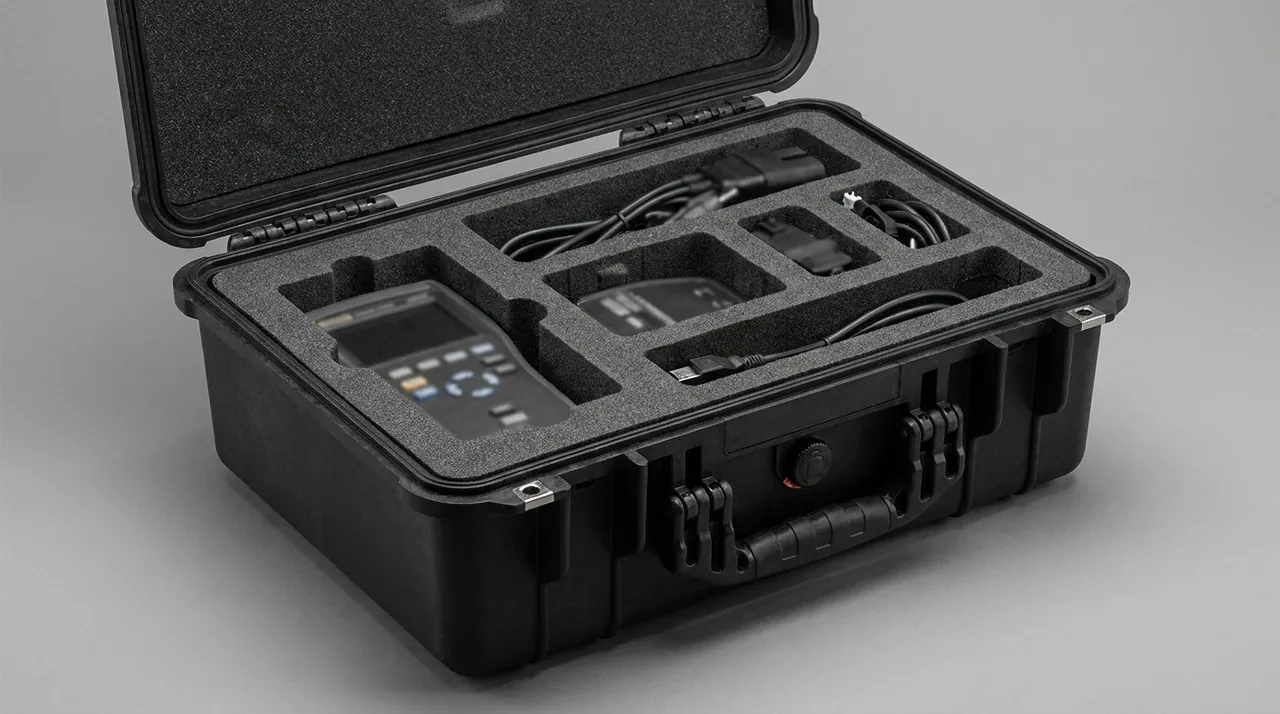
- Liner Options and Compartment Layout for Vinegar Line Parts
- Hardware Selection and Stacking Load Limits
- Climatic Exposure and Transport Test Verification
- Customization, OEM/ODM and Acceptance Criteria
- Frequently Asked Questions FAQ
- Conclusion and Related Reading
Vinegar Brewing Process Chain and Equipment Protection Challenges
Vinegar production varies widely by region. Shanxi aged vinegar starts from sorghum and bran and runs a solid-state acetic fermentation with a smoking and ageing stage; Zhenjiang aromatic vinegar is built on glutinous rice and a layered solid-state process with leaching to draw off the liquor; submerged liquid fermentation, by contrast, converts alcohol to acetic acid inside a self-priming fermenter within days. The process route shapes the equipment list, yet the transport protection problem stays remarkably similar.
Group the parts that move between plants and four families emerge:
| Part family | Examples | Inherent weakness |
|---|---|---|
| --- | --- | --- |
| Vessels and heat exchange | Fermenter shell sections, heads, cooling coils, serpentine tubes, jackets | Thin-wall distortion, weld and polished-face scratches |
| Leaching and filter bed | False bottom plates, filter plates, screens, spray headers | Hole deformation, open-area change, liquid trapped in gaps |
| Transfer and valves | Hygienic pump rotors, tri-clamp ferrules, butterfly valves, metering valves | Seal face nicks, ferrule roundness, brittle ceramic parts |
| Filling and sterilizing | Plate heat exchanger plates, filling valves, capping heads | Thin plates, gasket groove precision, hygienic dead corners |
Two difficulties dominate. The first is acid. Acetic acid in finished vinegar is not concentrated, typically 3–8%, but as an organic acid it corrodes carbon steel steadily, and 304 stainless steel is not entirely safe in chloride-bearing service either. Lactic and citric acid plus trace salts in the fermenting liquor create complex localized corrosion conditions. The second is hygiene. Food-contact surfaces carry requirements for surface roughness, freedom from dead corners and absence of residue; a scratch, a foreign particle or a crushed gasket produced in transit can render a part unusable at site acceptance.
Packaging design therefore has to answer three questions before anything else: does the residual acid need neutralizing, does the clean face need isolating, and must hygienic seals be packed in a clean condition? The answers set the grade of liner material and the cleanliness class of the packing environment.
Fermenter Vessels and Cooling Coil Parts
The fermenter is the main vessel of a vinegar plant. Submerged fermentation normally uses a stainless tank with cooling coils or a jacket, while solid-state fermentation may use ceramic vats or wooden barrels. Parts handled during maintenance and transfer include shell sections, elliptical heads, cooling coils, serpentine heat exchange tubes, sampling valve seats and top manway components.
| Part | Main risk | Handling arrangement |
|---|---|---|
| --- | --- | --- |
| Shell sections and heads | Thin-wall denting, edge distortion, weld scratches | Temporary internal support ring to hold roundness, protective edge rings |
| Cooling coils | Coil pitch distortion, skewed tube ends | Pitch-setting fixture, protective caps on tube ends |
| Serpentine tubes | Sagging under self-weight, local tube collapse | Multi-point cradles, no long unsupported spans |
| Manway and sampling parts | Seal face nicks, polished face scratches | Peelable film on seal faces, soft separators between parts |
Cooling coils are the family most often handled on assumption rather than analysis. A coil looks like a rigid tube assembly, but once the pitch between turns is crushed, the coil can no longer align with its internal supports and the whole assembly has to be re-formed. Have a pitch-setting fixture made to the coil outside diameter, seat every turn at its fixed spacing, cap the tube ends, and lay the assembly in an arc-faced cradle so that it never touches bare metal.
Polished faces deserve separate mention. Fermenter interiors are often mechanically or electrolytically polished, frequently to Ra 0.8 μm or finer, and a single hard object sliding across the surface leaves a scratch that cannot be repaired on site. Liner contact faces should use non-woven or food-grade cleanroom wipes; ordinary corrugated board or wood shavings must never touch the surface.
Leaching System Spray and Filter Bed Components
In solid-state fermentation, vinegar is recovered by leaching: water is trickled through the mash in a leaching tank or tower and the vinegar liquor is drawn off. The key components are false bottom plates, screens, spray nozzles and collection headers, and they share one trait — they work through their holes. Hole diameter, open area and hole shape directly set the flow rate and the evenness of extraction.
| Component | Failure mode | Protection focus |
|---|---|---|
| --- | --- | --- |
| False bottom plate | Face warping, hole burrs, edge distortion | Clamp the full face against warping, holes facing up, bound edges |
| Screens and cloth | Surface indentations, creases, holes | Roll onto a core, never folded under load |
| Spray nozzles | Deformed or blocked orifices, thread damage | Individual compartment, caps over orifices |
| Collection headers | Deformed pipe ends, acid film inside | Capped ends, internal neutralization and drying |
Spray nozzles are a classic small-part, high-risk case. Orifice diameters often sit around one millimetre, so any compression changes the spray pattern, and the deformation is usually invisible to the eye until the nozzle is installed and the distribution turns out to be uneven. Give each nozzle its own slot, cap the orifices, and where possible use a contour-machined EVA cavity so the head hangs free of load in every direction.
Filter cloths and screens behave in the opposite way: they fear folding. A crease left in a cloth becomes a permanent weak line and the usual starting point for a tear. Roll the cloth onto a core with a roll diameter above the minimum bend radius, tie both ends with soft cord, and store the roll upright rather than laid flat under pressure.
Filtration and Filling Parts
Finished vinegar is filtered and sterilized before filling. Common arrangements use diatomaceous earth filtration, plate-and-frame filtration or membrane filtration, followed by plate or tubular heat exchange for sterilization and then filling and capping. Transportable items in this section include filter plates, membrane modules, plate heat exchanger plates and gaskets, filling valves, ceramic metering parts and capping heads.
Plate heat exchanger plates are among the most transport-sensitive items anywhere on the line. Plates are typically 0.4–0.7 mm thick and rely on their corrugations bearing against each other to form flow channels, so any compression or knock that introduces a slight bend produces cross-leakage after assembly because the seal no longer closes evenly. The industry practice is to keep plates in their dedicated carrier, retain the original stacking order and orientation with numbering, and never break the stack into loose pieces. If plates must travel separately, clamp them between flat boards and band the whole stack.
| Part | Critical dimension or surface | Transport risk | Suggested practice |
|---|---|---|---|
| --- | --- | --- | --- |
| Filter plate | Face flatness, channel grooves | Warping, groove damage | Stacked and clamped, numbering retained |
| Membrane module | Membrane integrity, end cap seal | Membrane scratches, cap distortion | Guarded caps, no hard contact on membrane |
| Filling valve | Plug fit, outlet port | Ceramic plug fracture | Own compartment, soft liner, impact control |
| Tri-clamp ferrule | Roundness, clamp face | Seal failure from distortion | Strung in groups, protected from compression |
Tri-clamp ferrules and hygienic gaskets deserve a separate note. Their sealing depends on even radial compression, so a ferrule that loses its roundness will leak even with a brand-new gasket. Ship them strung in groups on a dedicated rod rather than loose, where they press against one another. Hygienic gaskets are food-contact parts and must be packed in a clean condition, never sharing a compartment with hardware or oily items.
Materials and Corrosion Control in Acetic and Lactic Acid Service
Corrosion in a vinegar plant is easy to underestimate because the medium does not look aggressive. Acetic acid is a weak acid, but it is an organic acid, and its corrosion mechanism differs from hydrochloric or sulfuric acid: attack on carbon steel tends to combine uniform thinning with pitting, and the corrosion products do not form a protective passive layer. When lactic acid, citric acid, trace chloride and dissolved oxygen are present together, the risk of localized corrosion on stainless steel rises noticeably.
| Medium condition | Main threat | Material direction | Packaging note |
|---|---|---|---|
| --- | --- | --- | --- |
| Acetic acid, low concentration, ambient | Uniform corrosion and pitting of carbon steel | 304/316L stainless, food-grade PP | Neutralize residual acid, keep dry |
| High acidity or hot sections | Intergranular and crevice corrosion at welds | 316L, duplex, titanium | Focus neutralization and rinsing on weld zones |
| Chloride from seasoning or cleaners | Chloride pitting, stress corrosion | 316L and above; avoid prolonged 304 contact | Rinse with deionized water; no chloride cleaners |
| Fermentation liquor and mash residue | Crevice liquid, microbial growth | Food-grade materials throughout | Remove residue completely and dry |
Cleaning and neutralization are the keys to handling residual acid. Vinegar equipment cannot simply copy a strong-acid plant's routine, because a food facility also has to consider whether the cleaning agent itself leaves a compliant residue. A workable sequence is to remove mash and solid residue first, neutralize with a food-grade alkaline cleaner by circulation or immersion, rinse with deionized water while checking pH and conductivity, and dry thoroughly. Stainless parts should not be exposed to chloride-bearing sanitizers for long periods, since chloride pitting is a real risk. Cleaning agent selection and residue limits must follow the applicable food safety standards and the plant's hygiene procedures; the parameters here are engineering practice references.
How Hygienic Cleaning Requirements Constrain Packaging Design
Food-grade equipment carries a constraint that other industries do not: packaging must not introduce a new contamination source. This directly shapes liner material, packing environment and documentation.
Start with the liner. Wood, ordinary corrugated board and recycled paper pulp products can all carry dust, wood particles and microorganisms, so they are unsuitable in direct contact with food-contact faces. Use a food-grade PE bag or clean PE film as the inner layer, then EVA or IXPE as the cushioning layer, with no paper material sandwiched between them. Where cleanliness requirements are higher, complete the closure inside a clean area and add a desiccant that meets food-contact requirements.
Next, the packing environment. Filling valves, metering parts and membrane modules that touch finished vinegar are best handled with a two-layer arrangement: a clean inner bag closed in the clean area, and an outer protective case assembled in a general area without breaching the inner seal. This split lets structure and cleanliness be handled by different layers, so hygiene is never traded away for structural strength.
Finally, documentation. Food equipment acceptance commonly calls for material certificates such as a food-contact compliance declaration, surface roughness reports, cleaning validation records and a packing list. Organize these by part number into a single file and ship it with the case; the acceptance visit shortens considerably.

Shell Material Selection for Acid and Washdown Service
Selecting a shell for food equipment means balancing corrosion resistance, cleanability and structural strength.
| Shell process | Material | Wall thickness | Why it fits |
|---|---|---|---|
| --- | --- | --- | --- |
| Rotational moulding | HDPE / LLDPE | 3–8 mm | Seamless, resists dilute acid, washable, large sizes possible |
| Injection moulding | Food-grade PP / PE | 2–5 mm | Smooth interior that cleans easily, good dimensional precision |
| Stainless frame with panels | 304 / 316L | By load | Corrosion resistant and washable as a unit for high-cleanliness duty |
| Aluminium frame with composite panel | 6061 plus composite | 1.5–3 mm | Light and stiff, suited to maintenance tool sets |
Four structural decisions matter. First, internal radii: rounding serves not only stress concentration but also cleanability, because a rounded cavity has no corner where residue collects, and that is a hard requirement in food service. Second, drainage and venting: form a sump and drain plug at the base so that leaked liquid cannot pool and ferment inside the case. Third, a removable liner: make the liner a module that lifts out as a whole so it can be cleaned or replaced on its own without scrapping the case. Fourth, rib layout: run longitudinal ribs along the base and long sides and transverse ribs across the short sides, gaining the needed bending stiffness with as little material as possible.
Material compatibility deserves an explicit warning. Some food-grade cleaning and sanitizing agents cause stress cracking in plastics, and a case in long-term contact with them can crack. Check the cleaning programme against the shell material during selection, and if necessary add a replaceable barrier inner bag.
Sealing Class Choice for Vinegar Service: IP65 and IP67 under IEC 60529
Dust and water ingress protection is graded under IEC 60529 or the equivalent GB/T 4208 and written as IP plus two digits: the first governs solids (0–6), the second liquids (0–9K).
| Class | Solid protection | Liquid protection | Verification | Fit for a vinegar plant |
|---|---|---|---|---|
| --- | --- | --- | --- | --- |
| IP54 | Partial dust protection | Splash | Splash from all directions | Covered internal transfers |
| IP65 | Dust tight | Jet | 6.3 mm nozzle, 12.5 L/min | Open temporary storage, near washdown bays |
| IP67 | Dust tight | Short-term immersion | 1 m depth, 30 min | Rainy regions, sea freight |
| IP69K | Dust tight | Hot high-pressure water | 80 °C, 80–100 bar | Returnable cases needing washdown |
Washdown work is common in food plants, and it is easy to misread that as "IP69K is mandatory". In practice the class should follow the case's actual service environment: if the case only moves between a dry store and a vehicle, IP65 is sufficient; only where the case itself is a washdown container inside the production area does IP69K become relevant. Higher classes mean more elaborate sealing and higher cost.
Two boundaries are frequently confused. IP67 covers short-term immersion, not continuous submersion. And the rating depends on gasket condition: ultraviolet light, ozone and temperature cycling harden rubber and build up compression set, so the effective class falls over time and gaskets are consumable items on an inspection and replacement schedule.
Use a primary seal plus a secondary seal, design the O-ring groove by its compression ratio, and keep the contact surface at an appropriate roughness so it beds evenly. Choose seal material by medium: food-contact service favours EPDM or silicone that meets food-contact requirements, oil and solvent exposure may call for FKM, and strongly corrosive contact faces can use PTFE encapsulation. For the trade-off between IP54, IP65 and IP67, see IP65 vs IP66 vs IP67 Differences.
Liner Options and Compartment Layout for Vinegar Line Parts
A liner has to satisfy three conditions at once: cushioning performance, food-contact compliance, and compatibility with the cleaning agents used.
| Liner material | Density (kg/m³) | Resilience and load | Fit for food service |
|---|---|---|---|
| --- | --- | --- | --- |
| EPE pearl foam | 20–35 | Light, high resilience | Needs a clean PE inner layer as a barrier |
| EVA | 40–90 | Machinable, good under load | Suited to locating cavities for precision parts |
| PE foam | 25–45 | Firmer, good energy absorption | Suited to base pads and dividers |
| IXPE | 30–60 | Closed cell, dense | Suited to water blocking and thin cushioning |
| Food-grade silicone pad | — | Soft, washable | Direct contact layer on clean faces |
Three compartment routes are common, chosen by part count and shape variation. Repositionable dividers shift within the slot and suit large batches of similar tri-clamp parts and ferrules. CNC-machined cavities follow the part contour for high locating accuracy, ideal for spray nozzles, metering valves and ceramic parts. Thermoformed wrap liners are seamless and give all-round coverage, suited to protecting stacks of thin parts such as plates and filter panels.
Coverage ratio follows the same logic as in other industrial settings: brittle precision items need a higher proportion of their surface wrapped to suppress movement, while heavy rigid bodies can be held more loosely for easier handling. Thin parts such as heat exchanger plates are better clamped as a stack than packed individually, because a stack supports itself while a single plate is more exposed at its edges. Data on resilience and compression set across foams is in Foam Material Comparison, and the trade-off between dividers and one-piece foam is set out in Divider versus Foam.
Hardware Selection and Stacking Load Limits
The moving parts of a case determine whether protection holds all the way through.
Latches should use a vibration-resistant self-locking design, sized in number to the case, with the load spread as evenly as possible; returnable cases that need handover confirmation can add a lock hole or a seal position. Hinges are best made with stainless pins in plastic bodies, and a long case should carry three or more to spread torque so the lid cannot shift under single-point load. A pressure equalization valve addresses the differential that temperature swings and altitude changes create between inside and outside: a fully sealed case bulges or draws its gasket into the groove, causing a local failure, while a valve with a hydrophobic breathable membrane equalizes pressure while still blocking liquid water and dust. Match airflow rate, cracking pressure and the case's declared protection class.
Stacking load should be calculated from the real storage layer count and case weight rather than estimated by feel.
| Stacked layers | Load on the bottom case (at 150 kg) | Structural suggestion |
|---|---|---|
| --- | --- | --- |
| 2 layers | About 150 kg | Standard reinforcement ribs |
| 3 layers | About 300 kg | Denser ribs plus pallet |
| 4 layers or more | Above 450 kg | Steel pallet or frame case |
Two stacking rules apply. The upper case should transfer its weight through the side walls and corner posts, never straight onto the lid. And stock held long-term needs periodic rotation, because plastic creeps slowly under sustained load. For cases carrying stacks of thin plates and glassware-type food parts, avoid high stacking altogether and keep heavy cases low and light cases high.
Climatic Exposure and Transport Test Verification
Packaging needs verification, but the emphasis for food equipment differs from heavy industry: structural strength is rarely the main issue, whereas corrosion resistance of metal parts and preservation of cleanliness are.
| Verification target | Test chosen | Reference | How to read the result |
|---|---|---|---|
| --- | --- | --- | --- |
| Metal and hardware corrosion | Neutral salt spray | GB/T 10125 | No red rust, no functional failure after the specified duration |
| Cushioning and fastening | Vibration test | GB/T 4857 series, ASTM D4169 | No part displacement, no liner collapse |
| Handling impact tolerance | Drop test | ISTA 1A / 2A / 3A | No damage to case or contents, no leakage |
| Condensation and material stability | Constant and cycling humidity | Hot-cold humid test | No pooled condensate, no liner deformation |
| Long-term stacking | Static load test | Stacking load test | No permanent deformation after unloading |
| Cleanliness retention | Opening cleanliness check | Plant hygiene procedure | Inner layer uncontaminated, no dust or foreign matter |
Beyond laboratory tests, keep three opening checks as routine practice: confirm the clean inner bag is neither torn nor has lost its seal; inspect seal faces and polished faces for scratches; and look for any sign of residual acid leakage. These cost little and catch most transit damage.
Be explicit about duration and level. Salt spray exposure time relates to the transport environment, the transit cycle and maintenance requirements, so a pass represents that specific set of conditions and is not a service-life warranty. ISTA and ASTM levels must be chosen for the actual transport mode and route combination, and passing a test does not guarantee freedom from damage under any particular logistics condition. For test design thinking, see GB/T 4857 Transport Packaging Cases and ISTA Transport Testing Procedure.
Customization, OEM/ODM and Acceptance Criteria
Vinegar equipment parts are rarely standardized, so an off-the-shelf case seldom fits and customization is the norm. Break the process into six confirmable stages: requirement capture, design, liner trial fit, case tooling, first-article approval, batch validation. Each stage should produce a defined output and a signature, so that problems do not roll forward into volume production.
Requirement capture matters most: ask for part dimensions and weight, centre of gravity, cleanliness class, residual medium type, documentation needs, and transport mode and destination in a single pass. The design stage must settle shell process, liner material and sealing scheme together, because the three constrain each other and fixing any one in isolation causes rework.
Acceptance criteria are best staged rather than compressed into a single pre-shipment inspection.
| Inspection stage | What is checked | Acceptance rule | Record form |
|---|---|---|---|
| --- | --- | --- | --- |
| Incoming | Case appearance, dimensions, hardware | No cracks or punctures, dimensions within tolerance | Incoming inspection sheet |
| Assembly | Liner fit, location effectiveness | No free travel, no foreign matter | Trial fit record |
| Sealing | Gasket contact and whole-case water test | Meets the declared class | Test report |
| Cleanliness | Inner clean bag, part clean faces | No contamination, scratches or dust | Cleanliness checklist |
| Load | Static stacking and lifting | No permanent deformation after unloading | Load test record |
| Dispatch | Marking, documentation, quantity | Matches the list, marking legible | Dispatch verification sheet |
JUNZHIJIA provides machined liners, case tooling, marking and documentation preparation, and works under OEM and ODM arrangements. The arrangements above are validated and refined by Kexin New Materials (Guangdong) Co., Ltd. across food and fermentation industry packaging projects, and can be tuned to a specific part's cleanliness class, residual medium and transport route.
Frequently Asked Questions FAQ
Q: Why can't fermenter cooling coils simply be stacked for transport?
A: Because coil pitch is a functional dimension. Inside the vessel the coil mates with supports and clamps, so once the pitch is crushed or locally distorted the assembly can no longer be aligned and usually has to be re-formed or remade. When coils are stacked, the weight of the upper coil concentrates on a few contact points, flattening those points and altering the pitch of the neighbouring turns. The coil still looks intact, but after installation the cooling turns out to be uneven. The correct approach is a pitch-setting fixture made to the coil diameter that holds every turn at its fixed spacing, protective caps over the tube ends, and the assembly laid in an arc-faced cradle so it never touches metal. If coils travel in several groups, fix and number each group so they cannot be mixed up. Re-measure pitch and tube-end alignment after transport as an acceptance record. Where a coil is long enough to need two cradles, keep both at the same height so the load is shared.
Q: The false bottom plate and the spray nozzles are both leaching parts. Do they need different protection?
A: Yes, because their failure mechanisms are opposite. The false bottom plate is a thin-plate item and suffers from overall warping and hole burrs, so the protection has to be full-face clamping: the plate only holds its shape when supported evenly across the whole face, holes should face upward to avoid being scraped by hard objects, and edges need binding to prevent knocks from curling them. The spray nozzle is a small precision item and suffers from local compression that deforms or blocks its orifices. Orifice diameters often sit around one millimetre, so a force from any direction can change the spray pattern, and such a change is hard to see by eye, only becoming apparent when the nozzle is installed and the distribution is uneven. Give each nozzle its own slot with caps over the orifices, and prefer a contour-machined cavity that leaves the head free of load. Both families still need residual vinegar removed and dried, or acid sits in holes and gaps and keeps corroding in transit.
Q: Why are tri-clamp ferrules and hygienic gaskets such frequent transport casualties?
A: Because their sealing depends on shape precision. A tri-clamp ferrule seals by compressing two faces evenly around the circumference, so once the ferrule loses roundness the clamping force is uneven and a brand-new gasket will still leak. That leak often shows up as a slow drip in a pressure test and gets misdiagnosed as a gasket fault, leading to repeated replacement. Hygienic gaskets are soft parts and take a permanent set or a compression mark under side load, so they no longer seat properly. Loose mixed packing is the main cause: ferrules pressing against each other and gaskets pinned under heavier items are everyday occurrences. Ship ferrules strung in groups on a dedicated rod, place gaskets flat in their own soft-lined cavity away from hardware, and pack hygienic gaskets in a clean condition so they cannot pick up dust or touch oily parts in transit. Where ferrules are returned for reuse, inspect roundness on receipt, not only before dispatch.
Q: Can residual acid in vinegar equipment be handled with a strong alkali or a chlorine-based sanitizer?
A: Neither is advisable. A food-grade alkaline cleaner is the right choice for neutralizing residual acid, but three cautions apply. First, strong alkali can corrode and discolour some stainless steels and aluminium parts, and the alkaline residue itself has to be rinsed away completely, which a casual extra flush rarely achieves. Second, chlorine-based sanitizers introduce chloride, and chloride is a driver of pitting and stress corrosion cracking in 304 stainless steel, so long contact raises the risk considerably; food plants normally control contact time and rinse immediately, or use a chlorine-free sanitizing method. Third, vinegar equipment cleaning must also meet food-contact compliance, so the cleaning agent itself must be a permitted food-grade product and its residue must stay within limits. A workable order is to remove mash and solid residue, neutralize with a food-grade alkaline cleaner, rinse with deionized water while checking pH and conductivity, and dry thoroughly. Whichever route is chosen, log the cleaning agents used against each part.
Q: Why do food-contact surfaces need special treatment in packaging?
A: Because scratches, foreign matter and dust can fail a part at hygiene acceptance even when the part is functionally perfect. Food-contact faces carry surface roughness requirements, and fermenter interiors are often mechanically or electrolytically polished to Ra 0.8 μm or finer, so one slide from a hard object leaves a scratch that cannot be repaired on site. Packaging materials themselves can be a contamination source too: wood, ordinary corrugated board and recycled paper pulp may carry wood particles, dust and microorganisms, and are unsuitable in direct contact with clean faces. The practical answer is layered packaging. The inner layer is a food-grade PE bag or clean PE film closed inside a clean area. The middle layer is EVA or IXPE providing cushioning. The outer layer is the protective case carrying structural strength and sealing. Each layer does its own job, so strength is never traded for cleanliness or the reverse. Keep the bagged parts in a clean, dry store until they are needed, so the outer case is opened only once.
Q: Should a vinegar plant specify IP65 or IP67 cases?
A: Base the choice on the case's actual service environment, not on whether the plant is wet. IP65 passes a jet test and withstands spray from all directions, suiting open temporary storage or transfers under a tarpaulin. IP67 passes a 30-minute immersion at one metre, which suits rainy regions, sites where brief ponding is possible, and sea freight. Only where the case itself is a washdown container inside the production area does IP69K need to be considered. A common misreading is that a wet food plant must automatically take the highest class; higher classes mean more complex sealing, higher cost, and a rating that declines as gaskets age and need replacement. Note also that IP67 describes short-term immersion, not long-term soaking. Finally, verify that seal materials meet food-contact requirements and that the shell plastic is compatible with the cleaning and sanitizing agents used, so that stress cracking does not appear after months in service. Log every gasket replacement against the case serial number so the service history stays visible.
Q: In custom case projects for vinegar equipment, which stage most often goes wrong?
A: In practice the liner trial fit is where problems surface, and it is also the stage most often skipped under schedule pressure. The reason is that requirement capture and design work from drawings and dimensions, while real parts carry deviations the drawings cannot show: weld distortion, polishing allowances, flange weld angle error. Those deviations only appear when the physical part is fitted. If tooling proceeds without a trial fit and the cavity does not match, the cost of correction multiplies. Break the work into six confirmed stages — requirement capture, design, liner trial fit, case tooling, first-article approval, batch validation. The trial fit should answer three questions: can the part be inserted and removed easily, is there any free travel at the contact faces, and is the clean face being touched by a hard liner edge? Those answers set the tooling parameters and determine how convenient the case will be in daily use.
Q: What verification does vinegar equipment packaging need, and what counts as a pass?
A: The emphasis belongs on corrosion resistance and cleanliness retention rather than raw structural strength, which is where this differs from heavy industry. A sensible combination is: neutral salt spray to assess metal and hardware corrosion behaviour; vibration to assess whether cushioning and fastening hold; drop testing to assess handling impact tolerance; constant and cycling humidity to assess condensation and liner stability; static load testing to assess long-term stacking deformation; and an opening cleanliness check to confirm the inner layer is uncontaminated and clean faces carry no scratches or dust. Agree the reading rules in writing before testing, for example no red rust or functional failure after salt spray, no visible foreign matter on clean faces after opening. Salt spray duration relates to the transport environment, so a pass reflects that condition set only and is not a service-life warranty.
Conclusion and Related Reading
Vinegar equipment packaging comes down to two things: clean the acid away and hold the clean faces intact. Neutralize and dry, then wrap in layers, then choose a class for the environment.
Related Reading