

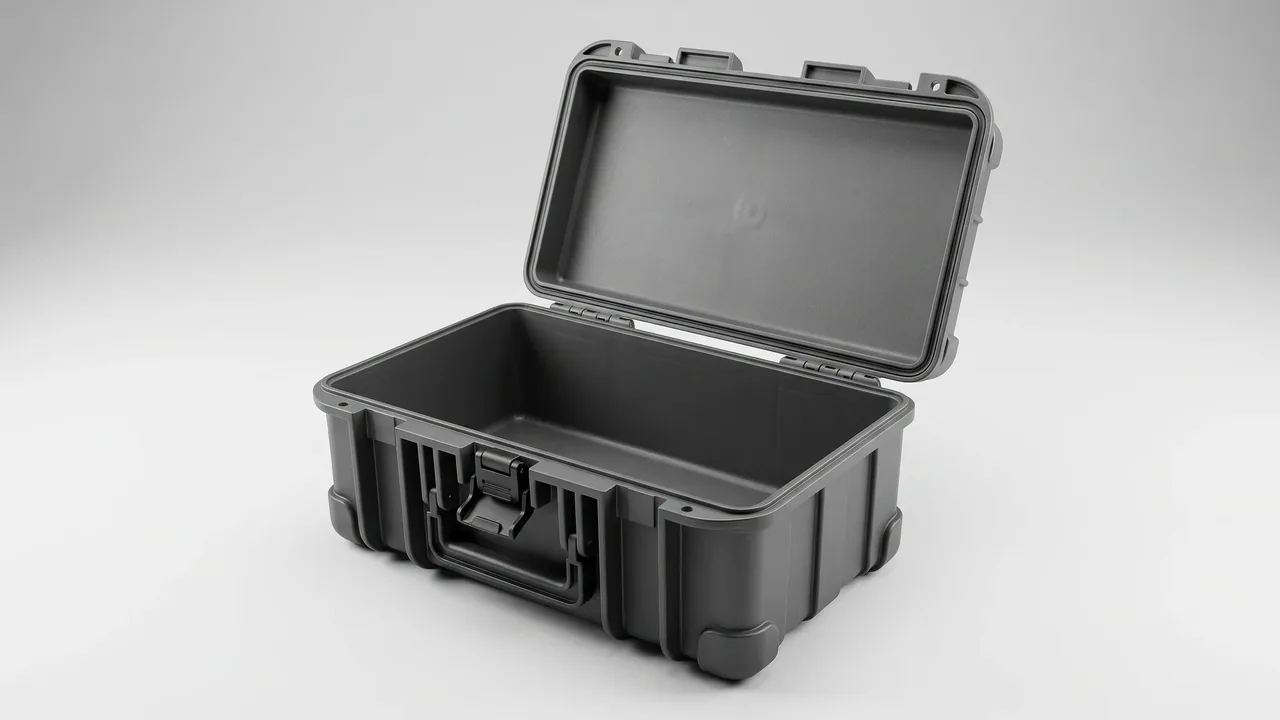
In the daily work of ammunition depots, defence trade offices and military or police issuing points, "ammunition chest" and "ammunition box" are often used interchangeably, as though they described the same object. In engineering terms they do not. An ammunition chest is built around fixed-location storage, tiered counting and access control in a permanent space. An ammunition box is built around transport, handover and palletised movement. "Ammunition container" is the umbrella term that covers both. The first question in any selection exercise is therefore not about dimensions but about the role the container plays in the process: does it leave the place where it is installed, is it lifted and carried repeatedly, must it survive transport vibration and stacking pressure, and does it have to be bound to an accounting record. Get the role wrong and every later decision, from material to lock to sealing class, follows it into error.
JUNZHIJIA, manufactured by Kexin New Materials (Guangdong) Co., Ltd., has supplied custom protective container programmes for military, police, defence-trade and industrial customers for many years. One boundary should be stated at the outset: this article deals only with packaging-container engineering, covering materials, liners, ingress protection, environmental testing, sealing and pressure equalisation, corrosion inhibition, cushioning and restraint, stacking and lifting, locks and tamper-evident seals, traceability marking and export packaging certification. It does not discuss the physical or chemical properties of any contents, nor any handling procedure. Project decisions must follow local regulations and export-control requirements; this article addresses packaging containers only.
Defining Chest and Box by Role, Not by Size
Many people assume the difference between a chest and a box lies in volume. The real dividing line is operating attitude and life cycle. A chest normally stands vertically, stays fixed, opens into multiple doors and compartments, and is opened and closed many times over a long service life. It serves a fixed space; the container barely moves and the contents move. A box normally sits closed under load, can be carried whole, stacks in groups and travels the entire route with pallets and vehicles. It serves the goods; container and contents move together. Four questions will place a project on the right side of the line: does the container leave its installation point; is it handled repeatedly by forklift, lifting gear or people; must it survive vibration, drop and stacking; does it need to be bound item by item to an access record. If the first two answers are yes, the form leans towards a box. If the container only opens and closes inside one room, it leans towards a chest.
There is also an easily overlooked middle case: the combination in which the box is the handling unit and the chest is the management unit. Unit-level stores use this pattern widely. The box is the smallest unit of counting and handover, while the chest supplies the tiers, anti-tipping structure and access control. This shared arrangement demands a modular relationship between box profile and chest opening; without it, shelf clearances are too low, boxes cannot be withdrawn, and chest records no longer match box serial numbers. The dedicated section later in this article works through the interface design.
The Real Cost of Getting the Boundary Wrong
Using a transport box as a long-term storage chest is the most common mistake. Under continuous load, the gasket slowly takes a permanent compression set. After a few months the lid closes but no longer holds the compression it was designed for, and the stated ingress protection exists only on paper. A box sitting on a floor also draws ground moisture into its base, which is unkind to both metal parts and liner. The reverse mistake, treating a fixed chest as a transport container, concentrates risk in joints and stiffness. Upright structures and shelf slots are not designed for longitudinal vibration spectra, so welds and slots fatigue over long journeys, and door mechanisms can drift when they are not positively restrained.
A second category of cost comes from compromising on dimensions. Thinning a box to fit an existing shelf mismatches wall thickness against span, so the lid bulges in the middle under stacking and the sealing face opens into a gap. Overbuilding a box to hit a count pushes the loaded weight past the single-person handling threshold, so handlers drag it instead of lifting it and the base wears and knocks far more often. What these failures share is that they look serviceable and behave unreliably; all of them trace back to skipping the role question at the start.
Fixed Installation and Structural Requirements for an Ammunition Chest
The first requirement of a chest is stability. Common shells are formed from cold-rolled steel sheet, folded and then spot-welded or bolted, with glass-fibre-reinforced engineering plastic used for damp environments or weight-sensitive installations. The stiffness of a steel chest comes from the closed sections created by folding plus reinforcement ribs on the back panel; flange height and sheet thickness together govern resistance to lateral distortion. A plastic chest relies on the curvature of moulded panels and an embedded frame. Shelves are the critical load-bearing parts, and their adjustable heights are set by slots or toothed rails in the uprights. Slot pitch decides how flexible the partitioning can be, while shelf capacity must be checked against the fully loaded weight of the containers on it, tier by tier, rather than estimated from an average.
Anchoring depends on the floor. Concrete slabs normally take expansion bolts or chemical anchors, with mounting holes pre-formed in the chest base and feet levelled before tightening. Where a raised or static-dissipative floor is installed, anchor depth and floor-layer strength must be assessed, adding a transition plate to spread load when required. Anti-tipping design is also a structural matter: heavy contents low, a service gap between chest and wall, and a lateral tie across the tops of adjacent chests all reduce the chance of an accidental overturn. Some sites require an equipotential bonding terminal on the chest body. That is part of the container structure; the specific method should follow the electrical and safety rules of the user's facility.
Doors and hinges decide how the chest feels over years of use. The door panel needs enough torsional stiffness, hinges should be heavy-duty with adjustable clearance so a door that sags under its own weight does not rub the frame, and the opening angle must leave room to withdraw a container; the aisle in front should be at least the measured swing radius. Ventilation and dehumidification ports, label slots and record windows look like small details, yet they decide whether the chest can actually be used to standard. A chest without a label holder ends up covered in sticky notes, and a chest without a record window forces a separate paper log, which is exactly how a rigid control routine develops a gap.
Transport Duty Cycles and Load Design for an Ammunition Box
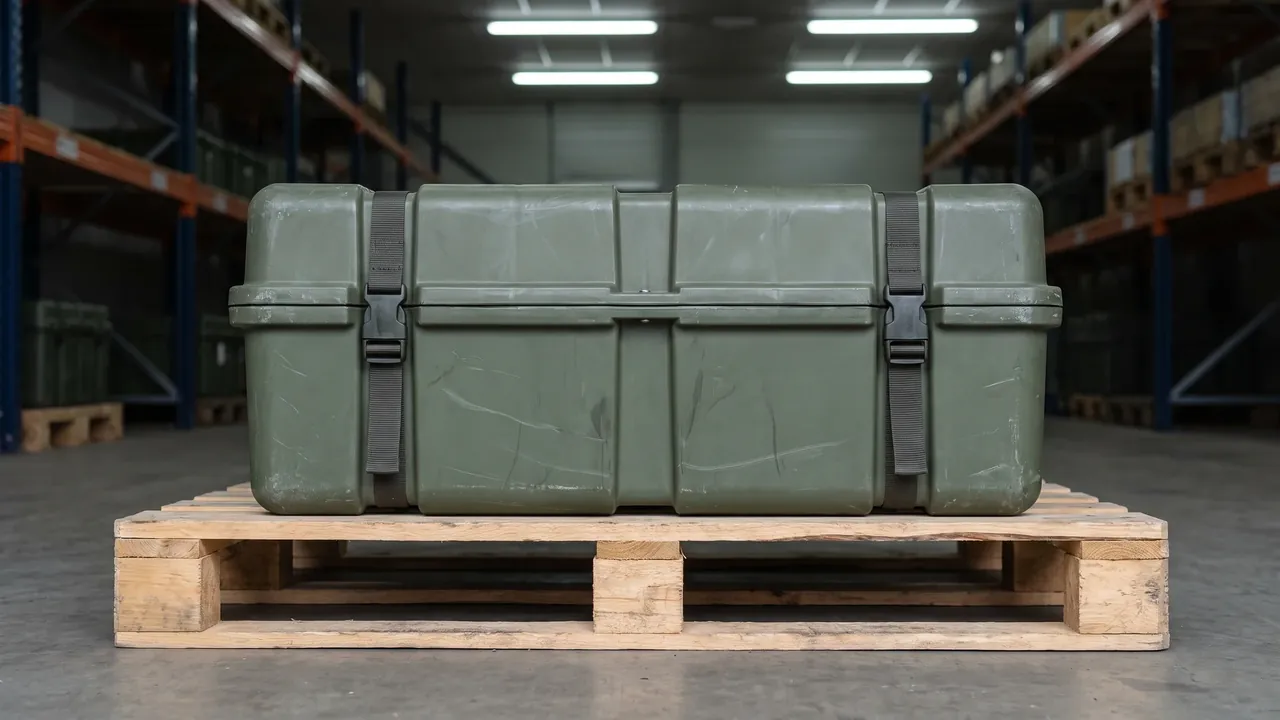
The design input for a box is not a single dimension but a set of duty-cycle parameters: transport mode by road, rail, sea or air; load spectrum and vibration spectrum; plausible drop height; number of stacking tiers and their duration; temperature and humidity cycling plus salt-spray exposure along the route. Writing these into the specification is what gives the box design a basis. Structurally, the usual approach combines closed sections with longitudinal and transverse ribs to raise bending stiffness, and wall thickness must match span. If the span is long and the wall thin, the lid deflects in the middle under stacking and pulls the sealing face apart. If the wall is over-thick, dead weight rises and the box attracts more knocks during handling.
Hinges, latches and handles are touched most often and fail first. Heavy boxes are better with a through-going hinge pin or stainless hinge blocks, and latches need pre-load travel so the gasket settles at its design compression once closed. Handles should be sized for the loaded weight and should leave room for two hands; above a certain weight the box should offer lifting points or forklift access so handling does not depend on muscle. Making the box footprint an integer multiple of a pallet module, for example the common 1200 x 1000 or 1200 x 800 mm planes, measurably improves vehicle and container utilisation, and in bulk defence-trade shipments that gain usually matters more than unit cost.
Liners and Compartments: From Profile Fit to Restraint
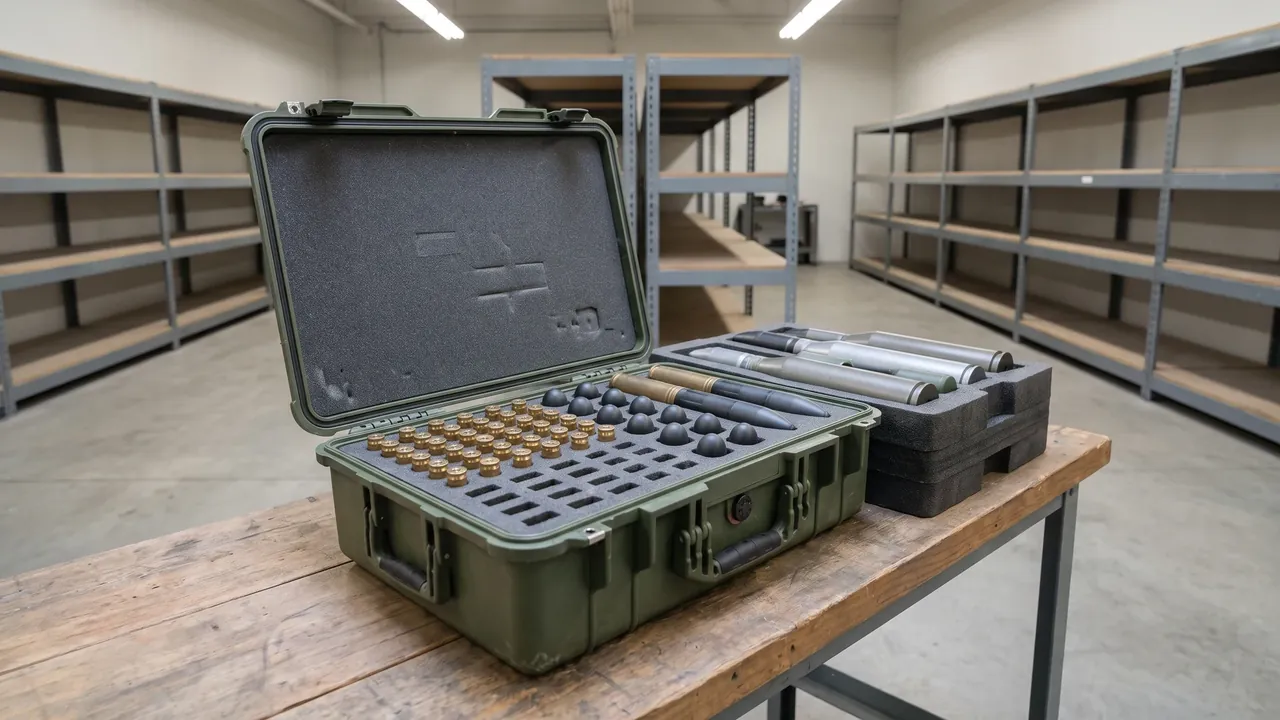
Liner approaches fall into three broad routes. The first is a CNC-moulded liner fitted to the container profile, usually in closed-cell EVA or PE foam, wrapping the profile completely so the contents have no room to shift; this suits fixed models and larger batch quantities and gives the most consistent protection. The second is a system of movable dividers and separator bars that splits the interior into compartments, offering the most flexibility for mixed sizes and frequently changing loads. The third is a modular insert that fixes each container on its own cradle or pallet insert before the assembly goes into the outer box, which simplifies group handover and rapid counting. Real projects often blend them: profile liners for the main items, removable dividers for the accessory zone.
Cushioning and restraint are two different jobs and should not be conflated. Cushioning absorbs energy, using closed-cell foam against high-frequency vibration and rubber or elastomer pads against low-frequency impact. Restraint controls displacement, using cavity walls and locating bosses to limit freedom in all six directions. Too much cushioning lets the container move inside the box, while too tight a restraint forces the shell during loading, so the design boundary is contact without clamping and location without preload. Machined faces, nameplates and interface flanges should be relieved so they never become load paths. Corner blocks at the eight corners raise drop resistance and reduce shell damage during handling. Foam compresses with repeated use and loses resilience, so an inspection and replacement interval should be tied to the handling frequency.
Sealing Classes, Gaskets and Pressure-Equalisation Valves
Sealing capability is usually described by an IP rating, where the last two digits state dust and water resistance: IP65 for water jets, IP66 for powerful water jets and IP67 for short-term immersion. A higher rating is not automatically better. A fully sealed box accumulates a pressure differential across temperature and altitude changes, which places an extra burden on the gasket. Gasket material should be chosen on temperature range, weather resistance and compression set: silicone behaves consistently across wide temperature bands, EPDM is weather and ozone resistant at moderate cost, and polyurethane offers wear and tear resistance. Sealing depends on the match between compression and groove design. Too little compression leaks, too much accelerates permanent set, so groove depth, gasket section and lid closing travel must be designed as one system. The flatness and surface roughness of the sealing face matter equally; flash, burrs or hard particles on a parting line become leak paths.
A pressure-equalisation valve addresses a problem in the other direction. Air freight subjects the cargo hold to large pressure swings, and high-altitude transport or seasonal temperature change in storage produces the same effect. Without a valve, the differential can deform the gasket and destabilise the seal, or create internal negative pressure that makes the lid hard to open, so it gets forced and the latch and sealing face are damaged. The valve passes gas but not water, allowing slow exchange while maintaining dust and water protection. It belongs in the maintenance plan alongside the gasket and the locks: a valve blocked by dust or salt crystals behaves exactly like no valve at all, so it should be cleaned during every scheduled inspection and its hydrophobic membrane renewed on a defined interval.
VCI Liners and Interior Environment Control
For metal parts in long-term storage, the main threat is not direct rain but condensation driven by temperature cycling, together with airborne salt and acidic gases. A VCI liner releases inhibitor molecules that diffuse through the enclosed volume and form a monomolecular film on metal surfaces, delaying corrosion in storage even if the box is opened briefly or the seal is challenged. It suits machined metal faces, fasteners and precision fits, provided the surfaces are clean, dry and free of oil before loading; residual cutting fluid or fingerprints prevent the film from bonding evenly. VCI material has its own service life and saturation limit, so containers that stay closed for long periods need inhibitor components renewed or topped up on the maker's schedule.
Environment control is a combination of measures rather than one measure. Desiccant inside the box absorbs residual moisture, and a humidity indicator card lets a handler judge the situation without opening the lid. In high-salinity sea freight or high-humidity storage, combining VCI with desiccant is the more dependable choice. The liner material itself must also be compatible with VCI to avoid softening, discolouration or sticking. In shared chest-and-box scenarios, a container returning from a humid environment should be wiped down and dried before it goes back into the chest; otherwise it carries moisture inside and raises the relative humidity of the whole chest.
Locks, Tamper-Evident Seals and Traceability Marking
Lock selection should distinguish between preventing accidental opening and preventing unauthorised opening. A mechanical latch with a padlock eye is the basic option and suits day-to-day protection against accidental opening; a combination lock suits shared use where distributing keys is impractical; a two-person dual-lock arrangement splits opening authority into two halves and is a common permission design at chest level. A seal exists to leave a trace. Single-use numbered seals, wire seals and tamper-evident void labels all provide evidence of whether a container was opened during handover, and placing seals on both the hinge side and the latch side covers different disassembly routes. Only when the seal number, the container serial number and the handover document correspond does the loop actually close.
Traceability marking is the infrastructure of any shared arrangement. Box side panels and end panels normally need weather-resistant nameplates or label positions carrying serial numbers, batch codes, QR codes or RFID tags, so that stock can be verified quickly at aisle, loading bay and receiving area. RFID suits rapid batch inventory, QR suits manual checking and mobile capture, and the two are often layered. Marking content should follow the user organisation's coding rules, and nothing about the contents should appear in external marking. The marking itself must be chosen for the environment: outdoor or sea-freight use needs UV- and salt-resistant label materials, or within months the serial number becomes unreadable.
Shared Scenario One: Box in Chest, Chest as the Accountability Unit
The classic unit-level stores arrangement treats the box as the smallest handling and counting unit and the chest as the framework for tiering, anti-tipping and access control. It counts quickly and hands over cleanly, at the price of tighter dimensional cooperation. Shelf clearances should be set from the actual box height plus a withdrawal allowance, and that allowance must be enough for fingers or a handle to enter. Shelf capacity should be calculated from the fully loaded box weight and checked under the least favourable distribution rather than a uniform-load estimate. Shelf depth should cover the full box length so the box does not overhang and load the chest unevenly.
A few structural details improve retrieval efficiency. Making shelves into pull-out trays or adding roller slides markedly reduces the effort of moving heavy boxes; interior lighting and tier numbering cut search time; door swing and aisle width must match the pull-out travel. On the records side, the chest should supply a clear tier-to-box mapping so that opening the door immediately shows which box is missing. Once box serial numbers are bound to chest positions in the management system, stocktaking changes from searching through boxes to scanning and verifying, and that is the main advantage of the shared arrangement over simply stacking boxes on the floor.
Shared Scenario Two: Handover and Transfer When the Box Leaves the Chest
Issue is the moment the box leaves the chest and the point where shared design most often shows its weaknesses. The first requirement of the interface is modular consistency: box profile, handle positions, chest opening and shelf pitch should form a fixed relationship so boxes can be swapped between positions instead of each box having one home. The second is handling friendliness. Box dead weight should stay within a sensible single- or two-person lift, and above that the box should offer lifting points or forklift access, with room inside the chest for the lifting tool, because otherwise the crew has no option but to drag the box and the risk of knocks and drops rises sharply.
Transfer also requires the seal and document routine to be designed into the container. Before departure, seal numbers are verified box by box and serial numbers recorded on the handover list; on arrival, seal integrity is checked before the box is opened. That routine only works when box marking is clear and seals sit where they can be seen. During palletised loading, boxes should be aligned vertically, heavy boxes low and profiles equal in height, so that no upper box bridges a gap and creates an eccentric load; stretch film and strapping then tie the pallet into one unit and reduce relative movement in transit. After issue, boxes returning to the chest should be cleaned and dried and then put back in position, which keeps exterior moisture and dust out of the chest.
Shared Scenario Three: Packaging Layers in Defence Export
Export projects normally involve several packaging layers: inner packaging protecting an individual container, outer packaging forming a handling and stacking unit, and pallets or unit load devices forming the transport unit. In this hierarchy the box usually travels as outer packaging or transport unit while the chest stays in the depot, so the export specification must state which layer carries transport protection and which layer carries the seal and traceability duties. Wooden packaging should complete heat treatment or fumigation to the phytosanitary rules of the destination market and carry the corresponding mark; packaging that requires performance testing should be tested to the requirements of the transport mode and destination, with classification, test items and acceptance criteria confirmed by a suitably accredited laboratory.
Export packaging also involves label and language adaptation. Shipping marks, warning labels, destination label rules and the language of accompanying documents are best settled during container design and printing, so that labels are not applied afterwards and left in disarray. The correspondence between seal numbers, serial numbers and the packing list should also be planned for a multilingual environment, or the receiving party will find the check ambiguous. Again, export projects must follow local regulations and export-control requirements; this article covers only the structure, marking and certification route of the packaging container.
Testing and Validation: Environmental and Transport Package Tests
Container reliability has to be demonstrated by test rather than asserted in a design note. Military-facing methods include MIL-STD-810H and the domestic GJB series, where the methods directly relevant to a container are vibration, mechanical shock, temperature and humidity cycling, rain and salt fog. Civil transport packaging offers the GB/T 4857 series and the ISTA series, and air-freight boxes may reference ATA 300. The two families look at different things: environmental testing examines how a product tolerates extreme conditions, while transport package testing examines how well the package protects its contents and survives the journey itself. They complement rather than replace each other.
Test parameters must correspond to the real loaded state. Drop height, vibration spectrum, stacking pressure and test duration should all be derived from the actual weight, centre of gravity and transport mode of the loaded contents. Testing an empty box proves almost nothing, because the risk comes from the mass and inertia inside it. After testing, the inspection should cover not only cracking, distortion and water ingress but also liner displacement or compaction, permanent gasket set, and loosened or cracked latches and hinges. These invisible forms of damage usually matter more than cosmetic marks. Complete validation produces a report and a batch record covering test items, parameters, results and production identification, which then supports change control and batch consistency.
Stacking, Palletisation, Lifting and Forklift Handling
Stacking height is not a matter of experience; it is set jointly by the box's compressive capability, the pallet's load capacity and the usable storage height. At the design stage a stacking test confirms the deformation of a box under prolonged static load, and the permissible tier count is derived with a safety factor. On the warehouse floor, boxes must be aligned vertically so no upper box bridges two lower boxes and creates an eccentric load. The profile of the lid, the direction of reinforcement ribs and corner strength all affect stacking stability, and a flat lid with locating stops is generally the better basis for multiple tiers.
Pallet and lifting decisions belong to the same operating system. The pallet should match box footprint and total weight: timber is inexpensive but requires attention to moisture content and phytosanitary treatment, plastic is dimensionally stable and easy to clean, and steel carries heavy loads at the cost of dead weight. For lifting, use slings at a sensible included angle with symmetrical attachment points close to the centre-of-gravity projection, because a single-point lift twists the box. Under forklift handling, fork height should align with the fork pockets and the forks should never puncture the base. Centre-of-gravity, this-way-up and stacking-limit markings should be printed directly on box and pallet to reduce mis-handling caused by verbal instruction. Secondary restraint in transit matters too: straps and anti-slip mats tie the pallet to the vehicle floor and cut forward movement under emergency braking.
Procurement and Acceptance: Writing Boundaries into the Specification
The outcome of a selection exercise has to land in a specification, otherwise production and acceptance have no common basis. A workable specification should state at least: the role of the container, chest or box, and whether it carries a transport function; external dimensions, internal dimensions and tolerances; body material, wall thickness and surface treatment; liner type and compartment scheme; sealing class, gasket material and pressure-equalisation valve configuration; lock type and the interface positions for seals and marking; applicable test categories, parameters and acceptance criteria; and the list of delivery documents, including material certificates, test reports and batch records. Set out in this way, a supplier can quote against verifiable requirements and a buyer has something to check against on delivery.
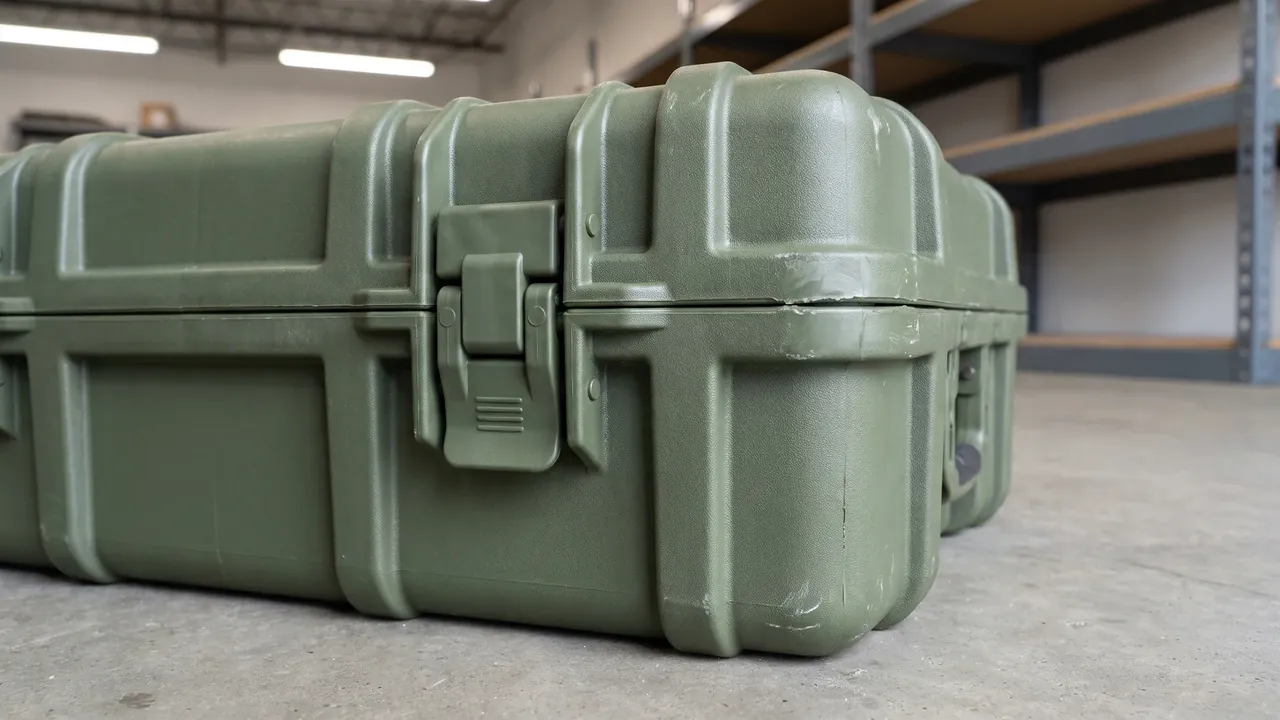
Acceptance should focus on whether the design intent has actually been realised: internal dimensions and liner fit; gasket compression and whole-box sealing performance; latch and hinge assembly strength and smoothness of operation; sheet-metal surface treatment and burrs; and the clarity and durability of marking. These determine reliability over a long service life. Batch deliveries should follow a sampling plan with in-process or tightened checks on critical characteristics. A change-control mechanism is also needed: when the material formulation, gasket supplier, liner process or lock model changes, sealing and strength should be re-validated rather than assumed equivalent. On military, police and defence-trade projects JUNZHIJIA normally consolidates the points above into a project technical annex confirmed alongside the sample, which reduces disputes after batch delivery.
FAQ: Ammunition Container Questions
Q: Why insist on separating an ammunition chest from an ammunition box when both simply hold things? A: Because their design inputs are fundamentally different. A chest takes its input from the space conditions of a fixed site, the need for tiered counting and the permission model for access. It is static for years, so structural effort goes into stiffness, shelf capacity and door-cycle life. A box takes its input from transport mode, vibration spectrum, drop height, stacking pressure and temperature-humidity cycling. It moves with the goods, so effort goes into impact resistance, seal retention, dead-weight control and pallet module matching. Mixing the two inputs produces predictable failures: a chest too heavy to move, a box whose gasket takes a permanent set after long storage, or a box that cannot be bound to chest records. Running the four role questions first, whether the container leaves the installation point, is handled repeatedly, must survive vibration and stacking, and must be bound to a record, is the least expensive route to a sound selection. It also keeps later decisions coherent, because once the role is fixed the material, lock, liner and test regime all follow from it instead of being argued case by case.
Q: When boxes are used inside a chest in a store, what interface design matters most? A: Modular consistency and retrieval ergonomics. Shelf clearance should be set from the actual box height plus a withdrawal allowance large enough for fingers or a handle, shelf capacity should be calculated from the fully loaded box weight rather than an average, and shelf depth should cover the full box length so the box does not overhang and load the chest unevenly. Pull-out trays or roller slides greatly reduce the effort of moving heavy boxes. On the records side, the chest should provide a tier-to-box mapping so box serial numbers can be bound to chest positions in the management system, which turns stocktaking from searching through boxes into scanning and verifying. Before a box goes back in, clean and dry it, because carrying exterior moisture inside raises the relative humidity of the whole chest and is unkind to every metal part stored there over a long period. A further point is that the box profile and the chest opening should be treated as one drawing rather than two. If the box is designed first and the chest adapted afterwards, shelf pitch almost always ends up improvised, and improvised pitch is why a store loses capacity without gaining order.
Q: Is a higher ingress protection rating always better for an ammunition box? A: No. The IP rating describes dust and water resistance, and IP65, IP66 and IP67 rise in that order, but a fully sealed box accumulates an internal-to-external pressure differential. In air freight, high-altitude transport or storage with sharp temperature swings, a fully sealed box without a pressure-equalisation valve can see the gasket deformed, the lid become difficult to open, or the lid forced open and the latch and sealing face damaged. The sensible approach is to set the rating from the scenario: IP65 or IP66 where water jets are the risk, IP67 where short immersion is plausible, plus an assessment of whether a pressure-equalisation valve is needed. Gasket material follows the temperature band and weather exposure, with silicone for wide bands, EPDM for weather and ozone, and polyurethane for wear. It is also worth separating the rating from the material itself, because a box rated IP67 with a poorly supported gasket leaks sooner than one rated IP66 whose gasket sits in a properly machined groove. Sealing is a system property rather than a label, so groove dimensions and closing travel belong in the specification.
Q: Which contents suit a VCI liner, and what are the preconditions for using one? A: VCI suits machined metal faces, fasteners and precision fits. The mechanism is slow release of inhibitor molecules that diffuse through the enclosed volume and form a monomolecular film on metal surfaces, so even a box opened briefly still delays corrosion in storage. The precondition is that surfaces are clean, dry and free of oil before loading, because residual cutting fluid or fingerprints prevent the film from bonding evenly and leave unprotected patches. VCI material has a service life and a saturation limit, so containers that stay closed for a long time need inhibitor components renewed on the maker's schedule. The liner foam must also be compatible with VCI to avoid softening, discolouration or sticking. In high-salinity sea freight and humid storage, combining VCI with desiccant and a humidity indicator card is the more dependable configuration, together with shorter inspection intervals. Documentation matters as well: record which inhibitor product and which liner material were used, because a later re-order with a different foam can change how the inhibitor behaves inside an identical shell.
Q: Why are tamper-evident seals and traceability marking treated as essential in defence-trade projects? A: Because they determine whether a handover has checkable evidence. A seal leaves a trace: single-use numbered seals, wire seals and tamper-evident labels show whether a container was opened during transport and handover, and placing seals on both the hinge side and the latch side covers different disassembly routes. Traceability marking links seal number, container serial number, batch and packing list into one chain, so both shipping and receiving parties can verify by scanning and transcription errors fall away. In cross-language defence-trade movements with several transfer points, this mechanism sharply reduces the cost of resolving disputes. Marking materials must suit the environment as well: outdoor and sea-freight use needs UV- and salt-resistant labels and nameplates, otherwise fading or detachment within months breaks the traceability chain outright. A practical sequence is to decide the seal type before the label layout, because seal placement constrains how the label must be arranged; a layout drawn without that constraint usually ends up with the seal crossing printed information, defeating both features at once.
Q: Does passing environmental testing prove a container is reliable, and what should acceptance focus on? A: Testing is necessary but not sufficient; what matters is whether the parameters correspond to the real loaded state. Drop height, vibration spectrum, stacking pressure and duration should be derived from the actual weight, centre of gravity and transport mode of the contents, and an empty-box test proves very little. Acceptance should focus on four things: internal dimensions and liner fit, which decide whether contents can shift; gasket compression and whole-box sealing performance, which decide whether the rating survives long use; latch and hinge assembly strength and smooth operation, the first things to fail under frequent use; and sheet-metal surface treatment and burrs, which govern the risk of scratching during loading. In addition, require test reports and batch records from the supplier so that a field problem can be traced, and so that any later change of material or process has a baseline against which to re-validate. Keep the acceptance record with the batch rather than the project file, because when the same container is re-ordered two years later that record is what tells the buyer whether anything has changed.
Q: How should the packaging layers of a defence export project be divided? A: Usually into three: inner packaging protecting an individual container, outer packaging forming a handling and stacking unit, and pallets or unit load devices forming the transport unit. The specification should state which layer carries transport protection and which carries the seal and traceability duties, so responsibility is neither duplicated nor left vacant. Wooden packaging should complete heat treatment or fumigation to the phytosanitary rules of the destination market and carry the appropriate mark, and packaging requiring performance testing should be tested to the requirements of the transport mode and destination, with classification and acceptance criteria confirmed by an accredited laboratory. Label language, shipping marks and document requirements are best settled at the design stage to avoid labels applied later and left in disarray. One further discipline is to freeze the layer definitions before the container is drawn, because seal position and lift points depend on which layer performs which duty. All arrangements must follow local regulations and export-control requirements, and this article addresses the packaging container only.
Q: How should the number of stacking tiers be determined rather than estimated from experience? A: Three constraints set it jointly: the compressive capability of the box under prolonged static load, the load capacity of the pallet, and the usable storage clear height. At the design stage a stacking test should confirm the deformation of a box over the specified period, and the permissible tier count is then derived with a safety factor rather than taken from a fixed figure. In storage, boxes must be aligned vertically with heavy boxes low and light boxes high and profiles of equal height, so no upper box bridges a gap and creates an eccentric load; eccentric loading is the most common cause of middle-tier deformation. Lifting and forklift handling belong to the same plan, with slings at a sensible included angle, symmetrical attachment close to the centre of gravity, and forks aligned with the fork pockets so the base is never punctured.
Related Reading
- Choosing between ammunition boxes and storage boxes for depots and defence trade
- Ammunition box structure and selection essentials
- Design boundaries between military ammunition boxes and ordinary boxes
- Long-term storage and rust prevention for steel ammunition cans
- The evolution of military ammunition box forms and structure
- Safety structure design for firearm storage boxes
- Material evolution and selection for military storage boxes
- How modular case and cabinet systems combine and expand