

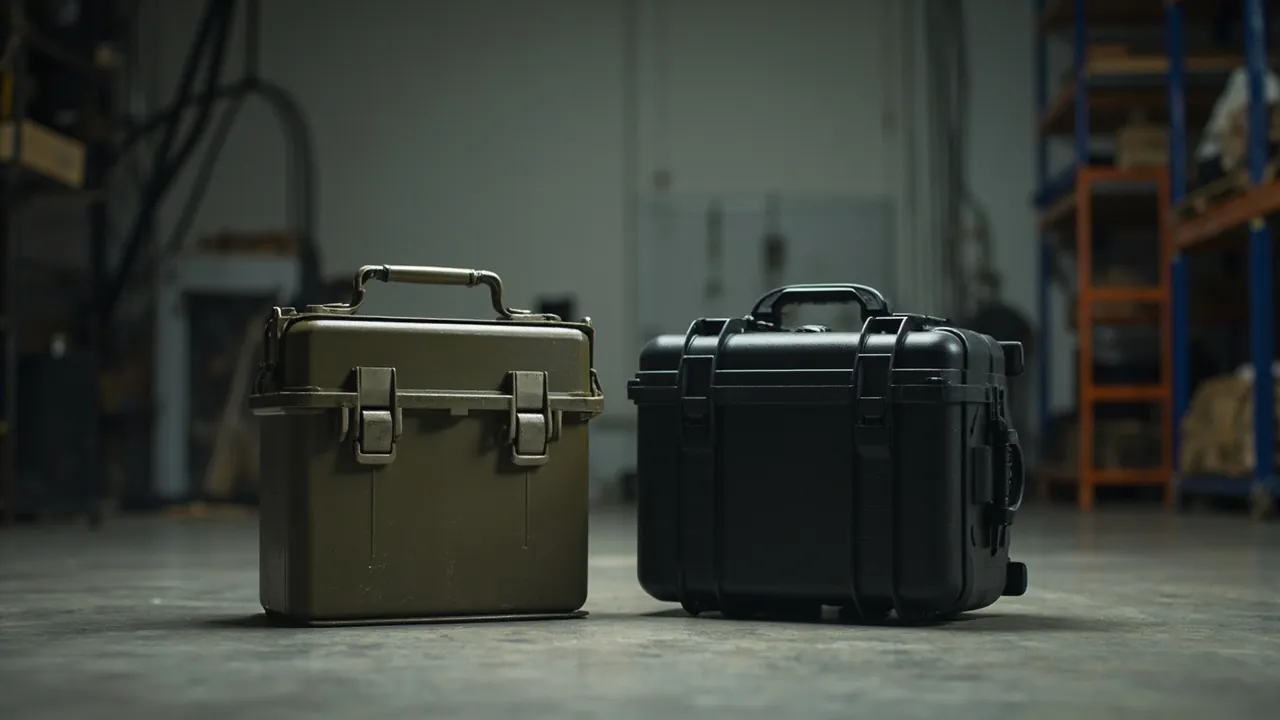
Short answer: the history of the military ammo box is really the industrial history of three disciplines coming together — container materials, sealing engineering and manufacturing processes. The story follows four transitions: from wooden crates to steel containers, which solved strength and stacking; from single steel cans to a standardized size system, which solved interchangeability and logistics efficiency; from steel to plastics, which solved corrosion, weight and cost; and from "it holds things" to "it can be verified", which solved traceability of ingress protection and transport compliance. None of these transitions was about appearance. Each was a fresh answer to the same question: how do you keep the contents intact in a harsher environment, over a longer storage period, at a higher handling intensity?
This article discusses only the container itself — the evolutionary logic of material systems, moulding processes, sealing structures, latch designs, liner configurations and test standards. It does not address the use or performance of any contents. This is a classic industrial packaging technology path, and it still has direct practical value for procurement today: once you understand what problem each generation was designed to solve, you can tell which generation a given case belongs to, and whether it suits your operating conditions. All figures are typical or empirical values; actual data should follow supplier drawings and test reports.
Table of Contents
- The direct answer: an evolution of materials and manufacturing processes
- Origins: the wooden crate era and the arrival of steel containers
- The WWII period: standardization of steel ammo boxes
- Post-war and Cold War: the mature steel can specification
- The material shift: why steel gave way to plastics
- The plastics era: the engineering logic of rotational and injection moulding
- Sealing evolution: from flat gaskets to grooved O-rings
- Latch and hinge evolution: from simple catches to metal cams
- Liner evolution: from paper padding to pre-cut foam and modularity
- Standardization and testing: from military methods to general packaging standards
- Structural features of the modern plastic tactical case
- Era comparison and material comparison tables
- What this means for procurement and selection today
- FAQ
- Conclusion and further reading
The direct answer: an evolution of materials and manufacturing processes
Treated as a class of industrial packaging product, the ammo box has moved through four clear technical stages, each driven by a concrete engineering conflict.
| Stage | Dominant material | Problem it solved | Main weakness |
|---|---|---|---|
| --- | --- | --- | --- |
| Wooden crate era | Timber plus metal corner brackets | Bulk transport and basic load bearing | Water absorption and rot, variable strength, no sealing |
| Steel container era | Cold-rolled steel, stamped or welded | Sealing, stacking strength, reusability | High tare weight, corrosion, cost |
| Transitional stage | Aluminium, FRP, modified plastics | Light weight and corrosion resistance | High cost, immature processes |
| Modern plastics era | HDPE, copolymer PP, engineering plastics | Weathering, low-temperature impact, integrated moulding | Rigidity depends on ribs, long-term creep |
One criterion runs through the entire line: how to achieve sealing and rigidity at the same time, and keep both after years of use. A wooden crate relies on fixing the contents in place and cannot really seal. A steel can achieves gas-tightness through welding or rolled seams, but is heavy and corrodes. A plastic case combines groove-compressed sealing with a rib structure, optimizing weight and sealing together, at the cost of long-term creep and a rigidity that depends entirely on structural design.
With that thread in hand, a practical procurement question becomes answerable: why modern plastic cases outperform steel in many applications, and where steel remains irreplaceable. The sections below work through it.
Origins: the wooden crate era and the arrival of steel containers
From the nineteenth century into the early twentieth, the workhorse of packaging was the wooden crate: boards nailed together, with metal corner brackets added at high-stress points. Its advantages were readily available material, simple fabrication and reasonable cushioning. Its weaknesses were equally clear:
- Water absorption and rot: in the open or in damp conditions, timber absorbs water, loses strength, mildews and attracts insects.
- Wide strength variation: wood is anisotropic, and knots or grain direction cause strength scatter, making uniform stacking design difficult.
- No sealing capability: the seams cannot be sealed effectively, so moisture protection depends entirely on wrapping the contents in oiled or waxed paper.
- Not reusable: a crate was often scrapped after a single journey.
As metalworking matured, sheet-metal stamping and rolled seam technology entered packaging. Steel could be stamped into a regular box and closed by rolled seams or welding to form a continuous metal shell, achieving genuine gas-tightness and moisture exclusion. This was the first qualitative change in container history: from holding things to keeping the environment out.
Early steel containers left a design legacy that still matters today: specification. Once container dimensions and load capacity were fixed, handling, stacking, transport and warehousing could all be designed around a fixed size, and efficiency rose sharply. This is the same logic behind matching a case footprint to a pallet module today. For the long-term storage advantages of the steel route, see military steel ammo can long-term storage.
The WWII period: standardization of steel ammo boxes
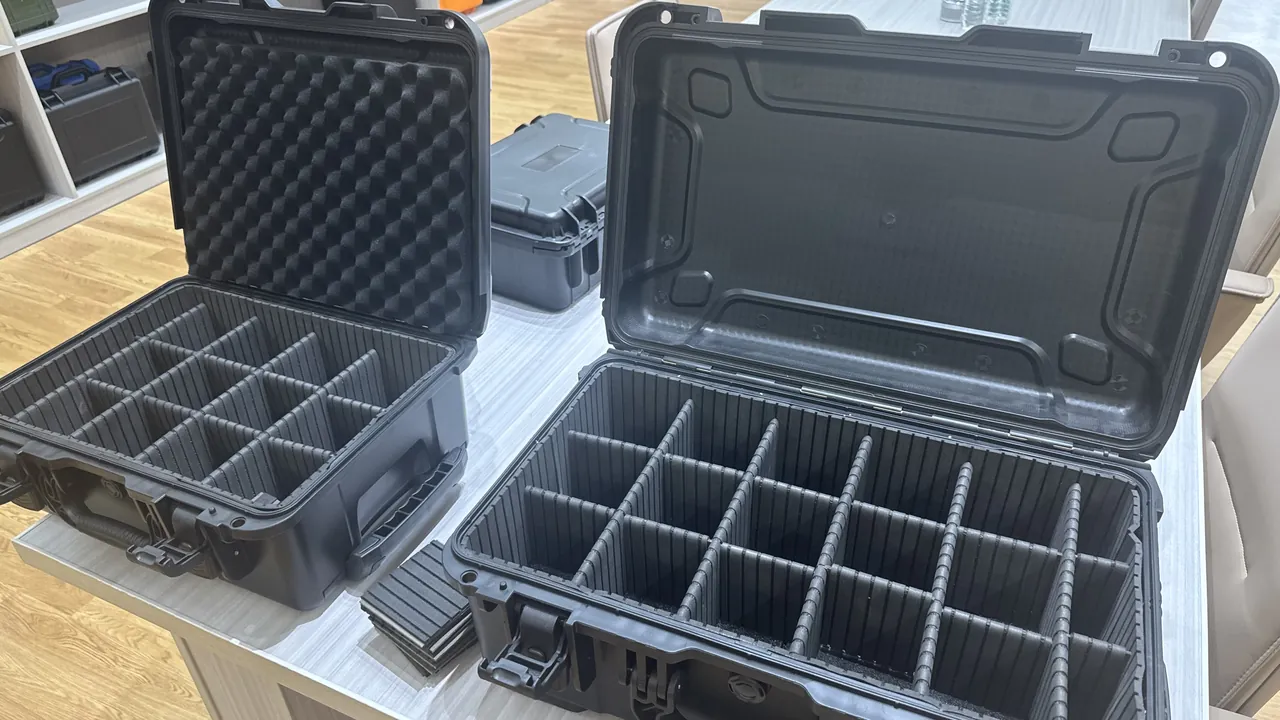
The large-scale industrial mobilization of the first half of the twentieth century turned packaging from a craft problem into a systems problem. The reason is simple: when supplies move across continents in tens of millions of units, any container that is not uniform, not stackable and not interchangeable becomes a logistics burden.
Several design paradigms established in this period proved enduring.
1. A size series. Within one system, capacity and purpose were divided into a set of fixed sizes, each with a clear code. Users did not need to remember parameters, only the size designation. Terms such as "50 cal box" that remain in use today are a continuation of that specification culture — they are fundamentally capacity designations, much like "20 ft container". The conversion method is covered in 50 cal ammo box capacity.
2. A settled structure. An upright rectangular body, a drop-on lid, folding side handles, end hinges and a front latch — this arrangement was inherited almost unchanged by plastic cases decades later. It simultaneously satisfies four requirements: one-handed opening, stackability, padlock compatibility and handling with the same tooling.
3. Unified material and process. Cold-rolled steel stamped into shape, with seams welded or rolled, and the surface phosphated and painted. Steel thickness typically fell in the 0.8-1.5 mm range, balancing strength and weight. Here an experience emerged that is still used today: thickness is not the only variable; section shape governs rigidity. Rolling ribs into a steel panel markedly improves dent resistance at almost no weight penalty.
4. The primitive form of sealing. Early steel boxes relied on metal-to-metal contact, and some designs inserted rubber or cork gaskets at the rim. This "flat gasket" sealing had uncontrolled compression, relying on rim stiffness to force the joint shut, and therefore demanded very tight manufacturing tolerances.
5. Interchangeability first. Lids and bodies of the same size had to be interchangeable, simplifying repair and resupply. This plainest of motives behind standardization is also the origin of the "one platform, multiple configurations" approach used in OEM/ODM today.
Post-war and Cold War: the mature steel can specification
From the post-war period into the second half of the twentieth century, steel containers entered maturity, with improvements focused on detail rather than paradigm.
- Latch upgrades: simple spring catches gave way to metal latches with a cam profile that produces an over-centre self-locking action, giving stable and adjustable clamping force and much longer cycle life.
- Standardized seals: rubber gaskets moved from accessory to specified part, with defined cross-section, hardness and compression range, making sealing performance reproducible.
- Systematic surface treatment: phosphating, galvanizing and painting combined into layered processes, and salt-spray duration became a negotiable acceptance metric under standards such as ISO 9227 and GB/T 10125.
- Human factors: wider handles, radiused corners and standardized label areas reduced hand injuries and identification errors during handling.
It is worth noting that the ceiling of the steel route was already clear by this period: weight and corrosion are properties of the material itself and cannot be engineered away. A steel container of the same volume weighs several times as much as a plastic one; and even with coatings, damp environments demand maintenance. These two constraints directly produced the next generation of materials.
The material shift: why steel gave way to plastics
The shift from steel to plastics was not a simple matter of plastics being better. It was that changing applications redefined the optimum.
Four drivers:
- Weight reduction. The limits of manual handling cap how heavy a container can be. Empirically, a sensible manual-carry ceiling is around 20-25 kg including contents, which means every extra kilogram of tare weight costs a kilogram of payload. Plastic containers reduce tare weight by an order of magnitude.
- Corrosion resistance. In coastal, humid and salt-spray environments, steel containers depend on coatings and maintenance. Plastics do not rust, and maintenance cost approaches zero.
- Low-temperature toughness. This determines which plastic is chosen. Homopolymer PP becomes brittle in the cold, whereas HDPE retains toughness at -30 °C to -40 °C, making it the workhorse for outdoor and cold-climate use.
- Integrated moulding. Injection and rotational moulding can form a complex case in one operation, complete with ribs, grooves, handle bosses and latch seats, reducing part count and assembly labour. This is what allowed the plastics route to beat steel on cost.
Early plastic attempts did not succeed. FRP was expensive and inconsistent; ordinary engineering plastics lacked rigidity and crept. What brought plastic cases into the mainstream was the combination of structural design and material modification — ribs to compensate for low rigidity, copolymer modification to improve low-temperature impact, and UV additives to handle outdoor ageing. A full comparison appears in protective case plastic materials and PP, ABS and PC case difference.
The plastics era: the engineering logic of rotational and injection moulding
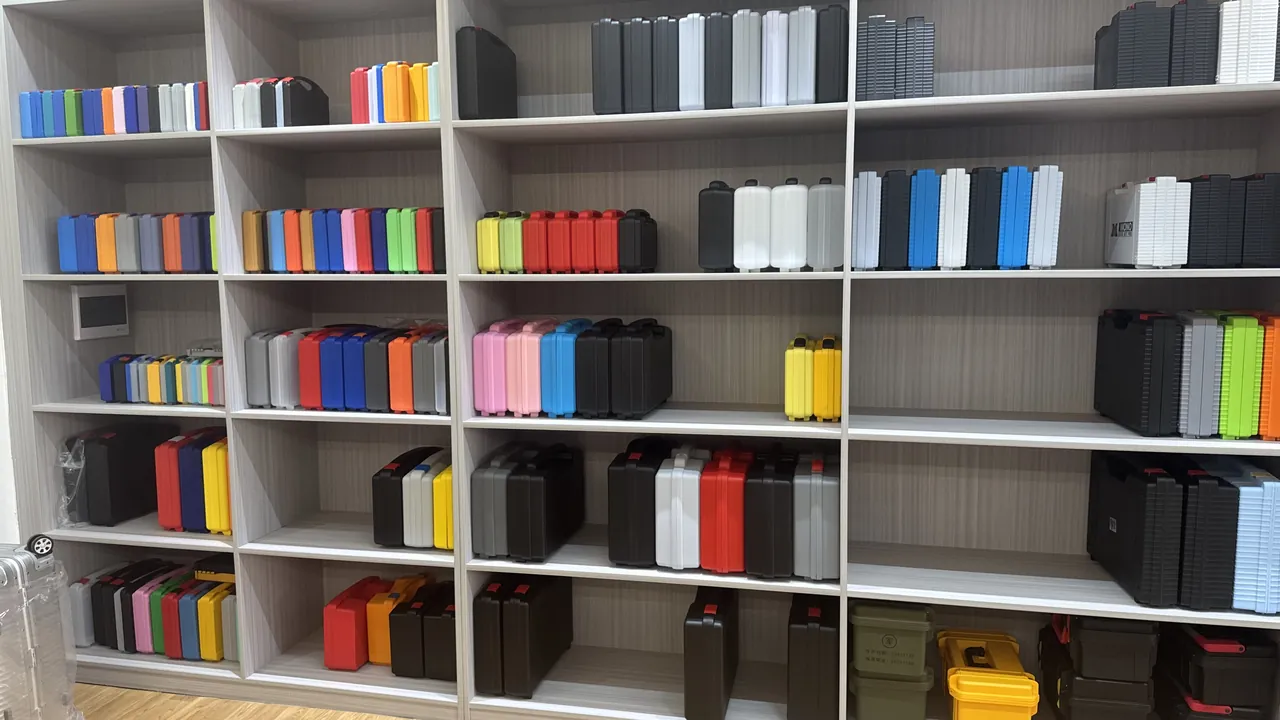
There are two main process routes for modern plastic tactical cases, and understanding their differences is understanding the cost and performance structure of two product families.
Rotational moulding. Plastic powder is loaded into a mould, which is heated while rotating on two axes, so the powder fuses layer by layer against the cavity wall and forms a seamless hollow body on cooling. Characteristics:
- Seamless and one-piece: no welds or knit lines, so the wall is continuous and the sealing face is sound.
- Controllable wall thickness: set by the charge weight, with slightly thicker corners.
- Suited to large sizes and low volumes: tooling cost is relatively low, which suits large cases and multiple variants.
- Limitations: long cycle time, high labour content, lower dimensional accuracy, and a typical rotational texture on the surface.
Injection moulding. Molten plastic is forced into a steel mould under high pressure and sets on cooling. Characteristics:
- High dimensional accuracy and good surface quality, suited to complex, tolerance-critical cases.
- Low unit cost at high volume: tooling is expensive but amortizes well.
- Fine structures in one shot: ribs, catches, grooves and insert bosses can all be moulded in.
- Limitations: high tooling cost, unsuitable for small batches, and large cases need large machines.
The selection logic is straightforward: large size, low volume, seamless requirement means rotational moulding; small to medium size, high volume, accuracy and appearance mean injection moulding. In practice, hybrid solutions combining a rotationally moulded shell with injection-moulded hardware and liners are common.
Ribs are the soul of a modern plastic case. Because the elastic modulus of plastic is far below that of steel, the wall must compensate through geometry. Typical practice includes grid ribs with rib heights of 3-8 mm and spacing of 40-80 mm, thickened and rolled rims, and thickened corners with bumpers. These divide a large panel into small spans so the wall does not bulge under stacking or torsion. The complete design set is in high-strength case structure and case reinforcement ribs.
Sealing evolution: from flat gaskets to grooved O-rings
Sealing is the most technically demanding part of container history and the clearest marker of generational difference.
Generation one: metal to metal. Performance depends on intimate contact between rim and body, is extremely sensitive to manufacturing tolerance, and fails as soon as the rim deforms.
Generation two: flat gaskets. A ring of rubber, cork or foam is applied to the rim and the two parts are pressed together by the latch. This is a clear advance, but it carries three structural problems: compression is uncontrolled, with pressure highest at corners and lowest along the straight runs; the gasket itself may absorb water; and with no lateral constraint, it moves under side loads.
Generation three: groove-compressed sealing. A U-shaped or rectangular groove is machined into the rim and fitted with an O-ring or profile extrusion seal. The principle is that the groove limits lateral movement while the latch travel provides a defined vertical compression, commonly designed into the 20%-30% range. The decisive advantage of this generation is maintainability: the seal can be replaced on its own, so the life of the case is no longer capped by the life of the seal.
| Seal generation | Sealing face | Compression control | Lateral resistance | Replaceability | Typical protection level |
|---|---|---|---|---|---|
| --- | --- | --- | --- | --- | --- |
| First | Metal to metal | Depends on tolerance | Not applicable | Not applicable | Basic dust exclusion |
| Second | Flat gasket pressed by latch | Uncontrolled | Poor | Mostly one-time | Around IPX4 to IPX5 |
| Third | Groove plus O-ring or profile seal | Set by groove and travel | Good | Replaceable separately | Around IP65 to IP67 |
Seal compounds matured alongside. Nitrile (NBR) resists oil at moderate cost; EPDM offers the best weather, water and ozone resistance and dominates outdoor use; silicone (VMQ) has the widest temperature window; FKM offers the best chemical resistance at higher cost. Hardness commonly falls between 50 and 70 Shore A, and groove dimensions, hardness and compression set must be designed as a set. Comparisons appear in case seal materials and outdoor case seal ring.
Latch and hinge evolution: from simple catches to metal cams
The evolutionary logic of latches and hinges is "from closing to holding, and from holding to holding for years".
Three latch generations:
- All-plastic catch. It closes by elastic deformation of the material itself: cheap and assembly-free, but plastic exhibits stress relaxation, so clamping force declines month by month while closed, and it becomes brittle in the cold.
- Plastic catch with metal pin. Load transfer moves to a metal pin, markedly improving life. This is the mainstream approach for lightweight cases.
- Metal cam latch. Stamped from stainless or zinc-plated steel with a cam profile that produces an over-centre self-locking action, giving stable and adjustable clamping force. Life is assessed on cycle count and clamping-force decay, with a common empirical benchmark of several thousand cycles at limited decay.
Three hinge generations:
- Thin plastic leaf. Becomes loose after repeated opening, letting the lid shift and the sealing face misalign.
- Thickened plastic hinge with pin. Improved life, but still at risk of cold brittleness.
- Through metal pin with wear bushing. A bushing or reinforced boss at the pin-and-hole joint keeps the lid stable when fully open, allows one-handed access and resists torsion.
The padlock hole is a standardization product. Early containers simply had a hole in the latch; modern design requires that the lock installation not compromise seal compression. Some designs lift the latch to give the lock more travel, leaving the gasket under-compressed — a classic design error. Selection details are in case latch selection.
Liner evolution: from paper padding to pre-cut foam and modularity
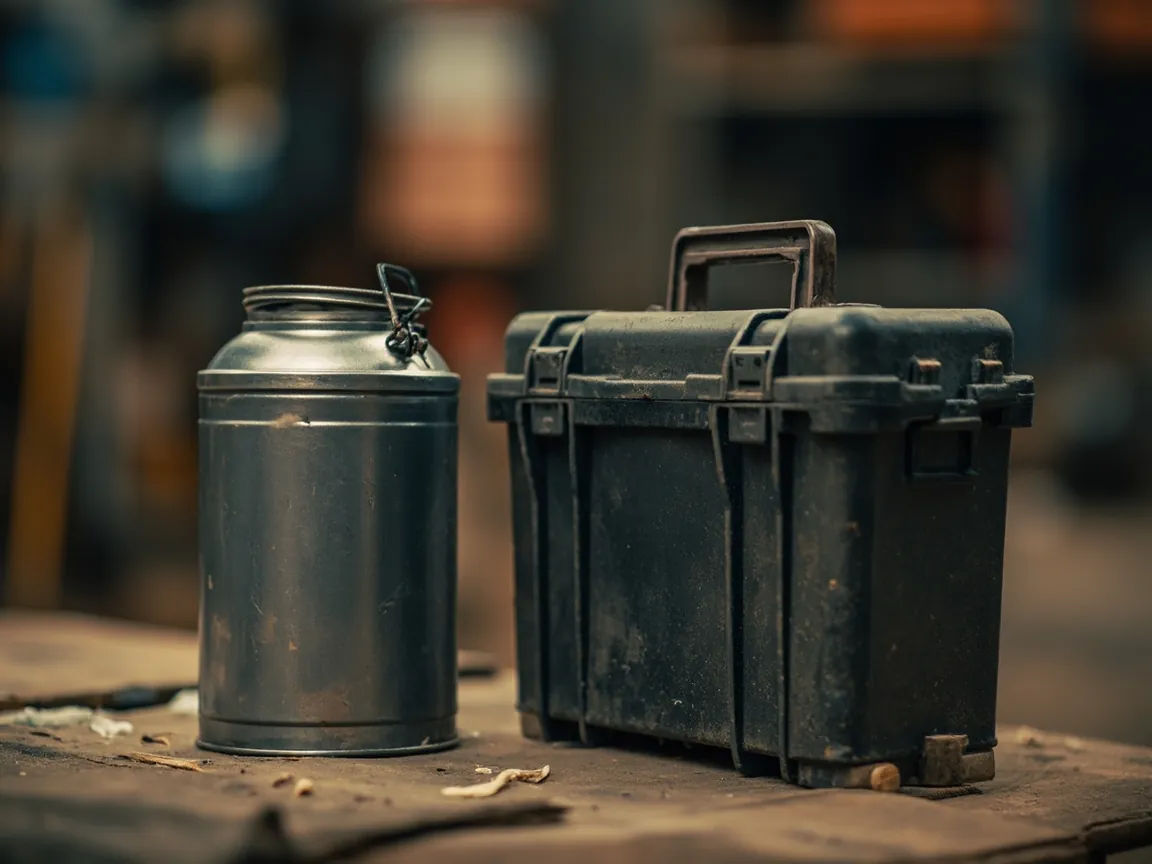
The liner's evolution reflects a change in thinking: from filling space to locating contents.
Generation one: bulk packing and paper padding. Paper, straw and wood shavings filled the gaps to stop movement. The problems were water absorption, fragility and unpredictable cushioning.
Generation two: open-cell foam and fibre padding. Open-cell polyurethane sponge is cheap and can be inserted as a block and hollowed out, making it a common industrial packaging choice. But its open structure absorbs water and oil and degrades into crumbs, losing support over time.
Generation three: closed-cell foam and pre-cut location. Closed-cell EVA, commonly 30-80 kg/m³, and PE foam in the XPE/IXPE family do not absorb water, recover consistently and can be CNC pre-cut into pockets that match the outline of the contents. The key change is conceptual: the liner is no longer just padding but a means of holding items in a fixed position. The governing parameter is the cushion curve, which sets the required foam thickness and density combination from item weight and expected drop height. See pre-cut foam design tips.
Generation four: modularity and gradients. Laminated layers produce a gradient — a low-density outer layer absorbing large deflections and a firmer inner layer providing support. Rigid dividers and pull-out trays serve mixed contents with frequent access, and VCI materials protect metal parts in long-term storage. The defining trait of this generation is that one shell can be configured with different liners, giving one case many uses.
Standardization and testing: from military methods to general packaging standards
The final marker of a mature container technology is that acceptance shifted from visual judgement to measurable standards. That shift made "durable" comparable and traceable.
Four families of standards apply to this class of container:
- Ingress protection: IEC 60529, with the Chinese national equivalent GB/T 4208-2017, describes dust and water protection through the IP code. Dust level 6 is dust-tight, and water level 7 is temporary immersion, commonly 1 m for 30 minutes. The key point is that the levels are not a simple progression — a sample that passes immersion does not automatically pass the jet test — so a technical agreement should state each digit explicitly. See what is an IP67 rating.
- Environmental reliability: methods in MIL-STD-810H covering high and low temperature (501/502), temperature shock (503), humidity (507), vibration (514) and shock (516), used to verify material and structure under extreme conditions.
- Transport performance: ASTM D4169, Standard Practice for Performance Testing of Shipping Containers and Systems, which organizes drop, vibration, stacking and concentrated impact sequences under a distribution cycle plus assurance level framework; the ISTA series, graded 1/2/3 by transport mode; and ISO 4180 with the GB/T 4857 series, which provide test plans and individual methods for complete filled transport packages.
- Material and surface testing: ISO 9227 and ASTM B117 for salt spray, with GB/T 10125 as the Chinese equivalent; ASTM G154 and ISO 4892 for UV ageing; and UL94 for flammability.
| Standard family | Representative standards | Primary use |
|---|---|---|
| --- | --- | --- |
| Ingress protection | IEC 60529 / GB/T 4208-2017 | Dust and water rating |
| Environmental reliability | MIL-STD-810H | Temperature, humidity, vibration, shock |
| Transport performance | ASTM D4169, ISTA, GB/T 4857 | Drop, vibration, stacking |
| Corrosion and ageing | ISO 9227, ASTM G154, UL94 | Salt spray, UV, flammability |
The value of this framework is that it lets a buyer replace "should be durable enough" with "shall pass, per this standard and method, under these conditions". The most fundamental gap between a modern container and the early wooden crate or steel can is not the material at all. It is whether the product can prove that it complies.
Structural features of the modern plastic tactical case
Layering the three generations together, the typical structure of a modern plastic tactical case reduces to seven features:
- A one-piece HDPE or copolymer PP shell with UV stabilizers; rotational moulding for large sizes, injection moulding for small and medium ones.
- Grid ribs plus a thickened, rolled rim, compensating for the low rigidity of plastic and resisting stacking and torsion.
- Groove-compressed sealing with a replaceable O-ring, usually EPDM at 50-70 Shore A.
- Metal cam latches with through-pin hinges, plus a padlock hole or integrated cylinder.
- A pressure equalization valve on some models, passing air but not water, to relieve the differential from temperature or altitude change.
- Configurable liners: closed-cell foam, pre-cut foam, rigid dividers, pull-out trays and VCI materials.
- Stacking location features: bosses and recesses interlocking between the top of one case and the base of the next, rather than flat surfaces resting on each other.
These seven features form a practical generation checklist. A case without grooved sealing belongs to the second generation; one without replaceable seals and metal latches is still transitional; only a case with all seven is a modern high-protection container. The full contrast between categories appears in military ammo box versus ordinary box, and verification methods for water resistance in waterproof ammo box really waterproof.
Era comparison and material comparison tables
Two comparisons quickly position a case in terms of technical generation and material role.
Technical generation comparison:
| Dimension | Wooden crate era | Steel container era | Modern plastics era |
|---|---|---|---|
| --- | --- | --- | --- |
| Sealing method | None, inner wrapping | Metal contact or flat gasket | Groove compression plus O-ring |
| Main failure mode | Rot, coming apart | Corrosion, deformation | Creep, seal ageing |
| Tare weight per volume | Medium | High | Low |
| Reusability | Essentially no | Yes, with maintenance | Yes, with low maintenance |
| Ingress rating | None | Mostly around IPX4 | IP65 to IP67 |
| Acceptance method | Visual | Visual plus some testing | Measurable and traceable |
Material comparison:
| Material | Low-temperature toughness | Rigidity | Corrosion resistance | Weight | Forming process | Typical role |
|---|---|---|---|---|---|---|
| --- | --- | --- | --- | --- | --- | --- |
| Timber | Medium | Medium | Poor | Medium | Jointed | Historical stage |
| Cold-rolled steel | Excellent | Excellent | Needs coating | High | Stamped and welded | High stacking loads, long warehousing |
| Stainless 304/316 | Excellent | Excellent | Excellent | Highest | Stamped and welded | Coastal and humid |
| Aluminium | Good | Medium-high | Good | Low | Bent and riveted | Instrument transport |
| HDPE | Excellent | Lower | Excellent | Medium | Rotational or injection | Outdoors, vehicle, general workhorse |
| Copolymer PP | Good | Higher | Good | Low | Injection | Indoor, light duty, cost-driven |
What this means for procurement and selection today
The history yields three directly useful judgements.
First, the generation sets the floor and the configuration sets the ceiling. A modern case with grooved sealing and metal latches already has a protection floor far above any transitional product. Above that floor, the liner configuration — foam type, thickness, divider method — determines whether it meets a specific duty cycle. Procurement should therefore confirm "generation compliance" first, then discuss "configuration fit".
Second, never judge the whole from a single metric. Thickness, material and latch type can each be dressed up individually. The reliable method is to request evidence across five items — lock, latch, liner, structure, report — and to probe any that is missing. This matches the framework set out at the beginning of this article.
Third, write standards into the contract. The greatest advance of the modern container is verifiability. State the ingress rating digit by digit, such as IP6X + IPX5 + IPX7; name the transport test basis, such as ASTM D4169, ISTA or GB/T 4857; specify the salt-spray duration. Acceptance then rests on evidence, and later disputes drop sharply.
JUNZHJIA is manufactured by KeXin New Materials (Guangdong) Co., Ltd., covering protective cases, toolboxes, rugged storage cases and waterproof junction boxes, serving wholesale, agency, OEM/ODM and global supply. Within the generation and configuration framework above, material systems such as HDPE or copolymer PP, sealing solutions such as EPDM, VMQ, NBR or FKM, latch types and custom liners can be configured to the customer's operating conditions, with corresponding test documentation and spare parts support.
FAQ
Q: Steel ammo cans versus modern plastic tactical cases — which is better?
A: This is not a question of which is better, but of which suits your duty cycle. Choose steel when you need extreme stacking strength for long-term multi-layer warehousing, weld-grade gas-tightness, puncture and crush resistance, or a strong basis for flame retardancy and static dissipation. Steel's weaknesses are weight and rust, which require a phosphated and painted, galvanized or stainless system, and shorter maintenance intervals in humid coastal sites. Choose plastic, HDPE or copolymer PP, when you need frequent manual handling, low-temperature impact toughness, resistance to a range of chemicals, or flexibility in colour and branding. Plastic's weaknesses are rigidity that depends on ribs, a surface that scratches, and noticeable creep under heavy long-term stacking. A middle path combines a plastic shell with metal hinges and latches, which is common in industrial packaging today. The deciding factors are always the duty cycle: low-temperature limit, the form water takes, stacking height and storage period.
Q: Why is the sealing on early steel boxes worse than on modern plastic cases?
A: Because the sealing principle changed generation. Early steel boxes relied on intimate metal-to-metal contact, with some designs inserting rubber or cork at the rim. This is flat sealing: two flat faces pressed together by a latch, with compression forced by rim stiffness, uncontrolled, and highly sensitive to manufacturing tolerance. As soon as the rim deforms in transit, the seal fails. Modern plastic cases use groove-compressed sealing: a continuous groove in the rim receives an O-ring or profile extrusion seal; the groove limits lateral movement while the latch travel provides a defined vertical compression, commonly designed into the 20%-30% range. That range matters because rubber sits in its most elastic state, with enough contact stress to seal but not enough over-compression to take a permanent set. Modern seals can also be replaced on their own, whereas early steel box seals were largely one-time, so seal failure often meant scrapping the whole container. The gap is not that steel is inferior to plastic; it is the structural logic of the seal.
Q: How do I choose between rotational moulding and injection moulding?
A: Judge on size, volume and precision. Rotational moulding suits large sizes and low to medium volumes: the mould is heated while rotating on two axes, plastic powder fuses against the cavity wall, and a seamless hollow body forms on cooling, with no welds or knit lines and a sound sealing face; wall thickness is controlled by charge weight. Its limitations are long cycle time, high labour content, lower dimensional accuracy and a typical surface texture. Injection moulding suits small to medium sizes at high volume: molten plastic is injected into a steel mould under high pressure, giving high accuracy and good surface finish, and can form ribs, catches, grooves and insert bosses in a single shot. Its limitation is high tooling cost, and large cases need large machines. A practical rule: large size, low volume, seamless requirement means rotational moulding; small to medium size, high volume, precision and appearance mean injection moulding. Hybrid solutions combining a rotationally moulded shell with injection-moulded hardware and liners are common. Whichever process is used, plastic rigidity must be supplemented by ribs and a rolled rim — that requirement is independent of process.
Q: Why do plastic cases need so many ribs? Why not just make the walls thicker?
A: Because rigidity is governed by section shape, not thickness. Bending resistance is proportional to the section moment of inertia, which grows with the cube of section height, meaning rib height, but only linearly with wall thickness. This means increasing rib height is far more efficient than increasing wall thickness, and it adds almost no weight. A 3 mm flat wall, for example, may bend more easily than a 1.5 mm wall carrying a 20 mm longitudinal rib. Thicker walls also bring two side effects. First, tare weight rises, directly reducing payload and working against the goal of weight reduction. Second, injection-moulded parts that are too thick develop sink marks and internal voids, which actually reduce strength. The standard approach for modern plastic cases is therefore to divide large panels into small spans with grid ribs of typically 3-8 mm height and 40-80 mm spacing, to keep the sealing face flat with a thickened rolled rim, and to spread impact loads with thickened corners and bumpers. This combination is the structural basis on which plastic replaced steel.
Q: What does the pressure equalization valve on a modern case actually do?
A: It solves the pressure differential problem by passing air but not water. Differentials arise in two ways: rapid altitude change, for example a vehicle climbing quickly from low to high elevation; and sharp temperature change, such as a case moving from direct sun into an air-conditioned room or cold water. Excessive differential causes two outcomes: difficult opening, because internal negative pressure holds the lid; or the seal being pushed open from the inside, letting external moisture in. A pressure equalization valve uses a micro-orifice or membrane that allows gas through while blocking liquid water, letting the internal and external pressures equalize slowly. Note carefully: a pressure equalization valve does not replace desiccant. It balances pressure, not humidity — external moisture can still migrate in slowly as vapour. For long-term storage, use it together with a replaceable desiccant pack and a humidity indicator card. The valve is itself a penetration in the sealing path, so its sealing performance must be included in ingress rating testing; confirm during procurement that this point has independent sealing measures and test evidence.
Q: What does a designation such as "50 cal box" still mean today?
A: Its meaning is specification identification, not contents. In industrial packaging, such a designation refers to an established set of external and internal dimensions, much like "20 ft container" or "IBC tote" — it is a packaging format code. Its value lies in three things. First, interchangeability: lids and bodies of the same size can be swapped, simplifying repair and resupply. Second, compatibility: shelving, tooling, pallets and stacking plans can all be designed around a fixed size. Third, communication efficiency: one code lets buyer and supplier confirm the main parameters without describing each one. But procurement must be clear that a code cannot replace parameters. Across suppliers, products sharing a code may differ entirely in internal dimensions, wall thickness, seal architecture and ingress rating. The correct approach is to use the code for an initial screen, then write internal length, width and height, usable volume, seal architecture, ingress rating and liner configuration into the technical agreement. The full conversion method is in 50 cal ammo box capacity.
Q: Why is verifiability described as the greatest advance of the modern container?
A: Because verifiability makes responsibility traceable. Acceptance in the wooden crate era was visual: is it broken, does it fit. The steel era added some testing but remained experience-driven. Modern containers base acceptance entirely on standards and tests: ingress protection rated digit by digit per IEC 60529 / GB/T 4208-2017, transport performance verified per ASTM D4169, ISTA or GB/T 4857, salt spray graded per ISO 9227 or GB/T 10125, and environmental reliability assessed method by method per MIL-STD-810H. The framework delivers three direct benefits. First, comparability: products from different suppliers can be compared on one scale rather than each making its own claims. Second, negotiability: a buyer can replace "should be durable enough" with "shall pass, per this standard and method, under these conditions", which sharply reduces disputes. Third, improvability: test data locates design weaknesses and gives iteration a direction. Conversely, the products most deserving of caution in procurement are exactly those that offer only verbal assurances and no test evidence. They tend to be at the stage of looking the part rather than having been verified.
Q: What is the single most important lesson from this history for selection?
A: The most important lesson is: establish the generation first, then discuss configuration. Generation sets the performance floor and configuration sets the ceiling. Four features are enough to identify the generation. First, whether the rim uses grooved sealing rather than a flat gasket or metal-on-metal contact. Second, whether the seal can be replaced on its own. Third, whether the latch is a metal part with stable clamping force rather than an all-plastic catch. Fourth, whether the shell has grid ribs and a rolled rim. A case with all four is a modern high-protection container, and liner configuration can then be matched to the duty cycle. If one or two are missing, assess whether it can still meet your scenario. For example, a case without grooved sealing may be entirely adequate in a dry indoor setting but will show its weakness in long-term outdoor storage. Applying the "generation first, configuration second" order avoids the most common procurement error: being drawn in by appearance and a few good materials while overlooking a design that is a generation behind. See military ammo box versus ordinary box.
Conclusion and further reading
Looking across the whole line: the wooden crate solved holding, the steel container solved sealing and stacking, standardization solved interchangeability and logistics, plastics solved weight, corrosion and integrated moulding, and the standards and testing framework solved provability. None of these was a simple material substitution. Each was a fresh answer to how to protect contents under harsher conditions. Understanding that thread is worth more than memorizing any individual model number, because models go out of date while judgement frameworks do not.
Three actionable recommendations. First, identify the generation with four features — grooved sealing, replaceable seals, metal latches, and ribs with a rolled rim. Second, choose material from the duty cycle, not the appearance — low-temperature limit, the form water takes, stacking height and storage period. Third, write standards into the contract — ingress rating digit by digit, transport test basis, salt-spray duration and acceptance criteria.
JUNZHJIA is manufactured by KeXin New Materials (Guangdong) Co., Ltd., covering protective cases, toolboxes, rugged storage cases and waterproof junction boxes, serving wholesale, agency, OEM/ODM and global supply. Material systems, sealing solutions, latch types and custom liners can be configured to the customer's operating conditions, with corresponding test documentation and spare parts support.
Further reading