

Archery gear is a classic dimension-sensitive category. A recurve bow gets one chance to be assembled: limb pocket angles, brace height and the tiller difference between upper and lower limbs all rest on the geometry set when the bow was tuned. A compound bow depends on upper and lower cam synchronisation and on timing marks. A single squeeze or twist can turn a tuned bow into a bow that must be re-tuned on arrival. Yet the real journey is full of squeezing, vibration, moisture and temperature swings: a boot packed against luggage, a cold low-pressure cargo hold, hours of high-frequency road vibration in a pickup bed, and a damp bow going straight back into a bag after a rainy session.
The point of protection is never fitting the bow in; it is returning the bow to the same set of dimensions every time the lid opens. JUNZHIJIA builds archery cases around three tasks: lock the gear so it cannot shift, absorb impact energy through graded foam layers, and keep water vapour, dust and thermal swings outside the sealed cavity. Only when all three hold is a case really protecting a bow rather than merely moving it.
Table of Contents
- Why Archery Gear Needs a Dedicated Case
- Transport Protection for Riser and Limbs
- Cams, Wheels and Timing Marks: Dimensional Drift Risk
- Protecting Sights, Scopes and Stabilisers
- String and Cable Protection Against Wear and Moisture
- Stowing Arrows and Broadheads
- Temperature and Humidity Effects on Limbs and Strings
- Liner Layouts Compared: Die-Cut EVA, Layered Foam, Tube Inserts, Compartment Trays
- Airline and Vehicle Transport Limits
- Locks, Labels and Loss Prevention
- Shell Structure and Sealing Class Selection
- Acceptance Criteria and Routine Maintenance
- Frequently Asked Questions FAQ
- Conclusion and Related Reading
Why Archery Gear Needs a Dedicated Case
A soft bow bag and a hard protective case solve completely different problems. A bag solves carrying and dust: the load path runs through stitching and zips, so a lateral squeeze meets almost no resistance and the limbs bend along their weakest direction. A case solves force. It takes the external load through walls, ribs and liner, transferring it away so the equipment itself never becomes a structural member. Three questions quickly separate a real case from a decorative one. With the lid closed, can a single hand push the bow around inside? Does the side wall visibly deflect under a 50 kg static load? In an ambient 90 percent relative humidity environment, is interior humidity held in a sane band?
The second issue is repeatability. Archery is a sport of repeating a motion to an extreme degree, and archers are highly sensitive to changes in how a bow feels. That feel comes from geometry. Every closing of the lid should return the riser, limbs and sight to the same position with millimetre-scale tolerance. This demands a liner that is not merely a hollowed pocket but a fixture with locating faces, limit steps and finger reliefs. For a structured comparison of foam density, rebound and service life, see Case Internal Foam Types.
The third issue is compatibility. One case often has to carry both a recurve and a compound bow, plus practice arrows and match arrows. That requires a liner built from removable modules rather than a die-cut that is fixed for life.
Transport Protection for Riser and Limbs
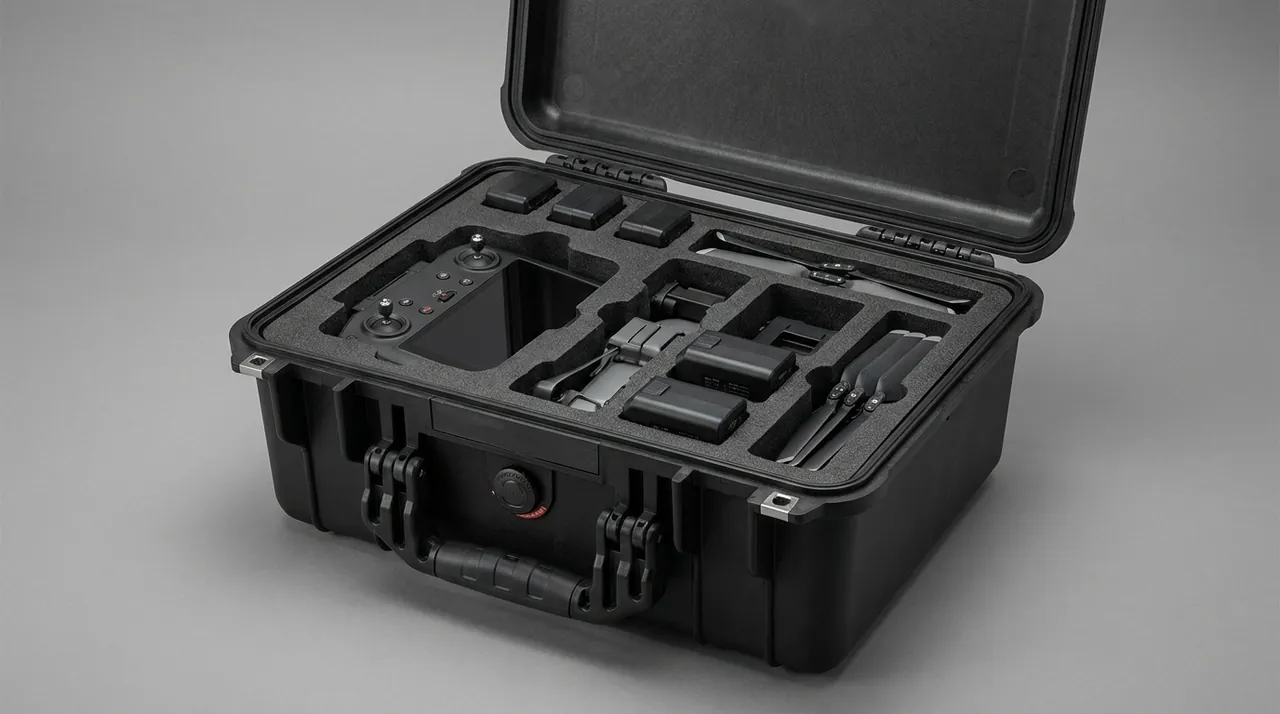
Risers are usually 6061-T6 or 7075 aluminium, occasionally magnesium. They are stiff but still vulnerable to local impact that deforms a pocket face. Limbs are wood and glass-fibre or carbon-fibre laminates, and what damages them is not axial compression but lateral bending and torsion: a limb that has been twisted can look perfect while its draw-force curve has already changed. Each limb therefore needs its own channel, cut 1.5 to 2 mm wider than the widest part of the limb so it slides in freely but cannot move sideways. Channel floors and walls should use roughly 30 kg per cubic metre EPE or about 45 Shore A EVA to form a compliant constraint.
Riser retention should follow a two-point support rule, never a single unsupported point. A riser centre of mass usually sits toward the grip. If foam is placed only under the grip, road vibration lets the riser pivot about that single point, rubbing the wall over time and loading the limb pockets. The correct arrangement clamps the riser at a cradle and a pressure block, both faced in foam, with compression held to 3 to 5 mm so the bow is held rather than crushed.
Recurve limbs can share a compartment with the riser, but they must sit in separate channels and never touch each other. Compound limbs, complete with cams, are longer, so the usual recommendation is one case with separate channels and cams facing inward. If the bow travels split, with riser in one case and limbs in another, the limb case needs axial end stops; otherwise the limbs slide along a long channel and strike the end repeatedly.
Cams, Wheels and Timing Marks: Dimensional Drift Risk
The cams and idler wheels of a compound bow are the timing reference of the whole system. Upper and lower cams are linked through cables and the string, and the starting angle is set by the draw stop or the cable end. After proper tuning, timing marks are drawn on the cables and cams. Those marks mean the rotational phase difference between the two cams should be zero at rest.
The problem is that cams are thin-walled aluminium or composite parts, and local pressure can produce small plastic deformation. A shift on the order of 0.5 mm is enough to change axial-to-axial brace height, normally held within plus or minus one sixteenth of an inch of the maker's value, which in turn changes draw length and the feel of the wall. Transport protection therefore has one hard rule: the cam must never become a load-bearing point. The solution is a half-surrounding groove that constrains the cam only in the axial direction while leaving 2 to 3 mm of radial clearance. A flat pressure plate directly on a cam is unacceptable.
Axial limitation matters just as much. A compound bow in a long channel will slide along its own axis, and when a cam hits the end wall the load lands on the thin rim. A soft strap with hook-and-loop closure across the middle of the bow provides axial locking, or a V-shaped locating block at the channel floor lets the bow self-centre under its own weight. For competition bows that must hold their tune, tape a parameter card to the inside of the lid recording brace height, draw weight, wall position and serial number, and read it before checking the bow.
Protecting Sights, Scopes and Stabilisers
The sight is the most fragile part of the kit because its geometry is inherently a long cantilever. One or more carbon or aluminium extension bars project 100 to 300 mm from the side of the riser, carrying the sight frame, sight pins or scope at the tip. The longer the cantilever, the greater the lever arm, and the higher the bending moment at the root for the same impact. It is no surprise that sights fail in transit far more often than limbs.
There are two protection strategies. The first keeps the sight on the bow inside the case, in which case the sight needs its own compartment sized to its maximum projection plus a resilient saddle at mid-span. That converts a cantilever beam into a two-point supported beam and cuts the bending moment by a large factor. The second removes the sight, which requires a dedicated tray that holds the extension bar first and the frame second, with the pin end touching nothing hard.
Scope lenses are optical parts, so the rules are no contact, no rubbing and no dust. Glass should face up or inward with a PE film between it and the foam. Large lenses deserve a ring of foam matched to their diameter rather than an edge resting against a hard wall. Stabilisers, long rods, short rods and V-bars, are usually removable and deserve a long channel with 2 mm clearance around the shaft, while V-bars and rod ends sit in their own small pockets so no load reaches the threads. A clicker is a 0.3 to 0.6 mm steel blade that snags on neighbouring arrows; a hinged foam flap over it is the simplest fix.
String and Cable Protection Against Wear and Moisture
Bowstrings are usually made from high-modulus polyethylene such as BCY 8125 or 452X, or polyester-based string materials, while compound cables bear directly on the cams. These materials share two traits: very high tensile strength with only moderate cut resistance, and a tendency to elongate slightly and gain mass when they absorb moisture, which shifts arrow speed and string stability. Stowing a string is therefore more than closing a bow in a case.
First, the string must never rub against a metal edge, a vane or a quick-disconnect fitting. A strip of fleece fabric or soft EVA on the contact path costs almost nothing and works well. Second, spare strings, string wax, serving, D-loops and string dampers belong together in one lidded compartment, so they cannot scatter into a limb channel and become hard points. Third, for long sea routes or humid regions, include replaceable desiccant and a humidity indicator card and hold interior relative humidity below 50 percent.
One further detail is de-tensioning. Removing the string from a recurve, or winding a compound down, before long storage cuts the static load on limbs and cams and reduces long-term creep; the case should keep a small dedicated pocket for the string. After a damp session, dry the string and let it return to room temperature before drawing, so it is never pulled hard in a cold, brittle state.
Stowing Arrows and Broadheads
Arrows are the part most often dropped in as an afterthought and the part whose damage is hardest to see. Shafts are carbon or aluminium-carbon composite, graded for straightness between 0.001 and 0.006 inch, and a shaft dented even slightly can fail in flight. Arrow stowage therefore follows one principle: locate every shaft individually and keep the ends free of load.
There are three common approaches. Tube inserts use a honeycomb panel or drilled foam with holes 0.3 to 0.5 mm larger than the shaft outside diameter, so arrows drop in vertically. Layered racks use two foam sheets with matching semicircular grooves that close around the shafts at an adjustable spacing. Arrow boxes are separate small cases where arrows lie flat behind a divider. The trade-offs appear in the next section's table.
Fixed-blade broadheads are especially demanding. Blade edges typically exceed HRC 50, so any rub against a hard surface rolls the edge, and a loose blade easily cuts foam and fingers. The correct method is a rigid blade box or blade guard so the cutting edge touches nothing. Mechanical heads may stay on the arrow if the trigger is not compressed. Vanes hate compression and heat; bundling arrows with a rubber band creates permanent vane set. Keep the nock end up so the nock never takes load.
Temperature and Humidity Effects on Limbs and Strings
Limbs are resin-based composite parts whose performance is strongly temperature dependent. In the cold the resin matrix stiffens and loses toughness; once it enters the glassy state its resistance to impact drops noticeably. Pulling a bow that has just been stored below freezing to full draw is one of the least friendly things an archer can do. Heat runs to the other extreme: as the matrix approaches its glass transition temperature, modulus falls and sustained load causes creep, which shows up as lost draw weight. Let the equipment warm up for two to four hours indoors before use, and choose a light-coloured or shade-tolerant shell to limit the temperature rise inside a parked vehicle.
Humidity cuts both ways. High interior humidity corrodes metal parts such as riser bolts, sight pins and quick-release fittings, and it feeds moisture into the string. On the other hand, a sealed case develops a pressure differential across the wall when it moves between air-conditioned buildings or changes altitude in flight. That differential can suck the gasket inward or push it outward, breaking the seal and making the lid hard to open. The answer is a waterproof-but-breathable pressure equalisation valve; the principle and selection logic are covered in Case Pressure Equalization Valve. For shipments across climate zones, run a full-case thermal cycle per High-Low Temperature Test Cases to confirm that the seal, liner and equipment stay put.
Liner Layouts Compared: Die-Cut EVA, Layered Foam, Tube Inserts, Compartment Trays
The liner defines the character of the case. Archery cases use four common liner types, and they are rarely exclusive; one case usually combines several in different zones.
| Liner type | Structure | Typical density / hardness | Locating accuracy | Cushioning | Durability | Best for | Relative cost |
|---|---|---|---|---|---|---|---|
| --- | --- | --- | --- | --- | --- | --- | --- |
| Die-cut EVA | A single EVA block CNC-milled to the equipment outline with vertical cavity walls | 60-80 kg/m3, 40-50 Shore A | Highest, repeatability under 1 mm | Medium, relies on material absorption | High, tolerates repeated handling | Risers, complete compound bows, sight trays | High |
| Layered foam | Two or more flat foam sheets with machined grooves that close around the part | EPE 25-35 kg/m3 or EVA 30-45 Shore A | Medium, depends on groove depth consistency | High, interlayer slip dissipates energy | Medium, layers can shift | Limbs, stabilisers, long items | Low |
| Tube inserts | Honeycomb panel or perforated foam with a vertical hole array | Insert panel 45-60 kg/m3 | Medium to high, per shaft | Low to medium, mainly prevents mutual contact | Medium | Arrows, spare string tubes | Medium |
| Compartment tray | A removable tray with internal dividers | Tray base 30-45 kg/m3, rigid dividers | High, tray lifts out whole | Low, needs a separate cushion pad | High | Small parts, tools, broadhead boxes, quick-release fittings | Medium-high |
A text sketch of the layout works like this. Divide the long axis into three zones. The left zone, roughly 40 percent of length, takes the riser and sight in die-cut EVA with a 10 mm EPE sub-pad for secondary cushioning. The middle zone, about 35 percent, takes limbs and stabilisers in layered foam whose two sheets close to a channel that follows the limb curve, with 20 mm end stops. The right zone, the remaining 25 percent, carries arrows and small parts, with tube inserts in the upper half and a lift-out compartment tray below. If the case must also accept a compound bow, make the left zone a removable module: pull out the recurve block, drop in the compound block, keep the shell. The boundary between a dedicated and a general-purpose case therefore sits in the liner, not the shell. For the modular customisation boundary and tooling triggers, see Case Custom Foam Factors.
Airline and Vehicle Transport Limits
Air travel imposes the hardest constraint on archery case design. Most carriers apply a free allowance of 158 cm for the sum of the three dimensions of an ordinary checked bag. Beyond that, the bag is handled as oversized, with different drop-off points, different loading positions and often a separate collection point, which means longer transfer times. The typical archery case is slim and long, perhaps 1000 to 1350 mm long, 200 to 400 mm wide and 150 to 250 mm deep. The long side is rarely the problem, but packing the sight and stabilisers into the same case easily pushes the sum past 158 cm.
Two engineering trade-offs follow. First, break the long items down: stabilisers, sight and arrows travel in separate containers so the main case holds only the bow and its three-dimension sum falls into the 130 to 150 cm range. Second, if a complete bow must travel, declare oversized baggage in advance and allow extra time. Weight also matters: a case strong enough for checked handling needs real wall thickness and reinforcement, and the resulting tare weight eats into the free weight allowance. Treat shell weight per litre of internal volume as an explicit design metric.
Vehicle transport follows different rules. A passenger car boot is typically 500 to 700 mm high, so a long case laid flat hits the wheel arches while a diagonal placement hits the rear seat. A pickup bed exposes the case to vibration and rain. For pickup use the shell must survive continuous road vibration, which calls for vibration and impact verification per ISTA Transport Testing Procedure. In practice, a rubber mat under the case plus a tie-down strap reduces the degrees of freedom by an order of magnitude.
Locks, Labels and Loss Prevention
Archery cases often cost more than any single item inside them, so the cost of loss or mix-up is high. Identification should be layered. On the outside, use abrasion-resistant label stock or silk screen to show equipment type, owner name, contact number and internal manifest number. At the handle, hang a replaceable luggage tag so a phone number is not printed permanently on the shell. Inside, near the opening, place a paper manifest listing models, serial numbers and value; it speeds up customs or event security conversations and supports any later claim.
For locks, checked air baggage needs a carrier-accepted openable lock, usually a TSA-recognised design, or the case may be forced open. The number of lock points should match the case size: cases over 900 mm long deserve two locks, and they must sit on the same latch axis. Otherwise the lid loads unevenly and the seal opens locally. Zip locks are meaningless on a hard case; use a through hasp. For high-value equipment, add barcode or QR asset labels and archive every trip with photographs, following the practice described in Case Asset QR Code Tracking.
One counter-intuitive suggestion: avoid a shell that looks expensive. Matte black or grey with no large logo measurably reduces attention. Loss prevention is mostly about being overlooked rather than about recovery after being noticed.
Shell Structure and Sealing Class Selection
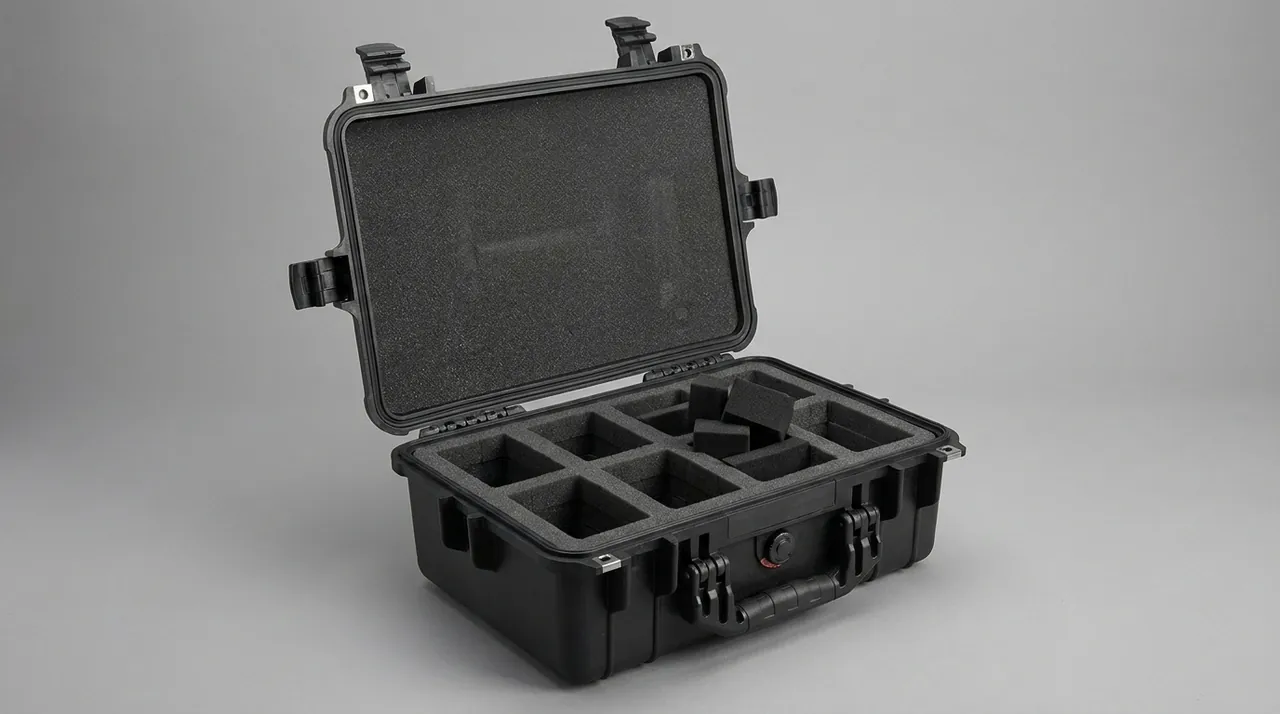
Shell material sets the baseline. Injection-moulded copolymer polypropylene gives high stiffness, surface hardness and dimensional stability, which suits volume production and cases that must hold cavity tolerance. Rotomoulded LLDPE offers thick walls with excellent impact and low-temperature performance for extreme environments and heavy equipment. Blow moulding sits between them on cost and weight. Archery cases usually choose a medium-size injection-moulded shell with reinforcing ribs to raise bending stiffness; long-case bending is the most common failure mode, and transverse ribs can cut deflection by an order of magnitude, as explained in Case Reinforcement Ribs.
On sealing class, indoor ranges and daily commuting are served by IP54 to IP55. Rainy training, sea freight and humid warehousing call for at least IP65. Where brief immersion or heavy spray is possible, for example training near water or long open-bed transport, specify IP67. A case carrying an optical scope is protecting a precision instrument, so the sealing requirement should not fall below IP65 with desiccant management. The life-limiting part of a sealing system is usually the gasket rather than the shell; rubber hardens and takes a compression set over time, so inspection and replacement must be scheduled. See Case Seal Aging.
Latches and hinges concentrate the load. A long case should use draw latches with pre-tension travel and a clear over-centre feel at closing. Hinges should run the full lid length or at least use three or more hinge points so the lid cannot warp along the long edge. Both should be assessed by fatigue life rather than static strength alone; the criteria are set out in Case Latch Selection.
Acceptance Criteria and Routine Maintenance
Incoming acceptance should leave a traceable record. Run the checks in this order. First, inspect the shell visually for cracks, stress whitening and transit scuffs. Second, close the empty case and confirm that latch pre-tension is consistent and the gasket is continuous with no gaps. Third, verify dimensions with a tape, checking key cavity sizes and pocket positions, normally within plus or minus 1 mm and within plus or minus 0.5 mm for die-cut pockets. Fourth, fit the actual equipment and check for movement, hard contact and whether it can be removed and replaced with one hand.
Routine maintenance focuses on seals, hardware and moisture. Inspect the gasket every three to six months and apply a thin film of silicone grease to slow hardening. Check fastener torque on latches and hinges every six months and deal with any loose rivet or screw immediately before damage spreads. Replace desiccant on the indicator card reading, typically quarterly. Clean the shell with mild detergent and a soft cloth only; never wipe polypropylene with petrol or alcohol, and avoid prolonged direct sun.
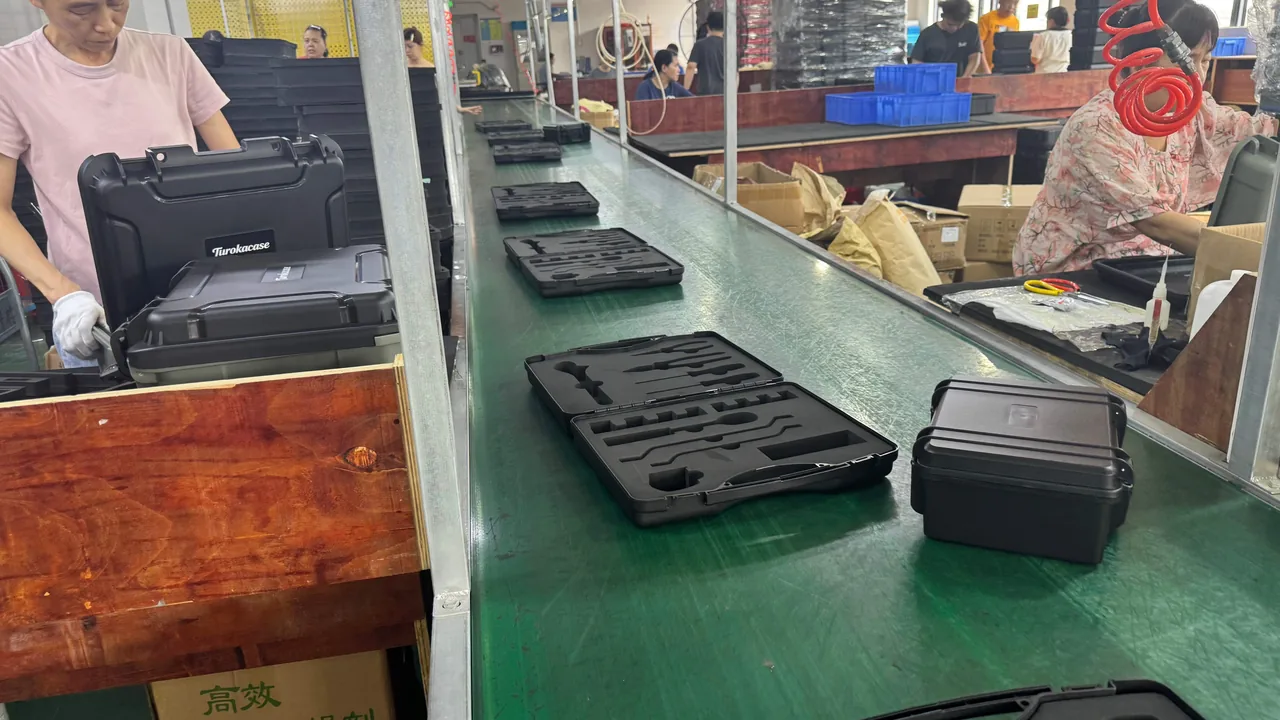
Manufacturing control matters just as much. Wall thickness uniformity, rib root thickness and cavity edge radii all drive service life. The shells, liners and hardware of the JUNZHIJIA archery case range are produced and integrated by Kexin New Materials (Guangdong) Co., Ltd., which also provides liner tooling, pilot runs and OEM/ODM delivery against specified equipment models.
Frequently Asked Questions FAQ
Q: Can a recurve and a compound bow share one protective case?
A: Yes, provided the liner uses replaceable modules rather than a single permanent die-cut. The controlling envelope for a recurve is limb length and riser width, which usually calls for a channel around 1000 to 1300 mm long. A compound bow is shorter overall, but because the cams are not centred and the strung bow is thicker across the brace height direction, it needs a different cavity. The engineering answer is to size the internal cavity for the largest envelope of the two, then build one die-cut EVA module per bow type and fix each module to the wall with hook-and-loop pads or locating pins so it lifts out whole. Both modules must keep cams and sights out of the load path, and module thickness should match internal clear height so closing compresses the foam by 3 to 5 mm. A single shared die-cut usually sacrifices cam protection on the compound, and brace height drift becomes measurably more likely over time.
Q: Is it better to transport a bow fully assembled or broken down?
A: On pure load on limbs and cams, breaking the bow down is better; on holding the tune, transporting it assembled is better, so this is a trade-off. Taking limbs off the riser removes the assembly preload, lets cams sit in individual guards and minimises deformation risk, at the cost of reassembly and re-tuning at every destination, roughly 20 to 40 minutes for a club archer and a full brace height and wall verification for a competitor. Assembled transport avoids repeated assembly but demands a cavity with at least two supports that turns a long cantilever into a stable supported structure. The practical compromise is assembled transport for short trips and self-drive journeys, and a semi-stripped arrangement for air and long-haul travel, with riser and sight in the main case and limbs and stabilisers in their own channels, which cuts the loads while keeping re-tuning work bounded. If the bow must stay assembled for a match, fit a travel brace or limb-saver block and re-check brace height before the first end, because a long journey is exactly when a small shift becomes visible on the target.
Q: Why do sights fail in transit more often than limbs?
A: The dominant reason is lever arm. A sight projects 100 to 300 mm from the side of the riser and carries a frame or scope at the tip, so it behaves as a cantilever. The root bending moment scales with the overhang. In a single 15 cm drop, a limb sees a distributed load while the sight root may see several times the local bending moment. A carbon extension bar that delaminates or cracks at the root often looks intact, yet the repeatability of the aim point has already changed. A second reason is stiffness mismatch: sights are built light and thin for weight saving, so their natural frequency is low and they resonate with vehicle vibration, which loosens threaded joints over hours of travel. Protection therefore adds a resilient saddle at mid-span to convert single-point support into two-point support, and uses medium-strength thread locker on every threaded interface. Removing the sight and stowing it separately is the more conservative choice.
Q: Does the case really need IP67, or is that overkill for commuting?
A: Whether a rating is overkill depends on equipment value and exposure, not on trip length. A case that only travels between an indoor range and a car is served by IP54, because the risk is dust and light splash rather than immersion. Move to IP65 or better as soon as any of these appear: a damp bow going straight into the case after rain, transport in a pickup bed or a motorcycle top box, sea freight or long humid storage, or an optical scope or electronic timer inside. IP67 means brief immersion or heavy spray does not let water in. Archers rarely drop a case in water, but the equipment is expensive and water damages both string material and metal fittings, so for competition-grade gear IP67 is reasonable redundancy rather than waste. Remember that sealing class is a system property: an aged gasket, an under-tensioned latch or a blocked equalisation valve defeats a high rating. A practical middle path is a case rated IP67 with a pressure equalisation valve and a replaceable gasket, so the rating is maintained in service rather than merely declared at purchase.
Q: Does moisture in string material really change shooting performance?
A: Yes, and the effect is measurable. High-modulus polyethylene absorbs very little water, but in prolonged humid conditions it still takes on moisture. The added mass raises the effective string mass, which reduces arrow speed, and water changes friction between fibres so the string's recovery during release shifts slightly, showing up as a small drop in impact point or wider dispersion. The more practical risk is cold humid weather, where a moist string frosts more readily, changing its diameter and the clearance to the serving. Control works at two levels. Inside the case, maintain a dry environment with replaceable desiccant and a humidity indicator card, targeting relative humidity below 50 percent. In handling, let gear acclimatise for two to four hours after moving from a cold to a warm space before shooting. Spare strings should be sealed separately rather than stored long term beside metal hardware. As a rule, record the string mass and brace height before a long trip and compare them again after acclimatisation, which turns a vague worry into a measurable check.
Q: Which liner is better, EVA or EPE?
A: They are not substitutes but complementary, and the best answer usually uses both in one case. EVA is dense, rebounds slowly and resists compression set, which suits anything that must hold cavity precision for years, such as a riser cradle, a sight tray or a cam groove. EVA is also harder, however, so it absorbs impact partly by transmitting it, and used alone it can pass energy into the equipment during a heavy hit. EPE is lighter, rebounds quickly and absorbs energy efficiently, making it ideal for base pads, interlayer pads and secondary cushioning, but it creeps under sustained load and thins, which degrades pocket accuracy. The standard combination is a structural layer in EVA and cushion layers in EPE: a cavity body in EVA at 60 to 80 kg per cubic metre with an 8 to 12 mm EPE pad under the cavity and inside the lid as the energy-absorbing layers. Validate the final stack against equipment mass and expected drop height.
Q: How should a long bow case be secured inside a vehicle?
A: The safety standard is that the case moves very little under emergency braking and road bumps and never touches a hard body point. Start by placing it in a constrained location, such as between the wheel arches of a boot or behind the rear seats, and avoid the outermost position near the tailgate, where a rear impact causes the most deformation. Then limit the degrees of freedom with a cargo net or strap applying a downward or forward constraint; 50 to 100 N of pre-tension is usually enough to stop bouncing, while over-tightening loads the case in bending. Next, isolate hard points with a 5 to 10 mm rubber mat under the case, which cushions and prevents sliding. Finally, do not stack weight on top. The middle of a long case has the least bending resistance, and top loading bows the lid and compresses the gasket. In a pickup bed, add water protection and check the tie-down anchors. Never rely on the lid latch alone to hold a long case in place, and never leave the case loose on a rear parcel shelf, where braking turns it into a projectile.
Q: What customisation options exist, and how should tooling cost be judged?
A: Archery case customisation usually comes in three tiers with rising cost and lead time. The lowest tier is appearance: colour, silk-screen or laser branding, nameplates and serial numbers, generally without tooling and with the shortest lead time. The middle tier is liner customisation, milling die-cut EVA pockets from the physical equipment or a 3D data set, which needs sampling and a trial fit and costs mainly in programming, material and labour; it suits teams or dealers with a stable equipment fleet. The top tier is shell structure customisation, covering cavity size, rib layout, latch and hinge style and valve position, which needs a mould and a much larger investment, appropriate when the buyer has a credible volume forecast. A simple test is to divide tooling cost by expected three-year sales; if the per-unit amortisation is below the price gap to a generic case, tooling is justified.
Conclusion and Related Reading
Geometry is the whole job. JUNZHIJIA delivers archery case customisation from liner die-cutting and shell tooling to pilot runs, with OEM/ODM and documentation support.
Related Reading