

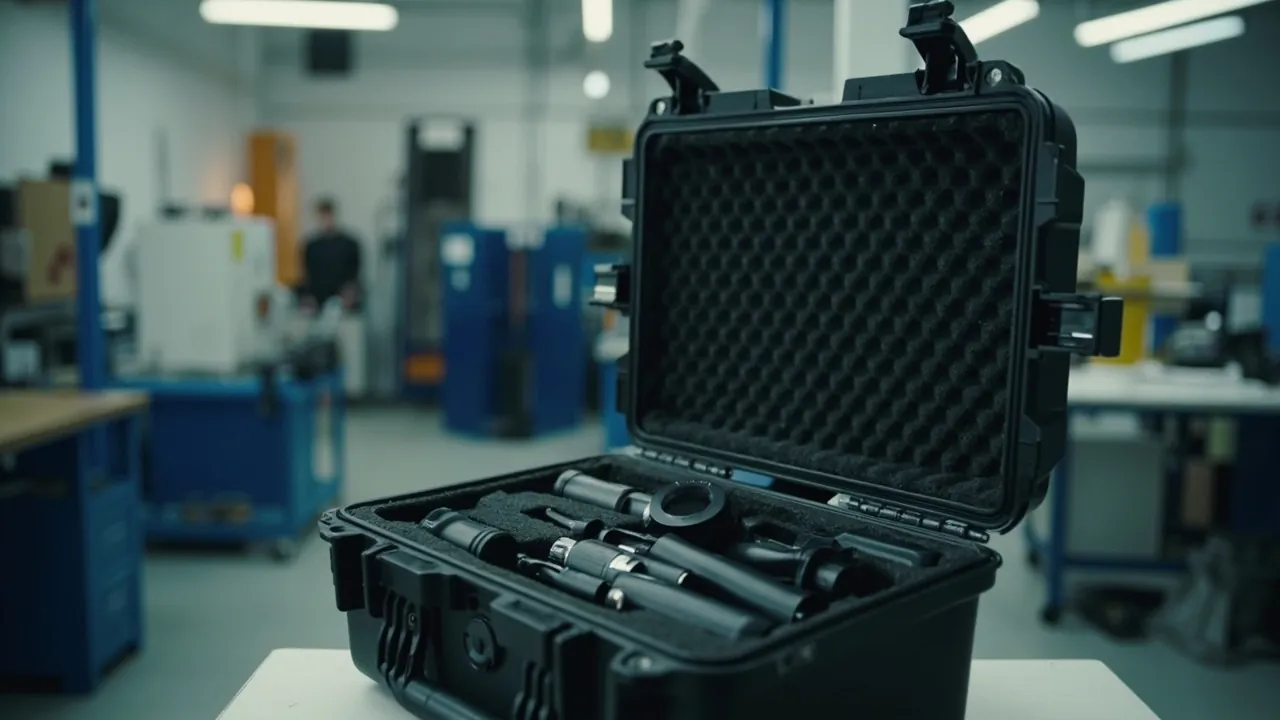
The job of a fastener manufacturing parts case is to keep cold-forming dies, punches, thread-rolling plates, heat-treat baskets and fixtures dimensionally accurate, edge-intact and free of corrosion through every step of in-plant handling, inter-plant machine changeover and export shipment. Cold-forming die faces are commonly finished below Ra 0.2, and punch-to-die clearances are measured in microns. A single 30 cm free fall can generate enough peak acceleration to chip a working edge or cause micro-fretting between a die insert and its holder. The right question is therefore not "does it fit" but "will the tooling still run after it has been dropped."
What makes this genuinely difficult is that the handling chain in a fastener plant is fragmented. A die set travels from the tool crib to the machine, back to the crib for regrinding, from one plant to a sister plant, and then to a customer in Southeast Asia or Europe. Five to eight manual transfers per trip is normal. Every open-and-close cycle is another chance to strike an edge. This article breaks the protection logic down by component type and gives workable answers on case material, ingress protection (IP65/IP67 under IEC 60529 and GB/T 4208), cushioning inserts, transport validation (ISTA, GB/T 4857, ASTM D4169, MIL-STD-810H test methods) and rust prevention, plus a selection table you can send straight to a quotation request.
Table of Contents
- 1. Protection tiers for fastener plant equipment and wear parts
- 2. Heavy-duty impact protection for cold-forming dies and punches
- 3. Heat-treat components: baskets, fixtures and furnace hardware
- 4. Edge protection for thread-rolling plates, taps and cutting tools
- 5. Feeding systems, vibratory bowls and drivetrain parts
- 6. Case material and structure: copolymer PP, UL94 and IK impact
- 7. Sealing and ingress protection: IP65/IP67 under IEC 60529 and GB/T 4208
- 8. Custom inserts: EVA and cross-linked PE foam, and pocket tolerance
- 9. Transport validation: ISTA, GB/T 4857, ASTM D4169 and MIL-STD-810H
- 10. Rust prevention: VCI vapor phase, desiccants and humidity indicators
- 11. Sizing and load calculation
- 12. Procurement and acceptance: OEM/ODM flow and AQL sampling
- Frequently Asked Questions
- Conclusion & Related Reading
1. Protection tiers for fastener plant equipment and wear parts
The asset base of a fastener plant falls into three groups: main machines (cold headers, thread rollers, tapping machines, heat-treat furnaces), process tooling (dies, punches, thread-rolling plates, trimming dies, feed rolls) and inspection equipment (thread ring gauges, plug gauges, hardness testers, optical sorting lenses). These three groups have very different transport sensitivities. Packing all of them in the same box either wastes money on over-packaging or under-protects the parts that matter.
A practical four-tier model for a fastener plant looks like this:
| Tier | Typical components | Dominant failure mode | Key protection measure |
|---|---|---|---|
| --- | --- | --- | --- |
| A (highest) | Cold-heading punches, die inserts, trimming edges, thread ring gauges | Edge chipping, micron-level dimensional drift, mirror-surface scratching | Individual pockets, soft contact layer, full restraint, dry rust protection |
| B | Thread-rolling plates, thread plates, taps, rolling dies | Tooth-face crushing, pitch deformation, crest collapse | Teeth facing up and isolated, matched pairs kept together, rust-inhibiting wrap |
| C | Heat-treat baskets, fixtures, lifting gear, guide plates | Distortion, scale shedding and contamination, corrosion | Rigid support, moisture control, separation to prevent mutual impact |
| D | Vibratory bowls, feed tracks, drive shafts, couplings | Thin-wall distortion, coaxiality loss, bearing contamination | Axial support, dust sealing, anti-vibration padding |
What Tier A parts share is that precision is the value. A multi-station cold-heading die set can cost more than a month of depreciation on an auxiliary machine, and when it fails it usually does not break, it drifts two to five microns. That drift shows up downstream as a thread gauge that will not pass or as scatter in the torque coefficient, and it is expensive to trace. Tier A parts therefore have to be designed as individually located items that never touch each other.
Tier C and Tier D parts, by contrast, are threatened by accumulated vibration and moisture rather than a single impact. A heat-treat basket that runs at 850 to 950 C develops a loose oxide layer, and when that scale falls off in transit it contaminates mirror-finish dies sharing the same box. Many plants have learned this the hard way. Separating baskets and dies into different cases, or at least isolating them on separate internal levels, is the cheapest fix available.
JUNZHJIA's standard approach in the fastener sector is a tiered, split-case layout driven by the customer's component list and precision classes: Tier A parts get individual cases or individual pockets, Tier B and C parts travel in general-purpose stackable cases, and Tier D long parts travel in long-item cases. That keeps total packaging cost under control while putting the highest-value tooling on the most controlled path.
2. Heavy-duty impact protection for cold-forming dies and punches
Cold forming applies high pressure to wire at room temperature and produces a bolt head, a nut blank or a special part in a single pass through multi-station tooling. The tooling set typically includes a shear knife, a first punch, a forming punch, a finishing punch, a reducing die and a trimming die, and every punch-and-die pair is a precision fit. The impact face of the punch and the bore of the die are the two surfaces that must not be damaged.
Heavy-duty protection solves three problems: impact energy absorption, relative displacement control, and contact-surface material matching.
First, energy absorption. Cold-heading punches are usually high-speed steel or powder-metallurgy high-speed steel at HRC 60 and above, which makes them hard but brittle. They handle the compressive stress of forming but not the concentrated point load of a drop. The practical approach is a two-stage cushioning system: the insert foam absorbs small energy events over 5 to 15 mm of deflection, while case ribs and a reinforced base provide rigid support for large energy events so the foam never bottoms out into a hard-on-hard contact. For punches under 20 kg, leave roughly 10 to 15 percent of insert thickness as compression reserve. For single items above 30 kg, add a high-density PE backing plate.
Second, relative displacement. Multi-station dies travel in groups of five to eight. If they are allowed to lie loose on the same layer, transport vibration makes them rub and strike each other. Each item needs its own machined pocket, with a single-side clearance of 0.3 to 0.5 mm and a pocket depth of 60 to 80 percent of the part thickness so the part nests into the foam rather than sitting on top of it.
Third, contact-surface matching. Mirror-finish dies must never rub directly against firm foam; add a non-woven or EPE transition layer. The lower the surface roughness, the softer the transition must be. For sleeve-type mating parts such as a die insert and its holder, separate packaging is better, since it eliminates a chance for misalignment before assembly.
One point deserves emphasis: die failures are frequently amplified at the regrinding step. A die removed from the machine carries cold-forming oil and metal fines. If it goes straight into the case, the oil glues those fines to the working edge, and in transit they act as lapping compound. The disciplined sequence is demagnetize and blow clean, apply a very thin film of rust-preventive oil, wrap in rust-inhibiting paper, then pack. Whether this step happens decides whether a die set survives three regrinds or eight.
3. Heat-treat components: baskets, fixtures and furnace hardware
Fastener mechanical properties are tightly coupled to heat treatment. Under ISO 898-1 and its Chinese counterpart GB/T 3098.1, the common property classes 8.8, 10.9 and 12.9 each map to specific material and heat-treat combinations, and any deviation in tempering temperature shows up in hardness and tensile strength. The baskets, fixtures, lifting gear, mesh belts and guide rails that serve the furnace are not fasteners themselves, but they determine the consistency of what comes out of the furnace.
These components have three transport characteristics:
- Heavy. A single basket is commonly 25 to 60 kg, and stacked transport puts substantial load on the case base.
- Thermal history. After prolonged high-temperature service, the surface carries a porous oxide layer that accelerates corrosion once moisture is present, and the scale sheds.
- Irregular geometry. Baskets are welded frames and grid structures with many sharp corners that can gouge whatever sits beside them.
For load, the case base needs reinforcing ribs or a full tray-style bottom, and the stacking strength should be designed at roughly 1.5 times the total case weight as a safety factor. Following the logic of the GB/T 4857 series, a stacking test should replicate the actual number of stored layers and the dwell period rather than applying a single short load.
For scale contamination, the most effective measure is to shot-blast or pickle-and-passivate the part before dispatch and then moisture-pack it immediately. Inside the case, use reusable desiccant packs with a two-stage humidity indicator card, typically set at 40 percent RH and 60 percent RH, so a warehouse walk-through can tell at a glance whether the desiccant needs replacing.
For geometry, baskets must be separated from each other with corrugated board, EPE sheets or wooden battens; metal-on-metal stacking should be prohibited outright. If the customer lifts baskets by overhead crane and lowers them directly into the case, provide lifting lugs or clearance for the sling so the strap does not crush the lid.

There is one detail that is easy to overlook: heat-treated parts must cool to near ambient temperature before packing. Sealing a warm part into a case heats the internal air, which then contracts as it cools and creates a negative pressure that fatigues the gasket over time. If the process genuinely requires warm packing, choose a case with a pressure equalization valve.
4. Edge protection for thread-rolling plates, taps and cutting tools
Threads are produced either by rolling or by cutting, and the corresponding tooling is thread-rolling plates, rolling dies, taps and dies. The value of these tools lies not in material cost but in thread-form accuracy and heat-treatment quality.
The failure mode for thread-rolling plates in transit is distinctive: crest collapse and localized pitch deformation. Plates are normally used in matched pairs, and if the tooth faces of two plates touch each other or a hard object, a single impact can leave a dent on the crest that later shows up as a localized pitch-diameter deviation in the rolled thread. Protection rests on three measures:
- Isolate the tooth faces. Place plates tooth face to tooth face with a soft separator between them, or orient all plates tooth face up with a divider between layers. Never let a tooth face rest directly on the case floor or against another plate's teeth.
- Keep matched pairs together. Plates must be packed, shipped and issued as pairs, with the pair number marked on the case, to prevent mismatched pairs on the shop floor.
- Wrap for rust prevention. Plates are typically made from Cr12MoV or SKD11-type cold-work die steel, whose corrosion resistance is limited when chromium content is modest; pitting can appear within two to three weeks in a humid sea freight environment. Rust-inhibiting paper plus VCI film is the most cost-effective combination.
Taps and cutting tools present a different problem at the cutting edge and the shank. A slender tap, say below M3, will bend or snap in transit if it is unsupported at both ends. The correct arrangement is a foam strip with longitudinal channels so the tap nests along its full length with roughly 5 mm of support at each end.
| Tool type | Typical material | Dominant failure mode | Recommended packing |
|---|---|---|---|
| --- | --- | --- | --- |
| Thread-rolling plate | Cr12MoV, SKD11 | Crest collapse, pitch deformation | Teeth up, layer dividers, rust-inhibiting paper |
| Rolling die | High-speed steel, powder metallurgy | Tooth-face scratching, bore fit damage | Bore locating arbor, compartmentalized tray |
| Tap (below M3) | HSS, cobalt HSS | Bending, edge chipping | Longitudinal channel foam, both ends supported |
| Round die | High-speed steel | Edge chipping, outside diameter damage | One part per pocket, soft end pads |
| Trimming die edge | Cold-work die steel | Edge chipping, flatness deviation | Edge up, high-density locating block |
Good tool management also means running the case as a ledger unit: one case maps to one tool list and one location drawing, and both issue and return are reconciled by count. That protects the tooling and also builds the tool-life data an operation needs. For thread tooling held to ISO 4759 tolerances, this discipline is part of the quality system rather than an administrative extra.
5. Feeding systems, vibratory bowls and drivetrain parts
The feeding system on a cold header includes straightening rolls, feed rolls, grippers, the shear knife holder and drive linkages, while vibratory bowls and linear feed tracks serve small parts and sorting stations. What these components share is thin walls, long spans and low resistance to distortion.
Feed rolls and straightening rolls usually fail through marks on the outside diameter. The outside diameter contacts the wire directly, so once it carries a dent the wire feed develops a periodic length fluctuation that shows up as length scatter in the finished part. These rolls should be located on their bore with the outside diameter suspended; the outside diameter should never be used as a support surface.
Drive linkages, camshafts and slides are rigid but long. The transport risk is bending and loss of coaxiality. Three-point support is the practical answer, with supports placed at roughly one-fifth and four-fifths of the shaft length and a soft support in the middle, so the middle does not sag the way it would with end support only.
Vibratory bowls are a special case. They are thin-wall bowls with spiral tracks, and a single crushed point degrades the sorting behavior of the whole bowl in a way that is nearly impossible to repair on site. A bowl should travel rim down, bearing on its base, restrained on all four sides, ideally in a dedicated wooden frame or PP hollow-board crate. If the customer needs to move whole bowls around the plant, add casters and forklift pockets.
On vibration isolation, many buyers focus on foam thickness and ignore the load-to-frequency relationship. Stated simply: foam that is too soft lets a heavy part punch through, and foam that is too hard behaves like no cushion at all. A workable rule is to choose a density band by part weight: 30 to 38 kg/m3 below 5 kg, 38 to 50 kg/m3 from 5 to 20 kg, and 50 to 70 kg/m3 or an EVA plus PE composite above 20 kg. In custom insert projects JUNZHJIA normally asks for a parts weight table and center-of-gravity positions before recommending density and structure, which is considerably more reliable than cutting pockets from an outline drawing alone.
6. Case material and structure: copolymer PP, UL94 and IK impact
Fastener plant parts cases are typically made from copolymer polypropylene, high-density polyethylene, ABS or engineering plastic composites. The trade-offs are as follows:
- Copolymer PP. Balanced impact and chemical resistance at moderate cost, the mainstream choice for industrial tool cases. Low-temperature toughness is better than homopolymer PP, which suits northern winters and cold storage.
- HDPE. The best toughness and low-temperature performance and resistance to most acids and alkalis, but lower stiffness and surface hardness, so it creeps under long-term stacking.
- ABS. Good surface quality and dimensional stability, but mediocre weatherability and oil resistance, more suited to instrument housings than heavy-duty cases.
For cases exported to the EU or North America, material flammability is often specified. UL94 is the common basis for evaluating the flammability of plastic materials, with HB for horizontal burning and V-0, V-1 and V-2 for vertical burning, lower numbers being more demanding. Note that UL94 rates the material, not the finished case; a flammability claim about a finished case requires evaluation of the finished structure. In a metalworking environment like a fastener plant, mechanical strength normally takes priority over flame rating unless the customer's site specifically requires otherwise.
For impact, the IK rating system defined in IEC 62262 (IK00 to IK10) characterizes an enclosure's resistance to mechanical impact in terms of energy. Cases for warehouse tooling circulation are commonly designed around the IK08 (5 J) level, and heavy export items may call for IK10 (20 J). IK performance depends strongly on wall thickness, rib layout and corner radius, and simply adding thickness is not the most economical route; well-placed ribs and generous internal radii often achieve more than an extra millimeter of wall.
Hardware matters just as much. The lid-to-body connection, latch clamping force and hinge stop angle determine whether the case still seals after hundreds of open-and-close cycles. For a closer look at that part of the design, see our write-up on matching case hinges, latches and seals, which includes empirical service-life figures for hardware at different open-and-close frequencies.
7. Sealing and ingress protection: IP65/IP67 under IEC 60529 and GB/T 4208
IP codes are the most basic and also the most misread specification on a protective case. IEC 60529, and GB/T 4208 which China adopted equivalently, define the first characteristic digit as protection against solid foreign objects and dust, and the second as protection against water.
| IP code | Dust meaning | Water meaning | Typical fastener industry scenario |
|---|---|---|---|
| --- | --- | --- | --- |
| IP54 | Dust protected (limited ingress) | Splash resistant | Short in-plant circulation |
| IP65 | Dust tight | Jet water resistant | Brief outdoor transfer, washdown areas |
| IP66 | Dust tight | Powerful jet resistant | Loading in rain, short port drayage |
| IP67 | Dust tight | Temporary immersion (order of 1 m / 30 min) | Sea freight, container condensation, barge transport |
| IP68 | Dust tight | Continuous immersion (conditions agreed with manufacturer) | Specialized water transport, in-water work |
For fastener parts cases, IP67 is the usual threshold for export sea freight and high-humidity warehousing in southern China. The reason is that day-night temperature swings inside a container cause condensation to deposit as liquid water on the case surface, and only a seal rated for temporary immersion reliably keeps that water out. IP65 suits in-plant and short-distance use; IP66 suits outdoor loading and short port drayage.
For the sealing details, including dual-lip gaskets, foamed silicone, seal groove cross-sections and the compression window, see the sealing structure of IP67 protective cases. The conclusion here is short: gasket compression should be held between 25 and 35 percent. Below 20 percent leaks are likely, and above 40 percent the gasket takes a permanent set and the case becomes hard to close. On die cases opened many times per shift, this matters a great deal.
The better the seal, the more pronounced the pressure problem becomes. During air freight or thermal cycling, the pressure difference can make a lid very hard to open or locally suck the gasket out of shape. Heavy-duty die cases that will ever travel by air or over high-altitude roads should be specified with a pressure equalization valve.
8. Custom inserts: EVA and cross-linked PE foam, and pocket tolerance
The insert is the real protective gear of a parts case. The main options are EVA, cross-linked PE foam, PU foam, EPE and XPE, and their properties differ substantially:
| Material | Density range (kg/m3) | Resilience | Abrasion resistance | Best suited to |
|---|---|---|---|---|
| --- | --- | --- | --- | --- |
| EVA | 60 to 120 | Good | Good | Precision die compartments, frequent access |
| Cross-linked PE foam | 25 to 60 | Fair | Fair | General cushioning, large-area support |
| PU foam | 20 to 45 | Good | Moderate | Instruments, sensitive electronics |
| EPE | 18 to 30 | Fair | Poor | Low-cost void fill, transition layer |
| XPE | 30 to 60 | Fair | Good | Water barrier layers, roof lining |
Fastener die cases most often use a combination: EVA for the inner compartment and location layer, cross-linked PE foam for the outer energy absorption layer. In heavy-duty service this combination is clearly better value than PU alone.
Pocket tolerance is the dividing line between an insert that truly protects and one that merely holds. The process determines the tolerance: hot-knife cutting lands around plus or minus 0.5 mm, CNC routing reaches plus or minus 0.2 mm, and die cutting suits high-volume thin sheets. For Tier A die parts, specify CNC routing with 0.3 to 0.5 mm single-side clearance. Too much clearance lets the part migrate in the case; too little makes it hard to remove and risks scratching. For a fuller comparison of materials and processes, see foam material comparison and the EVA insert customization process.
Two insert details belong on the drawing. First, finger access: pockets deeper than 40 mm need a finger relief or a nylon pull tab, otherwise the shop floor will pry parts out or tip the case over. Second, layer identification: each layer should carry a location drawing and part numbers to reduce mismatch during loading. For grouped tooling such as a multi-station cold-heading die set, a layered location drawing drives the mismatch rate down substantially.

9. Transport validation: ISTA, GB/T 4857, ASTM D4169 and MIL-STD-810H
A case's protective capability has to be verifiable, otherwise it is just marketing language. Three test frameworks are commonly used:
- ISTA. The International Safe Transit Association series, where ISTA 3A covers parcel delivery for single packages up to 70 kg, ISTA 3E covers unitized loads of identical packages, and ISTA 2A suits basic single-case performance verification. For die cases going out by express or less-than-truckload, ISTA 3A maps most closely to the real logistics chain.
- GB/T 4857 series. China's basic test methods for transport packages, covering vibration, impact, stacking, drop and compression. Domestic customers more often cite this series in acceptance.
- ASTM D4169. Organizes test intensity around distribution cycles, with 18 standard cycles to choose from, well suited to North American customers and complex logistics chains.
In addition, methods 514 (vibration) and 516 (shock) of MIL-STD-810H are frequently cited by customers as the methodological basis for environmental testing. This must be stated plainly: citing MIL-STD-810H means only that its test methods are used. It does not mean the product holds any military certification or qualification. In an industrial context such as fasteners, what customers actually care about is surviving vibration and drop, and adopting those test methods is sufficient without any qualification claim.
| Framework | Primary scope | Common sub-tests | Suggested use |
|---|---|---|---|
| --- | --- | --- | --- |
| ISTA 3A | Parcel and LTL single package | Drop, random vibration, concentrated impact | Export express, single-case dispatch |
| ISTA 3E | Unitized load | Compression, vibration, inclined impact | Pallet dispatch, third-party warehousing |
| GB/T 4857 | Domestic transport packaging | Vibration, stacking, drop, compression | Domestic customer acceptance |
| ASTM D4169 | Distribution cycle | Sequences assembled per DC | North America, complex logistics chains |
For program selection and test sequencing, see our breakdowns of ISTA transport testing procedures and GB/T 4857 transport packaging tests. The practical advice is this: copy your actual logistics chain into the test conditions rather than copying a good-looking report. Draw the node map from dispatch to machine installation, mark the maximum drop height, longest vibration duration and highest stack count, and only then choose the program. That is when the validation means something.
10. Rust prevention: VCI vapor phase, desiccants and humidity indicators
Corrosion of a metal part requires three conditions at once: a metal surface, water, and oxygen with an electrolyte. A protective case can control the water. By sealing and dehumidifying, it holds internal relative humidity below the critical value for corrosion, commonly taken as about 60 percent RH for carbon steel.
A three-layer system is well established for fastener die transport:
- Contact layer. Rust-inhibiting paper or film wrapped directly around the die. VCI-bearing paper sublimates vapor-phase corrosion inhibitor inside the enclosed space, where it adsorbs onto the metal surface as a molecular film.
- Barrier layer. A VCI film or aluminum-plastic laminate envelope reduces the water vapor transmission rate.
- Moisture absorption layer. Desiccant in the case, whether silica gel, montmorillonite or a calcium chloride base, together with a humidity indicator card.
An important caution: VCI is not a substitute for process rust-preventive oil, because the mechanisms differ. VCI depends on an enclosed environment with reasonably stable temperature. If a case is opened frequently or left open, the inhibitor concentration cannot be maintained and performance drops off noticeably. For high-frequency tool cases, a thin oil film plus rust-inhibiting paper is the better fit; for long-term storage and sea freight, a VCI envelope plus desiccant is the better economics.
Desiccant quantity should not be guessed. A workable estimate starts from the free internal volume in liters, then corrects for transit duration and target humidity. A common rule of thumb is 200 to 500 g of high-efficiency desiccant per 100 L of free space, taking the upper end for long sea voyages. Pair this with periodic humidity indicator checks so the need for re-packing can be judged without opening the case.
There is also a common mistake worth naming: handling a die's working surface with bare hands. Sweat is a strong electrolyte and can start a corrosion pit within hours. The correct practice is powder-free nitrile gloves, with a wipe of anhydrous ethanol or a dedicated cleaner and a blow-dry before packing.
11. Sizing and load calculation
The most common sizing error is choosing a case from the largest component's footprint, which produces an oversized case, excessive fill and unstable stacking. The right order is to calculate load and stacking first, then fix the external size and structure, and finally lay out the insert compartments.
For load, the following engineering estimates are useful, though they are estimates and not test results:
- Total case weight W = sum of component net weights + insert weight + case self weight
- Required stacking strength F = W x number of stacked layers x safety factor (1.5 to 2.0 recommended)
- For unitized pallet dispatch, verify pallet load separately following the stacking test logic of GB/T 4857
Three sizing rules apply:
- Internal clear size = largest component envelope + insert wall (15 to 25 mm per side) + finger-access allowance.
- External size should align with standard pallet modules, such as a clean subdivision of 1200 x 1000 mm or 1200 x 800 mm, to raise load efficiency and reduce transit damage.
- Keep total case weight in the 25 to 35 kg band where possible. Above 40 kg, add casters, a telescopic handle or forklift pockets. Above 60 kg, design as a palletized unit from the start.
Customers who change over machines across plants also need to think about returning empty cases. A nestable design can cut return volume by 40 to 60 percent, and in a multi-plant, multi-shift operation that saving usually exceeds the price difference on the cases.
12. Procurement and acceptance: OEM/ODM flow and AQL sampling
Case procurement has shifted from buying stock items to buying engineered solutions. A complete custom flow usually runs: requirement clarification (component list, weights, precision class, logistics chain), structural concept and insert drawings, prototype, pilot run, validation (drop, vibration, stacking, sealing), volume production, and outgoing inspection.
For acceptance, sampling is better than either 100 percent inspection or no inspection. The counting-sampling logic of GB/T 2828.1 provides a workable scheme: set a tighter AQL for critical characteristics such as sealing, hardware function and insert pocket location, and a looser AQL for non-critical ones such as color variation and printing. We cover the details in custom case acceptance AQL sampling.
On delivery capability, JUNZHJIA is manufactured by Kexin New Materials (Guangdong) Co., Ltd. and serves wholesale, distribution, OEM/ODM and global supply. We build foam inserts and compartment layouts to a customer's die list, match seals and hardware to the case platform, and can provide material and test documentation for a customer's quality department to file. For fastener customers we generally recommend starting with one work station's die set as a prototype, running it through the real logistics chain once, and only then committing to a volume program, which is considerably safer than a single large order.
When comparing quotes, put total lifecycle cost into the decision. A case that is 30 percent cheaper but distorts and leaks within two years usually costs far more in die repair and corrosion rework than the price difference. For service-life expectations, see our data on protective case service life.
Frequently Asked Questions
Q: How should I choose a transport case for cold-forming dies, punches and inserts, and what is the single most important specification?
A: The most important factor is not the case's IP rating but the locating accuracy and inter-part isolation of the insert. Cold-heading punches and inserts fail mainly through edge chipping and micron-level dimensional drift, and the root cause is almost always relative movement and mutual impact in transit, not water ingress. Choose in this order. First, grade parts by precision into A, B and C tiers; Tier A requires individual machined pockets with 0.3 to 0.5 mm single-side clearance and pocket depth at 60 to 80 percent of part thickness. Second, choose cushioning: heavy parts do best with an EVA inner layer plus cross-linked PE outer layer. Third, and only third, consider the case's IP rating, where IP67 under IEC 60529 and GB/T 4208 suits export sea freight and IP65 is enough for in-plant circulation. If heat-treat baskets with loose scale share the case, isolate them on a separate level. Suppliers should be given a component list, individual weights and center-of-gravity positions so pockets and densities are calculated rather than cut to an outline.
Q: Why do heat-treated components need moisture-proof packaging, and do parts without visible scale still corrode?
A: Yes, and the risk is no lower than for parts carrying scale. Heat-treat baskets, fixtures, lifting gear and mesh belts operate at 850 to 950 C for long periods, which produces a porous oxide layer on the surface. That layer accelerates corrosion of the substrate once moisture is present, and it also sheds and contaminates mirror-finish dies sharing the same case, a lesson many fastener plants have learned the hard way. Even new parts without obvious scale may be in an activated surface state after high temperature and less corrosion resistant than in their original condition. The workable sequence is to cool fully to near ambient temperature after the furnace, shot-blast or pickle and passivate, then pack moisture-proof immediately. Fit the case with reusable desiccant and a two-stage humidity indicator card, typically 40 percent RH and 60 percent RH, so warehouse checks need no unsealing. Note as well that packing a warm part creates negative pressure as the air cools, which fatigues the gasket over time; if the process truly requires warm packing, specify a case with a pressure equalization valve.
Q: In a fastener plant, how do I actually decide between IP65 and IP67 cases?
A: Decide from the harshest link in the logistics chain, not from the shop floor environment. IP65 means dust tight plus protection against water jets, which covers in-plant circulation, brief outdoor transfer and washdown areas, and it is entirely sufficient for day-to-day internal movement in a fastener plant. IP67 means dust tight plus protection against temporary immersion, in the order of one meter for 30 minutes, and its real value is handling container condensation. Day-night temperature swings inside a sea freight container deposit water vapor as liquid on the case surface, and only a temporary-immersion-rated seal blocks it. The decision rule is therefore simple: will the case go to sea, or into a high-humidity warehouse during the rainy season? If yes, specify IP67; if no, IP65 is more economical. IP66 suits outdoor loading and short port drayage. Bear in mind that an IP rating is a type test result, and real-world protection depends on the gasket retaining its compression, so hold compression between 25 and 35 percent and check that hinges and latches clamp consistently.
Q: How do I protect thread-rolling plates and other toothed tooling from chipped crests?
A: Three measures matter: tooth-face isolation, matched-pair control and rust-inhibiting wrap. First, isolate the tooth faces. Thread-rolling plates are used in pairs, and in the case the tooth faces must never touch each other or rest on the case floor. The correct arrangement is all plates tooth face up with a divider between layers, or tooth faces facing each other with a soft separator between. A single impact dent on a crest is enough to produce a localized pitch-diameter deviation in the rolled thread. Second, keep pairs together and numbered. Plates must be packed, shipped and issued as pairs with the pair number marked on the case; mixing pairs on the shop floor is often misdiagnosed as a machine problem. Third, prevent rust. Plates are typically Cr12MoV or SKD11-type cold-work die steel, whose corrosion resistance is limited at modest chromium levels, and pitting can appear within two to three weeks in humid sea freight. Rust-inhibiting paper plus VCI film is the most cost-effective combination. Thread-form accuracy itself falls under the ISO 4759 tolerance system, so packaging decisions belong with precision management.
Q: Should the insert be EVA or PU foam, and how do I set the hardness?
A: For fastener die cases, EVA is the better default, and PU is worth considering only for light precision parts. EVA is commonly 60 to 120 kg/m3 with good resilience and abrasion resistance, well suited to compartments opened frequently; PU is 20 to 45 kg/m3, soft and resilient but only moderately abrasion resistant, and it sheds particles under repeated handling. Hardness cannot be decided from feel alone, because load is what matters. A workable rule is to set density by individual part weight: 30 to 38 kg/m3 below 5 kg, 38 to 50 kg/m3 from 5 to 20 kg, and 50 to 70 kg/m3 above 20 kg, or move to a composite with an EVA inner layer and cross-linked PE outer layer. Foam that is too soft is punched through by heavy parts, which is equivalent to no cushioning, while foam that is too hard transmits impact straight to the die. On pocket tolerance, hot-knife cutting runs about plus or minus 0.5 mm and CNC routing reaches plus or minus 0.2 mm, so specify CNC routing with 0.3 to 0.5 mm clearance for Tier A parts. In custom insert projects JUNZHJIA normally requests a parts weight table and center-of-gravity positions before recommending density and structure.
Q: What transport testing should an export fastener parts case go through to be considered safe?
A: Draw the logistics chain first and choose the program from it; that is the cheapest route. For parcel or less-than-truckload dispatch of single cases up to 70 kg, ISTA 3A maps most closely to reality, with drop, random vibration and concentrated impact tests that expose weak insert locating and weak case corners. For pallet dispatch or third-party warehousing, an ISTA 3E combination of compression, vibration and inclined impact is a good fit. Domestic customers more often cite the GB/T 4857 series, covering vibration, impact, stacking, drop and compression. North American customers and complex logistics chains often organize test intensity through ASTM D4169 distribution cycles. Where a customer specifies an environmental test methodology, methods 514 (vibration) and 516 (shock) of MIL-STD-810H can be referenced, though it must be stated that this means only the test methods are adopted and does not imply any military certification. One practical caution: validation samples must use the production structure and process, not a hand-built thickened sample, otherwise the results do not cover volume production.
Q: Can die rust prevention rely on rust-preventive oil alone instead of VCI?
A: The two mechanisms differ and are not simply interchangeable. Rust-preventive oil works through a physical film that blocks water and oxygen. It acts immediately and does not depend on an enclosed space, but the film is easily wiped away during handling, and the user must degrease thoroughly before assembly, since residual oil on a cold-heading die attracts metal fines and creates a lapping effect. VCI works by sublimating corrosion inhibitor into an enclosed space where it adsorbs onto metal as a molecular film. It is non-greasy and ready to use out of the case, but it depends heavily on an enclosed volume at reasonably stable temperature: if the case is opened frequently or left open, inhibitor concentration cannot be maintained and performance falls off. A practical split is therefore to assign by usage frequency. High-frequency in-plant tool cases get a thin oil film plus rust-inhibiting paper, while long-term storage and export sea freight get a VCI envelope plus desiccant. Two more details: wear powder-free nitrile gloves before packing, because sweat is a strong electrolyte that can start a corrosion pit within hours, and demagnetize and blow-clean dies before regrinding so oil does not glue fines onto the working edge.
Q: How are minimum order quantity, prototype lead time and the delivery flow usually arranged for custom parts cases?
A: A sound flow has four stages: concept, prototype, validation and volume production. The first stage, requirement clarification, takes the most time and should not be skipped. Ask the customer for the component list, individual weights and center-of-gravity positions, precision classes, the logistics chain of in-plant, domestic, sea and air legs, whether stacking and pallet dispatch apply, and the target IP rating. The second stage produces the structural concept and insert drawings. We recommend prototyping with one work station's die set and running it through the real logistics chain once before committing to volume, which is much safer than a single large order. The third stage is validation, selecting appropriate items from ISTA 3A or 3E, GB/T 4857 or ASTM D4169 according to the logistics chain, with samples built to production structure and process. The fourth stage is volume production and outgoing inspection, with a tighter AQL for critical characteristics such as sealing performance, hardware function and insert pocket location and a looser AQL for color variation and printing. Minimum order quantity and prototype lead time depend on structure and tooling approach; combining standard modular case bodies with custom inserts usually lowers the entry threshold considerably. JUNZHJIA is manufactured by Kexin New Materials (Guangdong) Co., Ltd., serving wholesale, distribution, OEM/ODM and global supply, with matched seals and hardware and supporting technical documentation.
Conclusion & Related Reading
The value of a fastener manufacturing parts case comes down to two outcomes: whether a die set survives more regrind cycles, and whether it can go straight onto the machine on arrival. Neither is achieved by making the case thicker. It comes from grading components correctly, calculating insert pockets accurately, assembling a complete moisture and rust control system, and copying the right transport conditions into the test plan. In an industry where precision is profit, packaging is an underrated link in the chain.
If you are building a protection program for cold-heading dies, thread-rolling plates or heat-treat baskets, start with a complete component list and a logistics chain map, and ask the supplier for the insert concept before discussing the case body. Most rework and damage problems can be eliminated at the concept stage.
Related Reading