

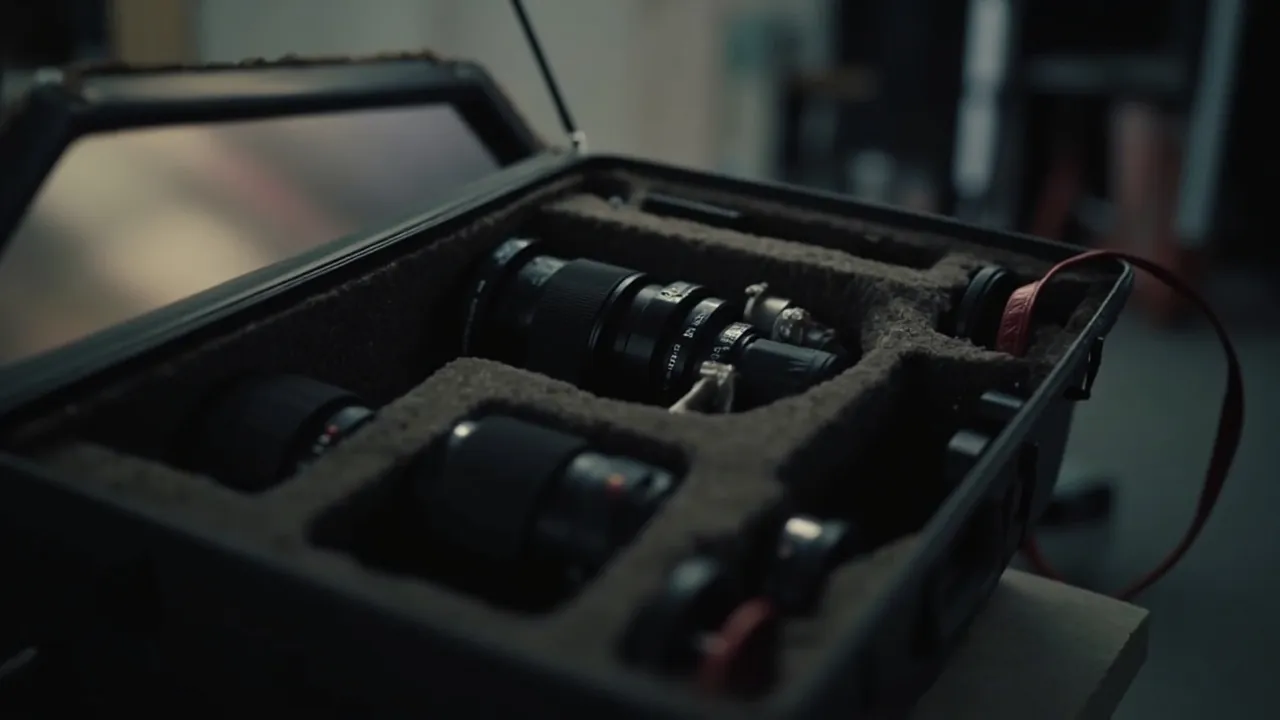
The selection logic for a film production equipment case can be reduced to one sentence: first split the gear into five independent units by department, camera, lighting, sound, DIT and specialty capture, then lock in the shell structure, protection rating and insert format against four hard requirements, stacking strength, cushioned compartmentalization, sealed moisture resistance and identifiability for handover, and finally decide the case format, carrying style and numbering system according to how the production moves, local vehicle moves, long-haul overland, air freight or overseas shooting. The difference between a film crew and an individual photographer is that the gear is not used by one person, not loaded in one vehicle and not finished in one day. The same camera may be loaded and unloaded four or five times in a day and pass through the hands of assistants, drivers, grips and airline ground staff. Real damage rarely happens during the shot; it concentrates in four non-creative moments: loading, stacking, moving and handover. A qualified production case is therefore not simply a hard box that holds a camera. It is a dispatch unit that resists stacking loads, absorbs shock, shuts out rain and dust, and supports numbering and fast inventory. Below we work through it in the order of failure modes, hard requirements, packing by department, inserts, transport, management system and mistakes.
Table of Contents
- Where Does On-Set Equipment Actually Get Damaged?
- Four Hard Requirements for a Production Case
- Packing by Department: Five Categories with Different Needs
- Inserts and Compartments: From Pick and Pluck to Custom Molded Trays
- Transport and Company Moves: Vehicles, Air Freight and Distant Locations
- Production-Level Dispatch: Numbering, Inventories, Inspection and Care
- Frequently Asked Questions (FAQ)
- Conclusion
- Further Reading
Where Does On-Set Equipment Actually Get Damaged?
Before choosing a case you have to see clearly where the damage comes from. Accident patterns on set follow a consistent rule: most damage does not happen while shooting, it happens while handling. Broken down, there are five categories.
Category One: Repetitive Impact During Loading
Gear comes off the truck onto the ground, from the ground onto a dolly, from the shuttle vehicle to the shooting position. Every landing is an impact. A single impact is rarely fatal; the real problem is repetition: four or five times a day means hundreds of times across a month-long schedule. What impact destroys is usually mechanical precision rather than appearance: the gear lash in a follow focus, the focusing guide rails inside a lens, ribbon connectors in a monitor, the damping seals of a fluid head. All of them drift out of tolerance through repeated knocks.
Category Two: Stacking and Sliding in Vehicles
Camera trucks and box vans brake hard and ride rough. If cases have no stacking locators, stacked cases slide against each other and strike one another, and cases at the bottom of a stack carry static load from everything above for hours on end. This combination of long-duration static load and short-duration shock is the hardest test of bending stiffness and creep resistance. A shell with insufficient stiffness will show a slightly deformed mouth after a few days of stacking, which then locally unloads the gasket.
Category Three: Rain Scenes, Water and Dust
Rain scenes, waterside work and desert locations are routine in production, not exceptions. Water damages equipment directly through short circuits and corrosion; dust damages it invisibly through wear, because fine particles that enter zoom ring threads, mount contacts, fan bearings and cooling channels keep grinding away. Coastal salt spray adds electrochemical corrosion on metal contacts and screws. That is why a production case cannot be judged only on whether it survives a drop; the full-perimeter seal and the protection rating matter just as much.
Category Four: Temperature and Batteries
A closed vehicle cabin in summer heats up fast, and lithium cells age faster at high temperature while plastic shells and foam inserts also age faster. Winter exteriors in northern locations reduce battery discharge capability and stiffen rubber gaskets. Condensation when gear moves from cold outdoors into a warm room is equally dangerous, because moisture condensing on circuit boards and glass is a leading trigger for short circuits and fungus.
Category Five: Administrative Loss
This category involves no physical damage yet causes the most disputes: cases that look identical, unclear numbering, wrong case taken, accessories left behind, a packing list that does not match the contents, and missing parts billed on return of rented gear. For a production, identifiability and handover clarity matter as much as protection. A case with no external label holder and no numbering system will slow the entire crew at the most time-pressured moment of a company move.
Four Hard Requirements for a Production Case
Requirement One: Crush Resistance and Stacking
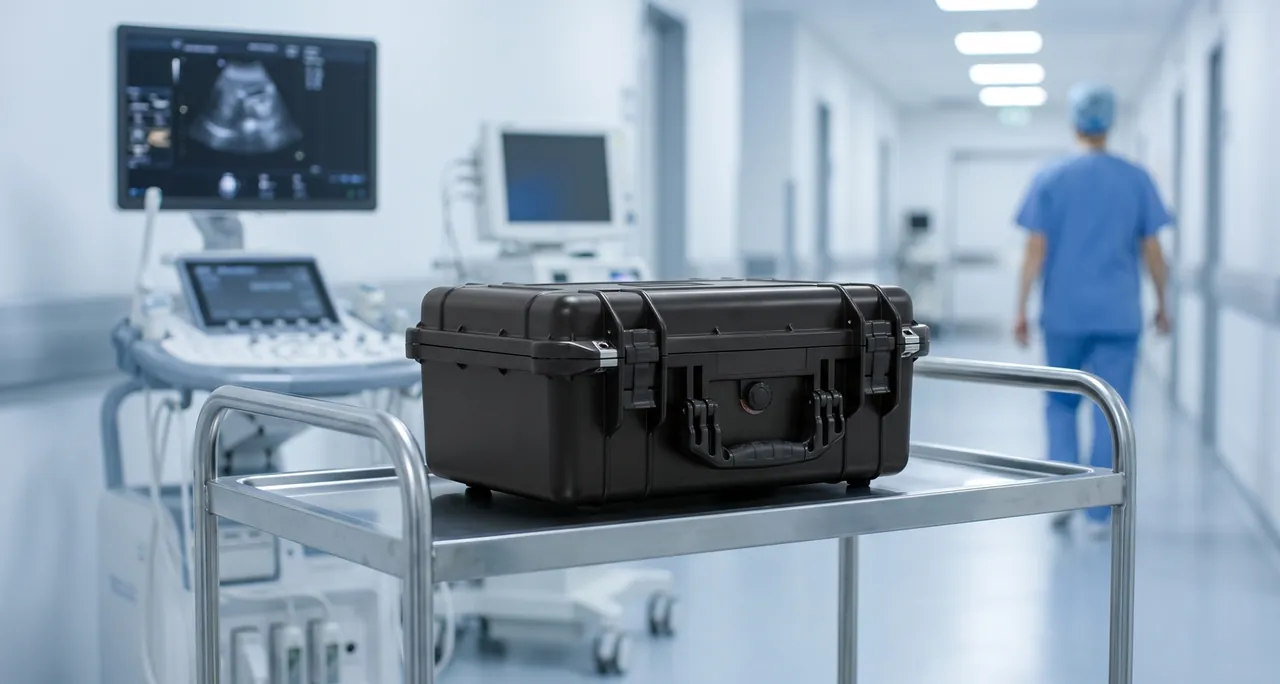
Production cases are stacked constantly. Crush resistance rests on three structural elements: the distribution of reinforcement ribs on the walls and lid, the flexural modulus of the shell material, and the fit accuracy of the stacking locators. Injection-molded engineering plastic shells (PP, ABS and modified grades) can form a network of ribs in one piece, raising bending stiffness substantially without adding much wall thickness or weight. The test is simple: press the long side wall with both hands and watch the deflection, then stack three empty cases and see whether the case mouth visibly dents.
Crush resistance is not the same as hardness. A shell that is hard but lacking in toughness cracks under impact in cold weather; a shell that is too soft deforms under stacking. The value of engineering plastics lies precisely in the balance between stiffness and toughness, which is why production cases generally use PP or ABS systems rather than commodity plastics.
Requirement Two: Cushioning and Inserts
The shell only solves the problem of not being crushed from outside; the insert is what actually protects the gear. An insert in a production case does three things: holds the equipment so nothing collides, absorbs impact energy, and gives every item a fixed place. Equipment that is not immobilized will keep striking the case wall during a rough ride even inside the toughest shell.
Closed-cell foam is the mainstream insert material. Open-cell PU sponge feels soft and conforms well, but it absorbs water and becomes a reservoir in rain scenes and waterside work, so it should be used with care or surface treated. Closed-cell EVA can be thermoformed and suits molded trays and lens bays. EPE pearl cotton is light with long cushioning travel, good for wrapping layers and fill. PE foam is firm and tear resistant, suited to dividers and structural support. EPP survives repeated impacts and recovers well, suiting high-value gear and frequent drops.
Requirement Three: Sealing and Protection Rating
The IP code (IEC 60529 / GB/T 4208) uses two digits, the first for solids and the second for liquids. The grades seen most often in production are IP65, IP66 and IP67:
| Rating | Dust meaning | Water meaning | What it means on set |
|---|---|---|---|
| --- | --- | --- | --- |
| IP65 | Dust protected (limited ingress, no harmful effect) | Low-pressure water jets | Handles ordinary rain and rinsing; not immersion |
| IP66 | Dust protected | Powerful water jets | Handles heavy rain, waves, high-pressure washing |
| IP67 | Dust protected | Temporary immersion (30 minutes under specified conditions) | Baseline for waterside work, accidental immersion and sea freight |
The JUNZHJIA protective-case line from KeXin New Materials offers IP67 capability and can be validated for environmental suitability against MIL-STD-810H, giving a verifiable basis for rain scenes, waterside work and air transport. It should be noted that an IP rating is a test result on a new product under standard laboratory conditions; real protection life depends on gasket condition and the stability of latch compression.
Sealing comes from compression, not from covering. The number and spacing of latches determine whether compression is uniform around the whole perimeter: about two on a small case, about four on a medium one, six or more on a large one, spaced as evenly as possible. After a rain scene, dry the outside of the case and clear sand out of the seal groove before closing, so grit cannot cut into the gasket.
Requirement Four: Identifiability and Stackability
Production cases are usually square boxes with flat tops and bottoms. That is not an aesthetic choice, it is a logistics requirement: flat faces combined with mating bosses and recesses let a stack sit without sliding, and flat side panels leave room for labels, cards and numbers. When choosing, look for:
- External label holder or card slot: Takes a packing card showing case number, department and responsible person.
- Stacking locators: Bosses and recesses on the top and bottom shells so cases do not slide in a moving vehicle.
- A unified size system: Use as few standard sizes as possible so a load can be planned and a replacement case swapped in.
- Color or marking differentiation: Distinguish departments with logo printing or colored labels to reduce mistakes on a company move.
Positioning of Three Case Formats
| Format | Structure and material | Strengths | Limits | Typical role on a production |
|---|---|---|---|---|
| --- | --- | --- | --- | --- |
| Injection-molded protective case | One-piece PP or ABS engineering plastic, full-perimeter seal | Light, well sealed, stackable, controllable unit cost | Cavity size limited by tooling; oversized gear needs custom work | Lens sets, monitors, sound, DIT, drones |
| Wooden flight case | Plywood with aluminum extrusion and hardware, foam lining | Any cavity size, can become a rack or work surface | Heavy, sealing depends on build quality, absorbs water and gains weight | Large fixtures, racks, cranes, fixed rigs |
| Soft gear bag | Nylon or canvas with padded dividers | Very light, foldable, easy to carry by hand | No crush resistance, no sealing, no drop protection | On-set loose items, cables, personal kit |
The three are not substitutes, they are a division of labor: injection-molded protective cases handle high-frequency moves and high-value precision gear, wooden flight cases handle oversized, very heavy and rack-mounted equipment, and soft bags handle loose items used on the spot.
Packing by Department: Five Categories with Different Needs
The first rule of production packing is pack by department, not by filling space. Packing by department means every crew is responsible for its own cases, a company move only requires counting cases, and handover responsibility is unambiguous.
| Department | Typical gear | Main risks | Insert and format advice |
|---|---|---|---|
| --- | --- | --- | --- |
| Camera | Bodies, prime set, zoom lenses, follow focus, matte box, filters | Impact shifting the optical axis, cracking cemented elements, mount wear | Custom pre-cut or molded tray, separate bays per lens, heavy items low |
| Lighting | LED panels, controllers, power supplies, cables, soft modifiers | High weight, heat-generating parts, tangled cable | Deep case with divider bays, weight split across layers, cables bagged |
| Sound | Mixer, wireless receivers, microphones, boom pole, headphones | Precision electronics, connectors sensitive to moisture and dust | Medium case with custom tray, individual mic tubes, receivers layered |
| DIT and data | Drive arrays, card readers, laptop, monitors, cables | Drives sensitive to shock, data cannot be lost | Dedicated shock bay for drives, external data-handling marking |
| Specialty capture | Drone, controller, batteries, gimbal, action cameras | Pressure change, water exposure, battery safety | Waterproof case plus pressure valve plus isolated battery bays |
Camera: The Lens Is the Most Expensive Cell
A cinema lens set is usually worth far more than the body, and it is extremely sensitive to shock and humidity. Packing rules: one bay per lens, at least 20 to 30 mm of foam around every item, a foam wall between lenses, and heavy zooms at the bottom of the case to lower the center of gravity. Precision parts with gears and blades, such as follow focus units and matte boxes, need their own bays and should never share a compartment with metal hardware.
Lighting: Weight and Heat Are the Main Conflict
Fixtures and power supplies are heavy, so the core task is spreading weight across several cases rather than building one heavy case that causes handling damage and injuries. Heat-generating parts such as LED panels and power supplies should be allowed to cool before packing, so residual heat does not accumulate in a closed case. Cables should be coiled and bagged to avoid rubbing against metal edges.
Sound: Many Small Items, Moisture-Sensitive Connectors
Sound kits are characterized by being small, numerous and expensive. Once wireless receivers, microphones, transmitters and connectors get damp or dusty, contact resistance and noise appear. A custom tray with an individual tube for each microphone, with receivers and transmitters layered, plus desiccant kept in the case, is the practical answer.
DIT and Data: Shock Protection Plus Process
Drives are most sensitive to shock while reading or writing, so before transport confirm the device is powered down and safely ejected. The general practice on the data side is multiple copies stored separately: keep at least two copies of original footage on different media, physically separated. The job of the protective case is physical transport safety; the backup strategy belongs to the DIT department.
Specialty Capture: Pressure and Batteries
Drone and action camera transport adds pressure change and battery safety to the list. For air transport the case should carry a pressure equalization valve to balance the cargo-hold differential, and lithium batteries are normally required in the cabin with terminals insulated under carrier and transport rules, so the case should have an isolated battery bay that can be pulled out quickly for security screening.
Inserts and Compartments: From Pick and Pluck to Custom Molded Trays
The insert format directly determines access speed and consistency of protection. The three mainstream forms each have their place:
| Insert form | How it is made | Strengths | Limits | Best for |
|---|---|---|---|---|
| --- | --- | --- | --- | --- |
| Pick and pluck foam | Pre-cut grid of cubes pulled out on site | No tooling, adjustable on site, low cost | Cube edges tear with frequent use, average durability | Changing kits, project-based rental |
| Pre-cut or die-cut foam | Die or CNC cut against a fixed list | High conformity, fast access, tidy look | Must be redone when the list changes | Fixed camera configurations, standing crews |
| Custom molded tray | Thermoformed or CNC-carved cavities | Most stable hold, allows finger access and tiers | Tooling cost, suits batch and standardization | Series equipment, long-term fixed setups |
The combination we recommend for productions is a pick-and-pluck base layer with a custom pre-cut top layer. The base guarantees cushioning depth and flexibility, the top layer positions the current project's gear precisely, and when the project changes only the top layer needs replacing, which balances cost and efficiency.
Four Practical Rules for Insert Design
- Leave 20 to 30 mm of foam around every item, and the same at the bottom and under the lid. Letting gear touch the case wall is the most common mistake.
- Heavy items low, center of gravity central: Heavy lenses and power supplies go at the bottom to avoid tipping.
- No movement when fully loaded: Close the lid and shake gently; nothing inside should visibly shift. Movement means the bay is too large or the foam density too low.
- Provide finger access: Cut a notch at the edge of each bay so crew do not dig foam out with fingernails and tear it.
Volume Estimation: Working Backward from the Inventory
The correct order is list the gear first, derive the volume, then pick the size, not buy the case and cram the gear in. A practical flow:
- List everything that goes in the case and compute the bounding volume of each item as length times width times height. For lenses use the matte box outer diameter rather than the barrel; for monitors use the real envelope including the hood and battery.
- Add the volumes and multiply by a margin factor of 1.4 to 1.8. The low end corresponds to tight packing with thin dividers, the high end to thick cushioning plus finger access space.
- Once you have the target internal volume, choose the next standard size up.
- Keep the loaded weight of a single case within what a person can safely carry. If it is too heavy, split into more cases rather than moving to a larger size.
The Cushioning Principle in One Sentence
When an impact occurs, the force on the equipment is inversely proportional to the deceleration distance. The job of foam is to stretch out the deceleration: by compressing and deforming, it absorbs energy and stops the gear over a longer time and distance, which lowers the peak acceleration. This is why a case with a very hard shell and thin foam often protects worse than one with a moderate shell and thick foam.
Transport and Company Moves: Vehicles, Air Freight and Distant Locations
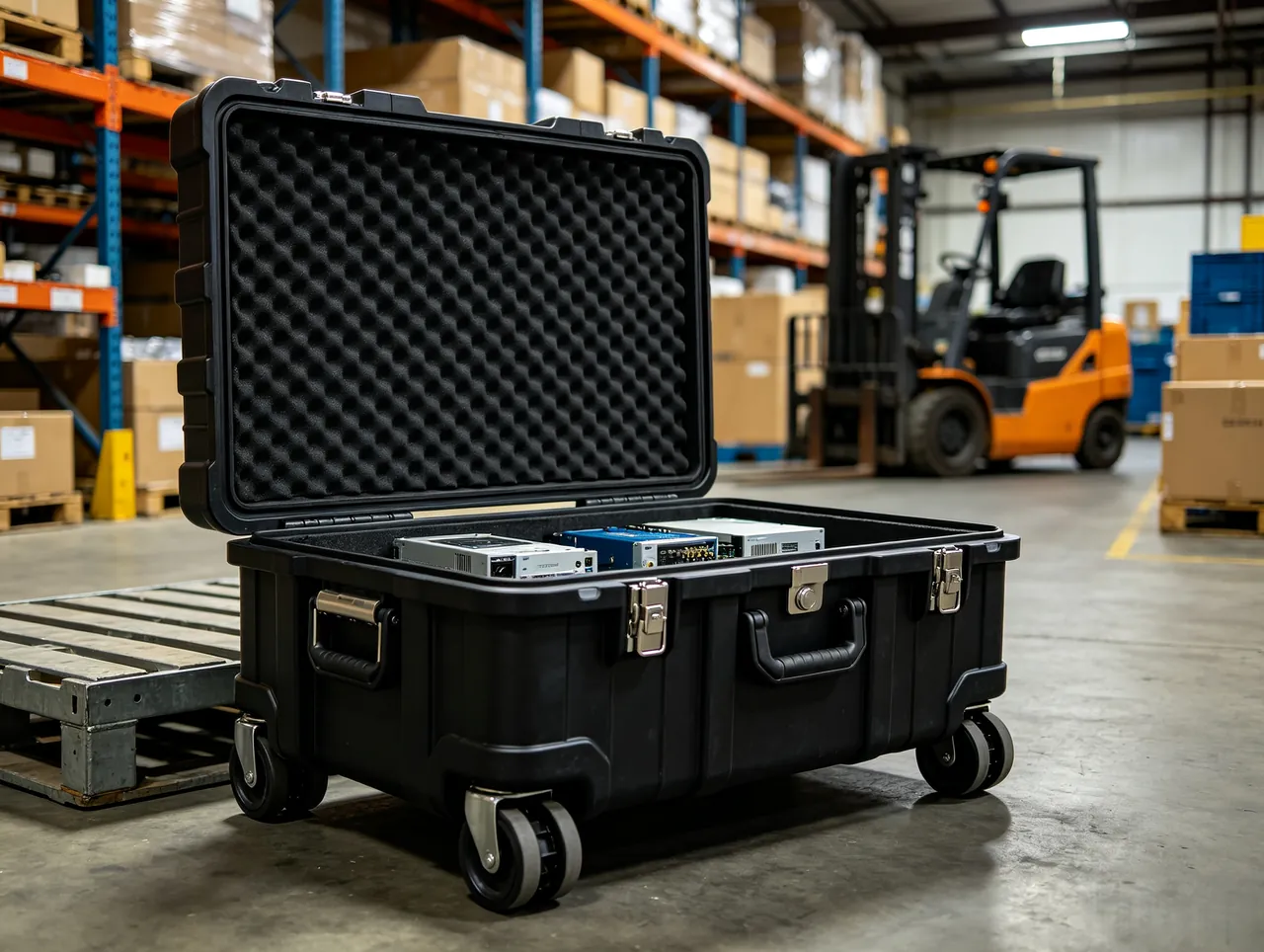
| Transport mode | Main risks | Protection priority | Recommended configuration |
|---|---|---|---|
| --- | --- | --- | --- |
| Local vehicle moves | Hard braking, sliding, stacking load, repeated handling | Stacking locators, strap-down, external numbering | Uniform-size molded cases with stacking bosses and label holders |
| Long-haul overland | Long-duration vibration, day and night temperature swing, roadside inspection | Cushioning depth, anti-open latches, humidity control | Custom tray plus recessed latches plus desiccant |
| Air freight | Throwing, cargo-hold pressure differential, cold and low pressure | Crush resistance, pressure valve, anti-open latches | Ribbed shell plus pressure valve plus lockable hasp |
| Sea or rail | Long transit, salt spray, high humidity | High sealing grade, rust-resistant hardware, more desiccant | IP67 sealing plus generous desiccant plus fresh-water rinse design |
Three Actions for Vehicle Moves
- Do not stack beyond the designed number of layers: Stacking capacity depends on shell stiffness and locator design; over-stacking keeps the bottom case overloaded for hours.
- Strap the stack down: Once stacked, strap the whole load so cases cannot surge forward under braking. Pad the contact points so straps do not crush the shell.
- Heavy cases low, light cases high: This lowers the center of gravity and keeps heavy cases from crushing precision gear in lighter ones.
Four Checks Before Air Freight
- Pressure equalization valve: As the aircraft climbs the hold pressure drops. A perfectly rigid sealed case builds a differential that at best makes the lid very hard to open and at worst damages the gasket or deforms the lid. The valve uses a microporous membrane that passes gas but blocks liquid water and dust, balancing pressure automatically.
- Recessed latches or lockable hasps: Protruding latches are easily damaged or hooked open on conveyors and in stacks, so recessed designs are the right choice for checked cases.
- A battery bay that can be pulled out fast: Spare lithium cells are normally required in the cabin and must have their terminals insulated under carrier and transport rules, so keep an isolated bay you can present at security.
- Photograph the packed layout: Take pictures before check-in so you have evidence if a dispute arises.
Extra Considerations for Distant and Overseas Locations
Remote schedules are long and resupply is hard, so carry spares for wear parts such as gaskets, latches and foam. Sea freight and coastal shooting add salt spray; rinse the outside of the case and the hardware with fresh water after work and dry it so salt does not remain. Before long-term storage, dry the inside thoroughly and replace or regenerate the desiccant on schedule.
Production-Level Dispatch: Numbering, Inventories, Inspection and Care
Numbering and Color Management
Give every case a unique number marked both outside and inside the lid: number, department, responsible person and principal contents. Color coding with labels or cable ties separates departments at a glance on a company move. A unified numbering scheme also ties into packing lists, rental lists and insurance lists, which cuts handover cost dramatically.
Packing Lists and Handover Rules
- One card per case: Number, itemized contents and quantity, laminated and inserted in the external holder.
- Count cases before departure and after wrap: Count cases and numbers, not individual items. This is both fast and reliable.
- Log anomalies: Any cracked shell, broken latch or detached gasket should be logged and the case taken out of service immediately, so the failure does not grow during transport.
Incoming Inspection Checklist
- Appearance: No cracks or deep scratches, ribs intact, corner radii even.
- Seal visual check: After closing, inspect along the lid edge to confirm the gasket is compressed evenly with no local gaps.
- Open and close feel: Latches seat crisply with a clear self-lock; the feel is consistent across a batch.
- Hinges: No play in the action, and the lid lands accurately on the seal groove.
- Foam rebound: Press and release; it should recover without collapse or crumbling.
- Stacking fit: Same-size cases mate correctly with no rocking.
- Pressure equalization valve: Body intact and not blocked.
- Marking provisions: Label holder and number position present.
Routine Care
- After every rain or waterside day, dry the outside and clear sand from the seal groove before closing.
- Wipe gaskets with clean water periodically and avoid strong solvents; replace them once they lose elasticity or crack.
- Foam is a replaceable consumable; when it collapses, replace it at the original density and keep using the shell.
- For long-term storage, stand cases upright, avoid prolonged overloaded stacking, and keep them out of direct sun and high heat.
Common Mistakes
- Mistake one: judge a case only by how hard the shell is. A hard shell solves crush and puncture; cushioning comes from the insert. A hard case without proper foam transmits impact straight into the gear.
- Mistake two: bigger is better, put everything in one case. An overloaded single case raises handling damage and injury risk and makes departmental handover harder.
- Mistake three: use the same insert for everything. Lenses, drives, cables and fixtures have completely different protection needs; design inserts by category.
- Mistake four: ignore numbering and lists. The biggest efficiency loss on a company move comes from not finding things, not from breaking them.
- Mistake five: protruding latches on a checked case. They are easily damaged or hooked open on conveyors and in stacks.
- Mistake six: put desiccant in and forget it. Desiccant saturates; once it changes color it must be dried or replaced, and the interval shortens in humid seasons.
Frequently Asked Questions (FAQ)
Q: For a production, how should injection-molded protective cases and wooden flight cases be combined? A: Divide the work by equipment character. Injection-molded cases are light, fully sealed and stackable, which suits lens sets, monitors, sound gear, DIT drives and drones, high-value precision items that move often. Wooden flight cases can be built to any cavity size and made into racks, which suits large fixtures, racks, cranes and oversized rigs, though they are heavy and their sealing depends on build quality. In practice both are used: precision gear in molded cases with custom trays, oversized heavy items in flight cases.
Q: How thick should the cushioning layer be in a production case? A: As a rule, leave 20 to 30 mm of foam around every item, with a cushioning layer at the bottom and under the lid as well. Thicker is not automatically better; what matters is whether the cushioning travel can stretch the deceleration out into a safe range. Heavier equipment and higher drop risk need more depth, and foam density matters too: too low gives inadequate support, too high shortens the travel. Verify by closing the lid and shaking gently; nothing inside should visibly shift.
Q: For rain scenes and waterside shooting, is a higher protection rating always better? A: Match the rating to the situation. Ordinary rain is usually handled by IP65 splash protection. Heavy rain, waves and high-pressure washing suggest IP66. Where accidental immersion, boat work or wading is possible, choose a case with IP67 capability. Bear in mind that an IP rating is a test result on a new product under standard conditions; long-term effectiveness depends on gasket condition and latch compression, so dry the case and clear sand from the seal groove after a rain scene before closing it.
Q: What are the three most critical features when air-freighting production gear? A: First, a pressure equalization valve to balance the cargo-hold differential so the lid does not deform or jam shut. Second, recessed latches or lockable hasps so the case cannot be damaged or hooked open on conveyors and in stacks. Third, an isolated battery bay that can be pulled out quickly, because spare lithium cells are normally required in the cabin with terminals insulated under carrier and transport rules. It is also sensible to photograph the packed layout before check-in.
Q: What is the safest way to pack drives and data media? A: Three things on the physical side: confirm the device is powered down and safely ejected, put drives in a dedicated shock-isolated bay where they cannot touch hard metal objects, and mark the outside of the case as precision media, handle with care. On the process side, the DIT department handles multiple copies stored separately, keeping at least two copies of original footage on different media. The case guarantees physical transport safety; it does not replace a backup strategy.
Q: If the foam tears or collapses with age, do I have to replace the whole case? A: No. Foam is a replaceable consumable; swap the insert at the original density and keep the shell. Match the original density, because too low gives inadequate support and too high shortens the cushioning travel. If the original used a custom tray, ask the manufacturer to reproduce it to the original specification. That is the practical value of choosing a maker with in-house tray and liner capability.
Q: How many case sizes should a production standardize on? A: Three or four is usually right, covering small for personal lens sets and sound bits, medium for bodies and common accessories, large for fixtures and cable, and an extra-large class for oversized items. Uniform sizes make vehicle loading calculable, replacements interchangeable and spares common; too many sizes reduce space utilization and make stacks unstable.
Conclusion
Choosing a film production equipment case is essentially engineering the dispatch problem. Split the gear into five independent units by department, camera, lighting, sound, DIT and specialty capture, so each crew owns its own cases; then set the shell structure and protection rating against four hard requirements, choosing a fully sealed structure with IP67 capability for rain scenes and waterside work, always specifying a pressure equalization valve for air or high-altitude transport, and preferring recessed latches for checked cases; then choose the insert form by how stable the kit is, pick and pluck for changing configurations, pre-cut or custom molded for fixed ones, with closed-cell EVA and EPE preferred to avoid water absorption; finally close the management loop with unified numbering, one card per case, counting cases at both ends of the day and an incoming inspection checklist. The usage side matters just as much: dry the case and clear the seal groove after rain scenes, check latch compression and gasket elasticity after long transport, and replace collapsed foam at the original density. KeXin New Materials (Guangdong) Co., Ltd. was founded in 2014 and is located in Zhongshan City, Guangdong Province, with a factory of about 18,000 square meters, more than 80 machines and over 100 staff. Its protective-case line is marketed globally under the brand kexinMaterials and under the JUNZHJIA product-line brand, covering more than 150 specifications, offering IP67 capability and environmental suitability validation against MIL-STD-810H. The company operates under ISO9001 and meets REACH, California Prop 65 and RoHS requirements, holds more than 20 utility model and design patents, and provides one-stop OEM and ODM customization from product design, mold manufacturing and injection molding to logo printing and tray and liner production. For bulk quotations, specification sheets or customization, please reach us through the contact page or inquiry form on this site.
Further Reading
- How Do Outdoor Protective Cases Improve Transport Safety for Equipment?
- Why Does a Protective Case Need a Stacking Structure?
- What Factors Matter When Customizing Protective-Case Foam?
- What Is Pick and Pluck Foam in a Protective Case?
- Are Internal Dividers or Foam Better for a Protective Case?
- Why Does an Outdoor Protective Case Need a Pressure Equalization Valve?
- Are Outdoor Protective Cases Suitable for Air Transport?
- Which Industries Are Trolley Tool Boxes Suited To?