

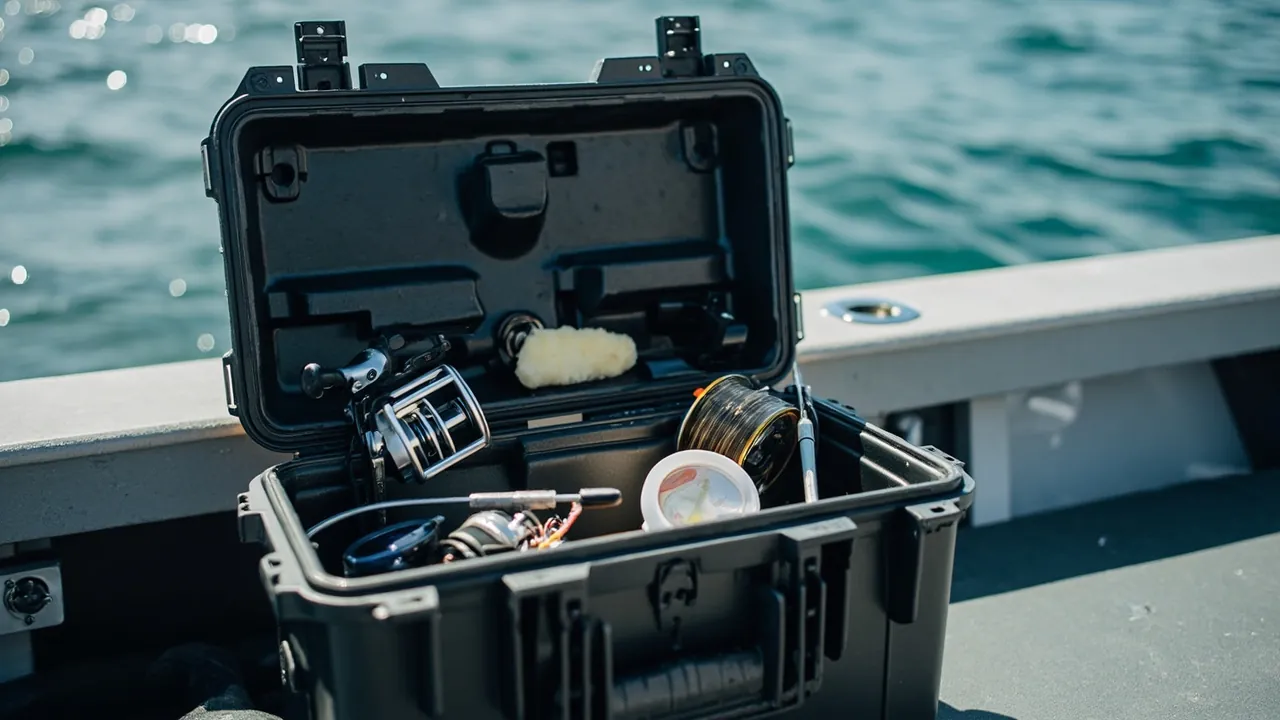
Choosing a fishing and watersports gear case comes down to one sentence: set the sealing grade and corrosion requirement against four risks, water, salt, hooks and humidity, choosing a fully sealed structure with IP67 capability that can be rinsed with fresh water for wading and boat fishing, and paying extra attention to salt-spray behavior of the shell and hardware in saltwater; then build compartments by fishing style and gear type so reels, hard lures, soft baits, sinkers, line and cutting tools each occupy bays that do not interfere with each other; finally treat dry-before-storing as a non-negotiable discipline. Fishing gear differs from ordinary outdoor gear in two ways. First, the gear itself carries water, salt and hooks, so the case must keep water out while tolerating residual moisture and sharp objects inside. Second, reels and fish finders are precision mechanics and electronics, and salt crystals or grit can seize or kill them within weeks. A qualified tackle case therefore has to be a sealed container, a rinseable salt-resistant structure, a compartment system and a moisture management unit at the same time. Below we work through failure modes, the technical basis of waterproofing and moisture control, compartmentalization, materials and hardware, scenario configuration, cleaning and storage, and mistakes.
Table of Contents
- Four Ways Fishing and Watersports Gear Fails
- The Technical Basis: Ratings, Sealing, Compression and Drying
- Compartmentalized Storage: Designing Bays by Style and Gear Type
- Shell Material and Hardware: Salt-Spray Resistance Comes First in Saltwater
- Case Configuration for Four Waterside Scenarios
- Cleaning, Drying and Long-Term Storage
- Frequently Asked Questions (FAQ)
- Conclusion
- Further Reading
Four Ways Fishing and Watersports Gear Fails
Before choosing, understand how tackle actually breaks. Unlike camera or film gear, tackle rarely fails in one dramatic moment; it degrades slowly through repeated exposure to water and salt.
Category One: Direct Water Ingress
Waves over the gunwale on a boat, wading to waist depth, capsizing a kayak, spray on a paddleboard, and the most overlooked one of all: deformation when the case is used as a step or a seat. Once water gets in, the first casualties are electronics, a fish finder head, a phone, a camera, and the line itself, because both nylon and PE lines change behavior when wet, while electronics simply short out.
Category Two: Salt Crystallization and Corrosion
The core risk in saltwater is not wetness, it is salt. When seawater evaporates it leaves crystals that absorb moisture and create a persistent electrolyte, accelerating electrochemical corrosion. In a reel, salt that reaches the gear box and the anti-reverse bearing increases drag, causes noise and eventually seizure. In case hardware, hinge pins, latch springs and screws rust first. Salt damage is delayed: nothing looks wrong the same day, and the problem appears a week or two later.
Category Three: Hooks, Knives and Sharp Objects Inside
Hard lures carry treble hooks, hooks are razor sharp, lip grips and pliers are hard, and sinkers are heavy. Left free inside a case they tangle, scratch the walls, puncture soft bags and injure whoever reaches in. The first rule of managing the inside of a tackle case is that every hook has a fixed place.
Category Four: Mold and Odor from Dampness
Locking wet clothing, towels, a landing net or soft baits into a sealed case saturates the internal humidity within a day or two, producing mold and an odor that is very hard to remove, and mold spreads to other gear. This is the counterintuitive point about sealed cases: sealing only resists moisture if what goes in is already dry, otherwise it simply locks the dampness inside.
The Technical Basis: Ratings, Sealing, Compression and Drying
How to Read an IP Rating
The IP code (IEC 60529 / GB/T 4208) uses the first digit for solids and the second for water. The three grades that matter on the water are:
| Rating | Dust meaning | Water meaning | What it means for fishing and watersports |
|---|---|---|---|
| --- | --- | --- | --- |
| IP65 | Dust protected | Low-pressure water jets | Handles spray and rinsing; not immersion |
| IP66 | Dust protected | Powerful water jets | Handles waves over the gunwale and high-pressure washing |
| IP67 | Dust protected | Temporary immersion (30 minutes under specified conditions) | Baseline for capsize, falling in, and water in the bilge |
The JUNZHJIA protective-case line from KeXin New Materials offers IP67 capability and can be validated for environmental suitability against MIL-STD-810H, giving a verifiable basis for boat fishing, wading and kayaking. An IP rating is a test result on a new product under standard laboratory conditions; long-term effectiveness depends on gasket care, latch compression and whether the shell has been deformed.
Sealing Comes from Compression, Not from Covering
Sealing relies on three things together: shell rigidity, a full-perimeter elastic gasket, and enough latch compression force. Miss any one and it fails: a shell without rigidity deforms under load and pulls the mouth out of shape; an aged or gritty gasket leaves microscopic paths; too few or unevenly spaced latches give uneven compression around the perimeter. When choosing, look at latch count and spacing: about two on a small case, about four on a medium one, six or more on a large one, spaced as evenly as possible.
The Three-Stage Flow: Drain, Rinse, Dry
Watersports differ from ordinary outdoor use in one key respect: the gear gets wet over and over. Moisture control therefore cannot rely on sealing alone, it needs a process:
- Drain: If the case has a tray or an inner level, provide a drain path or a removable tray so water does not sit in the bottom.
- Rinse: After saltwater use, rinse the outside, latches and hinges with fresh water to remove salt. A sealed case permits rinsing the whole exterior, but avoid driving a high-pressure jet straight into the seal gap.
- Dry: Open the lid and let everything dry thoroughly in a ventilated place before closing, then add desiccant to absorb residual moisture and use an indicator card to see when it is saturated.
Desiccant and Humidity Management
- Dose: Size it to the case volume and increase it in humid seasons or when the case is opened often.
- Regeneration: Indicating silica gel can be dried out and reused once it changes color, which keeps cost low.
- Monitoring: Keep a small hygrometer or indicator card inside so humidity becomes a number instead of a feeling. For long-term storage, hold relative humidity below 60 percent.
- Discipline: Never put wet gear into a sealed case. Wet towels, clothing and nets belong on a line or in a breathable mesh bag until dry.
Compartmentalized Storage: Designing Bays by Style and Gear Type
The core principle of tackle layout is to divide along three axes, material compatibility, sharpness and access frequency, rather than simply filling by size.
| Bay | Contents | Risk character | Storage method |
|---|---|---|---|
| --- | --- | --- | --- |
| Precision mechanics | Reels, spare spools | Salt, grit, crushing | Individual bays, soft wrap, desiccant alongside |
| Hard lures | Minnows, pencils, metal jigs | Treble hooks tangle together | Individual cells or boxes, hooks aligned |
| Soft baits | Worms, soft shads, curl tails | Plasticizer migrates and softens hard lure finishes | Separate sealed bags or boxes, physically isolated from hard lures |
| Sinkers and hardware | Sinkers, swivels, snaps, split rings | Heavy, deforms soft baits | Rigid cells that carry the load |
| Line | Spools, leader, spare line | UV, moisture, crushing | Dark bay, never shared with hooks |
| Tools and blades | Pliers, lip grip, scissors, knife | Sharp, hard, injurious | Fixed slots, blades covered, consistent orientation |
| Electronics | Fish finder head, battery, phone, camera | Water, shock, heat | Shock bay, separate dry bag, away from heavy items |
| Consumables | Towel, gloves, sunscreen, first aid | Damp, mold | Store dry, isolated from wet items |
The Reel: The Most Precise Item in the Kit
A reel contains gear trains, bearings, an anti-reverse bearing and a drag system, making it the item most in need of protection. Practical rules:
- Rinse with fresh water after every saltwater session: Wash surface salt off with a gentle flow; never drive a high-pressure jet that pushes salt and grit inward.
- Dry before storing: After rinsing, dry thoroughly and confirm there is no water on the spool or line roller before the reel goes back in the case.
- A bay of its own, no crushing: A reel should never be piled with sinkers and tools, because pressure deforms the spool and the handle.
- Service on schedule: Oil and inspect following the manufacturer's instructions, and shorten the interval during saltwater seasons.
Why Soft Baits and Hard Lures Must Be Separated
Soft baits contain plasticizers, and prolonged contact softens or even dissolves the paint and plastic body of hard lures, while different colors of soft bait stain each other. Soft baits must therefore be stored alone, ideally in original packaging or individual sealed bags placed in rigid cells, which both isolates them and stops sinkers flattening them.
Managing Small Parts
Swivels, snaps, split rings and small hooks are the items most likely to scatter, and once loose they roll around and scratch everything else. The practical answer is a transparent small-parts organizer with labeled cells by size, which shows remaining stock at a glance and keeps parts contained. This is why many anglers nest a small-parts box system inside the protective case.
Safe Storage for Blades and Hooks
Pliers, lip grips, scissors and knives should sit in fixed slots or sleeves with the cutting edge covered and a consistent orientation. Treble-hook lures are best kept in original packaging or a lidded lure box so hooks cannot catch gloves or fingers when the case opens.
Choosing the Compartment Form
| Form | Structure | Strengths | Best for |
|---|---|---|---|
| --- | --- | --- | --- |
| Fixed dividers | Molded or inserted walls | Rigid, carries load | Sinkers, tools, spools |
| Movable dividers | Removable panels in slots | Layout can change | Lure boxes, small-parts boxes |
| Foam bays | Pre-cut or pick and pluck | Most stable, shock absorbing | Reels, fish finders, cameras |
| Nested small boxes | Transparent boxes inside | Complete isolation, visible | Soft baits, small hardware, hooks |
The best tackle case usually combines all three levels: dividers for categories, small boxes for small parts, and foam for precision items.
Long Items: Rods, Nets and Rod Holders
Rods, landing net handles, rod holders and wading staffs are long items, and their logic is completely different from short items: they need full-length support, not just an empty gap. Carbon fiber tolerates evenly distributed load well but fears a point impact. Something pressing on one spot, a car door closing on the blank, or other gear piled on top can create damage that is invisible until the rod breaks on a fish. So:
- Long items go in a full-length rod channel or a dedicated tube so no section is unsupported.
- Separate multiple rods with dividers, keeping stress off the guides in particular.
- Store net heads and mesh separately, and never put a wet net away before it dries.
- Keep metal items such as rod holders and wading staffs isolated so salt does not transfer.
Volume and Size: Working Backward from the Fishing Style
As with any protective case, list the kit first and derive the volume, rather than buying a case and cramming it. A practical method: sort gear into precision, sharp, heavy, long and consumable classes and compute the bounding volume of each. Apply a margin factor of 1.4 to 1.6 to precision and sharp items, which need cushioning and fixation, and 1.2 to 1.3 to heavy items and consumables. Size long items separately by length against a rod channel or tube. Add the totals, choose the next standard size up, and keep the loaded weight within what one person can move safely. Boat cases get heavy fast, so splitting into two cases beats building one nobody can lift.
Shell Material and Hardware: Salt-Spray Resistance Comes First in Saltwater
Shell Material
Engineering plastics (PP, ABS and modified grades) are the mainstream choice on the water, and their advantage is that they do not corrode. Unlike a metal case, plastic does not suffer electrochemical attack in seawater, and there is no paint to flake off and expose rust.
- PP: Tough, low-temperature resistant, impact resistant and light, suiting a deck where the case is moved constantly and may be dropped.
- ABS: Rigid with a hard surface and dimensional stability, giving a crisp shape that suits a storage case with many dividers where fit accuracy matters.
The practical call: if the case moves around a deck and may be dropped, prefer PP; if it lives in a vehicle or cabin with a complex divider layout, ABS is a fine choice.
Corrosion Requirements for Hardware
Hardware is the weakest link in a saltwater case. Hinge pins, latch springs and screws rust first. Selection and care advice:
- Prefer corrosion-resistant hardware: Stainless or surface-treated metal parts, never plain carbon steel.
- Protect by design: Recessed or semi-recessed hardware reduces direct exposure and impact; insert molding metal into the shell improves connection reliability and allows replacement.
- Rinse with fresh water after every use: The cheapest and most effective corrosion measure there is.
- Lubricate and inspect regularly: Oil the moving parts of hinges and latches and treat any rust spot immediately.
Structural Details That Matter
- Reinforcement ribs: On deck a case gets stepped on and squeezed by other gear, so ribs supply bending stiffness and stop the mouth deforming and breaking the seal.
- Rounded corners: Cabins are tight, and radii reduce collision damage and scratches while leaving no dead corners to clean.
- Rinseable design: Smooth inner and outer surfaces without unreachable recesses make rinsing and draining practical.
- Anti-slip feet: Stability on a wet deck depends on feet that grip and stay attached.
- Drainage and ventilation: A tray that lifts out and a case that can be inverted to dry are the physical preconditions for the moisture process above.
Case Configuration for Four Waterside Scenarios
| Scenario | Main risks | Protection priority | Case and configuration advice |
|---|---|---|---|
| --- | --- | --- | --- |
| Bank fishing and wading | Spray, crossing water, sand, sun | IP67 sealing, rinseable, sun protection | Medium sealed case, non-slip base, shoulder strap for long walks |
| Boat and saltwater fishing | Waves, salt spray, deck crushing, heavy stacking | Salt-resistant hardware, stacking locators, fresh-water rinse | Medium to large case, corrosion-resistant hardware, drain tray and desiccant |
| Lure fishing with frequent moves | Frequent access, mixed lures, hook injuries | Clear compartments, one-hand opening, small-box system | Multi-level case, common lures on top, latch operable with one hand |
| Kayak and paddleboard | Capsize, full immersion, gear drifting away | High sealing grade, tie-down points, added flotation | IP67 sealed case plus tie-down points plus flotation for critical gear |
Bank Fishing and Wading: Walking Distance Decides the Format
Bank fishing is defined by distance: the walk from the car to the spot can take an hour or two, so the case must carry on the shoulder, carry in the hand and sit on wet rock. Weight and the carrying system come first, and sealing grade second, because a slip while wading at waist depth submerges everything.
Boat and Saltwater: Salt Resistance and Stacking First
Boat cases carry heavy sinkers, metal jigs and tools, so the shell needs real bending stiffness, and several cases on deck must stack and locate so they do not slide while underway. Rinsing with fresh water after saltwater is a hard rule, and the case design should support rinsing the whole exterior and then inverting it to dry.
Lure Fishing: Access Speed Is Catch Rate
Lure fishing means changing baits constantly, so the value of the case lies in access speed: common lures on the top layer or the outermost position, small boxes arranged by color or diving depth and labeled, and a latch that opens with one hand. Aligning hook points in one direction and keeping original packaging sharply reduces hooked hands.
Kayak and Paddleboard: Tie-Down on Top of Sealing
As on any water, two extra requirements apply: the case must have reliable tie-down points so it can be lashed firmly to the hull, and a sealed case is not a flotation device, so critical gear needs added flotation. When you capsize you recover the gear first, so a high-visibility color is a practical choice too.
Temperature and Sun: The Underestimated Fifth Risk
Sun exposure on the water is often stronger than on land because the surface reflects UV, and a vehicle parked on the shore heats up quickly. Both affect tackle in specific ways:
- Soft baits and plastic parts: Heat softens, deforms and even fuses soft baits, and accelerates aging of plastic components.
- Line: Nylon and PE lose strength under prolonged UV exposure, and leaders are particularly sensitive.
- Batteries and electronics: Fish finder batteries, phones and cameras age faster in heat, and screens and housings suffer in direct sun.
- Adhesives and coatings: The bonded areas of rod grips and grip materials can soften at high temperature.
Store the case in a shaded, ventilated place rather than in direct sun. During long bank sessions, cover the case with a light-colored towel or a shade cloth, and never leave gas canisters, lighters or low-melting items inside.
Cleaning, Drying and Long-Term Storage
The Standard Routine After Every Session
- Sort on the way out: Separate wet and dirty items from dry ones, and hang the wet ones separately.
- Rinse with fresh water: Rinse the outside, latches, hinges and feet, focusing on salt and sand, and rinse lures and tools as well.
- Invert and dry: Open the lid, stand the case inverted or half open in a ventilated place, and let it dry completely rather than baking it in the sun.
- Clean the seal groove: Check for sand, salt crystals and debris, and wipe with clean water.
- Reset the desiccant: Once dry, put desiccant and an indicator card back in before closing.
Periodic Care
- Hardware: Inspect hinges, latch springs and screws monthly or each season; remove rust and oil as soon as it appears.
- Gasket: Wipe with clean water regularly and avoid strong solvents; replace once elasticity is lost or cracks and compression marks no longer recover.
- Reels: Service on the manufacturer's schedule, shortened during heavy saltwater seasons.
- Line: Nylon and PE both have a service life. Replace line that has been soaked, sun-exposed or abraded, and treat leaders with particular attention.
Long-Term Storage
- Empty and dry: Before any long storage, empty the case completely and dry it, leaving nothing damp inside.
- Store with latches released: This keeps the gasket from losing elasticity under permanent compression.
- Avoid sun and heat: UV and heat accelerate plastic aging and line degradation, so store cool and ventilated.
- No standing loads: Do not stack heavy items on the case for long periods, or the shell will creep and deform.
Common Mistakes
- Mistake one: locking wet gear into a sealed case. Sealing locks the dampness in and mold appears within a day or two. Dry first, then store.
- Mistake two: watch the IP rating and ignore latch compression. Aged or gritty gaskets and loose latches make IP67 meaningless.
- Mistake three: skip rinsing after saltwater. Residual salt is the most insidious corrosion source and shows up later.
- Mistake four: mix soft baits with hard lures. Plasticizer softens hard lure finishes and colors bleed into each other.
- Mistake five: let sinkers sit on soft baits. The deformation is permanent and changes the action.
- Mistake six: substitute an ordinary storage box for a protective case. Ordinary boxes have no full-perimeter seal, no salt-resistant hardware and insufficient rigidity, so they deform and leak under deck loads.
- Mistake seven: ignore hook safety. Unsecured lures roll around and injure hands on the way out.
Frequently Asked Questions (FAQ)
Q: Does a tackle case really need to be IP67? A: It depends on whether full immersion is possible. For bank fishing and ordinary spray, IP65 splash protection is usually enough. Waves over the gunwale and high-pressure washing suggest IP66. As soon as deep wading, a capsize, a kayak rollover or water in the bilge is possible, choose a case with IP67 capability. IP67 means it withstands temporary immersion under standard test conditions, covering low-probability, high-loss events such as going into the water. Bear in mind that an IP rating is a test result on a new product; long-term effectiveness depends on gasket care and latch compression.
Q: How should the case and gear be cleaned after saltwater fishing? A: The core is gentle fresh-water rinsing plus thorough drying. Rinse salt off the outside, latches, hinges and feet with a gentle flow of fresh water, and do not drive a high-pressure jet into the seal gap where it would push salt and grit inside. Rinse lures and tools the same way, and keep pressure away from the reel interior. Then open the lid, stand the case inverted in a ventilated place until completely dry, wipe sand and salt crystals out of the seal groove, and only then put desiccant back in and close it.
Q: Can wet tackle go straight into a sealed protective case? A: Not recommended. Sealing resists moisture only if what goes in is already dry; otherwise it locks dampness inside, mold appears within a day or two along with an odor that is very hard to remove, and it spreads to other gear. Hang wet towels, clothing and nets in a ventilated place or keep them in a breathable mesh bag until completely dry. Use desiccant and an indicator card for residual moisture, and for long-term storage hold relative humidity below 60 percent.
Q: How should hard lures, soft baits and sinkers be compartmentalized? A: All three need physical separation. Soft baits contain plasticizers that soften hard lure finishes over time and bleed color, so keep them in original packaging or individual sealed bags inside rigid cells. Sinkers are heavy and permanently deform soft baits, changing their action, so they need their own load-bearing cells. Hard lures carry treble hooks, so keep them in original packaging or a lidded lure box with hook points aligned in one direction to avoid catching gloves or fingers.
Q: What is the safest way to transport a carbon fiber rod? A: Carbon fears point impact and crushing rather than even load. Use a dedicated rod tube or a hard case with a full-length rod channel so the blank is supported along its whole length with no unsupported span. Never lay a rod on the trunk floor with other gear on top, and never let a car door close on the blank. Separate multiple rods with dividers and keep load off the guides. When breaking down, collapse from the butt section toward the tip so grit between sections does not abrade the blanks.
Q: How do I protect a reel from moisture and salt? A: Three things. First, rinse surface salt off with a gentle fresh-water flow after saltwater use, keeping high pressure away so salt and grit are not driven into the gear box and anti-reverse bearing. Second, dry thoroughly before it goes back in the case, checking the spool and line roller for water, and keep it in its own bay where sinkers and tools cannot press on it. Third, oil and service it on the manufacturer's schedule, shortened during heavy saltwater seasons. For long storage, back the drag off so the washers are not under permanent compression.
Q: Can live bait be kept in a protective case? A: No. Live bait needs continuous oxygen and temperature control, which a sealed case cannot provide; it would simply die and contaminate the case. Use a dedicated bait bucket or an aerated live well. The protective case is for dry tackle, spare gear and electronics, and the two should stay separate.
Q: Will the hardware on a saltwater case always rust? A: Not guaranteed to rust, but it can be significantly delayed. Salt creates an electrolyte that accelerates metal corrosion, and hinge pins, latch springs and screws rust first. To slow it down: choose stainless or surface-treated corrosion-resistant hardware, use recessed designs that limit exposure, rinse with fresh water and dry after every saltwater session, and oil the moving parts regularly. The advantage of an engineering plastic shell is that the body does not corrode, so maintenance concentrates on hardware and the gasket.
Conclusion
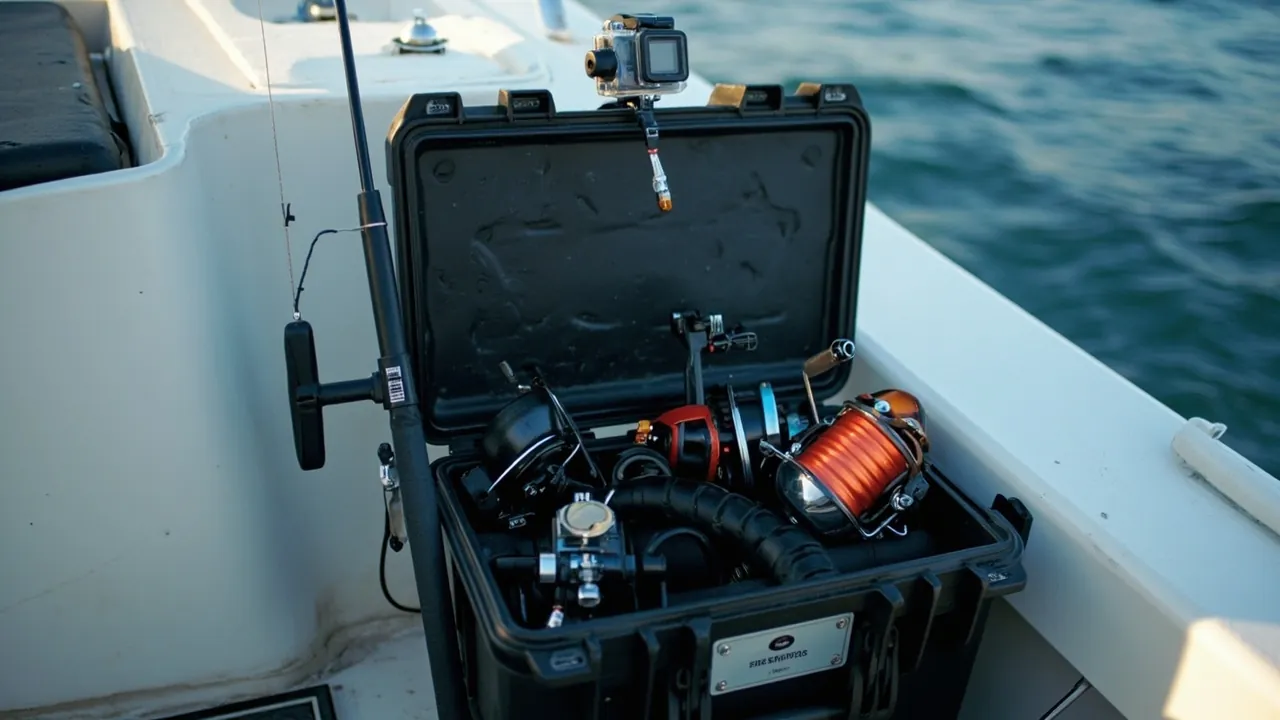
Choosing a fishing and watersports gear case is system design around four risks: water, salt, hooks and humidity. The order should be: set the protection grade by whether full immersion is possible, IP65 for bank spray, IP66 for waves over the gunwale and washing, and a fully sealed structure with IP67 capability that can be rinsed with fresh water for wading, boat fishing and kayaking, with salt-resistant hardware, recessed fittings and a ribbed shell as hard requirements in saltwater; then build compartments along material compatibility, sharpness and access frequency, dividers for categories, small boxes for small parts, foam for precision items, soft baits isolated from hard lures and sinkers kept off soft baits, and blades and hooks in fixed slots; finally fix the routine, rinse with fresh water after every session, invert and air-dry, wipe the seal groove, reset the desiccant, never store wet gear, and for long-term storage release the latches and keep the case out of sun and heat. The value of this combination is not any single high number, it is that sealing, compartments and drying form a closed loop: sealing keeps outside water out, compartments control the hooks and salt inside, and drying deals with the moisture that remains. KeXin New Materials (Guangdong) Co., Ltd. was founded in 2014 and is located in Zhongshan City, Guangdong Province, with a factory of about 18,000 square meters, more than 80 machines and over 100 staff. Its protective-case line is marketed globally under the brand kexinMaterials and under the JUNZHJIA product-line brand, covering more than 150 specifications, offering IP67 capability and environmental suitability validation against MIL-STD-810H. The company operates under ISO9001 and meets REACH, California Prop 65 and RoHS requirements, holds more than 20 utility model and design patents, and provides one-stop OEM and ODM customization from product design, mold manufacturing and injection molding to logo printing and tray and liner production. For bulk quotations, specification sheets or customization, please reach us through the contact page or inquiry form on this site.
Further Reading
- How Is a Waterproof Tool Box Different from an Ordinary One?
- What Does IP67 Mean for a Protective Case and Where Does It Apply?
- Why Do Outdoor Protective Cases Need a Waterproof Design?
- What Materials Are Commonly Used for Protective-Case Gaskets?
- Are Internal Dividers or Foam Better for a Protective Case?
- How Do Outdoor Protective Cases Handle Rain and Humid Environments?
- Why Does an Outdoor Protective Case Need a Pressure Equalization Valve?
- How Should You Choose the Size of a Tool Box?