

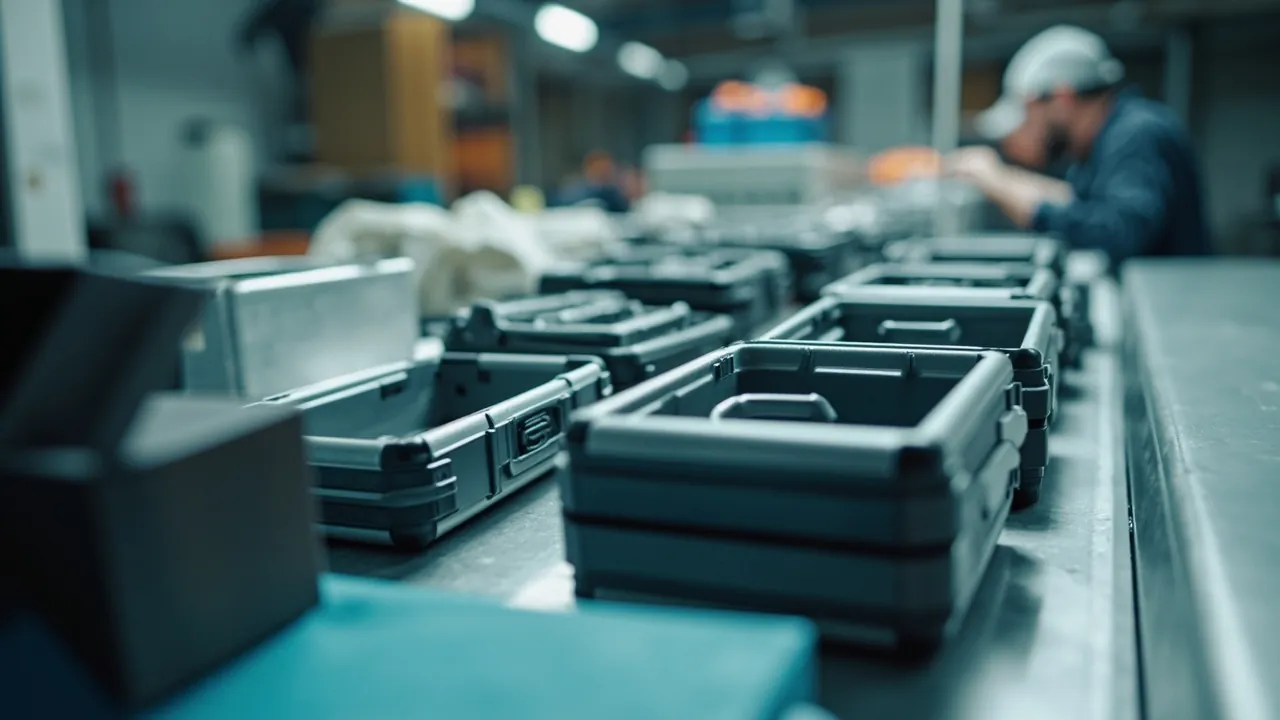
A foldable protective case is a case whose side walls fold inward and whose base flips, so that when empty it collapses into a thin slab, and when loaded it springs back into a box, greatly saving return and storage space. Unlike rotomolded or injection-molded hard cases that "always occupy one case volume", the value of a foldable case is "open when used, flatten when idle", especially suited to logistics, distribution and door-to-door service where the outbound trip carries goods and the return trip is empty. JUNZHJIA builds foldable protective cases in three types — PP injection-fold, PE soft-fold and oxford cloth with PP board — balancing light weight, stackability and a degree of protection. This article explains the selection of foldable cases systematically, from folding structure principles, material routes, size and folded thickness, load and stacking, protection rating to cooperation with tool carts and instrument carts, helping distribution, repair, warehousing and outdoor users complete transport in less space.
What Is a Foldable Protective Case
A foldable protective case is made of a lid, foldable side walls, a base and latches. When empty, the four walls fold inward and the base folds up, collapsing the whole case to a fraction of its original height; when loaded, lift the four walls, lay the base flat and fasten the latches to restore the box. The core value is "variable volume": the space occupied by empty return cases is far smaller than when fully loaded, so a fleet can carry more goods or run one fewer trip.
Compared with a single hard case, a foldable case has clear advantage in "empty-case turnaround" scenarios: express stations, door-to-door repair, exhibition materials and fresh cold-chain return crates all rely on it to cut cost. But it is not a replacement for a hard case, it is a supplement — heavy protection and heavy stacking still use rotomolded or aluminum cases, while the foldable case handles the light, high-frequency, collapsible part. Users who need hard protection basics can refer to the rotomolded case forming principles.
In the JUNZHJIA range, foldable cases run alongside rotomolded, injection-molded and aluminum cases: foldable cases take light turnaround, hard cases take protection and load, and users choose by "what goes out, is the return empty". For inner layers needing shielding or load, the device can still go into an aluminum case and then into a foldable outer case.
Folding Structure Principles
Folding relies on hinges at the side walls and base. Three common types: one, PP injection-molded whole walls use thin-wall creases as hinges that flex many times without breaking; two, PE soft walls use heat-sealed fold edges as hinges that are soft and rollable; three, "soft case with hard frame" of oxford cloth plus PP board, where pulling the board out collapses it. Latches pull the top edges tight after the walls stand, so the walls do not lean inward.
Hinge life is the key of a foldable case: PP creases depend on material toughness and wall thickness, too thin cracks easily; PE fold edges depend on heat-seal strength, a broken seal leaks; the board depends on PP board stiffness, bent is hard to restore. JUNZHJIA thickens and rounds the fold positions with limiting ribs, so folding has a stop point and standing has support. Folding cycles should be written in the spec (such as five thousand cycles), and procurement selects by turnaround frequency.
Hinge life should be validated against real turnaround frequency rather than a single number. Take an express station: if a return case folds twice a day and runs three hundred days a year, that is about six hundred cycles, so five thousand cycles could last eight years; at a high-frequency hub folding ten times a day, life drops below two years. Procurement should therefore convert "average folds per day times planned service years" into the required cycle life and compare it with the maker's rating, avoiding "rated enough, actually early-failed". For military or export projects, fold cycles can be verified by third-party fatigue test with a retained reference sample; for general turnaround, a simplified "inspect hinge and latch after one thousand folds" acceptance can replace full-life testing, balancing cost and credibility. Besides the hinge, the latch also has a fatigue limit: after long high-frequency use the tightening force drops, the wall leans inward and the case softens, so the latch should be managed as a spare alongside the hinge.
The base is fixed or folding: a folding base collapses more thoroughly but needs latch positioning, a fixed base is simpler but slightly thicker. For heavy goods choose a fixed base for stability, for light goods choose a folding base for savings. Related sealing can be combined with waterproof rating and IP realization.
Fold and Deploy Workflow
Standard deployment in four steps: lay the case flat, lift the four walls, lay the base flat, fasten the latches. Folding is reverse: open latches, flip the base up, lay the walls down, press flat. After practice it can be done with one hand, suited to high-frequency turnaround. JUNZHJIA puts direction arrows and stops at the fold positions, so novices learn by the drawing.
The process should be standardized to reduce wear: specify "stand the diagonal two walls first then the other two", avoiding single-side force that cracks the hinge; release only after the latch gives feedback, to prevent false latching. For batch stations, post the deployment diagram on the wall, training is instant on-boarding. For workstations that need to move with the vehicle, combine with the tool cart and cabinet.
Wrong operation is the main cause of early foldable case damage: forcing an unlocked wall, stepping on an un-laid base, overloading until deformed. Training and limit markings significantly reduce repair.
Material Routes
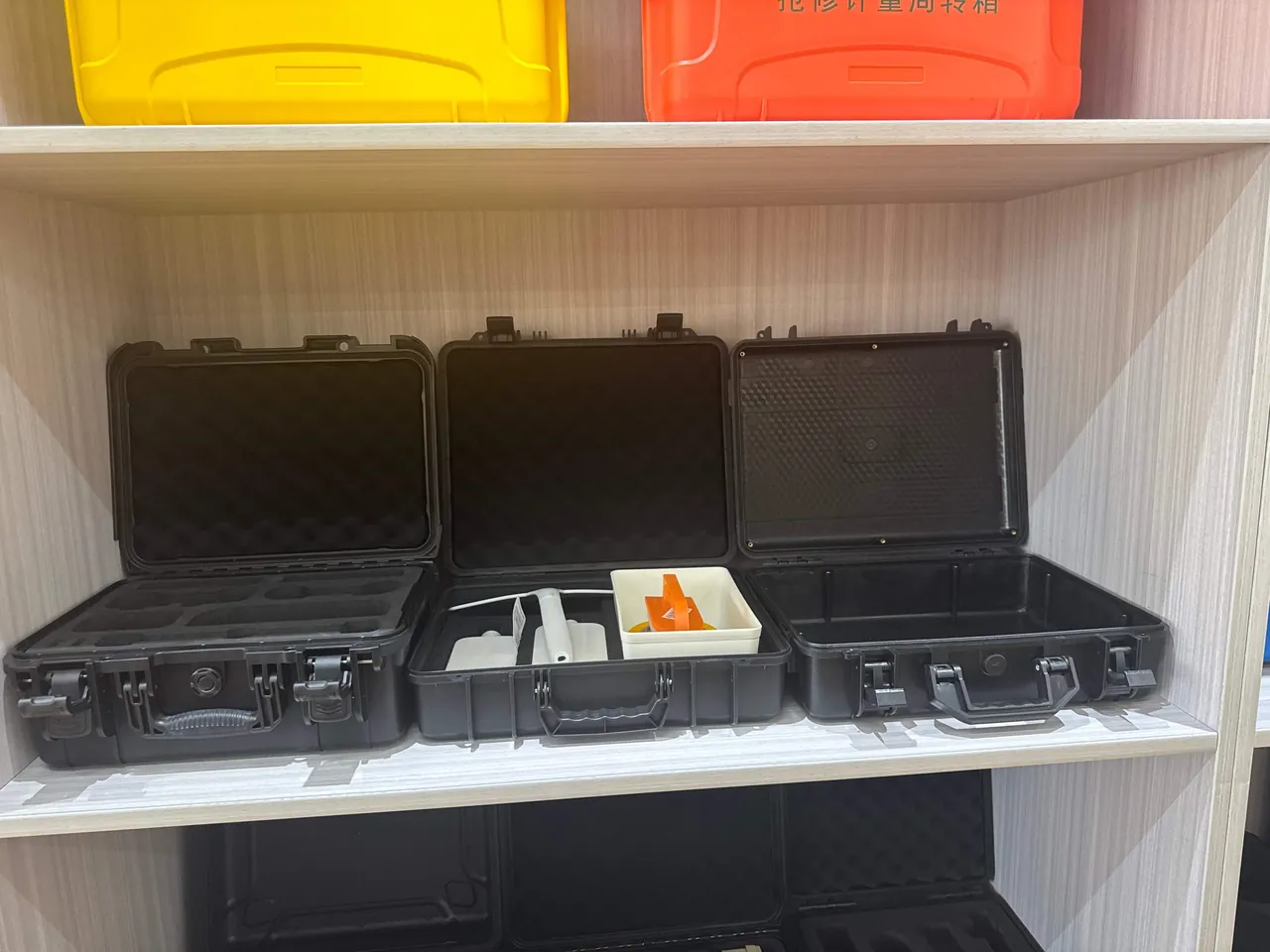
Foldable cases mainly follow three lines: PP injection-fold, PE soft-fold, and oxford cloth with PP board. PP injection-fold cases are rigid, stackable and dimensionally accurate, suited to standard turnaround; PE soft-fold cases roll and compress and resist low temperature, suited to irregular light goods; oxford cloth with PP board is lightest and most compact, suited to linen, tools and outdoor.
| Route | Advantage | Disadvantage | Suitable for |
|---|---|---|---|
| --- | --- | --- | --- |
| PP injection-fold | Rigid, stackable, accurate | Limited fold cycles | Standard turnaround |
| PE soft-fold | Rollable, low-temp resistant | Soft wall, weak to press | Irregular light goods |
| Oxford cloth with PP board | Lightest, most compact | Weak protection, puncture | Linen, tools |
Selection depends on goods and frequency: standard box-style turnaround chooses PP, cold-chain soft goods choose PE, linen and tools choose oxford cloth. JUNZHJIA keeps latch compatibility across the three lines, letting users build cases by "light turnaround". For inner shock needs, refer to the cushion liner case.
The key physical differences of the three material routes also decide their temperature band and life. PP injection-fold cases are rigid and dimensionally stable, with a typical temperature band of about -10°C to 80°C, suited to normal-temperature standard turnaround; PE soft-fold cases have good low-temperature toughness, typically about -40°C to 60°C, suited to cold chain and outdoor; oxford cloth with PP board is the lightest but its fabric has limited temperature and puncture resistance, suited to linen, tools and other low-impact light goods. Values are experience ranges, to be confirmed against the material TDS. If the turnaround involves oil or chemical media, confirm the chemical resistance of the board and fabric; if food or medical contact is involved, confirm compliance with the relevant food-contact migration limits and prefer closed-cell or washable structures that do not shed particles.
For humidity-sensitive light goods, add desiccant or a moisture-proof liner inside and reinforce locally with the sealing thinking in waterproof protective boxes and floating waterproof cases. A reminder: a foldable case's sealing is limited by its fold seams; if the contents are extremely humidity-sensitive, switch to a one-piece injection or rotomolded sealed case rather than stacking too much sealing expectation onto a foldable one.
Size and Folded Thickness
The value of a foldable case is measured by "fold ratio": loaded height divided by folded height. Good products have a fold ratio of 3:1 to 5:1, that is, after collapsing they occupy only two to three tenths of the original height. Sizes are standard module and custom: standard bases are 600x400, 500x350 and so on, good for pallets and compartment stacking; custom by goods shape.
Folded thickness also depends on whether the base and latches protrude. A folding base with protruding latches adds thickness; a fixed base with thin walls is flatter. Procurement should confirm "folded outer dimension" not just "folded height", because latches and labels may extend out. For return ride-sharing, thin means more loaded. Related small-part storage can be combined with the parts box series.
The module affects pallet utilization: same-module foldable cases can stack very high when empty and fill pallets when loaded, leaving no empty compartment. Long-term projects benefit from a standard module more than non-standard for turnaround and spares.
Size selection must also satisfy two constraints at once: "loaded can hold, collapsed can store". The loaded state should give an internal clearance slightly larger than the largest goods with 10–20 mm margin, avoiding forced loading that cracks the walls; the collapsed state should fit shelf layer height, compartment door height and arm reach, avoiding "flat enough but too heavy to move". Measure three bottlenecks first — shelf layer height, vehicle door clear height, elevator diagonal — then derive the case module. For automated high-bay warehouses or conveyor lines, also confirm the flatness and rigidity of the collapsed base, lest a soft wall or protruding latch jam on rollers.
The module and label positions should also be unified: one series uses consistent label slot positions and content format for cross-station counting and asset inventory. For group users, write module, material, latch and fold ratio into the procurement technical agreement, avoiding each branch buying its own type so cases cannot interchange and spares cannot be shared.
Load Capacity and Stacking
A foldable case carries less than a same-size hard case, because the wall is thin and relies on latches to pull tight. Ratings are mostly twenty to sixty kilograms, and stacking layers are limited by single-layer load and latch rating. When stacking, heavy bottom light top, align four corners, avoid eccentric load that cracks the hinge. JUNZHJIA recommends wall thickness by goods weight, heavy load chooses thickened PP or PE.
During dynamic transport, a foldable case is subjected to braking and turning forces, and the latch must resist shear. Vehicle use should secure with straps through limiting ribs and add anti-slip pads under the base. For extra height or weight, reduce layers and add straps. For stairs, foldable cases are light and easier to carry separately. Related load comparison is in the injection-molded case structure analysis.
A reminder: a foldable case is not the main stacking force; heavy goods stacking still uses hard cases. It handles "light goods high-frequency turnaround", leaving heavy protection to rotomolded and aluminum cases.
Staking safety also depends on alignment and load distribution. Because the walls are thin and rely on latches to hold the top edge, an off-center load concentrates stress at one hinge and quickly cracks it. Stack with the heaviest case at the bottom, keep the center of gravity near the geometric center of each case, and align the four corners so the upper case sits on the rigid posts rather than on a soft wall panel. Round or shifting goods should be secured with straps or dividers so they do not push the wall outward. On a vehicle, add a non-slip pad under the bottom case and strap the stack through the limiting ribs; for a tall stack, reduce one or two layers compared with the static rating to account for braking and turning dynamics. When in doubt, test the intended stack with representative goods for a short distance before a full rollout.
Protection Rating and Water Resistance
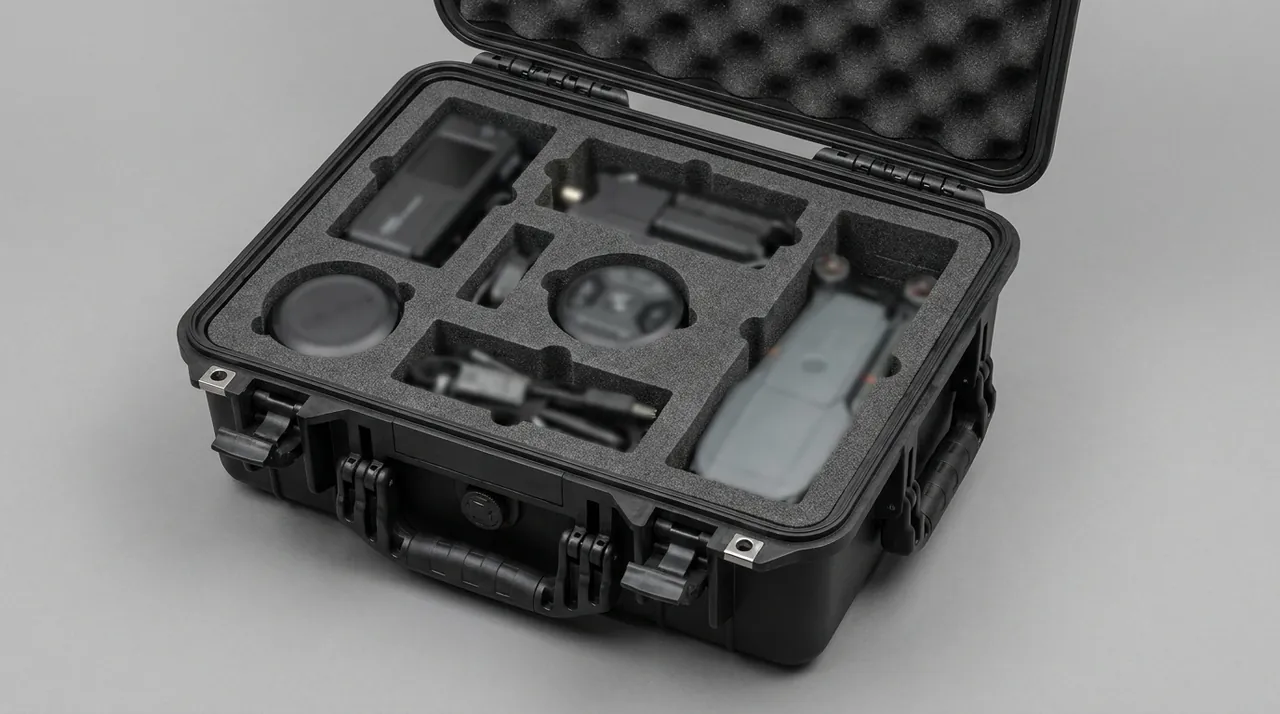
A foldable case focuses on "dust and splash protection", with weaker hard protection than rotomolded and aluminum cases. PP and PE bodies are waterproof, but fold seams and latches may seep, so they are mostly rated IP54 splash-proof rather than immersion. JUNZHJIA adds pressure strips at fold seams and flap covers at latches, so that in short rain transfer each case does not take in much water.
Understand foldable case waterproofing as "splash not immersion": short light rain and controlled compartment humidity are usable; long immersion and high-pressure washing are not. For overall watertight integrity, use a hard case or sealed container structure. Equipment with holes is fitted with waterproof breathable valves. More is in waterproof rating and IP realization.
For dust protection, a foldable case closes well after lid down, suited to clean workshops and light electronic turnaround. Select by condition: indoor IP54, outdoor vehicle chooses pressure-strip version.
Protection ratings should follow a recognized standard so the claim is verifiable. The IP code is defined in IEC 60529, mirrored domestically as GB/T 4208; a foldable case is normally specified as IP54, meaning dust-protected against limited ingress and protected against splashing water from any direction. It is not intended to pass the 1 m/30 min immersion test of IP67, and buyers should not assume otherwise. If the operator nonetheless needs an immersion-grade result, the correct answer is a different product class, not a heavier foldable case. Impact protection can be described with the IK code (IEC 62262) if relevant. In procurement, ask for the IP test report and confirm the tested configuration matches the delivered product, since a gasket added only on the sample will not appear on the production line unless specified. For dust-sensitive contents, prefer a version with pressure strips and a tight latch, and add a dust filter on any breather.
Internal Dividers and Storage
A foldable case can be fitted with partitions, inserts and straps inside, so light goods each have their place. JUNZHJIA supplies same-module liners, replacing one damaged piece at a time. Linen uses mesh bags, tools use partitions, cables use cable managers; deployed, you know what is missing at a glance.
Liners are selected by goods type: small parts use blister trays, files use pockets, rolling items use grids. For precision light goods, the cushion liner case approach applies; adding shock pads inside prevents vibration. Label content and number of each case to form a list clear at shift handover.
Internal modularization reduces misassembly and search, and helps inventory and audit. Multi-case systems recommend unified label positions for convenient asset management.
Space Saving and Portability
The biggest selling point of a foldable case is space saving: empty return cases collapse, so the fleet carries more goods or runs one fewer trip, directly cutting logistics cost. For densely networked distribution, door-to-door repair and exhibition materials, space is money. The higher the fold ratio, the more the return saves.
Portability shows in light weight and carry-ability: a PP foldable case is mostly one to three kilograms, more than half lighter than a same-size hard case; the oxford cloth version can be carried on one shoulder. For hiking outdoor and door-to-door service, light means carrying more. For systems that need to move with you, refer to the modular case system.
Cost accounting: for a station network of a thousand cases, the compartment volume saved by collapsing on return can be converted into trips and fuel, saving considerably per year. Write fold ratio into the procurement indicator.
A finer space estimate can be laid out as follows: assume a station has one thousand foldable protective cases, each 400 mm high loaded and 120 mm high collapsed, then each case saves about 280 mm of height on an empty return. If the compartment has a net height of 2.6 m and a floor area of 20 m², a full load stacks about six layers; collapsed, the same vehicle stacks more than twenty, so the return trips occupied by empty cases can drop several-fold. Convert that difference into trips, fuel and labor and it is the real value of a foldable case. Note that the space saving of a collapsible storage case depends on disciplined folding — a wall not fully laid down, a protruding latch or an outward label all eat into the fold ratio, so training and limit markings affect the actual payoff too. For mixed scenarios where the return is not fully empty, combine "heavy hard, light fold" with "carry out, flatten back": heavy goods in hard cases, light consumables in foldable cases, and flatten the foldable ones first on return to maximize the load factor of every trip.
Typical Application Scenarios
Foldable cases suit "light goods high-frequency turnaround": express station return crates, door-to-door repair tools, exhibition materials, fresh cold-chain return boxes, medical linen, and outdoor light packing. Their commonality is outbound with goods, empty on return, and needing to save space.
In distribution, foldable cases circulate as standard turnover crates; in repair, they carry common tools to the door and collapse on return to save vehicle space; in exhibitions, materials deploy at the show and collapse to return to storage. A reminder: if goods are heavy or need hard protection, a single protective case is safer; only "light and empty return" goes to a foldable case. Before selection, clarify goods weight and return ratio.
Across these scenarios the decisive variable is how empty the return trip is. A network that sends goods out and returns nearly empty gains the most, because the case spends most of its life collapsed. A network whose return is also loaded gains little and should look at hard cases with better stacking instead. It also pays to note the handling environment: a foldable case used on gravel or in wet weather will wear faster at the base and seams, so pick a version with a reinforced base and splash strips. For outdoor or hiking use, the oxford cloth version wins on weight, but it should not be used for anything sharp or wet that can seep, because the fabric offers little puncture or immersion protection. Matching the case to the actual trip profile, not to a brochure, is what turns the theory into daily savings.
Difference from Rotomolded and Injection Cases
Rotomolded and injection hard cases always occupy one volume, with strong protection and heavy stacking; foldable cases have variable volume, weak protection and light stacking. Selection depends on "whether return is empty and goods weight": heavy goods with hard protection use hard cases, light goods with empty return use foldable cases.
Mixed strategy: heavy and valuable items use their own hard cases, light consumables use foldable cases, balancing protection and space. JUNZHJIA recommends "heavy hard, light fold", assigning case type by goods rather than one size fits all. Related single-case selection is in military protective case selection.
For a quantified comparison, the table below uses the same size class as a reference, showing the typical differences between a foldable protective case and hard cases for quick judgment at selection:
| Dimension | Foldable Protective Case | Rotomolded | Injection-Molded |
|---|---|---|---|
| --- | --- | --- | --- |
| Empty volume | Variable, under 30% | Fixed | Fixed |
| Fold ratio | 3:1 to 5:1 | — | — |
| Ingress | IP54 splash mainly | IP67 easy | IP65 common |
| Rated load | 20 to 60 kg | Medium-high | Medium |
| Stacking | Light | Strong | Medium |
| Unit weight (PP) | 1 to 3 kg | Heavy | Light |
| Return transport | Saves space | Occupies | Occupies |
| Typical use | Light, high-frequency empty return | Heavy protection | Standard volume |
The table also shows that a foldable instrument case and a collapsible storage case are positioned for "light turnaround and space saving", while rotomolded and injection cases are positioned for "heavy protection and standard volume"; the two are not substitutes but split the work by goods. At selection, ask three questions first: is the return trip empty? Does single-case weight fall in the rated band? Does it need to move with a cart on site? The answers basically decide whether to use a foldable or a hard case.
It must be clear: a foldable case does not replace a hard case, it fills the "light turnaround" gap, and the two coexist in warehousing and fleets.
Working with Tool Carts and Instrument Carts
A foldable case can go into the shelf of a tool cart or instrument cart, forming a "mobile foldable warehouse". The cart provides casters and worktop, the foldable case provides collapsible turnaround; the combination lets light goods move within a site and collapse into the compartment for long distance. JUNZHJIA supplies in-vehicle fixing parts so the foldable case locks in the shelf without sliding.
The key point of cooperation is dimensional connection: the foldable case base should fit into the door layer or fixed worktop, and the latch corresponds to the vehicle fixing point. For precision light goods, add shock pads on the cart. Related vehicle ideas are in the shock design of the instrument cart and lab trolley.
On return, foldable cases collapse inside the vehicle, freeing shelf space for other goods, one vehicle serves two uses. This is the unique value of foldable cases cooperating with hard cases.
Selection and Procurement
Procurement in four steps: define goods weight, select material, set module, fit latches. First list goods weight and return ratio; then select PP, PE or oxford cloth by goods; then set the module series; finally fit latches and label positions.
The contract should state: fold ratio, rated load, stacking layers, material and wall thickness, latch form, fold cycles, waterproof rating, and spare parts list. Military or certified projects need material reports. Customization includes non-standard size and inserts, but keep module compatibility as far as possible for turnaround.
Do not be led astray by "universal foldable case"; land on fold ratio, rating and fold cycles. Acceptance is based on on-site fold cycle and loaded stack test, checking hinge, latch and base.
Write the acceptance criteria into the contract appendix so the receiving inspection has a clear basis. Ask for the material TDS, the fold-cycle data for the chosen material, the IP test report, and, for certified projects, the restricted-substance declarations (such as RoHS and REACH). Agree on an AQL sampling plan and a non-conformance process. Keep an approved reference sample and photos of the correct folded and deployed states; when a later batch feels different, the sample settles the question quickly. For a fleet rollout, standardize the module and latch across all stations so a case can move between sites and still fit the same cart, shelf and spare kit — this is what keeps a pilot tidy into a lasting system.
Use and Maintenance
Daily maintenance: clean and lubricate latches, prevent debris at fold positions; check sealing ring elasticity if any, replace if hardened or cracked; clean base of entangled wires and debris. In salt spray environment, remove rust and repaint hardware.
Inspection: whether walls stand straight, latches anti-loosening, base laid flat, labels intact. If wall crack or latch failure is found, stop use and return for repair. For long-term storage, avoid light, keep off ground, stand upright; collapsed state saves more space.
Foldable case life depends on fold cycles and material; after exceeding cycles the hinge degrades. Include fold counting in asset management and rotate at the point.
A short pre-use check keeps a fleet healthy: confirm the walls stand square, the latches engage with a clear click, the base is fully laid flat and the label is readable. If a wall leans or a latch is loose, take the case out of service before it fails under load. Clean fold positions of grit, which acts like sandpaper on the crease, and wipe spills promptly in food or medical use. Keep a small stock of latch and liner spares so a single worn part does not sideline a whole case. Over a year, this discipline costs little and prevents the small failures that otherwise turn into damaged goods or a stalled route.
Sustainability and Customization
Foldable cases are light, recyclable, with interchangeable accessories, and a standard module helps turnaround. PP and PE are recyclable, oxford cloth can be washed and reused. JUNZHJIA keeps standard latch and liner spares, with small repairs extending life. During customization, include repairable and recyclable items as indicators.
Procurement can require material declarations and restricted-substance lists, especially important for export projects. A standard module is more favorable for spares and expansion than non-standard. Include foldable cases in asset management, with labels and lists, to extend life and reduce total cost of ownership.
Sustainability also shows up in repair rather than replacement. Because the body, latches and liners are separable, a worn latch or a cracked liner can be swapped without discarding the whole case, and PP and PE are widely recyclable while oxford cloth can be washed and reused. When specifying, include repairability and recyclability as selection indicators, and ask the supplier to keep common spares available over the product's life. A fleet that repairs at the part level, tracks fold counts and rotates cases on schedule will spend far less over five years than one that replaces whole cases whenever a single component wears out.
Frequently Asked Questions (FAQ)
Question: Can a foldable protective case replace a hard protective case? Answer: It cannot replace a hard case, it supplements it. The division of labor is clear: a foldable protective case handles the "light goods, high frequency, empty return" part of the turnaround, trading collapsible walls for return and storage space; rotomolded and aluminum cases handle heavy protection, heavy stacking and shielding, trading fixed volume for strength and sealing. A common mistake in practice is using a foldable case for heavy or precision goods, only to crack the hinge or damage the equipment through vibration. The right approach is to assign case type by goods: heavy and valuable items go in hard cases, light consumables and standardized turnaround parts go in foldable cases, which is the "heavy hard, light fold" principle JUNZHJIA recommends. Two criteria decide it: first, is the return trip empty (a high empty-return share justifies a foldable case); second, does single-case weight fall within the rated 20-60 kg band. When both hold, a foldable case can significantly cut fleet and storage cost; otherwise use a hard case. The two coexist in fleet and warehouse, and combining them balances protection and space saving.
Question: What is the typical fold ratio of a foldable case? Answer: The fold ratio is the first indicator of a foldable case's value, defined as loaded height divided by folded height. Good products usually have a fold ratio of 3:1 to 5:1, collapsing to two to three tenths of the original height; a ratio below 3:1 saves little space and is close to an ordinary low box, so the value for money is weak. The fold ratio is affected by three things: how the walls and base fold (a folding base collapses flatter), whether latches and labels protrude (protrusion adds folded thickness), and the material (oxford cloth with PP board is flattest, PP injection next, PE soft-fold in between). So procurement must confirm the "folded outer dimension" in three dimensions, not just the "folded height", because latches, handles and labels may stick out and make actual stacking bulkier than the nominal figure. For return ride-sharing or multi-layer stacking, the thinner the folded case, the more fits. Write the target fold ratio and folded outer dimension into the procurement specification, and verify with a physical flatten test on acceptance, avoiding a mismatch between paper data and reality.
Question: How high can a foldable case be stacked? Answer: A foldable protective case carries less than a same-size hard case, because the walls are thin and rely on the latches pulling the top edges tight for rigidity; ratings are mostly twenty to sixty kilograms, and stacking layers are limited by both single-layer load and latch rating, so you cannot simply apply "hard case experience". When stacking, follow three rules: heavy bottom, light top; align the four corners; avoid eccentric load, which most easily cracks the hinge or makes a wall lean inward. In dynamic transport the case is subjected to braking and cornering shear, so the latch must resist shear; for vehicle use, secure with straps through the limiting ribs, add anti-slip pads under the base, and reduce layers with extra straps when the load is too tall or heavy. JUNZHJIA recommends wall thickness by goods weight, choosing thickened PP or PE for heavy loads, and states clearly that "a foldable case is not the main stacking force". If goods truly need heavy multi-layer stacking, switch to rotomolded or aluminum cases and leave the foldable case to the light, high-frequency turnaround stage, which is both safe and economical.
Question: Is a foldable case waterproof? Answer: A collapsible storage case is positioned for "dust and splash protection", not immersion-level watertightness. PP and PE bodies themselves do not absorb water, but the fold seams and latches are potential seep points, so such cases are mostly rated IP54 splash-proof rather than IP67 brief immersion. The industry approach adds pressure strips at the fold seams and flap covers at the latches, so a short transfer in rain does not let much water into the case. Understand the boundary of "splash not immersion" when buying and using: short light rain and a compartment with controlled humidity are fine; long immersion, high-pressure washing or floating the whole case are not. If the device itself needs overall watertightness, switch to a rotomolded, injection-molded or sealed container structure rather than expecting it from a foldable case. For equipment with openings, such as instruments that need cooling or venting, fit a waterproof breathable valve to equalize pressure. For dust, a foldable case seals well with the lid down and suits clean workshops and light electronic turnaround; grade by condition, IP54 indoors and the pressure-strip version outdoors on vehicles.
Question: How to choose PP, PE or oxford cloth? Answer: Each of the three material routes has its place. PP injection-fold is rigid, stackable and dimensionally accurate, with relatively limited fold cycles, suiting standard box-style turnaround and scenes that need stacking; PE soft-fold rolls and compresses and resists low temperature, but its walls are softer and weak against pressure, suiting cold-chain soft goods and irregular light goods; oxford cloth with a PP board is lightest and most compact, but has the weakest protection and fears sharp puncture, suiting linen, tools and light outdoor gear. The judgment dimensions are "goods type plus frequency plus protection need": standard high-frequency turnaround chooses PP, cold-chain soft goods choose PE, linen and tools choose oxford cloth. JUNZHJIA keeps latch compatibility across the three material lines, so users can mix one set of latch and label specifications and build cases flexibly by "light turnaround", cutting spare and training cost. If the case needs shock absorption, add a cushion liner; if it needs to move with a cart, use it on the shelf of a tool or instrument cart. In short, there is no best material, only the material that best matches the goods and frequency.
Question: What does foldable case life depend on? Answer: The life of a foldable case depends mainly on fold cycles and material; the spec often states something like "five thousand cycles", and procurement should require the maker to give the cycle life for the given material and write it into the technical agreement. The hinge is the weak point: PP creases depend on material toughness and wall thickness, and too thin cracks easily; PE fold edges depend on heat-seal strength, and a broken seal leaks; the PP board depends on stiffness, and once bent it is hard to restore. After exceeding the rated fold cycles, the hinge degrades stepwise, showing as whitened creases, cracks, or walls that sag after standing, at which point the case should be rotated out or repaired. The key to reducing early damage is disciplined operation: do not force an unlocked wall, do not step on an un-laid base, do not overload until it deforms — these wrong operations are the main cause of a foldable instrument case failing early. Include fold counting in asset management, set a rotation period by turnaround frequency, and check hinge, latch and base after each cycle. Changing life management from "replace when broken" to "rotate on schedule" significantly lowers total cost of ownership.
Question: Can a foldable case go onto a tool cart or instrument cart? Answer: Yes, and it is recommended. Placing a collapsible storage case on the shelf of a tool cart or instrument cart forms a "mobile foldable warehouse": the cart provides casters and a worktop, the foldable case provides collapsible turnaround volume, and together they let light goods move freely around a site and collapse into the compartment for long distance. The key to cooperation is dimensional connection — the case base should fit into the door layer or fixed worktop, and the latch position should match the vehicle fixing point; JUNZHJIA can supply in-vehicle fixing parts so the case locks in the shelf without sliding. On return, the foldable case collapses inside the vehicle, freeing shelf space for other goods to achieve "one vehicle, two uses", which is the unique value of combining foldable cases with hard cases and vehicle bodies. For precision light goods, add shock pads on the cart or use the vibration-damping design of an instrument cart to avoid transport vibration damaging equipment. At selection, first measure the inner dimensions of the compartment and shelf, then set the case module and folded thickness, ensuring it fits when standing and stows when collapsed, avoiding the common problem of "bought it and it does not fit".
Question: How to fit internal dividers? Answer: Inside a collapsible storage case you can fit partition boards, inserts and straps so light goods each have their place. JUNZHJIA supplies same-module liners, replacing one damaged piece at a time and lowering maintenance cost. Choose by goods type: small parts use blister trays, documents and papers use pockets, rolling round items use grids, and cables use cable managers or coil grooves; linen can use mesh bags for ventilation. With shadow management (each item in a fixed position), deployment shows at a glance what is missing, which suits "list handover" scenes such as door-to-door repair and exhibition setup. For precision light goods, borrow the cushion liner approach and add shock pads inside. Label the content and number of each case to form a list that is clear at shift handover; a multi-case system should unify label positions for easier asset management. One reminder: foldable case walls are soft, so liners should not be too tight, or they press the walls when deployed and interfere with standing; leave clearance in the design. Internal modularization reduces misassembly and searching and helps inventory and audit, an important part of light-goods turnaround management.
Question: What parameters should procurement specify clearly? Answer: Procurement of a foldable protective case is best done in four steps: first define goods weight and empty-return share, then choose the material (PP, PE or oxford cloth), then set the module series, and finally fit latches, liners and label positions. The contract should state: fold ratio, folded outer dimension, rated load, stacking layers, material and wall thickness, latch form, fold cycles (cycle life), waterproof rating, spare parts list, and the material report required for certified projects. For customization, non-standard size and inserts are allowed, but keep module compatibility as far as possible for turnaround and shared spares. Acceptance must not rely on a single sample; base it on an on-site fold cycle test and a loaded stack test, checking whether the hinge cracks, the latch resists loosening, the base lays flat, and the folded thickness meets target. Do not be led astray by "universal foldable case" marketing; land on the three hard indicators of fold ratio, rated load and fold cycles. Write standard numbers, material declarations and restricted substances (such as RoHS, REACH) into the contract to reduce disputes at volume and export acceptance.