

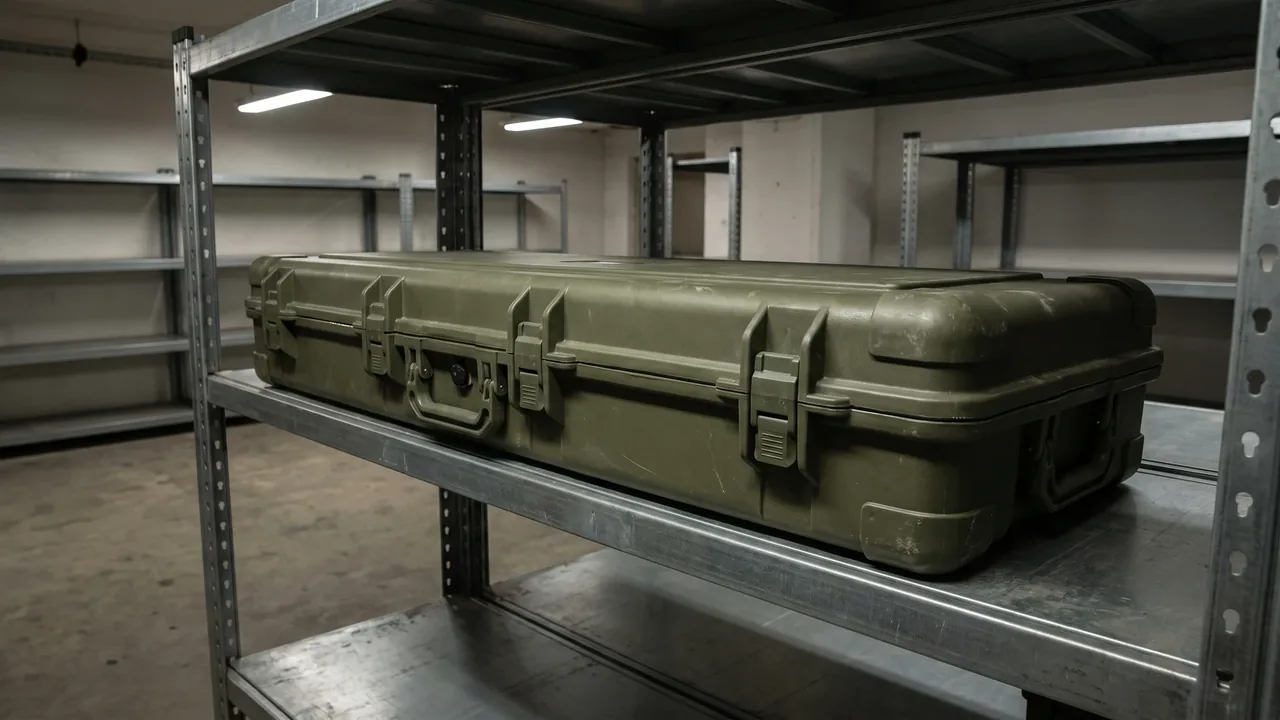
In defence procurement and armoury management, "military firearm boxes" is often treated as a single line item on a tender, and it is only at acceptance, stacking or issue that the buyer discovers a Military Firearm Storage Case and a storage box are not remotely the same product. The first is built for fixed armoury storage, long-term reserve and bulk stacking, and is judged on load capacity, sealing, rust prevention and traceability. The second serves unit equipment management — drawing, issuing and carrying on the move — and is judged on low weight, compartmentalisation, fast retrieval and mistake-proofing. Confusing the two usually produces one of two failures: a case stiff enough for the depot but too heavy to issue efficiently, or a box light enough to carry but unable to survive multi-layer stacking. As a manufacturer of firearm protective cases, JUNZHIJIA sets out the container-engineering boundary between a Military Firearm Storage Case, a firearm storage case and a military firearm storage box, so that defence buyers, armoury staff and unit equipment managers can select against the real scenario.
One scope note applies throughout. This article discusses only the container itself — shell structure, material, sealing, liners, locks, rust prevention and traceability configuration. It does not address equipment operation, propellant handling or any technical ordnance content. Where defence trade and export are involved, local regulations and export-control requirements govern, and this article covers packaging containers only. The sections that follow work through storage scenarios, shell materials, liner restraint, sealing and pressure equalisation, rust prevention and desiccant management, locks and seals, traceability marking, testing and compliance, stacking and loading, and finally an executable selection checklist.
Military Firearm Boxes: A Storage Case Is Not a Storage Box
Start with the distinction. A Military Firearm Storage Case generally means a container large enough to hold a batch or a complete set, engineered around stacking load, IP sealing, lifting and forklift interfaces and long-storage rust protection. A military firearm storage box generally means a smaller container sized for one item or a small quantity, engineered around compartments, location features, one-person handling and rapid counting. The difference is not size in the abstract but the first design constraint: for the case it is storage efficiency and whole-life reliability; for the box it is issue efficiency and counting accuracy.
Once that boundary is explicit, procurement stops grading two different products against one specification. Three mismatches recur. First, a storage box is required to meet case-level stacking load, so the walls thicken and the weight rises, eroding the very portability that justified a box. Second, a storage case is required to open as quickly as a box, so the sealing geometry is simplified and long-term moisture protection quietly degrades. Third, both are accepted against a single test sheet, ignoring that a box lives or dies by liner dimensional accuracy while a case lives or dies by shell rigidity. When JUNZHIJIA scopes a requirement with an armoury or a unit equipment office, the first question is always whether the container goes into a depot or onto an equipment vehicle, because that single answer sets roughly seventy per cent of the structural trade-offs that follow.
The Armoury Storage Scenario: Where Military Firearm Storage Cases Fit
Armoury storage has recognisable characteristics: equipment sits still for long periods, movement happens in large batches, space is used through multi-tier racks or floor stacking, and temperature and humidity swing with the seasons. Together these push stacking load and sealing to the front of the design brief. In a stacked store, lower cases carry the static weight of everything above them for months; if shell rigidity is marginal the wall creeps outward, the sealing face distorts with it, and a protection rating that passed at acceptance quietly fails a few months later. Case wall thickness therefore cannot be derived from payload weight alone — it must carry a rigidity margin for the stack height and the storage duration.
Environmental isolation is the second core requirement for a storage case. Even with air conditioning and dehumidification, a depot will see short periods of high humidity during a wet season, at a coastal station or in an underground store. A case holds its own microclimate behind a channel gasket and a pressure-equalisation valve, with desiccant keeping internal humidity low so that equipment never meets outside moisture between openings. JUNZHIJIA treats "closed means isolated" as the acceptance principle for such cases: once the lid is latched, the sealing line must be continuous and untwisted, and the pressure-equalisation valve must stay clear without over-venting.
Stacking and handling interfaces are equally mandatory. Depots use racks, pallets and forklifts, so a case needs locating features on the base, a matching load-bearing surface on the lid, and recesses or lifting points at the ends. JUNZHIJIA builds heavy storage cases with reinforcement ribs and a double-wall lid so that upper loads travel down the walls to the floor rather than through the contents, and provides cross-stacking positions so that stacked cases cannot shift into an eccentric arrangement.
The Issue and Distribution Scenario: What Military Firearm Storage Boxes Do
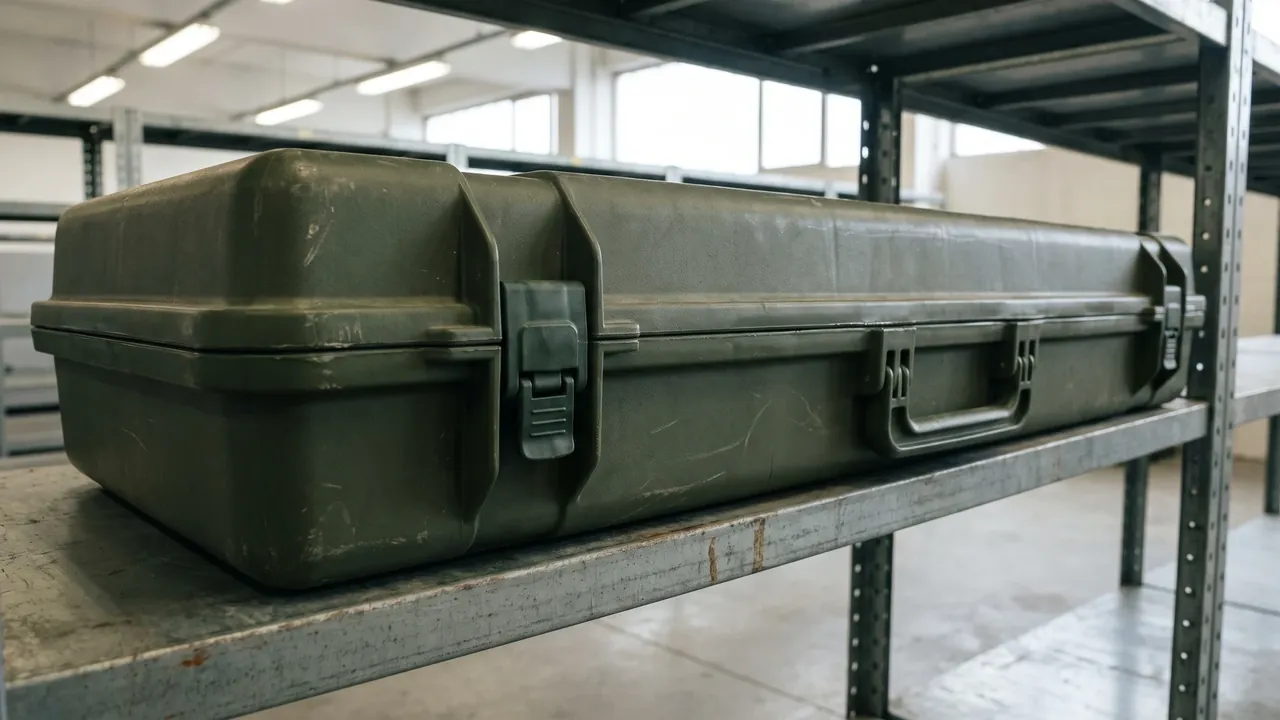
Unit equipment management cares about issuing the right item, counting it quickly and carrying it easily. A military firearm storage box earns its place through compartments and mistake-proofing. An issue event typically covers several items and accessories; mixed into one large case, counting means digging item by item, which is slow and error-prone. By fixing "which item belongs in which compartment" through dedicated cells and restraint features, a box lets the receiving soldier take and return by cell, and lets the equipment manager count by cell, cutting both time and error.
Portability is the second value. A box must stay within one-person carrying weight while keeping its locating accuracy through repeated opening and closing. JUNZHIJIA specifies a tough modified engineering plastic for these shells, uses a single-wall or reinforced single-wall lid to save weight, and selects fatigue-resistant hinges and latches so that position accuracy survives a high opening cycle. For boxes that travel on equipment vehicles, anti-slip feet on the base and stacking recesses on the lid keep the box from sliding in the cargo area and allow a modest amount of stacking.
A word of caution: a storage box is not simply a scaled-down storage case. As dimensions shrink, liner thickness, cell wall thickness and latch size all approach process limits, and copying a case sealing geometry into a box often fails because the lid lacks the rigidity to compress the gasket properly. JUNZHIJIA treats box sealing as its own design problem, pairing a thickened lid zone with a dedicated gasket groove so that effective sealing is achieved within a limited weight budget rather than by shrinking a large-case structure.
Shell Materials and Structural Strength: Choosing a Firearm Protective Case
Shell material sets the protection envelope of a firearm protective case. JUNZHIJIA commonly works with modified polypropylene, ABS and PC alloys. Modified PP offers good toughness, chemical resistance and moderate cost for larger cases whose duty is stacking load; ABS offers high surface hardness and a clean appearance for contents with precision parts; PC alloy excels in impact resistance for mobile scenarios with wide temperature swings. Where higher rigidity or stricter fire performance is required, rotationally moulded HDPE, steel or aluminium shells enter the picture, but the weight penalty of all three must be written into the specification so that a case cannot pass on paper and then be impossible to handle.
Beyond material, structural detailing usually matters more. Rib layout, corner radii, the double-wall lid, and local thickening at hinge and latch seats decide how a shell of a given material behaves in a drop or under a stack. JUNZHIJIA's rule is to spend material where it carries load: cross ribs at wall corners and the centre of the base, local thickening at stress concentrations instead of uniform thickening, and a double-wall lid for bending stiffness. This keeps weight under control while preventing the sealing face from distorting through lack of rigidity. For military firearm boxes that serve for many years, selection must also consider UV resistance and low-temperature toughness, so that outdoor or cold-region storage does not embrittle the shell.
Liners and Restraints: Giving the Firearm Zero Freedom Inside
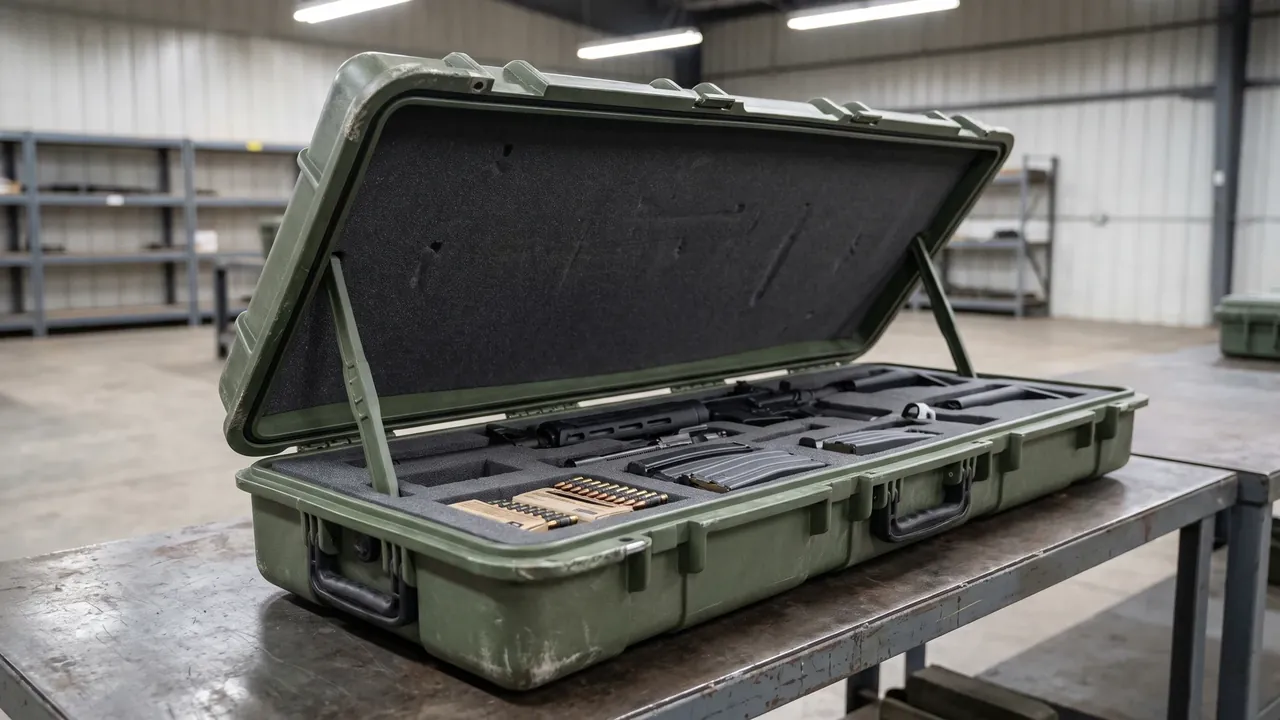
The shell provides external protection; the liner decides whether the contents can move inside. A Military Firearm Storage Case and a military firearm storage box share one liner goal — zero freedom for the load during transport and handling. There are two mainstream routes: a high-density EVA liner CNC-moulded to the actual profile, which gives the tightest fit and suits items of fixed shape; and adjustable dividers with pre-cut foam, which is more flexible and suits reserves whose mix changes over time.
Seen from an engineering angle, the liner does more than cushion — it spreads impact from a point into a face. When a case is dropped or a vehicle brakes hard, the inertia of the contents concentrates at a few contact points. If the cavity leaves clearance, the item accelerates before striking the cavity wall, adding a second impact. A moulded liner matched to the profile leaves almost no room to accelerate, so the closed-cell structure absorbs the shock as a whole. In firearm protective case liners, JUNZHIJIA also recesses precision zones so machined surfaces never touch a hard liner face, and uses removable dividers where items are handled often, balancing fit against flexibility.
Acceptance of a liner should check three things: whether the clearance against the item profile still leaves margin at the tightest point rather than clamping it, whether the recesses line up with the precision zones, and whether a locating feature between liner and shell stops the whole liner from shifting. Miss any one and a high-precision case degrades in service into ordinary packaging.
Sealing and Pressure Equalisation: Environmental Isolation in an IP67 Case
Sealing is the signature capability that separates a firearm protective case from an ordinary toolbox. An IP rating uses two digits: the first for dust, the second for water, and IP67 means dust-tight and protected against short immersion. Achieving IP67 consistently in volume production depends not on a thicker gasket but on consistent sealing geometry and controllable closing force. JUNZHIJIA uses a channel-type gasket at the joint face; when the lid is latched, the gasket is compressed into a continuous sealing line, and the channel restrains it from shifting during compression so no weak spot can form.
The pressure-equalisation valve works with the seal. A case meets a pressure difference during air freight, high-altitude road transport or storage across sharp temperature swings: when outside pressure falls the case develops positive internal pressure that pushes the gasket outward, and when outside pressure rises or temperature drops the case develops negative pressure that makes the lid hard to open — and a lid that is forced open damages latches. The valve allows slow gas exchange while preserving waterproofing and dustproofing, holding the pressure difference within what the gasket can survive. JUNZHIJIA lists the valve as standard for long-haul and air transport, and reminds users to check that the valve body is not blocked by dust, because a blocked valve is no valve at all.
Long-term sealing also depends on maintenance. Under permanent compression and ultraviolet exposure a gasket gradually loses resilience and stiffens in the cold, so the same closing force produces less compression. JUNZHIJIA advises a check interval matched to opening frequency — quarterly for issue boxes opened often, and once at the start and end of the season for reserve cases kept closed — and replacement of the gasket as a whole once it shows permanent set, cracking or obvious hardening, never a local patch.
VCI Rust Prevention and Desiccant Management for Long-Term Storage
Long-term armoury reserve creates a hard requirement for rust prevention. Metal surfaces oxidise slowly in humid air; even without liquid water entering the case, condensation driven by day-night temperature swings attacks critical surfaces. The combination a firearm protective case uses is sealing to block outside moisture, desiccant to absorb residual water vapour, and VCI vapour-phase inhibitors to suppress corrosion on metal surfaces. VCI works by slow release of inhibitor molecules that form a monomolecular film on metal, delaying corrosion during storage even if the case is briefly opened or the seal is challenged.
Configuring VCI and desiccant has a few execution points. First, equipment should go in immediately after cleaning and drying, because residual oil or fingerprints prevent an even inhibitor film. Second, desiccant has a finite capacity and must be replaced or regenerated on a maintenance cycle, with a humidity indicator card giving a visible criterion. Third, VCI has its own shelf life, so a reserve case that stays closed for a long period should have inhibitor components renewed on schedule. When supplying armouries, JUNZHIJIA treats desiccant, indicator cards and VCI components as separate consumables so that the depot replaces them on a cycle instead of discovering a problem only at the next opening.
The case interior deserves the same attention. Dust or metal debris left from a previous load becomes an ongoing contamination source and consumes desiccant capacity, so JUNZHIJIA recommends clearing the interior and the gasket groove after every opening and confirming the case is clean before closing. It is a small step, but it decides whether long-term moisture control actually holds.
Locks, Tamper Seals and Access Control
A military firearm storage case and a military firearm storage box are both controlled-equipment containers, and locks and seals are the physical nodes in the management chain. On the lock side, the common options are key locks, combination locks, padlock shackle seats and multi-point latch structures. What matters is not lock complexity but whether the lock points match the lid clamping. A single lock on a long case tends to lift the sealing face at both ends, whereas multi-point latches spread the load so security and sealing reinforce each other.
Seals answer a different question: whether the container has been opened. A numbered one-time seal, a pull-tight seal or a tamper-evident label leaves a mark that cannot be restored, so any interference during transport or handover becomes visible. JUNZHIJIA supports a purpose-made seal passage on controlled containers and recommends that buyers record seal numbers in handover documentation. Where a higher control level is required, a drill- and pry-resistant latch seat can be used, but it raises opening time and should be balanced against how often the container is actually opened.
It is worth stating plainly that locks and seals are a management barrier with a defined limit. They do not replace depot access control, surveillance or personnel procedures. In discussions with armouries, JUNZHIJIA consistently frames the container's role as making every opening recordable and every handover checkable, not as a substitute for the system around it.
RFID and Barcode Traceability: The Information Interface
Modern armoury and unit equipment management leans on information systems, and a protective case is a natural anchor for traceability data because it carries the equipment. A common approach is a weather-resistant label area on the exterior carrying a barcode or QR code that records item model, batch and inspection date; where fast batch reading is needed, a bay for a passive RFID tag can be moulded into the shell. The label area must avoid protruding ribs and the gasket groove, and the label material must resist low temperature, ultraviolet and repeated wiping, or it will fail early outdoors.
Traceability data is a management lever, not just a record. Once every military firearm storage case or box has a unique number, the depot can hold stock by container, verify condition by container and trace inspection history by container, while the issue point can confirm handover by scanning rather than handwriting. JUNZHIJIA recommends binding traceability data to the maintenance log — for example recording when the desiccant was last replaced or the gasket last inspected — so that container upkeep becomes plannable work instead of a judgement call.
Note that information features raise unit cost and bring their own risks, such as worn labels and duplicated codes. A traceability scheme should match the management granularity actually needed: batch-level for reserve cases, item-level for issue boxes, rather than one high specification applied to every situation.
Testing and Compliance: MIL-STD-810H, GJB and Export Packing
Military firearm boxes should pass environmental and transport testing before a design is frozen, so that the design envelope is known rather than assumed. Internationally, MIL-STD-810H environmental test methods cover vibration, shock, temperature, humidity and salt fog; in domestic defence supply, the GJB series sets requirements for material, structure and environmental adaptability; at the transport-packing level, the GB/T 4857 series, the ISTA procedures and the ATA 300 specification for international air transport are commonly cited. Test selection should follow the actual scenario, because a depot reserve and a mobile issue duty do not share one profile.
In development, JUNZHIJIA designs drop height and vibration spectrum around the real loaded weight and centre of gravity, verifying how the shell, liner and seal behave at the limit rather than testing an empty case. An empty case proves little, because the real risk comes from the inertia of the mass inside. Acceptance should focus on three items: liner fit against the contents, seal integrity and compression, and the assembly strength of latches and hinges. These map to anti-shift, moisture control and durability, and they are also where batch variation is most likely.
Where defence trade and export are involved, product testing is only part of the picture. Packing marks, dangerous-goods classification where applicable, wood-packaging phytosanitary rules and destination market access may all apply. The specific clauses that govern should be confirmed against local regulations and export-control requirements; this article covers the design and selection of the packaging container only, and does not address controlled technical content.
Stacking, Lifting and Palletised Loading
Once a container enters storage and logistics, stacking, lifting and loading become the real cost drivers. The stacking capacity of a Military Firearm Storage Case comes from shell rigidity and the design of the stacking surfaces: base and lid features should interlock to stop the upper case sliding, and the number of layers should be set from a rigidity test at full load rather than an empty-case estimate. JUNZHIJIA provides wall-thickness and rib configurations for reserve cases together with load guidance for different stack heights, so a depot can raise space utilisation without overloading the lower layer.
Lifting and forklift interfaces are mandatory on heavy shells. Lifting points should sit where rigidity is high so the shell cannot tear locally, and forklift recesses should let the forks enter cleanly without pressing on the base gasket. For cases moved often, pallet-mounting holes on the base let the case form a single unit with a standard pallet, improving handling efficiency and reducing the knocks that come from moving cases one by one.
Palletised loading also needs attention to centre of gravity and stability. Cases on one pallet should be of similar height, with heavy cases low and light cases high, so that no upper case bridges a gap and creates an eccentric load. In a container, the regular shell shape allows dense packing, with stretch film or strapping holding the unit together against inertia in transit. JUNZHIJIA normally supplies a loading diagram with delivery documents so that store staff can build a stable unit quickly.
The Selection Decision: Where Storage Case Meets Storage Box
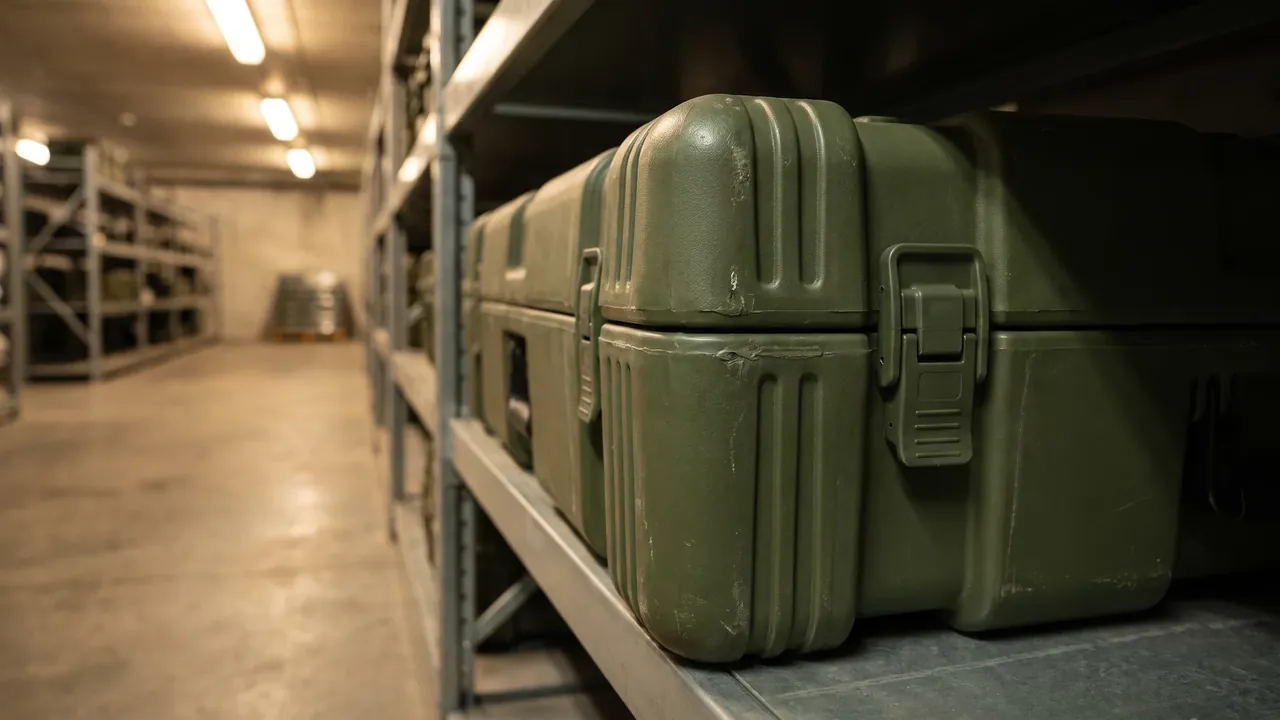
Reducing the analysis to an executable sequence keeps procurement and equipment management from taking wrong turns. Step one: confirm whether the scenario is long-term depot storage or issue on the move, which decides whether the container follows the case route or the box route. Step two: confirm whether the loading unit is a batch or a complete set versus one item or a small quantity, which decides shell size and liner route. Step three: confirm environmental conditions — depot humidity, coastal exposure, air freight, temperature range — which decide sealing level, pressure-equalisation valve and rust prevention. Step four: confirm management granularity, including whether item-level traceability or sealed handover is required, which decides locks, seals and labelling. Step five: confirm logistics, including stack height, pallet size and handling equipment, which decides stacking structure, lifting interfaces and loading pattern.
For a tender document, these five steps should become verifiable clauses rather than a general phrase such as "meets military standard". Write the sealing level as a specific IP rating, the stacking capacity as a layer count at full load, the liner requirement as a fit tolerance against the contents, and the rust protection as a specific form of VCI and desiccant. In helping defence buyers draft specifications, JUNZHIJIA finds that the more specific the clause, the fewer the disputes at acceptance and the more comparable the quotations between suppliers. It bears repeating that for any defence-trade or export purchase, the compliance requirements follow local regulations and export-control rules, and this article covers the packaging container only.
Common Misconceptions and Corrections
The first misconception is treating the IP rating as the sole selection metric. IP67 says only that a case is dust-tight and water-resistant; it says nothing about stacking strength, liner accuracy or rust protection, and an IP67 toolbox will not meet the duty of a long-term armoury reserve. The second is judging full-load performance from empty-case test data, ignoring how internal inertia amplifies shock. The third is dropping the pressure-equalisation valve in pursuit of light weight, so that sealing fails or the lid jams under air freight and temperature swings. The fourth is treating the liner as optional and substituting generic foam, leaving items free to move inside. The fifth is buying only the shells and carrying no consumables budget, so expired desiccant and VCI are never replaced and long-term moisture control exists only on paper.
The common correction is to procure the container as a system rather than a box. Shell, liner, seal, lock, rust-prevention consumables and traceability marking all belong to one scheme, and any missing part drags the whole down. When working with armouries and unit equipment offices, JUNZHIJIA first establishes the scenario and the maintenance capability on site, then configures a product at the matching level, avoiding the trap of a high specification that nobody can maintain. For military firearm boxes that serve for many years, maintainability usually matters more than a peak performance figure.
FAQ: Military Firearm Box Selection
Q: What is the fundamental difference between a Military Firearm Storage Case and a military firearm storage box? A: The fundamental difference is the first design constraint. A storage case serves fixed depot storage and bulk stacking, so its first constraint is storage efficiency and whole-life reliability, which drives shell rigidity, stacking load capacity, IP sealing, rust prevention and lifting and forklift interfaces. A storage box serves unit issue, drawing and carrying on the move, so its first constraint is issue efficiency and counting accuracy, which drives low weight, compartments, fast retrieval and mistake-proofing. The two are not distinguished by size but by design input. Build a box as a scaled-down case and the lid lacks the rigidity to compress the gasket; build a case as an enlarged box and the weight drags on issue. When JUNZHIJIA scopes a requirement, the first question is whether the container goes into a depot or onto an equipment vehicle, and that answer then sets the structural trade-offs that follow. A buyer who answers that question honestly usually finds the remaining decisions fall into place, because weight, rigidity and sealing level all follow from the storage-versus-issue choice rather than from a catalogue ranking.
Q: Why does a Military Firearm Storage Case need both a gasket and a pressure-equalisation valve? A: The gasket stops water and dust getting in; the valve keeps the pressure difference across the shell under control. A case meets a pressure difference during air freight, high-altitude transport or storage across sharp temperature swings. When outside pressure falls, the case develops positive internal pressure that pushes the gasket outward; when outside pressure rises or temperature drops, the case develops negative pressure, the lid becomes hard to open, and forcing it damages the latches. The valve allows slow gas exchange while preserving waterproofing and dustproofing, so the gasket always works within its designed compression range. Neither part is optional. With a gasket alone, pressure change destabilises the seal or makes opening difficult; with a valve alone, the case cannot block outside moisture. JUNZHIJIA lists the valve as standard for long-haul and air transport and reminds users to keep it clear of dust, because a blocked valve behaves like no valve at all. In practice the valve is the cheapest insurance on the whole container, since a gasket pushed out of position or a latch forced past its stop costs far more to replace than the valve that would have prevented both.
Q: How should the liner of a military firearm storage box be chosen, and how does a moulded cavity differ from generic foam? A: The difference is whether the contents have room to accelerate. Generic foam merely wraps the item; where the cavity leaves clearance, an impact lets the item accelerate before it strikes the cavity wall, adding a second impact that can be worse than the first. A high-density EVA liner CNC-moulded to the actual profile leaves almost no room to accelerate, so the closed-cell structure absorbs the shock as a whole and spreads force from a point into a face. For items of fixed shape with precision zones, a moulded cavity is preferable, with recesses so machined surfaces never touch a hard liner face. For reserves whose mix changes, removable dividers with pre-cut foam can be combined to balance fit against flexibility. JUNZHIJIA advises checking fit clearance, recess alignment and liner location at acceptance, since these three decide whether the container still delivers protection after years of use in a depot. It also helps to load the intended contents once during acceptance rather than judging the liner empty, because a cavity that looks generous on its own can prove too tight once the real item, its accessories and its protective wrapping are all in place.
Q: How do VCI rust prevention and desiccant work together in long-term armoury storage? A: They operate at different levels and must be combined rather than substituted. Desiccant absorbs residual water vapour inside the case and holds relative humidity low, cutting the risk of condensation. VCI components release inhibitor molecules that form a monomolecular film on metal surfaces, delaying corrosion during storage even if the case is briefly opened or the seal is challenged. Three points govern use. Items should be loaded immediately after cleaning and drying, because residual oil or fingerprints prevent an even inhibitor film. Desiccant has a finite capacity and must be replaced or regenerated on a cycle, with a humidity indicator card giving a visible criterion. VCI has its own shelf life, so a reserve case kept closed for a long period should have inhibitor components renewed on schedule. JUNZHIJIA usually treats desiccant, indicator cards and VCI parts as separate consumables so the depot replaces them on a cycle rather than finding a problem at the next opening. Recording the replacement date on the case exterior makes that cycle visible at a glance and removes the guesswork that otherwise leaves saturated desiccant in place for months.
Q: How should locks and tamper seals be configured on military firearm boxes? A: Locks should match their points to the lid clamping, and seals should leave an irreversible trace of opening. A single lock on a long case tends to lift the sealing face at both ends, while multi-point latches spread the load so security and sealing reinforce each other. Key locks, combination locks and padlock shackle seats each suit different scenarios, and selection should balance opening frequency against control level, since drill- and pry-resistant seats lengthen opening time. Seals answer a different question — whether the container has been opened. A numbered one-time seal, a pull-tight seal or a tamper-evident label leaves a mark that cannot be restored, so interference during transport or handover becomes visible. Buyers should record seal numbers in handover documentation, and the shell should provide a purpose-made seal passage. It must be stressed that locks and seals are a management barrier only, and do not replace depot access control, surveillance or personnel procedures. The practical test is whether a supervisor can tell, without opening the container, whether it has been accessed since the last inspection, and a numbered seal answers that question at a glance.
Q: How are military firearm boxes validated through MIL-STD-810H or GJB testing? A: Select the test items from the actual scenario first, then validate at full load rather than empty. Internationally, MIL-STD-810H environmental test methods cover vibration, shock, temperature, humidity and salt fog; in domestic defence supply, the GJB series sets material, structural and environmental requirements; at the transport-packing level, the GB/T 4857 series, the ISTA procedures and the ATA 300 specification for air transport are commonly used. A depot reserve and a mobile issue duty do not share one profile and should not share one set of conditions. JUNZHIJIA designs drop height and vibration spectrum around the real loaded weight and centre of gravity, because the true risk comes from the inertia of the mass inside, and an empty case proves little. Acceptance should focus on liner fit, seal integrity and compression, and the assembly strength of latches and hinges, which map to anti-shift, moisture control and durability. Keeping a batch record — drop height, vibration duration, seal test result and measured weight — means a field problem can be traced to a specific production run instead of being argued about from impression.
Q: How should the stacking height of a Military Firearm Storage Case be determined? A: From a rigidity test at full load, not from an empty-case estimate or experience. Stacking capacity depends on shell rigidity and the stacking-surface design, so base and lid features should interlock to stop the upper case sliding. A lower case carries the static weight above it for months; if rigidity is marginal the wall creeps outward, the sealing face distorts, and a rating that passed at acceptance fails a few months later. The layer count should therefore account for the storage duration as well as the test data, and long-term reserve should carry a larger rigidity margin. On one pallet, heights should be similar, with heavy cases low and light cases high, so no upper case bridges a gap and creates an eccentric load; in a container, cases should be densely packed and the unit held with stretch film or strapping. JUNZHIJIA supplies load guidance for different stack heights with a loading diagram. Store staff should also re-check the lower layer whenever a pallet is rebuilt, because a case that has crept outward after a long first stack will not recover its rigidity simply by being restacked.
Q: What is most often overlooked when buying military firearm boxes, and how is it avoided? A: The most overlooked point is buying a protective container as "a box" rather than as a system, and carrying no budget for consumables and maintenance. Shell, liner, seal, lock, rust-prevention consumables and traceability marking belong to one scheme, and any missing part drags the whole down: buying shells without desiccant or VCI leaves long-term moisture control on paper; chasing an IP rating without checking stacking strength wastes depot space; accepting on empty-case data risks failure at full load. The correction is to establish the scenario, environmental conditions, management granularity and logistics first, then convert the requirements into verifiable clauses such as a specific IP rating, a full-load stack layer count, a liner fit tolerance and a defined rust-prevention configuration. JUNZHIJIA also recommends assessing maintainability as part of selection, because for a container in long service, the ability to maintain it often matters more than a peak performance figure. A short maintenance plan listing the gasket check interval, the desiccant replacement cycle and the spare latch stock turns an expensive container into one that still protects equipment after a decade of depot use.
Q: What should buyers note about defence-trade and export purchases of military firearm boxes? A: Compliance requirements come before product performance, and the applicable clauses vary with destination and end use. Beyond product testing, an export scenario usually involves packing marks, dangerous-goods classification where applicable, wood-packaging phytosanitary rules and destination market access, and these should be confirmed as part of the purchase conditions rather than left until shipment. On the product side, transport mode drives configuration: air freight needs a pressure-equalisation valve for cargo-hold pressure change, sea freight needs enhanced sealing and VCI rust protection against high salinity, and a multi-modal route should be validated to its harshest leg. The most important point is that any defence-trade or export arrangement follows local regulations and export-control requirements. This article covers the design and selection of the packaging container only, and does not address controlled technical content. Buyers should treat this publication as container-engineering guidance and confirm all compliance questions with qualified advisers.
Related Reading
- Selecting a military protective case
- Military ammunition case versus storage box
- The evolution of military storage box materials
- Safety design of a firearm storage box
- Structure and function of a military security box
- GJB military-standard case compliance
- Applications for a military tactical protective case
- Choosing gasket materials for protective cases