

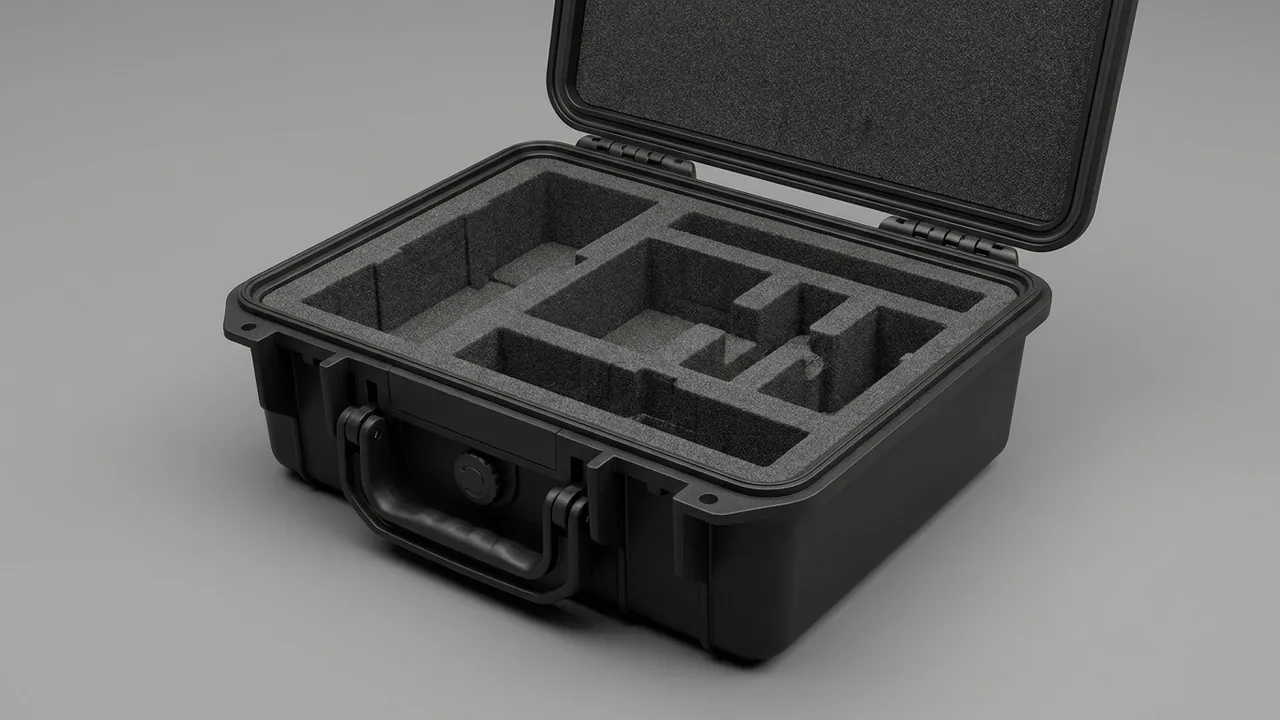
A reefer container is essentially a refrigeration system compressed into a box: the reefer unit supplies cooling, the ducting distributes cold air into the cargo cavity, the door seal holds the chamber airtight, and the aluminum or T-section floor carries the load while guiding return airflow. Any of these spare parts damaged in transit degrades the whole box temperature control. Shipping the copper-tube fins, long ducting and door seals as loose common goods is the leading cause of cooling failure, rework and claim disputes across ocean and land transport. This article systematically covers case selection, insert design and compliance testing for reefer container component cases, from compressors and condensers through ducting assemblies, door gaskets and aluminum floors. Equipment exporters, shipping agents and cold-chain engineers will learn salt-spray corrosion material choices, anti-deformation support for long parts, no-fold no-compress door seal shaping, and model-specific gasket fitting that can be executed on the floor.
In real reefer overhaul and spare-parts export scenarios, damage rarely comes from a single hard impact. It accumulates from repeated handling, stack pressure and high-humidity salt-spray exposure. Once the reefer unit copper fins lean over, heat-exchange efficiency can drop by double-digit percentages. An over-long ducting piece subjected to suspended load develops a permanent bow and will not seat against the roof air chamber on site. A door gasket folded by rough handling loses its spring-back and starts leaking cold air with condensation. Worse, such damage is invisible at dispatch and erupts only after overseas installation, driving expensive second logistics and downtime. This article avoids generic capability boilerplate and focuses on the concrete component features of reefer containers, giving a checkable, executable protection list with the applicable test and salt-spray standards so procurement and quality staff can verify directly against acceptance.
Why Reefer Container Components Need a Dedicated Transport Case
A reefer container is a refrigeration system packed into a shipping box: the reefer unit provides the cold source, the ducting sends cold air evenly into the inner cavity, the door seal maintains chamber airtightness, and the aluminum or T-section floor carries cargo while guiding return air. If any link of spare parts is damaged in long-distance transfer, the whole box temperature-control capability suffers. A generic wooden crate or simple carton cannot solve three reefer-specific problems: the reefer unit copper fins fear pressure and impact, the ducting is mostly an extra-long thin-wall part that fears suspended-load deflection, and the door seal is an elastomer that fears folding and compression deformation. JUNZHIJIA frames this need as a component-protection case designed around equipment features, not a generic transit box. It requires intervening in the component three-dimensional data at the structural design stage, using custom inserts to lock the movement freedom of every part, using case material to resist port salt spray, and using a locking system to guarantee sealing after repeated opening. For exporters, this front-loaded design is cheaper than post-shipment claims; for shipping and overseas warehouses, a standardized case type also eases stacking, scanning and inventory turnover. The component-level thinking is shared with related cases such as the refrigeration unit case and the cold room panel case.
Transport Risks of the Reefer Unit (Compressor / Condenser)
The reefer unit typically contains a compressor, condenser, evaporator and control system, where the compressor is a heavy concentrated mass block and the condenser is a large finned heat-exchange structure. The main transport risks come from three points. First, the compressor internal moving parts such as the crankshaft and valve plates are sensitive to long-term vibration; if the case rigidity is insufficient or the bottom cushioning is weak, loosening and refrigerant leakage risks appear. Second, the condenser fins are extremely thin, and external squeeze causes leaning and bridging that directly reduces heat-exchange area. Third, the electrical connectors and sensors on the reefer unit shell break easily under rough handling. To address these, JUNZHIJIA uses a heavy-block-sink plus perimeter-limit approach in the reefer unit case: the compressor is placed in the bottom load-bearing zone, supported and contoured by high-density EVA or IXPE, with a hard frame around it limiting lateral displacement; the condenser is partitioned separately and laid flat against the case wall to avoid stacking pressure. It must be emphasized that the reefer unit is a precision cooling component; before packing, confirm the internal refrigerant has been recovered or fixed per transport rules, referencing the equipment maker and IMDG requirements for reefer units, and never mix it with ordinary spares. The compliance framework for restricted transport placards can be referenced from the IMDG hazmat transport case.
Copper Tubes and Fins: The Most Fragile Yet Most Critical
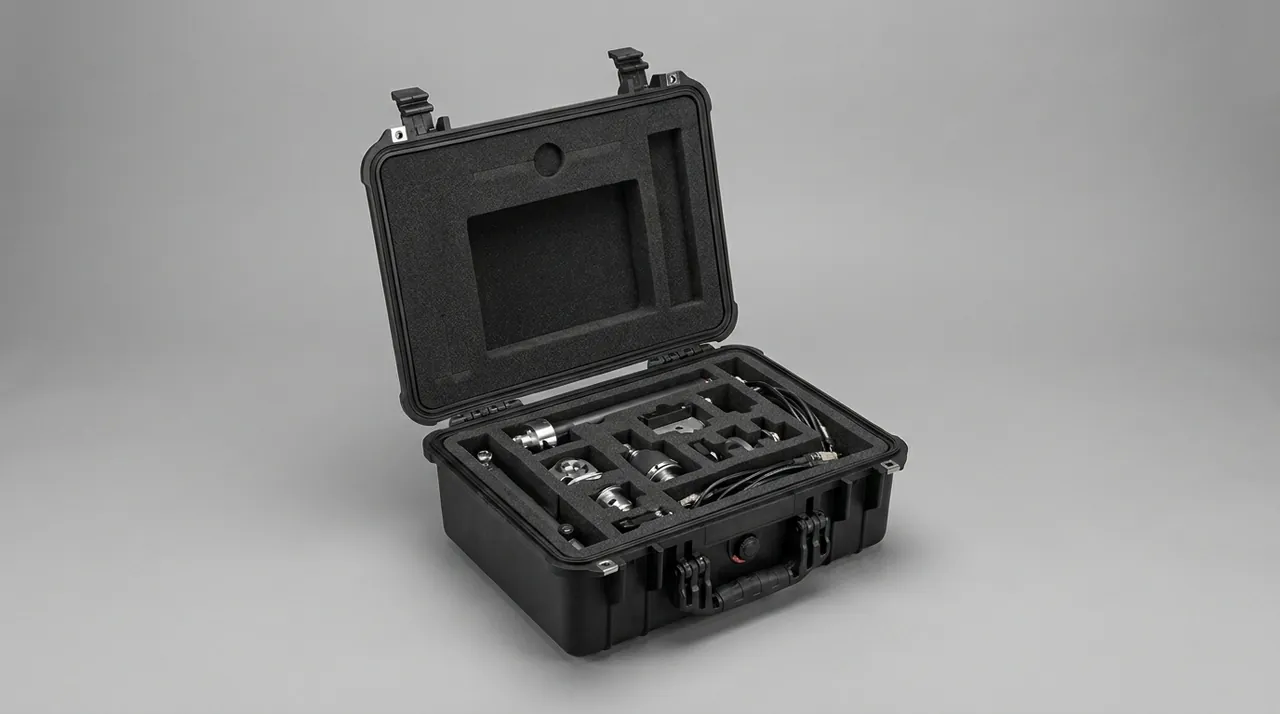
Copper tubes and fins are the physical basis of reefer unit heat-exchange efficiency, yet they are also the most fragile link in the whole-case transport. The fins are mostly aluminum foil on the order of 0.1 mm, and slight bumping or pressing makes them lean over and bridge, raising air resistance and lowering heat exchange. The copper tubes fear bending and port deformation; once a flare or threaded port is damaged, the labor and material cost of field flaring or remaking the joint is high. Therefore JUNZHIJIA opens a zero-stacking zone for copper tubes and fins in the component case: stepped foam slots hold the fins facing an open cavity, the tube ports get threaded protective caps and click into limit holes, ensuring no hard contact in any direction. For shaped parts like evaporator coils, the insert is CNC milled from 3D scan data so the coil fits without suspension. Experience shows that even a 5 percent fin lean-over visibly raises condensing pressure under high-temperature duty. Treating copper tubes and fins as precision parts that must travel in zero contact is the most cost-effective step to cut overseas installation failure rates. The slotting technique is detailed in the custom foam inserts guide for shaped-part fitting.
Anti-Deformation Support for Long Ducting Assemblies
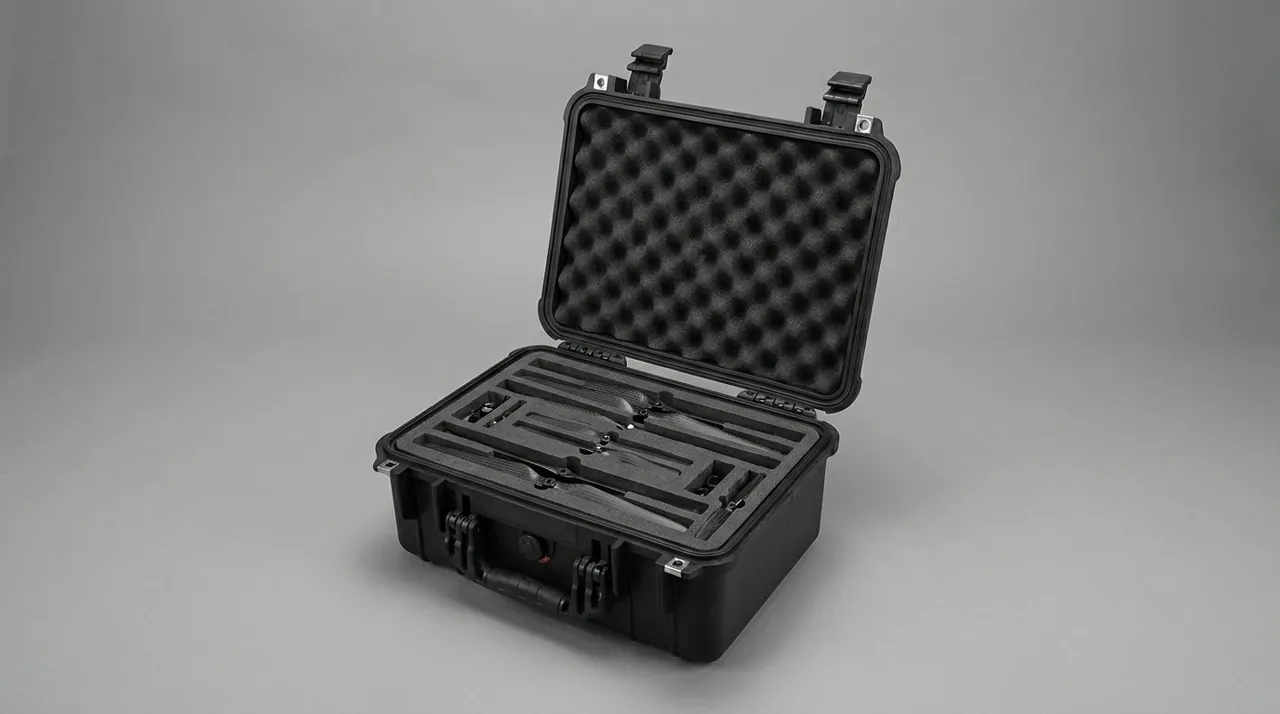
Reefer ducting is mostly thin-wall aluminum or stainless profiles whose length approaches the box width or longer, tasked with guiding reefer outlet air evenly to the roof and both sides. The greatest enemy of such long parts is suspended-load deflection: if the case supports only at both ends, mid-span self-weight or stack pressure bows the profile permanently, and it cannot seat against the roof air chamber on site, causing supply-air short-circuit and uneven cooling. JUNZHIJIA uses multi-point bridge support: three to five equally spaced support points along the ducting length, each with a slot foam matched to the profile cross-section so force distributes evenly; a removable cross-press strip above the ducting limits vertical bounce. For splittable sectional ducting, it is preferable to break it into standard segments fixed individually, reducing single-piece length risk and easing overseas warehouse reassembly by drawing. A reminder: the insulation closure cotton on the ducting surface, if pressed off in transit, hurts later insulation performance, so the insert must also softly protect the closure-cotton face from direct hard friction.
Door Seal Components: No Folding, No Compression
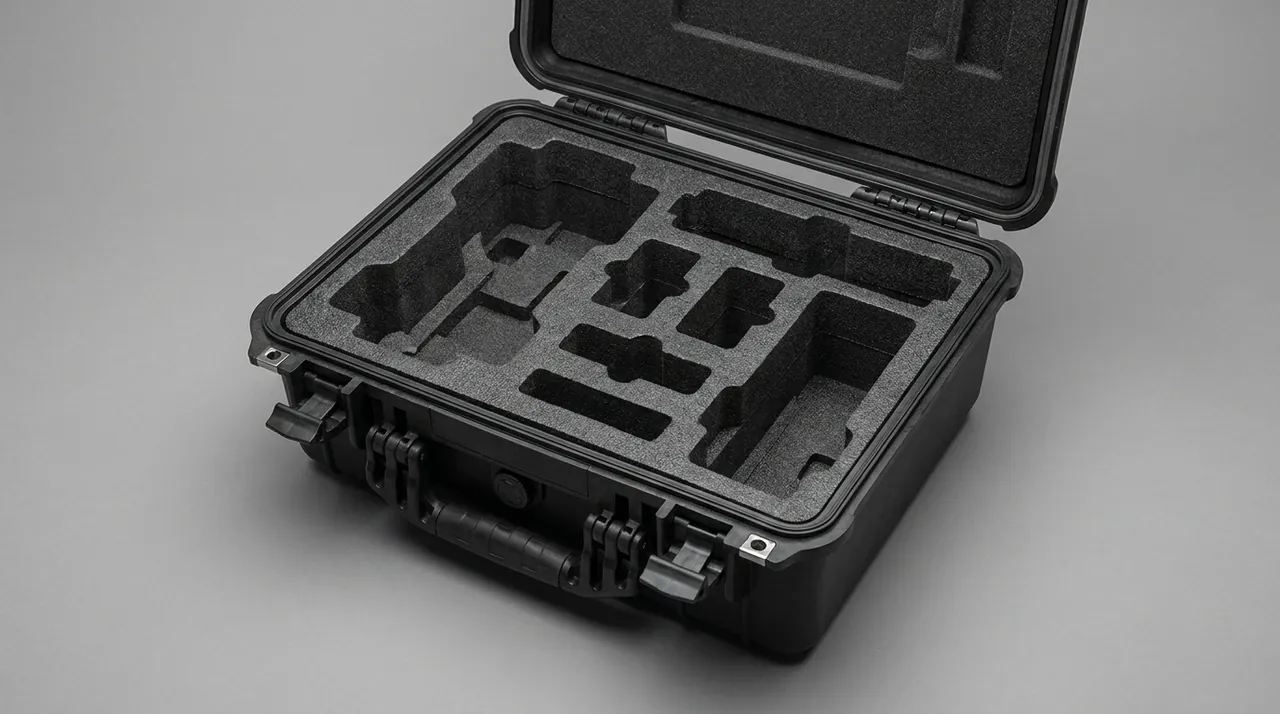
The door gasket is the last line of defense for reefer box airtightness and insulation, mostly EPDM or similar elastomer wrapping a magnetic strip or rigid clip edge. Its fatal weakness is not dirt but folding and compression: once an elastomer is forcibly folded or long-term flattened, it develops a permanent crease and spring-back failure, causing local cold leakage, wall condensation or even frost after the door closes. JUNZHIJIA enforces a no-fold no-compress, shaped-placement principle on door seals: long gaskets are supported on arc or spiral shaping frames following the original factory curvature, never forcibly creased; clip-edge gaskets are laid flat on layered foam, separated by soft spacers between layers to avoid mutual squeeze. The packing environment controls temperature and avoids light, preventing the elastomer from accelerated aging under long ocean-deck high temperature. For buyers, the first action after door-seal arrival is to lay it flat and let it spring back for 24 hours before trial fitting; this simple move screens out most transport compression damage and is far cheaper than discovering leakage on site and then dismantling for rework.
Aluminum Floor Rails and T-Section Floor Protection
The reefer floor must both carry cargo and form a return-air channel through T-section aluminum rails, and its surface flatness and rail tooth profile directly affect cold-air circulation efficiency. Transport risks concentrate on two points: first, the rail tooth surface gets burrs from hard-object impacts, which after refitting scratches cargo pallets or disturbs air guidance; second, the whole floor plate bends under stacking and, after installation, sits unevenly with abnormal door-closing force. JUNZHIJIA uses a tooth-surface protection plus whole-surface flat-support plan: a peelable protective tape or soft foam on the T-rail tooth surface, the plate laid flat on a whole-surface IXPE support layer, and rigid corner guards on the four case corners to prevent corner loading. For floors with embedded aluminum honeycomb or composite layers, control the single-case stacking layers to avoid long-term compression delaminating the composite. As a large flat part, the floor needs reserved thermal-expansion clearance inside the case to avoid jamming against the wall under thermal cycles, while corner guards absorb handling shocks at the edges.
Salt Spray Corrosion Resistance in Marine Environments
Most reefer spares travel by sea, and the high salt-spray, high-humidity port and deck environment is a long-term test for the case and metal fittings. JUNZHIJIA prioritizes corrosion resistance on the reefer component case: the case body can use aluminum alloy or stainless steel shell, or salt-spray validated engineering plastic; all metal latches, hinges and pivots get galvanized, dacromet or 304 stainless treatment. Referencing GB/T 10125 neutral salt-spray test, key hardware typically requires 48 to 96 hours salt spray with no red rust (specific grade per duty). Case seams and screw holes get sealant or sealing washers to reduce salt-spray ingress along gaps. It must be clear that salt-spray protection targets the case and fittings themselves, not the internal humidity control of components; the interior still needs desiccants and humidity indicator cards, forming a dual barrier of external anti-corrosion and internal moisture control. For repaired or second-hand parts, cleaning and desalination before packing is advised to avoid bringing salt into the case to corrode the insert long term.
Cushioning Insert Material Selection
The insert material decides cushioning and shaping ability. Common EVA, IXPE, EPP and PU foams each have scenarios: EVA is cost-effective and easy to carve, suited to heavy-block support and contouring of compressors; IXPE is closed-cell, moisture-proof and fine-surfaced, suited to large flat support of floors; EPP has good resilience and reusability, suited to door-seal layers needing repeated opening; high-density PU blocks suit zero-contact slotting of precision copper fins. When selecting, focus on three indicators: density, resilience and compression set, and avoid water-absorbing open-cell materials in salt-spray humid environments. JUNZHIJIA assigns material combinations by part mass and damage grade: heavy and hard parts use high-density support, light and fragile parts use zero-contact slots, and elastomers use soft layers. The table below gives the recommended insert combination for typical reefer parts for engineering check.
| Part category | Main risk | Recommended insert | Key indicator |
|---|---|---|---|
| --- | --- | --- | --- |
| Compressor | Vibration, bottom shock | High-density EVA support plus hard frame | Density >=45 kg/m3, compression set <10% |
| Condenser fins | Lean-over, stacking | Stepped foam zero-contact slot | Slot depth matches fin height, zero stack |
| Long ducting | Suspended deflection | IXPE multi-point bridge support | Equally spaced supports >=3 |
| Door seal | Fold-compress failure | EPP soft layer plus shaping frame | No fold, flat or arc support |
| T-section floor | Tooth impact | IXPE whole-surface support plus tooth protect | Rigid corner guards |
Sealing and Locking System: Hinges, Latches and Gaskets
The last mile of a protection case is the locking system. Reefer component cases often open repeatedly for customs inspection and overseas warehouse counting, so hinges, latches and gaskets must be durable and maintainable. JUNZHIJIA fits heavy-duty hinges and latches in stainless or dacromet treatment on the reefer case, together with a mature hardware scheme like the toolbox hinge latch seal, ensuring no looseness after ten thousand openings; an EPDM or silicone gasket around the lid reaches an IP rating (reference IEC 60529 / GB/T 4208), blocking water ingress under port showers and splashes. Latches should carry an anti-accidental-open safety to avoid vibration auto-release in transit. The gasket must be replaceable so overseas warehouses can swap it locally without affecting case life. It is worth stressing that the locking seal rating should match the internal drying plan: the gasket alone cannot block long-term high humidity, and desiccants with humidity cards are still needed as a backstop. The waterproof rating thinking can be extended by reading the IP67 protective case article.
Lifting, Stacking and Transport Packaging Marks
Reefer parts are mostly medium-to-large, and the case itself is heavy, so lifting and stacking safety directly affect arrival integrity. JUNZHIJIA reserves standard lifting points on the case shell rigidly connected to the internal load frame, ensuring forklift pockets and slings load on structural members rather than the shell; stacking follows the marked maximum layer limit to avoid bottom crush. Packaging marks follow GB/T 191 and GB/T 13384, clearly showing fragile, this-way-up, keep-dry and center-of-gravity icons and text on the case face, with multilingual (Chinese, English, destination-language) warnings. For reefer units containing refrigerant or compressed gas, confirm per IMDG and destination rules whether they fall under restricted transport and post corresponding placards; never mix with ordinary spares. The overseas leg also needs container lashing: the component case should be tied to the container wall with straps to prevent displacement collision from ship roll, with lashing points clear of case-face marks and latch areas.
Environmental Testing and Compliance Standards
To turn protection from a slogan into an acceptable metric, JUNZHIJIA runs a verifiable test set on the reefer component case: vibration and shock reference ISTA and GB/T 4857, ASTM D4169 transport cycles, verifying internal part displacement and damage under simulated road, rail and ocean vibration; salt-spray anti-corrosion references GB/T 10125; low-temperature and high-humidity cycles validate insert and gasket performance across the reefer-specific temperature-humidity span (relevant environmental test methods may reference the MIL-STD-810H compliance, but the product is not a military certification). The table below summarizes common standards and applicable items, easing procurement to set acceptance basis in contracts, and the ISTA transport testing procedure can be cross-referenced to design sampling.
| Standard | Applicable item | Focus metric |
|---|---|---|
| --- | --- | --- |
| ISTA / GB/T 4857 / ASTM D4169 | Transport vibration shock | Part displacement, cushion attenuation |
| GB/T 10125 | Salt-spray anti-corrosion | Red-rust-free hours |
| IEC 60529 / GB/T 4208 | IP sealing rating | Dust and water proof grade |
| MIL-STD-810H (method ref) | Temperature-humidity cycle | Insert and seal weather (non-mil) |
Custom Inserts and Model-Specific Fitting Engineering
JUNZHIJIA stresses model-specific customization rather than generic cases. The typical engineering flow is: customer provides part list, 3D drawings or physical samples; the engineering team analyzes damage points; outputs the insert layout and case structure plan; prototypes and confirms by customer trial fitting; small-batch validation; then mass supply. The key link is model-specific gasket and fitting: the door-seal cross-section and length, the reefer-unit joint protective cap specification, and the floor corner-guard size all vary with the specific box type such as 20ft or 40ft high cube and different reefer brands. JUNZHIJIA builds a part-to-fitting correspondence library so a customer series can reuse insert modules, lowering mold and maintenance cost. For R&D or small-batch spares, a modular divider system allows quick combination, balancing flexibility and protection. The output is not just a case but an archivable protection plan document for overseas teams to reassemble by the list, and to control quality consistency across later batches.
Ocean Loading, Lashing and Humidity Control
The outbound leg is where risk concentrates. It is advised to place the reefer component case in the middle of the container, away from the door and side walls, to reduce berthing impact and water ingress; wrap the case in rain tarp and ensure ventilation to avoid container sweat (surface condensation on cargo); place sufficient desiccants and humidity indicator cards inside, targeting relative humidity below an experiential 50 percent. If mixing multiple parts in one case, use rigid separator layers, heavy at bottom and light on top, with elastomers in a separate layer. During the voyage the case may experience 0 to 50 Celsius deck temperature swings, so the insert material must stay dimensionally stable in that range. After arrival, check the humidity card before opening; if damp, ventilate and dry immediately and record it as a basis for later claims and process improvement. JUNZHIJIA can supply optional temperature-humidity recorders so the transport environment is traceable, which matters for high-value reefer spares and provides objective evidence in cross-border disputes.
Acceptance Criteria, AQL and Inspection Documentation
Delivery acceptance suggests AQL (acceptable quality limit) sampling: case appearance, locking function and insert fit are checked at AQL 2.5 general inspection level, while key protection dimensions such as fin zero-contact slot depth and ducting support-point spacing are tightened at AQL 1.0. JUNZHIJIA provides an inspection document pack with the shipment: salt-spray test report for hardware, IP rating verification, vibration test summary, material certificate and RoHS or REACH compliance declaration where applicable. Buyers should set an arrival-intact-rate indicator and photo-keep flow in the contract, with overseas warehouses photographing on opening and reporting anomalies within 24 hours. For elastomers like door seals, add a spring-back recovery visual check; for copper fins, add zero-contact and port-cap-in-place checks. A complete document chain supports quality traceability and serves as evidence in cross-border claims, upgrading acceptance from look-at-appearance to verify-the-metric and practically reducing arrival disputes.
FAQ
Q: Is the price gap between naked compressor shipping and cased shipping really worth it? A: In the short term naked shipping saves the case cost, but the reefer compressor contains vibration-sensitive parts like the crankshaft and valve plates, and once condenser fins lean over they permanently lose heat-exchange area; field flaring, straightening and re-shipment often cost several times a custom case. For export and overseas repair, naked shipping also means arrival damage and installation downtime as hidden losses. JUNZHIJIA designs with the compressor mass sunk and the condenser in zero stack, pushing risk to the packaging stage. Experience shows that a single reefer unit's transport damage repair and downtime commonly exceed the purchase cost of dozens of protection cases, so on a full-chain cost basis cased shipping is almost always cheaper. This becomes even clearer when parts must cross an ocean leg plus several land transloads, because each handling event is a fresh chance to damage bare fins or bend a port. The case investment therefore pays back through fewer claims, faster installation and a predictable arrival condition that overseas teams can plan around.
Q: Why does long ducting deform easily and how does JUNZHIJIA prevent it? A: Reefer ducting is mostly thin-wall aluminum or stainless profiles as long as or longer than the box width; self-weight plus stacking pressure bows the suspended span permanently, and it cannot seat against the roof air chamber on site, causing supply-air short-circuit and uneven cooling. JUNZHIJIA uses multi-point bridge support: three to five equally spaced support points along the length, each with a slot foam matched to the profile so force distributes evenly, plus a removable cross-press strip limiting bounce. Splittable sectional ducting is broken into standard segments fixed individually to cut single-piece length risk and to ease overseas reassembly by drawing. Experience shows that with equally spaced, well-fitted supports the mid-span deflection stays within assembly tolerance and needs no field straightening. The ducting closure cotton also needs soft-contact protection against transport press-off that would hurt later insulation. Treating the ducting as a precision long part rather than a loose stick is what keeps the air path intact after a long voyage.
Q: Can door seals be folded to save space inside the case? A: Absolutely not advised. Door seals are mostly EPDM elastomer wrapping a magnetic strip or clip edge; forced folding or long-term flattening creates permanent creases and spring-back failure, causing local cold leakage, wall condensation or frost after closing, problems that surface only after installation. JUNZHIJIA enforces no-fold no-compress shaped placement: long gaskets ride arc or spiral shaping frames following original curvature, while clip-edge types lay flat on layered foam with soft spacers between layers. After arrival, lay flat and let spring back 24 hours before trial fitting to screen most transport compression damage. Sacrificing airtightness for saved volume is a classic false economy, because a leaking door drives compressor runtime up and energy cost throughout the voyage. Elastomers should also be packed away from light and heat to avoid deck-temperature accelerated aging, and overseas warehouses should store them separately in a cool, shaded place until the moment of fitting. For a typical 40ft high-cube reefer the door gasket run exceeds 12 meters, so one creased section can lift box humidity by several percent per day. JUNZHIJIA specifies a 12 to 15 mm EPDM magnetic strip at Shore-A 65 to 75, matched to a plus-or-minus 0.5 mm door-frame channel tolerance, with 304 stainless clip retainers at 6 mm pitch to resist salt-spray loosening.
Q: What case material is enough for marine salt-spray environments? A: The key is dual corrosion resistance of case body and hardware. JUNZHIJIA prioritizes aluminum alloy or stainless steel shells, or salt-spray validated engineering plastic; latches and hinges get galvanized, dacromet or 304 stainless treatment, referencing GB/T 10125 neutral salt-spray for 48 to 96 hours no red rust by duty. Seams and screw holes get sealant or washers to cut gap ingress. Note that salt-spray protection targets the case and fittings themselves and does not replace internal moisture control; desiccants and humidity cards are still required, forming an external anti-corrosion and internal moisture-control dual barrier. Repaired parts should also be cleaned and desalinated before packing to avoid salt corroding the insert and metal parts inside the case over the long term. On coastal or equatorial high-temperature high-humidity routes, specifying 304 or higher stainless hardware and anodized sealed aluminum further extends service life across many reuse cycles. The lid EPDM or silicone gasket should be rated per IEC 60529 and GB/T 4208 so the seam survives deck spray, and where stainless latches meet an aluminum shell a dielectric washer prevents galvanic corrosion at the contact face. The aluminum shell anodizing is specified at 10 to 15 microns with sealed pores to resist chloride attack, and JUNZHIJIA validates the assembly per GB/T 10125 at 96 hours neutral salt-spray with no red rust on 304 hardware.
Q: Must copper tubes and fins be packed separately, can they mix with other parts? A: Strongly advised to use a separate zero-contact zone. Fins are mostly 0.1 mm aluminum foil that leans and bridges under slight stacking, raising air resistance and lowering heat exchange; damaged copper ports like flares or threads cost high field rework. JUNZHIJIA opens a zero-stack zone: stepped foam slots hold fins facing an open cavity, ports get caps clicking into limit holes, and evaporator coils are CNC milled from 3D data to fit. Mixing with heavy blocks both crushes fins and wears ports, so reefer unit cases generally partition the condenser separately, laid flat against the wall, never stacked on the compressor. For shaped coils, insert fit directly decides transport safety and should enter acceptance as a tightened critical dimension. Treating the fin pack as a precision optical-like surface, rather than a rugged metal part, is the mindset that prevents invisible efficiency loss after arrival. A simple rule for the floor is that any part whose damage cannot be seen at a glance deserves its own contoured cavity.
Q: Can one case hold multiple parts, or must it be model-specific custom? A: Both are possible, depending on batch size and consistency needs. JUNZHIJIA supports model-specific insert customization so door-seal cross-section and length, reefer joint cap specs and floor corner-guard sizes match the exact box type, suited to fixed export and serialized spares; for small batches or R&D, a modular divider system allows quick combination balancing flexibility and protection. The key is doing damage-point analysis upfront: which parts need zero contact, which need mass sink, which need no-fold, deciding the insert layout. When mixing, use rigid separator layers, heavy bottom light top, and elastomers in a separate layer, labeling the internal list on the case face for overseas warehouse check. A clear internal packing list also speeds customs and warehouse handling, because staff can verify contents without opening fragile zones. The right choice is therefore driven by how many identical units you ship, not by a generic one-size approach. If a heavy compressor shares a case with fragile copper fins, the zero-contact fin zone must be a hard-walled sub-compartment so stack pressure never reaches the 0.1 mm foil. Mixed-layer cases are then AQL accepted at 2.5 general inspection, while critical dimensions such as fin slot depth and ducting support spacing are tightened to AQL 1.0 before the container is ever lashed.
Q: What to inspect at acceptance and what documents should the maker provide? A: Suggest AQL sampling: appearance, locking and insert fit at AQL 2.5, critical protection dimensions such as slot depth and support spacing tightened at AQL 1.0. JUNZHIJIA provides salt-spray report, IP verification, vibration summary, material and RoHS or REACH declarations. Overseas warehouses photograph on opening and report anomalies within 24 hours; door seals get added spring-back visual check, copper fins get added zero-contact and cap-in-place check. A complete document chain supports traceability and cross-border claims. The contract should set arrival-intact rate and keep-flow, upgrading acceptance from look-at-appearance to verify-the-metric, and keep photos and humidity cards after arrival as dispute-handling evidence. Buyers who archive these records build a feedback loop that lets later batches tighten the weak points, turning every shipment into a measurable input for continuous improvement of the protection design. For high-value reefer units, a joint pre-shipment video call can lock the packing standard before mass release. The vibration summary should reference ISTA or ASTM D4169 cycles with recorded part displacement, while the humidity indicator card color, the floor T-rail tooth surface and the lashing point condition are added to the opening checklist. Where the humidity indicator card turns pink above 30 percent relative humidity, the buyer opens a claim within 24 hours using the photo-keep flow as evidence, closing acceptance on a measured metric rather than appearance.
Q: Can you do OEM or ODM and fit seals and hardware by model? A: Yes. JUNZHIJIA provides OEM and ODM batch and custom service for reefer container components: custom inserts from customer 3D data, model-specific door-seal cross-section and length, reefer joint protective caps, floor corner guards and other fittings, with multilingual packaging and inspection documents, global supply and private labeling. One customer series can reuse insert modules to lower mold and maintenance cost. For reefer makers, shipping companies and overseas warehouses, custom cases under a unified quality system push transport risk forward and keep protection level consistent across batches, easing scale operations. Mature, maintainable hardware such as the toolbox hinge latch seal latch and hinge system can be reused across the series to simplify spare-part management. Model-specific fitting covers 20ft and 40ft high-cube variants from different reefer brands, where the gasket cross-section, the joint cap thread spec and the floor corner-guard size all change per box type, so the engineering team builds a part-to-fitting library from scanned samples.
Conclusion and Further Reading
Reefer cooling ability rests on the integrity of the reefer unit, ducting, door seal and floor. Treating these as loose common goods lets risk erupt only after overseas installation. JUNZHIJIA's equipment-feature custom case moves transport risk into the design stage with zero-contact fins, bridged ducting, no-fold seals and salt-spray hardware.
Related reading