

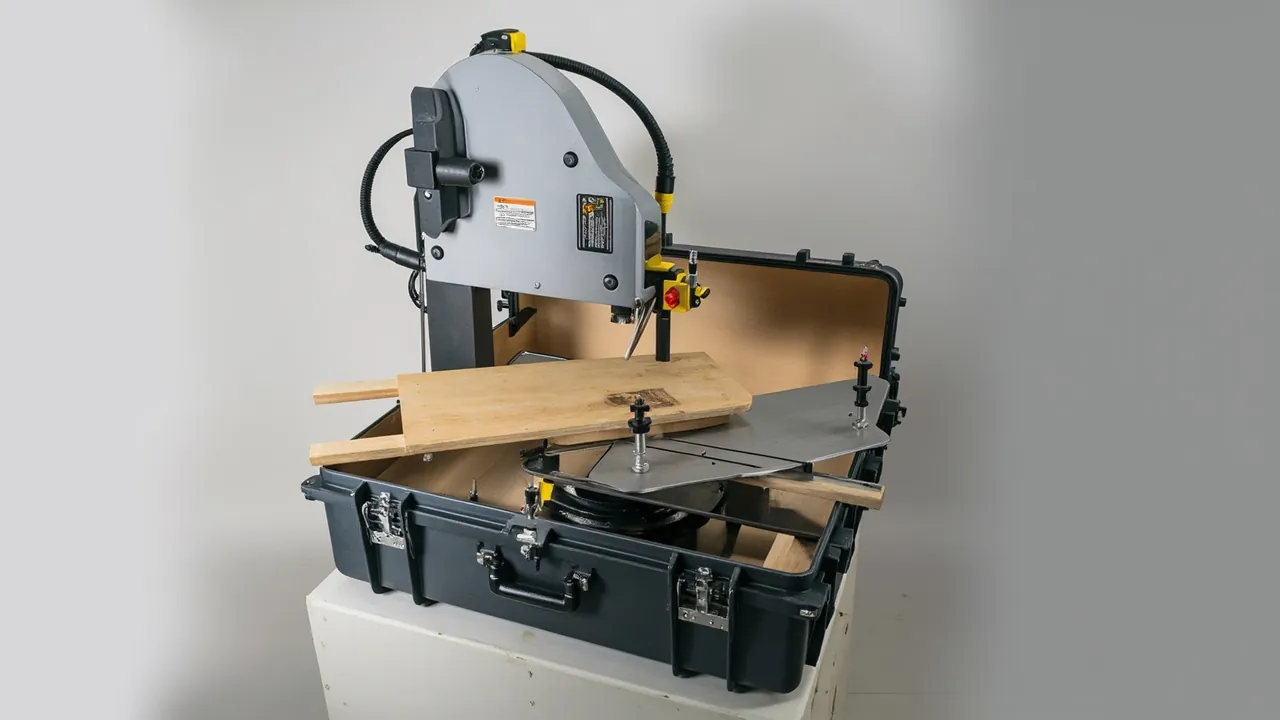
A sawmill equipment case has to solve one contradiction: keep a long, thin, highly tough saw blade and a high-precision feed mechanism inside the same box without letting either damage the other, and deliver both across a thousand kilometres with no rust and no change in form tolerance. Band saw teeth commonly run above HRC 60, but the back and gullet retain ductility, so a single point load in transit can chip a tooth beyond what re-sharpening can recover. Feed rollers, dogs and chain guides hold fits measured in hundredths of a millimetre, and a burr raised by impact will change the feed rhythm and the sawn surface. A sawmill spare parts case therefore has to cover three things at once: physical isolation of the tooth line, a defined rust boundary for bare steel, and structural stiffness under stacking and forklift handling.
This guide is written for sawmill maintenance departments, aftermarket spare parts buyers and woodworking machinery traders. It breaks the two main assemblies, sawing and feeding, into a failure-mode list, then works through blade layering, feed component restraint, humidity limits, transport test criteria and long ocean-freight practice, closing with FAQs and further reading.
Contents
- Why sawmill parts fail "one shipment at a time"
- A failure-mode list for sawing and feed components
- Saw blade cases: layering and tooth-tip isolation
- Restraining the feed mechanism
- The rust boundary for high-carbon saw steel
- Matching case structure to liner material
- Sealing, breather valves and condensation control
- Transport testing and receiving acceptance criteria
- Stacking, forklift handling and lifting safety
- Pre-shipment sampling and delivery documents
- Customisation workflow and prototyping gates
- Spare parts rotation and re-shipment
- Frequently Asked Questions
- Conclusion and related reading
Why sawmill parts fail "one shipment at a time"
Sawmill lines carry high downtime costs, so the common habit is to swap a part the moment production stops and drop the removed item into whatever box is at hand for return or re-sharpening. That habit is the problem. A blade pulled off the machine still carries sawdust and resin, and acidic sap trapped between the teeth will accelerate pitting on high-carbon steel inside a closed case. A feed roller lifted off its bed leaves its bearing seat exposed, and if it travels in the same box as a blade, the tooth line will score it. The receiving end opens the case to find a blade covered in rust blooms, a roller face carrying a dense pattern of scratches, and a dog with a bent locating pin. The repair bill can easily exceed the price of a proper sawmill equipment case.
A less obvious risk comes from stacking and temperature-humidity cycling. If a woodworking saw equipment case is loaded at the bottom of a stack, the lid creeps under long static load, the 5 to 10 mm clearance designed between liner and component disappears, and every small displacement during road vibration turns into hard contact between parts. When the vehicle crosses latitudes, the dew point of the air inside the case moves as ambient temperature falls. Without a pressure equalisation device, the differential draws moist air into the sealed cavity and sets up classic condensation rusting.
A case in this class is therefore not a container you fill, but a restraint system derived backwards from component stiffness, surface condition and transport route. The most direct way to judge whether a sawmill equipment case is acceptable is not to look at it, but to open it once on the outbound leg and once on the return leg, then measure tooth chipping, new scratches on roller faces and condensation traces inside.
A failure-mode list for sawing and feed components
Different components have completely different weak points, so protection design has to start with a failure-mode breakdown. The table below maps common sawmill spare parts to their protection priorities and can be used directly as a selection input.
| Component | Typical failure mode | Protection priority | Suggested liner form |
|---|---|---|---|
| --- | --- | --- | --- |
| Band saw blade (coiled or endless) | Chipped tooth, bent back, surface pitting | Segregate tip from back, limit minimum bend radius | Layered slots plus tooth-edge guard |
| Circular saw blade | Chipped tooth, flatness out of tolerance | Hang vertically, avoid face loading | Vertical slot plus centre arbor location |
| Feed roller / pressure roller | Face scoring, runout deviation, bearing seat damage | Keep face floating, axial end restraint | Upper and lower cradle of EVA |
| Dogs / locating pins | Bent pin, accelerated tooth wear | One cavity per piece, sleeve the pin | Die-cut cavity plus nylon sleeve |
| Chain and guide rail | Stiff link, scored rail face | Coil and secure, rail face inward | Reel bracket plus soft interlayer |
| Spindle / bearing housing | Fit-surface corrosion, precision face impact | Preservation oil, fit-surface sleeve | Custom cavity plus rust film |
| Motor and gearbox | Shaft extension corrosion, fan cover deformation | Shaft cap, whole-unit restraint | Foam cradle plus corner reinforcement |
A frequent mistake is to wrap every metal item "in the same piece of foam". The tooth line of a saw blade is effectively a row of tiny cutting edges: as soon as it repeatedly touches any hard surface under vibration, fatigue chipping begins within a short time. The correct approach is to leave the tooth line floating or separately isolated, with load carried by the back of the blade and by the case. In the same way, a feed roller face is a functional surface and must float, with location taken by the shaft journals at both ends.
For export orders, add one row to the failure-mode table covering the customer's on-site unpacking method. If the receiving team lifts the whole case with an overhead crane and then opens the lid to take parts out, the case needs a top-opening structure with lifting points. If they open cases one by one in a warehouse, a side-opening or drawer configuration fits better. Protection design must follow the actual work method, otherwise even an excellent liner will be destroyed by forced extraction.
Cavity layout should be arranged together with the pick-and-place path; our guide to custom foam insert design and tolerance covers die-cutting clearance and grip features. If the same customer also buys woodworking cutter spares, the woodworking machine component case can be built as a matching logistics unit to reduce storage adaptation effort.
Saw blade cases: layering and tooth-tip isolation
Saw blade case design comes down to three things: layering, bend limitation and pressure avoidance.
Layering. Coiled band blades should not be stacked in multiple layers, because the tooth line of a lower coil has to carry the full weight above it. The recommended approach is one independent shelf per coil diameter, using 8 to 12 mm plywood or 5 mm PP sheet, with locating slots at the four corners that engage the case wall ribs so the shelf itself cannot bounce. Endless blades can be folded into a U-shape along the long edge; the minimum inner bend radius at the fold must exceed the value specified by the blade maker, and a practical working floor in engineering is at least 200 times the blade thickness, subject to the manufacturer's published figure.
Bend limitation. A long blade inside the case must be restrained as a single rigid body, not left free to swing. Use three to five adjustable clamps distributed along the length, pressing only on the back region, with 3 mm cork or EVA on the contact face so the tooth line is never touched. Set the clamping force so that the blade shows no visible movement under finger pressure; over-tightening leaves residual stress in the back.
Pressure avoidance. The lid must transfer vertical load into the case walls and corner posts rather than into the blade stack. An economical way to achieve this is to fit load-bearing posts at the four internal corners with a height equal to the total liner height, so they meet the lid ribs directly and create a load bypass. If the gross case weight exceeds 40 kg, make the corner posts integral structural members rather than inserts.
One more detail is pick order. Putting the most frequently used blade at the bottom forces operators to lift upper layers repeatedly and multiplies the chances of touching a tooth line. Put the current shift's most-used blade on the top layer or in a separate side bay, and mark specifications and item numbers directly on the liner so nobody has to search.
For liner material, use closed-cell EVA at 45 to 70 kg/m³ or cross-linked PE on any face contacting the blade, and avoid crumb-shedding open foam. Fit PVC or PE guards along the tooth region; the guard should be a single extruded profile rather than a spliced assembly, because every splice becomes a friction point. If recyclability is required, switch to a thermoplastic elastomer layer with a removable locating structure so the case can be reused and the liner replaced separately. For moulding method and batch consistency, check EVA insert forming and inspection point by point.
Restraining the feed mechanism
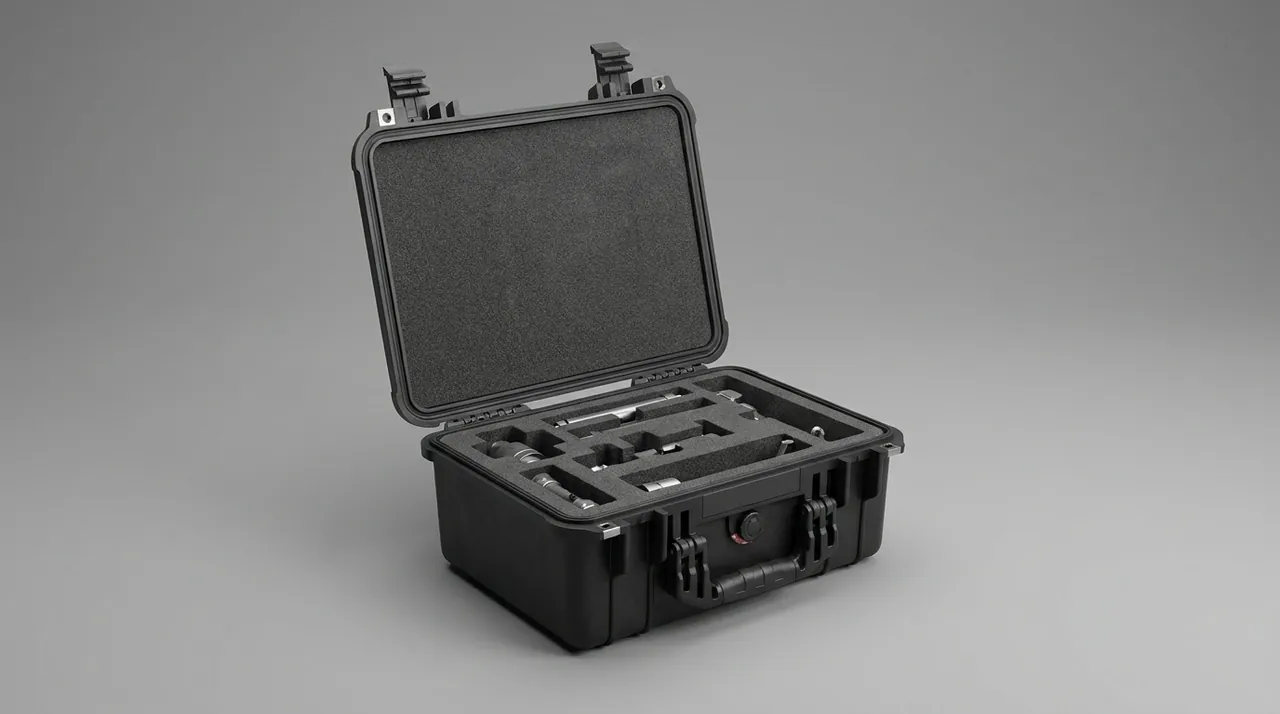
The feed mechanism advances timber on a fixed rhythm. Its common parts include infeed and outfeed roller sets, upper and lower pressure rollers, dogs or ratchets, chain, sprockets, guide rails and the servo or hydraulic drive unit. What they share is precision fits, protruding shaft ends and exposed tooth forms, which produce three failure types in transit: a bent shaft extension, a scored fit surface, and tooth forms and rails locking into each other.
The governing principle is "precision faces float, loaded faces carry". Take a feed roller:
- The roller face, a functional surface, must float with 8 to 15 mm clearance all round;
- Location is taken by the shaft journals or bearing housings at both ends, with a split cradle: lower half carries weight, upper half limits runout;
- Axial stops lined with soft material prevent end-to-end movement into the cavity wall;
- Coat bearing-seat fits with preservative grease and wrap in VCI film; do not leave them against bare timber liner for long periods, because wood releases acids that accelerate corrosion.
Wrap chain and guide rails separately. Coil the chain onto a reel bracket whose shaft can be detached from the case, and place rails in a dedicated long cavity with the functional face inward and end protectors fitted so threads or pin holes are not damaged. Sprocket teeth are impact-sensitive; give each one its own cavity so the tooth form never sits against another hard item.
Dogs are small, numerous and most likely to end up jumbled inside a liner. Use a die-cut cavity array with one position per piece, sleeve the pins in nylon or PE, and slope the cavity floor for easy gripping. For high quantities, build a two-tier tray liner with an upper carrier and lower storage level separated by a divider, so parts above cannot hammer parts below under vibration.
Feed drive units such as servo motors, gearboxes or hydraulic motors are relatively robust, but the shaft extension and encoder end remain weak points. Fit a plastic cap on the shaft extension, place the encoder side facing inward behind a soft interlayer, and support the housing on foam cradles so load lands on the casing rather than the shaft. If a gearbox has an oil port or breather plug, seal it before packing to avoid oil leaking into the liner in transit.
The rust boundary for high-carbon saw steel
Saw blade corrosion is not simply a matter of "getting damp". It is the combined result of humidity, temperature and contamination. In engineering practice, 40 percent relative humidity is treated as a safe line: below that level a continuous water film cannot readily form and corrosion rate falls sharply, while above 60 percent combined with temperature swings the condensation risk rises quickly. The control logic inside a case is therefore dehumidify first, isolate second, monitor last.
Dehumidify. Clean and preserve the blade before packing. Cleaning must remove resin, sawdust and hand sweat, since sweat salts are a leading cause of pitting; wipe with a neutral cleaner and dry thoroughly. Preservation can use rust-preventive oil, vapour phase inhibitor paper or a rust film. VCI materials suit closed cases because they form a molecular adsorption layer on metal, which is especially effective at gullets and other areas that are hard to oil. Dose by internal volume rather than by eye, because uneven placement leaves local concentrations too low to work.
Isolate. Sealing is the precondition for corrosion control. Use foamed silicone or EPDM extruded gasket with moderate durometer and low compression set, and specify a double-lip case mouth to preserve sealing through repeated opening cycles. PP or fibreglass composite walls do not absorb moisture, while timber structures need edge sealing and internal coating so the wood does not act as a reservoir as humidity changes. Gasket compounds differ widely in temperature and weather resistance; compare them using seal material comparison before committing.
Monitor. For ocean freight or long storage, place a humidity indicator card and a reusable desiccant canister inside. Size desiccant against internal net volume with at least 30 percent margin, fix the indicator card where it is visible on first opening, and if the voyage may exceed 30 days provide a replaceable desiccant bay plus a humidity recording label.
Preservation measures must also be compatible with the liner. Some foams release trace acids over long closed periods and produce what the industry calls foam rust on high-carbon steel. Require the supplier to state material neutrality or metal compatibility, and never place unidentified recycled foam directly against a precision metal face.
Matching case structure to liner material
Structure choice affects more than cost; it sets the protection ceiling and the number of reuse cycles. The table below compares common structures by application, batch size and transport distance.
| Structure | Typical wall | Reference protection | Best fit | Main limitation |
|---|---|---|---|---|
| --- | --- | --- | --- | --- |
| Injection-moulded PP case | 3 to 5 mm | IP67 with gasket | Small parts, single trips | Insufficient rigidity at large sizes |
| Rotomoulded PE case | 6 to 10 mm | IP67, excellent impact | Mid-size assemblies, repeated trips | Higher weight, mould cost |
| Aluminium frame with panels | 8 to 12 mm panels | Structural IK class by design | Medium to large, heavy loads | High cost, custom corners |
| Plywood case with ribs | 12 to 18 mm | Meets GB/T 4857 transport tests | Large parts, one-way or semi-reusable | Extra moisture treatment |
| Fibreglass composite case | 5 to 8 mm | Corrosion resistant, tough | Ocean freight, chemical sites | High unit price |
Liner and case are a matched design. Higher EVA density carries more load but cushions less; PU foam cushions well but creeps under long compression; cross-linked PE has good rebound and weather resistance for repeated opening. In practice a composite liner works best: a high-density EVA structural cradle at 70 to 90 kg/m³ carrying load, with a 25 to 45 kg/m³ PU or PE face layer bonded by heat lamination or adhesive, plus extruded guards in special zones such as the tooth line.
How the liner is fixed to the wall matters just as much. A liner held only by friction will shift as a whole in transit. Add hook-and-loop or engineering plastic clips on the back of key cradles, or provide counterbored screw holes at the liner base and bolt through to case-bottom reinforcement. Where removability is required, combine hook-and-loop with locating dowels so the liner can be lifted out and used as a tray.
Very long blades, for example band blades over 6 m, make a single straight case too long and too flexible. Two options exist. One is a segmented case in two or three sections joined by flanges and locating dowels. The other is a coiled case, where the blade is wound to a specified coil diameter in a circular cavity, trading height for length. The first suits forklift handling; the second stacks better inside a sea container. The choice should follow the transport mode, not the blade itself.
Sealing, breather valves and condensation control
Good sealing can create a new problem. A fully airtight case develops internal negative pressure as temperature drops, pulls the gasket tighter, and then draws moisture in on the next opening or forms condensate inside. The answer is a pressure equalisation valve, also called a waterproof breather vent.
The core of the valve is a hydrophobic breathable membrane that passes air molecules to equalise differential pressure while blocking liquid water and dust. Selection criteria include airflow, water entry pressure and mounting style, whether snap-in, threaded or adhesive. For mixed sea and air freight, fit at least one valve high on the case; for large volumes with sharp temperature swings, fit two symmetrically to balance faster. Position and protective cap selection follow the notes in our guide to pressure equalisation valve duty matching.
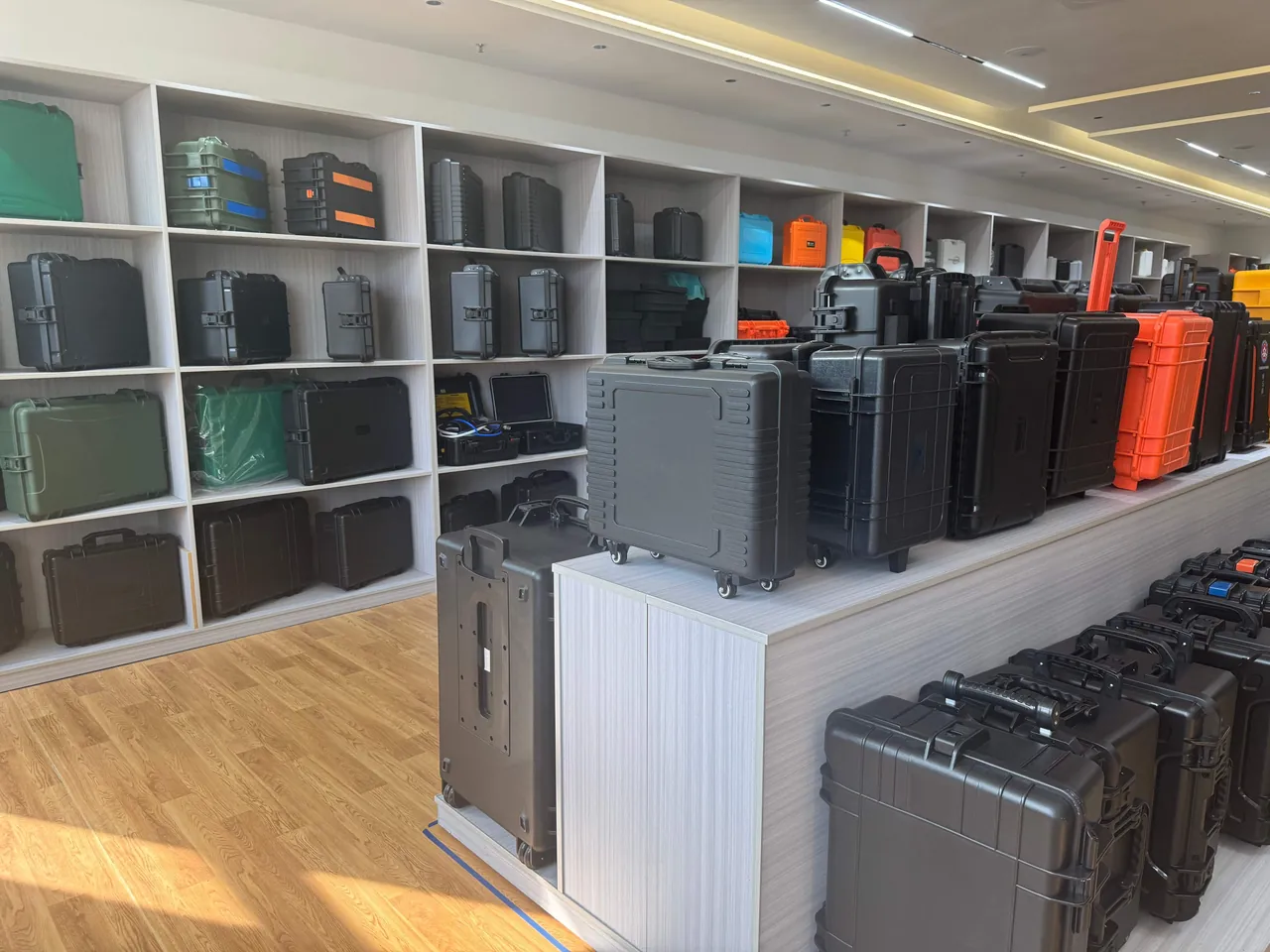
A breather valve does not permit water passage. If the case is exposed to rain or washdown, keep the valve away from areas where water pools on top and protect the membrane with a raised boss so it cannot be torn. Where high-pressure washdown is routine, choose a version with a protective cover.
The other half of condensation control is the packing environment itself. In a monsoon season or at a coastal plant, packing in an 85 percent RH workshop means the case starts with high internal moisture and even a generous desiccant load is consumed quickly. Establish a dehumidified packing zone, ideally 45 to 55 percent RH, or complete final closure in a low-humidity room. For spindle-class components with tight requirements, purge with dry air before closing.
Avoid leaving paper labels or ordinary paper wrapping inside, since they absorb moisture. Use laminated synthetic labels or laser-engraved liner markings instead, which resist moisture and do not shed. For export orders, keep label content bilingual and include item number, packing date and unpacking instructions so the receiver can complete an inventory check without full opening.
Transport testing and receiving acceptance criteria
Whether the protection design works is settled by test. Sawmill component cases are usually validated against three families of reference:
- General transport packaging tests: the GB/T 4857 series defines drop, stacking, vibration and impact methods and is the baseline for domestic transport packaging; sequencing and criteria are covered in GB/T 4857 transport packaging practice;
- International distribution cycle simulation: ASTM D4169 combines test sequences into a distribution cycle, which suits cross-border orders;
- International Safe Transit Association procedures: ISTA programmes emphasise reproducible whole-case performance and are widely used in e-commerce and third-party logistics.
For blades and feed components specifically, complete at least stacking to verify lid load capacity and liner clearance, random vibration to verify that tooth lines and roller faces do not abrade, drop or incline impact to verify corners and cradles, and environmental preconditioning with humidity testing to verify the rust-prevention scheme. Acceptance criteria should be quantitative: no chipped teeth, scratch length and count on roller faces within agreed limits, liner displacement no more than 2 mm, and no visible condensate.
Receiving inspection should be run from a checklist completed within 24 hours of unloading, with photographs returned. Items include external damage and moisture marks, seal integrity, humidity card reading, liner displacement, rust or scratches on components and impact damage on precision faces. For high-value orders, place single-use shock and tilt indicators inside so that any out-of-limit event is recorded objectively and responsibility can be assigned.
Test reports and acceptance criteria should be agreed in the contract or technical annex beforehand, including sample size, test sequence, limit values and disposition of failures. Testing after the fact rarely establishes responsibility or proves the condition at the time of shipment.
Stacking, forklift handling and lifting safety
Sawmill equipment cases tend to be long and heavy, so logistics risk concentrates in three areas: crushing in stacks, forklift tine penetration and unbalanced lifting.
Stacking. Lid and base need matching features, such as locating recesses on top and load-bearing bosses underneath, so the weight of the upper case travels into the lower case walls rather than into the middle of the lid. If gross weight exceeds 60 kg, print the maximum stacking layers on the side and base the figure on GB/T 4857 stacking results. For intercontinental sea freight, account for long-term static load in a hot, humid container and use a more conservative layer count than for short-term storage.
Forklift handling. The greatest risk is a tine pushed straight into the side wall. Provide two through fork pockets in the base at a height matched to common forklift tines, with timber or plastic skids underneath. Where no pockets exist, mark the fork centreline on the case and add a no-push warning. For cases with weight concentrated to one side, for example a spindle on one end and small parts on the other, the centre-of-gravity mark must be accurate or the load will swing as it lifts.
Lifting. Large cases often need an overhead crane. Put lifting points at the four corners or on dedicated lifting ears, and keep sling angles moderate so horizontal components do not crush the walls. Without ears, a sling passed under the base is acceptable, but add corner protectors where the sling touches the case to prevent both sling chafe and edge damage.
Load restraint in the vehicle is equally important. After stacking, strap the cases to the vehicle walls to prevent forward movement under braking, and put anti-slip mats between cases so they do not creep during long runs. For precision component cases, add arrows and this-way-up markings, plus tilt indicators where an objective record is useful.
Pre-shipment sampling and delivery documents
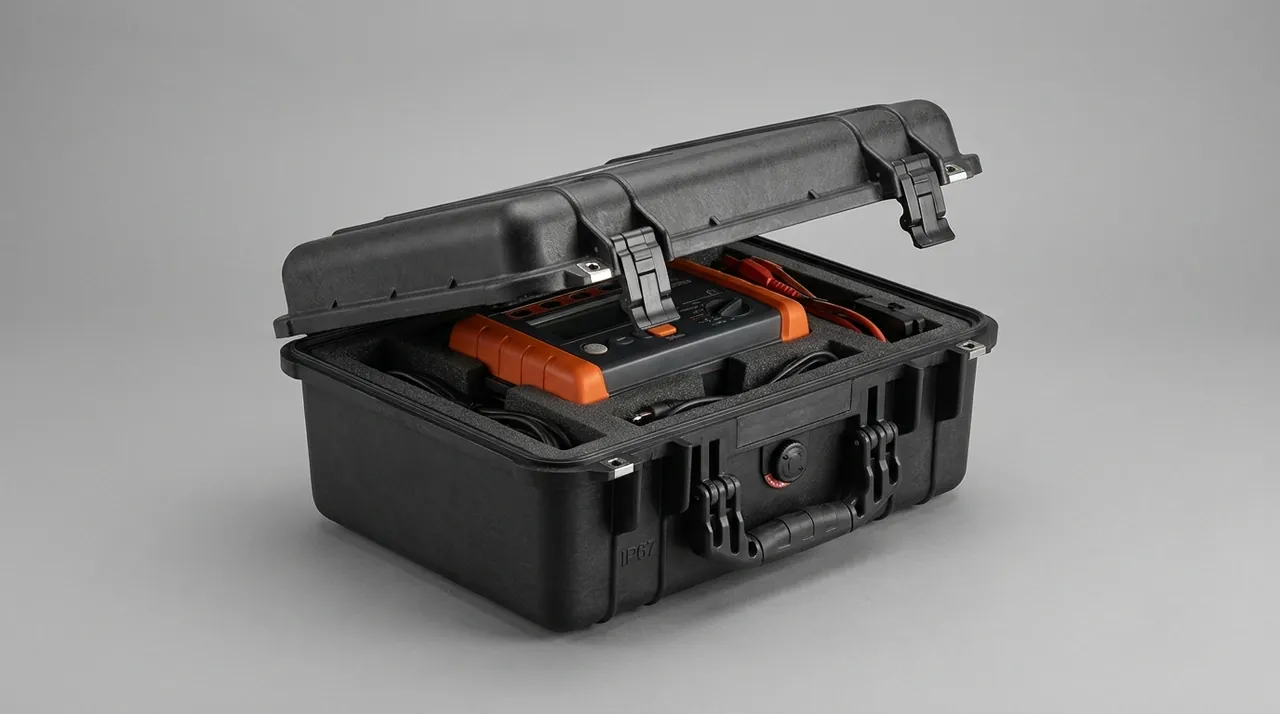
For batch orders, sampling is the most economical way to control consistency. Build a plan on AQL lines: cosmetic and marking defects at general inspection level, dimensional and functional items tightened; sampling plans and decision rules are described in acceptance sampling for custom cases. Typical items include:
| Inspection item | Method | Typical criterion |
|---|---|---|
| --- | --- | --- |
| Liner cavity dimensions | Calliper or go/no-go gauge | Within drawing tolerance, no interference |
| Tooth-line clearance | Feeler gauge and visual | Tooth line touches no hard surface |
| Gasket contact | Visual plus compression check | Continuous contact, no breaks, compression in range |
| Internal humidity | Indicator card | Below agreed threshold, e.g. 40 percent RH |
| Hardware function | Open and close cycles | Hinges and latches operate smoothly |
| Markings and documents | Item-by-item check | Numbering, batch and instructions complete |
Delivery documents should include at minimum a packing list with item numbers and quantities, material and specification notes, any required inspection records, illustrated packing and unpacking instructions, and replacement guidance for desiccant and humidity cards. Where the consignment includes lithium cells or other regulated goods, the matching transport paperwork is issued as a separate document set.
Where the customer needs third-party testing or material certification, state the test items, reference standards and who bears the cost in the contract. Commonly available documents include material composition reports, liner density and hardness records, gasket material statements and transport packaging test reports to the agreed standard.
Customisation workflow and prototyping gates
A compliant sawmill spare parts case normally passes through six gates: requirement confirmation, design, sample validation, pilot run, volume production and shipment inspection. When inputs and outputs at each gate are clear, rework stays under control.
- Requirement confirmation: collect the component list with maximum dimensions, weight, centre of gravity and precision-face locations, plus transport mode, stacking layers, reuse cycles and environment;
- Design: fix case structure, liner form, sealing and venting, hardware, and issue structural and liner drawings;
- Sample validation: build the first article, check fit, and run drop or vibration screening if needed;
- Pilot run: verify liner manufacturing consistency and assembly cycle time;
- Volume production: freeze process parameters and sample each batch;
- Shipment inspection: apply the agreed sampling plan and issue packing list with inspection records.
The most common cause of rework at the prototyping gate is a mismatch between the physical part and the drawing. Older machine spares often carry modifications, weld repairs or non-standard shaft extensions, so a liner built from the drawing alone interferes. Obtain coordinate measuring data or key measured dimensions before design; where that is impossible, confirm the outline with a 1:1 paper template or 3D scan. For volume orders, build one physical fit-check case first, run a full pack and unpack drill with the real component, and freeze the drawing afterwards.
Another source of rework is an unclear packaging unit definition: the customer wants one case to hold "one spare set" but never states which items constitute the set. Issue a packing list template at order confirmation and have the customer sign off item by item before production starts, so cavity positions are not rearranged after the case is finished. When choosing a manufacturing partner, review prototyping capability, liner machining equipment and inspection facilities against our guide to evaluating a protective case OEM factory rather than comparing unit price alone.
Spare parts rotation and re-shipment
Sawmill spare parts cases are usually not single-use items; they travel repeatedly for re-sharpening, repair and inter-site transfer. The case therefore has to be designed for repeated opening and repeated stacking.
Practices that extend service life include replaceable hardware, with hinges and latches screwed rather than riveted so they can be swapped on site; a gasket designed as a cartridge that can be pulled out and replaced in one piece; a modular liner where a damaged cradle is replaced individually instead of scrapping the whole insert; and sacrificial corner bumpers in metal or engineering plastic at the points most likely to take impact.
In the liner, the cavity mouth and fixing clips wear fastest. Chamfer the cavity edge or add a guard strip to reduce scraping during removal, and specify engineering plastic clips with anti-loosening features so the liner does not shift after many cycles. Where rapid on-site access is needed, a drawer or flap structure reduces the operation from lifting a whole lid to opening one section.
Rotation management also needs marking support. Provide a replaceable label holder on the case side for case number, contents, closing date and destination, and print specifications on the liner so operators can identify cavity ownership without consulting the packing list. These details determine whether the spare parts case becomes a reusable logistics unit inside the plant.
For spares held in long-term storage, the case should stack and be markable in the warehouse, and should retain a means of humidity monitoring. Establish an internal rule to open and re-inspect every six months, check desiccant condition and metal surfaces, and replace consumables in time so parts do not degrade while sitting on the shelf.
Frequently Asked Questions
Q: What makes a sawmill equipment case more expensive than an ordinary timber crate, and is it worth it? A: The premium comes from three areas. First the liner: a die-cut or CNC-machined EVA or PU insert requires tooling and sampling, which costs more than stuffing a timber crate with loose filler. Second the structure: wall thickness, corner posts and base load members must be calculated against stacking and forklift loads. Third sealing and hardware: gaskets, breather valves and replaceable hinges and latches are functional parts. Whether it pays depends on three questions. Is the component value high? Is the transport distance long? Will the case be reused? For a coiled band blade with hardened teeth, a dynamically balanced feed roller or a feed drive unit with an encoder, one transit damage event usually costs more in repair or scrap than the price difference. For low-value commodity parts supplied locally, a crate or carton with filler is sufficient. Model it as total cost per shipment equal to amortised case cost plus expected component loss, rather than comparing case prices in isolation.
Q: Can we just use sawdust or cardboard as cushioning inside a saw blade case? A: Not recommended. Sawdust and cardboard are hygroscopic, so in a cycling temperature and humidity environment they absorb and release moisture and hold local humidity high, which increases corrosion risk on high-carbon steel. Over long closed periods, paper and timber can also release trace organic acids that cause pitting where they touch metal, commonly called paper rust or crate rust in the trade. Fragments also embed in gullets and bearing fits, requiring extra cleaning at the receiving end, and a careless wipe can score a functional face. If cushioning is needed, use closed-cell EVA, cross-linked PE or PU foam, all of which have low water uptake, do not shed and have predictable compression recovery. If a customer prefers paper-based materials for recyclability, specify moisture-resistant composite board and keep a rust film or VCI layer between board and metal so they never touch directly. Note also that both compact under sustained load and lose thickness, so a gap designed at closure can open within days of road vibration and let the blade move inside its slot, whereas closed-cell foam holds thickness far better. Blow loose dust out of the gullets before packing.
Q: How do we size the desiccant, and is more always better? A: More is not better; the dose must match internal net volume, sealing class, transit duration and initial humidity. Practice is to compute a base dose from internal volume, apply a correction factor for transit days and seal performance, and keep at least 30 percent margin. Overdosing adds cost without improving safety, and placement matters more: distribute desiccant where air can reach it rather than piling it in one corner, where local humidity stays high anyway. For long ocean voyages, use a replaceable desiccant bay so consumables can be swapped without opening the main cavity. Pair it with an indicator card whose colour change records the humidity peak during transit and gives objective evidence that the preservation scheme worked. Check compatibility as well, since some chlorine-based desiccants carry a corrosion-promotion risk for certain metals in a closed environment. Record the desiccant type, dose and installation date on the packing list so the receiving team can judge remaining capacity instead of guessing. In a coiled blade case, place one unit near each end of the stack rather than all at the centre, because long cavities develop humidity gradients.
Q: With so many small parts such as feed rollers and dogs, how do we keep the liner organised? A: Three principles: one cavity per piece, precision faces floating, and guided removal. A die-cut cavity array is the usual answer. Cut each cavity to the maximum outline, keep at least 5 mm of wall between cavities to prevent migration, slope the floor 3 to 5 mm or add a finger notch for single-hand retrieval, and give pins and other slender protrusions their own sleeved cavities so the piece cannot rock. If one layer is insufficient, use a two-tier tray, but always with an independent divider and no through-holes between levels, otherwise vibration creates hard contact. Print item numbers and quantities on the liner so operators can count against the packing list. Make high-wear cavities replaceable modules, fixed with screws rather than adhesive, so a worn slot can be renewed without remaking the whole insert. Pay particular attention to tooth forms and pin bores on dogs: engaged teeth form a self-locking friction pair that wears quickly, so never leave a channel where two adjacent pieces can touch tooth to tooth.
Q: In a monsoon climate or a high-humidity region, will the case become a steam box? A: The risk is real but manageable. First, the packing environment must be below target humidity, ideally 45 to 55 percent RH in a dehumidified area; closing the case in an 85 percent RH workshop leaves high internal moisture and burns through desiccant fast. Second, balance sealing against venting, because a fully airtight case generates negative pressure under temperature cycling and draws moisture in, so fit a pressure equalisation valve. Third, make monitoring concrete by using indicator cards and replaceable desiccant bays so that whether the contents got damp becomes readable data rather than a guess. For extremely humid regions, choose lower-absorption wall materials such as PP or fibreglass composite and increase gasket compression. Inspect within 24 hours of arrival, and if the indicator has changed colour, follow the pre-agreed procedure to check metal surfaces and replace desiccant rather than discovering the problem at machine installation. Where the destination warehouse has no climate control, reopen and re-preserve within 24 hours instead of storing a sealed case in a hot, humid store for weeks, because the blade faces are the first surfaces to show pitting.
Q: Do we really need transport testing, and what happens if we skip it? A: Testing is strongly recommended, especially for long-distance export orders. Its value is bringing what happens on the road into the factory before volume production, so weak points in structure, liner or sealing surface early. Skipping it typically shows up at the customer: lid creep under stacking closes the liner clearance, long vibration rubs tooth lines against cradles, temperature and humidity cycling produces condensation rust. Resolving these costs far more than a test programme and is usually accompanied by batch disputes and downtime. For references, GB/T 4857 suits domestic transport, ASTM D4169 simulates cross-border logistics as a distribution cycle, and ISTA programmes emphasise reproducible whole-case performance. Cover at least stacking, random vibration, drop or incline impact and humidity preconditioning, and write quantitative criteria into the technical annex, for example liner displacement under 2 mm, no new scratches on liners or functional faces, and no visible condensate. The report is also valuable evidence in tenders and customer audits.
Q: Our spares go back to the maker for re-sharpening frequently; how should the case be designed for repeated use? A: Work from three ideas: maintainable, replaceable and identifiable. Maintainable means a modular liner so a damaged cradle is replaced individually rather than as a whole sheet. Replaceable means hinges and latches fixed with screws and a gasket designed as a pull-out cartridge, so consumables can be renewed on site. Identifiable means a replaceable label holder on the case side recording case number, contents, closing date and destination, plus item numbers printed on the liner. Structurally, add engineering plastic or metal corner bumpers so the most exposed positions become sacrificial, and chamfer or guard cavity mouths to reduce scraping. Where opening is frequent, prefer a drawer or flap arrangement to limit damage to the gasket each cycle. Also write a six-monthly re-inspection into internal procedures to check desiccant and metal surface condition, replace consumables in time, and prevent spares from degrading in storage. Record the trip count on each case, because the tooth-line clearance set at first article closes gradually as liner slots wear, so clearance should be re-measured every few trips instead of assumed.
Q: Which contract clauses are most often overlooked? A: Acceptance method and limit values top the list. Many orders specify only dimensions and quantity, with no agreement on the inspection window, ideally within 24 hours of unloading, the check items such as external damage, seal integrity, humidity card reading, liner displacement and component surface condition, or the disposition of failures through replacement, repair or price adjustment. Next come document clauses: whether material composition reports, liner density and hardness records, gasket material statements or transport packaging test reports must be provided within the contract, agreed in advance because retrospective testing rarely settles responsibility. Third is the packaging unit definition: which items go in one case, whether they form a set, and whether spares ship with the machine, all confirmed item by item on a packing list template. Fourth is marking and language, where export orders benefit from bilingual labelling and illustrated unpacking instructions that reduce on-site error. Finally, define responsibility boundaries: whether shock and tilt indicators are fitted, and which party records and judges transport events, so that any damage claim rests on objective evidence.
Conclusion and related reading
The value of a sawmill equipment case is not the box itself but the fact that it turns three outcomes into repeatable engineering results: teeth that do not chip, roller faces that are not scored, and fits that do not corrode. Getting there means deriving liner form and structural stiffness backwards from failure modes, holding humidity inside a safe boundary with sealing, venting and desiccant working together, and freezing the design intent into measurable criteria through stacking, vibration and drop testing. For buyers, handing over the component list, transport route and acceptance criteria before production starts costs far less than complaining afterwards.
Case bodies in this series are produced and delivered by Kexin New Materials (Guangdong) Co., Ltd. Cooperation covers drawings-based customisation, OEM and ODM programmes, and wholesale, agency and direct cross-border supply. For orders involving blade corrosion control or load calculations, material certificates and factory inspection records can be supplied under contract. To adapt a liner to a specific machine model, provide key measured dimensions or 3D scan data so fit validation passes on the first prototype.
Related reading