

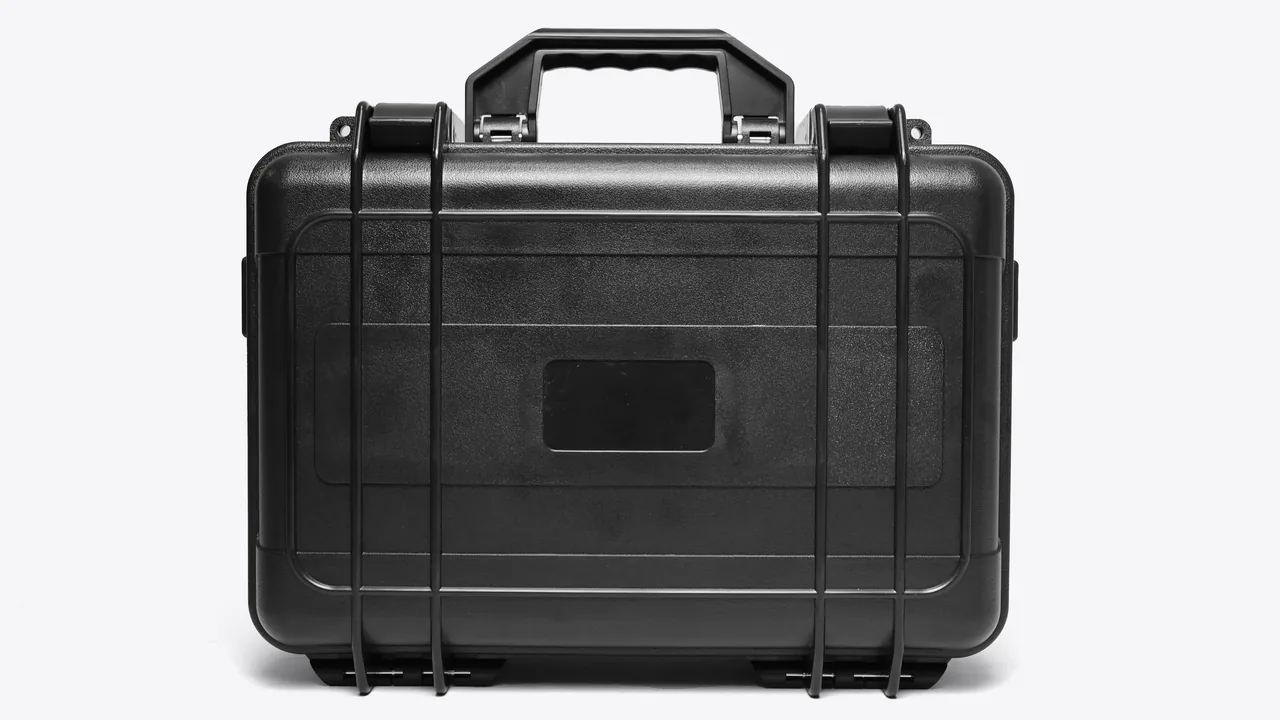
A silage wrapper is the machine that turns a bound forage bale into an airtight, fermentation-ready package by wrapping it in stretched film, layer after layer. Its architecture differs sharply from a baler, a mower-conditioner, or a combine: a rotating wrapping table, a film-stretching frame, a pre-compression and shaping unit, a film cutting and clamping assembly, a hydraulic power station, and a control system. Each of those subassemblies fails in transport for its own reason. This article examines the distortion, ageing, and impact risks facing film frames, pre-compression rubber rollers, film cutters, and hydraulic stations, and explains how JUNZHIJIA — manufactured by Kexin New Materials (Guangdong) Co., Ltd. — designs protective cases that keep each part intact from the factory floor to the field.
1. Anatomy of a Silage Wrapper and Its Component Inventory
Before any case design can be discussed, the assembly logic of the machine has to be understood. On both semi-automatic and fully automatic silage wrappers, the wrapping table is the centre of the machine. The bale rests on rollers or a belt bed; the table rotates while the film frame revolves around the bale, laying down overlapping film layers until the bale is sealed.
The component inventory typically divides into six systems.
The wrapping system includes the film-stretching frame, film roller shaft, tension springs, damping friction discs, frame slewing bearings, and film guide rollers. These parts are mostly slender cantilever structures, and the parallelism of the two frame arms directly determines whether the film overlap rate stays uniform.
The pre-compression and shaping unit includes pre-compression rollers, rubber coverings, roller-end bearing housings, clamping cylinders or hydraulic cylinders, pressure regulating valve blocks, and shaping side plates. The rubber layer acts as both a friction element and a protective element.
The cutting and clamping assembly includes film cutters, cutter carriages and slide rails, return springs, film clamping plates, and pneumatic or electric actuators. Film cutters are a classic edge part: once the edge chips, the film tail cannot be severed cleanly.
The hydraulic and power station includes hydraulic pumps, relief valves, directional valves, cylinders, accumulators, reservoirs and filters, and hose assemblies.
The transmission system includes cycloidal gear reducers, chains and sprockets, drive shafts, universal joints, and pulleys.
The control and sensing group includes control panels, PLCs or dedicated controllers, angle encoders, proximity switches, wiring harnesses, and junction boxes.
These six categories differ enormously in geometry, material sensitivity, and failure mode, which means a single packaging specification cannot serve all of them. That is precisely why a case manufacturer needs a dedicated design for a silage wrapper rather than a generic agricultural parts box.
2. Film Frame Geometry and Why It Distorts
The film frame is the single most demanding item in the whole packaging problem. To let the film roll make a complete revolution around the bale, the frame is usually built as a gantry or a cantilever: a slewing shaft carries two arms that project outward, and the film roller shaft and guide rollers sit at the arm ends. To save weight, the arms are often thin-wall square tube or folded welded plate.
This geometry has high bending stiffness along the axis but is comparatively weak laterally and in torsion. Three transport conditions cause most of the damage.
The first is a lateral concentrated load on an arm. When the frame lies flat in a truck and other cargo presses on the middle of an arm, the arm takes a permanent plastic bend, the distance between the two arms changes, and the film overlap rate deviates from its setting once the frame is refitted.
The second is torsion from stacking. If the two arms are not laid in the same plane, the slewing shaft carries torque, the fit between shaft end and bearing housing deforms slightly, and slewing resistance rises.
The third is free fall during handling. If a frame is slung at one point and the other end drops, a sharp impact at the arm end dents the tube wall. The dent becomes a stress concentration and may crack later in service.
One more easily missed damage mode is weld cracking. The heat-affected zone of a weld has lower toughness than the base metal, so under repeated vibration a fillet weld joining arm to shaft can initiate a micro-crack. That crack is invisible in storage and only propagates under load once the machine is running again.
The protection priority for a film frame is therefore not "wrap it thicker" but "support it correctly" — full-length support along both arms, the slewing shaft kept horizontal, and no external force acting on the free ends.
3. Failure Mechanisms of Pre-Compression Rubber Rollers
The pre-compression roller is one of the few soft-over-hard composite parts on a silage wrapper. A metal core is covered with a rubber layer that provides friction, absorbs the impact of an uneven bale surface, and prevents film damage. The performance of that rubber layer determines pre-compression quality, and it also dictates how the part must be handled in transit.
The first enemy of the rubber layer is ozone and ultraviolet light. Double bonds in the rubber molecular chain are extremely sensitive to ozone, and even at low concentrations, prolonged exposure produces surface crazing. Once crazing appears it propagates along the stress direction into deep cracks, and the rubber eventually debonds. Storing a rubber roller in an ordinary cardboard box does not block ozone or UV — and because cardboard absorbs moisture and then clings to the roller surface, it actually accelerates ageing.
The second enemy is mineral oil and organic solvent. Leaking oil from hydraulic components shipped in the same case will soak into the rubber surface and cause swelling. The roller face becomes uneven in volume, dynamic balance is lost, and the machine vibrates in operation.
The third enemy is sustained compression. Rubber exhibits compression set under long-term load. If a rubber roller is weighed down for months, a permanent flat spot remains after unloading, friction drops at that spot, and the bale slips there.
The fourth enemy is low-temperature embrittlement. In an unheated northern warehouse, rubber passes through its glass transition and loses toughness. An impact at that point produces brittle fracture rather than elastic recovery.
These four failure modes map onto four packaging requirements: light-tight sealing, oil isolation, no load bearing, and impact cushioning at low temperature. A compliant case must satisfy all four at once.
4. Edge Protection for Film Cutters and Clamping Assemblies
The film cutter is small and inexpensive, yet it is frequently the part responsible for the longest downtime. The reason is that the edge is acutely sensitive to chipping. Film cutters are usually straight-edged or serrated, with an edge angle typically between twenty and thirty degrees. The cutting tip is hard and also brittle.
Edge damage has three typical sources.
The first is direct contact with other hard parts. If cutters are bagged together with bearings, bolts, or chain links, relative movement during transport makes the edge strike hard surfaces repeatedly and chip.
The second is cutters engaging each other. When several cutters are piled together, their edges bite into one another. This damages the edges and creates a genuine laceration hazard, a classic example of an unsafe packing arrangement.
The third is distortion of the cutter carriage rail. Cutters mount on a rail and return by spring. If the rail is bent, the clearance between blade and clamping plate goes out of control, the cutting stroke cannot complete, and the film is not severed.
Clamping plates and return springs also deserve attention. A clamping plate is a thin sheet part that loses elasticity once compressed, while a return spring held in compression for a long period loses free length and can no longer return the cutter.
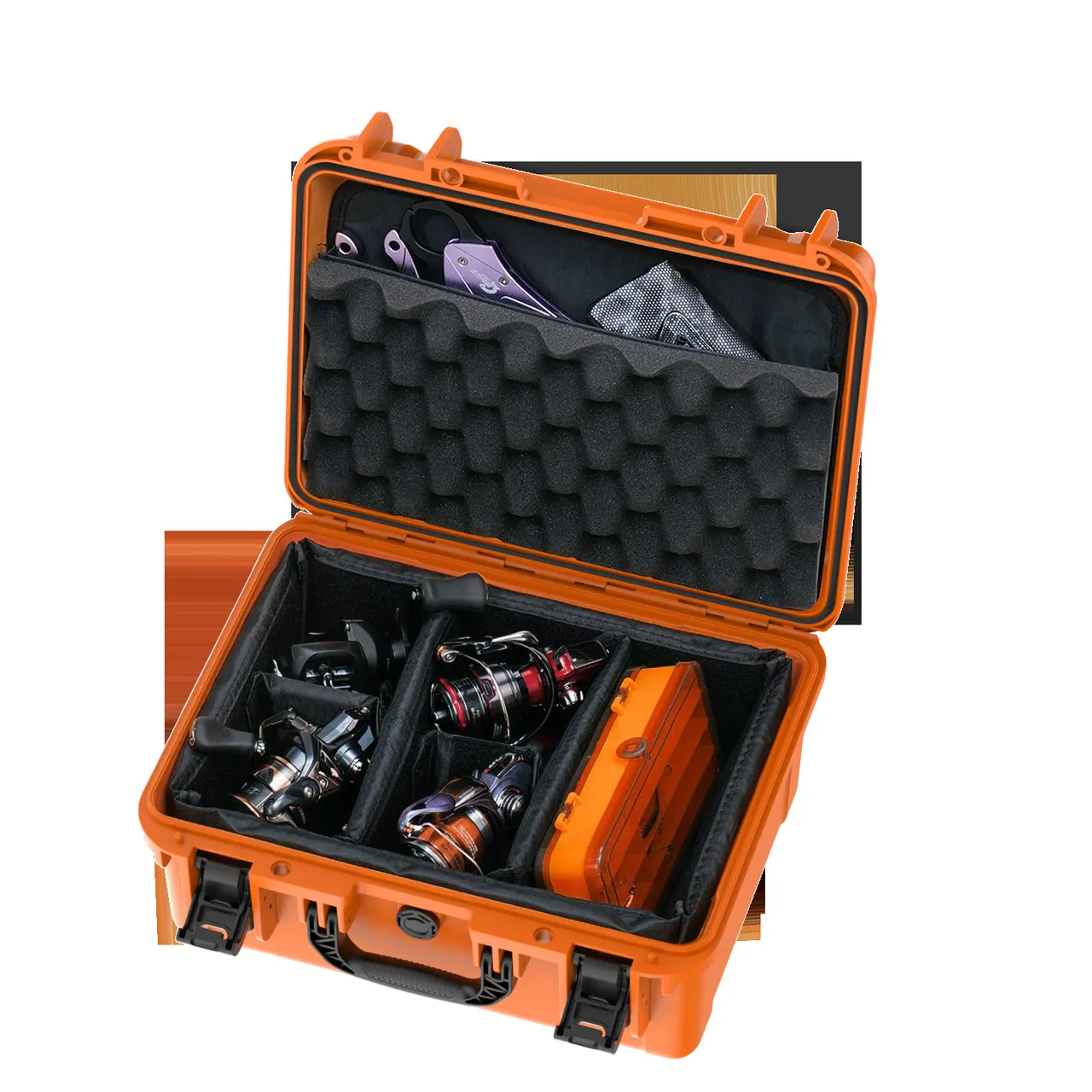
The right approach for these parts is "individual location plus zero edge contact." Each blade sits in its own recess, the edge is suspended or rests against a soft liner, and a divider fully separates blade from blade so that no hard-to-hard contact point exists anywhere in the case. This calls not for thicker walls but for a more precise internal cavity design.
5. Hydraulic Station Transport and Moisture Control
The hydraulic station on a silage wrapper drives the table, the clamping functions, and the opening and closing motions. It is the power centre of the machine. Protecting hydraulic components is fundamentally different from protecting mechanical parts: mechanical parts fear distortion, hydraulic parts fear contamination.
Hydraulic contamination takes three main forms.
The first is particulate contamination. If the internal walls of lines and cylinders corrode during transport because of vibration and moisture, rust flakes and metal particles enter the oil and accelerate pump and valve wear. This contamination is nearly undetectable before commissioning.
The second is moisture contamination. Hydraulic oil that has absorbed water forms cavitation under high temperature and pressure, which destroys the oil film; over time the oil emulsifies and loses lubricity. Condensation risk is especially pronounced in humid seasons and during sea freight.
The third is seal ageing. O-rings and oil seals are typically nitrile or fluoroelastomer. Prolonged exposure to UV and ozone hardens them and removes elasticity, so the sealing face loses preload and begins to weep.
Hydraulic station packaging therefore concentrates on three points. First, every port is fully plugged: all oil ports and fittings receive dust caps before dispatch and are secured inside the case so they cannot work loose in transit. Second, vapour-phase corrosion inhibitor (VCI) material is added inside the case; VCI molecules attach to metal surfaces within the enclosed volume and form a molecular protective film that suppresses corrosion and limits moisture attack on port faces. Third, humidity is controlled through a combination of desiccant and a pressure equalisation valve, which holds relative humidity low while preventing the temperature-driven vacuum that would otherwise draw moist air in.
Hydraulic hose assemblies need separate treatment for bend radius. A hose stored beyond its minimum bend radius for a long period will fatigue-crack its inner rubber layer, and a hose forced into a kinked fold is scrap. The case interior therefore needs curved cradles that let hoses coil naturally at their factory bend radius without forced deformation.
6. Storage Risk While the Machine Waits for the Next Season
Silage work is intensely seasonal. Many owners strip the wrapper after harvest and store the components for months, sometimes across a full year. This storage window is often when the most damage accumulates.
Thermal cycling is the most pervasive threat. Day-night temperature swings make the air inside a case expand and contract. If the case cannot breathe, a pumping effect forms at the seal and draws external moisture inward. This is exactly why a protective case needs a pressure equalisation valve: it allows slow air exchange while blocking liquid water and dust.
Ground moisture is the second threat. Concrete floors release water vapour continuously during humid seasons. A case placed directly on the floor sits in a high-humidity microclimate, and corrosion on metal parts typically begins at the bottom face, where it is least visible.
Stacking load is the third threat. Using a protective case as a bottom shelf and piling heavy items on top deforms the shell, changes the liner geometry, and turns a precisely fitted recess into a loose pocket where parts begin to shift.
Insects and rodents are the fourth threat, and they are especially common in agricultural warehouses. Rodents chew rubber and wiring harnesses, a problem that bulk cardboard packaging can hardly avoid.
A complete storage plan therefore contains four actions: keep cases off the floor, stack only to the designed layer count, inspect desiccant condition on a schedule, and keep seals closed. All four can be supported at the structural level by the case design itself.
7. Design Logic of Anti-Distortion Cradles
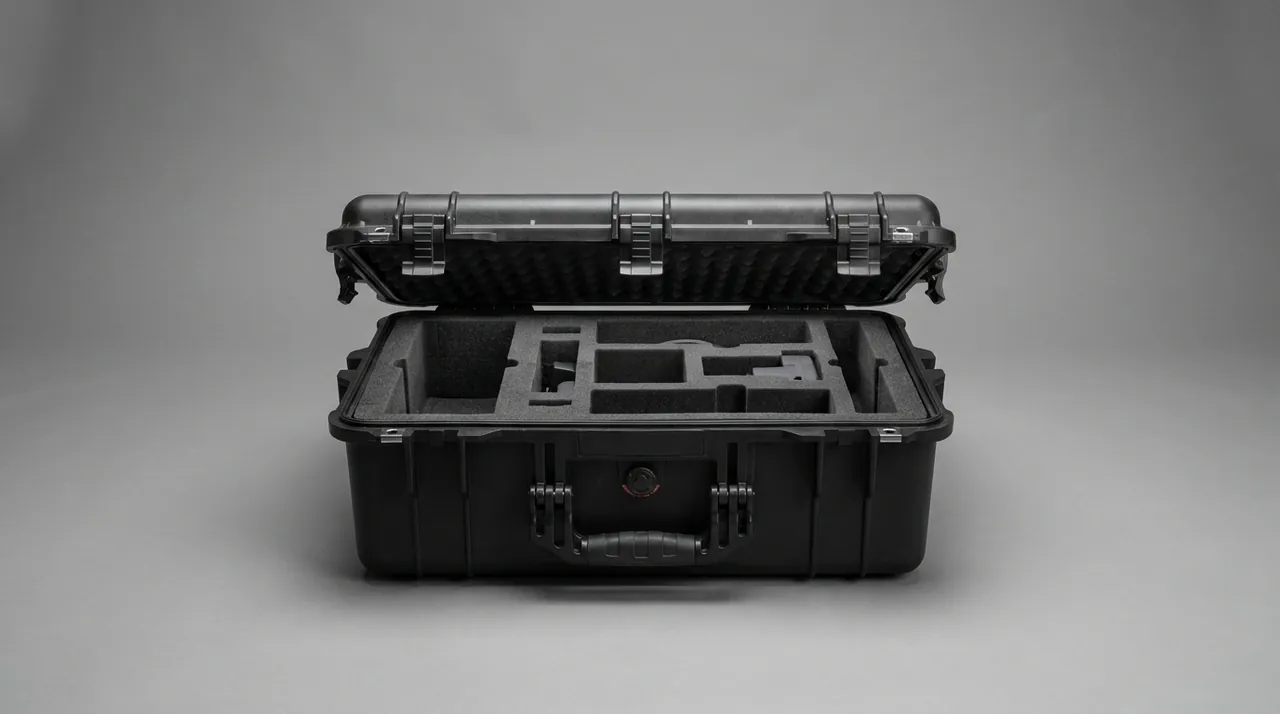
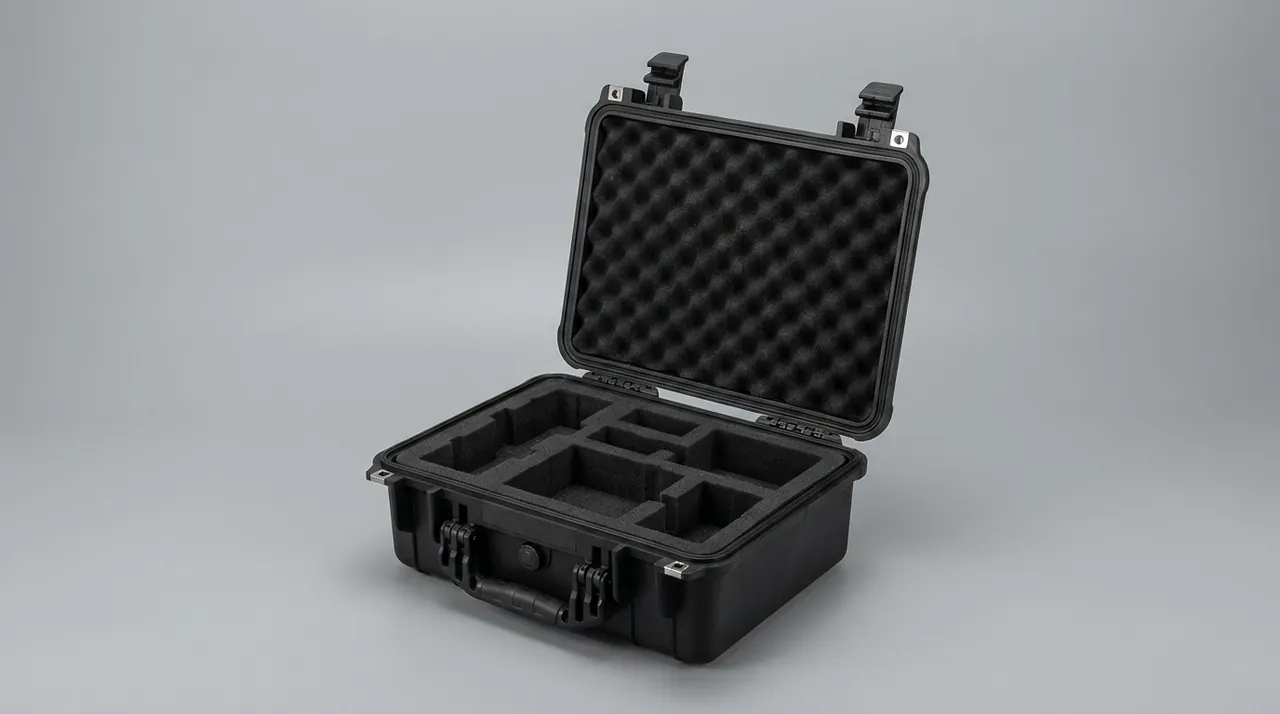
For long cantilever parts such as film frames, JUNZHIJIA applies a principle of full-length support, two-end restraint, and profiled mid-span bearing.
Full-length support means the cradle contacts the part over at least two thirds of its length, avoiding the simply-supported condition where both ends rest on supports and the middle hangs free. A simply-supported beam enters resonance bands under vibration, and amplitude is amplified.
Two-end restraint means the part is constrained both axially and laterally, but not by rigid clamping. A small clearance is left and filled with an elastomer. Rigid clamping transmits impact straight into the part when the case is struck, whereas an elastomer absorbs it.
Profiled mid-span bearing means the cradle's supporting surface is machined to the actual part contour. If an arm is square tube, the support should be shaped to match that tube rather than being a flat plate. The larger the contact area, the lower the pressure per unit area and the smaller the risk of plastic deformation.
For cylindrical soft-faced parts such as pre-compression rollers, the cradle should be a V-block or semicircular saddle so that the rubber layer is loaded along the cylinder generatrix rather than at a single point. A low-hardness EVA layer on the saddle surface further distributes pressure.
For thin-edged parts such as film cutters, the cradle should be a multi-slot comb structure, each slot holding one blade with the edge touching no surface at all.
For the hydraulic station, the cradle's priority is to keep load off the ports. Every port position needs clearance so that external impact on the case is never transmitted into a fitting.
All cradles wear over time. They should therefore be replaceable modules that a user can swap on site without replacing the whole case, which also extends the case's service life.
8. Compartment Layout and the Removable Divider System
A silage wrapper component case usually carries anywhere from a dozen to several dozen different parts. Mixing them in one cavity means abandoning protection altogether, so compartmentalisation is not optional.
The first step is grading by sensitivity. Tier one includes film cutters, tension springs, and sensors or controllers. Tier two includes pre-compression rollers, guide rollers, and cylinders. Tier three covers general metal structures such as side plates, brackets, and sprockets. Each tier occupies its own zone and is physically isolated by dividers.
The second step is matching cavity size to part size. Bigger is not better: an oversized cavity lets parts move inside, while an undersized one simply will not accept the part. The ideal is a uniform cushion thickness between part and cavity wall.
The value of a removable divider system is that it accommodates batch variation. The same machine may have revised parts in a later model year, or a user may ship only part of the kit at a time. Removable dividers let one case shell serve several combinations, reducing the number of case variants a user must keep on hand.
The dividers themselves need structural strength. A thin divider buckles under impact and loses its isolating function, so dividers should have ribs or folded edges. This is an easily overlooked detail that strongly affects long-term reliability.
9. What IP67 Sealing Is Actually Worth in Farm Conditions
IP67 means the highest level of dust protection plus the ability to withstand short-term immersion without water ingress under defined conditions. For a farm machinery parts case, that value shows up in three scenarios.
The first is rain during field transfer. Farm parts move with the machine constantly during harvest, and heavy rain en route cannot be avoided. A non-sealed case takes on water within minutes, and rubber parts, electronic components, and edged parts are damaged simultaneously.
The second is pressure-washer cleaning. The habit on farms is to clean with a pressure washer, and protective cases on the same yard often get sprayed too. An IP67 rating tolerates short-term spray without ingress, though it is important to note that IP67 does not promise resistance to prolonged high-pressure hot water; that belongs to IP69K.
The third is water crossing during transport. Rural roads flood in the rainy season, and the lower part of a case may be briefly submerged as a truck passes.
It must be stated clearly that IP67 is not a permanent guarantee. All sealing depends on a rubber gasket, and gaskets age and flatten after dozens of open-and-close cycles. The gasket is therefore a consumable and belongs on the spare parts list. Keeping the sealing face clean, preventing sand from embedding in it, and checking for foreign objects on the sealing line before closing all extend seal life considerably.
10. Liner Material Choice: EVA, EPE, and XPE
Softer is not automatically better for a liner. It has to balance cushioning, resilience, compression resistance, and machining precision.
EVA is an ethylene-vinyl acetate copolymer with relatively high density, good rebound, and the ability to be machined into precise three-dimensional recesses. Its compression set is low, so it recovers shape even after sustained load, making it suitable for cradles and saddles that carry continuous weight.
EPE is expanded polyethylene with closed cells, low weight, and good cushioning, but limited rigidity and machining precision. It suits large-area void filling and low-stress parts.
XPE is cross-linked polyethylene foam with finer cells, better dimensional stability, and weathering resistance superior to EPE, which makes it preferable where shape must be held long-term and moisture resisted.
In a silage wrapper parts case, the common combination is an outer EPE energy-absorbing layer, an inner EVA shape-holding layer, and XPE plus VCI film in the metal parts zone. Rubber parts require particular care: the liner must be free of sulfur and of plasticisers that can migrate, because the liner itself can otherwise cause rubber degradation.
How the liner is fixed to the case matters just as much. If a liner is held only by friction, repeated opening and closing will eventually loosen it and destroy its locating function. The reliable approach is mechanical interlock or adhesive bonding to the case shell.
11. Four JUNZHIJIA Solutions for Silage Wrapper Parts
Drawing on the risks above, JUNZHIJIA has developed four targeted solutions for silage wrapper components.
The first is an anti-distortion cradle for long parts. The cradle is machined to the actual cross-section of the film frame arm, supports it at multiple points along its full length, and uses elastomeric limit blocks at both ends. It is removable for adjustment and replacement, and it addresses arm bending, shaft torsion, and weld cracking together.
The second is a light-tight saddle for rubber rollers. The pre-compression roller drops into a semicircular saddle so the roller face is loaded along the generatrix and local flat spots are avoided. A light-blocking layer sits between saddle and shell to cut off UV and ozone, and no liner material that migrates into rubber is used anywhere in the case, preventing swelling.
The third is an edge-isolation comb slot for film cutters and clamping plates. Each blade enters its own slot, the edge is suspended, and ribbed dividers fully separate one blade from the next, protecting edges while removing the laceration hazard.
The fourth is a moisture-controlled cavity for hydraulic components. This cavity is independently sealed, contains VCI material and a replaceable desiccant cartridge, and the case carries a pressure equalisation valve for slow breathing. Oil ports are held in dedicated pockets and take no pull during transport, and a curved cradle in the hose zone maintains bend radius.
All four solutions sit on the same IP67 shell. The shell is injection-moulded engineering plastic with reinforcing ribs, rounded corners that spread drop impact, latches and hinges validated by cycle-life testing, and handles positioned at the loaded centre of gravity. Colour and marking can be customised, but marking serves identification only and does not affect structure.
12. Packing Procedures and On-Site Acceptance Points
Even the best case depends on correct packing practice. The following points define the working procedure for a silage wrapper parts case.
First, cleanliness. Parts must be free of soil, crop residue, and moisture before entering the case. Grit wears liners and sealing faces, and moisture invites corrosion.
Second, position verification. Every part must sit in its designated recess and must not cross compartments. Crossing means the part presses on a divider, and the divider deforms over time.
Third, fastener check. Bolts, clamps, and caps must all be secured in their positions and never left loose in a cavity. Loose small parts penetrate liners under vibration and strike hard components.
Fourth, seal inspection. Before closing, check that the gasket is intact and that no foreign object sits on the sealing line. After closing, every latch must engage fully; a single unlatched catch defeats the seal.
Fifth, record keeping. Log the packing date, parts list, and desiccant replacement interval for traceability.
On-site acceptance should focus on four items: the empty-case sealing test result, whether liner and cradle machining matches the drawing, how the case behaves in the loaded stacking test, and whether marking and batch information can be traced. All of these can be confirmed by sampling inspection before volume delivery.
13. Common Misconceptions and Procurement Advice
Several misconceptions recur in procurement discussions.
The first is that a harder case is a better case. An over-rigid case transmits all impact energy into the contents, which often causes more damage. The correct division of labour is that the shell provides structural strength while the liner absorbs energy.
The second is one big case for everything. That puts sensitive parts and heavy parts in the same cavity, and the sensitive parts pay the price. Grading and compartmentalising costs far less than replacing damaged parts.
The third is ignoring the special nature of rubber parts. Shipping rubber rollers in the same case as oils or solvents is a common cause of scrap.
The fourth is reading IP67 as permanent waterproofing. The gasket is a wear item with a replacement cycle, and this should be explicit at the procurement stage.
The fifth is substituting a cardboard box with foam for a purpose-built case. It looks cheaper in the short run, but the damage from a single long-haul shipment usually exceeds the purchase price of a proper case.
On the procurement side, buyers should supply a complete parts list with weights, maximum envelope dimensions, transport mode, and storage environment. The manufacturer then designs the compartment layout and cradle structure and advises on stacking layer count and stacking load. If parts may be revised later, an adjustable zone should be reserved at the design stage so a revision does not scrap the whole case.
For users who must ship to multiple destinations, a modular case system is worth considering: a common outer shell with swappable internal liner modules to suit different part combinations. Over a long service life this usually works out cheaper in total cost of ownership.
14. Maintenance, Service Life, and Spare Parts Strategy
A protective case is itself equipment and needs maintenance. Three items matter most: the gasket, the latches and hinges, and the liner cradles.
Gasket replacement interval depends on cycle frequency and environment. High-frequency opening, dusty conditions, or long-term outdoor use all shorten it. The judgement criteria are hardening, flattening without rebound, cracking, or permanent deformation.
Latches and hinges are moving parts and should be checked regularly for looseness and binding. A squeaking hinge pin should receive a suitable grease, taking care not to use an oil that migrates into the liner.
Liner cradle wear shows up as a recess that has widened and no longer fits the part. Once clearance exceeds the design value, the part moves inside the case and protection degrades; the cradle module should then be replaced.
A sensible spare parts strategy is to over-stock wear items and under-stock structural items. Gaskets, desiccant cartridges, and cradle modules are wear items and are best held at twenty to thirty percent of usage; the shell and dividers are structural and can be held below five percent.
Daily actions that extend life include avoiding long storage in direct sunlight, avoiding drops from height, avoiding overloading in stacks, closing the case gently rather than slamming it, and never placing additional load on the lid after packing.
For a case manufacturer, supplying spares and maintenance guidance is part of the service. JUNZHIJIA delivers packing procedures, a maintenance interval table, and a spare parts list with the product, so that protection performance is maintained in real use rather than decaying year after year after first delivery.
15. How This Differs from a Baler Parts Case
Because silage wrappers and balers often work the same harvest line, buyers sometimes treat the two packaging problems as interchangeable. In practice the emphasis is completely different.
The hard problems on a baler are the knotter and the compression chamber: the knotter is a high-precision motion assembly that fears damage to precision fits, while the chamber wall plate is a large thin sheet that fears loss of flatness. On a silage wrapper the hard problems are the film frame and the rubber roller: the frame is a long cantilever that fears bending and torsion, and the rubber roller is a soft-faced composite that fears ageing and compression.
Beyond that, the hydraulic station on a wrapper drives more functions, so port count and circuit complexity exceed those of a baler, and the moisture-controlled cavity has to be designed to a higher standard. Film cutters and clamping assemblies are a component category unique to wrappers and simply do not exist on a baler.
Compartment logic, cradle form, and material choice should therefore be designed independently for the two machines. Buyers are best served by submitting separate requirements per machine rather than one generic list covering both, because only then can the manufacturer deliver a genuinely matched protection scheme.
For related equipment protection approaches, see baler parts cases, combine harvester parts cases, and mower-conditioner parts cases. Users who bale and wrap in a continuous field operation may also find the heavy-load support logic in tractor implement transport cases useful.
16. Frequently Asked Questions
Q: Why can't a silage wrapper film frame simply be strapped and packed like ordinary metal parts? A: A film frame is a classic slender cantilever structure with high axial bending stiffness but comparatively weak lateral and torsional stiffness, which means its weak directions are exactly the ones that transport vibration loads. Strapping creates concentrated restraint at the middle of an arm, and under vibration that restraint point becomes a stress concentration where the arm takes a permanent plastic bend; the slewing shaft can also twist out of tolerance when the arms are not laid in one plane. Once the distance between the two arms changes, the film overlap rate deviates from its setting when the frame is refitted, and wrapping quality drops in a way that is difficult to diagnose because nothing is visibly broken. Weld cracking is a further risk, since the heat-affected zone has lower toughness and can initiate micro-cracks that stay invisible until the machine runs again. The correct approach is a cradle profiled to the arm cross-section, supporting the part at multiple points along its full length, with elastomeric limit blocks at both ends that restrain displacement without rigid clamping so no force reaches the free ends. This is a structural design problem rather than a packaging materials problem, which is why a generic box cannot substitute for a purpose-built case.
Q: What threatens pre-compression rubber rollers most in storage, and what must the case provide? A: Four things matter most, and each requires a different countermeasure. Ozone and ultraviolet light produce surface crazing that propagates along the stress direction until the rubber debonds, so the case must supply light-tight protection rather than a cardboard box that absorbs moisture and clings to the roller. Mineral oil and organic solvents soak into the rubber and cause swelling, which makes the roller face uneven and destroys dynamic balance, so hydraulic components must be isolated in a separate cavity. Sustained compression causes compression set, leaving a permanent flat spot where friction falls and the bale slips, so the roller may carry no load and nothing may be stacked above it. Low-temperature embrittlement makes the rubber fracture under impact instead of recovering elastically, so cushioning matters more than rigidity in cold storage. In practice this means a semicircular saddle that loads the roller along its generatrix rather than at a point, a light-blocking layer between saddle and shell, and liner materials entirely free of sulfur and migrating plasticisers, since an incompatible liner will itself degrade the rubber it is supposed to protect.
Q: Why do film cutter edges damage so easily in transit, and how is it prevented? A: Film cutters are usually straight-edged or serrated with an edge angle between twenty and thirty degrees, and the cutting tip is hard but brittle, making it acutely sensitive to chipping even though the part itself is small and inexpensive. There are three sources of damage. First, packing cutters with bearings, bolts, or chain links lets relative movement during transport drive the edge repeatedly into hard surfaces until it chips. Second, piling several cutters together makes their edges bite into each other, which damages the edges and creates a genuine laceration hazard during unpacking. Third, a bent cutter carriage rail destroys the clearance between blade and clamping plate, so the cutting stroke cannot complete and the film tail is never severed, producing a downtime that has nothing to do with the blade itself. The countermeasure is a comb-style multi-slot cradle where each blade has its own slot, the edge is suspended and touches nothing, and ribbed dividers fully separate adjacent blades. This protects the edges and removes the handling injury risk at the same time, since it eliminates every hard-to-hard contact point by design rather than by careful handling.
Q: What is the most commonly overlooked hydraulic contamination risk in transport? A: Moisture contamination and internal wall corrosion are the most commonly overlooked, largely because neither is visible before commissioning. Hydraulic oil that has absorbed water forms cavitation under high temperature and pressure, which destroys the oil film and accelerates wear; at higher water content the oil emulsifies and loses lubricity entirely, and the resulting damage is often misattributed to pump wear. Condensation risk is especially severe in humid seasons and during sea freight, where temperature cycles drive moisture into any enclosed space that cannot manage its own humidity. At the same time, if the internal walls of lines and cylinders corrode during transport because of vibration and moisture, rust flakes and metal particles enter the oil and accelerate pump and valve wear, a form of contamination that is almost impossible to detect by eye. A related oversight is port protection: if a dust cap works loose in transit, external particles enter the system directly. The hydraulic station should therefore sit in an independently sealed cavity with vapour-phase corrosion inhibitor, a replaceable desiccant cartridge, capped ports held in dedicated pockets, and no pull or twist on any fitting while the case is in motion.
Q: Is IP67 sealing genuinely valuable for a farm machinery parts case, or is it over-engineering? A: IP67 earns its place in three conditions specific to agriculture. First, rain during field and road transfer: parts move constantly during harvest and heavy rain en route is unavoidable, and a non-sealed case takes on water within minutes, damaging rubber parts, electronic components, and edged parts simultaneously. Second, pressure-washer cleaning: the farm habit is to wash with a pressure washer, and protective cases in the same yard are usually sprayed as well, which an IP67 case tolerates for short periods. Third, water crossing during transport, where flooded rural roads can briefly submerge the lower part of a case as a truck passes. Two caveats matter in equal measure. IP67 does not promise resistance to prolonged high-pressure hot water, which belongs to IP69K, so buyers should not read IP67 as covering every washdown scenario. And IP67 is not permanent: sealing depends on a rubber gasket that ages, hardens, and flattens over repeated cycles. The gasket belongs on a scheduled replacement list rather than being treated as a one-time design feature that lasts the life of the case.
Q: How should EVA, EPE, and XPE liners be chosen for this application? A: The three materials differ and should be selected by load state and precision requirement rather than by price alone. EVA has higher density, good rebound, and can be machined into precise three-dimensional recesses; its low compression set means it recovers shape after sustained load, which suits cradles and saddles carrying continuous weight such as film frame supports. EPE has closed cells, low weight, and good cushioning but limited rigidity and machining precision, so it suits large-area filling and low-stress parts such as side plates. XPE has finer cells, better dimensional stability, and superior weathering resistance, making it preferable where shape must be held long-term and moisture resisted, which is typical in the metal parts zone. The combination used in a silage wrapper case is an outer EPE energy-absorbing layer, an inner EVA shape-holding layer, and XPE with a vapour-phase corrosion inhibitor film around the hydraulic and machined metal components. Rubber parts need extra care: liners containing sulfur or migrating plasticisers will themselves degrade the rubber, so material compatibility must be checked before the liner is specified, not after a batch of rollers has already aged in storage.
Q: What tends to go wrong during the storage period when a wrapper waits for the next season? A: Storage is often where the most damage accumulates, because nothing draws attention to it. Thermal cycling makes the air inside a case expand and contract; without breathing capability the seal creates a pumping effect that draws external moisture inward, which is precisely why a pressure equalisation valve matters. Ground moisture is the second issue: concrete releases water vapour continuously in humid seasons, and a case sitting directly on the floor keeps its bottom face in a high-humidity microclimate where corrosion starts out of sight and is found only when the part is fitted. Stacking load is the third: using a protective case as a bottom shelf deforms the shell, changes liner geometry, and lets parts shift inside so that a precisely fitted recess becomes a loose pocket. Insects and rodents are the fourth and are especially common in agricultural warehouses, where rodents chew rubber and wiring harnesses, a problem bulk cardboard packaging can hardly prevent. The practical routine is to store off the floor, stack only to the designed layer count, inspect desiccant on a schedule, and keep every seal closed between inspections.
Q: Can the film frame, pre-compression rollers, film cutters, and hydraulic station share one case? A: They can share one case shell, but they must never share one cavity, and that distinction is the whole point of the design. Grading by sensitivity and physical isolation are essential. Tier one covers film cutters, tension springs, and sensors or controllers, all of which are damaged by impact or contamination. Tier two covers pre-compression rollers, guide rollers, and cylinders, which are sensitive to load and to rubber ageing. Tier three covers general metal structures such as side plates, brackets, and sprockets. Each tier occupies its own zone separated by ribbed dividers. Cavity dimensions must then match the parts: an oversized cavity lets parts move and strike each other, an undersized one will not accept them at all, and the ideal is a uniform cushion thickness around every part. A removable divider system accommodates batch variation and part revisions, letting one shell serve several combinations. Dividers themselves need structural strength, since a thin divider buckles under impact and loses its isolating function, so ribs or folded edges are required rather than optional in a case that will be handled for years.
Q: How can a buyer tell whether a silage wrapper parts case is genuinely compliant? A: Four acceptance items are more useful than a visual check of wall thickness, which tells almost nothing about protection performance. First, the empty-case sealing test result, verified by pressure decay or immersion, together with confirmation that the pressure equalisation valve functions in both directions rather than being a cosmetic fitting. Second, liner and cradle machining accuracy against the drawing, with particular attention to how closely each recess matches the part contour, since excessive clearance lets the part move inside the case and defeats the purpose of a fitted liner. Third, loaded stacking test performance: stack to the recommended layer count and check for shell deformation, liner displacement, and seal failure, because these are the conditions of actual warehouse use. Fourth, traceability of marking and batch information, which matters for later quality investigation and spare parts matching. It is also worth requesting cycle-life test data for the latches and hinges, since those two components determine how reliably the case opens and closes over years of use.
For broader selection guidance, see agricultural machinery parts cases, how to judge case structural strength, and case foam material comparison. Adjacent steps in the silage chain are covered in baler parts cases and feed mixer parts cases.
For broader selection guidance, see agricultural machinery parts cases, how to judge case structural strength, and case foam material comparison. Adjacent steps in the silage chain are covered in baler parts cases and feed mixer parts cases.