

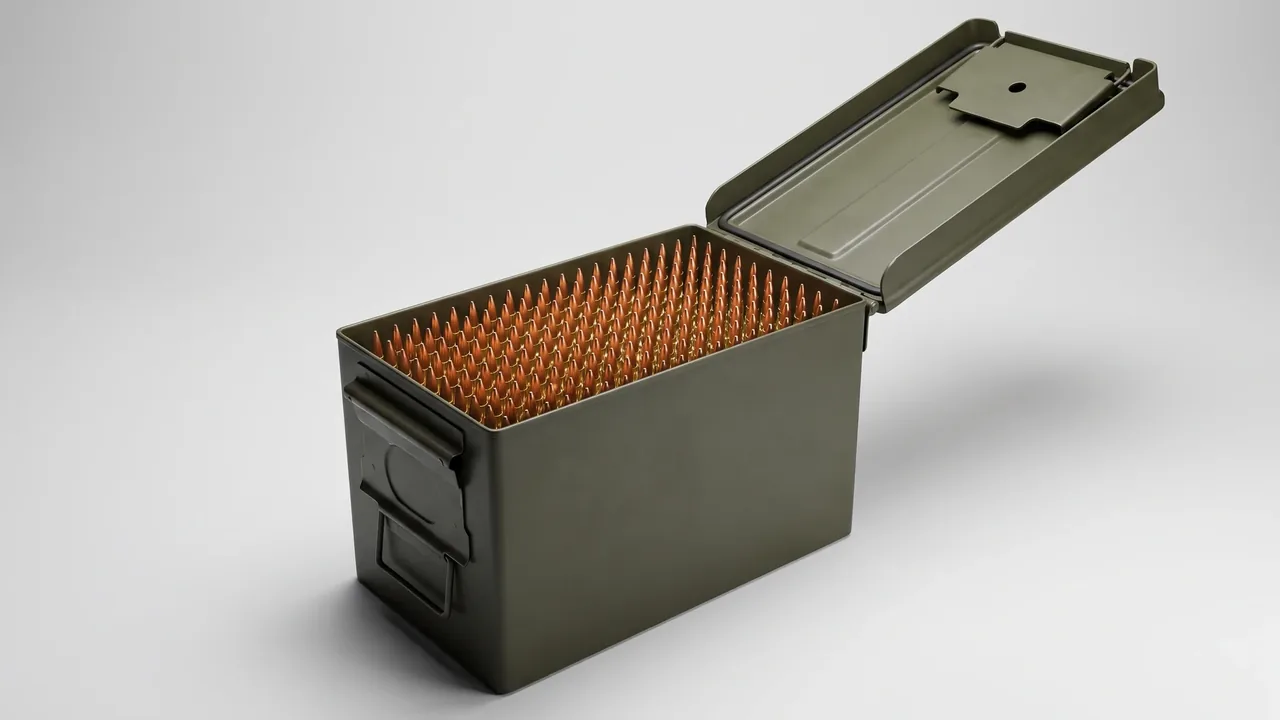
Across military and police issue, shooting-range operation and ammunition retail, the selection of a small arms ammunition box is often reduced to a single question: how many rounds will it hold. The engineering decision that actually reaches the drawing board has to settle four variables at once — the issue multiple, the load one person can move, the storage horizon and the traceability granularity. Kexin New Materials (Guangdong) Co., Ltd., which manufactures the JUNZHIJIA line of protective cases, keeps confirming one conclusion in its design reviews: bigger is not better. Capacity must converge together with the issue unit, the handling station and the palletized load, or the case stops being useful within a few years.
Small-caliber ammunition packs a high round count into a small volume and moves through the supply chain frequently, which turns the case from a mere shell into a countable logistics unit. This article stays strictly within packaging-container engineering: capacity gradients, liners and dividers, sealing and protection ratings, stacking and lifting interfaces, seals and RFID traceability, and the way UN export packaging certification constrains case geometry. Local regulations and export-control requirements always take precedence; only the packaging container is discussed here.
Three Issue Tiers for Small-Caliber Ammunition: Squad, Company and Depot
The issue tier sets the first boundary on capacity. At squad level the priority is one person, one case, ready to hand, so the case usually stays in the small-capacity range with a single carry handle and a shoulder-strap attachment point. The lid has to open far enough that a soldier can hold it with one hand and still reach inside. At company level the case becomes a resupply waypoint: capacity rises, two-person carry handles or side grips become mandatory, and the base gains stacking recesses so several cases can be temporarily layered without sliding apart.
At depot level the human-lifting constraint disappears and the pallet and rack module takes over. Cases in this tier favor a squared silhouette, shedding protruding features so that length and width divide a standard pallet face into whole numbers and leave little dead space. The three tiers are not a simple size ranking but three different load paths. A squad case endures repeated opening and lifting, a company case endures the twisting of a two-person carry, and a depot case endures the sustained pressure of vertical stacking.
The most common selection error is to push a depot-level capacity down to squad level. The result is a case that is too heavy to carry when full and too bulky to fit a vehicle side locker. At the container design stage, Kexin New Materials usually draws the issue chain first and only then fixes the capacity and handle format for each segment.
How Capacity Gradients Map to Issue Multiples
The issue multiple is the smallest counting unit in the chain, and case capacity should be an integer multiple of it rather than an arbitrary figure. When capacity and multiple do not share an integer relationship, the last case in a split always keeps a block of dead space; that void amplifies movement in transit and leaves a remainder that will not reconcile during stocktaking.
A workable gradient splits case types into a base case, a half-base case and a double-base case. The base case issues one complete unit and goes directly to a squad; the double-base case serves company-level holding and cuts the number of opening events; the half-base case handles small draws and training consumption without committing a full case. Keeping the capacity ratio between the three within a factor of two lets them share liner tooling and pallet loading plans.
Capacity marking must travel with the case's external identity. Where the lid offers enough flat area, a color block plus a numeral can mark the capacity tier; the side label zone should reserve room for re-labelling, because issue multiples change with the mission. One caution: the capacity figure describes only the number of positions the container provides, not the specific category of contents, and actual loading follows the task instruction. When the capacity gradient is aligned with the issue multiple, the case becomes predictable — a manager can estimate stock from the case type alone, which is also the precondition for later RFID batch counting.
Outer Case Structure: From Individual Carry to Full-Pallet Dispatch
The outer case is the skeleton on which capacity lands. Small carry cases are usually single-piece injection mouldings with even wall thickness, thickened corners forming a drop buffer, and an integral hinge between lid and body that eliminates loose parts. Mid-size cases introduce a rib network: the ribs raise stiffness and suppress sink marks during cooling, which keeps the lid-to-body mating face flat.
Large depot cases shift their emphasis to compression. Internal ribs stop being stiffeners and become load paths; their direction must align with the vertical stacking axis so the weight of upper cases travels along the walls into the floor. The base is often a shallow tray, and the four corners carry stacking bosses that are both locators and load-bearing features.
Material choice follows the scenario. Where low weight matters, a modified plastic body with local metal reinforcement is preferred; where impact resistance and long service life dominate, rotational moulding in one piece wins. Metal cases excel at compression and weather resistance but add self-weight and force a fresh trade-off between capacity and manual handling. Plastic cases are light and geometrically free, at the cost of possible creep under sustained load. In structural review Kexin New Materials reads three drawings together — the load-path diagram, the opening-interference diagram and the stacking-transfer diagram — and only closes the outer design when they agree. Edge treatment matters too: sharp corners chip on impact, while a modest chamfer improves grip and spreads the shock over a larger area.
Liners and Dividers: Giving Every Round a Fixed Position
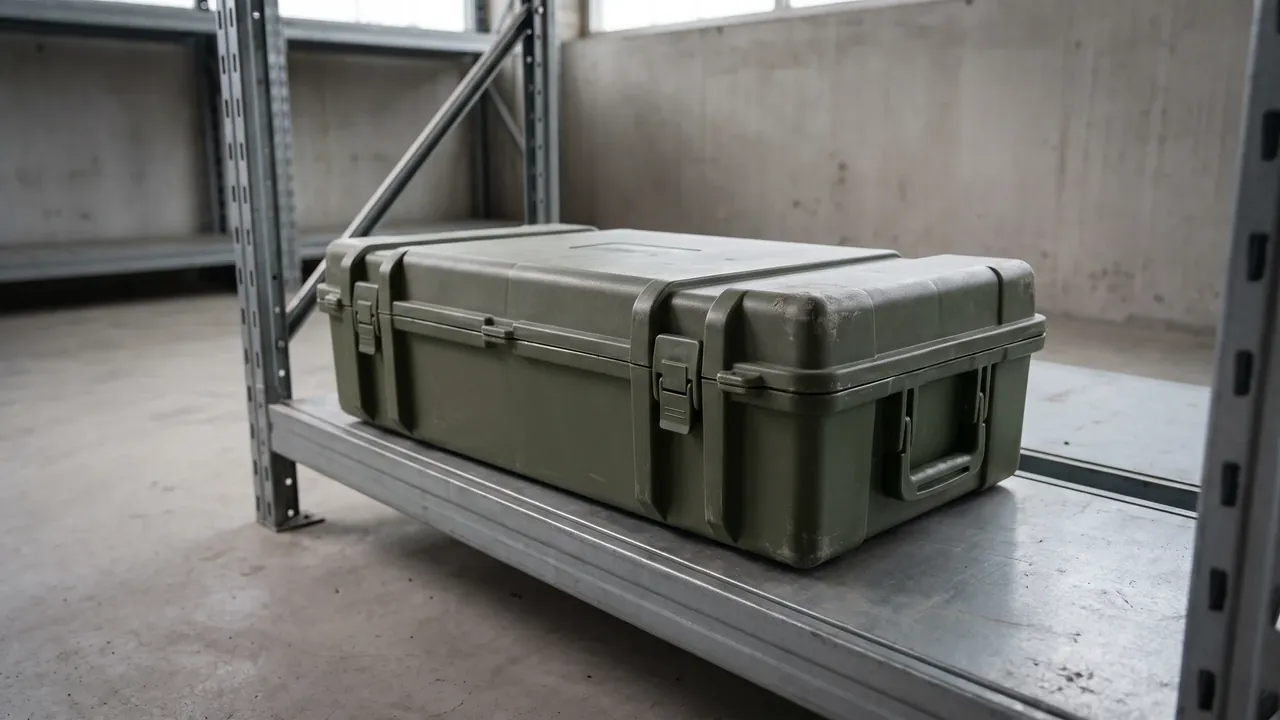
The liner is the part that governs both capacity accuracy and protection quality. Three paths dominate. The first is a single foam block milled with locating pockets that follow the profile of the contents, ideal for fixed, batch-consistent items. The second is a divider set with separate pads, where the partition defines the cell and the cell size changes by swapping partitions — the flexible choice when formats vary. The third is a tray liner, which groups cells into a tray that can be lifted out and set back in one motion, a strong fit for the high-turnover rhythm of ranges and training grounds.
Divider design has to settle three details. Cell clearance must be right: too tight and items jam on insertion, too loose and the locating effect disappears, so a sensible fit allowance against the item's dimensional tolerance is needed. Cell depth should cover most of the item's height and expose only a short section for finger grip. Cell-floor cushioning matters most, because the vertical shock should be absorbed by the liner rather than passed straight into the case body.
EVA, EPE and XPE are the usual liner materials. EVA recovers well and mills precisely, so it suits fine locating; EPE is light and cushions strongly, ideal for shock-led layouts; XPE is stiffer and holds cell shape, which helps long-term storage. Kexin New Materials often blends materials within one case — a cushioning layer outboard, a locating layer inboard — to balance drop protection against long-term dimensional stability. For deeper detail on liner customisation, see ammo box foam insert customisation and the trade-off between case dividers and a solid foam block.
Latches, Sealing and Protection Ratings
Sealing is produced jointly by latch pressure and the gasket. Small cases typically use two latches that press the lid onto the gasket and create a continuous compression band; large cases move to four or six latches so the long edges do not suffer an under-compressed gasket where rigidity falls away. Latch travel is equally important. Too short a stroke makes closing hard and leaves the gasket under-compressed; too long a stroke feels slack and, after the gasket relaxes over time, produces a false lock.
Gasket material and cross-section must match the case mouth. A hollow gasket compresses little and recovers durably, which suits a frequently opened carry case; a solid gasket resists deformation and suits a case that stays locked for long periods. The meaning of a protection rating is simply the shell's ability to hold back water and dust: IP67 indicates short-term immersion without ingress, and IP68 indicates continuous immersion without dust or water entry under stated conditions. For a fuller explanation, see ammo box waterproof rating explained.
A pressure-equalisation element is widely overlooked. Once the case is sealed, changes in ambient pressure and temperature during transport create a differential, and without an equaliser the lid can feel suctioned on opening, or the gasket can be crushed in reverse. A vent fitted with a waterproof breathable membrane lets gas exchange slowly while blocking liquid water, which is why it appears on long-distance transport cases.
VCI Corrosion Protection and Long-Term Storage
In long-term storage the micro-environment inside the case is easier to neglect than shell strength. Metal components corrode in humid air, and the VCI approach lets a corrosion-inhibiting agent volatilise slowly inside the sealed space and form a molecular protection layer on metal surfaces. For an ammunition box, VCI usually appears as a film, a rust-inhibiting bag or a composite liner layer — an environment-management measure inside the container, not a treatment applied to the contents.
VCI and the liner have to be compatible. If the liner material adsorbs a large share of the inhibitor, the effective concentration in the protected volume drops and storage performance is lost. At the material-selection stage, Kexin New Materials therefore evaluates how the liner interacts with VCI, and where necessary designs the inhibitor layer as a separate, replaceable inner bag that keeps concentration stable and is easy to renew on schedule.
A storage case should also provide humidity indication and a desiccant compartment. An indicator card lets anyone opening the case judge at a glance whether action is needed, while the desiccant bay offers renewable moisture absorption. The bay should be replaceable without opening the main volume; a common solution places it in a separate pocket on the inside of the lid, closed with a removable cover. The sealing principle behind this is explored further in the importance of sealing in ammunition storage boxes.
Cushioning, Stacking and Palletized Loading
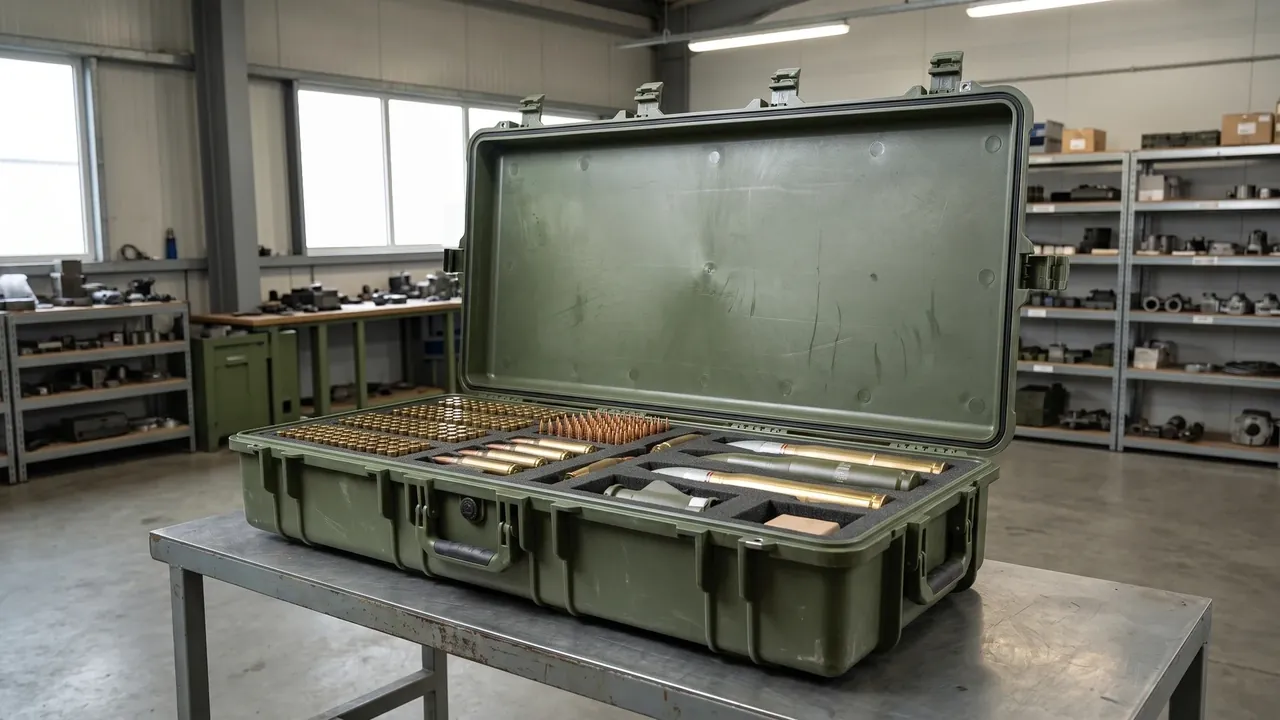
The goal of cushioning is to let a drop or a vibration deposit its energy into the liner first, so that a lower peak reaches the contents. Small cases absorb energy through thick-wall corners and foam corner blocks, while large cases lay a full cushioning layer across the base and place the heaviest cells near the geometric centre of the case, reducing the torque created by an off-centre load. Thicker is not automatically better: excessive thickness steals capacity and undermines stacking stability, so engineering has to balance capacity, weight and drop resistance.
Stacking design has to answer two questions — how many layers, and whether the stack will topple. The layer count follows from the case's compression strength and the pallet's capacity together. The lid top needs a load-bearing structure, typically a ring-shaped rib inside the lid that spreads the upper weight into the walls instead of loading the centre of the lid. Toppling is prevented by interlocking the stacking bosses with the recesses; bosses that are too tall lift the upper case and create a gap, while those too shallow lose their locating function.
Palletization escalates a single-case problem into a system problem. Base dimensions should follow the pallet module, so that a whole number of cases covers one standard pallet face without large overhang. An overhanging corner makes the stack sway in transit and is the leading cause of pallet-edge damage. Once the stack is complete, stretch film or strapping keeps cases from shifting relative to one another. Friction between pallet material and case base also matters: too little friction lets upper cases slide under braking, so an anti-slip mat may be needed. More stacking and storage detail appears in military ammunition box stacking and storage.
Lifting, Fork Handling and Manual-Carry Ergonomics
The handling method determines the interfaces on the outside of the case. On a manually carried case the handle must keep the case from swinging against the body, and its cross-section should be wide and its edges rounded so a long carry does not cut into the hand. On a two-person case the side handles must be symmetrical and level, so neither carrier is overloaded. When the case weight exceeds the safe manual-handling range, a mechanical interface is required — adding more people is not a design solution.
Fork and lifting interfaces are standard on heavy cases. Fork pocket height and spacing must match common forklift tines, and the pockets need thickened walls or metal sleeves so repeated insertion does not wear through the shell. Lifting eyes belong at structural nodes so the case shows no visible deflection during a lift, and the eyes themselves need an adequate safety margin. During structural validation, Kexin New Materials runs static-load and repeated-handling simulations to confirm the interfaces stay true after extended use.
Ergonomics also covers the working face when the case is open. Opening the lid raises the overall centre of gravity, and a narrow case can tip forward at full opening. The fix is to limit the opening angle or to fit a stop inside the lid so the lid rests in a stable position and leaves both hands free for loading.
Locks, Seals and Tamper-Evidence Management
Traceability along the issue chain relies heavily on locks and seals. A lock hole lets the case be secured uniformly; it must sit clear of the gasket's compression band so that lock loads do not break the seal. Metal latches tolerate repeated operation better than plastic ones, but their pivots need anti-loosening features to prevent them working free over time.
The key property of a seal system is that it is one-time. A numbered seal threaded through the lock hole or a dedicated seal hole cannot be restored once broken, so a manager can judge integrity from the number alone. Seal-hole dimensions must accept common seal formats, the hole should be exposed for easy inspection, and it must not overlap easily damaged areas such as handles or fork pockets.
Tamper evidence also includes anti-tamper labels and liner seals. An anti-tamper label spans the joint between lid and body, so opening breaks it and leaves an irreversible visual record. A liner seal between liner and wall confirms that the liner has not been privately removed or swapped. With all three measures in place, a case becomes readable: stocktaking staff can tell whether a case has been opened without counting every item. Locks and seals manage the condition of the container itself; their object is the case's open-and-close record, independent of the specific category inside, and actual use requirements follow the task instruction and local regulations.
RFID and Barcodes: Unit-Level Traceability
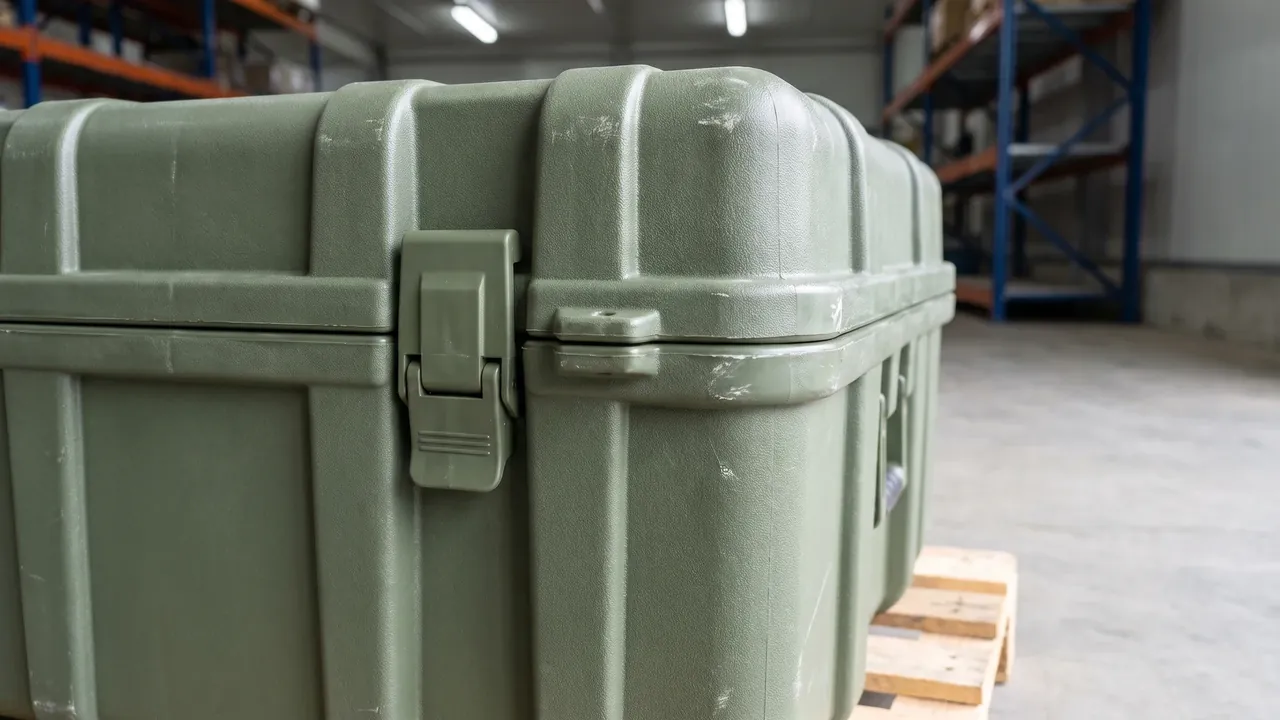
Once the small cells are rolled up into a capacity unit, the traceability object shifts from individual items to the whole case. Barcodes are cheap and read at short range, suiting manual-scan receiving and issuing stations; RFID reads in batches and suits rapid pallet-level stocktaking. The two usually coexist: a barcode on the case surface as the primary identity, and an RFID tag inside the case or on the inside of the lid as a second identity for batch counting. For a manager, the barcode answers "is it accurate" while RFID answers "is it fast", and only together do they cover receiving, issuing, recovery and disposal.
RFID tags hit a shielding problem on metal cases. The usual fix places a spacer between tag and metal, or mounts the tag in a non-metallic window such as a plastic insert or a dedicated recess. The tag position must also avoid forklift friction zones and stacking compression zones, or it will be worn away or crushed over time. If the tag is embedded in the liner, the liner replacement workflow must migrate the tag with it, or the traceability chain breaks at the relining step.
Traceability data should echo the capacity gradient: cases of the same multiple use a continuous number block, and the block changes with the model. That way, even if a tag is damaged, the number alone still indicates the capacity tier and batch of a case.
How UN Packaging and Export Certification Constrain Design
Once an ammunition box enters cross-border transport it stops being only a protective container and must satisfy packaging-transport regulations. UN packaging certification asks whether the package can stay intact under transport conditions, and typically assesses whether the case structure, closure method and liner retention can withstand transport loads. The certification mark is printed on the case in a specific format that encodes the packaging category and design and manufacturing information, so once certified, a case cannot have its structure or materials changed at will.
Export controls constrain design from another direction. Different countries and regions require different packaging, marking and documentation, so the text, graphics and markings on a case must satisfy the destination's rules, and some scenarios demand traceable batch records. These requirements directly affect the area of the lid label zone, the printing method and whether extra seal positions are reserved.
Certification is not a one-off. Changing material, wall thickness or liner structure can all trigger revalidation. Kexin New Materials recommends bringing the certification path into selection from the start, rather than finishing a case and then retrofitting certification at the cost of rework. For related compliance points, see ammunition transport box certifications and how military and police cases differ from ordinary boxes.
Validating Cases with MIL-STD-810H and GJB Environmental Tests
Environmental testing turns design intent into verifiable evidence. The case-relevant items within MIL-STD-810H and the GJB series revolve around drop, vibration, rain, fungus and salt fog. Drop testing verifies the integrity of corners, edges and faces after impact, with attention to whether the case cracks, whether sealing fails and whether the liner shifts. Vibration testing simulates sustained transport jolting and watches for latches working loose and stacking structures fatiguing.
Rain and immersion testing target the sealing design, checking whether the gasket still blocks water after continuous compression and repeated opening. Salt-fog testing faces coastal and high-humidity environments and challenges metal parts and coatings. Fungus testing examines liner stability under prolonged damp conditions, because a mouldy liner rapidly degrades the micro-environment inside the case.
Results must feed back into design. A crack at a case corner after a drop points to insufficient corner cushioning or thin walls; a latch loosened by vibration points to a missing anti-loosening feature; a corroded hinge after salt fog points to a wrong material or surface treatment. Recording the failure point of every test as a checklist is the most reliable basis for iterating a case model.
Range and Retail Scenarios: Capacity and Display Differences
The range scenario is high-frequency, short-duration and local. Shooters move repeatedly between firing points and transfer stations, so capacity should not be large or a single carry becomes exhausting; openings are frequent, so latch and hinge durability outranks sealing. Range cases commonly use a tray liner that lifts out and drops back in one motion, cutting loading and recovery time.
The retail scenario shifts to display, anti-theft and visibility. Ammunition retail needs the case to show its capacity tier and format clearly on a shelf, so the label zone is large and the printing crisp, and the case is styled for presentation. At the same time it must resist theft, so a lock hole and a one-time seal are common to prevent casual opening during display. Retail capacity tends to be small, easy for a customer to carry in one hand and quick for staff to verify.
What the two scenarios share is readability. The range needs to see at a glance whether the cells are filled; retail needs to see at a glance whether the format and the seal are intact. Drawing the usage flow before choosing a capacity tier usually beats stacking up specifications.
A Selection Checklist: From Issue Multiple to Case Type
Here is the sequence that folds the earlier sections into an executable order. First, fix the issue multiple and the draw frequency, and choose the base, half-base or double-base capacity tier. Second, fix the handling method — one-person carry, two-person carry or mechanical fork handling — and derive the handle, lifting eye and fork pocket. Third, fix the storage horizon, whether short-term turnover or long-term storage, and decide whether to introduce VCI and a desiccant bay. Fourth, fix the traceability granularity, whether case-level or pallet-batch, and select the barcode and RFID scheme. Fifth, check transport and export requirements and confirm whether a UN certification mark and special markings are needed.
The order should not be reversed. Without capacity there is nothing to optimise in liner and pallet; without handling method the outer case will be reworked; and if certification is left to the end, the case exterior and label zone often need major changes. When taking on custom projects, Kexin New Materials usually asks the customer to answer the first three steps before entering the joint design of structure and liner. In procurement documents the category is often listed as "Boxes, Small Arms Ammunition", and that phrasing itself reflects the point of the whole exercise: the case is a countable unit first and a container second.
The final purpose of capacity and issue logic is to make every draw, stocktake and shipment predictable. A capable small-caliber case does not stand out on one parameter; it lets capacity, structure, sealing, traceability and certification coexist without fighting each other inside one design. For the fundamentals, revisit the ammunition box selection overview and 50-caliber ammunition box capacity design.
Small Arms Ammunition Box FAQ
Q: What unit should define the capacity of a small arms ammunition box? A: The basic unit should be the issue multiple, not a loose count of rounds or cells. In engineering terms you first break an issue chain into the units that are repeatedly drawn, find the smallest one that is drawn often, and treat it as the multiple; case capacity then equals an integer multiple of that figure. The benefit is that the last case in a split never keeps a large dead space, and contents do not shift in transit. When capacity and multiple lack an integer relationship, stocktaking always leaves a remainder that will not reconcile, and over time managers stop trusting the marked capacity. Once the unit is fixed, liner cells, label-zone area and pallet loading plans must all be built on the same unit, so that no stage is computing with its own private number.
Fix the issue multiple first, then let the internal dimensions follow, and make the arithmetic visible on the label so any handler can check a count without opening the case. A box whose capacity cannot be expressed in the issuing unit will generate counting errors at every stage of the chain, no matter how good its shell is.
Q: Why does one ammunition type need several case capacities? A: Because the three tiers of the issue chain face completely different constraints. The squad tier demands one-person carry and instant access, so capacity must stay small; the company tier carries resupply and needs a capacity two people can lift; the depot tier follows pallet and rack modules, bounded by stacking and load rather than human strength. With only one capacity, the squad tier is forced to move an over-heavy case, while the depot tier wastes a great many opening events. A sound approach offers base, half-base and double-base cases, with the capacity ratio held within a factor of two so all three share liner tooling and pallet plans. Multiple tiers also let a manager estimate stock from the case type alone, without opening each case to count.
Map the chain before buying anything: a range box that is opened fifty times a day has different priorities from a bulk case that is opened twice a year. Matching one capacity to each tier, and labelling it clearly, removes most of the re-packing that otherwise happens whenever stock changes hands between levels.
Q: Dividers or a single carved foam block — which suits small-caliber boxes better? A: It depends on whether the format is stable. When the contents are fixed for a long period and batches are consistent, a single milled foam block gives fine locating accuracy and strong overall cushioning, and is the safer choice. When formats change with the mission, or one case must accommodate different batches of cells, the divider approach is more flexible, since swapping a partition resets the cell size. In practice a hybrid is common: a solid foam locating layer as the base, with replaceable dividers on top, balancing precision and adaptability. Whichever you choose, three details must be handled — cell clearance, cell depth and cell-floor cushioning — or even a premium material will still cause jamming on insertion or a failure of the locating effect.
Where the format changes often, dividers win because they can be re-set without a new tool; where the format is frozen, a cut foam block gives better location and less rattle. Whichever you choose, check that a loaded box still closes without force and that the contents cannot shift when the box is tipped on its side.
Q: Is a higher protection rating always better? A: No. A protection rating describes the shell's resistance to water and dust, and a higher rating generally means a tighter seal and greater opening effort. For a range turnover case that opens frequently, an overly high sealing class brings hard opening and pressure suction, which lowers efficiency instead of raising it; for a case meant for long storage or cross-region transport, a higher rating earns its keep. Selection should first establish the environment the case will face, then decide the gasket cross-section, the number of latches and whether to fit a pressure equaliser. Treating the highest class as a universal optimum tends to force unnecessary sacrifices among capacity, weight and operating feel.
Choose the rating from the wettest realistic event in the service plan, then stop: a tighter box costs more, seals harder and therefore breathes less, which makes moisture management inside more demanding, not less. For most range and retail duty, a well-made mid-range box with a maintained gasket and correct desiccant is the better engineering answer.
Q: What does VCI corrosion protection require from liner materials? A: Compatibility is the core requirement. VCI works by letting a corrosion-inhibiting agent volatilise within a sealed space and form a protective layer, so if the liner adsorbs a large share of that agent, the effective concentration falls and storage performance drops. Material selection therefore has to assess how the liner interacts with the inhibitor, and where necessary the inhibitor layer becomes a separate, replaceable inner bag that holds concentration steady and is easy to renew on schedule. The liner itself must also stay stable under prolonged damp conditions, because mould would degrade the micro-environment inside the case. VCI is an environment-management measure inside the container, and whether to use it depends on the storage horizon and transport environment rather than on a blanket rule.
Ask the liner and foam suppliers for compatibility statements in writing, and keep the paper with the product file, because an inhibitor that is adsorbed by the wrong foam simply disappears. Where mixed materials are unavoidable, separate the source from the foam with a barrier film and verify the arrangement with a coupon test before fleet-wide use.
Q: Do RFID tags fail when mounted on metal cases? A: They can, and they need a dedicated design. Metal shields or reflects radio signals, so a tag placed directly on the outer shell loses read range and read rate. The common fixes are a spacer between tag and metal, or a tag mounted in a non-metallic window such as a plastic insert or a dedicated recess. The tag position must also avoid forklift friction zones and stacking compression zones, so it is not worn away or crushed over time. If the tag sits inside the liner, the liner replacement workflow has to migrate the tag with it, or the traceability chain breaks at the relining step. A well-designed tag scheme, by contrast, lets a whole pallet be counted in a single pass.
Where metal is involved, either use tags designed for on-metal mounting with a tested spacer, or move the tag to a plastic latch or liner element and record that position in the procedure. Do a real read test on a loaded, stacked pallet before fixing the design, because antenna behaviour on a full shelf differs from a bench test.
Q: Does UN packaging certification restrict case design? A: Yes, and at the structural level. Certification asks whether a package stays intact under transport conditions, and assesses the case structure, closure method and liner retention against transport loads. The certification mark is printed in a specific format and encodes the packaging category and design and manufacturing information, so once a case is certified its structure and materials cannot be changed freely. Changing material, wall thickness or liner structure can all trigger revalidation. Bringing the certification path into selection from the start avoids the rework of finishing a case and then retrofitting certification. Destination requirements for marking and documentation also shape the design of the lid label zone.
Treat the certification as a boundary condition rather than a constraint on creativity: it fixes how the package must behave under defined tests, and the design freedom lies in how you meet those behaviours. Involve the certifying body early on any new construction, because a late change to wall geometry can void an already-issued approval.
Q: How do range and retail cases differ in selection? A: The differences centre on the usage flow and visibility. The range stresses high-frequency turnover and local carrying, so capacity should stay moderate, latch and hinge durability outranks sealing, and a tray liner shortens loading and recovery. Retail stresses display, anti-theft and visibility: the case must show its capacity tier and format clearly, the label zone is large with crisp printing, and a lock hole plus a one-time seal prevent casual opening during display. The two share readability — the range wants to see at a glance whether cells are filled, retail wants to see at a glance whether the format and seal are intact. Choosing capacity from the usage flow is usually more effective than stacking up specifications.
Related Reading
- Ammunition box selection overview
- 50-caliber ammunition box capacity design
- How military and police cases differ from ordinary boxes
- Ammo box foam insert customisation
- The importance of sealing in ammunition storage boxes
- Military ammunition box stacking and storage
- Case dividers versus a solid foam block
- Ammunition transport box certifications