

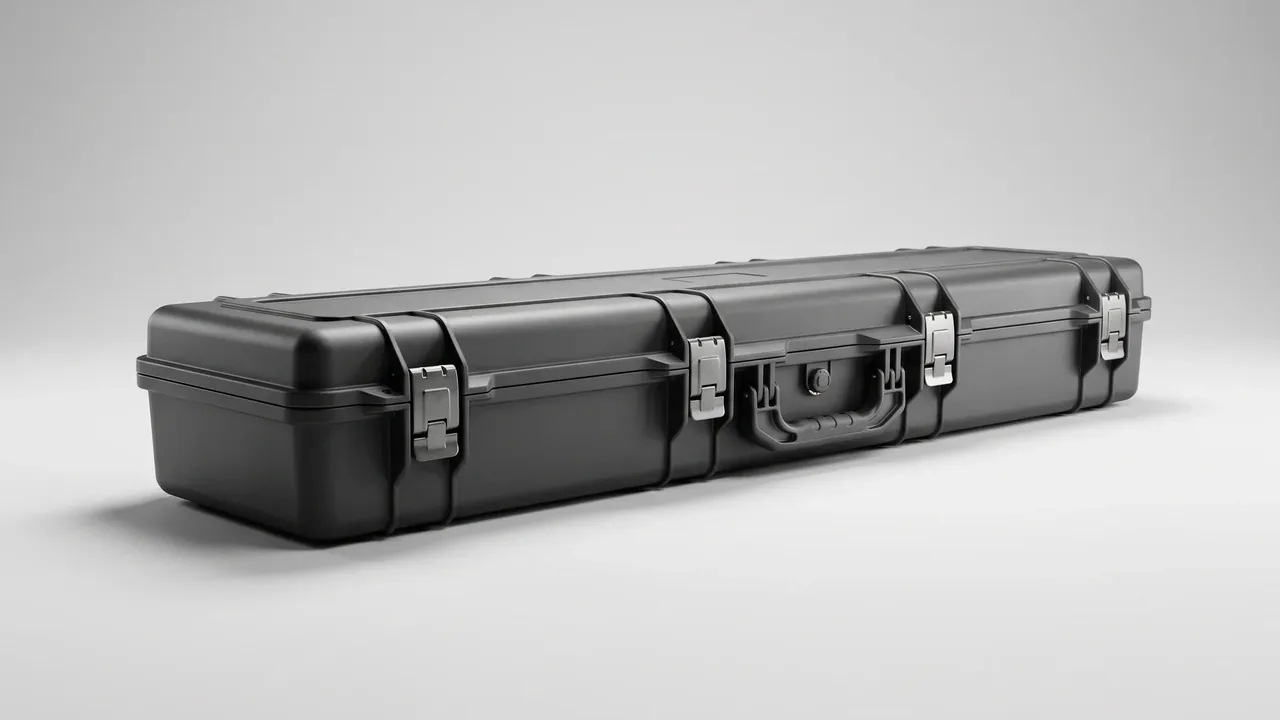
In the supply chains of precision shooting suppliers, law-enforcement marksman units, and defense-trade customers, a sniper rifle case and a long weapon case are asked to do far more than hold a payload. They must carry an item that is usually longer than 1.2 meters through a combined road, sea, and air route and deliver it in the same condition it had when it was zeroed. The contents of such a case normally include a long metal body plus a telescopic sight and other precision optics. Those two elements differ in stiffness, center of gravity, and sensitive axis, yet each must be supported inside one case in the way its working state requires.
JUNZHIJIA is manufactured by Kexin New Materials (Guangdong) Co., Ltd. and has long supplied custom protective cases for precision equipment and long-dimension gear. From a manufacturer's point of view, the real cost of a long weapon case is not the shell itself. It is the optic drift caused by one shipment, the lining compression caused by one drop, or the corrosion that appears after a stretch of humid storage, and none of those defects can be reversed in the field with simple tools. This article discusses packaging container engineering only, covering material, lining, sealing, cushioning, traceability, and test verification. It does not cover the operation or use of any equipment.
The Transport Damage Cost of Long-Dimension Equipment
The first property of a long payload is low-frequency vibration. An item longer than 1.2 meters often has a natural bending frequency that falls inside the densest band of road-transport excitation. The periodic impacts produced when a truck crosses a joint or a speed bump keep feeding energy into it. When the excitation nears the natural frequency, even a modest amplitude can create repeated bending moments at both ends over a long trip, leaving barely visible residual bending in the metal body and small relative displacement inside the optics. The special danger is that there is no visible external damage, yet a post-trip check shows the whole point of impact has shifted.
The second property is a forward-shifted center of gravity. A long item fitted with an optic usually has its center of gravity near the rear or middle, and when the support points inside the case do not match that center, the case tends to tilt backward or forward during handling and the payload slides and presses inside the cavity. The third property is the irreplaceable sensitive axis. The optical axis is a virtual geometric relationship; any load that turns the sight body relative to the item itself rewrites that axis directly. Together these three properties move the design focus of a long weapon case from wrapping to restraint.
After-sales data groups the damage of long equipment in transport into three types: zero drift of the optic, lining collapse that destroys fit after long compression, and corrosion of machined metal surfaces in humid conditions. All three share one feature: they can be prevented during transport but cannot be reversed after delivery.
The Engineering Principle of Zero-Shift Lining
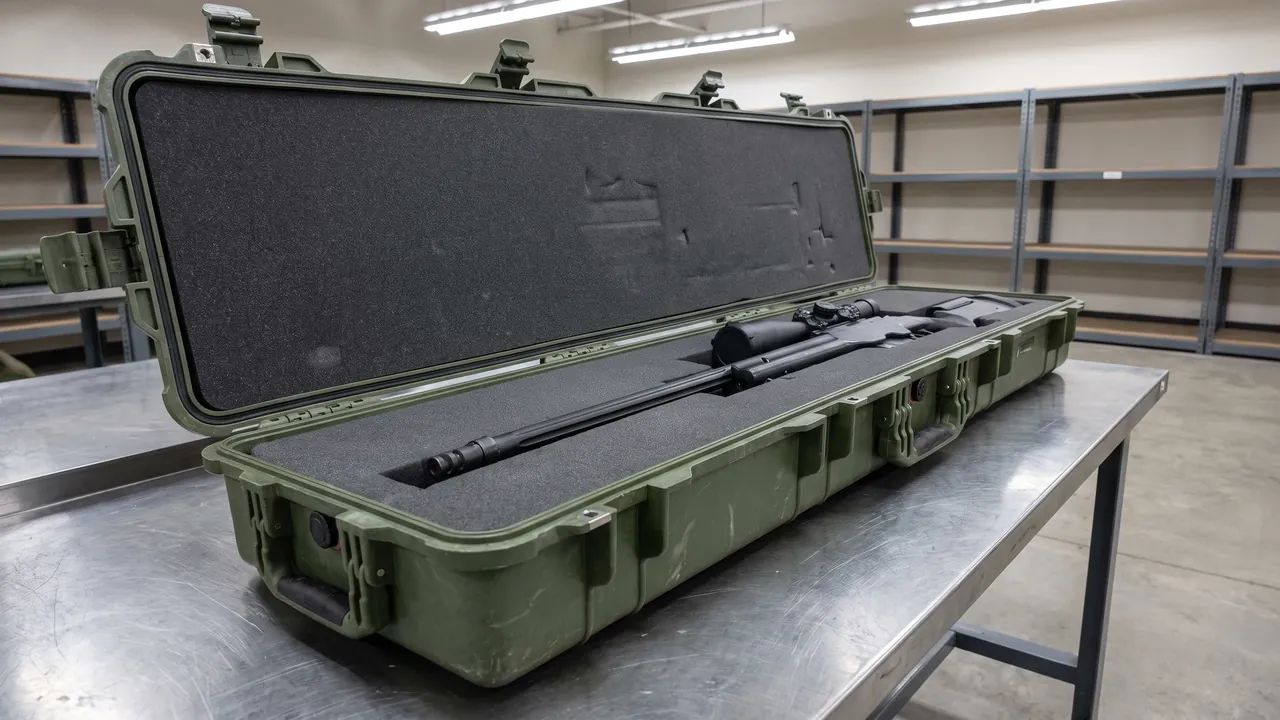
Zero shift means that all six degrees of freedom of the payload are restrained closely enough to leave almost no relative motion. Absolute zero shift is not achievable in engineering, but displacement can be held at a level that does not rewrite the assembly relationship. There are three layers to this approach. Axial stops prevent forward and backward travel, lateral fit stops side sway, and vertical support keeps weight moving along the designed path. JUNZHIJIA forms the cavity directly from the payload outline by CNC machining, so the lining leaves only a minimal assembly clearance instead of using soft padding to catch an ill-fitting generic cavity.
The second point of zero shift is pressure distribution over the contact area. When contact between a long body and the lining is concentrated at a few points, the whole impact energy is pressed onto a limited area, the lining compresses quickly, and the payload surface shows marks. JUNZHIJIA widens the effective contact area in the lining design, spreads support in segments along the length of the item, and switches to a soft facing at machined surfaces, bringing unit pressure down to a level the material can bear for years. After this treatment the lining still holds its original thickness after many loading cycles.
The third point is reproducing the assembly attitude. The load direction an item experiences when installed in its host system is the one it is most used to. If the cavity is formed in the same attitude, the forces encountered in transport stay close to the working direction and there is no sudden change in stress state. This matters most for a combined unit that carries both the body and the optic, because a change of attitude tends to make the sight mount the first part to take shear, and that is exactly the point where displacement is least acceptable.
Zero-shift lining also standardizes field work. When the cavity reproduces the stored attitude, loading and unloading become a matter of seating the item in place rather than re-aligning it. Operators do not have to judge by experience whether the item sits correctly, and handover and inspection are easier to verify. For law-enforcement and defense-trade users who move equipment in and out of storage frequently, pushing the assembly datum forward into the packaging structure removes a good deal of hidden loss caused by human error.
Lining Materials and Layered Structure
Long weapon cases commonly use three foam families: EVA, EPE, and PU. EVA is closed-cell, rebounds slowly, absorbs vibration well, and resists repeated compression, so it suits a precisely formed cavity. EPE is lighter and cheaper but recovers less after long compression. PU is soft and conforms well and is often used as the contact layer at very sensitive surfaces such as lenses. JUNZHIJIA normally uses high-density EVA as the main forming layer, machines the fitted cavity, and then bonds a non-woven or short-nap facing at the contact surface to prevent scratches and make loading smoother.
Layering is common in long-case design. The outer layer isolates moisture and dust, the middle layer provides cushioning and forming, and the side facing the payload carries a rust-prevention or antistatic function. The value of layering is that each layer carries a single function, so the failure of one does not immediately reach the payload surface. For example, even if the rust-prevention layer is exhausted during long storage, the main EVA layer still maintains the geometric restraint and the payload does not move inside the cavity.
Material choice must be tied to transport conditions. A case used across climate zones should prefer a formula that stays tough at low temperature, so the lining does not become brittle and crack during winter handling. A plan for high-salinity sea freight needs reinforcement in both the material and the functional layer. Selection is not about choosing the hardest option; it is about matching lining hardness to the weight, center of gravity, and sensitivity of the payload.
Optic Protection Cavity and Optical-Axis Displacement Control
The optic is the part that must never be rigidly constrained. A thin-walled optical tube can deform slightly under any concentrated pressure from the lining, which then affects imaging and the optical center. JUNZHIJIA therefore gives the optic its own protection cavity, leaves an even clearance around the sight body, and supports the optic only at rigid points such as the mount or base. The lining never presses on the lens or the adjustment ring. A free space is normally kept at the top of the cavity so that pressure on the lid is not transferred to the optical element.
The second tool for optical-axis control is a shared datum. When the optic is already mounted on the item body, the two should not be fixed separately, because relative displacement in transport would act directly on the connecting structure. JUNZHIJIA forms the combined unit as one piece in its installed attitude, so the body and the optic share a single support datum and the transport load direction matches the working direction. For very long items that must travel in two sections, a locating feature is set at the joint so the relative position can be reproduced on reassembly.
The protection cavity also has to manage cleanliness. Optics are sensitive to dust and moisture, so the cavity should stay independently closed and should be fitted with dust caps and a desiccant when needed, and it should be opened in a clean environment. If the case is briefly opened in the field, check for sand that may have entered the cavity before closing it again, so that fine particles do not rub the lens surface repeatedly during handling.
Case Load-Bearing Structure and Bending Stiffness
Added length magnifies bending deformation, and this is the most fundamental difference between a long weapon case and an ordinary case. If a case longer than 1.2 meters lacks stiffness along its length, its base bows downward when supported at both ends with the middle unsupported, and after long stacking it may take a permanent bend. The payload then loses its original support relationship. JUNZHIJIA answers this with longitudinal reinforcing ribs on the walls and base, so the case forms a beam-like structure along its length and routes bending moments to the corners rather than leaving a large flat panel to carry them alone.
Lid stiffness matters just as much. The lid is often the weakest face; if it is a single flat panel, its center sinks under load and directly compresses the free space reserved in the lining. JUNZHIJIA uses a double-wall lid with ribs between the walls on long cases, so the lid keeps its flatness while carrying the weight of the case above. Hinges and latches are also distributed sensibly along the length, avoiding a design that closes only at the two ends and leaves the middle vulnerable to opening.
On material, modified PP offers good toughness, chemical resistance, and moderate cost and suits most long weapon cases. ABS has high surface hardness and good forming accuracy and suits plans with higher appearance demands. PC alloy offers outstanding impact resistance and suits transport with large temperature swings. JUNZHIJIA selects material by payload weight and transport route and makes structure and material meet one common stiffness target, avoiding the imbalance in which the material is strong enough but the structure deforms first.
One detail that is easily overlooked is how the inner and outer walls are connected. If a long case is merely enclosed by thin walls, the two shells tend to deform independently under load and fine cracks appear at the joint over time. JUNZHIJIA adds inner stiffening pads and connecting ribs at key positions so the walls act as one body, which raises stiffness and gives hinges and latches a more reliable mounting base. The connections for wheels and feet also need local reinforcement, because those points take concentrated dynamic loads during rolling and landing.
Sealing, IP Rating, and the Pressure Equalization Valve
Sealing in a long weapon case is required in two directions: water and dust from outside must not enter, and moisture inside must stay controllable. JUNZHIJIA fits a silicone gasket at the mating face and uses lid pressure to create continuous compression, reaching IP67 protection, meaning short immersion does not leak. The gasket profile and compression amount are designed so that sealing is assured without aging faster because of over-compression, which matters especially in inspection work with frequent opening and closing.
The pressure equalization valve solves a different problem. In air freight the cargo-hold pressure changes substantially, and a pressure differential also appears in high-altitude transport or storage with large seasonal temperature swings. Without a valve, the differential can deform the gasket and destabilize the seal, or create negative pressure inside the case that makes the lid hard to open. JUNZHIJIA fits a pressure equalization valve that allows slow gas exchange while maintaining waterproof and dustproof protection, keeping the seal stable when pressure varies. The valve itself must be kept clean; if dust blocks it, it stops working, so it should be checked together with the sealing face during maintenance.
Gasket maintenance determines case life. Before each opening, wipe the case rim clean so that sand is not pressed into the sealing face. During long storage, keep the lid closed but not locked hard, so the gasket rests in its natural state. Related practice is covered in the guide to case gasket materials and in the explanation of how a pressure equalization valve works.
Anti-Corrosion Lining and Internal Humidity Management
Once a machined metal surface inside a long weapon case corrodes, the cost of treatment far exceeds the cost of prevention. JUNZHIJIA fits a VCI vapor-phase anti-corrosion lining or bag inside the case. The slowly released corrosion-inhibiting molecules form a monomolecular protective film on the metal surface, so that even if the case is briefly opened or the seal is challenged, corrosion during storage is delayed. VCI performance depends on a clean starting surface, so equipment should go into the case immediately after machining, cleaning, and drying. If oil or fingerprints remain, clean the surface first.
Humidity management supplements corrosion prevention. A desiccant can be placed inside together with a humidity indicator card, so the user can judge directly whether replacement is needed. For equipment stored long term, check the sealing face and desiccant condition every few months. For high-salinity sea freight or storage in humid regions, strengthen the anti-corrosion configuration and prefer closed-cell materials, because open-cell material that absorbs water becomes an internal moisture source. Related configurations are described in the note on internal moisture and rust control for protective cases.
Anti-corrosion is not simply adding a bag. The metal surface, the lining, and the air in the case form one micro-environment, and VCI works reliably only when clean initial state, closed-cell material, and an effective seal are all present at the same time. If any one is broken, protection ends early.
Cushioning Stops, Stacking, and Pallet Loading
The goal of cushioning is to absorb and spread impact energy before it reaches the payload. JUNZHIJIA sets locating grooves and rigid stops in the lining, allowing the payload to travel only a very small distance before hitting a stop, so repeated impacts do not accumulate displacement. Drop and vibration tests set their conditions from the actual loaded weight and center of gravity inside the case, verifying that the lining still confines the payload to a safe range under extreme conditions. Cushioning is not about being as soft as possible; an overly soft lining lets the payload slide a long way inside the cavity and actually raises the risk of collision.
Stacking capacity is set by the case structure. A long case is more prone to eccentric load through bridging when stacked, so JUNZHIJIA recommends layering by the rule of heavy low, light high, with cases on one pallet of similar height, so that an upper case does not bridge between two lower ones. The base and lid have matching stacking features, and outer ribs carry the upper load down the walls to the floor, bypassing the contents as far as possible. Stack height should be planned with single-case weight and pallet capacity together, rather than simply pursuing more layers.
Pallet loading affects the safety of a whole consignment. The center of gravity of a long case should sit as close as possible to the pallet center, adjusted when necessary through internal layout or loading order. When several cases share a pallet, their centers of gravity are best staggered to reduce the chance of the whole load tipping. For export sea freight, also consider bracing and anti-shift measures inside the container so that cargo does not move during the voyage. Related methods appear in the note on case stackability and pallet planning.
Lifting, Forklift Handling, and Ergonomics
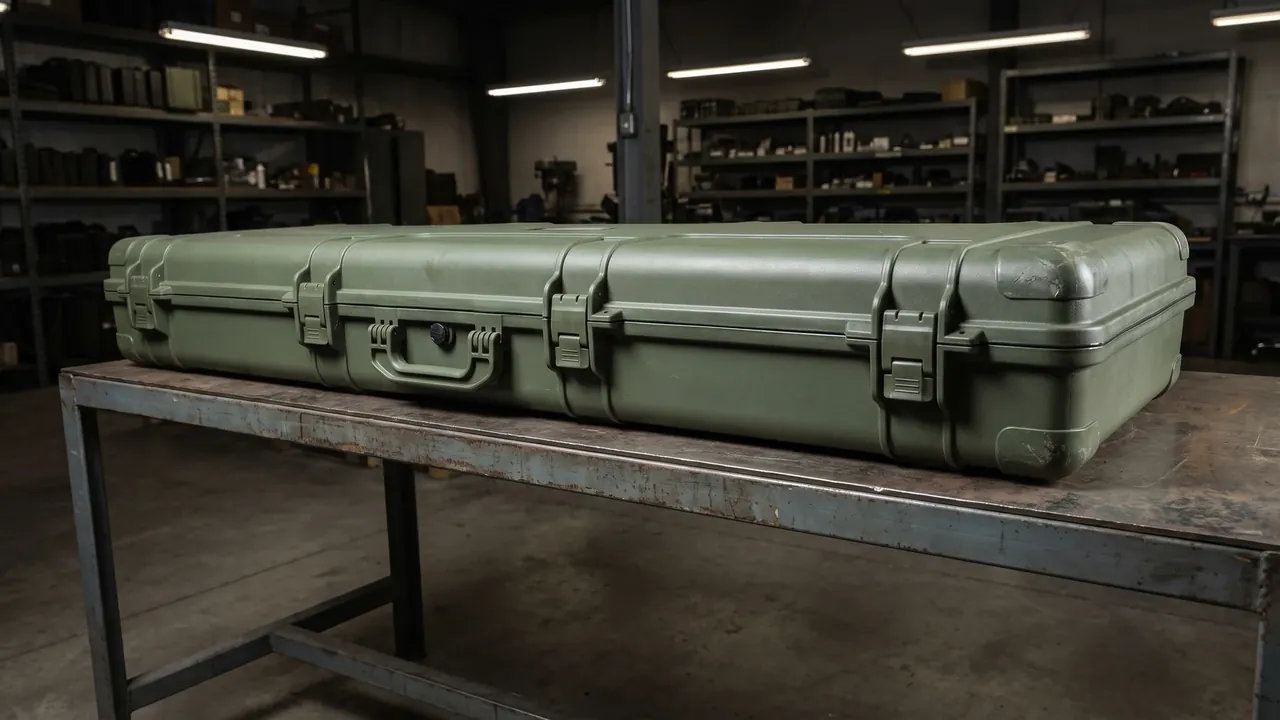
A long weapon case is handled differently at each stage, and the protection design must cover all of them. For whole-case lifting, the shell should have reliable lifting points or reinforced zones so that slings do not bite into the wall and leave local dents. In forklift work, the fork entry positions should be clearly marked on the base so the operator knows where to insert the forks and does not push them into a weak area. For heavier long cases, the base usually needs local thickening or an embedded support plate to spread the concentrated load.
Ergonomics matters too. A long case is normally carried by two people, and without sensible side handles the carriers can only hug the case, which makes a drop more likely. JUNZHIJIA fits symmetric handles on long cases and, when needed, offers a telescopic handle and wheel set so the equipment can be rolled on flat ground and long carries cost less effort. A wheel option must match case stiffness so that dragging on one side does not twist the shell.
Handling labels are the last reminder. The outside should state the placement direction, center-of-gravity hint, permitted stack layers, and moisture requirement, so workers at every stage can judge quickly. For law-enforcement and defense-trade customers, the label can also carry the equipment name and serial number to speed up handover checks. Outer surfaces rub during transport, so labels should use a wear-resistant process rather than ordinary stickers.
Disagreement about handling often appears in the last mile. A dock and a warehouse have forklifts, while a field transfer may have only people and simple vehicles, so the same case must pass both mechanical and manual tests. JUNZHIJIA covers both scenarios in the structure: the base guarantees fork entry space and local strength, the sides guarantee handle positions and grip for two-person carries, and a wheel option can be added on top, so the case can be moved safely at every stage instead of being dragged or thrown for lack of a proper leverage point.
Locks, Seals, and Asset Traceability
Locks on a long weapon case must keep the case firmly closed in transit and also serve the management process. JUNZHIJIA offers several lock options, including a keyed mechanical lock, a latch structure that accepts an external padlock, and an anti-opening design that needs a tool to release. Latch strength must match case capacity so that the case does not stay intact while the locking point fails first. Related options are covered in the note on case lock customization.
Tamper-evident seals address the question of whether the case was opened. A one-time seal gives direct evidence at handover, and the seal number is matched to a handover record so any abnormal opening can be detected. For equipment moving between organizations, using a seal together with a lock covers the management chain better than a lock alone.
RFID and QR codes lift traceability to the data level. Each case can carry a unique number, scanned at inbound, outbound, inspection, and return steps to build a complete usage record. This supports asset counting and, when damage appears, allows fast tracing to a specific batch and transport leg. JUNZHIJIA can supply the matching marking process for a customer's management system, so the case enters a traceable state the moment it is packed.
Test Verification and Standards Compliance
The capability of a protective case must be proven by test, not by design description alone. Common references include the environmental test methods of MIL-STD-810H and the GJB series used for military products. Test items normally cover vibration, shock, drop, stacking, and temperature-humidity cycling, simulating the typical severe conditions of a combined transport route. JUNZHIJIA sets test conditions from the actual loaded weight and center of gravity inside the case instead of applying generic parameters unrelated to the contents.
The test is not about whether the shell survives intact; it is about whether the payload is still deliverable afterward. Acceptance therefore focuses on three items: whether lining fit stays within design range, whether the gasket is intact with normal compression, and whether latches and hinges remain tight. These three points determine long-term reliability in repeated opening and stacking. Related standards interpretation is available in the note on MIL-STD-810H compliance for protective cases.
JUNZHIJIA keeps test conditions and measured data on file for each batch, so any anomaly can be traced. For custom plans, a sample is usually verified first, confirming that lining, sealing, and structure all meet the target before mass production begins. Standards compliance is not a one-time action but a record system that runs through sample, production, and after-sales service.
Export Packaging Compliance and the Custom Process
For defense-trade and export customers, packaging must also meet transport and control requirements. Wooden parts and pallets should satisfy plant quarantine rules, favoring heat-treated solutions with the treatment mark retained. Where items carry a dangerous-goods classification, their packaging should follow the United Nations requirements for the transport of dangerous goods and hold the corresponding certificate. It should be emphasized that specific defense-trade and export requirements are governed by local regulations and export-control rules; this article discusses only the engineering and compliance coordination of the packaging container itself and does not cover the operation or use of any equipment.
A custom project normally starts with requirements. Define the payload outline, weight, center of gravity, and sensitive areas, confirm the transport route and use environment, and then move into lining and structure design. The design stage outputs the cavity layout and support plan, followed by a sample for verification, and mass production begins after fit, sealing, and test performance are confirmed. Every step should map to the customer's acceptance criteria so that design and acceptance do not drift apart. Related methods appear in the note on sampling and approval for custom protective cases.
For a long weapon case, the most easily overlooked point is maintainability. Whether the lining can be replaced, whether the gasket can be purchased separately, and whether locks and wheels can be repaired all affect availability over years of use. JUNZHIJIA recommends confirming spare parts and the maintenance plan during the custom stage, so the case keeps its designed performance across its whole life cycle.
Maintenance, Reuse, and Life Management
A long weapon case usually serves for years, and maintenance determines its real life. Keep the lining intact in daily use and do not remove it or substitute other material, because a substitute often cannot reproduce the original support relationship. Clean the sealing face regularly so sand is not trapped. Avoid overloading, since a payload above the design weight weakens lining cushioning and case capacity. Store empty cases in a cool, dry place to slow aging of the engineering plastic under long sun exposure. Related practice appears in the note on cleaning and maintenance for protective cases.
Reuse is a common need. After the equipment is replaced, the original cavity may no longer fit. JUNZHIJIA offers lining replacement or re-machining so the case can keep serving after a payload change instead of being scrapped as a whole. For budget-sensitive customers, this maintainable structure is often more economical than a one-time purchase.
The key to life management is records. Logging the number of uses, repair history, and lining replacement time for each case shows when the gasket or lining needs replacement. For law-enforcement and defense-trade scenarios that must stay highly reliable over the long term, the case should be brought into the asset management system and counted and maintained together with the equipment.
Sniper Rifle Case FAQ
Q: Compared with a traditional gun case, what is the most fundamental engineering difference of a sniper rifle case? A: The most fundamental difference lies in the length and sensitivity of the contents. A sniper rifle case must hold equipment that is generally longer than 1.2 meters, and added length sharply magnifies the risk of bending deformation in the case while also making the payload more prone to low-frequency resonance under transport excitation. At the same time the equipment usually carries a telescopic sight and other precision optics, and the optical axis is extremely sensitive to relative displacement. A traditional short case focuses more on crush resistance and sealing, while a long weapon case must take zero-shift lining and optical-axis preservation as its design main line. JUNZHIJIA forms the cavity from the actual payload outline by CNC machining, spreads support in segments along the length, gives the payload only a very small range of motion in all six degrees of freedom, and forms the cavity in the installed attitude to reproduce the working load direction, lowering the probability of optic drift and lining compression at the source.
Q: What is a zero-shift lining, and is zero shift really achievable in engineering? A: Zero shift is a design requirement rather than an absolute standstill in the mathematical sense. Engineering cannot keep the payload completely motionless, but it can hold relative displacement at a level that does not change the assembly relationship. JUNZHIJIA reaches this goal in three layers: axial locating features and rigid stops prevent forward and backward travel, lateral fitted contact limits sway, and segmented vertical support keeps weight moving along the designed path. With a widened contact area and lower unit pressure, the lining still keeps its original thickness and fit after long use. It should be noted that zero shift depends on the geometric accuracy of the lining, so the cavity must be machined from the payload outline rather than padded out of an oversized generic cavity, which loses its restraint ability after the first impact. In practice the fit is verified on a sample by checking that the payload cannot be moved by hand beyond a small clearance, and by confirming after drop and vibration testing that the cavity has not opened up. A lining that still holds its shape and grip after those checks is what makes the zero-shift claim meaningful rather than a marketing phrase, and it is the same check a buyer can ask a supplier to document before approving a batch.
Q: Why does the optic get its own cavity instead of being fixed together with the equipment? A: The optic is a thin-walled optical element, and its optical axis is a virtual geometric relationship that must not be rewritten. If it is rigidly constrained together with the item body, the small relative displacement between the two during transport acts directly on the connecting structure, and the sight mount is usually the first part to suffer, with optical-axis deviation and imaging problems as the result. JUNZHIJIA gives the optic its own protection cavity, leaves an even clearance around the sight body, and supports it only at rigid points such as the mount or base, never letting the lining press on the lens or the adjustment ring. For a combined unit that is already assembled, the body and the optic are formed as one piece in the installed attitude so they share a single support datum, keeping the transport load direction aligned with the working direction and avoiding relative displacement. Because the sight stays in its own cavity, it can also be loaded and removed on its own when only the optic needs service, which shortens handling time and reduces the number of times the full case has to be opened in the field.
Q: Why does a long weapon case place such emphasis on bending stiffness? A: Because length directly magnifies bending deformation. If a case longer than 1.2 meters lacks stiffness along its length, its base bows downward when supported at both ends with the middle unsupported, and after long stacking it may take a permanent bend, after which the payload loses its original support relationship and the lining tends to compress locally. JUNZHIJIA places longitudinal reinforcing ribs on the walls and base so the case forms a beam-like structure along its length and routes bending moments to the corners. The lid uses a double wall with ribs between the walls to prevent its center from sinking and compressing the space reserved in the lining. Hinges and latches are distributed sensibly along the length so that closing only at the two ends does not leave the middle vulnerable to opening. Material and structure must meet one common stiffness target so that the case does not end up with material strong enough while the structure deforms first. Stiffness can also be checked cheaply during development by loading the case at the same points where it will stand in a stack and measuring how much the base deflects. If the deflection is visible to the eye, the rib pattern or wall thickness has to be revisited before tooling is committed.
Q: What exactly does the pressure equalization valve do on a long weapon case? A: It balances the pressure difference between the inside and outside of the case. A long weapon case meets large cargo-hold pressure changes in air freight, and a pressure differential also appears in high-altitude transport or storage with large seasonal temperature swings. Without a valve, the differential can deform the gasket and destabilize the seal, or create negative pressure inside that makes the lid hard to open, and forcing it open may even draw outside moisture in. JUNZHIJIA fits a pressure equalization valve that allows slow gas exchange while maintaining waterproof and dustproof protection, keeping the seal stable when pressure varies. The valve itself must be kept clean, because dust blocking it stops it working, so during maintenance it should be checked together with the sealing face to make sure it stays open over long use. For users who fly or work at altitude regularly, the valve is best treated as a wear item and inspected more often, because a blocked valve turns every future pressure change into a fresh risk to the gasket.
Q: Which parts inside a long weapon case suit a VCI anti-corrosion lining? A: Mainly machined metal surfaces, such as the exposed surfaces of a long metal body and fitting interfaces. VCI works by slowly releasing corrosion-inhibiting molecules that form a monomolecular protective film on the metal surface, so that even if the case is briefly opened or the seal is challenged, corrosion during storage is delayed. JUNZHIJIA normally fits a VCI lining or bag inside together with closed-cell material and a desiccant to build a stable internal micro-environment. It should be noted that VCI has limited effect on surfaces that have already corroded, so equipment should go into the case immediately after machining, cleaning, and drying. If oil or fingerprints remain, clean the surface first, because otherwise the protective film cannot attach evenly and protection drops noticeably. When several metal parts share one case, keep them from pressing directly against each other, since contact points can shield the surface from the vapor and become the first places to rust even when the rest of the cavity is well protected.
Q: What should be considered when stacking and palletizing a long weapon case? A: The core is controlling the center of gravity and avoiding bridging. A long case is more prone to eccentric load through bridging when stacked, so layering by heavy low and light high is recommended, with cases on one pallet of similar height so an upper case does not bridge between two lower ones. The base and lid have matching stacking features, and outer ribs carry the upper load down the walls to the floor, bypassing the contents as far as possible. When palletizing, the center of gravity of a long case should sit as close as possible to the pallet center, adjusted when necessary through internal layout or loading order. When several cases share a pallet, their centers of gravity are best staggered to reduce tipping risk. Export sea freight also needs bracing and anti-shift measures inside the container, and stack height should be planned with single-case weight and pallet capacity together. A simple rule that helps is to keep the total stack no higher than what one person can inspect comfortably, which also makes it easier to spot a case that has shifted out of line during transit.
Q: What results matter most in test verification of a long weapon case? A: The question is not whether the shell survives, but whether the payload is still deliverable after the test. Common references include the environmental test methods of MIL-STD-810H and the GJB series used for military products, and test items normally cover vibration, shock, drop, stacking, and temperature-humidity cycling to simulate the typical severe conditions of a combined transport route, with conditions set from the actual loaded weight and center of gravity inside the case. Acceptance focuses on three items: whether lining fit stays within design range, whether the gasket is intact with normal compression, and whether latches and hinges remain tight. These three points determine long-term reliability in repeated opening and stacking. JUNZHIJIA keeps test conditions and measured data on file for each batch, so anomalies can be traced and the structure design improved continuously.
Related Reading
- Transport Protection for Rifle and Long Weapon Cases
- Gun Case Buying Guide: From Use Case to Structure
- Key Factors in Custom Lining Design
- Comparing Types of Internal Case Foam
- How a Pressure Equalization Valve Works
- Selection Points for Military Protective Cases
- MIL-STD-810H Compliance for Protective Cases
- Instrument Case Selection Guide