

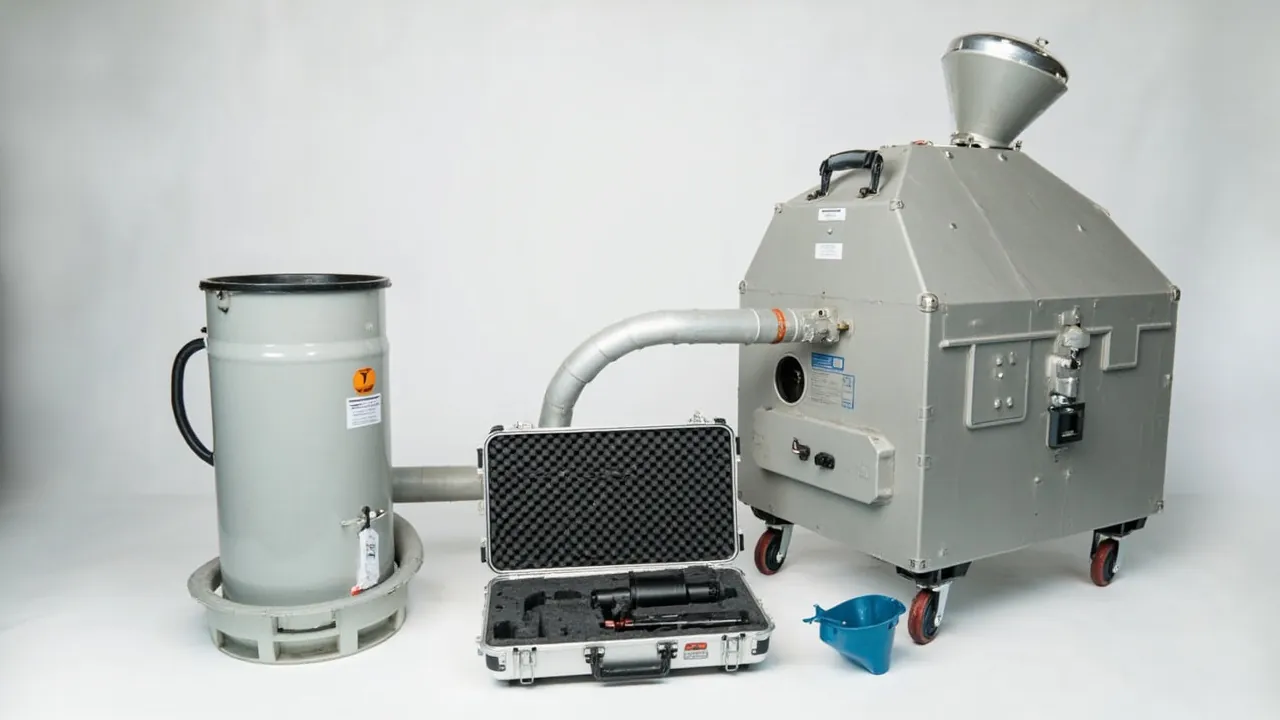
Spare parts supply for bins and silos has a characteristic that is easily overlooked: most components spend a period waiting in a dusty yard before they ever reach the equipment. Discharge units, screw conveyors, rotary feeders, pulse valves and filter bags happen to be the two families most vulnerable to moisture and dust ingress, with metal mating surfaces and electrical coils on one side and filter media and precision diaphragms on the other. The complication is that many sites store silo spares next to the silo itself, where dust concentration is high, day-night temperature swings are large, and the ground stays damp through the rainy season. By installation time, the coil insulation has dropped or the filter bags have absorbed moisture and caked.
The core problem a bulk silo equipment case must solve is delivering components intact from the factory to the installation position in a dusty, humid, open-air environment. This article works along three lines, discharge components, dust control components and instrumentation, and sets out the moisture-control main line, dust isolation, compartmentalised packing and acceptance method for silo system integrators, powder plant maintenance departments and packaging engineers.
Table of Contents
- Delivery Scenarios and Failure Mechanisms for Silo Spares
- Discharge Units and Gate Valves: Protecting Wear Faces and Mating Faces
- Shaft System Protection for Screw Conveyors and Rotary Feeders
- Dust Control Components: Filter Bags, Cartridges and Pulse Valves
- Precision Protection for Level and Pressure Instruments
- The Moisture Control Main Line in Powder Plant Conditions
- Dust Isolation and Cross-Contamination Control
- Compartmentalised Packing for Electrical and Pneumatic Components
- Case Solutions for Large and Irregular Parts
- Reinforced Moisture Protection for Sea Freight and Long-Term Stock
- Acceptance, Testing and Compliance Documentation
- Customisation Workflow and Spare Parts List System
- Frequently Asked Questions
- Conclusion and Further Reading
Delivery Scenarios and Failure Mechanisms for Silo Spares
Designing effective packaging starts with understanding what these components actually experience before reaching the installation position. A typical route runs from the manufacturer shop floor, to finished goods storage, to loading, to a regional warehouse, to an open-air project yard, and finally to the installation point by crane. Across that route, the case spends at least 40 percent of its life in an uncontrolled environment.
Moisture is the first failure factor. Relative humidity in powder plants and silo areas runs between 60 and 90 percent year round, and ground dampness is pronounced during the rainy season. Metal mating surfaces show rust within weeks in this environment, and the insulation resistance of electrical coils falls noticeably after moisture absorption. In practice, a semi-sealed case without desiccant stored outdoors for 90 days can hold internal relative humidity above 75 percent throughout.
Dust is the second failure factor. Dust around silos is predominantly fine particulate, often below 10 microns. Particles of this size penetrate ordinary packaging gaps and enter bearing housings, cylinder chambers and terminal cavities, where they accelerate wear, slow actuation or reduce insulation.
Compression and impact is the third failure factor. Discharge units and screw conveyors are long heavy items that deform under mid-span load when stacked, while pulse valves and instruments are small precision items easily crushed by larger cargo or dropped from a pallet.
| Failure factor | High-risk parts | Typical mechanism | Packaging countermeasure |
|---|---|---|---|
| --- | --- | --- | --- |
| Moisture | Mating faces, coils, filter media | Condensation, insulation loss, caking | Barrier film, desiccant, sealed structure |
| Dust ingress | Bearing housings, cylinders, terminal cavities | Abrasive wear, sluggish actuation | Sealing, dust caps, positive pressure |
| Compression set | Screw conveyors, discharge units | Mid-span bending | Multi-point support, no mid-span load |
| Impact | Pulse valves, level instruments, gauges | Diaphragm rupture, drift | Compartments, cushioning, separate packing |
Mapping mechanisms to components turns packaging design from experience-based judgement into a verifiable engineering choice. Bins and silos are a classic bulk material handling setting, and the shared features with heavy and large-component transport are covered in the mining and mineral processing parts case guide and the conveyor roller and bulk handling component case references.
Discharge Units and Gate Valves: Protecting Wear Faces and Mating Faces
Rotary valves, slide gates, butterfly valves and gate valves are the discharge core of a silo system, all built as a metal housing with moving parts and sealing faces. The protection difficulty is that two important face families coexist on one component: the wear-resistant working face and the precision mating face, and the two demand different packaging treatment.
Wear-resistant working faces, such as rotary valve rotor blades and gate sealing faces, normally use hardfacing, thermal spray or hardening, giving high hardness at the cost of some brittleness. They fear impact and scoring, so the packaging must keep the working face suspended and out of contact with other metal.
Mating faces, such as valve body flange faces, bearing housing fits and shaft end fits, need rust and impact protection. Flange flatness directly determines sealing performance, and a raised dent from transit produces a leak after installation. Film the flange face and fit a flange protection cover.
Fixing the moving element is essential. If a rotary valve rotor is free to turn in transit, it grinds against the housing and enlarges the assembly clearance. Lock the rotor with a wooden wedge or a dedicated locking block before packing and remove it after arrival.
Bearings and shaft seals need dust and moisture protection. These are the points where dust ingresses most readily, so fit temporary dust covers at the factory and include desiccant in the case.
Arrival inspection items should include: rotor turns freely without binding, flange face free of raised dents, sealing faces free of corrosion, locking block intact, which confirms the rotor did not turn in transit.
Shaft System Protection for Screw Conveyors and Rotary Feeders
For components containing a long shaft, such as screw conveyors and rotary feeders, packaging design centres on one principle: the shaft system must not carry bending moment.
Support points must land on the housing, not on the shaft. If a screw shaft overhang rests directly on the case floor, the shaft end weight causes bending, and after installation this shows up as uneven clearance between the screw flight and the housing, producing rubbing and vibration. The correct approach is to seat the screw housing on support blocks and place an adjustable bracket under the shaft end with a soft pad against the journal.
Transport long screws in sections. Screw conveyors are commonly built as flanged sections, and shipping by section preserves straightness better than shipping whole. Section shipping requires that flange dowels and bolts not be lost, so kit them per section.
Hanger bearings are wear items and must not be loaded in transit. Store them in a separate compartment, never in direct contact with the screw flights.
Flight edge protection. Screw flight outer edges are thin, and clearance to the housing is measured in millimetres. Any flight deformation in transit causes binding. Fit a temporary support such as a wooden wedge or foam strip between flight and housing to fix the clearance.
Drive units such as gearboxes and motors should ship separately from the screw body, because a drive unit has its own oil seals and breather, and both dust and compression in a shared case add risk. For handling thinking on rotating equipment shaft protection, see the pump and valve parts case reference.
Dust Control Components: Filter Bags, Cartridges and Pulse Valves
Dust control components are the most delicate category in silo spares, because their function depends directly on the physical structure of the material itself.
Filter bags are woven or membrane-coated media and fear three things: moisture, compression and sharp-object snagging. A damp bag cakes and, once installed, raises differential pressure and resists cleaning. A compressed bag loses its pleat and membrane structure, reducing filtration efficiency. Recommended packaging: individual wrapping, sealed with a moisture barrier film, desiccant inside the case, no heavy item stacked above the bags, and a coil diameter no smaller than four times the bag diameter.
Filter cartridges are semi-rigid with a bonded joint between end cap and media. The bond is prone to cracking under low temperature and impact, so cartridges need impact and cold protection, and winter transport should avoid prolonged exposure below minus 10 degrees Celsius.
Pulse valves and solenoid valves are precision items containing a diaphragm, a spring and a solenoid coil. Transit shock can distort the diaphragm or displace the spring. Pack them in separate compartments with multi-layer cushioning, and include desiccant to prevent coil moisture absorption.
Bag cages are multi-section wire structures that deform easily. Pack them section by section on brackets and avoid stacking load that bends the joints.
Blow pipes and venturi tubes are thin-wall items requiring channel support at both ends to avoid mid-span compression.
| Dust control component | Construction | Main risk | Packaging focus |
|---|---|---|---|
| --- | --- | --- | --- |
| Filter bag | Flexible coated fabric | Moisture caking, snagging | Individually sealed, desiccant, no load |
| Filter cartridge | Semi-rigid bonded structure | Bond cracking, moisture | Impact and cold protection |
| Pulse valve | Diaphragm plus coil | Diaphragm distortion, moisture | Separate compartment, cushioning |
| Bag cage | Multi-section wire | Joint bending | Section support, no stacking |
| Blow pipe | Thin-wall long tube | Mid-span bending | Channel support at both ends |
Precision Protection for Level and Pressure Instruments
Silo systems normally carry level instruments such as radar, RF admittance, rotary paddle and plumb bob types, plus pressure transmitters, differential gauges and flow meters. These are high precision, small, high value items and by far the most likely to fail silently in transit.
The horn and lens of a radar level instrument are the precision critical faces; any scoring or deformation changes the beam angle. Keep the horn suspended and fit a dedicated protective cover.
The paddle of a rotary level switch is a thin blade that bends very easily. Remove and pack it separately, or fit a rigid protective sleeve.
The pressure port and diaphragm of a pressure transmitter must not be touched. Once the diaphragm deforms, the instrument is failed and cannot be repaired on site. Fit a plug or protection cap over the pressure port.
Terminal cavities and cable entries need dust and moisture protection. Confirm sealing plugs are fitted before dispatch so dust cannot reach the circuit board cavity directly.
The packaging grade should match the precision instrument positioning: separate outer case, multi-layer cushioning, ESD protection where a board is included, moisture protection through desiccant and a humidity indicator card, and an outer marking of precision instrument and do not drop. For cushioning structure design principles, see the cushion liner and shock isolation reference.
A common misconception is packing instruments in the same case as large components. Site statistics show that a significant share of instrument damage originates from compression and collision within a shared case rather than from a drop. Separate packing costs more, but it is worthwhile for high value, long lead time instruments.
The Moisture Control Main Line in Powder Plant Conditions
Moisture control is the primary design line for silo and bin component packaging and must be addressed at material, structural and management levels simultaneously.
At the material level, rank barrier films by moisture resistance: aluminium laminate, then metallised film, then PE film, then an ordinary plastic bag. For long storage and transit, use aluminium laminate with heat sealing to minimise moisture permeation. On case material, engineering plastic outperforms timber on moisture resistance, but UV performance must be confirmed.
At the structural level, reduce the number of breathing cycles. The gasket between case body and lid is critical, and its compression, hardness and interface form determine sealing performance. For a comparison of sealing materials and selection logic, see case seal material comparison and selection. Where the case is used in a large temperature swing, assess whether a pressure equalisation valve is required so that differential pressure does not defeat the seal.
At the management level, size the desiccant from internal net volume, transit duration and target humidity. A practical figure is 200 to 400 g per cubic metre for a 30 to 60 day cycle in a temperate climate, rising to 300 to 500 g in humid climates or for sea freight. Distribute the desiccant evenly rather than concentrating it in one corner, and fit a humidity indicator card so the transport environment can be judged on opening.
One practical detail: fix desiccant sachets to the case wall or liner rather than leaving them loose on the component surface. Loose sachets shift in transit and can abrade the component.
For a quantified sealing reference, where a component is highly moisture sensitive, evaluate the case against an IP rating under IEC 60529 or GB/T 4208; IP67 means complete dust protection and no effect from short-term immersion and is a common target level. See the IP67 protective case sealing guide for detail.
Dust Isolation and Cross-Contamination Control
Silo sites are highly dust sensitive, because in sectors such as food, pharmaceutical and lithium battery materials the powder is subject to strict cross-contamination limits. Packaging design must address both keeping external dust out and preventing internal cross-contamination between components.
Keeping external dust out relies on sealing structure and dust caps. Every opening, whether flange, terminal, oil port or breather, should carry a temporary cap or plug before dispatch, with the quantity recorded on the packing list so the site can verify that all have been removed.
Preventing internal cross-contamination requires zoning. Components that contact the product, such as discharge unit internals and screw flights, must not be stored with lubricants, rubber parts or packaging debris. For food and pharmaceutical grade components, add a food-grade barrier film between liner and component.
Cleanliness declarations: where a customer has a cleanliness requirement, perform a cleaning step before packing, document it, and include a cleanliness declaration in the case. For components required to meet GB 4806 food contact material requirements, the packaging material itself should also be confirmed not to migrate harmful substances.
Reusable cases need evaluation. A reused case may retain dust from the previous consignment, creating cross-contamination risk when used for a different material system. Keep cleaning records for reused cases and assign dedicated cases to different material systems.
Compartmentalised Packing for Electrical and Pneumatic Components
Electrical and pneumatic components in a silo system include control cabinet modules, solenoid valve islands, cylinders, sensors and terminal boxes. All share the same vulnerabilities: moisture, dust, static and impact, and all need strict separation from other components.
Solenoid valves and valve islands contain precision spools and seals, and dust ingress causes failure to actuate. Pack them individually with dust caps and include desiccant.
Cylinders have a precision plated piston rod that must not be struck or rubbed against hard objects in transit. Retract and lock the rod, or fit a protective sleeve. Plug the air ports.
Control modules containing circuit boards need ESD shielding bags, and should not rub directly against ordinary plastic liners, which generates static. For handling of static sensitive parts, see the ESD shielding case reference.
Air preparation units such as filters, regulators and lubricators are assemblies with bowls and seals that must not be compressed in transit. Stand them upright and restrain them in channels.
Marking and wiring: keep original manufacturer marking on electrical items and add bilingual labels. Seal wiring diagrams in a waterproof bag in a dedicated document compartment so they do not abrade against other components.
Case Solutions for Large and Irregular Parts
A significant proportion of silo and bin spares are non-standard large items such as discharge chutes, non-standard flanged pipe spools and access platform members. These cannot be covered by standard cases and need per-item design.
Three routes for per-item design. First, a universal heavy-duty case with a custom liner, suited to parts with reasonably regular geometry and larger batch size. Second, a pallet with a protective frame, suited to bulky but lighter parts, using a timber or steel frame to limit distortion and protect critical faces. Third, a fully enclosed case, suited to high value parts that are sensitive to the environment.
For liner machining on irregular parts, CNC-machined shaped EVA based on a 3D scan or drawing is recommended. For small batches, modular blocks can substitute for full tooling. The relationship between cost and batch size is covered in the custom case mould cost analysis.
Case size modularisation cuts long-term cost significantly. Align external case dimensions to the 1200 x 1000 mm or 1200 x 800 mm pallet module so cases go directly onto pallets, racks and into containers without wasted space.
Lifting and forklift compatibility matters especially for large parts. Beyond fork pockets, provide sling guide channels so rigging can be threaded even when the case is close to the ground. Fit stops in the base to engage pallet or vehicle deck recesses.
Reinforced Moisture Protection for Sea Freight and Long-Term Stock
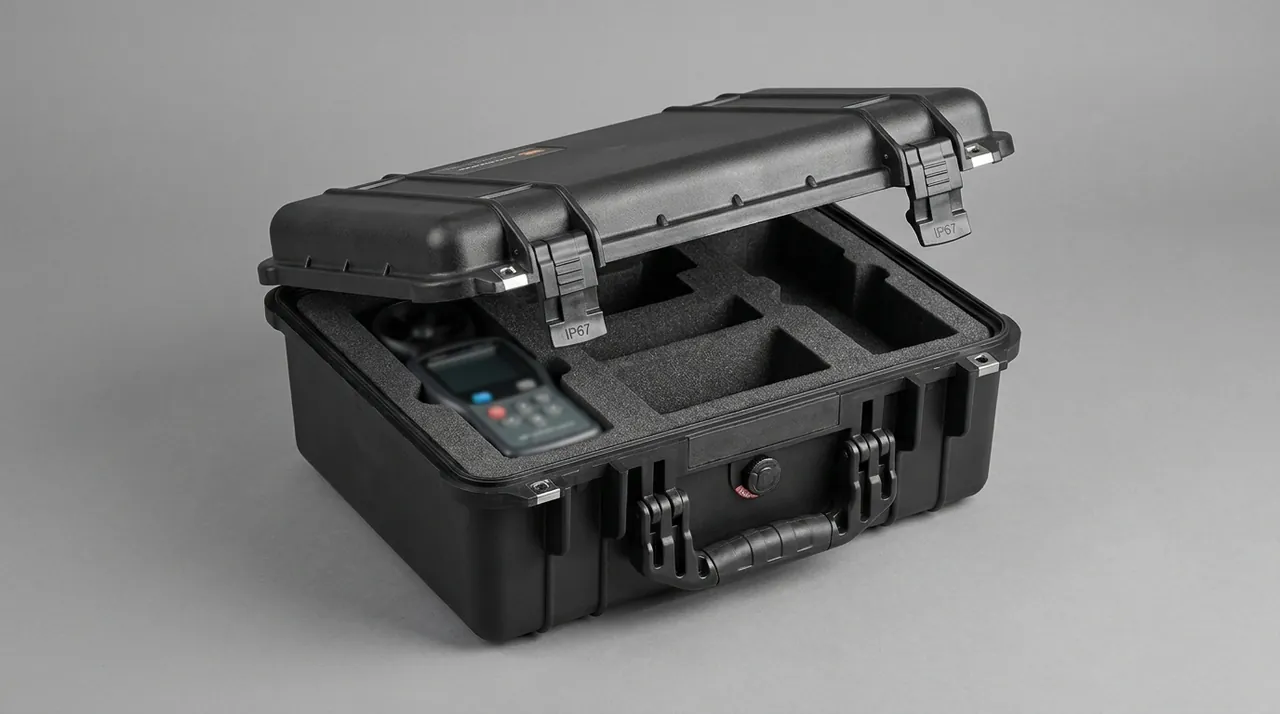
Sea freight and long-term storage are the two extreme moisture cases and need separate reinforcement.
Sea freight reinforcements include upgrading the barrier film to heat-sealed aluminium laminate; sizing desiccant at 300 to 500 g per cubic metre; fitting a humidity indicator card and tilt indicator; meeting ISPM 15 for wooden packaging through heat treatment or fumigation with the IPPC mark; fitting a moisture barrier pad and ensuring the case base does not sit in condensate. Sea voyages are long, and container interiors develop container rain under day-night temperature swings, so the case itself must not be a moisture-absorbing material, or must carry an external waterproof cover.
Long-term stock reinforcements include storing cases at least 100 mm above the ground on pallets; ensuring no water can pond on the lid, with a waterproof top cover where needed; inspecting one case every three months for the humidity indicator card, desiccant condition and rust spots on components; and keeping rubber parts and filter media away from heat and sustained compression.
Stacking limits: keep large part cases to two high at most and print the maximum layer count and a do-not-lay-on-side mark. For long discharge component cases, add a clear no-stacking-at-mid-span marking.
For test method selection in sea freight and long-term storage scenarios, see the ISTA transport testing procedure and the GB/T 4857 transport packaging test series references.
Acceptance, Testing and Compliance Documentation
Arrival inspection and test verification close the loop on the packaging design.
A recommended eight-item inspection list: case exterior free of damage and collapse; tilt indicator not triggered; humidity indicator card within threshold; desiccant not saturated; discharge unit rotor turns freely with the locking block intact; flange and sealing faces free of dents and corrosion; filter bags and cartridges free of moisture caking and compression marks; instruments cosmetically intact with legible marking; documents complete, including packing list, material certificates and cleanliness declaration where applicable.
Assemble the test set by scenario. Domestic road transport suggests GB/T 4857.3 or .4 for stacking, GB/T 4857.7 for sinusoidal vibration and GB/T 4857.5 for drop. Export sea freight suggests adding unitised load vibration and incline impact, or running an ASTM D4169 distribution cycle with a defined assurance level. Acceptance has three tiers: no structural failure of the packaging, no displacement or deformation of components, and functional and mating faces within tolerance.
On compliance documentation: wooden packaging requires ISPM 15 evidence; components with food contact require compliance with the applicable GB 4806 requirements and a declaration of conformity; components for clean or high purity service can be supported by cleanliness test records; and where a case contains grease, lubricant or a battery, assess whether dangerous goods provisions such as ADR or IMDG apply.
Note that MIL-STD-810H is an environmental test method standard, cited as a basis for environmental testing only. It is not a product certification.
Customisation Workflow and Spare Parts List System
Silo project spare parts lists typically have many line items with low quantities each, so customisation focuses on combining a structured list system with universal cases and dedicated liners.
List system design: group by functional system (discharge, conveying, dust control, instrumentation, electrical), sort within each group by installation position, and map every line item to a case number and compartment number. Provide both electronic and printed versions, with the printed version sealed in a waterproof bag inside the case.
Universal case plus dedicated liner: standardise cases into a few load ratings and size modules, and customise liners per component model. This covers many low-volume line items while controlling tooling cost.
Suggested delivery flow: provide the component list and drawings, confirm the case split plan and centre of gravity, receive the case and liner proposal, validate with a prototype, confirm by test, run a pilot batch, then deliver in batches with inspection records retained. The step most likely to go wrong is the case split plan, because it must balance weight distribution, site unloading sequence and container space utilisation at the same time.
JUNZHJIA serves silo and bulk material handling system integrators with protective case solutions matched to the system parts list, dedicated sealing and moisture barrier liners, separate packing structures for instruments and a list and marking system travelling with the case, supporting OEM and ODM programmes and global supply. If an established packaging specification is already in force for the silo scope, an equivalent replacement can be qualified with supporting test evidence.
Frequently Asked Questions
Q: Can filter bags and pulse valves share one case?
A: Not advisable. Filter bags are flexible media that fear moisture and compression, while pulse valves are precision items needing separate cushioning and dust protection. In a shared case, the clamping force needed to secure the pulse valves transfers onto the bags and damages pleats and membrane coating, and the metal valve bodies can abrade and snag the bags under vibration. If packing efficiency genuinely requires a mixed case, fit a rigid divider and restrain each side independently, with no clamping force from the valve zone reaching the bag zone. Separate cases are the safer route: pack bags together after individually sealing them in moisture barrier film, and pack pulse valves in compartments by quantity. Both items carry significant unit cost and neither can be repaired on site, so the extra case is far cheaper than a rework. Record the filter bag batch number together with the case number so that a later moisture problem can be traced back to a specific consignment.
Q: How much desiccant is enough?
A: Calculate from internal net volume, transit duration and target humidity rather than adding a few sachets by feel. As a practical approach, use 200 to 400 g per cubic metre of internal volume for a 30 to 60 day cycle in a temperate climate, rising to 300 to 500 g in humid climates where relative humidity stays above 75 percent, or for sea freight. Use net volume, which is the actual air volume after deducting component volume, not the external case dimensions. Distribute the desiccant evenly and fix it to the liner or case wall rather than leaving it loose on the component, where it can shift and abrade surfaces. For long-term storage, fit replaceable desiccant cartridges and replace every three to six months. A humidity indicator card is strongly recommended because it tells you directly whether the transport or storage environment exceeded expectations, which is far more reliable than reconstructing events afterwards.
Q: Will a rotary valve rotor turn during transport?
A: It will if it is not fixed. Sustained transit vibration rotates the rotor slightly inside the housing. Although the speed is very low, the accumulated effect over a long journey is grinding at the clearance between rotor blades and housing, which enlarges assembly clearance and can score the sealing face. Fix the rotor position before packing with a wooden wedge or dedicated locking block, and mark the case as transport locked, remove before installation. At arrival, first confirm the locking block is intact and has not moved; if it is loose or missing, the case experienced significant shock and the rotor-to-housing clearance should be checked further. Beyond the rotor, gate valve discs and butterfly valve plates need the same locking treatment for the same reason. Where a valve cannot be locked directly, block the actuator linkage instead and mark the blocking point on the outside of the case.
Q: How should level and pressure instruments be packed?
A: Treat them as precision instruments and never pack them with large components. Specifically, suspend the horn and lens of a radar level instrument and fit a dedicated protective cover; remove the paddle of a rotary level switch and pack it separately, or fit a rigid protective sleeve; fit a plug or cap on the pressure port and diaphragm of a pressure transmitter, since a deformed diaphragm fails the whole instrument with no on-site repair; and confirm sealing plugs are fitted in terminal cavities and cable entries before dispatch so dust cannot reach the board. Use a separate outer case, multi-layer cushioning, ESD shielding bags for board-bearing items, desiccant and a humidity indicator card inside, and mark the outer case as precision instrument and do not drop. Site statistics show that a significant share of instrument damage comes from compression within a shared case rather than from dropping, which is why separate packing pays off.
Q: What matters for exporting wooden packaging?
A: The central requirement is ISPM 15. Wood packaging material used in international transport, including pallets, dunnage, support timber and wooden case components, must be heat treated or fumigated and carry the IPPC mark, which includes the country code, producer code and treatment code where HT means heat treatment and MB means methyl bromide fumigation. Three errors are common: treating only the pallet while ignoring internal support timber; using a blurred or incomplete mark that the destination customs authority rejects; and letting fumigation validity lapse relative to the shipping date. Paper documents and wooden accessories inside the case can also trigger quarantine requirements. Where a customer wants to remove wood-related risk entirely, switch to plywood or engineering plastic cases, which are generally not subject to ISPM 15. For sea freight, also address container condensate by fitting an external waterproof cover. Record the IPPC mark details and the heat treatment or fumigation date on the shipping documents as well as on the wood itself.
Q: Will condensate form inside the case during sea freight?
A: It will, and this is the most underestimated moisture problem in sea freight. Over a long ocean voyage, container wall temperature drops below the dew point at night, and moisture in the air condenses on the internal surfaces and on the cargo, a phenomenon known in the industry as container rain. Four countermeasures apply. First, upgrade the internal barrier film to heat-sealed aluminium laminate so moisture is kept away from the component. Second, increase desiccant quantity, using 300 to 500 g per cubic metre for sea freight. Third, choose a non-absorbing case material, or fit an external waterproof cover over a wooden case and make sure no water collects inside the cover. Fourth, apply a vapour-phase corrosion inhibiting film to the component surface as a final line of defence. Check the humidity indicator card and tilt indicator immediately on arrival; if triggered, open and inspect at once and document the findings to support liability allocation and any claim.
Q: Do dust control components have temperature requirements?
A: Yes, and they differ by component. Filter bag and cartridge media are usually synthetic fibre or membrane constructions, and prolonged heat accelerates ageing; rubber seals harden at high temperature. Keep transport and storage below 60 degrees Celsius and avoid sun-exposed container roofs. On the other hand, the bonded joint between cartridge end cap and media becomes brittle at low temperature, so winter long-haul transport should stay above minus 10 degrees Celsius, using an insulated vehicle or additional cushioning where necessary. Pulse valve diaphragms are also cold sensitive; elasticity falls at low temperature and the diaphragm cracks more readily under shock. Taken together, a transport temperature window of minus 10 to 60 degrees Celsius is a reasonable specification for dust control components, and it should be stated in the packing documentation. Where the destination has extreme seasonal variation, define the transport environment requirement in the contract.
Q: How can reused cases avoid cross-contamination?
A: Establish cleaning and dedication practice. First, clean and record every reused case after return, focusing on residual dust in liner gaps and corners. Second, assign dedicated cases to different material systems, distinguished by colour or numbering, especially in food, pharmaceutical and lithium battery settings where the consequence of cross-contamination far outweighs the case cost. Third, design the liner as a removable, replaceable module, because liners retain dust readily, and replace by batch for contamination-sensitive projects. Fourth, add a food-grade barrier film on components that contact the product, referencing the applicable GB 4806 requirements for food contact materials. Where a customer has a cleanliness requirement, complete cleaning before packing, record it, and provide a cleanliness declaration with the shipment. Where a case has previously served a different material system, quarantine it after cleaning until the cleanliness record has been reviewed and approved, and mark the case internally with the material system it is dedicated to.
Q: Which inspection items are most often missed?
A: Site experience points to four. First, the humidity indicator card: many teams sign off on external appearance alone, yet the indicator card is the most direct evidence of whether the transport environment exceeded limits. Second, the tilt indicator: especially on heavy component cases, tilting can cause internal displacement while the exterior stays intact. Third, temporary protection items at openings, such as flange covers, terminal plugs and oil port caps, whose quantities need verification and which must all be removed, since leaving one can let dust in or cause an oil leak. Fourth, locking blocks and retaining wedges, which must be removed before installation, since leaving one can prevent start-up or cause damage. Turn the inspection list into a table with sign-off per item, photograph any anomaly with a scale reference and the case number, and retain the record for traceability. Assign the checklist to a named individual rather than to the receiving team in general, since diffuse responsibility is the main reason items get skipped.
Conclusion and Further Reading
The core of silo and bin spare parts packaging is holding three lines in a combined dusty, humid, open-air environment: metal mating surfaces must not rust, precision components must not ingest dust, and filter media must neither absorb moisture nor be compressed. The three lines correspond to moisture control design, dust isolation and compartmentalised packing, and none substitutes for the others.
Proceed in four steps: group by functional system and identify the failure mechanism for each group, define the case split plan and liner zoning, select test items according to the delivery scenario and verify, and finally write the acceptance checklist and cleanliness declaration into the contract annex. For high value small items such as filter bags, instruments and pulse valves, always pack separately rather than trading their integrity for packing efficiency.
JUNZHJIA serves silo and bulk material handling system integrators with protective case solutions matched to the system parts list, sealing and moisture barrier liners, separate instrument packing structures and a list and marking system travelling with the case, covering joint development for silo and bulk-handling projects, delivery to global sites, and material and test documentation issued by agreement.
Further Reading