

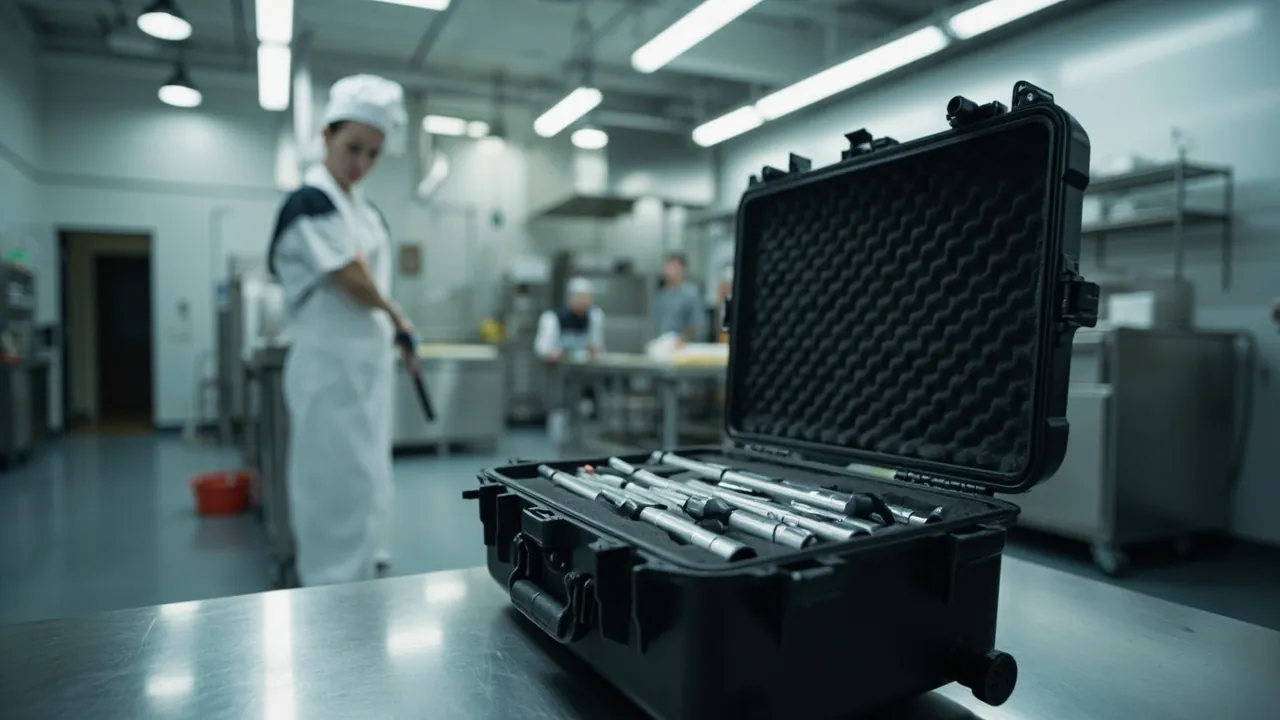
Central kitchen equipment logistics is fundamentally different from ordinary commercial cookware handling. A combi oven, a precision dosing head, or a set of cold-meal circulation trays may travel repeatedly between a central kitchen, satellite kitchens, and chain outlets, facing road vibration, loading drops, grease, condensate, cleaning-chemical residue, and hygiene audits along the way. The core question when selecting a central kitchen equipment case is not "will it fit" but "can it balance hygiene compliance against physical protection." The shell and liner must satisfy food-contact material requirements where applicable (the GB 4806 series), the interior must be moisture-controllable, washable, and sanitizable, the enclosure should reach IP65 or better per IEC 60529 / GB/T 4208, and the case must retain structural integrity and latch reliability under ISTA or GB/T 4857 transport test conditions. JUNZHJIA provides integrated capability in this segment, from insert modelling and gasket selection to full-case validation, and can supply structure drawings and test-basis documents matched to specific equipment models.
Most buyers evaluate a case once on outside dimensions and unit price, then run into three problems within six months: stainless panels denting because items collide inside the case, water pooling after washing or rain exposure with hinges starting to rust, and latches loosening after a few dozen trips until dust and water ingress protection is effectively gone. This article follows a practical sequence, equipment classification, material compliance, seal architecture, transport validation, and circulation management, and provides selection parameters, acceptance methods, and troubleshooting guidance that chain restaurants, contract catering operators, prepared-food plants, and central kitchen contractors can reuse as a protection framework.
Table of Contents
- 1. Protection Challenges in Central Kitchen Equipment Transport
- 2. Equipment and Utensil Inventory That Needs Protection
- 3. Hygiene Compliance Boundary: GB 4806 and Food-Contact Materials
- 4. Shell Material Comparison
- 5. Insert Design: EVA, EPE, PU, and Removable Dividers
- 6. Scratch Prevention, Edge Protection, and Knife Retention
- 7. Sealing and Waterproof Ratings: IEC 60529 and GB/T 4208
- 8. Washing, Sanitizing, and Drainage Architecture
- 9. Cold-Meal Delivery: Distinguishing Insulated Boxes from Equipment Cases
- 10. Transport Vibration and Drop: ISTA and GB/T 4857
- 11. Latch, Hinge, and Gasket Selection
- 12. Circulation Workflow and Handover Management
- 13. Marking, Traceability, and Batch Management
- 14. Procurement Acceptance and Life-Cycle Cost
- Frequently Asked Questions
- Conclusion and Further Reading
1. Protection Challenges in Central Kitchen Equipment Transport
The central kitchen logistics model produces protection challenges that differ from industrial equipment transport. Industrial equipment is normally shipped once and installed permanently. Central kitchen equipment and utensils, by contrast, are high-frequency circulation items: prepared or cooked semi-finished products go out to outlets in the morning and empty utensils come back on the same vehicle; when an outlet is renovated or a machine is serviced, small processing equipment travels back to the central kitchen. A single circulation unit may complete 200 to 300 round trips per year, which places continuous stress on latch life, gasket compression set, and insert positioning accuracy.
The challenges fall into five categories:
- Hygiene risk. Dead corners, crevices, and unsealed foam retain food residue and moisture and become microbial growth sites. During audits, inspectors open circulation cases to check whether interior walls are cleanable, whether mold spots are present, and whether detergent odour lingers.
- Physical impact. Stainless panels are vulnerable to localized point loads; a single knock can produce a 0.5 to 2 mm dent. Knives have cutting edges that must be re-sharpened or scrapped once rolled. Metering pumps and dosing heads are precision assemblies where axial shock causes calibration drift.
- Moisture and condensation. Utensils taken out of a cold room condense rapidly, and interior humidity can exceed 90 percent. If the case neither breathes nor seals, condensate has nowhere to go, paper labels dissolve, and metal parts rust.
- Chemical exposure. Chlorinated sanitizers, alkaline cleaners, oils, and acidic seasoning residue all attack metal components and ordinary rubber gaskets.
- Handover error. Cases moving between outlets and the central kitchen routinely produce missing or mismatched items with no traceable accountability.
Practical note: in central kitchen settings, cleanability is questioned by auditors far more often than the headline protection rating. Confirm early whether the interior is fully flat with no burrs, and whether the liner can be lifted out as a single piece for washing.
2. Equipment and Utensil Inventory That Needs Protection
Central kitchens span an enormous equipment range, from tens of grams of cutlery to processing machines weighing over a hundred kilograms. Grading the protection requirement ensures budget is spent where it matters.
| Category | Typical items | Primary risk | Suggested IP rating | Suggested insert |
|---|---|---|---|---|
| --- | --- | --- | --- | --- |
| Precision metering | Dosing heads, weighing modules, flow meters | Axial shock causing calibration drift | IP65 | EVA zoning plus locating blocks |
| Cutting tools | Slicers, bowl-chopper blades, boning knives | Edge rolling, operator injury | IP54 (with sheath) | Knife slots plus magnetic or clip retention |
| Panels | Stainless worktop panels, splash guards | Localized dents, scratches | IP54 | EPE backing plus non-woven interleaf |
| Electrical control | Thermostats, VFDs, terminal modules | Water ingress, dust-driven short circuits | IP65/IP67 | Anti-static foam plus desiccant |
| Utensil circulation | Stainless basins, portion trays, meal compartments | Deformation, stacking scratches | IP54 | Removable dividers plus frame support |
| Insulated meal delivery | Insulated boxes, gel packs, soup buckets | Rapid temperature rise, tipping and leakage | IP65 | Vertical retention plus anti-tip base |
The table shows that a single circulation fleet usually needs two or three distinct case grades, not one universal box. Using an IP67 waterproof case to carry stainless basins wastes budget; using a thin-wall IP54 case to carry a variable-frequency drive is an uncontrolled risk. JUNZHJIA typically helps clients complete this graded inventory at project kickoff and then configures case sizes and insert tooling accordingly, avoiding both over-specification and under-specification.
3. Hygiene Compliance Boundary: GB 4806 and Food-Contact Materials
This is the most commonly overlooked topic in central kitchen projects and the one most likely to surface in an audit. The boundary must be stated clearly:
- The GB 4806 series comprises mandatory national standards for food-contact materials and articles. It governs materials that come into direct contact with food, such as liner bags, trays, and holding containers.
- The outer shell of an equipment transport case is normally an indirect-contact or non-contact component and is not managed as a food-contact material. However, if the case itself is used as a container for ingredients or semi-finished products, it must be specified and documented as a food-contact material.
Three principles are recommended in practice:
- Separate functions. The equipment case carries equipment and utensils only; it does not hold food directly. When food must be carried, use a compliant inner bag or inner tray as a secondary container that can be removed and washed separately.
- Make material traceable. Raw materials for the shell and liner should come with material certificates, including resin grade and compliance statements for PP, HDPE, or EVA. Avoid sheet from unidentified recycled sources, which can cause odour migration and excessive extractables.
- Keep cleaning reachable. There should be no blind holes or inaccessible layers inside the case. If foam is used, it must be edge-sealed; otherwise switch to an EVA or PU liner that can be removed as a whole.
Compliance note: when explaining the design to an auditor, describe the two-level architecture of "equipment case plus food-grade inner bag or tray" rather than claiming the entire case is a food-contact material. Accurate wording is itself part of compliance competence.
For prepared-food plants and contract caterers, the common configuration is a food-grade PP or HDPE injection-moulded shell, an EVA liner with fully sealed edges, and one washable inner tray compliant with GB 4806. This satisfies the auditor's requirement for cleanability and separability without paying food-contact certification cost across the entire case.
4. Shell Material Comparison
Shell material determines impact resistance, chemical resistance, temperature tolerance, and dead weight. Central kitchen environments combine grease, detergent, and hot wash-down, so "cleanability under chemicals" matters more here than in outdoor engineering applications.
| Material | Impact resistance | Chemical / detergent resistance | Temperature range (typical) | Dead weight | Typical use |
|---|---|---|---|---|---|
| --- | --- | --- | --- | --- | --- |
| Food-grade PP | Medium | Good | -10 C to 80 C | Light | Utensil circulation, meal compartments |
| HDPE | Excellent | Good | -20 C to 70 C | Medium | Heavy equipment cases, cold-chain boxes |
| Copolymer PP with glass fibre | Excellent | Excellent | -20 C to 100 C | Medium | Precision equipment cases, frequent circulation |
| Stainless steel (304/316) | Medium (dents easily) | Excellent | Wide | Heavy | Fixed installation, rarely moved |
| Aluminium-magnesium alloy | Medium | Medium | Wide | Medium | Electrical enclosures needing low weight |
Engineering guidance:
- Above 200 trips per year: prefer copolymer PP or glass-fibre reinforced PP, with reinforcing ribs at latch and hinge bosses.
- Long-term cold-chain use: avoid standard PP because of low-temperature embrittlement risk; use low-temperature modified PP or HDPE.
- Steam or hot wash-down: check the heat deflection temperature and keep wash water at least 20 C below it.
- UL94 flame retardance: if the case carries lithium battery tools or chargers, confirm the material's flame rating, commonly targeting UL94 V-0 or V-2, and request the material's flame test report from the supplier.
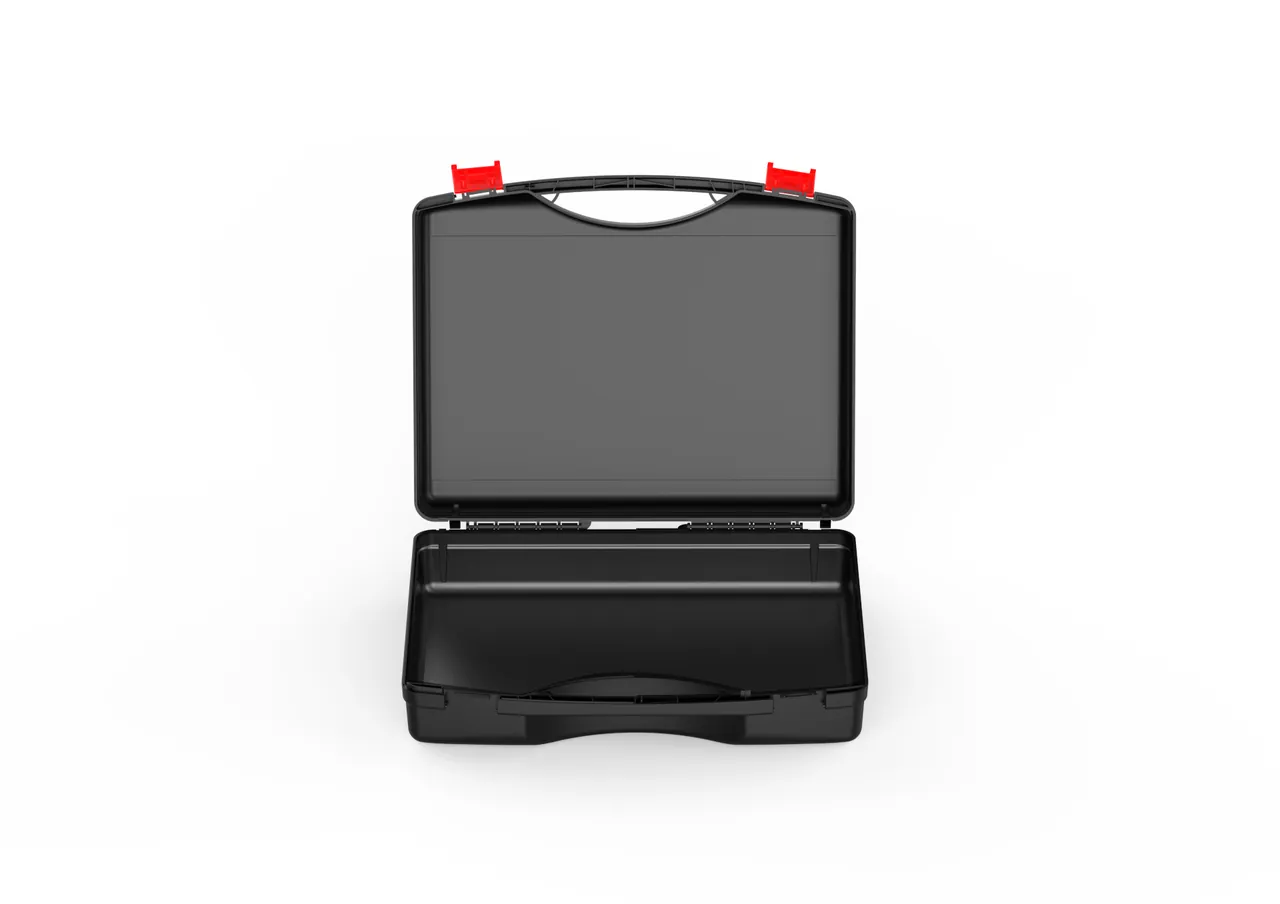
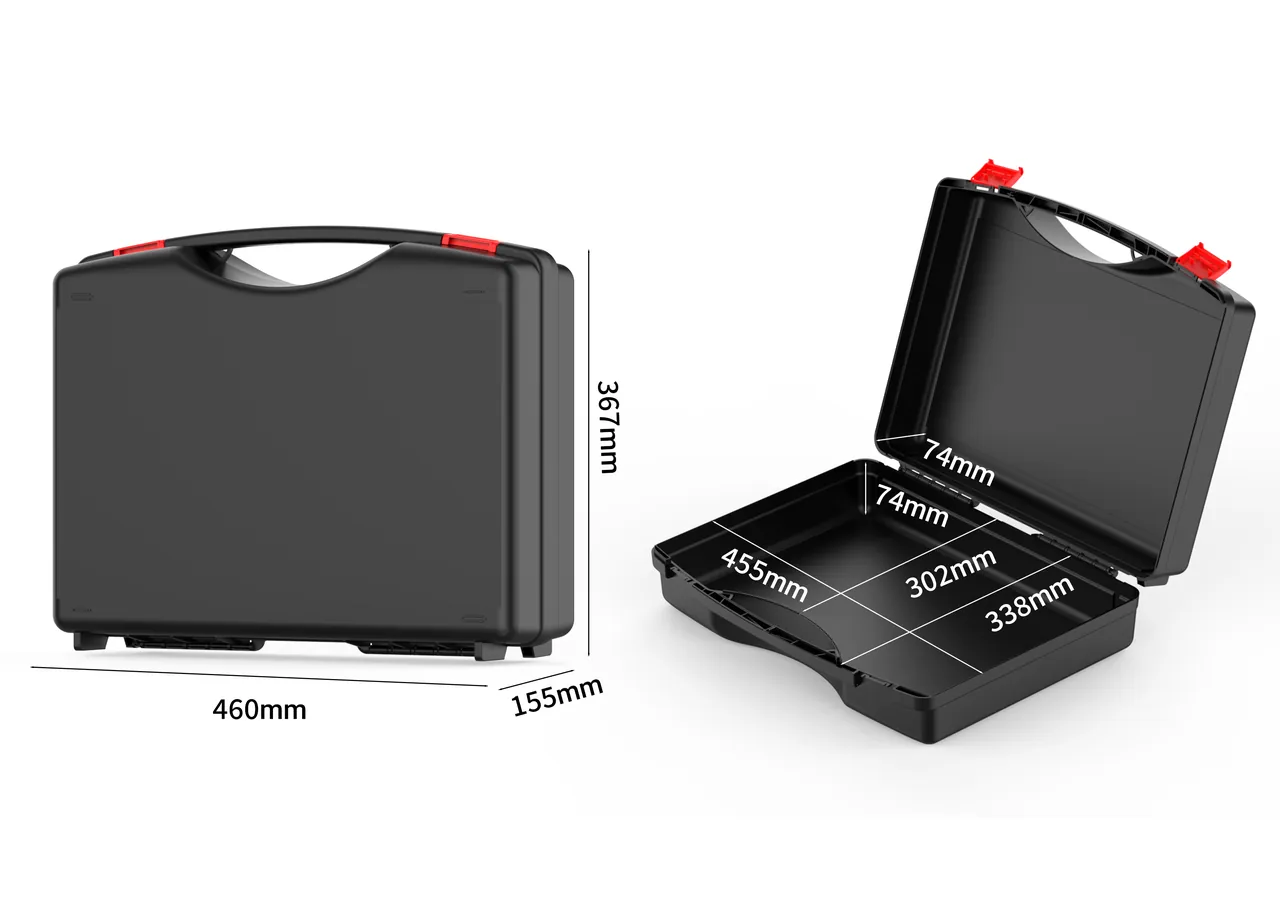
Thicker walls are not automatically better. Excessive wall thickness raises dead weight and therefore the probability of a handling drop. For a medium equipment case in the 600 x 400 x 300 mm internal class, a wall thickness of 3 to 5 mm with reinforcing ribs usually satisfies normal impact requirements.
5. Insert Design: EVA, EPE, PU, and Removable Dividers
The insert determines whether the equipment is genuinely protected. It has three jobs: cushioning, locating, and separating. If any one is missing, the weakness surfaces after a few dozen trips.
- EVA liner. Density is tunable, it can be CNC-milled precisely, and after edge sealing the surface is dense and easy to clean, making it the first choice for central kitchen equipment cases. Typical density range is 45 to 80 kg/m3, with the higher end for precision items.
- EPE (pearl foam). Good cushioning at low cost, but the surface is porous and readily absorbs oil and water, and it crumbles over time. Suitable as one-way transport cushioning or as a supplement in non-hygienic applications.
- PU foam. Excellent resilience and conformity, but slow to dry after absorbing water; in hygiene applications it needs edge sealing or film lamination.
- Removable divider systems. Slotted or clipped dividers allow compartment sizes to change, which suits frequently varying utensil sets. If utensil dimensions are stable, a custom milled insert still gives better locating accuracy and cleaning convenience.
Key insert design parameters:
- Interference fit. Allow 1 to 3 mm of interference between equipment and insert so the material's elasticity holds the item in place and prevents movement in transit.
- Base cushion thickness. At least 20 mm, and 30 to 50 mm for heavy equipment.
- Hand clearance. Leave 30 to 40 mm finger clearance on both sides of the equipment; otherwise operators will grab the equipment panel directly and tear the insert.
- Drainage and venting. If utensils enter the case wet, provide flow channels or drain holes at the insert base so water cannot accumulate.
Because insert milling accuracy depends on equipment geometry, batch projects should supply the physical item or a 3D model. Different insert materials behave differently in compression set and moisture uptake, so it is worth reviewing a comparison of protective case foam materials before committing to a grade. JUNZHJIA can produce insert drawings from scan data and build a first-article sample for trial fitting on the real equipment before tooling for mass production; the complete sequence is described in this guide to moving from 3D data to a first-article custom insert.
6. Scratch Prevention, Edge Protection, and Knife Retention
Knives and stainless panels are the two most commonly damaged item types inside central kitchen cases, and their handling logic differs completely.
Cutting tools. The protection targets are the edge and operator safety. Recommended practice:
- Give each knife its own slot, 2 to 3 mm wider than the blade thickness and at least 8 to 10 mm deeper than the cutting edge;
- Align all blades in the same direction so adjacent edges never face each other;
- Add a hard backing plate at the slot base so the tip cannot pierce the foam;
- Mark knife count and specification on the outside of the case for handover counting.
Panels and utensils. The protection targets are localized point loads and mutual abrasion. Recommended practice:
- Insert a non-woven or felt interleaf 1 to 2 mm thick between panels;
- When stacking stainless basins, add a cardboard or EPE ring between base and rim so edges cannot cut in;
- Provide a frame support inside the case so that stacked utensils do not jam after vertical compaction.
A frequently missed detail: scratches on stainless surfaces come mostly not from transport vibration but from operators rummaging inside the case. Sensible compartmentalization that reduces searching is more effective at preserving appearance than simply adding cushioning.
7. Sealing and Waterproof Ratings: IEC 60529 and GB/T 4208
Ingress protection is the most frequently asked specification and also the most frequently misread.
An IP code has two digits. The first indicates solid particle protection from 0 to 6; the second indicates water protection from 0 to 9. Common ratings in catering applications mean the following:
- IP54. Dust protected with limited ingress that does not impair operation, plus splash resistance. Suitable for utensil cases circulated short distances under a roof.
- IP65. Dust tight plus protection against water jets. Suitable for wash-down areas and rain-exposed loading.
- IP67. Dust tight plus protection against temporary immersion, typically 1 metre for 30 minutes. Suitable where the case may fall into a puddle, an ice bath, or a washing tank.
Three points deserve emphasis:
- An IP rating is a conclusion under type-test conditions, not a permanent capability. A gasket ages, a latch deforms, or a drop damages the shell, and real-world protection degrades.
- IP65 and IP67 differ mainly in water, since both reach dust class 6. If the site only washes down and never immerses, IP65 is the more economical choice.
- State clearly whether the rating applies to an empty case or a loaded case. Most IP testing is performed on a closed empty case; if a sharp item inside presses against the sealing face, actual sealing fails.
IEC 60529 and GB/T 4208 describe corresponding test methods. For domestic procurement, citing GB/T 4208 in the contract makes acceptance discussions easier. A recommended clause reads: "Dust and water testing shall be performed at the specified class in accordance with GB/T 4208; after testing there shall be no significant water or dust ingress." Where short-term immersion risk genuinely exists, it is worth reviewing the structural differences described in this analysis of IP67 protective case design before paying a premium for immersion capability.
8. Washing, Sanitizing, and Drainage Architecture
Central kitchens usually impose stricter washing requirements on circulation containers than general industrial settings do. The case must be designed to accommodate the washing action itself.
Recommended design points:
- No dead corners. Use rounded transitions rather than right angles where soil accumulates, and avoid layers between liner and shell that admit water but do not dry.
- Liner removable as a whole. Once out, the liner can be washed, air-dried, and UV-sanitized, while the shell is washed separately.
- Drain and vent ports. Provide a closable drain at the base that lets water out while maintaining the sealing class when closed.
- Sanitizer resistance. Confirm tolerance to chlorinated sanitizers, peracetic acid, and quaternary ammonium compounds, and run an immersion test where necessary.
- Drying verification. After washing, verify dryness explicitly, for example by placing blotting paper to detect residual water, rather than assuming visible dryness means the crevices are dry.
Where empty cases return from cold-meal delivery, condensate is common on the return leg, and drainage then matters more than the sealing rating: draining cleanly affects the hygiene outcome more than sealing tightly.
9. Cold-Meal Delivery: Distinguishing Insulated Boxes from Equipment Cases
In central kitchens, "equipment case" and "insulated box" are often used interchangeably, yet their design goals differ. Mixing them means both functions fall short.
| Dimension | Equipment transport case | Insulated meal-delivery box |
|---|---|---|
| --- | --- | --- |
| Primary goal | Impact resistance, retention, rust prevention | Slowing temperature rise, stable temperature hold |
| Key parameters | Cushion thickness, insert accuracy, IP class | Insulation thickness, thermal conductivity, gel pack configuration |
| Typical construction | Hard shell plus milled insert | Hard shell plus PU or vacuum insulation plus gel pack cavity |
| Food-contact compliance | Indirect contact, depends on use | Inner liner often must be food-contact compliant |
| Relevant standards trail | Mainly ISTA / GB transport test series | May follow the GB/T 22918 cold-chain temperature management approach |
The test is simple: if the payload fears temperature swings, it is an insulated box; if it fears impact, it is an equipment case. When both are needed, choose an equipment case plus a separate insulated inner bag rather than asking one box to do both jobs.
Two further practical details matter in cold-meal delivery: gel packs should be pre-chilled to the set temperature before loading so heat is not introduced with the pack, and the fill volume should stay below about 80 percent of design capacity to leave air circulation space.
10. Transport Vibration and Drop: ISTA and GB/T 4857
Transport testing is the most economical way to validate a case design. The typical central kitchen route is van or refrigerated truck, unloading at the outlet, hand trolley, then back of house, and its shock signature is dominated by low-to-medium frequency vibration plus frequent manual handling drops.
Both the ISTA series and the GB/T 4857 series provide citable test frameworks:
- ISTA 2A / 3A. Suited to transport performance validation of individual packages, covering drop, vibration, and stacking. Project sequences and pass criteria are described in this overview of ISTA transport testing procedure.
- ISTA 7D. Suited to temperature-controlled transport, covering temperature simulation for cold-chain distribution.
- GB/T 4857 series. China's basic test methods for transport packages, including drop (4857.5), vibration (4857.7 and 4857.10), and stacking (4857.3), which makes domestic acceptance and contract citation easier. See the key points of GB/T 4857 transport packaging testing.
A recommended validation sequence:
- Define the representative load state, meaning the heaviest combination and the least favourable centre of gravity.
- Choose drop height according to real handling height; manual handling commonly corresponds to 600 to 900 mm.
- Run fixed-frequency or random vibration testing and inspect insert displacement and latch loosening.
- Re-test sealing after the sequence to confirm the IP class has not failed.
One clarification: MIL-STD-810H and similar environmental test standards are frequently cited as method references in civilian case specification, but they are methodology standards and do not constitute military certification. External communication should describe them accurately as "test methods referenced," never as "military standard certified."
11. Latch, Hinge, and Gasket Selection
These components set the lower bound of case life. Most "failed within six months" complaints trace back here.
Selection guidance for hinges, latches, and gaskets follows the engineering logic described in this toolbox hinge, latch, and gasket selection guide. The core conclusions are:
- Hinges need a metal core. All-plastic hinges fatigue-crack under frequent opening; specify a metal pin or metal hinge boss.
- Latches need secondary security. A single-point latch can pop open when a case is knocked during handling; prefer two-point or self-locking designs.
- Gaskets must be replaceable. The gasket is a wear part and should be field-replaceable rather than co-moulded into a shell that must then be scrapped entirely.
- Match gasket material to temperature. EPDM suits ambient service; low-temperature cold-chain use calls for low-temperature silicone or a dedicated low-temperature compound so the gasket does not harden and lose resilience at minus 20 C.
In gasket groove design, compression ratio is typically held between 20 and 30 percent. Too little compression leaks; too much accelerates permanent set. Where a client needs the compression ratio optimized for actual duty, JUNZHJIA can supply sample gaskets in several hardness grades for comparative testing.
12. Circulation Workflow and Handover Management
The case is only the carrier; the workflow is what actually prevents loss. A "one case, one card, one list" circulation system is recommended:
- Numbering. Laser-mark or hot-stamp a serial number on every case and bind it to the asset register.
- Checklist. Give each case a rewritable checklist card listing item name, specification, and quantity.
- Handover. The loader and the receiver each sign once, with photographs of critical condition.
- Stocktaking. Sample-count weekly and full-count monthly, with discrepancies entering a traceability process.
- Exception closure. After any missing or damaged item, complete the cause record and responsibility determination within 24 hours.
For cross-outlet circulation, a two-colour tag system on the case helps: green for "cleaned and ready," yellow for "awaiting wash," red for "awaiting repair." This simple colour code substantially reduces the hygiene risk of an unwashed case being put straight into service.
13. Marking, Traceability, and Batch Management
The marking system must serve three audiences at once: operators, hygiene auditors, and warehouse staff.
Recommended fields:
- Case serial number and owning unit;
- Equipment and utensil list with quantities;
- Last wash date and next wash due date;
- Load limit in kilograms and stacking layer limit;
- Temperature-control instructions where applicable.
Wash labels must resist water and cleaning. Ordinary paper labels fall off after two wash cycles; use water-resistant polyester labels or direct silkscreen printing so that records do not disappear with the label.
Where cases support food-related circulation, keep complete wash and sanitizing records covering time, chemical, concentration, and operator. These records are frequently sampled during system audits, including hygiene control point management along HACCP lines.
14. Procurement Acceptance and Life-Cycle Cost
The most common procurement mistake is comparing unit price alone. The true cost of a central kitchen circulation case should be assessed over its full life cycle:
Cost per trip = (purchase price + insert tooling amortization + annual maintenance) / (annual trips x service life in years)
A worked example: Case A costs 300 units and lasts 1.5 years; Case B costs 520 units and lasts 4 years. At 250 trips per year, Case A costs about 0.80 per trip and Case B about 0.52 per trip. Case B looks 73 percent more expensive but is actually 35 percent cheaper per trip.
Acceptance should follow a sampling plan, for which the method described in this guide to AQL sampling for custom protective case acceptance is directly applicable. Key checks:
| Acceptance item | Method | Pass criteria |
|---|---|---|
| --- | --- | --- |
| Appearance and burrs | Visual plus hand check of interior | No sharp edges, no flash, no unsealed foam |
| Dimensions and fit | Trial-fit the actual equipment | Clearance matches drawing, no forced compression |
| Sealing class | Test per GB/T 4208 at the specified class | No significant water ingress after test |
| Latch life | Open-close cycling | Function normal after the agreed cycle count |
| Insert retention | Re-inspect after vibration | No displacement, no tearing |
| Material evidence | Document review | Resin grade and flame test reports complete |
For service-life management, the logic in this assessment of protective case service life evaluation is useful: track the three wear parts, namely the gasket, hinges, and latches, rather than waiting for the whole case to fail before replacement.
Frequently Asked Questions
Q: Does a central kitchen equipment case need to be IP67?
A: Not necessarily; decide from the actual exposure environment. The second digit of an IP code indicates water protection, increasing from splash resistance to immersion. If the case only travels short distances under a roof, IP54 splash protection is usually sufficient. If it is washed down in a cleaning area or loaded in rain, specify at least IP65, which combines dust tightness with water-jet protection. Only when there is genuine risk of falling into a puddle, an ice bath, or a short immersion is IP67 justified. Before choosing, clarify whether the rating applies to an empty case or a loaded one, and require the supplier to provide test evidence at the corresponding class under GB/T 4208, whose methods correspond closely to IEC 60529. Over-specifying raises both cost and dead weight and can actually increase the chance of handling drops.
Q: Can an equipment case be used directly to hold ingredients or semi-finished food?
A: It is not recommended. The GB 4806 series consists of mandatory national standards for food-contact materials and articles and governs materials that touch food directly. An equipment transport case is positioned as an indirect-contact or non-contact component and is not normally managed as a food-contact material. Once it is used as a holding container, however, it must be specified and documented as food-contact compliant. A safer architecture is two-level: the outer equipment case handles protection and circulation, while an inner washable bag or tray compliant with GB 4806 holds the food. Both parts can be cleaned and replaced independently, satisfying hygiene audits without paying food-contact certification cost across the whole case.
Q: How can denting of stainless utensils inside the case be reduced?
A: Denting originates in localized point loads. Improvement can come from three directions. First, compartmentalize and locate each item so nothing collides. Second, interleave layers, adding non-woven cloth or felt between panels and a cardboard or EPE ring between base and rim when stacking basins so edges cannot cut in. Third, increase base cushion thickness, targeting 30 to 50 mm for heavy items. It is also worth noting that most visible scuffs come not from transport vibration but from operators searching inside the case, so sensible compartmentalization that reduces searching is more effective than simply adding more cushioning.
Q: Why is foam liner not recommended in central kitchens?
A: The main problem is porosity. Standard PU foam and unsealed EPE have porous surfaces that absorb grease, water, and detergent residue, dry slowly, and become microbial growth sites that also generate odour. Where cushioning genuinely requires foam, apply full-surface film lamination or edge sealing and ensure the liner can be removed as a whole for washing and air drying. For central kitchen projects with higher hygiene requirements, an EVA milled liner is preferable: the surface is dense and wipeable, dimensions are stable, and with a split compartment structure it combines locating accuracy with cleaning convenience. When it eventually wears, it can be replaced on its own without scrapping the entire case.
Q: The case never dries fully after washing. What is the cause?
A: In most cases there is a layer that admits water easily and drains poorly. Three causes are common. First, a gap exists between liner and shell with no drainage path, so water can only leave by evaporation. Second, the case base is flat with no flow channel, so water pools and dries naturally. Third, corner radii are insufficient and true right angles create dead spots. The remedy is a closable bottom drain with flow channels, an insert design that avoids closed cavities, and a post-wash blotting-paper check of crevices for residual water. On cold-chain return legs, drainage often matters more than sealing class, because draining cleanly affects hygiene results more directly than sealing tightly.
Q: Does MIL-STD-810H mean the case holds military certification?
A: No. MIL-STD-810H is an environmental test methodology standard that describes how to simulate and evaluate environmental effects. In case specification it can serve as a method reference for vibration, shock, and temperature-humidity testing, but it must be described accurately as "test methods referenced" and must never be presented as "military standard certified" or as evidence of military qualification. For central kitchen equipment cases, a validation path closer to reality is to cite the ISTA series or the GB/T 4857 series for transport package testing, combined with real manual handling drop heights and van vibration spectra, which yields conclusions that better reflect actual circulation duty.
Q: Can an insulated meal box and an equipment case be combined into one product?
A: It is possible in a narrow set of cases but generally not advisable. The design goals differ. An equipment case pursues impact resistance, retention, and rust prevention, with cushion thickness, insert accuracy, and IP class as key parameters. An insulated box pursues slower temperature rise, with insulation thickness, thermal conductivity, and gel pack configuration as key parameters. Combining them creates a conflict: thickening walls for insulation raises dead weight and reduces cushioning margin, while thickening the liner for protection consumes volume needed for gel packs. A more workable approach is an equipment case plus a separate insulated inner bag, or two dedicated case types with clear marking to prevent mixing on site.
Q: How often should a circulation case gasket be replaced?
A: There is no fixed interval; judge by condition rather than by calendar time. A gasket is a wear part and its main failure modes are compression set, hardening and cracking, and adhesive separation. Assess in three steps: visually check for cracks, deformation, or a gasket that has come out of its groove; press it to test whether resilience has clearly dropped; and run a waterproof re-test at the specified GB/T 4208 class. In cold-chain service, prolonged low temperature hardens gaskets faster, so inspection intervals should be shortened. Design selection should ensure the gasket is field-replaceable on its own, since co-moulding it into the shell forces whole-case scrapping and this effect on life-cycle cost is often underestimated.
Q: What size should a central kitchen equipment case be?
A: Work backwards from the loading list, not forwards from existing shelving. Determine size in three steps. First, survey the external dimensions and weight of every item that needs circulation and identify the heaviest and largest. Second, derive the internal cavity dimension from the intended combination, allowing 1 to 3 mm interference and 30 to 40 mm hand clearance. Third, calculate the loaded weight and confirm it stays within a safe manual handling load, splitting into two cases if necessary. Note that larger external dimensions are more likely to be crushed during vehicle stacking, so it is unwise to maximize single-case size merely to reduce case count. If utensil specifications change often, choose a case type with removable dividers for greater adaptability.
Conclusion and Further Reading
Selecting a central kitchen equipment case is fundamentally a three-way balance among hygiene, protection, and circulation efficiency. The implementation path compresses into five steps: build a graded equipment inventory, define the material compliance boundary from contact relationships, set the protection class from the exposure environment, solve locating and cushioning through insert design, and verify through transport testing and acceptance sampling. What truly determines cost is not unit price but the replaceability of the three wear parts, the gasket, hinges, and latches, along with whether the liner can be removed as a whole for cleaning.
For buyers, the three most practical rules are: write cleanability into the technical agreement, write the protection class test basis into the acceptance clause, and write replaceability of wear parts into the service-life terms. With those three in place, a central kitchen case fleet will hold stable performance over a cycle of three years or more.
When a project requires insert design for specific equipment models, gasket selection, or OEM/ODM volume supply, JUNZHJIA can provide matching structure drawings, material certificates, and test-basis documents, and can schedule first-article trial fitting to the project timeline.
Further Reading