

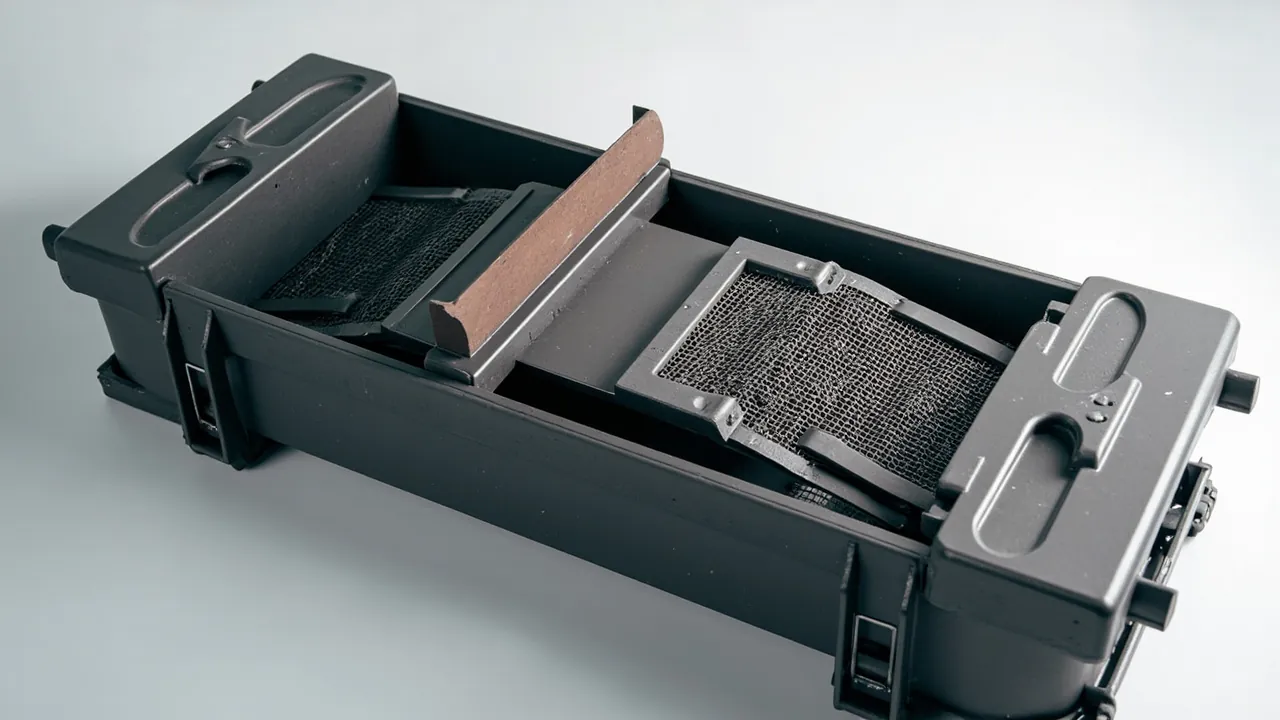
Jaw plates, screen mesh, cheek plates, toggle plates and screen decks are the most frequently replaced consumables on mining and aggregate crushing lines, and they are also the cargo most likely to generate rework and claims in transit. A single jaw plate commonly weighs 300 to 1500 kg and carries a cast manganese working face, so a chipped tooth tip condemns the whole plate; screen mesh is a long-span thin-wall metal part, and once stacked under load its flatness drifts beyond tolerance, causing slack and material bypass when tensioned on site. The real job of a crushing and screening parts case is therefore not to fit the parts in, but to lock down three variables for the whole journey: unit weight, tooth geometry and flatness.
Damage rarely happens on the main transport leg. It happens during workshop transfer before loading, temporary storage in the yard, and secondary handling after unloading. All three share the same conditions: no lifting points, no dunnage, and manual rolling or forklift pushing. This article breaks down the packing logic for jaw plates and screen components by their mechanical behaviour, and gives executable practice for case structure, liner selection, fastening and acceptance testing, written for spare parts buyers, maintenance engineers and packaging engineers.
Table of Contents
- Four Transit Damage Modes of Crushing & Screening Parts
- Jaw Plates: Resolving the Conflict Between Weight and Tooth Geometry
- Layered Surface Protection for Manganese and Alloy Steel Parts
- Screen Mesh and Screen Decks: Flatness Is the Only Hard Metric
- Structure and Load Verification of Heavy-Duty Cases
- Liner Strategy: Combining Wood Skids, Rubber Pads and Shaped EVA
- Managing Fasteners and Small Components by Compartment
- Sealing, Moisture Control and Open-Yard Storage
- Lifting Interfaces Compatible with Manual Handling
- Transport Testing and Acceptance Criteria
- Container Fit-Out for Overseas Mine Site Delivery
- OEM/ODM Customisation Workflow and Delivery Milestones
- Frequently Asked Questions
- Conclusion and Further Reading
Four Transit Damage Modes of Crushing & Screening Parts
Crushing and screening spares meet four characteristic damage modes along the logistics chain. Classifying the damage before designing the packaging is far more effective than choosing a case and then improvising.
The first mode is impact chipping. Jaw plate tooth tips, impact plate edges and hammer end faces are hard, low-toughness geometry where stress concentrates on an edge line often under 10 mm wide. Under a drop or direct metal-to-metal contact, the stress concentration factor can reach 3 to 5, which is enough to form a crescent-shaped chip in a cast surface. The remedy is to suspend the sharp edge and absorb energy with compressible material, not to press the edge against a rigid liner.
The second mode is compression set. Metal woven mesh, polyurethane screen panels and punched decks are thin-wall parts with a large length-to-thickness ratio. When stacked bare, the maximum deflection of the middle layers usually exceeds allowable flatness, and the deformation becomes permanent after unloading. Mine sites require uniform tension across the screen surface with no local dishing; once plastic deformation exists, the deck will slap during operation and suffer secondary damage.
The third mode is abrasion and corrosion. Manganese steel develops surface rust within weeks in a damp environment. This does not affect core properties, but it interferes with fit-up clearance judgements on site. Alloy steel decks and stainless screens can suffer pitting and scratching. Coastal mine sites and rainy-season yards are the highest-risk settings.
The fourth mode is loss of small parts. Wedges, clamping bars, tension bolts, rubber cushion strips and wear liner strips are cheap individually but indispensable collectively. A missing wedge can idle a machine.
Mapping the four modes to packaging actions produces a clean design list: suspend sharp edges, stand large flat parts on edge or compartment them flat, apply film plus vapour-phase corrosion protection to metal surfaces, and compartmentalise small parts. The underlying principles are covered in the custom foam insert design guide.
| Damage mode | High-risk parts | Main trigger | Packaging countermeasure |
|---|---|---|---|
| --- | --- | --- | --- |
| Impact chipping | Jaw tooth tips, hammers, impact plates | Drops, direct metal contact | Suspended edge plus compressible energy absorber |
| Compression set | Screen mesh, decks, woven cloth | Bare stacking, no dividers | Stand on edge or compartment flat |
| Abrasion and rust | Manganese, alloy and stainless parts | Humidity, open storage | Film, vapour-phase inhibitor, sealed case |
| Lost small parts | Wedges, clamping bars, bolts | Mixed loading, no positions | Compartmentalised positions plus packing list |
Jaw Plates: Resolving the Conflict Between Weight and Tooth Geometry
Jaw plates are among the heaviest single wear items in the crushing chamber. A moving jaw for a 600 x 900 machine typically weighs 400 to 600 kg, and a 1200 x 1500 machine can exceed 1200 kg. The first constraint imposed by that mass is lifting, and only the second is cushioning.
The difficulty in tooth protection is that the tip is the one region that must never be loaded, and it happens to sit on the outermost face where the case wall or a neighbouring part will press first. The engineering answer is to leave 15 to 25 mm of clear space around the tooth tip and fill that space with closed-cell foam, so the tip sees only the compression force of the material and never a rigid reaction.
Orient all tooth faces the same way. When several jaw plates ship together, align the tooth faces in one direction with at least 20 mm of separation, avoiding tip-to-tip contact. If stacking is unavoidable, place an interlayer with hardness below HRC 30 between tooth faces, at least 10 mm thick.
The back of a jaw plate usually carries mounting bosses or dovetail slots. These are load-bearing features and should be the primary support surfaces. Internal supports should sit on bosses or thickened zones, never on the transition fillet at the tooth root, which is a stress raiser and will become a crack initiation site under sustained pressure.
For very heavy plates above 800 kg, use an independent unit strategy: one plate per case or per skid, an 18 mm or thicker plywood base, steel strapping, and corner stops to prevent lateral shift. Structural practice for this class of heavy cargo is described in the mining equipment parts case reference.
Layered Surface Protection for Manganese and Alloy Steel Parts
The material range across crushing and screening parts is wide, spanning manganese steel such as the ZGMn13 family, high-chromium cast iron, alloy structural steel, stainless steel and polyurethane. The protection requirements differ substantially, and applying one specification to every part is the main cause of recurring surface problems.
Manganese steel work-hardens readily and gains surface hardness under impact, but in the as-supplied condition it is relatively soft and easily gouged by sharp objects. Protection focuses on scratch and moisture resistance: PE wrap plus a vapour-phase corrosion inhibiting film is sufficient, with no need for additional oil.
High-chromium cast iron is hard and brittle. The priority is impact resistance, because any corner knock can initiate microcracks. Fit corner protectors and avoid placing these parts in the same case in direct contact with manganese parts; the hardness gap is large and the harder part will bite into the softer one in transit.
Alloy structural steel parts such as toggles, pitmans and bearing housings are usually quenched and tempered and may carry machined surfaces. Those surfaces need rust-preventive oil plus face protection, and must not be mixed with castings. Where a machined surface has a fit tolerance, shaped liners are recommended to stop the micro-motion that causes fretting wear.
Stainless screen mesh and decks need additional attention to chloride corrosion. For coastal deliveries, no chlorine-bearing foam should be used inside the packaging. Choose halogen-free PE or EVA with low outgassing and add an appropriate quantity of desiccant. Seal integrity drives the protection outcome; the IP67 protective case sealing guide explains gasket selection and compression force design.
Screen Mesh and Screen Decks: Flatness Is the Only Hard Metric
Screen media looks easy to pack and is in practice the most failure-prone category on a mine site. The reason is simple: it is large, thin, expensive and not repairable.
The first rule of flatness control is to ban bare multi-layer stacking. A single woven metal screen can measure 2.4 m by 6 m while weighing only 30 to 80 kg. When stacked, the accumulated self-weight drives the lower layers into plastic deflection. Three workable approaches exist: stand the screens on edge at 75 to 85 degrees with a continuous bottom channel; lay them flat in individual compartments with compartment height exceeding the mesh crimp height by at least 10 mm; or roll them, provided a mandrel is used and the roll diameter stays above 400 mm to avoid permanent curvature.
The second rule is edge protection. Woven mesh edges normally carry a bound or hooked edge. Once a hook edge is straightened, the screen cannot be tensioned on site. Provide continuous support along all four edges rather than point support.
Polyurethane and rubber screen panels tolerate compression better but are temperature sensitive. Above 60 degrees Celsius they soften and take a permanent set, so transport and storage should avoid sun-exposed container roofs and metal sheds.
Punched and bar decks are semi-rigid. When stacked, keep them oriented the same way with paper interlayers, limit the stack to eight layers, and keep layer-to-layer offset within 5 mm so that protruding edges do not get bent by a forklift.
| Screen component | Unit characteristics | Recommended loading | Key limit |
|---|---|---|---|
| --- | --- | --- | --- |
| Woven metal mesh | Thin, long span, rollable | Stand on edge preferred | Edge angle 75 to 85 degrees |
| Polyurethane panel | Medium rigidity, temperature sensitive | Flat, compartmentalised | Ambient 60 C maximum |
| Punched deck | Semi-rigid, thin edges | Same-direction stack with interlayers | Eight layers maximum |
| Bar deck | Rigid, many slots | Stand on edge | Prevent slot closure under load |
| Tension hook assembly | Small, easily deformed | Separate compartment | Hook must carry no load |
Structure and Load Verification of Heavy-Duty Cases
Heavy parts case structure should be derived backwards from the stacking load, not forwards from whether the part fits.
The base panel is the primary load-bearing member. For cases above 800 kg gross, use 15 to 18 mm plywood, or 12 mm plywood with steel reinforcement rails. Fit load blocks at the corners and mid-span so that stacking loads pass through the blocks into the case frame rather than into the part's bearing surfaces.
Keep frame uprights at 600 mm centres or closer. Crushing spares create pronounced point loads inside a case, and wider upright spacing lets the walls bulge.
Convert stacking limits into real load. When the part itself is tall, two-high stacking can equal the load of three conventional layers. As a rule, limit cases above 600 kg gross to two-high and print stacking orientation and layer limits on the corners.
Match case stiffness to the transport regime. Long-haul road and sea transport have different vibration spectra: road transport shows elevated power spectral density peaks between 5 and 20 Hz, while sea transport is dominated by low-frequency roll and alternating bending. A case that is too flexible will amplify its internal response in the resonance band and increase the shock seen by the part.
For test methods and sequencing on heavy transport packaging, combine the ISTA transport testing procedure and GB/T 4857 transport packaging test series references to define the test matrix.
Liner Strategy: Combining Wood Skids, Rubber Pads and Shaped EVA
A liner is not a single sheet of foam laid across the case. It must be configured zone by zone according to how the part carries load.
The bottom bearing layer uses high-density EVA at 60 to 80 kg per cubic metre, or a rubber pad, 15 to 25 mm thick, to distribute point loads evenly. This layer should not be too soft; excessive compliance lets heavy parts sink and lose lateral restraint.
The lateral restraint layer uses medium-density EVA at 40 to 60 kg per cubic metre, 20 to 30 mm thick, machined to the part profile. Pocket depth should be 15 to 25 percent of part thickness, which restrains without making assembly difficult.
The edge and tooth cushion layer uses low-density PE foam at 25 to 35 kg per cubic metre, 20 to 40 mm thick, allowing large compression travel to absorb energy.
The top compression layer uses compressible sponge or an air bag to take up the gap between the lid and the top of the part. This step is often skipped, yet it is the single most effective measure against vertical bounce.
For complex geometry such as dovetail jaw plates or ribbed screen frames, CNC-machined shaped liners are recommended. Tooling cost versus batch size, and how to substitute modular blocks for full tooling at low volume, are covered in the custom case mould cost analysis.
One frequently overlooked detail: liners absorb moisture too. Open-cell EVA takes up humidity and then becomes a corrosion source during long storage. For humid deliveries, add a PE barrier film between liner and part, or fit a replaceable desiccant cartridge inside the case.
Managing Fasteners and Small Components by Compartment
Wedges, clamping bars, tension bolts, rubber strips and wear liners account for a small share of value but carry an outsized risk of shortage. A missing 3 kg wedge can idle a 200 tonne per hour crusher for half a shift.
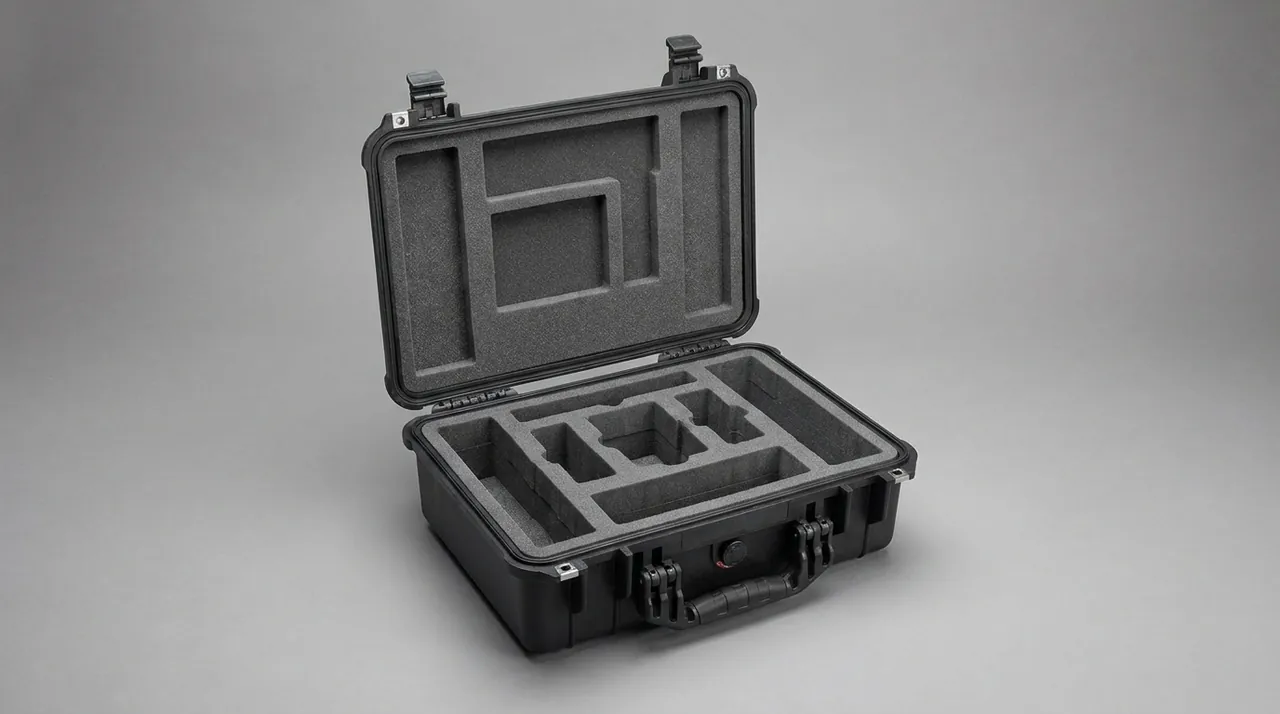
The engineering approach is to compartmentalise by functional group rather than by size. All tension hardware for one machine goes into one compartment, secured with ties or elastic retainers, with a transparent lid or a labelled compartment index.
Fit a packing list inside the case covering part number, description, material, quantity, the machine model it serves and the installation position. Seal it in a waterproof bag on the inside of the lid, and duplicate it on the outside face.
External markings should include gross and net weight, external dimensions, maximum stacking layers, centre of gravity indicated by arrow or dot, and lifting point locations. For an offset-centre heavy case, centre of gravity marking materially reduces the risk of tipping during unloading.
Sealing, Moisture Control and Open-Yard Storage
Storage conditions at a mine site are frequently worse than transport conditions: open yard, rainy season, large day-night temperature swings, high dust concentration.
The breathing effect caused by temperature cycling is the core moisture problem. With a 15 degree Celsius swing, a one cubic metre semi-sealed case can exchange roughly 10 to 15 volumes per hour of internal air. Without a barrier, external moisture keeps entering and condensing on metal surfaces.
There are two paths. The first is to raise seal integrity with a gasketed case structure that keeps moisture out. The second is to fit a breathable pressure equalisation valve so the case does not bulge or inhale under differential pressure. The choice depends on delivery duration and climate. The mechanism and selection logic are covered in pressure equalisation valve for protective cases.
Size the desiccant from internal volume and transit duration. A practical figure is 200 to 400 g of desiccant per cubic metre of internal volume for a 30 to 60 day transit, taking the upper bound for humid climates and sea freight. Distribute the desiccant evenly rather than piling it in one corner.
On case material, choose a weather-resistant engineering plastic or a plywood case with a waterproof coating for long open-yard storage. Plastic cases degrade under ultraviolet light, so select a grade containing UV stabilisers.
Lifting Interfaces Compatible with Manual Handling
Crushing spare parts logistics routinely involves both crane lifting and manual handling, so the packaging must serve both.
For lifting, provide forklift pockets in the base or guide channels for slings. Slings should pass under the base load beams, never through a lid handle. For cases above one tonne, print a lifting diagram directly on the case.
For manual handling, keep any single package under 25 kg, or under 50 kg for a two-person lift. Anything heavier converts to mechanical handling and should be marked accordingly.
Centre of gravity and counterweight: keep heavy parts low in the case, and counterweight the opposite side when the heavy part sits off-centre. An offset case swings during lifting and that swing is a common cause of handling incidents.
Size lifting points to a factor of four. When using lifting eyes, the eye base must connect to the primary load frame, not just to a skin panel.
Transport Testing and Acceptance Criteria
Whether a packaging design is acceptable should be settled by test data rather than experience.
Common references include the GB/T 4857 series covering vibration, impact, stacking and drop; the ISTA series including procedures 1A, 2A, 3A and 3E selected by weight and transport mode; and ASTM D4169 for distribution cycle performance testing with assurance levels assigned by configuration. ISO 4180 test intensity tables are also useful for international road and sea freight.
The logic of test sequencing is to run compression first, then vibration, then impact. Reversing the order masks early failure modes.
Acceptance criteria should have three tiers: no structural failure of the package itself, no significant displacement or deformation of the contents, and no new damage on functional surfaces after unpacking.
For the graded approach in distribution cycle testing, see ASTM D4169 distribution cycle testing for protective cases.
Where the buyer requires test documentation with the shipment, JUNZHJIA can supply case material reports, seal test records and liner material certificates, with scope and frequency agreed at contract review.
Container Fit-Out for Overseas Mine Site Delivery
The challenge in overseas mine site delivery is not protection itself but container space utilisation and the handoffs between transport legs.
Match the size module to container internal dimensions. A 20 ft container measures roughly 5898 x 2352 x 2393 mm internally and a 40 ft high cube roughly 12032 x 2352 x 2698 mm. Case dimensions should align to the 1200 x 1000 mm or 1200 x 800 mm pallet module to reduce void space.
Distribute weight within axle limits. Heavy components belong low in the container and nearer the doors to ease handling, but avoid a lateral imbalance that would compromise the road leg.
Multi-leg handoffs are especially pronounced in mining: sea freight to port storage to road transport to a site yard to installation. Each leg may involve open storage, so sealing and stacking markings must remain valid throughout.
Customs and compliance: wooden packaging must meet ISPM 15 heat treatment or fumigation requirements and carry the IPPC mark. Where a component contains oil or a hazardous substance, such as an accumulator with hydraulic fluid, assess it against the relevant ADR or IMDG provisions. See ADR/IMDG hazmat transport case requirements for further detail.
OEM/ODM Customisation Workflow and Delivery Milestones
Custom packaging for crushing and screening spares typically follows these milestones:
- Requirement capture: part drawing or physical sample, unit weight, centre of gravity, delivery market, transport mode and stacking requirements.
- Design: case structure drawing, liner zoning drawing, fastener list and gross weight estimate.
- Prototype: build one sample case, load the actual part, run static stacking and short-haul validation.
- Test confirmation: run the agreed vibration, drop or incline impact tests and issue a report.
- Pilot batch: confirm liner tolerance, assembly cycle time and operator ergonomics.
- Volume delivery: supply by batch with batch records and key dimension audit data retained.
The three most common mistakes in custom projects are underestimating centre of gravity offset, specifying liner tolerances so tight the part cannot be loaded on site, and ignoring that the unloading site has no lifting gear. All three are avoidable with one prototype validation.
For aggregate and mining customers, JUNZHJIA runs case projects end to end, from structural design to volume supply, provides gasket and spare parts kits configured per machine model, and can extend an ODM scope from the case itself to the internal liner and marking system. If the buyer already operates an approved packaging specification, an equivalent replacement can be validated against that document.
Frequently Asked Questions
Q: Must a jaw plate above 800 kg always ship one per case?
A: Not absolutely, but one per case or one per skid is strongly preferred. The deciding factor is not the weight itself but the centre of gravity offset and whether adequate tip clearance can be guaranteed. Above 800 kg, a single-part package allows 15 to 25 mm of tip clearance, full base support and four-corner restraint. If two plates share a case, at least 20 mm of rigid interlayer is required between them and the gross weight must stay within the capacity of the lifting gear and forklift available. In practice, one plate per skid with steel strapping is the better route, because skids can be stacked two high and moved directly by forklift at the mine site. Where the buyer confirms a 2 tonne forklift and lifting slings are available on site, a two-per-case arrangement saves cost, but it should be validated by stacking and vibration testing, and the interlayer must be confirmed not to migrate under sustained vibration.
Q: Is roll packing or standing on edge better for screen mesh?
A: It depends on the aperture structure and the delivery distance. Flexible media such as woven and manganese mesh can be rolled, which saves significant space and reduces edge damage, but roll geometry matters. A roll diameter below 400 mm leaves permanent curvature that cannot be flattened during tensioning. Use a mandrel above 150 mm diameter with sealed ends to control moisture. Polyurethane panels and punched decks are semi-rigid and must never be rolled; stand them on edge or compartment them flat. When standing on edge, use 75 to 85 degrees with a continuous bottom channel rather than point supports, and restrain the top with a clamping bar. Short domestic hauls allow more latitude, but for international sea freight, standing on edge with an added moisture barrier is preferable, because long transit with large humidity swings does not ventilate well inside a roll and interlayer corrosion becomes likely.
Q: Should the tooth face of a jaw plate be coated with rust preventive oil?
A: Manganese tooth faces are generally not oiled, for two reasons. First, the oil film adsorbs dust and forms an abrasive paste during service, which accelerates initial wear. Second, work hardening depends on impact and the oil film does not change that behaviour, but it does add a cleaning step. A vapour-phase corrosion inhibiting film is the better choice, or a PE wrap with desiccant. Where the face is machined, for example a composite jaw plate with a ground working surface, apply a thin rust preventive grease and add face protection. For exports to high-humidity regions, use a three-layer combination of vapour-phase film, barrier film and desiccant, and place a humidity indicator card inside the case so the transport environment can be judged at unpacking. Where a customer specifies rust-free arrival, record the film grade and desiccant quantity on the packing list so the protection package can be audited against the order.
Q: Can crushing parts and screen mesh share one case?
A: It is not advisable. Crushing parts such as jaw plates, hammers and impact plates are hard, heavy and sharply angled, while screen mesh is thin-walled, long-span and compression-sensitive. Their mechanical requirements point in opposite directions. Fixing a heavy part requires substantial clamping force, and that same force will crush the screen. If loading efficiency forces a mixed case, separate the two zones with a rigid divider, restrain each side independently, and place the screens above the heavy parts with no stacking load above them. Splitting into separate cases is the safer route even at the cost of one extra case, because it is cheaper than dealing with a deformed screen on site. Loading efficiency can be recovered through optimised case dimensions and nesting pallet designs. In practice the decision usually turns on the value of the screen rather than the cost of the case, because a large woven or polyurethane deck that must be replaced after deformation typically costs several times the difference between one case and two.
Q: What tests does a packaging design need to pass?
A: Select the test set from the delivery scenario. Domestic road transport typically uses GB/T 4857.4 for stacking, GB/T 4857.7 for sinusoidal vibration and GB/T 4857.5 for drop. Export sea freight should add GB/T 4857.17 or an ISTA 3E unitised load test. Air freight or multiple handoffs may call for an ASTM D4169 distribution cycle with a defined assurance level. The sequence must be static stacking, then vibration, then impact; it should not be reordered. Acceptance has three tiers: no structural failure of the package, no displacement or deformation of contents, and no new damage on functional surfaces. Buyers may specify test scope, intensity level and third-party witnessing in the contract, and require the test report with the shipment. Note that MIL-STD-810H is an environmental test method standard used as a basis for environmental testing, not a product certification. Document the test set, the sequence and the acceptance tier in the contract annex so that both parties judge the result against the same criteria rather than against recollection.
Q: How should packaging be upgraded for six months in an open yard?
A: Six months outdoors is medium to long term storage and needs three upgrades. First, sealing: move to a gasketed waterproof case, or add an outer waterproof cover that does not trap water at the base. Second, barrier protection: add a PE barrier film and ample desiccant, using a practical figure of 300 to 400 g per cubic metre for a 90 day cycle, with a humidity indicator card. Third, load management: limit stacking to two high, place the case on a pallet at least 100 mm above the ground to avoid capillary moisture, and avoid ground contact. Material ageing also matters. Plastic cases need UV-stabilised grades and wooden cases need a waterproof coating. Inspect one case every three months, focusing on tooth face rust, screen flatness and desiccant condition. Experience shows that roughly seventy percent of open-yard storage damage comes from moisture and compression rather than from impact.
Q: Which is better as a liner, EVA or expanded polyethylene?
A: They serve different roles and are normally combined. EVA has higher density, better rebound and can be CNC machined, making it suitable for restraint and bearing layers, especially in returnable cases that are opened and closed repeatedly. Expanded polyethylene has lower density, larger compression travel and lower cost, making it suitable for cushioning and void fill where large displacement must be absorbed at sharp edges. The recommended build for crushing parts is high-density EVA at the base bearing layer, medium-density EVA machined with pockets for lateral restraint, expanded polyethylene wrapping tooth tips and edges, and an expanded polyethylene or sponge compression layer at the top. This combination preserves restraint accuracy while controlling material cost. Note that expanded polyethylene loses rebound under sustained compression, so in returnable cases it should be designed as a replaceable consumable module while the EVA portion remains as semi-permanent structure.
Q: How do I stop parts from shifting inside the case in transit?
A: Shifting comes from insufficient restraint plus insufficient compression, not simply from weak fastening. Three measures. First, raise restraint coverage so the part has rigid constraint in at least three horizontal directions, not just base support. Second, compress in layers: fit a compressible top layer such as sponge or an air bag inside the lid so that when closed it applies continuous pressure to the top of the part, with compression set at 20 to 30 percent of material thickness. Third, control internal void volume, keeping free space below 15 percent and filling the remainder with blocks. Heavy parts also need anti-slip treatment: a rubber mat under the base, or strapping connected to the case load beams. After loading, apply a manual horizontal push test to the case; movement of 5 mm or less is acceptable. Record the result with a photograph and repeat the check after any reload or repacking, because a case that was secure on first loading can become loose once it has travelled a short distance over rough ground.
Q: How do I avoid imbalance and axle overload when loading a container?
A: Prepare a loading plan before loading. The plan should record the weight and position of each case and calculate the longitudinal centre of gravity and lateral offset. Lateral offset should stay within 5 percent of container width, and the longitudinal centre should be near the middle with a slight bias towards the doors for unloading. Heavy cases belong on the container floor over the floor bearers, not on the unsupported door span. For a single unit above 1.5 tonnes, verify forklift capacity and consider rails or rollers. On the road leg, gross weight and axle loads must comply with local regulation, and over-dimension permits may be required. Leave strapping space: 50 to 80 mm gaps between cases for webbing, and dunnage or air bags at the door end to stop the load shifting as a whole. Photograph the completed load with strapping method and seal number recorded for traceability in the event of a dispute.
Conclusion and Further Reading
The design logic of a crushing and screening parts case amounts to splitting one continuous mechanical problem into four independently controllable sub-problems: sharp edges must not be loaded, flat parts must not be bent, metal surfaces must not get wet, and small parts must not go missing. Assign one clear packaging action to each and the design will stay on course.
In practice, work in three steps: classify by mechanical behaviour, define case load path and restraint structure, then verify by stacking and vibration testing. For the two extremes, very heavy jaw plates and very long screen mesh, accept a small loss of loading efficiency to keep each unit independent, because site rework and waiting for a spare cost far more than one extra case.
JUNZHJIA serves the spare parts logistics needs of the mining and aggregate industry with heavy-duty protective cases tailored to machine models, CNC-machined liners and accompanying marking systems, backed by joint development for aggregate and mining projects, shipment to world markets, and material and test records released under contract.
Further Reading