

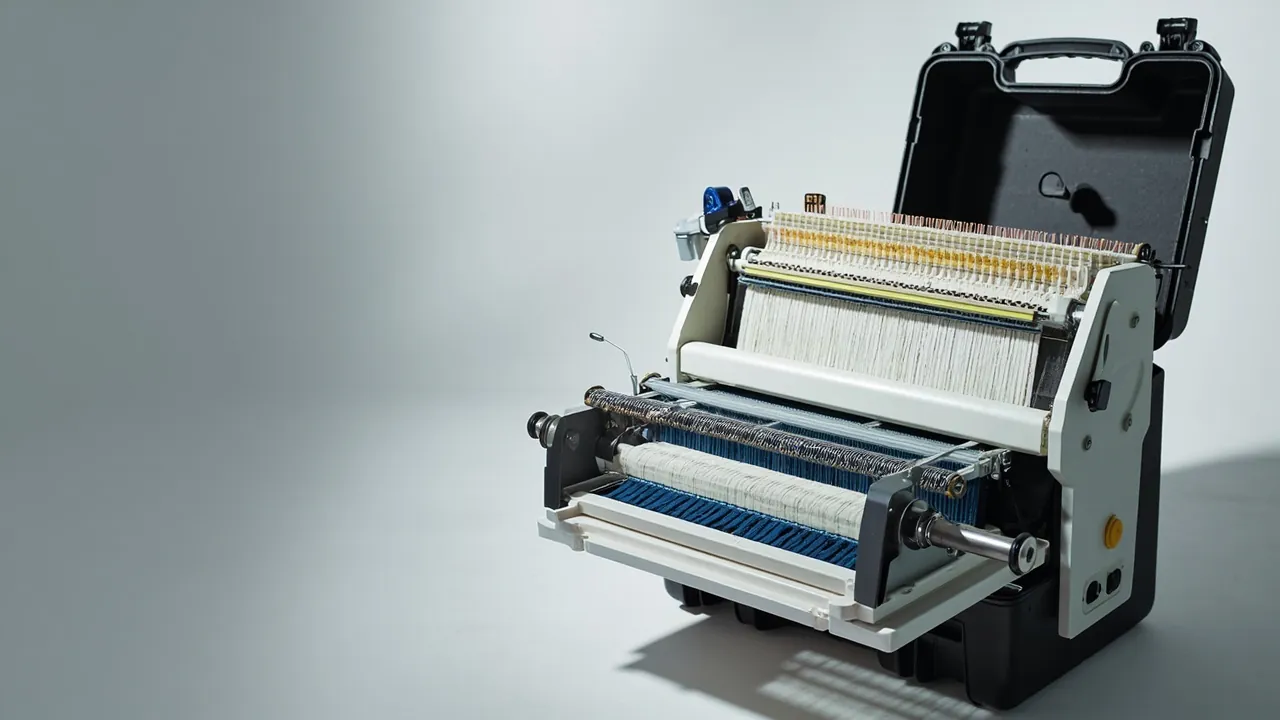
Needle beds and cams combine thin-wall hardness, precision fits and extreme sensitivity to rust. The defects they leave in fabric cost far more than the parts themselves. Needle slot width on a cylinder or dial is commonly held to a tolerance in the 0.005 mm class, and once roundness drifts out of tolerance the needles no longer reciprocate smoothly in their slots, so vertical lines and dropped stitches appear in the fabric almost immediately. A knitting cam whose working surface has been hardened to HRC 58 or above is controlled for profile error in the hundredths of a millimetre; a single burr raised on that surface will keep scraping needle butts and destroy needles in batches. The answer is not softer padding and a few straps. It is one part per pocket, zero contact with any working surface, and a slot and profile environment free of corrosion.
Knitting mills face a tightly grouped set of problems. The cylinder of a circular knitting machine is a large-diameter thin-wall ring with low radial stiffness, and ovalisation is the deformation it suffers most easily in transit. Needle and sinker counts are enormous, with a single circular machine carrying a thousand or more needles, so bulk packing makes both counting and size-sorting painfully manual. Cam boxes are matched in knit, tuck and float groups, and mixing them once can throw a whole group out of profile consistency. Those three factors together make knitting component cases harder to design than most textile equipment cases. This guide follows three lines, the cylinder and dial, the needles and sinkers, and the cams and cam boxes, and covers packing structure, liner materials, corrosion and cleanliness control, transport testing and receiving criteria, plus quotation and traceability practice. For liner and sealing fundamentals, see our framework for textile machinery part protection and the guide to how seal materials shape the environment inside a case.
Table of Contents
- 1. Why needle beds and cams are the hardest items to move out of a knitting hall
- 2. Cylinder and dial: slot tolerance, roundness and the ovalisation risk
- 3. Needles and sinkers: a knock means scrap for thin hardened parts
- 4. Cams and cam boxes: working surface profile and hardness drive fabric quality
- 5. Rust as the slowest and most damaging risk for high-carbon parts
- 6. Choosing liner material: density, resilience, compression set and outgassing
- 7. Case selection: how to support a large ring and handle off-centre load
- 8. Splitting the shipment by functional module rather than by weight
- 9. Static, fly and cleanliness control
- 10. Transport testing and acceptance: from test sequence to fabric verification
- 11. Extra measures for sea freight and humid destinations
- 12. Quotation checklist, traceability marking and the customization route
- Frequently Asked Questions
- Conclusion and Further Reading
1. Why needle beds and cams are the hardest items to move out of a knitting hall
From a mechanical standpoint, the core parts of a knitting machine behave in two counter-intuitive ways. First, stiffness is distributed very unevenly. A cylinder is a large-diameter thin-wall ring whose radial stiffness is far below its axial stiffness, while a needle is a slender part less than a millimetre thick. The direction in which each is fragile is completely different. Second, the failure threshold is low while the consequence is heavy. A cam working surface with a dent almost invisible to the eye will install perfectly well and then, in service, spread damage in the form of needle butt wear until the fabric shows holes and needles fail in batches. Transport protection for knitting parts therefore has to satisfy two dimensions at once: geometry retention, delivered by support and constraint, and surface integrity, delivered by isolation and cleanliness.
| Component | Typical transport failure | Effect on loop formation and fabric | Packing measure |
|---|---|---|---|
| --- | --- | --- | --- |
| Cylinder and dial | Ovalisation, chamfer damage at slots, rust in slots | Vertical lines, dropped stitches, high needle consumption | Internal support ring plus circumferential banding, never single-point support |
| Needles | Hook distortion, seized latch, broken butt | Single-needle drop that spreads into a vertical line | Slot board with one pocket per needle, never bagged loose |
| Sinkers | Blade bending, burr at the tip | Surface fuzziness, uneven loops | Thin slot with end stops and equal spacing |
| Knit and tuck cams | Burr on working face, local profile collapse | Abnormal butt wear, holes | Working face touches nothing hard, individual soft seat |
| Cam boxes | Mounting face distortion, damaged dowel holes | Loss of group consistency, whole set scrapped | Cams removed and packed separately, face protected |
| Needle selectors | Piezo element shock damage, humidity-driven insulation loss | Pattern faults, selection failure | Vibration-damped seat plus desiccant, never shared with heavy parts |
Use this table as the basis for splitting a shipment, and it answers the practical question of which parts must travel alone, which may share a case, and which must be dismantled before packing.
2. Cylinder and dial: slot tolerance, roundness and the ovalisation risk
The geometry of a cylinder defines the loop-forming quality of the whole machine. Slots are distributed evenly around the circumference, and at common machine gauges the slot pitch is only a millimetre or two when converted from inches. Individual slot width is usually held in the 0.005 mm class, cumulative error around the circumference is controlled on a coarser scale, and outer diameter roundness is called out at a smaller magnitude still. The message is clear: a cylinder is a part with high local precision and low overall stiffness, so the main threat in transit is not a local impact but global ovalisation. Once ovalised, slot pitch varies periodically around the circumference, the needle and cam relationship changes with it, and regular vertical lines appear in the fabric. Such deformation generally cannot be compensated by machine setting at commissioning.
The core idea for preventing ovalisation is to replace external squeezing with internal support. Fit a support ring or adjustable spreader matched to the bore, so the ring is pushed round from the inside, then apply circumferential banding or soft straps on the outside with evenly distributed load. Never sling a cylinder from a single point, never cinch a strap through the bore, and never let one section of the ring rest directly on a timber batten. Use at least four support points distributed around the circumference so radial load travels through the ring's own hoop stiffness instead of creating local bending.
The dial follows similar logic in a different attitude. On most machines the dial is a horizontal ring, and stacking dials flat means the slot face of the lower part carries the weight of the one above, which easily crushes slot edges. Fix each dial in a vertical or designed attitude so the slot face is not a load-bearing direction. If stacking cannot be avoided, insert a divider board with relief slots, add a soft interlayer, and make sure pressure lands on the outer flange face rather than the slot zone.
One more point is routinely missed: clean the cylinder and dial thoroughly before packing, removing knitting oil and fly. In transit, oil mixes with metal particles to form an abrasive paste that is extremely difficult to remove from slots, while loose fly simply re-deposits on clean surfaces at opening. The order must be clean, then protect against corrosion, then pack. Reversing the order destroys the corrosion layer with oil contamination.
3. Needles and sinkers: a knock means scrap for thin hardened parts
Needles are the highest-consumption precision parts in a knitting mill, and the ones most casually packed. On common specifications the blade is under a millimetre thick, and the hook and latch are hardened, so this thin-and-hard combination can survive millions of flexing cycles in normal loop formation while being unable to survive a single collision inside a packing case. After slight hook distortion a needle may still knit for a short while, but it soon shows as a single-needle drop that operators spend a long time finding.
Needles therefore belong in a slot board or compartment box, positioned individually and grouped by specification and machine gauge. Bulk bagging is not acceptable. If needles of more than one gauge end up in the same case, the sorting labour at reinstallation can exceed the packing cost. Pocket bores should match the blade, with depth covering most of the blade and only the butt exposed for handling, and with enough wall thickness between pockets that extracting one needle does not drag out its neighbours. Because the butt is the most vulnerable region, relieving the bottom of the pocket locally so the butt hangs free rather than pressing on a hard base is a worthwhile detail.
Sinkers, yarn guides and jacquard elements follow similar logic with more emphasis on equal spacing between flat parts. If they lie face to face, vibration causes inter-part sliding and edge friction that rolls the tips. A comb-style slot with pitch slightly greater than the part thickness gives each piece an independent degree of freedom without face-to-face contact. Where a case holds a very large quantity, arrange them in layers with alternating slot direction between adjacent layers so that no continuous sliding channel forms.
Counting is part of the design brief. Because counting needles is labour-intensive, a fixed pocket count gives an immediate "one missing equals one short" judgement, and a quantity card with specification labels should travel inside the case. For returnable needle boxes, choose a liner grade with low compression set so pocket bores do not open up and lose their grip after repeated trips.
4. Cams and cam boxes: working surface profile and hardness drive fabric quality
A cam is the classic knitting part where surface precision is traded for fabric quality. Knit, tuck and float cams are controlled for profile accuracy in the hundredths of a millimetre, working face roughness is specified at a very low value, and the material is usually alloy tool steel or a powder metallurgy grade hardened to HRC 58 or above. High hardness buys wear resistance and brings brittleness with it: one knock may leave no visible dent, yet raise a fine burr or cause local collapse, and that is exactly where needle butt wear begins.
Three rules cover cam packing. First, the working face must never touch any hard material, including other cams, the case wall, fasteners and the inside of a timber crate. Contact should be designed onto the non-working face, usually the mounting base or a side face. Second, every cam gets its own seat, made from a medium-hardness closed-cell material that compresses slightly, so the cam is constrained while retaining a small amount of compliance; rigid clamping concentrates stress. Third, pack by functional group, keeping the cams of one knit group in the same layer and zone with group markings preserved, so that reinstallation cannot put a cam in the wrong position.
For cam boxes the mounting face and dowel holes are the priority. The mounting face is the datum for co-planarity across the whole cam set, and once it distorts, the relative positions fail even if every individual cam is perfect. The recommended approach is to strip the cams, pack them separately, fit a protection plate over the mounting face, and plug dowel holes with soft caps to keep debris out. If a project genuinely requires a fully assembled cam box to travel, make sure the mounting face carries the load rather than the cam working faces pressing against anything.
Selector units are a separate class of sensitive part: the piezo ceramic element responds badly to both shock and moisture. Pack them independently with a vibration-damped seat, add desiccant, and never place them in the same layer as cams or other heavy parts, because the impact energy a heavy part generates under vibration far exceeds what a piezo element can absorb.
5. Rust as the slowest and most damaging risk for high-carbon parts
Of all the transport risks affecting knitting parts, rust is the most underrated and the hardest to reverse. Needles, cylinders and cams are largely made from high-carbon or alloy steels with ground and polished surfaces that are chemically active. Once internal relative humidity stays high, spot oxidation can appear within days. The difficulty with rust is that it is a chronic failure: light corrosion does not stop the machine immediately, but it steadily degrades loop-forming stability through rising slot friction and worsening cam surface roughness, until the fabric defects can no longer be hidden.
Build corrosion protection in three layers: vapour-phase inhibition, humidity control and barrier. Choose a multi-metal VCI material effective on carbon steel, alloy steel and common platings, and confirm before packing that no acidic cleaning residue remains on the parts. Control humidity with desiccant and a humidity indicator card so condition can be judged at opening. Reduce the moisture exchange rate with an aluminium composite or high-barrier bag and a properly formed heat seal. The layers are not interchangeable: desiccant without a barrier is exhausted prematurely, while a barrier without humidity control simply seals the moisture in.
6. Choosing liner material: density, resilience, compression set and outgassing
Liner selection for knitting parts should start from the constraint function and only then move to material parameters, never the other way round. Within one case, the cylinder needs surface contact with circumferential distribution, the cams need individual seats with a little compliance, and the needles need pocket location with low-friction extraction. Those are three different structures, and the material is only the means. Putting material parameters ahead of structural need most often produces a very dense, very hard liner that concentrates stress on rigidly clamped cams or makes needles difficult to extract from an over-hard pocket. The table below gives typical parameter bands and matching applications for structural review.
| Liner material | Density band (typical) | Resilience and compression set | Outgassing and cleanliness | Best match in knitting |
|---|---|---|---|---|
| --- | --- | --- | --- | --- |
| Cross-linked EVA foam | 0.05 to 0.12 g/cm3 | Good resilience, low set | Low outgassing, controllable odour | Cylinder seats, individual cam pockets |
| Cross-linked XPE foam | 0.03 to 0.06 g/cm3 | Firmer, good compression resistance | Reasonably clean | Divider boards, circumferential padding |
| PU foam | 0.03 to 0.06 g/cm3 | High resilience, good energy absorption | Some formulations outgas | Support for off-centre loads |
| EPE pearl foam | 0.02 to 0.04 g/cm3 | Soft, large long-term set | Sheds particles | Temporary fill only, never primary restraint |
| Fabric-backed VCI liner | Depends on substrate | Depends on substrate | Can carry vapour phase inhibitor | Direct contact layer at working faces |
One constraint is specific to the knitting industry: the liner must not contain migratory components that affect knitting oil or rubber parts. Plasticizer or residual blowing agent in a low-grade foam can volatilize inside a sealed case and deposit a thin film on cam working faces and needles, which then requires extra cleaning before the parts can be used.
7. Case selection: how to support a large ring and handle off-centre load
The difficulty in case selection here is the enormous size spread. A single circular knitting machine contains both a thin-wall ring several hundred millimetres across and needles under a millimetre thick. If one case size is used for everything, small parts sit in a large void and lose their restraint; if everything is split into small cases, handling and stacking the rings becomes awkward. A better approach is a family of case sizes, each matched to a defined part size band.
For a large ring, load must travel through circumferential distribution onto a flat base. Support blocks evenly spaced around the circumference carry the ring flange on a flat base and, together with the internal support ring, form a stable constraint. Avoid a structure with only four supports, because it makes the ring bend locally under its own weight. For slender rods such as yarn tubes and tension bars, provide multi-point support slots with spacing no greater than one third of part length, which prevents slow bending under sustained vibration.
Sealing structure serves the corrosion objective. Both IP65 and IP67 substantially reduce the risk of water ingress, but a pressure equalization valve is mandatory alongside them, because otherwise day and night temperature cycling creates internal condensation that keeps steel parts in a humid micro-environment. Gasket ageing and latch wear are the dominant failure modes of returnable cases; the inspection points are set out in our guide to case hinges, latches and seals, and if the project needs a dedicated moulded case the amortization logic is covered in the analysis of custom case mould cost.
| Transport leg | Main environmental hazard | Case-side response | Liner-side response |
|---|---|---|---|
| --- | --- | --- | --- |
| Short inland road | Road vibration, handling impact | Moulded hard case or plywood crate with larger feet | Medium-density EVA, individual pockets |
| Long road haul with transfers | Repeated handling, cumulative vibration | Reinforced corners, redundant latches | Higher energy absorption, closer support spacing |
| Sea container | High temperature, high humidity, long duration | Sealed case plus pressure equalization valve | Barrier bag, desiccant, indicator card |
| Air freight | Low pressure, rapid temperature change | Pressure equalization valve is essential | Avoid fully sealed skin packing that balloons |
8. Splitting the shipment by functional module rather than by weight
The most common mistake in knitting machine relocation is filling cases by weight, meaning a cylinder is crammed into the same case as a pile of cams to use up the space. Under vibration the heavy part repeatedly strikes the cam working faces, and the cost of that is far higher than ordering one more case. Split by functional module instead: loop-forming system parts, yarn supply system parts, needle selection and control parts, and drive and frame parts each get their own cases, with part-type zones inside each case.
Loop-forming parts include the cylinder, dial, needles, sinkers and cams. This is the highest precision group, so it travels separately and goes through a clean, protect, isolate sequence. Yarn supply parts include feeders, yarn guides, tensioners and yarn tubes, where the main risk is distortion and burrs in the yarn path, so each needs individual location and internal path protection. Selection and control parts include selector units and electronic modules, where shock and moisture dominate, requiring a vibration-damped seat and desiccant. Drive and frame parts are heavy and less precision-critical, so they can share cases provided they are treated against corrosion so that rust water never contaminates other cases.
After splitting, solve the re-identification problem. Label each case with machine number, functional module and position range, and include a numbered cross-reference or assembly relationship sheet inside. For a machine with this many parts, delivering that cross-reference with the shipment shortens pre-installation preparation substantially. When a project covers several machine types, embed a machine type code in the case number so identical parts from different machines are never interchanged.
9. Static, fly and cleanliness control
Knitting halls have an inherent static and fly problem. Polyester and nylon charge up through friction during high-speed loop formation, attracting fly that accumulates in the yarn path and around the cams. The static risk during transport comes from the same source, with friction between liner and metal as the generator. The direct harm is not breakdown but contamination attraction and operator risk: a charged case wall re-deposits dust onto the cleaned cam working faces or into slots, so the parts need a second cleaning before use.
Three controls apply. First, use a liner with controlled surface resistivity as the direct contact layer to provide a drain path. Second, fit a simple metal drain plate inside the case with a marked grounding point so the operator can discharge before handling parts. Third, control particle generation from the packaging itself, avoiding unfinished foam edges, heavily inked labels and shedding board in contact with precision parts. For knitting parts, which are sensitive to fly, these three are baseline requirements rather than options.
On cleanliness class, knitting components are not cleanroom parts, but two points matter: corrosion protection auxiliaries and liners must not generate particulate contamination, and unpacking should happen in a reasonably clean area. If a project unpacks inside a clean or dust-controlled shop, use an inner packaging format that can be removed as a whole rather than extracting and cleaning part by part in the hall. The general method for static-sensitive cushioning and shielding is described in our article on ESD shield case design.
10. Transport testing and acceptance: from test sequence to fabric verification
A packaging scheme should be transport tested once it is frozen, particularly for a new part type, a new liner concept, or a first export order. The sequence should cover conditioning, vibration, shock and stacking compression, with the reference chosen to match the route and transport mode. Random vibration is the most important test for cylinders and needles, because it simulates the sustained excitation of a long journey, the very condition that spreads slot corrosion, causes needle-to-needle collisions and produces compression set in the liner. The selection and sequencing logic is described in our walkthrough of the ISTA transport testing procedure and in the design notes on shock cushioning cases.
Judgement after testing must return to installability rather than whether the case survived. Recommended re-checks for knitting parts include cylinder roundness and critical diameters, slot condition for rust and chamfer damage, sampled needle hook and latch function, magnified inspection of cam working faces for burrs or collapse, cam box mounting face flatness and dowel hole condition, and functional sampling of selector units. The strictest and most informative validation is to reinstall the tested parts on a machine and knit, then inspect the fabric for vertical lines, holes and dropped stitches. Fabric verification catches hidden damage that dimensional checks cannot.
Sampling plans and decision rules for receiving inspection belong in the contract. For high-value parts inspect critical characteristics fully; for high-count items such as needles use stratified sampling. The principles for setting sampling level and acceptance criteria are covered in our article on custom case acceptance and AQL sampling.
11. Extra measures for sea freight and humid destinations
Sea freight and humid destinations amplify three risks at once: corrosion, condensation and liner ageing. Condensation comes first. Container internal temperature can swing by more than ten degrees Celsius between day and night, and a sealed case without a pressure equalization valve will condense internal moisture onto metal surfaces as it cools. Besides fitting the valve, increase desiccant quantity to match voyage length and destination climate, and place a humidity indicator card inside to record the peak condition.
The second measure is a higher barrier class. For high-carbon parts such as cylinders and cams, use an aluminium composite barrier bag with a properly formed heat seal, plus desiccant and an indicator card inside, creating an independent micro-environment. Where a part is too large to bag as a whole, wrap critical surfaces in VCI film and manage case-level desiccant instead, but accept the reduction in protection level and shorten the receiving inspection interval accordingly.
The third measure is control of liner compression set. A long sea voyage will visibly thin a low-density foam liner, so restraint fails on the second trip. For returnable projects, treat liners as consumables with a defined replacement interval and mark the replacement date on the case.
The fourth measure is a higher handling standard. Humid regions usually come with rain and open-air transfer, so apply pictorial markings such as keep dry, this way up and do not roll in line with GB/T 191, and consolidate onto pallets to reduce individual lifts. For a large cylinder case, mark the lifting points according to the centre of gravity so that off-centre slinging does not tilt the case or shift the contents.
12. Quotation checklist, traceability marking and the customization route
For an executable proposal, the part information must be complete. Provide at least: a part list with drawings covering name, material, heat treatment state, net weight and envelope dimensions; a description of critical faces such as slot faces, working faces, mounting faces and bore fits; planned load per case and target case weight; transport mode and route characteristics; destination climate; whether reusable construction and a sealing class are required; whether traceability by machine and position is needed; and delivery schedule with acceptance criteria.
JUNZHJIA cases for knitting equipment are built by Kexin New Materials (Guangdong) Co., Ltd. Ring parts such as cylinders and dials ship with internal support rings and circumferential banding sized to the bore, while cams sit in individual soft seats shaped around their knit group and carrying group identity. Customization is available on an OEM and ODM basis, and the company serves wholesale, agency and worldwide supply channels, releasing outgoing inspection reports and material documents against agreed contract clauses. A typical route runs from part assessment and protection level definition, through support and liner concept review, to prototype and trial fit, transport testing where required, batch production with inspection, and finally delivery with packaging documentation. For a new thin-wall ring, build one trial support arrangement and confirm that the ring shows no radial deformation in the clamped state before committing to volume.
If the same project also covers other textile process equipment, compare the priorities described in our guides to nonwoven line component cases and spinning frame component cases so that numbering conventions and case families can be unified and site management kept simple.
Frequently Asked Questions
Q: Is an internal support ring mandatory for a cylinder in transit, and what happens without one?
A: It is strongly recommended, and for a larger diameter cylinder it is essential. A cylinder is a thin-wall ring whose radial stiffness is far below its axial stiffness, so without internal support a tightened strap or a single support point imposes local bending and produces ovalisation. The consequence is that slot pitch varies periodically around the circumference, the needle and cam relationship changes, and regular vertical lines appear in the fabric. That deformation usually cannot be compensated by machine setting at commissioning, so the cylinder has to be replaced. The correct method is to fit a support ring or adjustable spreader matched to the bore, then apply circumferential banding outside with evenly distributed load and at least four support points. Two prohibitions matter as much as the recommendation: never sling the ring from a single point, and never let one section rest directly on a timber batten. Also check that the support ring itself is stiff enough, because a soft support ring provides no support at all and simply adds mass.
Q: Can needles be shipped in bags, and how do we stay efficient when quantities are large?
A: Bagging is not advisable. A needle is a thin-wall hardened part, and in a bag there is no fixed relative position between needles, so transport vibration makes them rub and strike one another, producing hook distortion, seized latches and broken butts. After installation these defects typically show as single-needle drops that require a long stop to trace, so the hidden cost dwarfs the packing cost. Large quantities should be handled through structure rather than through loose packing: use a slot board or compartment box, group by gauge and specification, locate one needle per pocket with pocket depth covering most of the blade and only the butt exposed, and keep enough wall thickness between pockets that extracting one needle does not pull out its neighbour. Counting becomes a matter of fixed pocket positions, where a missing position means a missing needle, backed by a specification label and quantity card inside the case. Where several gauges are involved in one project, split by gauge into separate cases or compartments rather than sorting again at the machine.
Q: If a cam working face picks up a small burr, can we dress it and keep using it?
A: This needs great caution, and dressing on site is generally not advisable. Cam working face profile is controlled in the hundredths of a millimetre with a very low roughness specification, and dressing changes both the profile and the surface at the same time. Local dressing creates a dip or a step, so the needle butt experiences a force in a direction the design never intended, and the result is accelerated butt wear and batch needle failure. The dressing marks themselves also become sites where abrasive particles lodge. The correct sequence is to judge the nature of the damage under magnification: if it is only surface deposit or an oil stain, clean it and use the cam; if metal has been displaced or collapsed, send the cam back to the manufacturer to assess whether re-grinding and profile re-verification are possible. Because cams are normally used in matched groups, a single repaired cam whose profile no longer matches its partners breaks group consistency, so replacing the group or obtaining a matched set from the original maker is usually the safer decision.
Q: Do knitting parts need antistatic packing when the hall is already full of fly?
A: Yes, and the purpose differs from the electronics industry. In electronics, static control prevents discharge damage to devices. In knitting, the problem is contamination attraction: a charged case wall or liner re-attracts fly, short fibre and dust onto freshly cleaned slots, cam working faces and needles, so the parts need a second clean before use, and a charged liner rubbing against part surfaces can also give operators a shock when they reach in. An antistatic liner provides a drainable contact surface that suppresses charge accumulation over a long journey. Be clear that antistatic does not mean conductive: surface resistivity should stay in a sensible band, because an over-conductive liner can discharge abruptly enough to damage delicate contact surfaces, and a fully insulating liner solves nothing. Where the case shell is an insulating material, a liner on its own cannot complete the path, so the working arrangement adds a metal discharge plate and a marked grounding point inside the case alongside the antistatic contact layer. Operators should be shown that grounding point during site induction, because a labelled but unused discharge point delivers no benefit at all.
Q: What extra corrosion measures are needed for sea freight to a humid destination?
A: Four directions need strengthening at the same time. First, improve internal barrier performance: for high-carbon parts such as cylinders and cams, use an aluminium composite barrier bag with an intact heat seal and place desiccant plus a humidity indicator card inside to create an independent micro-environment; where a part is too large to bag, wrap critical surfaces in VCI film and raise the receiving inspection frequency to compensate. Second, deal with condensation, because a sealed case must have a pressure equalization valve, otherwise the temperature cycle condenses water onto metal and creates a worse micro-environment than ordinary air. Third, size the desiccant for the voyage rather than reusing figures from a short inland trip, using destination climate as a calculation input. Fourth, watch liner ageing, since a long voyage visibly thins a low-density foam, so manage liners as consumables and mark their replacement date. At destination, inspect the outer case and indicator card first, then the barrier bag and VCI film, and only then re-check the parts themselves.
Q: Which transport tests should the case pass, and how is a pass decided?
A: Cover four test classes: temperature and humidity conditioning to represent the climate before and during shipment; random vibration, which addresses sustained excitation and is the single most important test for cylinders and needles; shock or drop to represent handling, with magnitude set by case weight; and stacking compression converted from the actual number of tiers and duration. Reference standards may be ISTA 3A, ASTM D4169, or a combination of sub-tests from the GB/T 4857 series, with the first two more common on export projects and the third practical for domestic work. Judgement cannot stop at whether the case broke; it must return to installability. Re-measure cylinder roundness and critical diameters, check slots for rust and chamfer damage, sample needles for hook and latch function, inspect cam working faces under magnification for burrs or collapse, verify cam box mounting face flatness and dowel holes, and functionally sample selector units. The most informative validation is to reinstall the tested parts and knit a trial, then inspect the fabric for vertical lines, holes and dropped stitches.
Q: How should we choose the liner foam, and is higher density always better?
A: No, higher density is not automatically better. Density is only one dimension; for knitting parts the more important properties are energy absorption on rebound, compression set, outgassing and cleanliness. A high-density material resists compression well but may recover slowly, so under sustained vibration it is not necessarily better at dissipating energy than a medium-density grade. A low-density material is soft but takes a large permanent set, so after repeated trips it no longer restrains the part. For cylinder seats and individual cam pockets, choose a cross-linked foam with good resilience and low set. For divider boards and circumferential padding, a firmer grade is appropriate because it carries load. For temporary fill, a low-density material is acceptable provided it never provides primary restraint. One knitting-specific constraint applies throughout: the liner must not contain migratory components that affect knitting oil or rubber parts, because volatiles from a low-grade foam deposit a film on cam working faces and needles inside a sealed case.
Q: How do we set the sealing class, and is IP65 enough?
A: It depends on the route and the sensitivity of the parts, so there is no single answer. For a short inland trip with relatively moisture-tolerant parts, basic dust and water resistance is sufficient and the priority should sit with liner restraint. For sea freight, multiple transfers or open-air transfer, choose a higher sealing class and fit a pressure equalization valve, because water ingress and condensation occur together on those routes. Note that sealing class addresses water and dust entering from outside, while the corrosion risk to steel parts comes mainly from humidity inside the case, so the two must be designed separately: sealing is defined against IEC 60529 or GB/T 4208, while the internal micro-environment is managed with a barrier bag, desiccant and an indicator card. Sealing without internal humidity control can produce more condensation than an unsealed case. Returnable sealed cases also need a periodic inspection regime covering gasket resilience, valve function and even latch loading.
Q: Can you apply traceability markings that match our machine numbers and positions?
A: Yes, and for a knitting machine with this many parts, traceability marking shortens installation preparation considerably. Three methods are common. First, mark or hot-stamp positions on the liner, identifying machine number, functional module and position range. Second, fit a durable nameplate to the case side or the inside of the lid stating case number, part name, quantity, machine number and position range. Third, retain the knit group identity on cam seats so that cams of one group stay in the same case and layer. The methods can be combined. For projects mixing several machine types, embed a machine code in the case number so identical parts are not interchanged between machines, and build a cross-reference of case number, part number and installation position to travel with the shipment. Traceability-marked packaging for knitting components is supplied under the JUNZHJIA brand by Kexin New Materials (Guangdong) Co., Ltd., with marking levels and content set from your list, sales channels covering OEM and ODM commissions, wholesale, agency and global supply, and inspection plus material documents issued as the contract requires.
Conclusion and Further Reading
Three judgements summarise needle bed and cam protection. A thin-wall ring is threatened mainly by global ovalisation, so protection comes from internal support and even circumferential load rather than from tighter straps. A hardened working face and a thin needle are threatened mainly by surface damage, so protection comes from individual location and zero contact, and any attempt to save space by crowding parts together will be repaid as fabric defects. A high-carbon part corrodes as a chronic failure, so it needs the closed loop of vapour phase inhibition, humidity control and a barrier layer. Apply those three to support structure, splitting strategy and test criteria, and needle beds and cams will survive relocation and shipping without becoming a quality problem at the other end.
Further Reading