

Paint booths sit at the centre of powder coating and liquid coating lines, and the components around them — spray guns, powder pumps, atomiser caps, electrode pins, venturi throats, powder hoses and high-voltage modules — form a mixed load that is at once precision-grade, easily deformed and easily contaminated. When a line is relocated, duplicated at a second site, shipped overseas as a complete package, or returned to the builder for overhaul, these parts are frequently dropped into a cardboard box or a plastic tote. Weeks later the result appears: bright compression marks on atomiser cap faces, electrode pins bent laterally by more than 0.3 mm, grooved venturi throats, and powder caked on the inside of delivery hoses. Once atomiser cap concentricity drifts beyond 0.02 mm the spray pattern centre shifts and film-thickness uniformity degrades. Electrode pins are typically only 0.8 to 1.6 mm in diameter, so any lateral squeeze produces irreversible plastic bending.
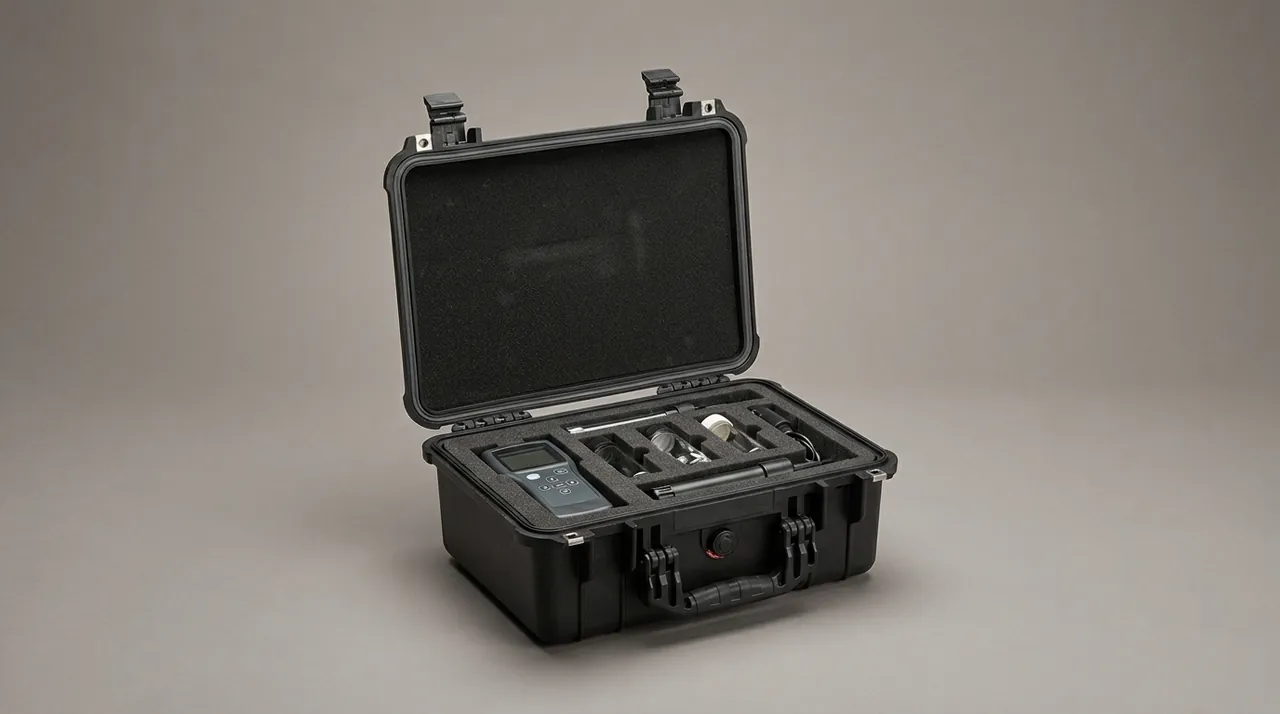
JUNZHIJIA paint booth cases follow three design principles: precision parts in dedicated compartments, fragile parts with zero freedom to migrate, and cleanable liners that can be lifted out and washed. Atomiser caps, electrode pin seats, gun needles, venturi sleeves and electrostatic modules are assigned to zones by risk level, cushioned by composite EPE, EVA and IXPE liners, and indexed so a gun can be verified and reassembled straight from the case after road, rail or sea transport.
Table of Contents
- Failure Modes in Paint Booth Guns and Powder Pumps
- Atomiser Cap Concentricity and Spray Pattern Retention
- Electrode Pins and Pin Seats: Axial Anti-Bend Compartments
- Venturi Throat and Wear-Sleeve Protection in Powder Pumps
- Coiling Powder Lines and High-Voltage Cables Without Kinking
- Gun Bodies, Triggers and Needle Assemblies in Separate Pockets
- Moisture Control for Electrostatic Generators and HV Modules
- Small-Part Compartment Liners: EPE, EVA and IXPE Compared
- Sealing Class and Pressure-Equalisation Valve Trade-offs
- Case Load Ratings, Stacking and the Transport Test Matrix
- Colour Change and Cross-Contamination of Liners
- Unpacking Acceptance Criteria and the Three-Point Field Check
- Custom Liners, Tooling and Shipped Documentation
Failure Modes in Paint Booth Guns and Powder Pumps
Damage to paint booth components rarely comes from a single drop. It comes from the combination of sustained micro-vibration, stacking static load and residue corrosion acting together. A gun hanging loose in a carton oscillates thousands of times during a road leg; the electrode pin and the atomiser cap face tap each other at low amplitude and generate deformation that is invisible to the eye yet decisive for accuracy. Under stacking load the pump body and throat joint are loaded in shear and the sealing ring flattens. Powder left inside a delivery hose absorbs moisture, cakes, and blocks the line on the first restart. Separating these paths makes the countermeasures obvious.
| Component | Dominant failure mode | Trigger | Countermeasure |
|---|---|---|---|
| --- | --- | --- | --- |
| Atomiser cap | Face imprint, concentricity drift | Stacking load, contact with adjacent part | Dedicated pocket with suspended face |
| Electrode pin | Lateral plastic bend, tip fracture | Vibration against wall, squeeze | Axial locating seat, one pocket per pin |
| Powder pump venturi | Throat grooving, sleeve displacement | Transit shock, foreign matter ingress | End caps, anti-rotation locating pin |
| Powder delivery hose | Kinked bore, caked powder | Coil radius too small, moisture in residue | Large-radius coiling, dried end caps |
| High-voltage module | Insulation loss, surface tracking | Moisture ingress, contaminated connectors | Sealed compartment, desiccant management |
| Gun trigger | Trigger shaft distortion, spring displacement | Loose stowage | Body cradle, trigger locked mid-open |
| Needle and nozzle set | Blunted tip | Mixed stowage with metal parts | Soft compartment, one set per pocket |
The practical consequence of this table is that every countermeasure has to land on a specific pocket geometry and retention method. Filling the case with more foam is not the answer. Over-packing presses directly on the atomiser cap face and can create the very imprint the foam was meant to prevent. The correct approach is to suspend the precision face, let non-functional surfaces carry the load, and keep each critical part in its own compartment.
Atomiser Cap Concentricity and Spray Pattern Retention
The atomiser cap, often called the air cap or spray head, governs spray pattern shape and film-thickness distribution. Its centre orifice, ring of air holes and the gun needle form the whole atomising geometry, and factory concentricity is normally held between 0.01 and 0.03 mm. An imprint, an ovalised lip or a tilted face introduced in transit changes the momentum distribution of the air stream, showing up as pattern offset, fuzzy edges and heavier orange peel.
Three rules govern the protection design. First, suspend the face: cut the pocket 1.5 to 2 mm deeper than the component height so the metal face never touches a rigid surface, and let a soft ring seated on the cylindrical outside diameter carry the load. Second, constrain radially but leave room to breathe: an EVA pocket bore 0.5 to 1 mm smaller than the component diameter gives a light interference fit, while a heavier interference can grip the part hard enough that low-temperature contraction of the foam introduces stress into the cap. Third, separate every part: each atomiser cap occupies its own pocket, and two caps must never be stacked face to face, because opposing faces press on each other.
For small-bore caps, such as those paired with 0.8 mm or 1.0 mm nozzles, add a 3 to 5 mm IXPE cover layer above the pocket to create a soft clamp from below and above. IXPE has a closed-cell structure, rebounds slowly and creeps very little, so it does not collapse and lose clamping pressure the way plain PE does after months of stacking.
Electrode Pins and Pin Seats: Axial Anti-Bend Compartments
The electrode pin that charges the powder in an electrostatic gun is among the most fragile items in the case. The body is slender, hard and low in toughness, and a lateral force above roughly 5 to 10 N can produce a bend that will not spring back. A bent pin not only distorts the electrostatic field but also discharges eccentrically against the cap bore, triggering a chain of effects: sparking, fluctuating transfer efficiency, and local back-ionisation on the workpiece.
The core of transit protection is to convert lateral force into axial force. Cut a shallow channel coaxial with the pin so the full length of the body rests on a soft channel floor, point the tip inboard and fit a small PE tip cap, then seat the pin holder in a slightly deeper locating hole with a 45-degree chamfer at the top edge so it cannot score the pin body during loading.
A more robust option is an integrated pin assembly: pin, holder, spring and terminal are loaded into the pocket as one module, so the holder absorbs the load while the pin body stays free. Springs are the hidden risk. Vibration fatigue can strip preload from a spring, so the module must be held compressed but never to solid height; a compression of 60 to 75 percent of free length is a practical target.
Multi-pin rotary bell or long-barrel guns must be stored one pin per pocket, never banded side by side. A cable tie creates point contact between adjacent pins, and vibration turns that contact into repeated tapping, which is one of the most common causes of blunted tips. If slender gauges also travel in the same case, the long-part cradle logic used in measuring tool protective cases transfers directly to pin and needle storage.
Venturi Throat and Wear-Sleeve Protection in Powder Pumps
A powder pump draws material from the hopper and delivers it to the gun using the venturi effect, and its throat is the point of highest velocity and most severe erosion in the whole powder circuit. The throat usually carries a ceramic or hardened-steel sleeve, and the clearances are tight. If the pump takes an impact in transit the sleeve can shift relative to the body, and once reassembled the air parameters drift as a whole, showing up as surging delivery, lower transfer efficiency and a powder rate that no longer responds linearly to the setpoint.
Three ideas cover venturi protection: caps, anti-rotation and fixed reference. Caps means fitting a PE or EVA end cap on each powder inlet and outlet to keep out foreign matter and protect the end faces. Anti-rotation means preserving the locating pin or key between body and throat, and cutting a matching anti-rotation slot in the liner so the two cannot turn against each other. Fixed reference means giving the pump body and the throat separate pockets; never remove the throat and stow it loose beside the body.
Vacuum-type powder pumps need one more item: a reference for the venturi gap. Some models generate negative pressure across a 0.05 to 0.15 mm annular gap that is set by shim thickness. When the gap measures differently after transport, the shims have usually been compressed. Reserve a small pocket for spare shims and ship a gap gauge in the case, which lets the maintenance team verify the setting on site instead of returning the pump to the builder.
| Venturi element | Sensitive parameter | Typical tolerance | Transit protection focus |
|---|---|---|---|
| --- | --- | --- | --- |
| Throat bore | Roundness, surface roughness | Ra 0.4 micron or finer | End cap, keep foreign matter out |
| Sleeve fit | Interference and coaxiality | Coaxial within 0.03 mm | Anti-rotation slot, separate pocket |
| Annular gap | Shim thickness | 0.05 to 0.15 mm | Dedicated shim pocket, include gauge |
| Inlet and outlet ports | Thread and face flatness | Face runout within 0.05 mm | Thread protectors, soft load bearing |
Coiling Powder Lines and High-Voltage Cables Without Kinking
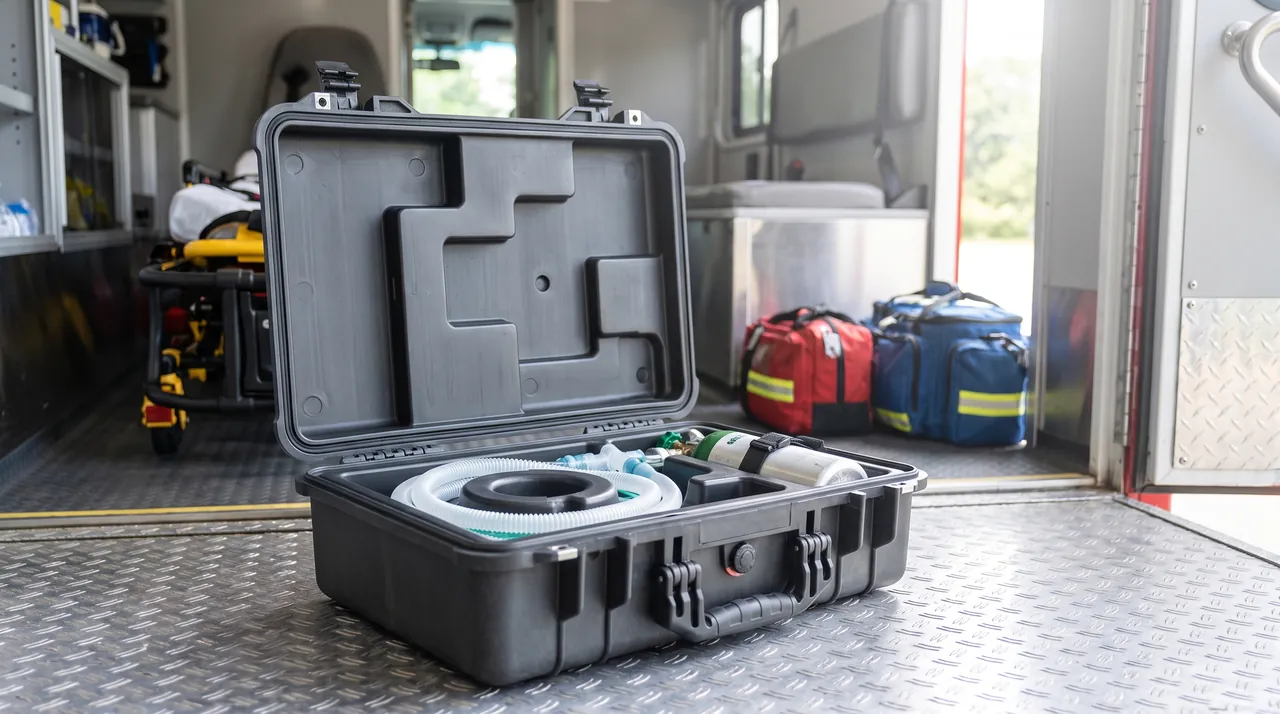
Powder hoses and high-voltage cables look as though they tolerate compression but are in fact the parts most sensitive to tight bends. Delivery hose is usually lined with polyurethane or PTFE, and its minimum bend radius is typically six to ten times the outside diameter. Coil it tighter than that and the bore takes a permanent crease; powder collects in the crease and eventually forms a hard blockage. High-voltage cable suffers a different failure: repeated tight bending fatigues the shield and eventually breaks it.
The recommended arrangement is a large-diameter winding post with unidirectional coiling. Fit a cylinder with a diameter at least twelve times the hose bore, wind the hose in one direction only, and secure the ends with releasable ties that are snug rather than tight. Cap the ends and add a small desiccant sachet. Never let several hoses cross and stack on top of each other; the crossing point concentrates pressure and flattens the wall locally.
Hoses longer than about 3 m are better folded in a serpentine rather than coiled, so the body stays close to straight. Separate each layer with a 5 mm EPE divider to stop adjacent walls from pressing together and trapping moisture.
Before coiling a high-voltage cable, spot-check insulation resistance, which is normally expected to be 500 megohms or higher, keep the bend radius above 150 mm, and put each connector in its own sealed bag. Connectors are where surface tracking starts, so they must never rest directly against metal parts. The bending-radius discipline used when packing air compressor parts is a useful reference, because the geometry problem is the same.
Gun Bodies, Triggers and Needle Assemblies in Separate Pockets
The gun body itself is a relatively robust casting or engineering-plastic moulding, but the trigger, trigger shaft, return spring and needle adjustment knob are all prone to shifting. A gun rolling inside a case works the trigger repeatedly, which fatigues the spring or bends the shaft. Once the adjustment knob has been knocked, needle travel no longer matches the factory setting and the operator has to recalibrate before the first production part.
The answer is a body cradle plus a trigger locked mid-open. Cut the cradle to the outline so it supports the grip and the barrel at two load-bearing surfaces. Insert an EVA wedge behind the trigger to hold it half open: fully closed compresses the spring and keeps it loaded for months, while fully open leaves the trigger unsupported and easy to strike. Ring the needle adjustment knob with a soft collar to stop it rotating in transit.
Needles, nozzle sets and seals must be isolated individually. The nozzle and needle are a matched pair, and loose stowage lets the two tips strike each other; seals that are compressed take a permanent set. Give every needle, nozzle and seal set its own pocket with soft dividers creating three layers, needle above, nozzle in the middle and seals below.
Rotary bell guns need special treatment because the bell cup is a thin-walled high-speed part. It must travel in its own pocket with the cup mouth facing up or down rather than sideways, and the lip should carry a ring protector so that edge impacts cannot distort a component whose balance depends on its lip geometry.
Moisture Control for Electrostatic Generators and HV Modules
Electrostatic generators, high-voltage multiplier modules and control boards are electrical assemblies, and the transit threat is moisture and contamination rather than shock. Paint booth air permanently carries suspended powder and solvent vapour, so by the time a module is removed its surfaces already hold residue. If the packaging seal is poor, condensation inside a sea container dissolves that residue into a conductive film and insulation resistance falls immediately.
Start with cleaning and drying: wipe the housing and connectors with anhydrous ethanol, dry at 60 degrees Celsius for two hours, and only seal the module into its bag after it has returned to room temperature, so heat sealing cannot trap internal condensation. Add silica gel desiccant sized to the net internal volume, typically one gram per three to five litres of enclosed air, and choose an indicating grade so the operator can see on opening whether it has expired.
Inside the case, the module belongs in a dedicated antistatic compartment lined with antistatic EVA or conductive foam so that friction cannot build a charge. The overall case should reach IP65 or better, meaning dust-tight and protected against water jets from any direction; the definitions and test methods behind those codes are set out in an explanation of the differences between IP65, IP66 and IP67.
One caution applies to all sealed cases. Air freight and high-altitude road legs create a pressure differential between inside and outside that can make a case hard to open and can suck the seal out of shape. Fit a pressure equalisation valve so the differential bleeds off slowly. The trade-off between airflow and water resistance in different valve designs is covered in a guide to pressure equalisation valve selection, and it matters most on projects where a fully packed case is flown to an overseas paint shop.
Small-Part Compartment Liners: EPE, EVA and IXPE Compared
The liner is the load-bearing skeleton of a paint booth case, and the wrong material will defeat every pocket dimension chosen upstream. The three common materials differ in ways that matter, so selection should be based on rebound, creep, cleanliness and washability rather than on how the sample feels in the hand.
| Property | EPE | EVA | IXPE |
|---|---|---|---|
| --- | --- | --- | --- |
| Rebound speed | Fast | Medium | Slow |
| Long-term creep | Higher | Low | Very low |
| Surface cleanliness | Fair, sheds particles | Good, can be film-faced | Good, closed cell, no shedding |
| Washability | Poor, absorbs water | Medium | Good, tolerates alcohol wipe |
| Typical use | Outer bulk cushioning | Precision part pockets | Precision faces, clamp layers |
| Relative cost | Low | Medium | Higher |
A layered composite works best. Use 20 to 30 mm of EPE on the outside for bulk energy absorption, 20 mm of routed EVA in the middle to form pockets that match the component outline, and a 3 to 5 mm IXPE face layer wherever a precision surface or a critical contact sits. This soft-hard-soft stack attenuates impact energy in stages while ensuring no precision face ever touches a hard material.
Where colour changes and cleaning are frequent, the EVA and IXPE layers should be removable washable inserts held by clips or hook-and-loop tape rather than bonded in place. Inserts can be lifted out, washed in warm water with a neutral detergent, dried and refitted. Bonded liners that absorb powder and solvent can only be replaced as a whole, which costs more over the life of the case.
For odd-shaped and very small parts, such as a 0.5 mm needle tip or a miniature seal, a vacuum-formed thin tray is often the best answer. Each item drops into its own blister, the tray sits inside the EVA pocket, and the whole set can be stacked, hung and counted at a glance. If you are still deciding between routed EVA and rigid dividers, read the comparison of case dividers versus foam and the guide to internal foam types, and settle which parts rely on pockets for location and which rely on foam for clamping before committing to tooling.
Sealing Class and Pressure-Equalisation Valve Trade-offs
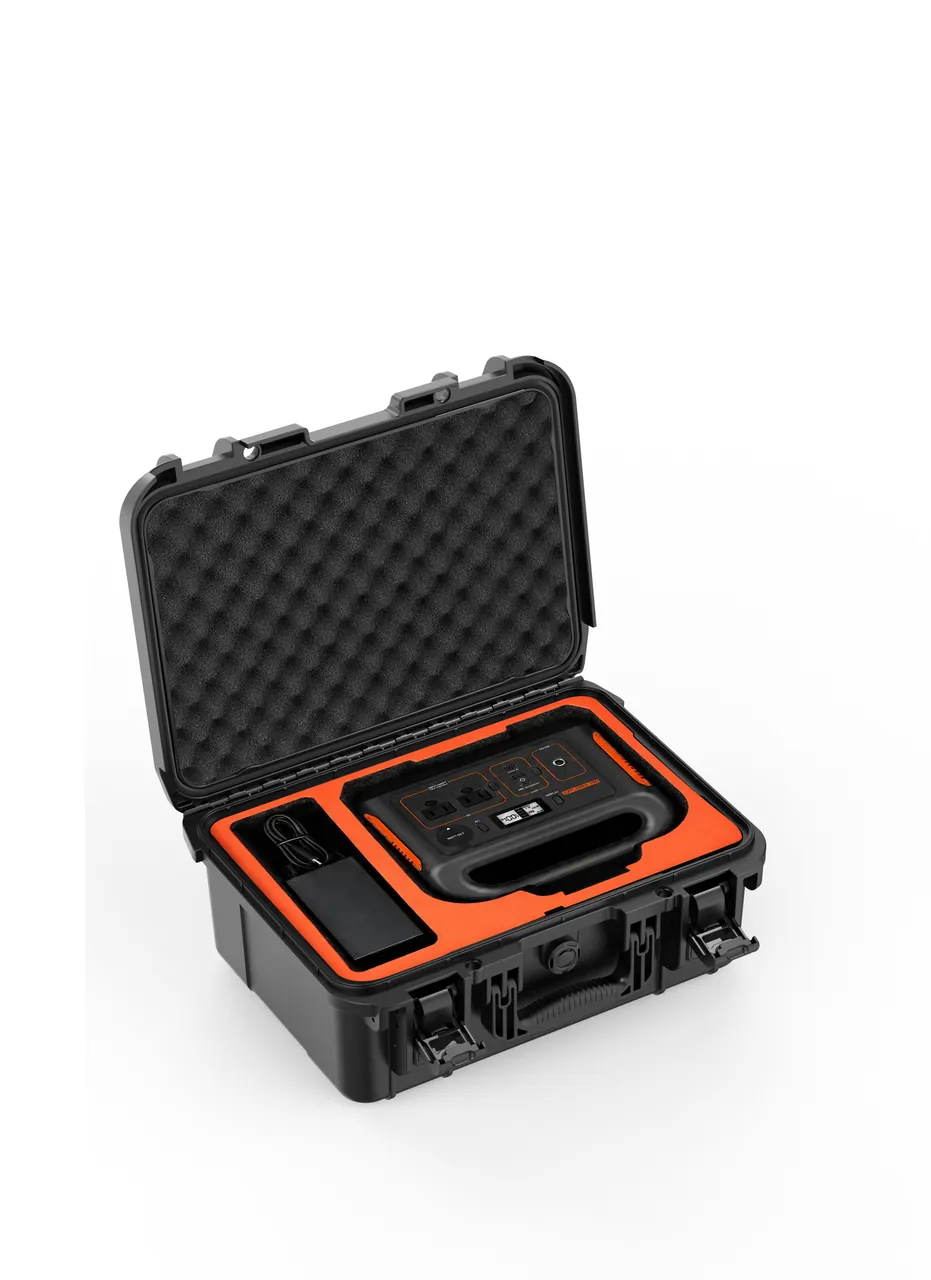
Paint booths generally run at higher humidity and solvent concentration than ordinary workshops, so the sealing strategy has to satisfy moisture control and serviceability at the same time. The key is not to push the ingress protection class as high as possible but to choose it against the transport route and the opening frequency.
If parts only move between buildings on one site and the case is opened almost weekly, IP54 is adequate, and a higher class merely adds latch and gasket stress on every cycle. For inter-provincial road legs or sea freight where the case may stay closed for months, IP65 to IP67 is the sensible target, supported by desiccant management inside. The practical difference between IP67 and IP65 lies in short-term immersion, and for paint booth components IP65 usually covers rain and washdown unless the route carries a specific flooding risk.
A pressure equalisation valve is essential on any long-duration sealed case. It lets the internal and external pressures equalise slowly, which prevents the lid-suction effect caused by temperature and altitude swings and stops the gasket from sitting under one-sided load for months, which is what accelerates compression set. When choosing a valve, balance airflow against water resistance: the vent has to handle the temperature swing of the route without degrading the ingress protection class, and a design with a hydrophobic membrane typically delivers enough airflow while holding IP65 or better.
Case Load Ratings, Stacking and the Transport Test Matrix
Weights vary enormously in this application. A case holding only atomiser caps and electrode pins may weigh under 5 kg, while one packed with powder pumps and delivery hoses can exceed 60 kg. The structural design must be based on the heaviest configuration, not on the average.
| Item | Light configuration | Medium configuration | Heavy configuration |
|---|---|---|---|
| --- | --- | --- | --- |
| Typical payload | 3 to 8 kg | 15 to 30 kg | 40 to 70 kg |
| Wall thickness | 3 to 4 mm | 4 to 6 mm | 6 to 8 mm |
| Reinforcement | None or local | Lateral and longitudinal ribs | Full frame with corner reinforcement |
| Stacking layers | 3 to 4 | 2 to 3 | 2 |
| Handle type | Single top handle | Two side handles | Two side handles plus feet |
| Recommended wheels | None | Optional | Castors with brakes |
Stacking capacity depends on the liner as much as on the shell. EVA held at 25 degrees Celsius under 0.2 MPa static load for 30 days typically loses 1 to 3 percent of its thickness, and at 45 degrees Celsius the loss can reach 5 to 8 percent. That means the top case in a southern summer warehouse will have a compressed liner, and parts will be loose when it is opened. The countermeasures are a higher-density EVA, in the 0.15 to 0.25 g/cm3 range, or a rigid PE plate added on the load-bearing face.
For transport validation, test the composite road and sea route rather than a single leg. Run vibration to the GB/T 4857 series or an ISTA procedure, set drop height by weight class, and apply a stacking load matching the real number of layers for 24 to 72 hours. Note that a passing test qualifies one configuration on one route only; changing the liner material, the stacking count or the case weight invalidates the result and requires a fresh assessment.
Colour Change and Cross-Contamination of Liners
Paint booths are extremely sensitive to residual powder when the colour is changed, particularly when moving from a dark shade to a light one or from a metallic powder to a solid colour. A liner that has absorbed powder becomes a secondary source of contamination: light-coloured material dislodges from liner crevices and lands directly on the next batch of product. Liner cleanliness therefore belongs in the formal selection criteria for the case rather than being treated as an afterthought.
The measures are straightforward. Specify closed-cell, non-shedding EVA or IXPE for any layer that touches a component directly. Design the liner as removable inserts that can be lifted out as a set. Provide a detachable catch tray in the base to collect powder that falls out during transport. Include a small colour-change cleaning kit in the case containing lint-free cloths, neutral detergent and labels.
Where metallic pigments such as aluminium or bronze powder are handled, watch for conductive residue as well. A discontinuous conductive film on the liner surface can provoke abnormal discharge from the electrostatic module. Use antistatic liner material in that situation, wipe periodically with isopropyl alcohol, and allow the liner to dry completely before reloading parts.
Indexing and traceability are part of the same discipline. Mark every pocket with a position number, match each part set to a position, and keep the packing list consistent with the numbering. Responsibility for cleaning residual powder after opening, and the wiping interval, should be written into the equipment management procedure rather than left to habit.
Unpacking Acceptance Criteria and the Three-Point Field Check
Acceptance of a paint booth parts case should not rest on a subjective judgement that the contents look fine. Use measurable criteria: no visible imprint on atomiser cap faces and concentricity re-measured within 0.03 mm; electrode pin straightness checked on a surface plate with a feeler gauge, with bend no greater than 0.05 mm; venturi annular gap re-measured with a gauge within 0.02 mm of the design value; and module insulation resistance at or above 500 megohms.
In the field, run a three-point check. Inspect the exterior: shell deformation, gasket marks or tears, and free operation of the pressure valve. Inspect the interior: liner displacement or collapse, parts that have shifted, and desiccant indicator colour. Inspect function: rotating the pump dry and listening for noise, confirming that gun voltage builds normally, and verifying that trigger travel matches the factory setting.
If the liner has collapsed or the desiccant has changed colour, do not keep using the original liner as a load-bearing element. Replace the liner, dry the contents again and repack. Once saturated, indicating desiccant changes from blue to pink or from orange to green, and at that point it no longer absorbs moisture, so internal humidity rises quickly.
Custom Liners, Tooling and Shipped Documentation
Brands and models are highly fragmented in this sector. Atomiser cap diameters, electrode pin lengths and pump throat connections differ between manufacturers and are rarely interchangeable. Almost every case in this application therefore needs a custom liner; a standard insert cannot simultaneously deliver pocket precision and general-purpose flexibility.
The usual custom process runs in five steps: supply the parts list and 3D models or physical samples; agree the pocket layout and liner material stack; produce the first-article liner and a sample case; trial-load and run drop and vibration validation; and release to volume production after sign-off. At the first-article stage, always load the extreme configuration, meaning the heaviest and longest combination, so that no pocket turns out to be undersized after tooling is committed.
As the manufacturer, JUNZHIJIA supplies moulded shells, routed and vacuum-formed liners, logo printing, silkscreened position numbers and shipped documentation covering the packing list, pocket layout drawing, material declaration and test report index, with OEM and ODM support and multilingual labels. For overseas line-delivery projects the package can also include adhesive position labels and replaceable instruction cards so the site team can switch language without reprinting the case interior.
Frequently Asked Questions FAQ
Q: Which part of a paint booth spray gun is most likely to be damaged in transit?
A: Service records put electrode pins first, atomiser cap faces second and delivery hose bores third. Electrode pins fail most often because they are slender and low in stiffness: any lateral displacement that ends against an adjacent metal part subjects the pin to repeated bending under vibration, and a 0.2 to 0.5 mm plastic bend is the usual outcome. Such a bend is hard to see but shifts the electrostatic field and destabilises discharge, and it usually forces a full re-set of gun voltage and powder output before the line runs cleanly again. Atomiser caps suffer face imprints and ovalised lips, normally from stacking load or from two caps stored face to face. Delivery hoses develop internal creases that trap powder, a gradual problem that only surfaces when the line restarts. All three paths share the same root cause, namely sustained low-level disturbance over many hours, so the answer lies in pocket location and rigid constraint rather than in extra foam thickness.
Q: Why do electrode pins bend during shipping, and how can that be prevented?
A: Electrode pins are usually stainless steel or tungsten carbide, 0.8 to 1.6 mm in diameter, with a length-to-diameter ratio that can exceed 30 to 1, which makes them classic slender columns. They resist axial compression reasonably well but resist lateral bending very poorly, and a side force above roughly 5 to 10 N is enough to leave a permanent bend. The remedy is to convert lateral loading into axial loading. Cut a shallow coaxial channel so the full pin length rests on a soft channel floor. Point the tip inboard and fit a small PE protective cap. Seat the pin holder in a locating hole with a 45-degree chamfer at the mouth. Even better, load the pin, holder, spring and terminal as one integrated module so the holder carries the load. On multi-pin rotary bells, dedicate one pocket to each pin and never band several pins together, because a cable tie creates point contacts that tap against each other under vibration.
Q: What does venturi throat wear affect, and how is it protected in transit?
A: The venturi throat is the highest-velocity, most heavily eroded point in the powder circuit, and the sleeve clearance inside it is typically only 0.05 to 0.15 mm. Once the bore shows grooving or the sleeve shifts, momentum transfer between air and powder degrades, which appears as surging delivery, reduced transfer efficiency, a powder rate that no longer responds linearly, and in bad cases a repeating spray-starve cycle. Transit protection rests on three items: caps, anti-rotation and a fixed reference. Fit PE or EVA caps to the powder inlet and outlet to keep out foreign matter and protect the end faces. Keep the locating pin between body and throat and cut a matching anti-rotation slot in the liner so the parts cannot turn. Give the body and the throat separate pockets and never stow a removed throat loose beside the body. On vacuum pumps, pocket the spare shims separately and ship a gap gauge so the setting can be verified on site instead of at the factory.
Q: What concentricity tolerance applies to atomiser caps, and how does the liner hold it?
A: Factory concentricity for an electrostatic atomiser cap is normally between 0.01 and 0.03 mm, and the assembled requirement is usually held within 0.03 mm. If concentricity drifts past about 0.05 mm in transit, the pattern centre visibly shifts, film-thickness uniformity falls away, and the edges become fuzzy or show orange peel. The liner holds tolerance through three rules: suspend the face, constrain radially with a soft material, and separate every part. Cut the pocket 1.5 to 2 mm deeper than the component height so the metal face never contacts a rigid plane. Make the EVA pocket bore 0.5 to 1 mm smaller than the component diameter for a light interference fit, without gripping so hard that low-temperature contraction loads the cap. Give each cap its own pocket and never stack two caps face to face. For small-bore caps, add a 3 to 5 mm IXPE cover to clamp from above and below; being closed-cell with low creep, it will not collapse after months of storage.
Q: Which foam is best for compartmentalising small spray gun parts?
A: A layered composite beats any single material. Use 20 to 30 mm of EPE on the outside for bulk energy absorption, since it is inexpensive and rebounds quickly. Use roughly 20 mm of routed EVA in the middle to form pockets matched to the component outline, because EVA holds dimensions, accepts a film facing and sheds very little. Add a 3 to 5 mm IXPE face layer wherever a precision face or a critical contact sits, producing a soft-hard-soft stack that attenuates impact energy in stages. Where the paint booth demands frequent colour changes and cleaning, make the EVA and IXPE layers removable inserts secured by clips or hook-and-loop tape so they can be washed in warm water with a neutral detergent. Switch to antistatic EVA when metallic pigments are involved, because a conductive residue film can cause abnormal discharge. A liner bonded permanently into the shell has to be replaced as a unit once it absorbs powder, which raises long-term cost.
Q: Paint booths are humid environments. What sealing class and moisture control are needed?
A: Choose the sealing class from the transport route and the opening frequency rather than simply going as high as possible. For short intra-site moves with weekly access, IP54 is enough. For multi-province road legs or sea freight with access measured in months, target IP65 through IP67. Solvent vapour and humidity in a paint booth dissolve residue on module surfaces into a conductive film, so electrical assemblies should be cleaned, dried, allowed to return to room temperature and only then sealed into their bags with indicating silica gel sized to the enclosed volume. Any long-duration sealed case also needs a pressure equalisation valve, both to prevent lid suction caused by temperature and altitude swings and to stop the gasket sitting under one-sided load, which accelerates compression set. A valve with a hydrophobic membrane typically delivers adequate airflow while maintaining IP65 or better, which is the usual requirement for overseas projects. Record the desiccant weight and the date of each repack, because humidity management only works when someone can tell whether the sachet is still active.
Q: How many spray guns and powder pumps fit in one paint booth parts case?
A: Capacity depends on component size and on how densely the foam is pocketed, so there is no single answer, but practical ranges are useful. A manual electrostatic gun stored one per pocket with a small pocket for the needle and nozzle set needs roughly 120 by 90 by 60 mm. An automatic gun, being longer, needs about 180 by 90 by 80 mm. A powder pump body plus a separately pocketed throat typically takes 150 by 150 by 120 mm. Take a case with external dimensions of 600 by 400 by 250 mm; after allowing for liner wall thickness and the latch zone, usable volume is roughly 520 by 320 by 190 mm, which normally holds two to four manual guns plus two powder pumps, or one automatic gun plus four pumps. Finalise the layout by supplying a complete parts list with maximum envelope dimensions and having the supplier issue a pocket drawing for confirmation.
Q: What parameters are needed to specify a custom paint booth parts case, and what about lead time and documents?
A: Provide the parts list with names, quantities, materials and individual weights; key envelope dimensions with 3D models or clear photographs; the location and tolerance of every precision face; the transport route by road, rail, sea or air together with stacking requirements; and whether frequent cleaning and colour changes are expected. For overseas delivery, state the label language and certification requirements of the destination market. The standard sequence is parts list review and pocket layout, first-article liner and sample case, trial loading with drop and vibration validation, then volume production. At first-article stage, load the heaviest and longest configuration so that no pocket proves too small after tooling. Documentation covers the packing list, pocket layout drawing, material declaration and test report index, and can be extended with multilingual position labels under OEM or ODM customisation.
Conclusion and Related Reading
Suspend atomiser faces, convert pin side-loads to axial loads, cap venturi throats and keep liners washable. JUNZHIJIA builds the liners, tooling and documents to order.
Related Reading