

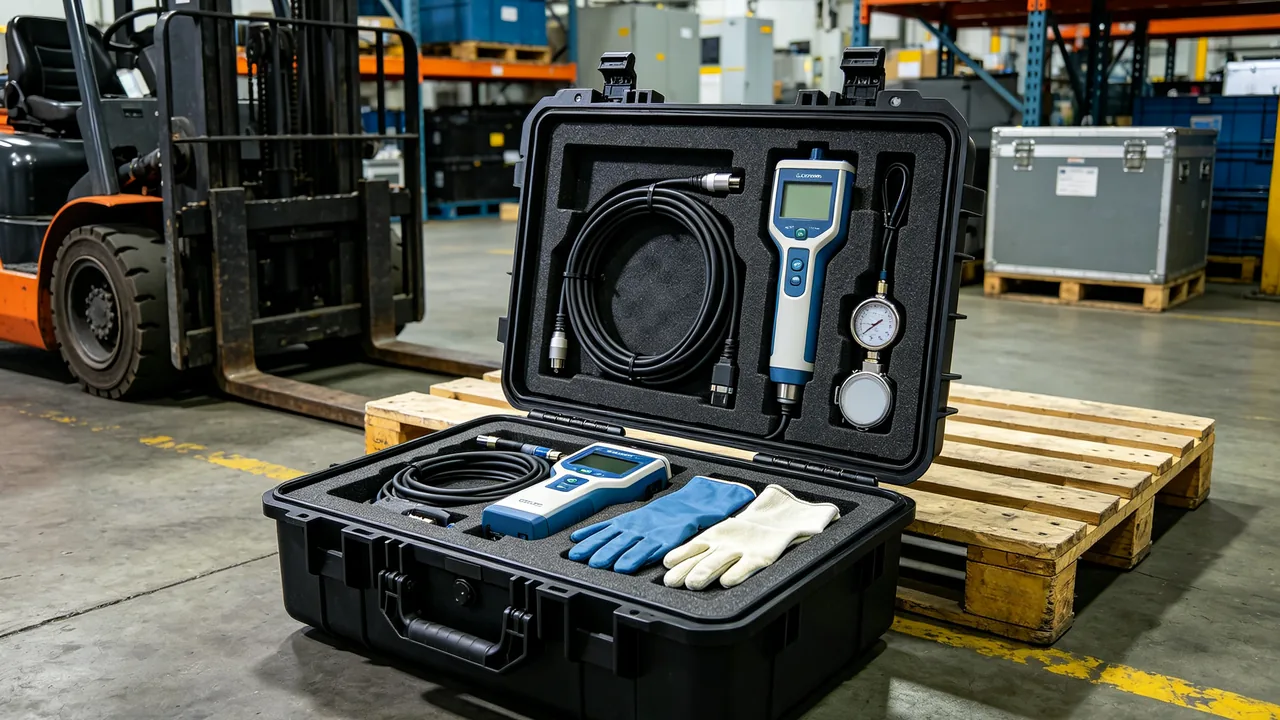
When powder coating line components are pulled for service, changed over, or moved with the whole line, the damage that matters is rarely a dent. It is contamination and moisture. Once cured powder lumps form on the multiplier, electrode pin or venturi throat, the gun delivers uneven output and transfer efficiency drops. Once a filter cartridge or fluidizing plate takes on moisture, its permeability changes and both the recovery loop and the feed loop become unstable. The cases JUNZHIJIA builds for these parts are designed around a single idea: seal the part clean, hold the moisture out, and never let static charge accumulate inside the box. On a powder coating line, the case is a cleanliness container first and a cushion second.
This article moves through component classification, residue and moisture risk, split protection by subsystem, insert selection, dust explosion and emission compliance, cleaning procedure and incoming recheck. Every item can be lifted straight into a purchase specification or a work instruction. MIL-STD-810H appears here only as a source of environmental test methods, not as a military certification. Powder coating uses solvent-free powder, but curing ovens and pretreatment stages still raise volatile organic compound and combustible dust questions, so packaging and shipping cannot ignore dust explosion and chemical compliance.
Contents
- Powder coating line component families and transport sensitivity tiers
- Residue and moisture: why cartridges and venturis suffer most in transit
- Insulation protection for corona and tribo charged guns
- Moisture and vibration protection for high voltage generators and cables
- Clean packing for hoppers, fluidizing plates and powder hoses
- Deformation control for cyclone separators and cartridge assemblies
- Fixturing booth internals and reciprocator assemblies
- Comparing insert approaches: compartment, drawer and contoured
- Case material, conductivity and static control requirements
- Dust explosion and VOC compliance essentials
- Cleaning and powder removal before packing
- Transport testing, incoming acceptance and return to service
- FAQ
- Conclusion and related reading
Powder coating line component families and transport sensitivity tiers
A complete powder coating line breaks down into seven shippable groups: the gun body including housing, multiplier module, electrode pin and powder inlet; the feed system including hopper, fluidizing plate, venturi pump and powder hose; the high voltage system including generator, high voltage cable and ground harness; the recovery system including cyclone separator, filter cartridges or sleeves and collection hopper; booth internals including baffles, deflector plates and window assemblies; motion hardware including reciprocator carriage, rails and lift mechanism; and control and electrical parts including the PLC cabinet, electrostatic controller and sensors.
Sensitivity sorts into three tiers. Tier one is cleanliness-critical: gun bodies, multipliers, filter cartridges, fluidizing plates and venturi throats, where surface condition is effectively the same thing as performance, and where oil, cured powder or dust contamination cannot be undone without damaging the surface. Tier two is electrically and statically sensitive: high voltage generators, high voltage cables and electrostatic controllers, which fear moisture, repeated flexing and shield damage. Tier three is structural and geometric: reciprocator rails, cyclone shells and flat booth panels, which fear distortion and dents, because even small deviations shift the airflow field and the spray distance.
The practical consequence of this tiering is simple: never mix the three tiers inside one cavity. Put a filter cartridge next to a rail and the anti-rust oil on the rail contaminates the cartridge. Put a high voltage cable in with heavy parts and vibration will crush the cable internally.
A useful test: if surface condition directly determines performance, the part gets its own compartment and its own sealed environment, never a shared cavity.
Residue and moisture: why cartridges and venturis suffer most in transit
Filter cartridges and fluidizing plates are porous media, so their performance is defined by pore structure. Transport attacks exactly that structure in two ways.
- Powder compaction. Powder coatings do not melt at ambient temperature, but under compression, humidity and sustained vibration they cake. Caked powder closes the channels between cartridge pleats or blinds the micropores of a fluidizing plate. The part can look perfect on arrival while permeability and fluidization uniformity have already changed.
- Moisture uptake. Most filter media and fluidizing plates are hydrophilic. After absorbing moisture, permeability drops and the media becomes an anchor point for powder, so the recovery loop shows rising differential pressure shortly after restart.
Venturi pumps behave similarly but less visibly. A venturi's conveying capability depends on throat geometry and internal wall roughness, and powder caking at the throat changes the entrainment ratio directly, showing up as low output at an unchanged air setting. Because the throat is internal, a visual check at unpacking misses it entirely.
This is why powder coating line packaging must include powder removal and drying as two mandatory upstream steps, with verifiable records. Powder removal works best as reverse air purge plus soft brushing plus oil-free compressed air. Avoid high pressure water and solvents, which drive moisture into the media. For drying, purge with dry air and place desiccant in the cavity, with a humidity indicator card as the receiving-end proof. This remove-residue-then-control-moisture sequence matches the practice used for industrial filtration hardware, described in dust collector equipment component protection for filter media and hopper parts.
Insulation protection for corona and tribo charged guns
Powder guns split into corona charging and tribo charging types, and their transport sensitivities differ.
The heart of a corona gun is the high voltage multiplier and the electrode pin. The multiplier is usually potted inside the gun body, so what it fears is mechanical damage to the high voltage insulation and moisture ingress. A crush or drop that micro-cracks the potting leads to creepage along the crack under high voltage, showing up as voltage that will not build or a protection trip that keeps repeating. The electrode pin is extremely thin and sits at the very tip of the gun, making it the part most often bent during packing or unpacking.
A tribo gun has no high voltage electrode. Charging comes from friction between powder and the gun tube wall, which makes it extremely sensitive to the internal surface condition of the tube. Scratches, oil films or powder scale on the bore all change triboelectric charging efficiency and therefore transfer efficiency. Protection for this type centres on sealing the tube ends and preserving bore cleanliness, not on dielectric strength.
Split protection in practice:
- Give every gun body its own compartment with one soft restraint at the front and one at the rear, so the body never touches a hard surface.
- Remove electrode pins, flat nozzles and extension bars before packing and place them in a labelled small-parts compartment.
- Fit soft plugs in both ends of a tribo tube, and confirm no powder scale or oil film remains on the bore before closing.
- Never stack multiple guns together. Stacking makes tubes rub and crushes nozzles.

Moisture and vibration protection for high voltage generators and cables
High voltage generators and cables are the parts on a powder line whose electrical performance depends most on insulation condition, so their transport requirements resemble precision instruments rather than ordinary machinery.
Key controls:
- Moisture. The surface resistance of high voltage insulation is highly humidity sensitive. Moisture raises surface leakage current and directly drags output voltage down. Size desiccant to cavity volume and purge the cavity with dry air before sealing. For shipments crossing climate zones, a case with a pressure equalization valve prevents the moisture draw that happens the moment the box is opened.
- Vibration. Cable shields and inner insulation develop fatigue cracks under repeated bending. Coil cables at or above the manufacturer's minimum bend radius and restrain them with soft material. Never fold a cable into a sharp corner.
- Static. High voltage circuits and electrostatic controller boards are electrostatic-discharge sensitive. Choose insert materials with a controlled surface resistance band and place boards in antistatic shielding bags.
- Ground path integrity. Every conductive part on a powder line ultimately sheds charge through the ground path. If a ground terminal is chipped or corroded in transit, the installed ground resistance may fail to meet specification. Fit protective caps and apply anti-seize compound to ground terminals.
For high voltage parts that will be stored for long periods, place a separate humidity indicator card in the cavity and write two rules into the site procedure: read the card first at unpacking, then measure insulation. The underlying problem is the same one addressed in case pressure equalization valve applications: keep a sealed cavity from actively drawing in water as temperature and pressure change.
Clean packing for hoppers, fluidizing plates and powder hoses
The feed system contains many components in odd shapes, and it is the subsystem most likely to be thrown into a case carelessly, which also makes it the main source of cross contamination.
Powder hopper. Remove all residual powder, especially dead corners in the base and the seal groove in the lid. The lid gasket is a wear item, so remove it and bag it separately rather than letting the hopper body press a permanent set into it. If the hopper has a vibrator or agitator, confirm it cannot rotate into the hopper wall while vibrating in transit.
Fluidizing plate. This is a porous sintered part that fears compression, bending and contamination. Store it flat, never upright or at an angle, on a flat soft support, with no lateral clamping force and nothing stacked on top. Large plates are better shipped in a dedicated flat crate.
Powder hose. Conveying hose is usually abrasion resistant, and bore smoothness affects conveying stability. Coil it at a large radius, plug both ends, and never leave a small radius bend in place long enough to set a permanent crease. When hose shares a case with rigid parts, give it its own compartment.
| Component | Main transport risk | Packing point | Incoming recheck |
|---|---|---|---|
| --- | --- | --- | --- |
| Powder hopper | Caked residue, gasket set | Clean out powder, bag gasket separately, soft lid cover | No caked powder, gasket undistorted |
| Fluidizing plate | Compression set, blinded pores | Store flat, soft support, nothing on top | Plate flat, even fluidization |
| Venturi pump | Throat caking, bore scratches | Wrap separately, plug both ends | Throat clean, entrainment normal |
| Powder hose | Creases, bore contamination | Coil large, plug both ends | No permanent crease, clean bore |
| Hose fittings | Seized threads, seal face damage | Thread protector plus anti-seize | Threads hand-turn, seal face intact |

Deformation control for cyclone separators and cartridge assemblies
The recovery system is the lung of a powder line, and its parts are thin-walled cylinders, porous cartridges and large flat panels, all of them low stiffness structures.
Cyclone separator. The shell wall is thin, so the main transit risks are shell dents and flange distortion. Pack it upright with the base ring supported by a circular saddle, plus one soft strap at mid height and one near the top. Flange faces need blind plates or soft covers. One point deserves special attention: most cyclone inlets enter tangentially and protrude a long way from the shell, making them the longest cantilever on the assembly, so they need independent support or should be removed.
Cartridge assembly. Cartridges usually mount as a group on a frame or tube sheet. Shipping the assembly whole concentrates load on the tube sheet edge, which distorts the sheet and crushes cartridges. A better practice is to pack them separately: each cartridge in a contoured slot with soft end caps protecting pleats and end caps, and the tube sheet laid flat with full-face support.
Collection hopper and discharge valve. Rotary and star valves have a defined clearance between rotor and housing, and transit shock makes the rotor scrape the housing. Ship these assembled and horizontal, with locating blocks so they cannot roll.
Fixturing booth internals and reciprocator assemblies
Booth internals are mostly large flat panels and the reciprocator is a linear motion mechanism. Both share one property: geometric accuracy is functional accuracy.
Booth panels. Baffles, deflector plates and window assemblies are thin-sheet structures whose principal risk is flatness loss. Pack with full-face support plus edge protection. Never stack them bare and never cinch a strap around the middle. Add corner guards and interleave panels with board or foam so coated faces do not rub.
Reciprocator. The carriage and rails set the stroke accuracy and repeatability of the guns. Keep the rails parallel in transit and never leave the carriage parked against one end under sustained load. Use transport locking hardware to hold the carriage at mid travel or at the manufacturer's specified shipping position, and protect both rail ends. If a rail exceeds the case diagonal, plan for split shipping.
Windows and sensors. Glass, optical parts and position sensors are fragile and easily knocked out of adjustment, so they always get their own compartment, never a shared cavity with heavy metal.
Comparing insert approaches: compartment, drawer and contoured
Insert choice drives packing cycle time, on-site pick efficiency and long-term reusability. Because powder line parts vary widely in shape, most inserts end up as a combination.
| Insert approach | How it is made | Best suited parts | Locating accuracy | Load and unload speed | Best batch profile |
|---|---|---|---|---|---|
| --- | --- | --- | --- | --- | --- |
| Fixed compartments | CNC routed EVA or PE cells | Guns, powder pumps, fittings, small parts | High | Medium | One kit per case, high mix |
| Drawer or tray | Rails and trays inside the case | Electrode pins, nozzles, meters, tools | High | High | Service and repair kits |
| Fully contoured moulded | Thermoformed EVA or EPP | High volume identical guns or cartridges | Medium high | Medium | Production spares |
| Rigid dividers plus soft lining | PVC or aluminium composite cells | Booth panels, cyclone shells, rails | Medium | Low | Whole line relocation |
Fixed compartments suit the one-kit-per-case pattern and remain the most common solution. Drawer inserts suit service cases that are opened frequently and cut a surprising amount of search time on site; the routing and laminating process is described in custom EVA foam insert processing. Rigid divider layouts suit large parts during whole-line moves where locating precision is secondary. A quick selection method is to count four parameters: parts per case, heaviest single part, whether mechanical lifting is required, and whether one person must lift the part by hand. Those four usually narrow the field to one or two options.
For material, powder coating parts require controlled surface resistance as a precondition. Standard EVA and PE are insulators and accumulate charge under friction, which is an ignition risk when a case is opened in a dusty area. Use conductive EVA or PE with carbon black loading, or add a conductive surface layer, and make sure a continuous ground path exists between that layer and the case's metal hardware.
Case material, conductivity and static control requirements
A powder coating environment means a combustible dust environment, so case conductivity, sealing and chemical resistance need to be evaluated together.
| Case type | Structure | Typical IP rating | Suitable parts | Static and grounding notes |
|---|---|---|---|---|
| --- | --- | --- | --- | --- |
| Injection moulded hard case | One-piece shell, light | IP67 | Guns, pumps, controllers | Verify insert conductivity |
| Rotomoulded or blow moulded case | Large format, adjustable wall | IP65 to IP67 | Cyclones, hoppers, rails | Can be fitted with a ground terminal |
| Aluminium magnesium case | Stiff, naturally conductive | IP65 to IP67 | High voltage generators, controllers | Naturally groundable, treat interior surfaces |
| Timber frame crate | Low cost, free sizing | Not sealed | Booth panels, large shells | Not conductive, needs a ground braid |
Where dust explosion risk exists, ground continuity through the case and insert should be an acceptance item. Resistance between any two points along the path from the conductive insert layer, through the case frame, to the external ground terminal must stay inside a controlled range, and must not be broken by paint, anodizing or plastic washers. This step is routinely skipped during unpacking on real sites, yet it is the single factor deciding whether static discharge occurs the moment the lid opens.
For the seal, powder residue is largely organic and has limited swelling effect on rubber, but these parts are moisture sensitive, so the goal is moisture exclusion rather than solvent resistance. Lid hinges, latches and handles matter for the same reason: reusable cases should be judged on cycle life using the criteria in toolbox hinge, latch and seal selection.
Dust explosion and VOC compliance essentials
A powder coating line does not use solvent-borne paint, but two compliance topics still need front-end attention.
Combustible dust risk. Powder coating material is a combustible dust, and a dust cloud can be explosive under the right concentration, oxygen content and ignition energy. In China the governing basic requirement is GB 15577, the safety regulation for dust explosion protection; equipment exported to the European Union falls under ATEX Directive 2014/34/EU. The requirements that touch packaging and shipping include avoiding dust cloud formation while opening, decanting or cleaning; avoiding packaging materials that accumulate static charge; avoiding heavy compressed air blowing inside enclosed spaces, using low pressure static-dissipative tools instead; and preserving ground continuity on removable conductive parts.
Volatile organic compound emissions. A curing oven generates a small amount of organic emissions as the coating crosslinks, and low temperature cure powders with additives are more noticeable. The relevant Chinese standards include GB 37822 for fugitive emission control and GB 16297 for integrated air pollutant discharge. During a whole-line relocation, if oven seals, exhaust ducts and burner components ship with the line, keep them sealed so residual volatiles do not migrate inside the case and contaminate other parts. After reassembly, complete a leak test on the exhaust system before raising temperature. Packaging practice for the abatement section is covered in air pollution control equipment component protection.
Cleanliness requirements. For lines that also produce medical or automotive appearance parts, booth internals and guns carry higher pre-pack cleanliness expectations, comparable to cleanroom equipment turnover packaging described in cleanroom equipment component turnover packaging.
Cleaning and powder removal before packing
Turning powder removal into a signed checklist is the most effective way to cut performance-drop claims. Run the sequence and keep records:
- Isolate power, release pressure, and discharge the high voltage circuit.
- Remove and log fragile accessories: electrode pins, nozzles, extension bars, sensors.
- Clean the recovery system in reverse airflow order, from cartridges through cyclone, collection hopper and hose.
- Remove dead-corner residue with soft brushes and oil-free compressed air, wiping with a damp lint-free cloth where needed and drying fully afterwards.
- Handle hopper and fluidizing plate separately; never wet-clean a fluidizing plate.
- Clean insulation surfaces on high voltage parts; never use silicone or oil-based cleaners.
- Fit the insert, seat the parts, tighten restraints.
- Add desiccant and a humidity indicator card; confirm no free powder remains in the cavity before sealing.
- Close and label with the parts list, cleanliness state, closing date and static or grounding markings.
One safety rule belongs in the same document: never blow down inside a case or an enclosed space. Blow-down should happen in a ventilated area with dust extraction, with operators in antistatic clothing, respirators and eye protection.
Transport testing, incoming acceptance and return to service
Specify verifiable transport performance in the purchase document:
- GB/T 4857 series. Covers vibration, drop, stacking and compression methods, and validates a full case well for domestic road freight.
- ISTA test procedures. Pick the programme that matches parcel or LTL handling whenever a shipment travels through courier networks.
- ASTM D4169. A distribution cycle framework that bundles handling, vehicle and warehouse hazards into one schedule.
- MIL-STD-810H, methods 514 and 516. Method references for vibration and mechanical shock; quoted as environmental test methodology only, never as a military certification.
Incoming acceptance benefits from splitting criteria into appearance and performance groups:
| Dimension | What to inspect | Pass criterion | Non-conformance action |
|---|---|---|---|
| --- | --- | --- | --- |
| Cleanliness | Cartridges, fluidizing plate, venturi, hopper | No caked powder, oil or free dust | Rec clean and re-inspect |
| Moisture | Humidity indicator card | Below colour change threshold | Replace desiccant, dry, re-inspect |
| Geometry | Cyclone roundness, rail straightness, panel flatness | Within drawing tolerance | Deviation report, fitness review |
| Electrical | High voltage insulation, ground continuity | Insulation and ground resistance within spec | Replace or repair |
| Function | Powder output, transfer efficiency, recovery pressure drop | Inside process window after restart | On-site adjustment or part change |
Return to service deserves its own emphasis, because it introduces new risk. Before the first air-on check after reassembly, verify that every ground connection is restored, every cartridge is seated, and no fluidizing plate has been over-clamped. A large share of cases described as failed on arrival actually fail during reassembly rather than in transit, which is why merging the reassembly checklist with the incoming acceptance sheet is the safer management choice. Method selection for transport validation is compared in ISTA transport testing procedure and GB/T 4857 transport packaging testing.
Manufacturer capability. Under the JUNZHIJIA brand, Kexin New Materials (Guangdong) Co., Ltd. supports integrated case and insert customization for powder coating lines, confirming dimensions from gun length and hopper diameter through to cartridge frame geometry before tooling. OEM and ODM orders are accepted, with wholesale, agency and global supply available, and test and material documents can be attached to the contract and shipped with the goods.
FAQ
Q: Can powder coating guns be carried in an ordinary tool box?
A: For short moves by one person it can be a temporary fix, but it is not a sound ongoing transport method. Gun sensitivity concentrates in three places. The electrode pin or nozzle at the very tip is the part most easily bent. The multiplier potting inside the body, once micro-cracked by a crush, will creep under high voltage. Tribo charging guns are extremely sensitive to bore surface condition, so any scratch or oil film changes charging efficiency. Ordinary tool boxes have no compartments or soft locating features, so stacking several guns makes tubes rub and turns nozzles into load-bearing points. If a temporary solution is unavoidable, at minimum wrap each gun in soft material, remove and bag electrode pins and nozzles, place one soft restraint at each end of the body, and make sure no loose hard objects share the box. For an ongoing programme, tool a contoured insert with separate cells, and manage removed electrode pins, flat nozzles and extension bars by part number so that sites cannot mix accessories between gun models.
Q: How clean must a gun be before packing, and how is that verified?
A: The pass criterion is no free powder visible and no powder scale on critical surfaces, not simply a clean looking exterior. Verify three areas. First, the internal flow path: any residual powder in the air and powder channels changes conveying resistance after restart, so purge from the outlet end with oil-free compressed air until no visible dust leaves the gun. Second, the nozzle and electrode zone: inspect the nozzle bore, electrode pin and the surrounding insulation individually, because scale there changes the electric field and transfer efficiency directly. Third, the exterior and seams: mould parting lines, clip grooves and label edges trap powder, so use a soft brush with air purge. Do not wash gun internals with high pressure water or solvent, because moisture enters insulation structures and potting. Complete a drying step after cleaning and record it. Place a humidity indicator card in the case and read it before reassembly so that transit moisture and incomplete cleaning can be told apart rather than blamed on each other.
Q: Should filter cartridges ship as an assembly or individually?
A: Individually is more reliable in the great majority of cases, and shipping the assembly carries clearly higher risk. Cartridges normally carry load through a tube sheet or frame, so shipping the assembly concentrates weight on a few mounting points at the sheet edge. Under vibration the sheet distorts and the cartridges crush each other at the pleats. The pleat damage is often invisible on inspection while permeability has already changed. The safer practice is to separate cartridge from tube sheet: each cartridge in a contoured slot, soft end caps protecting pleats and end cap adhesive, foam between cartridges, and the tube sheet laid flat on full-face support rather than local supports to avoid flatness loss. If an assembly must ship whole, at least give every cartridge independent axial restraint and make sure the overall support points land on the steel frame rather than the tube sheet edge. At incoming inspection, go beyond appearance and sample permeability, or measure recovery pressure drop after restart, so the decision to replace before reassembly is data driven.
Q: Why do powder coating cases need conductive materials and grounding?
A: Because powder coating material is a combustible dust whose cloud can be explosive at the right concentration and ignition energy, and static discharge is one of the most common ignition sources. Standard EVA and PE inserts are insulators, so friction between insert, part and case during a long trip generates and accumulates charge. If dust is airborne when the lid opens, a discharge becomes possible. For this reason the case and insert should be treated as part of the static control system. Use conductive EVA or PE with carbon black loading, or add a conductive surface layer, and ensure continuous conduction from that layer through the case frame to the external ground terminal, without breaks caused by paint, anodizing or plastic washers. Supporting work rules include never blowing down inside an enclosed space while unpacking or cleaning, using low pressure static-dissipative blow-off tools, and having operators wear antistatic clothing. GB 15577 sets the basic dust explosion requirement in China, and equipment exported to the European Union also falls under ATEX Directive 2014/34/EU.
Q: Why can a fluidizing plate not be shipped upright or at an angle?
A: Fluidizing plates are normally porous sintered or microporous panels whose function depends on uniform porosity, and storing them upright or at an angle makes the plate carry sustained bending stress from its own weight plus vibration. Even without visible distortion at the time, the pore structure can shift to give uneven permeability, showing up after restart as uneven fluidization, dead zones or powder drilling through the bed. Store the plate flat, and specifically flat with full-face support: a flat and even soft pad under the entire face, no lateral clamping force at the edges, nothing stacked on top, and no other component resting on it. The only case where upright storage is worth considering is a plate with its own rigid frame strong enough to carry bending load, where restraints act on the frame rather than the plate face and are confirmed to do so. If a plate is too large for full-face support in a standard case, ship it in a dedicated flat crate with an even floor and corner limits, never mixed with guns and powder pumps. On arrival, check flatness and fluidization uniformity, not just appearance.
Q: When relocating a whole line, which components come out first and in what packing order?
A: A practical order is electrical and static parts first, cleanliness critical parts second, and structural panels last. The logic is that the first two groups are most sensitive to environmental contamination, so getting them out and sealed early shortens their exposure. Four batches work well. Batch one covers high voltage generators, electrostatic controllers, sensors and high voltage cables, cleaned and dried on removal, packed in antistatic insert cases and sealed separately. Batch two covers gun bodies and fragile accessories, with electrode pins, nozzles and extension bars numbered into their own compartments. Batch three covers the feed and recovery systems: hopper, fluidizing plate, venturi pump, cartridges and cyclone, with thorough powder removal and drying for the plate and cartridges. Batch four covers booth panels, reciprocator rails and the carriage, with panels flat side down on full-face support and the carriage locked at the manufacturer's shipping position. Note that a cyclone tangential inlet is a long cantilever and needs independent support or removal. Assign one recorder to log every case with its parts list, cleanliness state and closing date so reassembly does not stall on missing or misplaced items.
Q: Recovery pressure drop is high after arrival. How do we tell transit damage from incomplete cleaning?
A: Use elimination rather than replacing cartridges on suspicion. First read the humidity indicator card. If it shows moisture uptake, the media absorbed water in transit, and the pressure rise is largely reversible: replace desiccant, dry the media by the approved method, and re-measure. Second, open the cartridges and inspect the pleats. If you find caked powder sheets between pleats, cleaning before packing was incomplete and vibration compacted the residue; this is less reversible and usually means cleaning per manufacturer procedure or replacement. Third, check the tube sheet and frame for distortion. A bowed sheet edge or gaps around installed cartridges lets dust bypass the filter, which also raises pressure drop and emissions. Fourth, inspect cyclone and hopper seals; a gasket compressed out of shape in transit changes airflow distribution. Finally confirm the clamping torque used at reassembly, because over-clamping a cartridge artificially raises initial pressure drop and is the most common source of a false diagnosis. Putting these four steps and the arrival records into one acceptance sheet sharply reduces arguments about responsibility.
Q: For export orders, what marking should appear on powder coating line component cases?
A: Markings must serve transport identification, static safety and export compliance at the same time. Start with identification. Every case needs the part description, piece count, net and gross mass, designated sling points and the maximum stack height, together with the standard pictorial symbols for upright orientation and dry storage. For powder equipment, add one symbol that is not standard on general freight: an ignition source warning wherever residue could carry combustible dust. Where a set is split across several cases, print both the individual case number and the total on every label. For static safety, mark the case clearly to indicate electrostatic sensitivity or grounding requirements, state that the insert is a conductive type, and note that ground should be confirmed before opening. For cases holding high voltage cables and electrostatic controllers, advise reading the humidity indicator card before energizing. For export compliance, timber packing and dunnage must meet ISPM 15 heat treatment or fumigation requirements and carry the correct mark. If parts carry residual coating material, confirm against destination country rules whether they fall under controlled goods and mark accordingly. Retain whole-case transport test reports for customer audits and claims. Dust explosion requirements also carry regulatory weight in some markets, for example ATEX Directive 2014/34/EU in the European Union, so equipment shipped with the line should reference the relevant explosion protection design and marking in its technical file.
Conclusion and related reading
Case design for a powder coating line differs fundamentally from pretreatment or plating equipment cases: it is first a cleanliness container and only then a cushioning container. Three commitments cover most of the risk. Pre-pack powder removal and drying must be thorough and documented. Parts whose surface condition is their performance, including guns, multipliers, cartridges and fluidizing plates, must have independent compartments. And the cavity must provide a continuous ground path from insert to case to external terminal so that unpacking carries no static risk. Treating cleanliness and moisture as their own acceptance dimensions identifies problems far earlier than an appearance check.
Related reading