

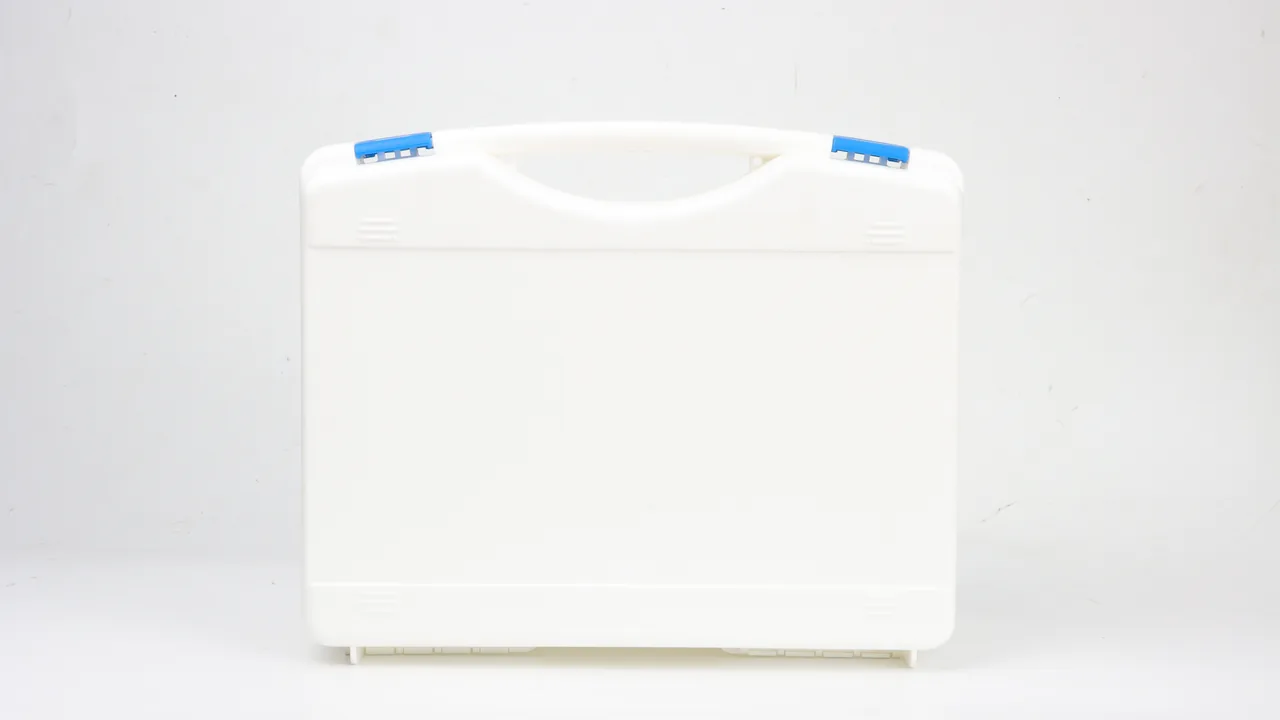
Poultry plants rebuild, relocate and re-spare equipment constantly, and every move passes through an environment that is humid, greasy and still carrying blood water and cleaning chemistry. De-feathering fingers and plucking discs hate compression and stickiness, drums and grid plates hate side squeeze and ovality, high-speed cutting discs and clamps hate impact, and washing and conveyor parts travel with residual liquid on them. These parts are expensive and the downtime they cause is worse, so a case that lets them deform, corrode or lose an edge is not protection at all. The JUNZHIJIA principle: protecting poultry processing parts means moving the plant hygiene standard into the packaging itself, so rust prevention, shape retention and cross-contamination control are solved together rather than one at a time. This article covers de-feathering, cutting, washing and conveying parts item by item, through materials, structure, sealing, cushioning, stacking, salt fog and transport testing, and closes with selection and acceptance criteria you can apply directly.
Table of Contents
- Poultry Lines: Transport Pain Points from Scalding to Cutting
- De-feathering Fingers and Plucking Discs: Soft Parts versus Grease and Set
- De-feathering Drums and Grid Plates: Holding Roundness in Thin Walls
- Cutting Discs, Blades and Clamping Blocks: Edges and Datum Faces
- Washers and Conveyor Parts: Chain Links, Sprockets and Spray Pipes
- Food-Grade Materials: 304/316L, PP and Contact Compliance
- Washdown Readiness: No Dead Corners, Fully Removable Liners
- Cross-Contamination Control: Compartments, Colour and Clean Status
- Sealing Systems: IP65/IP67 against IEC 60529 and GB/T 4208
- Cushion Liners and Dividers: Layering EPE, EVA, PE and IXPE
- Latches, Hinges, Pressure Valves and Stacking Load
- Salt Fog Exposure and Transport Test Validation
- Selection Checklist, Tooling, OEM/ODM and Acceptance Criteria
- Frequently Asked Questions FAQ
- Conclusion and Related Reading
Poultry Lines: Transport Pain Points from Scalding to Cutting
A poultry line runs through hanging and killing, scalding, de-feathering, head and feet removal, evisceration, splitting and cutting, de-boning, trimming and final washing. The spares coming off it look nothing alike: rubber de-feathering fingers, thin-walled stainless drums, hardened blades and disc assemblies, strands of conveyor links and slender spray pipes.
Harder still, surface condition travels into the case with the part. De-feathering parts arrive with feather residue and grease, cutting parts with blood water and bone chips, washing and conveying parts with a water film and cleaning agent. Those residues are both a corrosion driver and a source of microbes and odour, so a poultry case cannot be a shock container alone. The short-haul logic used across food plants is described in Food Processing Line Cases, but poultry residue is heavier.
| Part group | Form | Main transit failure | Protection focus |
|---|---|---|---|
| --- | --- | --- | --- |
| De-feathering fingers | Rubber or EPDM strips | Compression set, sticking, ozone cracking | Upright storage, anti-stick separation |
| Plucking disc | Stainless disc with finger clusters | Disc warp, finger root cracking | Flat supported seating, bore cap |
| De-feathering drum | 304/316L welded cylinder | Ovality, flange damage | Support rings, saddles, end rings |
| Cutting disc | Hardened or stainless disc | Edge chipping, flatness loss | Slotted box, floating edge |
Poultry plants share a site with cold stores, thawing rooms and wash bays, so the packing environment is humid before anything else happens. Sealing a case in a damp bay raises the starting moisture inside, and once a mid-voyage temperature swing adds condensation, corrosion is almost guaranteed. Work three actions together: dry before packing, control moisture inside, and let the case breathe under control.
De-feathering Fingers and Plucking Discs: Soft Parts versus Grease and Set
De-feathering fingers are consumables ordered often and handled roughly, and packaging is where most are quietly ruined. Rubber is viscoelastic. Under a sustained concentrated load it takes a permanent compression set, showing up as flattened, hardened fingers that spring back slowly, and plucking efficiency drops immediately because the finger can no longer fling out and wrap the carcass. Stacking pressure also lets neighbours stick where residual grease has migrated, and pulling them apart at opening tears the surface.
A plucking disc concentrates dozens of fingers on one disc, so risk shifts from the finger to the disc and the finger root. The disc is thin pressed or welded plate; side squeeze warps it, and once flatness is out the assembly vibrates at speed. The finger root is the highest-stress point on the disc, so movement inside the case that repeatedly bends the root works it toward a crack.
The packing rules are therefore no compression, no sticking and no shifting. Fingers stand upright or hang, carrying none of the load above them. PE film or thin IXPE separates neighbours so migrated grease has no bridge to form. Discs lie flat with the whole face supported, and the bore gets a cap against lifting damage. New and used fingers never share a cavity.
| Risk source | Mechanism | Engineering action | Site check |
|---|---|---|---|
| --- | --- | --- | --- |
| Stacking load | Rubber compression set | Upright, single layer, 20 mm headspace | Free recovery within 24 hours |
| Grease bridging | Oil migration onto touching faces | PE film separation, slotted storage | Fingers separate without force |
| Ozone ageing | Oxidative chain scission | Dark storage away from motors | Fine surface cracking |
| Root bending | Fatigue cracking from disc movement | Face-supported disc, axial restraint | Whitening or cracks at root |
De-feathering Drums and Grid Plates: Holding Roundness in Thin Walls
A de-feathering drum is usually a welded stainless cylinder with a wall of only 1.5 to 3 mm. It is large in diameter with good global stiffness but poor local stiffness, and its typical transit failure is not fracture but ovality. Side squeeze and stacking load flatten the circular section, and once roundness is out of tolerance the clearance between the plucking disc and the drum wall disappears locally. The two then gall, wear fast and can seize.
The protection logic for thin rounds is internal support, external cradle, capped stacking. Inside, two to four removable support rings hold the section circular. Outside, saddles matched to the drum diameter carry weight through area contact. In transit the drum travels in a single layer with a capped stack count, and neither standing on end nor side loading is permitted. Flanges and weld preparations are functional faces, so they get protective rings and a safe stand-off from the case wall.
The governing variable is support count against span. Deflection of a ring under a radial point load scales steeply with span, so shortening spans beats thickening the wall. The table below gives a starting point, tuned afterwards to actual wall thickness and diameter.
| Drum size | Support rings | Maximum saddle span | Roundness in transit | Stack limit |
|---|---|---|---|---|
| --- | --- | --- | --- | --- |
| 600 x 1.5 mm | 3 | 800 mm | 0.3 percent of D | Single layer |
| 900 x 2.0 mm | 3 to 4 | 1000 mm | 0.25 percent of D | Single layer |
| 1200 x 2.5 mm | 4 | 1200 mm | 0.25 percent of D | Single layer |
| 1500 x 3.0 mm | 4 to 5 | 1400 mm | 0.2 percent of D | Dedicated frame |
| Grid or screen plate | Not applicable | Flat, 600 mm spacing | Flatness 1 mm per metre | 15 sheets maximum |
Welds and flanges need their own attention. Weld reinforcement is easily crushed by a wire sling and can act as a crack starter, so lifting points belong on dedicated lugs or on the support frame, never on the drum itself. Mask the flange sealing face before dispatch and cap the bore ends.
Cutting Discs, Blades and Clamping Blocks: Edges and Datum Faces
The cutting stage holds the most fragile parts on the line. Circular blades, serrated blades, disc assemblies and de-boning dies have hard, low-toughness edges, and any hard-to-hard contact chips them. Disc flatness and balance set cutting quality: even a slight warp shows up as ragged cuts, higher noise and shorter bearing life, while clamping blocks and guide plates lose accuracy permanently when a datum face takes a dent.
The worst thing you can do to an edge is pack it face-down against a surface. Let the edge float instead: cut a slot in EPE or EVA matched to the blade profile so the spine and body faces carry the load while the edge stays suspended. Separate multiple blades one sheet per slot using a soft, non-shedding material. Discs lie flat with the full face supported, and the bore takes a plug against scoring; if a combined tool travels assembled, insert blocks to limit relative movement.
Clamping and guide parts need their datum faces kept away from packaging material, because a scratch changes the assembly gap and the cut precision with it. Cover the datum with a soft facing of IXPE or fine EVA and let non-functional faces carry support, adding plugs or sleeves to sliding bores.
| Edge or datum failure | Trigger | Liner action | Acceptance check |
|---|---|---|---|
| --- | --- | --- | --- |
| Edge chipping | Blade against blade or wall | Slotted box, floating edge | No nicks under magnification |
| Disc warp | Unsupported load or stacking | Full-face support, no stacking | Flatness within 0.05 mm |
| Bore scoring | Sling rubbing during lift | Bore plug plus lifting lugs | Bore deviation within 0.02 mm |
Blades also carry a management dimension. As sharp implements they must be edge-protected and clearly labelled for transport and storage, with the packing list stating blade count and specification so the receiving plant can check and trace them.
Washers and Conveyor Parts: Chain Links, Sprockets and Spray Pipes
The washing and conveying section is the wettest part of a poultry plant. Chain, sprockets, corner guides, spray pipes and nozzles are normally removed still damp and go straight into a case, which is where most rust starts. Links have gaps that hold water, and once moisture is trapped inside it cannot drain, so rust begins from within and seizes neighbouring links.
The rules for conveyor chain are coil in order, dry separately, separate cavity. Coil the chain into a regular circle and strap it with a soft band so it cannot tangle loose, keeping the coil radius generous because too tight a bend deforms the pins. Blow out the gaps with compressed air before packing, add desiccant inside the case and include a humidity indicator card. Sprockets are toothed parts that dent easily, so they travel in a separate cavity, teeth up, on a soft pad.
Spray pipes and nozzles combine a slender form with fine threads. A pipe with too few support points bends, and a bent pipe cannot be straightened cleanly, so the spray pattern shifts. Long pipes get multi-point cradles spaced by diameter, ports get sleeves, and nozzles travel bagged or fixed to a drilled board.
| Part | Moisture control | Fixing | Cushioning |
|---|---|---|---|
| --- | --- | --- | --- |
| Conveyor chain | Blow dry plus desiccant | Coiled and strapped, radius 300 mm | Wrapped in PE bag |
| Sprocket | Blow dry plus VCI film | Teeth up, flat | Soft pad, axial restraint |
| Spray pipe | Blow dry plus caps | Multi-point cradle, 800 mm | Sleeve with light pre-load |
| Nozzle | Dried and bagged | Fixed to a drilled board | Bag plus soft lining |
Washer housings and spray hoods are welded stainless sheet, weak in stiffness and large in area, so a local load warps the whole panel. They belong in a frame with a stiffening structure, where an edge beam takes the load instead of the face. Rollers and sprockets are rotating parts too, and their journal and end-face protection follows Conveyor Roller Cases.
Food-Grade Materials: 304/316L, PP and Contact Compliance
What separates a poultry processing case from general industrial packaging is that its materials may contact food-contact surfaces indirectly. Opening a case and staging a part can transfer packaging debris, flaking coating or rubber volatiles onto equipment surfaces, and from there into the product stream. Material choice must therefore satisfy two lines at once: structural reliability, and no new risk to the food chain.
The main case materials are copolymer PP and glass-filled PP, which resist water and most cleaning agents, do not absorb moisture and can be washed whole. Heavy or long parts often use aluminium profiles clad with PP panels, so the profiles carry bending and the panels close the volume. Fasteners, hinges and exposed latches should be 304 stainless, upgraded to 316L where chloride is higher, such as coastal plants or sea freight.
| Position | Recommended material | Why | Avoid |
|---|---|---|---|
| --- | --- | --- | --- |
| Case body | Copolymer PP or PP-GF | Water and chemical resistance | High-recyclate black PP |
| Frame for long parts | Aluminium profile | High specific stiffness, no rust | Plain carbon steel |
| Exposed metal | 304 stainless, 316L in chloride | Corrosion resistance | Zinc plating that can flake |
| Gasket | EPDM or silicone | Weather and heat resistance | Natural rubber that ages |
| Contact separation | Closed-cell IXPE or fine EVA | Low shedding, low odour | Open-cell PU, PVC sheet |
The soft separation layer touching equipment should avoid materials that shed, migrate plasticiser or carry odour. Chosen materials should come with a food-contact compliance statement naming the applicable temperature and contact condition, and batch documentation should be traceable, which matters more on export orders where the declaration is expected to travel with the case. Food grade is not a material you pick but a combination of material, process and clean condition: mould release agents, printing inks and label adhesives all belong in the review. Where parts are destined for central kitchen pre-treatment, the template used in Central Kitchen Equipment Cases can be shared.
Washdown Readiness: No Dead Corners, Fully Removable Liners
Because the equipment itself must survive washdown, the case carrying it will be washed too. If the structure has corners that cannot be reached or floors that cannot drain, it becomes a microbial habitat and an odour source that re-contaminates the parts it was meant to protect.
Three moves solve this. First, remove dead corners: fillet internal corners at R 10 mm or larger, and make compartments and dividers lift out as one piece so the interior becomes a continuous surface that can be washed. Second, drain fully: give the base a 1 to 2 degree fall and fit a drain plug so rinse liquid leaves on its own instead of needing the case tipped by hand. Third, withstand the chemistry: specify EPDM or silicone gaskets and alkali- and chlorine-resistant copolymer PP, avoiding PC cavities that stress-crack in chloride service.
Some options that look hygienic do the opposite. A single carved foam block fits beautifully but locks rinse liquid into the carved seams, so it gets dirtier with every wash, while open-cell sponge holds water and becomes an odour source. A better arrangement makes the locating foam a replaceable cradle and uses separately washable soft facings where the part is touched. Drying matters as much as washing: air-dry the case open with removable vent rails inside, and where turnaround is fast, resist packing damp, because a wet case sharing a cavity with metal parts is a corrosion cell built on purpose.
| Wash condition | Site reality | Case requirement | Gasket requirement |
|---|---|---|---|
| --- | --- | --- | --- |
| Low-pressure hose | Plant water, ambient | Fillets plus drain plug | IP65 class, EPDM |
| High-pressure hose | 30 to 80 bar | Ribs clear of the seal path | IP66/IP67, 25 to 35 percent compression |
| Foam cleaner | Alkaline or chlorinated | Alkali-resistant PP, no PC cavity | Chemical-resistant EPDM |
| Combined hot pressure | Pressure plus heat | Full sealing plus drain design | IP69K-compatible structure |
Cross-Contamination Control: Compartments, Colour and Clean Status
Poultry processing is unusually sensitive to cross-contamination. Raw and cooked areas, dirty and clean areas, and different batches and lines are already separated in the plant, and spares need the same discipline in transit. If a spare shares a cavity with a contaminated item, whatever clings to the case wall transfers to clean equipment at the destination, creating a contamination path that is very hard to trace.
Two dimensions drive the layout. By clean status, washed and disinfected parts travel apart from unwashed line spares with clear labelling. By part nature, rubber, metal and edged parts are isolated from each other, which prevents material migration and galvanic corrosion and speeds picking.
Colour and labelling turn a layout into an executable rule. A common scheme uses red for unwashed, blue for washed and green for awaiting inspection, marked on the case exterior with a wash-resistant label. Disposable inner bags have a role too: for parts already washed and disinfected that must stay clean, a food-grade PE bag before the cavity reduces direct contact. The bag must not become a moisture trap, so confirm the part is fully dry before sealing.
| Dimension | Typical split | Structure | Marking |
|---|---|---|---|
| --- | --- | --- | --- |
| Clean status | Unwashed, washed, awaiting inspection | Separate cavities, removable dividers | Three-colour status tag plus label |
| Part nature | Rubber, metal, edged | Separate cavities, hard dividers | Cavity map plus in-mould numbering |
| Batch control | By purchase batch | Inner bag plus divided slots | Packing list bound to batch number |
Sealing Systems: IP65/IP67 against IEC 60529 and GB/T 4208
Sealing discussions come back to IEC 60529 and its equivalent adoption GB/T 4208, where the two digits answer two separate questions: whether solid particles can get in, and whether water can get in. A higher first digit means finer particles are excluded; a higher second digit means harsher water conditions are tolerated.
IP65 and IP67 do most of the work. IP65 means dust-tight and resistant to nozzle spray, suiting hose washing in the plant and open-air staging. IP67 means dust-tight and able to survive short immersion under defined conditions, suiting routes where water can pool, soaking as a cleaning method, or sites prone to flooding. IP69K addresses high-pressure hot water where hygiene demands are highest. Note that IP69K describes high-pressure hot spray, a different axis from prolonged deep immersion, and the two do not substitute. The test conditions behind these grades are compared in IP65 vs IP66 vs IP67 Difference, and where hot pressure washing is used, check the limits in IP69K High-Pressure Hot Water Rating.
| Site condition | Exposure | Suggested class | Structural key point |
|---|---|---|---|
| --- | --- | --- | --- |
| Dry indoor storage | Light dust | IP54 class | Basic dust protection |
| Hand hose washing | Spray, ambient | IP65 | Gasket compression, latch pre-load |
| High-pressure washing | 30 to 80 bar | IP66 | Ribs clear of seal, groove design |
| Possible pooling or soaking | Short immersion | IP67 | Double seal, hinge concentricity |
| High-pressure hot water | Heat plus pressure | IP69K-compatible | Heat-rated gasket, drain design |
Sealing depends far more on structural detail than on the gasket itself. The mating faces must be flat, and the groove depth must match the gasket section so compression lands in the 25 to 35 percent band when the lid closes. Hinges must be concentric on both sides, otherwise one side crushes while the other barely touches and spray enters through the light side. Latches supply clamping force, and too few or badly placed leave local pressure gaps. Gaskets also age and swell with oil, so they belong on a replaceable-parts list with a defined inspection interval.
Cushion Liners and Dividers: Layering EPE, EVA, PE and IXPE
A liner is not soft padding; it is a system that dissipates impact energy along a controlled path and holds a part in a known position. A mature liner usually has three layers. The innermost contact layer touches the equipment and must be soft, non-shedding and non-marking. The middle locating layer is formed to the part outline and locks it in place. The outer carrying layer takes the larger shocks and spreads them into the case.
For materials, the contact layer is usually 3 to 5 mm IXPE, fine and weather-resistant, suited to machined faces and long shafts. The locating layer is usually 10 to 20 mm EVA, high in compression strength and tear-resistant, suited to carved forms. The carrying layer is usually 30 to 50 mm EPE or a moulded PU cradle, good at absorbing energy at reasonable cost. Between cavities, add a hard divider of PP honeycomb or plywood to cut the displacement path of a part under shock.
| Material | Character | Main function | Typical thickness | Suited parts |
|---|---|---|---|---|
| --- | --- | --- | --- | --- |
| IXPE | Fine closed cell, soft | Contact layer | 3 to 5 mm | Ground faces, disc faces, shafts |
| EVA | Harder, tear-resistant | Locating layer | 10 to 20 mm | Finger clusters, clamps |
| EPE | Low density, absorbing | Carrying layer | 30 to 50 mm | Heavy parts, drum surrounds |
When different metals share a case, structure is not the only consideration: stainless touching carbon steel in a damp environment forms a galvanic cell and accelerates corrosion of the more active metal. Add an insulating divider between them and keep condensation from pooling at the contact face.
Latches, Hinges, Pressure Valves and Stacking Load
Latches, hinges and the pressure equalisation valve are the three most overlooked parts of a case, yet they decide sealing and safety directly. Latches supply clamping force, and their rating should be read as holding without releasing or loosening, which is why heavy cases use stainless draw latches with anti-loosening features. Hinges carry opening, closing and part of the load, and both sides must be concentric so the lid closes evenly. The valve solves differential pressure from temperature swings: through a day-night cycle or an air-freight pressure change, internal positive or negative pressure builds, and without a valve the vacuum can hold the lid shut and the overpressure can lift the gasket, either of which breaks the seal.
Stacking load is the item that most needs actual arithmetic. Most deformation-on-arrival cases are not undersized structures but stacking plans that do not match real rack conditions. Check three things together: static load on the bottom case, creep under long storage, and the added bending from eccentric loading.
| Stack layers | Case weight with part | Load on bottom case | Suggested case | Notes |
|---|---|---|---|---|
| --- | --- | --- | --- | --- |
| 2 | Up to 40 kg | Up to 40 kg | Standard PP with ribs | Locating bosses to stop sliding |
| 3 | 40 to 60 kg | 80 to 120 kg | PP-GF with corner pillars | Eccentricity under 10 percent |
| 4 | 60 to 80 kg | 180 to 240 kg | Aluminium profile frame | Pallet required |
| 5 or more | Over 80 kg | Over 320 kg | Frame case plus pallet | Stacking type test mandatory |
Two more variables matter: floor flatness decides whether load concentrates on a few corners, and warehouse temperature decides long-term plastic capacity, so a hot store needs fewer layers. For spares held long term, run one type test for the combined stacking and storage condition so creep is built into the design.

Salt Fog Exposure and Transport Test Validation
Corrosion pressure on a poultry case comes from two directions: sea fog on the transport side, and plant humidity plus cleaning residue on the storage side. The usual approach is to grade by chloride exposure, set material and test requirements from that grade, and verify with neutral salt fog to GB/T 10125, noting that the test covers exposed metal and fasteners only. Test conditions and failure criteria are set out in Salt Spray Corrosion Test.
| Exposure grade | Typical setting | Metal solution | Suggested salt fog | Verdict |
|---|---|---|---|---|
| --- | --- | --- | --- | --- |
| Light | Inland plant, dry store | 304 stainless | 96 hours | No red rust |
| Medium | Coastal plant, damp bay | 304 with protective coating | 240 hours | No red rust, no blistering |
| Heavy | Sea export route | 316L fasteners plus EPDM gasket | 480 hours | No red rust, no pitting |
| Severe | Salt fog plus high humidity | 316L plus VCI protection | 720 hours | No corrosion on critical faces |
Run transport testing as three stages rather than one full programme. Stage one is screening, where a prototype case goes through ISTA 1A or 2A style tests to expose structural weak points quickly. Stage two is qualification: set an assurance level under ASTM D4169 and simulate the combined vehicle vibration, drop and stacking condition to prove the design. Stage three is production sampling: run regular vibration and stacking checks to GB/T 4857 to confirm the process has not drifted. Use one set of criteria across all three so a laboratory pass and a production sample can be compared. Cycle details are covered in ISTA Transport Testing Procedure.
| Stage | Reference | Main items | Pass criteria |
|---|---|---|---|
| --- | --- | --- | --- |
| Screening | ISTA 1A or 2A | Fixed-frequency vibration, drop | No cracking, liner stays put |
| Qualification | ASTM D4169 | Random vibration, drop, stacking | Parts do not shift |
| Production sampling | GB/T 4857 series | Vibration, stacking, drop | Matches the qualified prototype |
| Environment | GB/T 10125 | Neutral salt fog | Judged by exposure grade |
Soft measures work alongside the tests. A humidity indicator card inside lets the plant see whether condensation happened, and wrapping machined faces in VCI film with montmorillonite desiccant sized to the internal net volume slows corrosion at the source. A pressure equalisation valve lets the case breathe, while loading away from the container door and roof drip zones with a ventilation gap to the container wall lowers the chance of surface condensation.
Selection Checklist, Tooling, OEM/ODM and Acceptance Criteria
Start selection by building a part profile rather than choosing a case type and making the part fit. A profile needs at least five dimensions: size and weight, position of fragile faces, material and corrosion sensitivity, surface clean status, and turnover pattern.
| Profile dimension | Information to confirm | Effect on the solution |
|---|---|---|
| --- | --- | --- |
| Size and weight | Max size, unit weight, centre of gravity | Case size, lifting points, stacking |
| Fragile faces | Edges, flat faces, bores, flanges | Support points and floating zones |
| Material and clean status | Stainless grade, rubber, washed or not | Rust prevention, compartments, desiccant |
| Turnover and route | Single trip or reusable, distance | Durability, washability, salt fog grade |
Run customization as three gates and one freeze. Gate one is concept approval, turning the part profile into a protection concept and structural sketch with explicit support and restraint logic. Gate two is prototype validation, using a sample case for drop, vibration and spray screening. Gate three is tooling freeze, committed only after the structure is confirmed, followed by first-article approval. Splitting design approval from tooling commitment is the main control on rework cost, because once a tool is cut every structural change multiplies.
For OEM and ODM work, the usual scope covers structural and liner design, prototype build and testing, tool development and volume production, brand and marking customization, and the documents that travel with the case: packing list, material declaration, test report, and cleaning instructions. The critical point is not what can be made but who owns the result, so agree the test items, criteria and limits of responsibility in writing, as described in OEM/ODM Custom Protective Cases. Manufacturing is handled by Kexin New Materials (Guangdong) Co., Ltd., from a single prototype to volume supply.
Accept a batch using counting sampling split into four criteria groups. Appearance defects such as sink marks, flash and cracks run at AQL 2.5; functional defects such as sealing, latches and valves run at AQL 1.5; dimensions are measured item by item; documents are checked batch by batch. Structural performance such as stacking and drop is validated as a type test per batch rather than on every case. If a functional item fails, hold the whole batch rather than releasing the good-looking units.
| Criteria group | Checked items | Sampling or AQL | Record |
|---|---|---|---|
| --- | --- | --- | --- |
| Appearance | Sink marks, flash, cracks, colour | AQL 2.5 | Defect location and photo |
| Dimensions | Overall size, cavities, fits | Sampled, 2 mm or 0.3 percent | Measured data sheet |
| Function | Gasket compression, latch pull, valve | AQL 1.5 | Item-by-item test record |
| Documents | Packing list, declaration, report | Every batch | Filed against batch number |
Frequently Asked Questions FAQ
Q: The de-feathering fingers look undamaged, yet plucking efficiency drops once they are fitted. Why?
A: The dominant failure mode is compression set, not fracture. Rubber is viscoelastic, so fingers left under the weight of layers above them, or squeezed against neighbours in a stack, gradually lose their rebound. They flatten, harden and return slowly, and once fitted they can no longer fling out and wrap the carcass, so plucking efficiency falls. The protection answer is to keep fingers unloaded, unstuck and unable to shift. Store them upright or hanging in a single layer with at least 20 mm of headspace above, and separate neighbours with PE film or thin IXPE so migrated grease has no bridge to form. Add restraint so a cluster cannot slide around in transit, and never let new and used fingers share one cavity. At goods-in, check free rebound recovery and look for whitening or fine cracks at the finger root. Storage temperature matters as well: a container roof that reaches 60 °C in summer accelerates the set markedly, so keep spare fingers out of direct sun and out of the top layer of a stack. Log the batch number of every set issued.
Q: The de-feathering drum is thick stainless steel, so why worry about deformation at all?
A: Thickness and stiffness are different properties. A drum is large in diameter with a wall of only 1.5 to 3 mm, making it a classic thin-walled cylinder that resists local side squeeze far less than axial compression. Its usual failure is not crushing but ovality, and once roundness is out of tolerance the clearance between the plucking disc and the drum wall disappears locally. The two gall, wear quickly and can seize. The effective countermeasure is not a thicker wall but a shorter support span, because ring deflection under a radial load scales steeply with span. In practice, insert two to four removable support rings to hold the section circular, cradle the drum on saddles matched to its diameter, and ship it in a single layer without standing or side loading. Mask flange faces and fit end rings before dispatch. Confirm roundness before the drum goes back on the line, using a dial gauge against the inside wall at several stations. A drum that has taken a set will show it as a repeating out-of-round reading, not as a visible dent.
Q: A cutting disc is solid steel. Does it really need a dedicated liner?
A: Yes, and liner quality decides whether the disc can be used at all. The two governing measures are flatness and edge integrity. Flatness drives cut quality and balance, while edge condition drives safety and service life. A disc that is left unsupported in a case warps under load, and once flatness is out the machine shows ragged cuts, higher noise and shorter bearing life. An edge that strikes a hard surface or another blade chips, and most chips cannot be repaired. Let the disc lie flat with its full face supported so it never spans an open gap. Cut EPE or EVA to the blade profile so the spine and body faces take the load while the edge floats inside the slot. Separate multiple blades one sheet per slot using a soft, non-shedding material, plug the bore against lifting damage, and add blocks if a combined tool travels assembled. Check flatness with a straight edge across the full face at goods-in, and feel the edge for nicks before the disc is mounted; a chipped edge cannot be dressed back without changing the balance.
Q: Conveyor chain packed while still wet really does seize up. How do you prevent it?
A: In warm humid conditions it happens easily. Water enters the gaps between links and cannot drain, so the interior stays damp, and if the case then sees a day-night temperature swing the gaps sit in a thin film of water for weeks. Even stainless can suffer crevice corrosion and seize. Chains that need real force to unfold at the plant are usually this case. Protect by drying first: blow the link gaps out with compressed air, wipe if needed, and only then pack. Size montmorillonite desiccant to the internal net volume, taking the upper figure on hot humid routes, and include a humidity indicator card. Coil the chain into a regular circle and strap it with a soft band, keeping the coil radius at 300 mm or more so the pins are not deformed. Always keep sprockets in a separate cavity, teeth up on a soft pad, so teeth are not damaged by chain or wall.
Q: Poultry hygiene demands are high. Is a higher sealing rating always better for the case?
A: No. Match the site and add one step of margin, rather than buying the highest number. A higher rating usually means a thicker gasket, greater clamping force and higher cost, and excessive clamping makes the case hard to open and ages the gasket faster. Start from what the site actually does. Hand hose washing in the plant or open-air staging is served by IP65. High-pressure washing suggests IP66. Routes where water can pool or where soaking is part of cleaning need IP67, and only sites with very high hygiene demands using high-pressure hot water need an IP69K-compatible structure. Remember that IP69K describes high-pressure hot spray, a different axis from prolonged deep immersion, and neither substitutes for the other. Beyond the grade, sealing depends on flat mating faces, a groove matched to the gasket section, compression held between 25 and 35 percent, hinge concentricity and evenly distributed latch force. Whatever grade is chosen, ask for the gasket section and its compression ratio on the drawing, because that figure, not the label, decides how the case behaves after a year of washdown and sun.
Q: How do you design compartments so the separation is real rather than decorative?
A: Separation only works if it can be executed, so manage the physical boundary and the status marking together. For the physical boundary, divide cavities with hard dividers that lift out as one piece, made of a material that neither absorbs odour nor sheds, so the divider cannot become a contamination source. When splitting by part nature, keep rubber, metal and edged parts apart, which prevents material migration and galvanic corrosion and speeds picking. For status marking, externalise the rule with colour and tags: red for unwashed, blue for washed, green for awaiting inspection, marked on the case exterior with a wash-resistant label or in-mould marking, with the matching status tag fitted at packing. For parts already washed and disinfected, a food-grade PE inner bag before the cavity reduces direct contact. Always confirm the part is fully dry before sealing the bag. Where a cavity holds one washed part and one unwashed part, the divider must be tall enough that a hose jet cannot bridge over it. Photograph a correctly packed case and keep it at the packing station as the reference standard.
Q: Why can a liner not use a single foam, and how do you economise when the budget is tight?
A: Because a liner has to do three different jobs at once: touch the surface, lock the position and dissipate energy, and no single foam excels at all three. IXPE is fine and leaves no marks, ideal against machined faces, but too thin to absorb energy. EVA is high in compression strength and resists tearing, ideal carved as a locating layer, but too stiff to compress under small shocks. EPE absorbs well and costs little, ideal as a broad carrying layer, but too soft to locate. When budget is tight, protect the critical and economise on the general. Put IXPE and EVA near fragile faces such as edges, flat faces, bores and flanges, because failure there cannot be repaired, and use EPE or a moulded paper cradle for the fill and support around a large part. Do not omit hard dividers between cavities, since they cut the displacement path, and add insulating dividers between different metals.
Q: Can a protective case be customised for a non-standard spare with no drawing, and how do you control schedule and risk?
A: Yes. Without a drawing, a 3D scan produces a point cloud that is reverse-engineered into an editable model, alongside measurements of centre of gravity, lifting points and fragile faces, and for hot parts the surface temperature history, which decides whether a heat-sensitive liner is even allowed. Control schedule and risk by deciding in stages and committing late. Stage one is the protection concept and structural design, turning the part profile into support and restraint logic. Stage two is prototype validation, using drop, vibration and spray screening to expose problems and iterate. Stage three freezes dimensions and releases tooling. After the freeze comes first-article approval to confirm production consistency. Separating design approval from tooling commitment is the key cost control, because once a tool is cut every structural change multiplies.
Conclusion and Related Reading
Downtime on a poultry line is billed by the hour, so one avoided rework outweighs the case price. JUNZHIJIA supports de-feathering, cutting, washing and conveying parts with survey, sealing and liner design, transport testing, tooling and OEM/ODM documentation.
Related Reading