

Winter equipment is rarely damaged on the slope. It is damaged on the unglamorous legs of the journey — home to resort, resort to airport, airport to hotel — when nobody is watching. One all-mountain board rubs edge-to-edge against another for a hundred kilometres inside a soft bag. A park board sits under a suitcase in a cargo hold. A binding spends a night on a roof rack in freezing rain. None of this shows up immediately, yet all of it surfaces the next morning as a board that will not glide, a binding that will not release, or a base that has gone grey. A ski or snowboard is a long, thin, laminated shell: wood or foam core, glass fibre skins, steel edges. A single localised stress travels a long way along the grain before it finally delaminates somewhere completely unrelated.
JUNZHIJIA holds that protecting ski equipment is not about putting boards in a bag — it is about separately constraining, separately isolating and separately cushioning the four load-bearing surfaces: edge, base, top sheet and binding. Only when nothing touches, nothing shifts, and nothing takes a concentrated load will a board come out of check-in, stacking and vibration with the geometry and release integrity it left the factory with.
Table of Contents
- Typical Failure Modes for Boards and Bindings in Transit
- Edge Burring and Base Scoring: Mechanism and Reversibility
- Binding Release Values: Why They Must Be Rechecked After Transport
- Separate Compartments for Boots, Helmets and Protective Gear
- Airline Check-In and Roof Rack Transport: Linear Dimensions, Size Class and Weight Limits
- Meltwater, Road Salt and Snowmelt: Why Drainage and Drying Matter
- Internal Retention for Two Boards Plus Poles
- Stowage for Wax, Scrapers and Tools
- Three Protective Layouts Compared: Padded Sleeve, Foam-Ribbed Hard Case, and Die-Cut EVA
- Case Structure, Sealing, Latches and the Pressure Equalization Valve
- Transport Test Programme and Acceptance Criteria
- Pre-Season Inspection and Post-Season Storage Checklist
- Frequently Asked Questions FAQ
- Conclusion and Related Reading
Typical Failure Modes for Boards and Bindings in Transit
The loads a board sees in transit are nothing like the loads it sees on snow. Underfoot, load is distributed along the length of the board, points in a consistent direction, and lasts seconds at a time. In transit, load arrives at discrete points, in random directions, as hours of vibration layered on top of static compression. Most failed board bags fail because their designers treated these two load cases as the same thing.
| Failure mode | Typical trigger | Observable result | Countermeasure |
|---|---|---|---|
| --- | --- | --- | --- |
| Edge burring, rolled edge | Edges stacked directly against each other, long vibration | Ragged edge, poor grip, heavy tuning needed | Edge channels, edge guards, EPE interlayer |
| Base scoring and scratching | Grit trapped under the base, or contact with metal binding parts | Wax will not hold, sluggish glide | Base facing inward on a dedicated channel, non-metallic contact surfaces |
| Top sheet indentation, core delamination | Concentrated compression on the lid from stacked luggage | Dull sound on tapping, no visible crack | Lid ribs, stacking limits, local reinforcement |
| Binding pre-release or non-release | Sustained vibration altering spring preload, icing | Drift in release value, unreliable function | Dedicated binding cradle, post-transit retest |
| Binding screws backing out | Long vibration combined with thermal cycling | Binding shifts relative to the board | Foam cradle carrying the binding body, torque recheck |
| Boot shell collapse, liner dampness | Crushing stack, meltwater ingress | Deformed last, mould and odour | Isolated boot bay, drainable, ventilated |
| Helmet shell cracking, EPS compression | Stacking load or drop impact | Hairline cracks, permanently compressed liner | Curved helmet pocket, never loaded from above |
| Pole bending, tip puncture | Shared bay with edges, unrestrained ends | Bent shaft, punctured top sheet | End cradles for poles, separate bay |
The value of a table like this is not exhaustiveness. It is that it tells you how to divide the interior. Whenever two items in a case have a path by which they can touch, that path eventually becomes a wear track. Compartmentalising is not about slicing space into fragments; it is about cutting contact paths.
Edge Burring and Base Scoring: Mechanism and Reversibility
Steel edges are the most overlooked and most permanently damaged part of a board. They leave the factory hardened and precision-ground, with edge hardness typically in the 48–52 HRC band. That gives excellent resistance to compression and poor resistance to shear. When two edges slide against one another under vibration, what actually happens is low-load, long-stroke abrasive wear: fine wax residue, grit and ice particles are trapped between two edge corners and repeatedly crushed, rounding the sharp corner and raising a burr. You cannot see this after one trip, but one intercontinental round trip can cost a race board a meaningful share of its edge grip.
Base damage is subtler. The base is a low-friction polymer layer, extruded or sintered, usually only 1.0–1.5 mm thick. Once a scratch cuts through to the core, the base has to be patched. The most common source of scoring in transit is not an external object but the metal inside the case: binding baseplates, screw heads and pole tips, all far harder than the base. Putting bases inward, topsheets outward, and replacing every contact surface with foam is the cheapest single measure with the highest return. Base-inward has a second benefit: the base sits flat against foam in surface contact, spreading pressure, while the topsheet faces outward where indentation is easy to spot at a glance.
It helps to separate reversible from irreversible damage. Slight edge burring, shallow base scratches and surface wax are all recoverable through tuning, base repair and waxing. Core delamination, edge separation and a continuous row of dents in the top sheet are structural. The field test is simple. Run a finger along the edge from tip to tail — anything that catches is a burr. Tap the top sheet with a knuckle — the sound should be uniform and crisp; a dull patch means the core has separated from the laminate. Transport protection exists to stop reversible problems from becoming irreversible ones.
Binding Release Values: Why They Must Be Rechecked After Transport
A binding is a precision spring mechanism. Its job is to hold the boot firmly in normal skiing and to release reliably once torsional or forward lean load exceeds a set threshold. That threshold is calibrated as a release value, and it is ultimately a spring preload converted through a lever ratio. The problem is that spring preload is not a constant.
Sustained vibration lets the spring assembly creep through microscopic relative motion, and over time preload can fall. Cold changes both the elastic modulus of the spring steel and the viscosity of the grease. Repeated thermal cycling can allow threaded joints to back out by a fraction. Individually these shifts are tiny. Stacked together, they can move the real release value far enough from the calibrated figure to matter. For a light junior skier or a heavy adult, the risk runs in opposite directions — either the binding fails to release when it should, or it releases when it should not.
The correct practice after a long trip is therefore to take the boards to a shop with a calibrated release tester and re-measure both toe and heel, rather than "tightening by feel". What transport protection can do is immobilise the binding body so it takes no additional load. What it cannot do is replace a mechanical recheck after arrival. The two are complementary and neither is optional.
Inside the case, the rule for bindings is carry, never compress. There should be a foam block beneath the binding body so that its weight travels through the baseplate into the case floor rather than through the mounting screws into the board. Above the binding, leave 10–15 mm of clearance so that a stacked load cannot press directly onto the lever arms. The toe of the front binding and the heel of the rear are the outriggers of the mechanism, and they are the parts least able to tolerate lateral squeeze.
Separate Compartments for Boots, Helmets and Protective Gear
Boots and helmets look tough and are in fact load-sensitive. A boot shell is hard, but the geometry of the last determines control; once a last is deformed laterally, the foot sits differently inside the shell and the skier loses power transmission for reasons that are hard to explain afterwards. A helmet is a thin shell over EPS or EPP. The liner's ability to absorb energy depends on cellular collapse that is irreversible — any squeeze beyond threshold permanently consumes part of the margin, and nothing shows on the outside.
The sensible arrangement gives boots a dedicated bay whose footprint follows the sole profile, with soft foam supporting the cuff sides and nothing loading the toe or heel. The helmet gets a pocket close to spherical so load spreads across the shell rather than concentrating at one point, with at least 20 mm of clearance above it. Padding and body armour can be folded into a soft sleeve beside the boot bay, where they act as gap filler and secondary cushioning.
One detail is routinely missed: boots and pads come back from the hill carrying meltwater and sweat. Sealed into a non-breathing bay, eight hours later they smell of mildew, and over seasons the liner fabrics age faster. Give the boot bay two drain holes at the bottom and a small vent slot between the boot bay and the board bay, so moisture can diffuse instead of sitting in place.
Airline Check-In and Roof Rack Transport: Linear Dimensions, Size Class and Weight Limits
Airline check-in and roof rack transport impose completely different constraints. Carriers care about outside dimensions and weight, because those map directly onto baggage handling equipment and hold balance. Roof racks care about frontal area, mounting point strength and rain ingress.
On most carriers, skis and snowboards fall into the oversized or special baggage category. Taking an all-mountain board at 150–170 cm and a pair of skis at 160–185 cm, and adding wall thickness and end cushioning, the external case length usually lands between 175 and 205 cm. That creates the first threshold: linear dimensions (length plus width plus height) will very likely exceed the free allowance for standard baggage, and the item is billed as oversize. The second is weight: most carriers cap a single checked item at 23 kg, sometimes permitting 32 kg on oversize items with advance notice. The third is size class — on some narrow-body aircraft the hold door is height-limited, and the case cross-section must stay within a band to load without manual handling problems.
| Transport mode | Key constraint | Recommended external length | Recommended cross-section | Special note |
|---|---|---|---|---|
| --- | --- | --- | --- | --- |
| Narrow-body check-in | Hold door height, oversize fee | 175–190 cm | ≤ 30 × 25 cm | Favour a low-profile hard case |
| Wide-body check-in | Weight cap, sorting equipment | 190–205 cm | ≤ 34 × 28 cm | Keep each item under 23 kg |
| Roof rack | Frontal area, mount points, rain | Board length + 5 cm | As low as possible | Mount nose-forward, avoid wind scooping |
| Rail or coach hold | Aisle width, many handling cycles | 175–195 cm | ≤ 30 × 25 cm | Reinforce corners and handle area |
| Car boot, seats folded | Clearance behind the seats | Board length + 5 cm | Any | Prevent the board sliding in the cabin |
On a roof rack the two governing points are frontal area and mounting. Mount the case nose-forward so air flows along its long axis rather than broadside, and clamp at reinforced zones rather than through thin walls. After a stretch of motorway driving, a roof-mounted case has also seen real wind pressure and driving rain, so sealing performance and drainage matter more here than in a cargo hold.
Meltwater, Road Salt and Snowmelt: Why Drainage and Drying Matter
Winter water is more destructive than summer water because it is a cold, salty, gritty liquid. Roads in cold regions are treated with calcium chloride, magnesium chloride or sodium chloride, and traffic throws that brine onto roof racks, where it clings to case surfaces and seams. Brine attacks stainless hardware, aluminium hinges and plated latches, and low temperatures disable many of the passivation mechanisms that would otherwise slow corrosion.
Worse, the equipment itself carries snow back. Boards leave the resort with snow packed into the base, the edge and the recesses of the binding. That snow melts inside the case into standing water, soaking edges, screws and springs in brine for hours. Binding spring cavities and screw holes are narrow crevices, and once liquid is in, it does not evaporate readily.
Three design requirements follow. First, drainage: the lowest point of the case should have a closable drain plug or channel so water leaves actively rather than by evaporation. Second, separation: board bay, boot bay and tool bay should be divided by solid walls, not mesh, so brine cannot migrate between them. Third, drying: prefer closed-cell foam for the liner, because closed cells do not absorb water, wipe clean and resist mould; open-cell foam feels softer but behaves like a sponge, taking brine in and releasing it slowly, still salty, for weeks.
| Liquid source | Ingress path | Consequence | Design response |
|---|---|---|---|
| --- | --- | --- | --- |
| De-icing brine spray | Roof rack splash, seams | Pitting on hardware, stiff latches | Seals plus surface treatment plus fresh-water rinse |
| Snow carried on equipment | Base, binding recesses, boot treads | Standing water, edge rust | Floor drain plug, wipe down before packing |
| Condensation from cycling | Warm day, cold night, inner wall dew | Damp liner, mould on trim | Pressure equalization valve plus desiccant plus vents |
| Direct rainfall | Exposed rack, aged seals | Long-term seepage | Periodic seal compression checks |
Internal Retention for Two Boards Plus Poles
Two boards plus poles is the most common recreational load and also the most troublesome, because it combines three long rigid bodies with two slender rods. A sensible layout layers them by load role: boards are the primary asset and sit innermost; poles are accessories and sit outermost; bindings are precision parts and get their own cradle.
In practice, two boards can be set base-to-base with top sheets out, each dropping into a channel matched to the base camber. Between the two channels, a foam divider 15–20 mm thick keeps them apart, and the divider should stand slightly proud of the edges so no part of either board can touch the other. The bindings sit on the central bulge of each board, which is the stress concentration zone of the case and the area most exposed to top loading, so foam should bear firmly on both sides of the binding to create lateral restraint, with local reinforcement in the lid above.
Poles are too often an afterthought, yet a pole tip is one of the sharpest metal objects in the case. The right approach is a dedicated half-round channel running lengthwise, with a cradle at each end and the tip protected by a cap. Where space allows, put poles on the opposite side of the case from the boards with a divider between, so that even a lateral shock can only move a pole within its own channel instead of jabbing a top sheet.
An alternative is adjustable dividers instead of fixed foam channels. That suits boards of different lengths, but dividers against walls and against each other always leave gaps that permit slight movement under vibration. If you choose them, make each one an interference fit or pack the gaps with foam strips. See Case Internal Foam Types and Case Removable Divider System.
Stowage for Wax, Scrapers and Tools
Skiing is a hobby that travels with tools. Patching, tuning and waxing mean carrying wax blocks, scrapers, a brass brush, a file, a gummy stone, sometimes an iron, and lint-free cloths. These small items look harmless and are not: scraper and file edges are sharp, brass brush bristles snag liners, and wax shavings contaminate base material.
The design rule is one slot per item, with no interference on removal. Files and scrapers get their own slots with cutting edges facing the case wall. The brush gets a sealed box so bristles cannot shed into the board bay. Wax blocks sit in a shallow lidded tray so fragments do not scatter. Soft goods such as cloths and gloves act as gap filler. The tool bay usually sits at one end of the case, which is also the end handlers grab, so the outer wall there needs extra thickness or a handle reinforcement plate.
One frequently ignored issue is vapour: some wax solvents keep off-gassing inside a closed case and age foam and seals over long contact. Keep the tool bay airflow-separated from the board bay and ventilate on opening.
Three Protective Layouts Compared: Padded Sleeve, Foam-Ribbed Hard Case, and Die-Cut EVA
Protective systems on the market fall into three families, and the gaps between them in cost, weight and protection level are far wider than marketing language suggests. Understanding the structural difference matters more than remembering any brand.
| Layout type | Internal structure | Equipment fit | Reference weight | Protection focus | Cost | Typical use |
|---|---|---|---|---|---|---|
| --- | --- | --- | --- | --- | --- | --- |
| Padded sleeve | Single layer of EPE or foam, zip, partial edge guards | 1 board plus soft boots | 1.5–2.5 kg | Against scuffing and light knocks | Low | Local driving, day trips |
| Hard case with foam ribs | Lid and base foam ribs, edge channels, generic dividers | 1–2 boards plus bindings | 5–8 kg | Against impact and stacking | Medium | Routine check-in, club sharing |
| Hard case with die-cut EVA | Custom EVA cavities, base-matched channels, accessory pockets, drainage | 2 boards plus poles plus tools | 6–10 kg | Against impact, movement, brine | High | Airline check-in, seasonal touring |
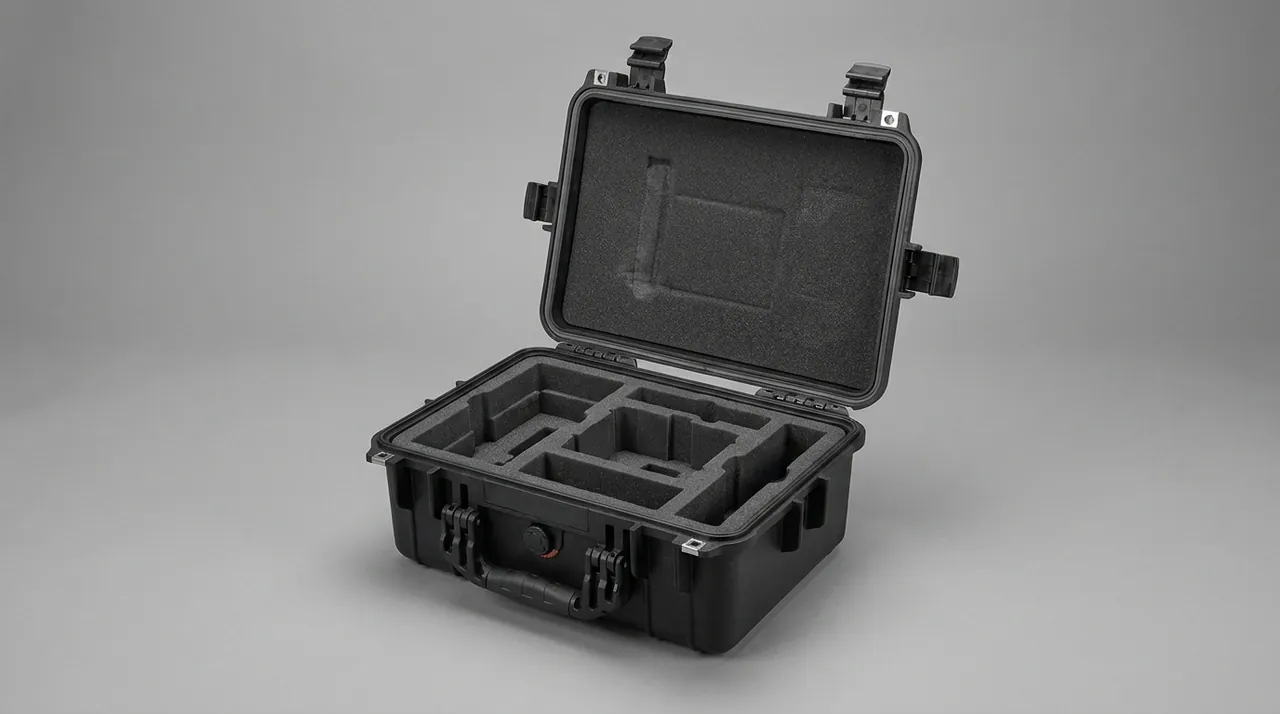
A padded sleeve is light and cheap, and its honest role is scuff protection rather than impact protection. It offers almost no resistance to concentrated load: buried at the bottom of a luggage stack, the board transmits that load straight into its own structure. A foam-ribbed hard case is the best general-purpose compromise. The ribs provide an elastic cushioning layer that absorbs energy by compressing, but generic dividers fit a given board shape only approximately, and the board can still creep slightly inside the case. Die-cut EVA replaces generic space with dedicated space: every board, every binding and every pole has a defined geometric position, and movement is minimised. The price is higher tooling and machining cost, and one case that fits only a narrow range of board shapes.
The selection criterion is not price but the transport route. If equipment only moves between home and the local hill, a sleeve is enough. If there is one or more airline trips a year, or the equipment is valuable, a hard case is the floor. If the equipment is race-grade, tours intercontinentally, or one batch of cases must serve several sets of gear, the extra cost of custom EVA cavities is recovered the first time it prevents structural damage. For more on how EVA liners are formed, see EVA Thermoformed Liner Process.
Case Structure, Sealing, Latches and the Pressure Equalization Valve
Case structure sets the ceiling on protection. A ski case is a long, thin-walled box with a high aspect ratio, which means its inherent stiffness in bending is low. The remedy is longitudinal ribs along the major axis plus a transverse reinforcing ring at mid-length — exactly where the bindings sit. Ribs do more than add stiffness: under load they distribute stress over a larger area.
On sealing, ski cases typically target IP65 to IP67 under IEC 60529 or GB/T 4208 test methods. IP65 resists water jets and IP67 tolerates short immersion. For roof racks, rain and snow, IP65 covers the overwhelming majority of situations; because brine residue can remain inside, a higher rating reduces concern during cleaning. Sealing depends on uniform compression of the gasket, usually held at 25–35% of free height. Under-compression leaks; over-compression takes a permanent set and the gasket loses resilience.
Latches are the most handled and most fatigue-prone parts. A ski case latch must do two things at once: open with one hand and, when closed, supply enough pressure to bring the gasket to its design compression. That makes the number and placement of latches more important than the strength of any single one. The classic error is a strong latch at each end and nothing in the middle, so the middle of the case opens a gap under load. A good arrangement is one primary latch at each end plus at least one auxiliary latch or compression point at mid-length.
The pressure equalization valve is mandatory on a sealed case and especially so in snow sports. Picture a case sealed at minus 15 °C on the hill and then carried into a room at plus 20 °C. The trapped air expands; without relief it pushes on the lid, can lift the gasket, and produces a jet of air when opened. Reverse the direction — warm room to cold exterior — and the case develops a partial vacuum that makes it very hard to open and can suck the gasket into the gap. The valve uses a hydrophobic breathable membrane to equalise pressure in both directions while blocking liquid water. For the principle and selection, see Pressure Equalization Valve.
Transport Test Programme and Acceptance Criteria
Whether a protective design works cannot be settled by opinion. Ski case validation normally uses a combination of tests covering stacking, vibration, drop, thermal cycling and salt spray. Each dimension maps to a real condition in the transport chain, and the parameters should be tailored to the actual route rather than copied from a template.
| Test | Reference standard | Typical parameters | Acceptance criteria |
|---|---|---|---|
| --- | --- | --- | --- |
| Stacking | GB/T 4857.3 or ASTM D642 | 2.4 m stack, 24 h | Permanent deformation ≤ 5 mm, no collapse |
| Random vibration | ISTA 3A or GB/T 4857.7 | Random profile, 30–60 min | No relative movement of contents, no loosening |
| Drop | ISTA 3A or ASTM D5276 | One corner, three edges, six faces | No through cracks, no displacement of contents |
| Thermal cycling | GB/T 2423.1 / GB/T 2423.2 | −20 °C to +55 °C, multiple cycles | Foam does not embrittle or crumble, latches operate |
| Salt spray | GB/T 10125 | Neutral salt spray, 48 h | No red rust on hardware, no latch seizure |
Vibration is the most underrated item on that list. The real threat to a ski case is not one violent drop but hours of low-amplitude, high-frequency vibration. It slowly wears every interface that has clearance, backs screws out, and lets foam slide against a base. The post-vibration inspection should therefore focus not on whether the case cracked but on whether the contents returned to their original positions. In drop testing, pay particular attention to the ends of the case and to the areas above the bindings, because those are the highest stress locations.
For more on methods and interpretation, see Transport Vibration Testing for Cases and Drop Test Height by Weight. Note that any test is a simulation of a specific route, and a standard is not by itself a guarantee of success in real transport. Test items and parameters should be confirmed case by case against equipment value, mode of transport and customer requirements.
Pre-Season Inspection and Post-Season Storage Checklist
The service life of a set of equipment often turns on a habit practised only twice a year. Before the season, the job is confirming that last season's storage caused no harm. After the season, the job is making sure the next opening day starts from the same place.
Pre-season checklist:
- Run a finger along each edge tip to tail; confirm no burrs or rolled corners
- Tap the top sheet with a knuckle; the sound should be uniform, no dull patches
- Check the base for deep scratches reaching the core; patch if needed
- Re-measure toe and heel release values with a calibrated tester
- Check binding mounting screws for looseness or corrosion; retorque to specification
- Check boot lasts for deformation, liners for mould, buckles for smooth action
- Inspect the helmet shell for hairline cracks and the liner for compression
- Confirm poles are straight and tips are intact
- Check case gasket for ageing and correct compression, latches for smooth travel
- Check the pressure equalization membrane for blockage or damage
Post-season checklist:
- Dry base, edges and bindings; remove salt and wax residue
- Apply a thick storage wax; leave it unscraped to block oxidation
- Release binding springs to the lowest setting or per manufacturer guidance
- Dry boots fully, release all buckles, avoid long-term pressure on the last
- Store the helmet separately; nothing may be stacked on top
- Keep poles away from boards so tips do not press on a top sheet
- Add a desiccant pack and leave the drain plug open for ventilation
- Store upright or flat in a cool, dry place, out of direct sun to slow material ageing
Both lists share one logic. Transport protection addresses damage during movement; storage protection addresses damage during time. Do both and a set of equipment approaches its designed service life.
Frequently Asked Questions FAQ
Q: Which part of a ski or snowboard is most often overlooked when it comes to transport damage?
A: If only one area can be named, it is the topsheet around the binding mounting zone. It is hard to see because the binding body covers it, yet it takes a triple load: the weight of the binding itself, the preload of the mounting screws, and any compression transmitted from the lid when the case is stacked. When the lid has no local reinforcement above the binding, stacking load travels through the baseplate and concentrates on the topsheet, producing a small area of very high pressure. In the short term this shows as shallow denting; over time it can separate the core from the laminate. To inspect, remove the binding and check whether the mounting area is flat and whether there are radial hairline cracks around the screw holes. To prevent it, give the binding body its own foam cradle inside the case and add ribs in the lid above it, so load is spread through foam rather than concentrated through hardware.
Q: How should someone choose between a padded sleeve and a hard case?
A: The criterion is whether the transport route includes stacking and impact you cannot control. A padded sleeve is fundamentally a scuff-protection container. It isolates boards from each other and absorbs light knocks, but it offers almost no resistance to concentrated load; buried at the bottom of a luggage stack or sharing a hold with heavier freight, it passes that load straight into the board. If equipment only travels in your own boot and is loaded by you, a sleeve is entirely adequate and wins clearly on weight and bulk. But as soon as a third party handles the load — airline check-in, long-distance coach, courier, or a club moving many sets at once — a hard case is the floor, because you cannot control which layer it ends up on. A second consideration is board value. Race boards, custom builds and carbon constructions are effectively written off once the core delaminates, so for those a hard case with a custom liner is advisable regardless of route length.
Q: Why must binding release values be rechecked after transport rather than just skiing on them?
A: Because the release value is set by spring preload, and preload is affected by vibration, thermal cycling and mechanical shock in transit. Sustained vibration lets the spring seat, adjustment screw and lever contact surfaces creep through microscopic relative motion, and over time preload can drop. Deep cold changes both the elastic modulus of the spring steel and the viscosity of the lubricating grease. Repeated thermal cycling can allow threaded joints to back out slightly. Each effect is small alone, but a release value is a sensitive parameter: a drift of a few percent can change whether the binding releases under a given torsional load. For a lighter skier, a value that has drifted high means the binding may not release in a fall, which raises injury risk considerably. For a heavier skier, a value that has drifted low means the binding may release during normal skiing. The correct practice is a re-measurement with a calibrated tester at a specialist shop after every long trip, not tightening by feel.
Q: Why do two boards travel better base-to-base with the topsheets facing outward?
A: Because the decision follows the hardness difference between the surfaces. The base is a low-friction polymer layer, usually only one to one and a half millimetres thick. Its durability depends on its own lubricity rather than on hardness. The topsheet is a glass-fibre and resin composite skin — harder but more brittle. If two topsheets face each other, it looks like a smooth-on-smooth arrangement, but topsheets are not smooth: the binding mounting zone, decorative inserts and edge structures all form raised features. Under vibration those features concentrate pressure onto the bases opposite them, scoring them and potentially cutting through to the core. Reversing the arrangement so bases face each other means relative motion between two low-friction surfaces is essentially sliding, wear is minimal, and because bases are cambered the true contact area is very small. Topsheets facing outward also let you spot compression marks the moment the case is opened. The principle fits in one sentence: let the hardest surface take any contact from outside the board, and let the softest surface only ever touch something equally soft.
Q: What case dimensions and weight should be targeted for airline check-in of ski equipment?
A: Three constraints apply at once. The first is length. All-mountain boards commonly run 150–185 cm, and once wall thickness and end cushioning are added the external case length typically lands between 175 and 205 cm. On most carriers that is oversized baggage, billed separately or requiring advance notice. The second is weight. Most carriers cap a single checked item at 23 kg, and although oversize items are sometimes allowed up to 32 kg with notice, the combined weight of case and equipment should be kept under 23 kg where possible — weight reduction is worth more than any added feature. The third is cross-section. Hold doors on narrow-body aircraft are height-limited, so a recommended cross-section is within roughly 30 by 25 cm; an over-wide case may be refused at the gate or require slow manual handling. Reduce the section by moving cushioning into the lid and floor rather than the sides. Put contact details and an equipment identifier on the outside and a contents list inside, so a delayed baggage claim resolves quickly.
Q: How serious is road salt damage to a ski case, and does it need special treatment?
A: It is serious, and it is the highest corrosion risk in winter transport. De-icing agents used on cold-region roads are mainly calcium chloride, magnesium chloride and sodium chloride. In solution these salts have high conductivity and highly active chloride ions, and they attack aluminium hinges, stainless hardware and plated latches by pitting. The problem is how quietly they arrive. While driving, brine spray is thrown onto the roof rack and clings to case surfaces and seams; it then travels into the case with meltwater, and the snow carried back on equipment is itself salty. That brine forms standing water inside the case, soaking edges, binding screws and springs for hours. Low temperatures also suppress the passivation that would otherwise slow corrosion, so attack continues where you cannot see it. The countermeasures are simple but must be consistent: rinse the case exterior with fresh water after every winter trip, dry it and leave the drain plug open, touch up edge and screw areas with rust-preventive wax, keep a desiccant pack inside, and maintain gaskets with silicone grease so they stay resilient.
Q: Custom EVA liners cost more than generic foam dividers. When is that spend justified?
A: The test is whether movement-induced loss can exceed the liner cost difference. Generic dividers or foam ribs provide a broadly suitable space, and the board still has some freedom to move. On short, infrequent, low-shock routes that freedom is not enough to cause damage, and the generic option is the rational choice. But when the route includes airline check-in, frequent relocations or mixed loads, every small movement of the board produces two consequences: abrasive wear between the edge and adjacent structures, and lateral squeeze on the binding. The first degrades glide; the second can shift the release value. A custom EVA liner fixes the geometric position of every item, minimises movement, and can accommodate poles and tools at the same time, removing the need for a second bag. For race-grade equipment, for teams that travel intercontinentally, and for clubs where one case must serve several sets of gear, the investment is usually recovered the first time it prevents structural damage. Conversely, for recreational equipment on a simple route, the generic layout is entirely sufficient.
Q: How should boards be stored after the season so that next season's performance is unaffected?
A: The three priorities are oxidation, deformation and moisture. First, clean thoroughly: dry the base and edges, remove residual wax and salt, and check for scratches that need patching. Second, seal the base: apply a thick layer of storage wax and leave it unscraped, which blocks air and moisture, preventing the base polymer from oxidising and going grey; simply scrape it off before the new season. Third, release the bindings to their lowest setting, or relax the springs as the manufacturer advises, so they are not held under high stress for months. Fourth, dry boots completely and release every buckle, avoiding plastic bags, which age liner materials in a closed environment. Fifth, store helmets alone with nothing stacked above them, and keep poles away from boards so tips do not press on a topsheet. Finally the case: add a desiccant pack, leave the drain plug open for ventilation, and store it upright or flat in a cool dry place out of direct sunlight.
Conclusion and Related Reading
Protection converts an uncontrollable journey into a controlled internal environment. When edges have channels, bases have surfaces, bindings have cradles and boots have bays, nothing drifts. JUNZHIJIA builds ski and snowboard cases with custom liner tooling, die-cut EVA and integrated drainage, and supports OEM/ODM.
Related Reading