

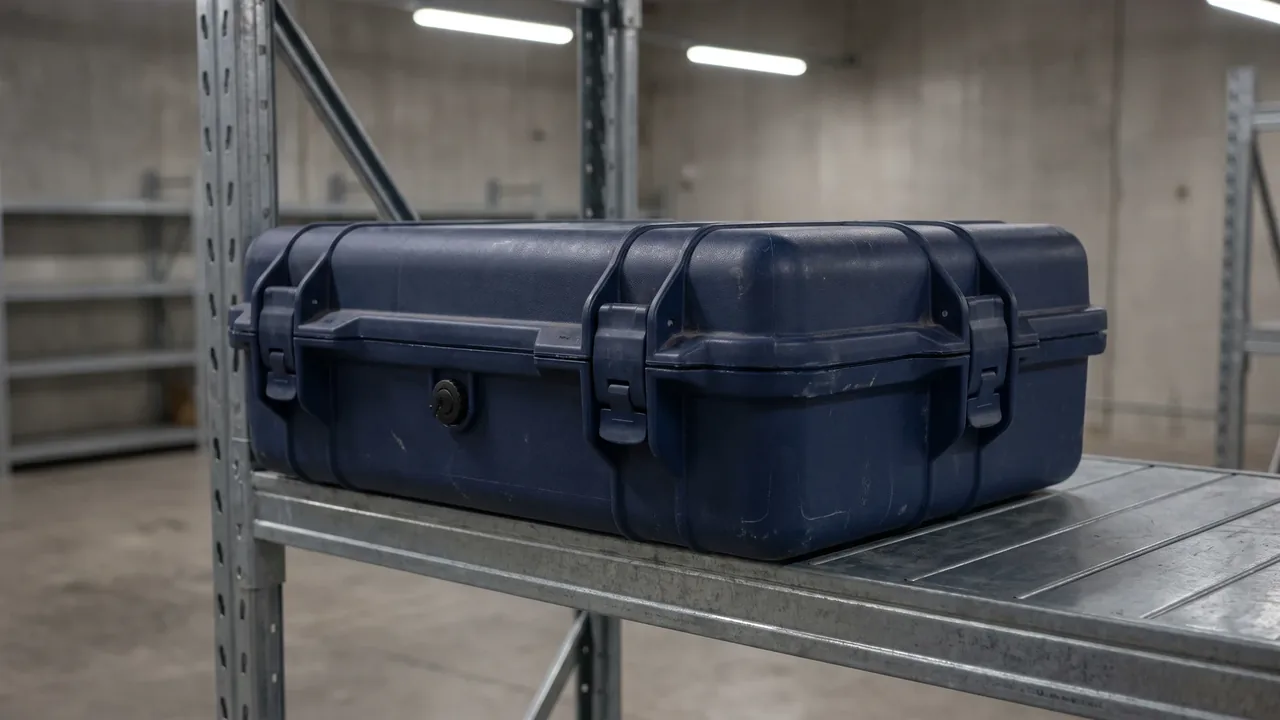
A telecom base station maintenance case, sometimes called a base station maintenance case, a telecom repair case, or a tower maintenance case, is a portable, stackable, vehicle-friendly protective enclosure built for telecom operators, tower companies, and base station maintenance crews. The central conclusion is clear: a maintenance case that reaches the IP67 sealing level, carries a custom cut-foam liner, and provides a vibration-resistant structure will minimize the damage risk to field repair tools, portable test instruments, and spare modules during rain, dust, drops, and long-distance transport. The standard purpose of this case is to store and transport the test instruments, fiber connectors, RF jumpers, and spare modules that base station field crews use for fault location and temporary restoration, so a single dispatch vehicle can resolve most common faults without returning to the warehouse. This article explains the configuration principles and protection details of the telecom base station maintenance case across material selection, sealing, liner systems, shock absorption, EMC shielding, latches, stacking, certification, and customization. For a broader view of similar enclosures, see the telecom base station case and the communication equipment case guide.
1. Field Scenarios and Tool Configuration List
Base stations sit on urban fringes, hilltops, rooftops, tunnel mouths, and highway shoulders, so maintenance crews face very different site conditions on every dispatch: summer rooftop heat above sixty degrees Celsius, winter mountain cold below minus twenty, and coastal sites with long-term high salt fog and humidity. The first question a base station maintenance case must answer is what to load, how to load it, and how much to load. A typical field repair kit divides into four groups. The first group is test instruments: optical power meters, red light sources, antenna feeder analyzers, multimeters, and portable spectrum analyzers. The second group is hand tools and consumables: fiber cleavers, stripping pliers, adjustable wrenches, hex key sets, insulated screwdrivers, and cable ties. The third group is connectors: fiber jumpers, adapters, RF jumpers, waterproof branch units, and heat-shrink tubes. The fourth group is emergency spares: optical modules, power modules, fuses, and short cable lengths. Placing these four groups in separate zones of one maintenance case prevents tools from knocking each other and shortens fault location time. It must be stressed that the case only stores and transports items; it never replaces RF tuning or high-voltage work, and live operations still follow operator safety rules. For sites that move large network equipment by vehicle, combine this with the telecom network equipment cases and the comms emergency case loading plans. A practical dispatch workflow helps the case earn its keep: the crew lead reviews the fault ticket the night before, checks the case content list against the expected task, and adds any site-specific spare that the standard kit lacks, so the morning departure is not delayed by a missing part. Recording which case went to which site also supports later root-cause analysis when a repeated fault pattern appears, because the instruments used can be traced and recalibrated if needed. The case is therefore not only a container but a small managed asset within the maintenance system.
2. Shell Material and Structural Selection
The shell material of a base station maintenance case decides overall weight, impact resistance, and weather durability. The mainstream options are modified polypropylene injection-molded cases, acrylonitrile butadiene styrene blended cases, and rotomolded polyethylene cases, with a smaller share of aluminum profile cases for users who prize minimal weight. PP injection cases are light, low cost, and tough, retaining good impact resistance from minus thirty to plus seventy degrees Celsius, which suits routine rooftop and street-side maintenance. ABS cases are stiffer and more rigid but a little more brittle in cold, so wall thickness and rib layout need control. Rotomolded PE cases are seamless, highly resistant to knocks, and better for frequent mountain loading where occasional drops happen. Whatever the material, the shell should carry reinforcement ribs and thickened corners to resist compression deformation. Coastal sites need confirmation of neutral salt spray resistance to avoid surface cracking or metal fitting rust. Structural selection should keep the empty case within one-person carry range while reserving handles, shoulder strap loops, and forklift slots. Wall thickness and ribs matter as much as material: the main wall should resist daily knocks without denting, and corners plus latch roots should be extra thick. Ribs raise bending stiffness and spread drop impact without much weight gain. For cases that will be printed or labeled, surface flatness prevents label peeling. When buying, press the wall to feel stiffness and inspect parting lines for flash. Aluminum profile cases deserve a separate mention: they are lighter per volume and resist denting better than plastic, yet they cost more, need careful edge sealing to keep IP67, and can feel cold in winter and conduct heat in summer, so they suit specialist crews rather than the whole fleet. Cost tradeoff also matters; a rotomolded case costs more upfront but survives rougher handling, while an injection case wins on unit price for large fleets that replace on schedule. Buyers should weigh total life cost, not just the sticker. For a material comparison, read the communication electronics protective case.
3. Sealing Design and the IP67 Rating
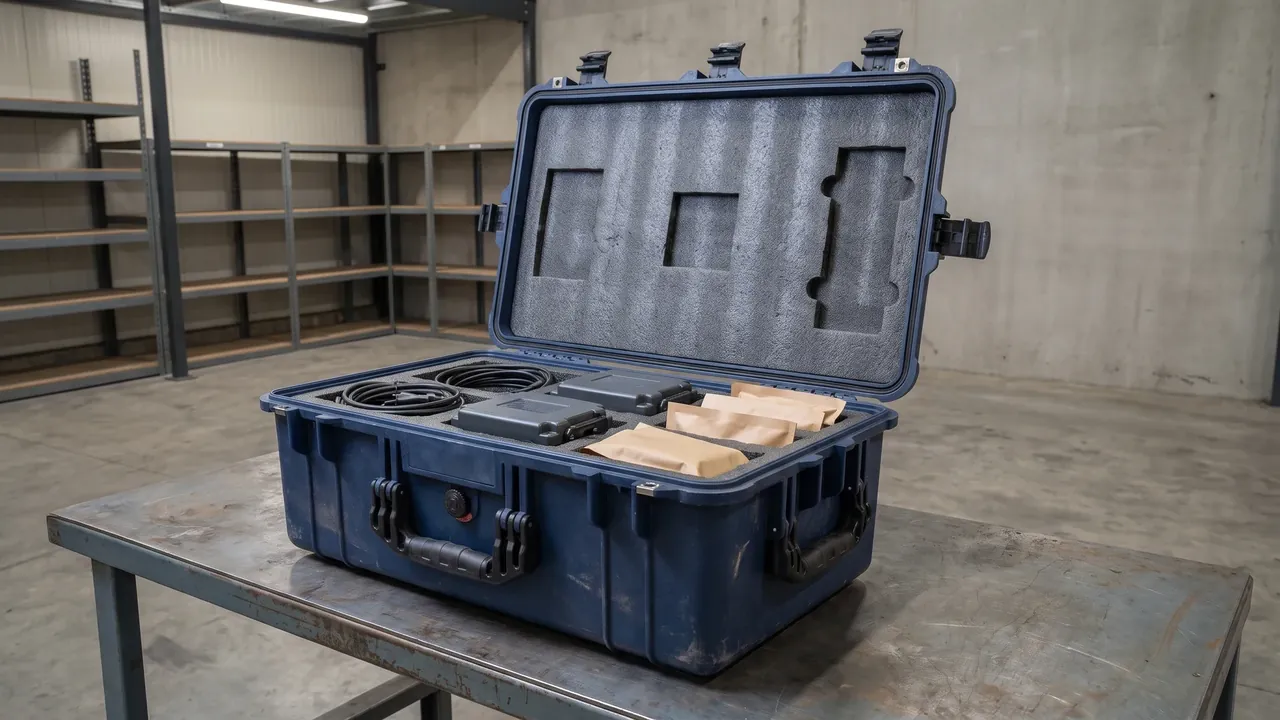
Sealing is the most important protection ability of a base station maintenance case. Under the equivalent standards GB/T 4208 and IEC 60529, IP67 means the enclosure is fully protected against solid objects of one millimeter or larger and can survive immersion in one meter of water for thirty minutes without ingress. For field repair, IP67 means sudden rain, wading a ditch, or vehicle splash will not wet the test instruments and spares inside. Achieving IP67 depends on a continuous elastic gasket around the lid, precise lid-to-body fit, and even clamp force after latches close. The gasket is usually EPDM or silicone rubber; EPDM resists ozone and weather, while silicone keeps better rebound in cold. Before shipment, the case should pass water immersion and spray checks. A typical practice is static immersion at one meter with the lid closed, then multi-angle spray at a set pressure, confirming no water trace enters. Note that the IP rating describes the closed and latched state; if the lid is not fully shut or the gasket ages and cracks, protection drops sharply. Over the service life, the sealing should be re-checked rather than assumed, because an aged gasket can pass a quick visual yet fail a pressure spray, so a quarterly immersion or spray check on a sample from the fleet is a low-cost insurance against water damage to expensive instruments. For the full definition of ratings, consult the IP rating guide and the IP67 protective case.
4. Liner System and Cut-Foam Trays
The shell solves outer protection, but the liner protects instruments and spares. A base station maintenance case liner usually has three layers: a bottom cushion that absorbs impact from the case floor, a middle die-cut foam or divider tray shaped to instruments and tools so each item has its place, and a top elastic retainer or mesh pocket that stops items jumping out when the lid opens. Common liner materials are cross-linked polyethylene foam, ethylene vinyl acetate foam, and polyurethane foam. EVA has adjustable hardness and can be thermo-textured for shaped slots; XPE rebounds well and tolerates a wide temperature range for the bottom cushion. For unusual antenna feeder analyzers or fusion splicer spares, a custom liner cut by computer-aided layout keeps the instrument fixed yet easy to lift with one hand. JUNZHIJIA can build custom liners from the actual instrument or a three-dimensional drawing, offering survey, prototyping, and batch fitting as one service so the liner, shell, and gasket form a matched whole. The payback of a well-made liner shows up quickly: fewer scratched instrument faces, faster pick time during a fault, and lower loss of small connectors that are easy to misplace. Liner design must also reserve a spare pocket and a cable coil zone so fiber jumpers are not crushed by sharp objects. For liner layout advice, see the communication equipment case guide.
5. Shock Absorption, Impact, and Transport Testing
Base station maintenance cases travel long distances on bumping service vehicles, and the precision instruments inside are most sensitive to vibration and drops. Vibration design covers three levels: material damping through the elastic foam layer absorbing high-frequency small-amplitude vibration; structural damping through buffer cavities at corners and feet spreading drop impact; and position damping through custom slots fixing instruments so they cannot collide. For verification, follow MIL-STD-810H Method 516 drop shock procedures and ISTA 3A transport simulation, performing free drops at typical heights and vibration sweeps on the loaded case, then checking instrument readings and appearance. Experience shows that after several drops on edges, corners, and faces, as long as latches and gaskets stay intact and the liner shows no permanent crush, the structure meets field transfer needs. Test data should be recorded as typical or experience values because load and road differ widely and a single number cannot be applied blindly. For vibration-sensitive instruments, add a damping sheet under the tray to cut resonance fatigue. When setting drop heights, use a weight-graded rule: light small cases take higher drop heights, heavy large cases take lower ones because heavier cases generate larger impact energy. Repeat verification under different load states. Beyond free drops, random vibration testing on a shaker table better represents long highway or rail transit, because real roads excite many frequencies at once and resonance can build where a single drop never would. Crews can also perform a simple field check without a lab: load the case as normally carried, shake it side to side, and listen for loose items; any rattle means the liner slot is too large and should be re-cut. Keeping a log of each verification, with date, load, and result, builds a maintenance history that helps predict when a case should retire. For transport simulation, read the field inspection equipment cases.
6. EMC Shielding and Antistatic Options
Base station sites have complex electromagnetic environments; some test instruments are sensitive to outside interference, and a case holding several wireless devices may couple internally. For this, high-end base station maintenance cases offer an electromagnetic compatibility shielding option: a conductive fabric or metallized textile lines the inner wall, and a conductive gasket sits at the lid closure, forming a near-Faraday-cage shielding cavity with typical shielding effectiveness in the tens of decibels, enough to suppress common broadcast, intercom, and base station leakage. Note that shielding requires continuous gasket overlap when the lid closes; any gap sharply cuts effectiveness. Meanwhile, if the case holds electrostatic-sensitive RF or optical modules, the liner surface can be antistatic treated to keep surface resistance in a controlled range and avoid damage from static discharge during handling. EMC and antistatic are optional by need; ordinary patrol cases need not force them, but prioritize them near equipment rooms or dense sites. For shielding parameters, see the communication electronics protective case. When budgeting, remember that a shielding version is not free: the conductive lining, the continuous gasket, and the tighter assembly tolerance all add cost, and the benefit is only realized where interference is actually present. A sensible middle path is to shield only the compartment that holds the most sensitive instrument and leave the tool compartment standard, which captures most of the benefit at a fraction of the cost. Crews should also be told that the shield is defeated the moment the lid is opened, so shielding protects stored transit, not active measurement, and live testing still needs site-specific interference management.
7. Latches, Hinges, and Pressure Equalization Valve
A reliable locking system keeps the case from opening by itself in the field. Base station maintenance cases usually use double or triple latch structures; latch bodies are often reinforced nylon over a metal core, resisting corrosion and cold brittle fracture. Higher versions add a latch cover and padlock loop so crews can seal the case with their own padlock and prevent tool loss in transit. Hinges should be embedded metal leaves or integral injection hinges; the former carries load and is replaceable, the latter has no exposed rivets and better sealing. Another overlooked detail is the pressure equalization valve: when a case moves from plain to high mountain, or from a cold vehicle to a warm room, the pressure difference can suck the lid shut or pull humid air into the seam. A breathable yet watertight membrane valve balances inside and outside pressure without breaking IP67 and suppresses condensation. JUNZHIJIA has accumulated experience in matching gaskets and valves by model, recommending suitable valve bodies and gasket combinations by case volume and working altitude. For latch and seal coordination, combine with the outdoor case waterproof design.
8. Casters, Tow Handles, and Stacking Structure
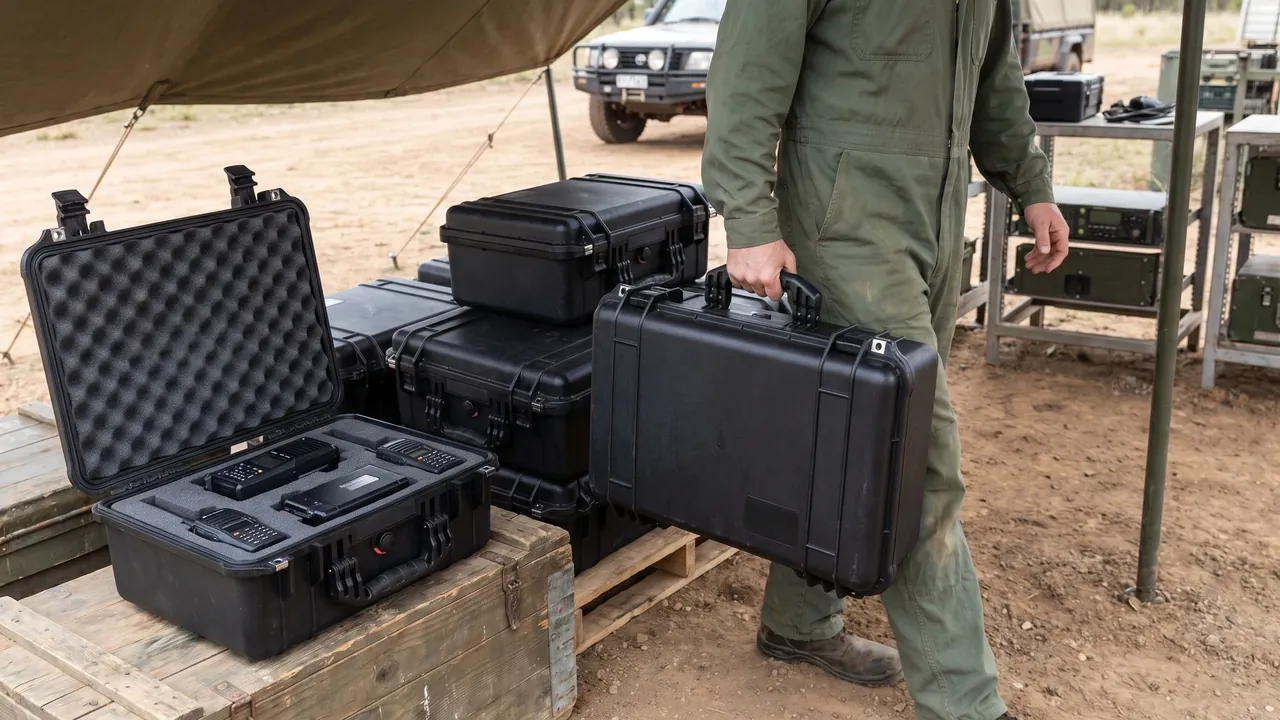
Base station maintenance cases move often between equipment rooms, garages, and service vehicles, so large models need casters and a telescopic handle to ease crew carrying. Casters should be braked swivel wheels with elastic polyurethane treads absorbing ground bumps and galvanized or painted rust-resistant frames; the handle should embed into the case reinforcement ribs to avoid root cracking from long pulling. Stacking matters too: the case top corners carry male studs and the bottom carries matching female seats so two cases nest precisely without side slip. Stack height needs evaluation against compressive strength; experience allows several layers of empty same-type cases, but loaded stacking should limit layers and avoid eccentric load. For vehicle transport, add reflective strips and strap loops on the case and secure it to the floor with tie-down straps to prevent sliding during hard braking. For fleets moving many network devices, see the telecom network equipment cases loading advice. A practical stacking rule is to group cases by weight class so a light case never sits beneath a heavy one, and to keep the stacked column within the vehicle width so it cannot tip during cornering. If the route includes unpaved access roads to remote sites, deflate caster pressure slightly for a softer ride and inspect wheels after each trip for embedded gravel that could seize the axle. Where space is tight, consider nesting an empty case inside a larger one only when the inner case is firmly blocked so it cannot shift and abrade the outer liner. Good stacking discipline reduces both case damage and the risk of a case becoming a projectile in a sudden stop.
9. Temperature Control, Condensation, and Humidity
Although a base station maintenance case does not actively cool or heat, sensible passive temperature and humidity control extends instrument life. On hot rooftops, dark shell surfaces can far exceed air temperature, so shade the case when not in use. In winter mountains, the closed-cell foam liner insulates against rapid cooling. Condensation is the hidden threat: a cold case entering a warm humid equipment room sweats on the inner wall and may seep along the seam. Beyond the valve in section seven, place controllable humidity desiccant packs inside and replace them regularly; humidity-sensitive spares can go in a sealed bag before entering the case. For long-stored spares, attach a temperature-humidity indicator card so crews judge at a glance whether dehumidification is needed. Another overlooked case is large day-night temperature swing mountain sites: daytime air expands, nighttime cooling may suck outside humid air in if the valve fails, so keep the valve membrane clean and free of oil. For brief open work on hot rooftops, keep a cover cloth and reset the lid quickly after taking parts. Where the case must stay open for extended splicer work, place it in the vehicle shadow and lift the lid only on the side away from direct sun, then close during any weather change. Humidity control deserves a routine: replace desiccant packs on a fixed schedule tied to season, more often in the rainy south and less in arid regions, and record the exchange date on the indicator card. Crews should also avoid storing wet jumpers inside the closed case, because trapped moisture will condense overnight and may reach connectors; instead air-dry cables before packing. For more strategies, read the 5G base station case.
10. Labeling, Asset Tracking, and Color Management
Maintenance units manage hundreds or thousands of cases, so scientific labeling and asset tracking avoid misplacement, loss, and expiry. Common practice is to etch or stick a QR asset code on the lid and register in and out by handheld terminal; color management distinguishes use, for example red cases hold emergency spares, blue cases hold test instruments, yellow cases hold general tools, so crews identify fast at night or in emergencies. The case face should also carry clear transport marks such as fragile instrument, keep dry, and this way up, plus the operator or tower company ownership mark. JUNZHIJIA offers screen printing, laser engraving, and labeling processes so marks survive outdoors without fading. Tracking and color management do not change protection but decide the case usability in the real operation system. For general methods, see the field inspection equipment cases. A concrete workflow that many tower companies adopt is to print a content list on the lid interior, so any crew opening the case sees at a glance what should be inside and can report missing items immediately; this simple step cuts the silent loss of small tools that otherwise disappear between dispatches. Color management also helps during joint operations where several contractors share a site, because a consistent color code prevents one team from walking off with another team's case.
11. Certification List and Procurement Acceptance
When buying a base station maintenance case, use verifiable standards and documents as acceptance basis rather than appearance alone. Buyers should state in the specification: protection grade IP67 per GB/T 4208 and IEC 60529; impact and transport adaptability per MIL-STD-810H and ISTA procedures; material flame class referencing UL94; hazardous substance limits meeting RoHS and REACH; and for export or outsourcing, supplementary CE files. At acceptance, require batch-matched test reports or typical value records and sample gaskets, latches, and liners on incoming inspection. JUNZHIJIA can provide matched gaskets by model and a fairly complete document system for archiving and audit. Standards are only thresholds; real life depends on material thickness, rib layout, and assembly process, so write verifiable structural parameters into the contract appendix. For standard systems, consult the IP rating guide and the communication equipment case guide. A useful acceptance trick is to ask for the test method, not just the passed grade: a supplier stating IP67 should explain the immersion depth, duration, and whether the test used the actual production gasket and closure, because a hand-built sample can pass while mass production drifts. Similarly, a flame class such as UL94 should name the specific rating level and the tested wall thickness, since the same material can rate differently at different thicknesses. Procurement teams that keep these details in the specification and the incoming inspection record build a defensible audit trail and reduce the chance of substandard cases reaching the field.
12. Customization Workflow and OEM/ODM Service
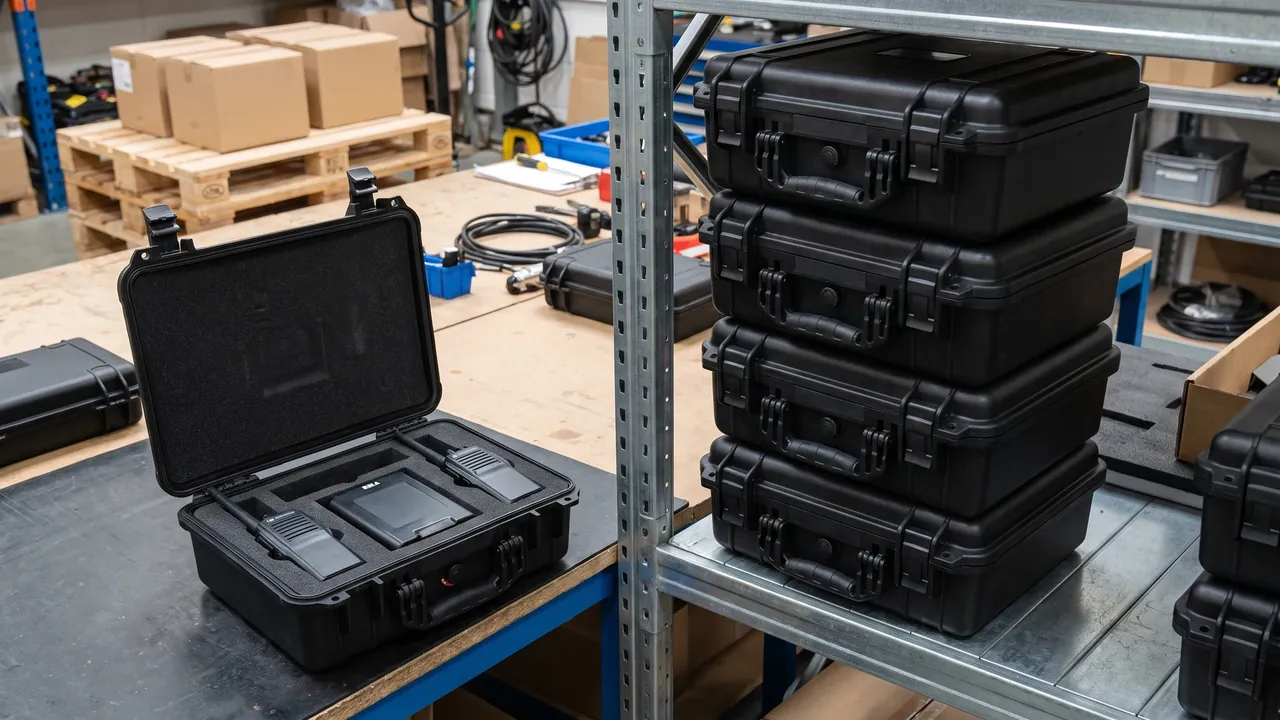
When standard sizes cannot hold special instruments or match crew habits, customization becomes necessary. A mature workflow has five steps: first, requirement research to clarify the load list, environment, and transport; second, three-dimensional modeling and liner layout to set zones and slots; third, prototype by rapid forming to verify open-close and pick feel; fourth, small-batch trial with typical immersion, drop, and salt spray verification; fifth, batch delivery with spare parts. JUNZHIJIA offers OEM to ODM cooperation depth, either contract manufacturing from customer drawings or participating in early structural design, and delivers matched gaskets, valves, and liner spares. The core risk of custom projects is tooling and lead time, so the contract should set minimum order quantity, first-sample confirmation nodes, and quality acceptance criteria to avoid rework. For general customization points, read the communication shelter case guide.
13. Daily Maintenance, Spare Parts, and Service Life
The case itself needs maintenance to keep protecting. Crews should build a simple check system: before each dispatch, inspect the gasket for integrity, debris, or cracks; monthly, lubricate latches and hinges lightly to avoid sticking; quarterly, do an immersion or spray check to confirm IP67 has not degraded; replace aged hardened gaskets with the same model. If the liner shows permanent crush or loose slots, re-cut or replace it so instruments do not shake in the slot. Wipe shell dirt with a damp cloth; avoid strong solvents that whiten the material. Experience shows that with standard use and periodic gasket replacement, a PP or PE case serves many years, far better than one-time paper or wooden packaging. Suppliers who stably provide gaskets, valves, and liner consumables greatly lower whole-life cost. For general care, see the communication equipment case guide. A spare parts inventory tied to the case fleet pays off: keep a small stock of gaskets, valve membranes, latch springs, and a spare liner section so a damaged case returns to service in days rather than weeks, and track consumption to forecast when a model is reaching end of life. When a case is retired, the liner and metal fittings can often be reused on a replacement shell of the same model, which lowers waste and cost. Treating the case as a maintained asset rather than a disposable box is what separates a fleet that looks good after years from one that falls apart after a single harsh season.
FAQ
Q: What size base station maintenance case is appropriate, and how do I set the volume from the crew kit? A: The first step in setting volume is to list the load clearly, weighing and measuring the test instruments, tools, connectors, and emergency spares. As a rule, a single-person daily maintenance crew can use a medium case around fifty centimeters long that holds an optical power meter, an antenna feeder tester, and common tools. Crews that carry a fusion splicer and several jumper reels should choose a large case over seventy centimeters or a wheeled version. The second step is to reserve twenty to thirty percent margin so later spare additions do not force a case change. The third step is to check the service vehicle trunk and rooftop passage size to avoid a case too large to move upstairs. Finally, do a physical trial fit to confirm instruments sit without shake and lift with one hand. Wrong size either fails to hold everything or makes the empty case too heavy, and both lower dispatch efficiency. Therefore size selection should follow the basic principle of fitting the load, being carryable, and leaving margin.
Q: Does IP67 sealing degrade with use, and how do I check and maintain it? A: IP67 describes the protection in the closed and latched state, and it is not permanent. The gasket under long-term ultraviolet, ozone, and temperature cycling will harden, crack, or take a permanent compression mark, and once a local failure appears the rating drops sharply. Daily checking is simple: before each close, run a hand along the gasket to confirm no sand, no crack, and normal rebound; monthly, shine a flashlight along the lid seam to spot any light leak. For maintenance, replace the gasket when its surface becomes sticky or hard, keeping the groove clean and the fit direction correct. Suppliers such as JUNZHIJIA usually match gaskets by model so crews can reorder quickly. Also avoid transporting in rain with the lid not fully pressed, which is key to prolonging gasket life. Crews should also keep a spare gasket kit matched to the model so a failed seal can be fixed on site rather than waiting for a return, and train new members to recognize the early signs of gasket fatigue during the weekly tool check. With regular checks and timely replacement, IP67 ability can be maintained for years.
Q: Is a custom liner necessary, and what differs between generic foam and die-cut liner? A: Custom liner is not mandatory for every scene, but a base station maintenance case loads fixed-shape precision instruments, and generic loose foam, though cheap, cannot fix instruments firmly, so they collide in transit. A die-cut liner cuts slots from the actual instrument or a three-dimensional drawing so each item has its place, ready to take when opened and fixed when closed, greatly lowering scratch and knock risk. The difference shows in three points: positioning accuracy, because cut slots fit the shape with little shake; pick efficiency, because fixed slots remove the need to search; and consistency, because batch liners are identical for easy rotation. For unusual antenna feeder analyzers or splicer spares, custom liner is nearly required. JUNZHIJIA can build custom liners from the actual item so the liner, shell, and gasket form a matched whole. With a tight budget, customize only the most expensive instrument first and use divider trays for the rest.
Q: When is the EMC shielding version of the maintenance case worth selecting? A: EMC shielding is not required for every crew; it suits two scenes. First, when the case holds several wireless devices or modules that may couple and disturb readings. Second, when the work point sits near equipment rooms or dense sites where external broadcast, intercom, and base station leakage are strong enough to disturb sensitive test instruments. The shielding version lines the inner wall with conductive material and sets a conductive gasket at the lid, forming a near-Faraday-cage cavity with typical shielding effectiveness in the tens of decibels. But any lid gap cuts the effect, so the shielding version demands tighter assembly tolerance and stricter daily closure. Ordinary street or rooftop patrols in calm electromagnetic environments need only the standard version. Selection should rest on field measurement and instrument sensitivity rather than blindly adding configuration. The shielding version also carries a small weight and cost premium and demands stricter closure discipline, so crews who choose it should be briefed that leaving the lid ajar defeats the design entirely. Related parameters appear in the communication electronics protective case shielding section.
Q: How high can maintenance cases stack, and what should I watch in vehicle transport? A: Stack height depends on shell compressive strength and whether loaded. Experience allows several layers of empty same-type cases, but loaded stacking should cut layers and avoid eccentric load, or the bottom lid may permanently deform and the seal fail. In vehicle transport, first tie the case to the floor with straps to prevent sliding during hard braking; reflective strips and strap loops on the case improve night safety. Stack up and down using the top stud and bottom seat so cases bite precisely without side slip. On long mountain roads, place the heaviest and most shock-resistant case at the bottom and the precision instrument case on top with extra cushion. After arrival, inspect shell appearance and latches before opening. When several cases travel together, label the stacked load so the needed case sits on top and need not be unstacked, and keep the heaviest cases toward the vehicle center to protect handling stability. Scientific stacking and tying protect both the case and the people and equipment inside the vehicle.
Q: For large cases with casters and tow handles, do wheels and handles break easily? A: Casters and tow handles are high-frequency stressed parts of large maintenance cases, and their life ties directly to material and mounting. Quality solutions use elastic polyurethane treads with rust-resistant frames and embed the handle root inside the case reinforcement ribs to avoid cracking from pulling; cheap solutions may use thin metal or ordinary plastic that loosens or falls off after long bumpy towing. To extend life, lift rather than drag over thresholds and stairs; regularly clear cable and sand from wheel axles; and fully retract and lock the handle after use. At purchase, require the supplier to state wheel frame material and handle load typical values, and do repeated extend-retract and roll tests at acceptance. A good supplier will also document the expected service life of wheels and handles under typical use so the crew can plan replacements rather than wait for failure. If a crew mostly loads by vehicle and rarely drags on ground, a heavy case with handles but no wheels may prove more durable.
Q: What stages and lead time does a non-standard base station maintenance case customization go through? A: Customization usually goes through five stages: requirement research, three-dimensional modeling, prototype, small-batch trial, and batch delivery. The requirement stage clarifies the load list, environment, and transport; the modeling stage sets zones and slot layout; the prototype stage verifies open-close feel by rapid forming; the trial stage does typical immersion, drop, and salt spray verification; then batch and spare delivery. Lead time depends on whether a new mold is needed: modifying the liner on a standard case may take only weeks, while a brand-new shell mold needs longer tooling and debugging. JUNZHIJIA can provide OEM to ODM cooperation depth and match gaskets, valves, and liner spares. To control risk, the contract should set minimum order quantity, first-sample confirmation nodes, and acceptance criteria to avoid rework that delays the schedule. A practical habit is to require the supplier to deliver a small spare parts kit with the first batch, containing spare gaskets, valve membranes, and a spare liner section, so field repairs do not wait on a new production run. The handover document should list every customized dimension and the liner drawing version, because a later repeat order must match the original to keep interchangeability across the fleet.
Q: What certifications or test documents does a base station maintenance case need, and how to accept at purchase? A: Buyers should write verifiable standards into the specification: protection grade IP67 per GB/T 4208 and IEC 60529; impact and transport adaptability per MIL-STD-810H and ISTA procedures; material flame class referencing UL94; hazardous substance limits meeting RoHS and REACH; and for export or outsourcing, supplementary CE files. At acceptance, require batch-matched test reports or typical value records and sample gaskets, latches, and liners on incoming inspection. Judging only by appearance or verbal promise is insufficient; write verifiable structural parameters into the contract appendix. JUNZHIJIA can provide matched gaskets by model and a fairly complete document system for archiving and audit. Beyond the single case, procurement teams should track certification expiry and keep a master list of which standard applies to which case model, so a future audit can show continuous compliance rather than a one-time pass. Standards are only thresholds, and real life depends on material thickness and assembly process, so verification must be concrete and repeated, not assumed from a certificate on file.