


A communication shelter case is a whole-case protective equipment case built for signal corps units, emergency communication vehicle crews, and satellite communication support teams that must keep mobile communication gear organized, dry, shielded, and instantly deployable. This article covers only the protective container itself, discussing shell materials, sealing, cushioning liners, electromagnetic shielding, stacking, and labeling from an engineering standpoint. It does not describe the electrical performance or technical parameters of any contained device. Where cross-border movement is involved, local regulations and export controls apply, and this text addresses the packaging container only. The broader framework of Communication Equipment Cases: Protection and Integration for Mobile Comms Gear supports this thinking, while Command Operations Case: Modular Integration of Field Command Equipment shows how case groups cooperate in command scenarios. Within the support system, the shelter case is both a transport unit and a turn-up node, and its container quality directly shapes how fast emergency communications can be established and how intact the equipment remains. A well-specified shelter case also reduces training burden, because crews learn one standard layout instead of many ad-hoc boxes, and it becomes a teaching aid as much as a storage aid in the field.
A shelter case that is specified along the full custody chain also lowers lifecycle cost, because fewer damaged assemblies and fewer lost items let the case pay for itself within a few deployment cycles, while a standard case family shrinks the inventory of case-specific consumables a depot must stock. Field evidence from communication units shows the biggest source of avoidable delay is not the repair itself but the search for the right module, which a well-planned case removes before the first connector is mated. Treating the case as a predictable asset rather than a variable risk is what separates a mature support chain from an ad-hoc one.
What a Communication Shelter Case Is For
The primary job of a communication shelter case is to give mobile communication equipment a stable, controlled, and rapidly deployable home so that support crews can restore links in minutes, whether during movement, bivouac, or post-disaster operations. Unlike a simple storage bin, a shelter case balances protection, shielding, and integration: protection means resisting drops, compression, rain, and dust; shielding means isolating external electromagnetic interference and containing internal radiation; integration means matching internal cells to device shapes so gear is ready to seat the moment the lid opens. For a vehicle crew, the case rides in the cab or bed, so it must survive vehicle vibration yet remain man-portable. For satellite support units, the case must shrug off altitude cold and salt spray, which pushes sealing and structure to the front of the specification. The first step in planning is to profile the devices by size, weight, and electromagnetic sensitivity, then choose case size and liner accordingly, rather than dumping everything into one large box. A shelter case should never be treated as a universal container; uses beyond its rated load or protection grade weaken reliability, so defining what it is not for is as important as defining what it is for. When the inventory grows, plan a small group of cases by trade instead of one oversized case that nobody can search quickly during a night breakdown. The same case standard also helps cross-point lending, because a relieving crew can take over a known layout without a lengthy familiarization tour, which matters most during surge tasking when time is already against the unit. A documented layout also shortens the handover briefing, because the incoming shift can be told "bay three, top cell" and act without ambiguity.
Shell Materials: ABS, PP, and Aluminum
The shell material decides weight, stiffness, and weather resistance. ABS engineering plastic holds tight dimensional tolerances and takes surface finishing well, which suits injection-molded shells where the liner must seat precisely. PP polypropylene offers superior toughness and low-temperature impact resistance, and at equal wall thickness it is lighter, making it a favorite for cases carried by hand every day. Aluminum delivers the highest stiffness and can also serve as a structural layer for electromagnetic shielding, but adds weight and cost, so it is usually reserved for fixed or heavy-duty storage. A broader discussion of materials and molding appears in Case Shell: Structural Materials and Molding Process of Protective Cases. In practice, communication points lean on PP or ABS injection shells because they balance moisture resistance, drop survival, and cost; when shielding is required, an aluminum shell with a shielding liner is evaluated, but this article stays at the container level and does not discuss the electrical behavior of any contained device. Material choice should also match the temperature range: cold regions favor PP for crack resistance, while rigid support needs may justify aluminum after a proper review. Wall thickness and rib design matter as much as the resin grade, so request a cross-section drawing before committing to a large batch order for the field. For cases living outdoors for years, add UV-stabilized resin and corrosion-resistant hardware to the specification, and list metal fittings as consumables so lifecycle cost stays predictable. Where the case must also serve as a shielded enclosure, specify the aluminum option early, because retrofitting shielding into a plastic shell is far more costly than choosing the right base material at the start. A clear material decision at procurement also simplifies the spare-parts list, since the depot then stocks one family of seals and latches for the whole fleet of cases.
Moisture Control and Sealing
Moisture is a leading threat to comms gear, especially during rainy seasons and sea freight, because internal condensation directly raises the risk of faults in electronic assemblies. Effective moisture control uses two paths together. First, the Case Seal Strip: The Key Waterproof and Dustproof Accessory for Protective Cases forms a continuous seal face once the lid closes, blocking outside humidity. Second, a desiccant pouch or humidity indicator card inside the case absorbs residual moisture and signals its state. Seal strips are typically elastomers whose compression set and aging cycle matter; once they lose rebound after long compression, the seal fails. For the structure behind immersion protection, see Waterproof Cases: Sealing Structure & Immersion Protection, and for what the rating code actually means, What Is an IP67 Protective Case? Core Protection and Selection. The seal protects only the interior volume; this article does not discuss the electrical stability of any contained device. In salt-spray or very humid sites, inspect the seal seam for continuity and swap the desiccant once saturated, so moisture control stays a closed loop rather than a one-time setup. For equipment bays needing a higher airtight grade, a secondary seal lip inside the lid gives a redundant barrier if the main seal is compromised, further lowering condensation risk during long storage.
Cushioning Liner and Zoned Storage
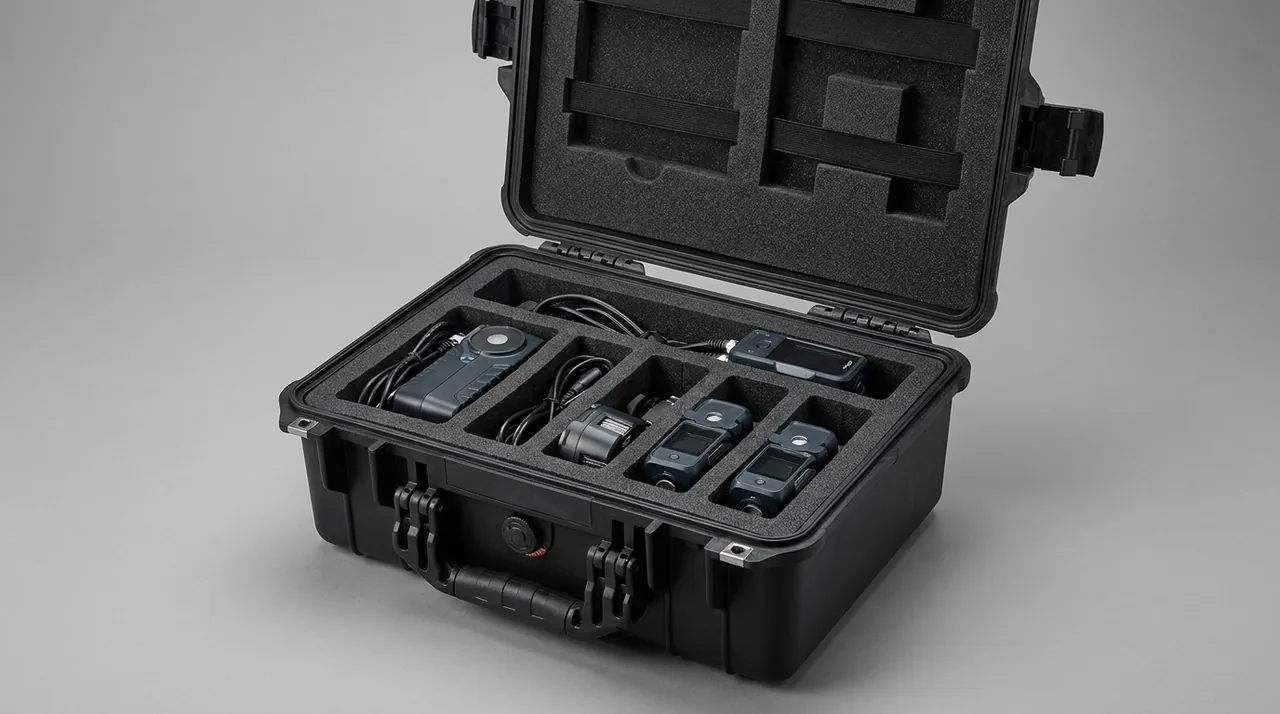
Comms gear includes power amplifiers, filters, and connectors that are fragile to shock, and vibration during transit is a leading cause of hidden damage. Cushioning relies on the Case Foam Lining: Cushioning and Customization of Case Interiors, where cutouts lock each device in its own cavity so nothing collides. For mixed inventories, the Can You Add Dividers to a Protective Case? Designing a Removable Divider System approach lets crews reconfigure cells without new tooling. Zoned storage lowers damage and also supports inventory: each cell maps to a label, and the location code matches the device number. Liner materials commonly include EVA and PE foam, which differ in rebound and moisture uptake, and the maker should recommend density based on device weight and shape. A good liner also leaves buffer margin so that on a drop the foam deforms and absorbs energy instead of passing the shock straight to the gear. Layered liners keep heavy power units below and light control modules above, preventing crush damage and easing retrieval in the order the gear is actually brought online during a turn-up.
Electromagnetic Shielding and Interference Isolation
Mobile communication gear is sensitive to the electromagnetic environment; strong external interference can couple into the link, while the gear's own radiation can pollute nearby channels. A shelter case achieves interference isolation through shell and liner shielding: an aluminum shell itself forms a continuous conductive cavity, and with a conductive seal gasket it creates a Faraday-cage effect once closed; for non-metallic shells, a shielding fabric or conductive coating on the inner surface provides the isolation. It must be clear that shielding is a container-level engineering measure; this article does not judge the electromagnetic compatibility of any contained device, and related compliance follows local regulations and industry standards. For the system logic behind shielding design, see EMI Shielding Cases: Interference Isolation for Sensitive Electronics. In practice, shielding effectiveness depends on the continuity of seam treatment, so the clamping force of the conductive seal and the cleanliness of the overlap surfaces belong in routine maintenance. For devices with antennas or exposed ports, the case should provide a non-metallic observation window or filtered feed-through, keeping the shield intact where cables cross, so the penetration does not become a leak point.
Rapid Inventory: Labels, Locations, and QR Codes
Rapid inventory is what separates a shelter case from an ordinary toolbox. When a crew must confirm in seconds whether a certain RF module is in the case before departure, the labeling system has to be both human readable and machine scannable. The baseline is a weatherproof label per cell showing name, model, and quantity. The advanced route adds Digital Management for Protective Cases: Asset Numbering and QR Code Traceability, giving each case and each cell a unique QR code that a handheld terminal scans for check-in and check-out. Efficiency comes from standardization: fixed locations, uniform labels, and one coding rule, so any shift can search by the same logic. Across multiple cases, QR codes also link transfer records between boxes, preventing both duplicate purchasing and silent shortages. Label stock should resist oil and abrasion; silk-screened category words on the shell aid distant recognition. The count process itself belongs in the support spec, stating when weekly, monthly, and pre-departure checks fire, so the QR system becomes a daily habit rather than a shelf idea. When labels wear out, the replacement must follow the same template, or the coding discipline slowly erodes and the system loses its speed advantage.
Classifying Critical Gear and Planning Locations
Good classification lifts a case from "it fits" to "it is found." Useful dimensions are function, consumption frequency, and criticality. Frequently changed items belong in the top cell reachable on opening the lid; critical-path devices deserve a locked or isolated cavity to prevent mis-pick. Location planning can borrow the long-term keeping principles from Storage Cases: Long-Term Keeping and Warehouse Management, pushing low-frequency items down and high-frequency items forward. For standard connectors and joints, the cell logic of Screw, Nut & Bearing Parts Boxes: Fastener Sorting transfers directly into the liner grid of a shelter case. Classification is not one-time; the support point should adjust locations from turn-up records so the contents always track real consumption. When the device count grows, expand the case group horizontally before stacking one box taller, preserving reachability and count speed so a single case never turns into an unsearchable clutter bin. A simple rule of thumb is that no cell should need more than two moves to reach, which keeps even a fully loaded case fast to serve during an unplanned outage at night.
Stacking, Transport, and Shock Protection
Shelter cases are stacked in warehouses and trucks, and stack stability depends on the Case Stacking Corner: Load-Bearing and Alignment Hardware for Stacked Cases at the four corners, which carries inter-layer load and provides an alignment stop to prevent drift. For general stacking method, see Stackable Cases: Warehouse Turnaround & Stacking Protection. Transit vibration is absorbed by shell stiffness and liner together; Shockproof Cases: Cushioning Structure & Impact Isolation Design explains buffer layering. Stack layers must respect the rated stack load, because overload crushes the lower seal strip and causes hidden deformation, so every load should be weighed and height-checked, and the cases tied down in the vehicle to stop horizontal slide. For long-haul rides, consider the road spectrum and vehicle suspension, and add an anti-vibration pad between case and vehicle when needed, cutting high-frequency transmission to the gear and extending its usable storage window inside the controlled container. Document the stack height limit on the case face so temporary handlers do not exceed it under time pressure at the loading dock.
Temperature, Humidity, and Safety Stock
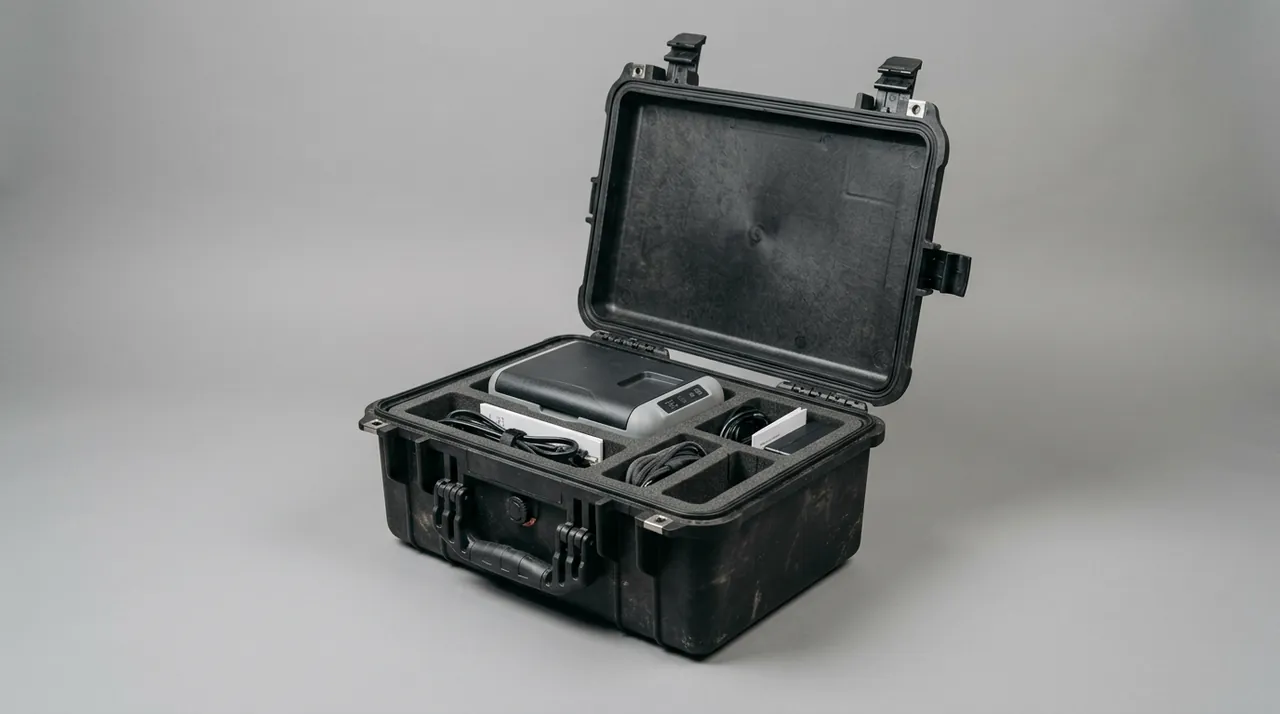
A shelter case is also a micro inventory node for the support point. The safety-stock thinking in How Should Protective Case Inventory Be Planned? Setting Safety Stock for Common Specifications applies directly to minimum quantities of critical gear inside the case. With a humidity indicator or small logger, crews catch an abnormal interior environment early, for example when desiccant fails and humidity climbs. How Should Protective Cases Be Stored? Moisture and Sunlight Rules for Warehousing stresses that single-case protection and warehouse environment management are complementary. Safety-stock numbers should be derived from consumption history and replenishment lead time, not guessed, so that busy periods do not run dry and quiet periods do not pile up excess. For seasonally driven gear, use dynamic safety stock and raise the floor before peak tasking. Logger curves also serve as evidence for later quality tracing, proving the gear stayed in a controlled environment across storage and transit. Pairing the case with a small consumable list lets the crew reorder desiccant and seals on the same purchase order, which avoids a later scramble when the indicator first turns pink during a deployment.
Latches, Stacking Corners, and Transit Fixing
In transit the case must resist both theft and accidental opening. Case Latch: Pressure and Theft Resistance Hardware for Protective Cases covers latch pressure and anti-theft design. A press latch suits daily use, while a latch with a hole accepts a cable seal or padlock for accountable scenarios. Stacking corners were discussed above; together with latches they form the external skeleton: latches govern opening, corners govern stacking. For transit fixing, straps should pass through handles or dedicated slots so the case stays put under hard braking and rough roads, avoiding knock-on between cases or against the vehicle wall. For a case fixed long term in a vehicle, anti-slip feet cut resonance transfer. At a shared support point, the seal number and handover record should enter the ledger so every opening traces to a responsible person, which deters theft and wrong picks alike and raises the overall closed-loop management level. Inspect latch tongues for cracks at each quarterly check, because a failed latch mid-transit can spill the entire liner and turn a controlled inventory into a roadside recovery job.
Protection Grades and Certification: IP67, GJB, MIL-STD-810H
Common certification keywords are IP67, GJB, and MIL-STD-810H. IP67 means the case can survive limited-depth immersion without ingress, a direct measure of sealing. GJB sets domestic defense compliance and environmental and mechanical test requirements, detailed in GJB Military Standard Cases: China Defense Compliance & Testing. What Does MIL-STD-810 Testing Cover? How Protective Cases Comply walks through temperature shock, vibration, and drop logic. Certification verifies the container under given conditions; this article does not judge whether any contained device meets trade or export control, which follows local law. Buyers should request the original test report rather than trust a nameplate when comparing grades. Under the same rating, makers differ sharply in seal structure, wall thickness, and latch count, so the specific test conditions in the report beat the code alone as a decision input for procurement. A useful habit is to keep a one-page summary of each certificate next to the case ledger, so auditors and new staff can confirm the protection grade without hunting through filing systems during an inspection.
Standardized Storage and Transport as an Equipment Case
A shelter case is one member of the equipment case family, and its value multiplies under standardized handling. Field Camp Case: Living and Equipment Storage for Field Bivouac shows case groups cooperating during field training; Logistics Support Box: Modular Resupply Configuration stresses organizing resupply by module. Through Reusable Shipping and Storage Container: Economics of Returnable Logistics, a depot can cycle the same shelter cases between warehouse, vehicle, and site, cutting one-way packaging waste. Standardization also means unified box type, label, and liner module, so batches bought later swap cells and parts, shrinking the count of non-standard items on the support chain and raising response speed. When several trades share one case standard, cross-point gear transfers and temporary loans become feasible, further compressing prep time and improving asset use across the whole support chain. This standardization pays off most during surge demand, when a known case layout lets a relieving crew take over without a lengthy familiarization tour of an unfamiliar box.
Maintenance, Cleaning, and Consumable Replacement
A shelter case is durable but not maintenance-free. Where Can You Buy Protective Case Spare Parts? A Consumable Stocking List lists seal strips, latch tongues, and handles to keep on hand. Routine care includes checking the seal for deformation, clearing liner dust, and confirming label clarity; replace the strip when it hardens or the latch loses rebound. How to Avoid Procurement Pitfalls When Buying Protective Cases: Ten Common Quality Problems helps catch thin walls and weak latch welds at intake. How Long Do Protective Cases Last? The Key Factors That Decide Durability reminds that life depends on material, frequency, and environment, and that clean, correct storage extends service greatly. Clean with neutral detergent, avoiding strong solvents that attack seal and shell; before long idle, dry the liner, refresh the desiccant, and store the case off the floor in the depot so it is in good shape at next activation, keeping the shelter case ready rather than forgotten. A disciplined maintenance routine also protects the shielding continuity, because conductive seals and overlap surfaces are exactly the parts that degrade first and silently, so they deserve the same attention as the shell itself. Inspecting those parts on a fixed schedule turns a hidden weakness into a scheduled, inexpensive replacement before any field failure occurs. A short maintenance card slipped into a clear pocket on the lid gives any handler the checklist at the moment they open the case, which is when maintenance is most likely to actually happen.
Common Questions
Q: How is a communication shelter case different from a normal equipment case? A: The difference lies in the support goal and the container design focus. A normal equipment case stores general instruments and prizes quick access and portability. A shelter case exists to keep mobile communication gear rapidly deployable and intact, so it emphasizes whole-case protection, electromagnetic shielding, shock isolation, and rapid inventory. At the container level, a shelter case usually carries a fuller seal, a zoned liner, a shielding layer, and location labels, sometimes a QR asset code, whereas a normal case is often an open rack. For a support unit, choosing a shelter case means standardizing and digitizing the equipment dispatch step, which shortens set-up time and improves stock visibility. This article covers only the container structure and does not address the technical parameters of any contained device, and where trade rules apply, local law and export control govern the rest. Procurement, acceptance, and ledger should also be kept separate from ordinary tool management, because mixing consumables and devices distorts the count and hides real shortages on the support line. In practice a vehicle crew often needs both, but the shelter case is the one that travels to the outage rather than waiting at the bench.
Q: Which shell material should I choose for a shelter case? A: Shell material is a trade between weight, stiffness, and cost. ABS injection shells hold tight tolerances and finish well, suiting liners that must seat precisely. PP polypropylene is tougher, survives low-temperature impact better, and weighs less, which fits cases carried daily in a vehicle. Aluminum is stiffest and can also serve as a shielding structure layer, but heavier and pricier, usually for fixed heavy storage. For most comms points, PP or ABS already balances moisture and drop resistance, and shielding needs trigger an aluminum-plus-liner review. Consider the temperature range and possible salt spray, and add surface treatment for weather resistance when needed. Material choice affects only the container; this article does not discuss material compatibility of contained devices, which follows local regulation and export control. In cold regions PP's crack resistance stands out; for shielding or load-bearing structure, review a metal option only after the requirement is proven, never by default assumption. Also compare wall thickness and rib design between suppliers, because the resin grade alone does not tell the whole story of field behavior.
Q: What is the effective way to keep a shelter case dry? A: Effective drying combines sealing and absorption. First, the lid seal strip forms a continuous face when closed, blocking outside humidity, and the strip must be checked regularly for rebound and aging. Second, a desiccant pouch or humidity card inside absorbs residual moisture and shows its state. In very humid settings, consider a secondary seal on the lid or a higher-grade shell, and for bays needing high airtightness add a redundant seal lip. Drying protects only the interior volume and cannot change how a contained device absorbs moisture, so open the lid briefly and close it fast. For cross-border or special-environment moves, follow local regulations and export controls; this article discusses only the packaging container's protection design. Once the desiccant saturates it must be replaced, and with the humidity card reading it forms a closed-loop record that truly keeps relative humidity inside the case within a safe band for the gear. Logging each open-close with the card reading turns a vague feeling of dryness into an auditable condition that survives inspection weeks later.
Q: How is electromagnetic shielding achieved at the container level? A: Container-level shielding relies on a continuous conductive path across the shell and seams. An aluminum shell forms a conductive cavity, and with a conductive seal gasket it creates a Faraday-cage effect once closed; a non-metallic shell can use a shielding fabric or conductive coating on the inner surface to achieve isolation. The key to shielding effectiveness is the continuity of seam treatment, so the clamping force of the conductive seal and the cleanliness of the overlap surfaces belong in routine maintenance. For devices with antennas or exposed ports, the case should provide a non-metallic window or filtered feed-through so cables cross while the shield stays intact, avoiding a leak point. It must be clear that shielding is a container engineering measure; this article does not judge the electromagnetic compatibility of any contained device, and related compliance follows local regulations and industry standards. Under the same shell, makers differ sharply in overlap craft, so request measured shielding data rather than trust marketing claims when comparing grades.
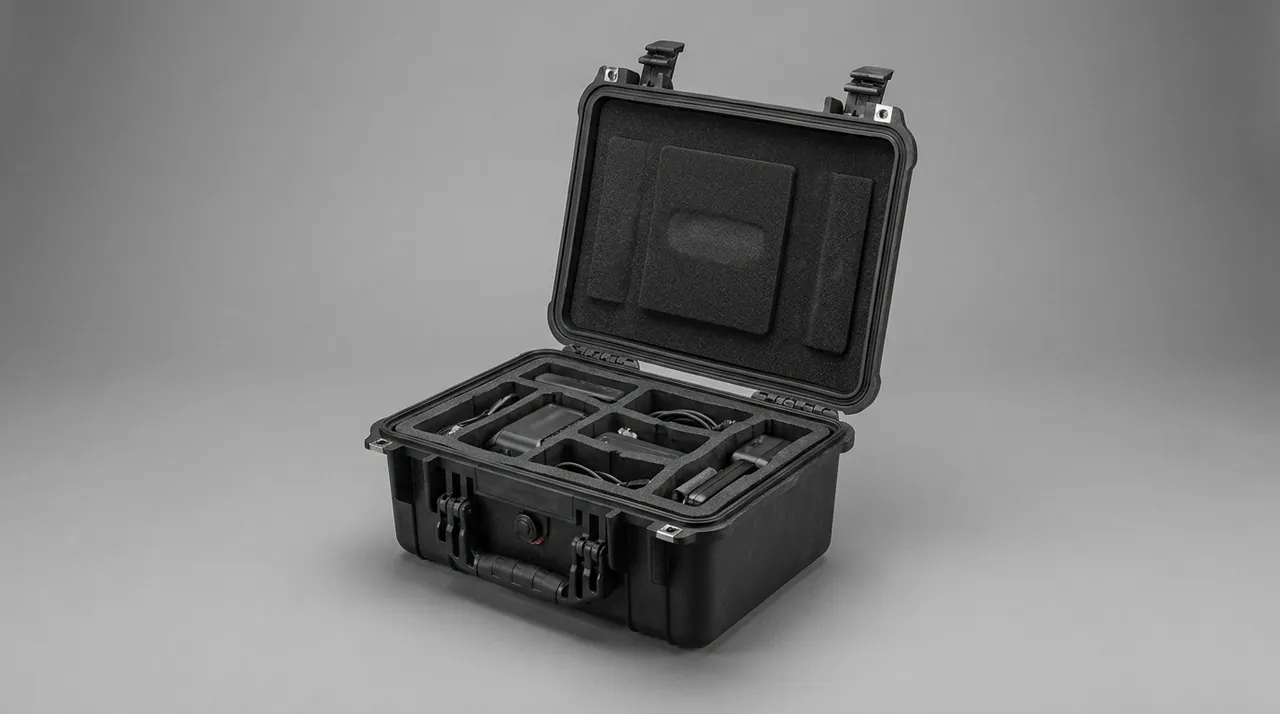
Q: How should the foam liner be arranged to cut gear damage? A: The key is a separate, fitted cavity for each device. Mill or cut the foam so fragile units sit in their own pockets and cannot clash during transit; for irregular shapes use layered liner with light control modules on top and heavy power units below. EVA and PE foam differ in rebound and moisture uptake, and density should match device weight. An adjustable divider system suits changing inventories without new tooling. The liner should also reserve a label spot per cavity so cells map to codes for easy counting. The liner gives only mechanical buffering; this article does not cover electrical or chemical protection of contained devices, which follows local rules. Under drop conditions the foam's compression absorbs impact energy, so foam thickness and density should be designed against the drop height the case may face, not filled at random, or the cushion will bottom out and pass the shock through. Where one case serves several trades, color-coded inserts let crews swap the interior for the day's mission without losing the outer shell's standardization.
Q: What real help does a QR inventory system give a shelter case? A: A QR system turns "person hunts gear" into "system guides person to gear." Once each cell or device has a unique code, a handheld terminal scans check-in and check-out, and the system updates stock and flags shortages automatically. Across several cases, QR codes also link transfer records, avoiding both duplicate buys and silent gaps. The payoff shows in three ways: quick confirmation that a critical device is present before departure, instant write-off after turn-up, and monthly counts that become scans instead of manual checks, cutting error rates sharply. Deploy with one coding rule written into the support spec so every shift operates the same way. This article covers only the container-side labeling scheme, not the information rules for any contained device. Compared with barcodes, QR carries more data and tolerates smudges better, which suits greasy field environments where labels get dirty fast. The discipline only pays off if replacements follow the same template, or the coding quietly erodes and the speed advantage disappears.
Q: What should I watch when stacking shelter cases? A: Stack safety rests on the corner stacking hardware and the rated load. The stacking corner gives an alignment stop and carries inter-layer load, preventing drift; each layer's total weight must stay under the rated stack load, or the lower seal strip is crushed and hidden deformation follows. Weigh and height-check every load to avoid an unstable tall stack. In a vehicle, tie stacks down so hard braking cannot slide them into case-on-case knocks. For long storage, follow moisture and sunlight rules: lift off the floor and avoid direct sun to slow material aging. Stack parameters apply to the container only; this article does not judge stacking safety of contained devices, which follows local law. Before stacking, also inspect the four corners for intact stops, because worn alignment lugs weaken positioning and should be replaced with spare corner hardware on schedule. Mark the height limit on the case face so temporary dock handlers do not exceed it under time pressure during a busy load.
Q: Can the latch on a shelter case provide theft resistance? A: The latch's role is to delay unauthorized access rather than to defeat a determined thief. On one hand it provides the closing clamp force that keeps the lid from popping open in transit; on the other hand an embedded lock core or an external padlock restricts casual opening. In field or shared-storage scenarios, choose a catch latch with an anti-mistake catch that stays reliably closed yet opens fast in an emergency. For accountable scenarios, a latch tongue with a hole accepts a cable seal or padlock, and the seal number plus handover record enters the ledger so every opening traces to a responsible person, deterring both theft and wrong picks. Real high-value protection should combine storage management with asset binding rather than rely on a single case's latch strength, which is the closed-loop logic that keeps the whole support chain honest. Pairing the case with a small consumable list lets the crew reorder seals and latches on the same purchase order, which avoids a later scramble when a lock fails during a deployment far from supply. The latch is also the component most exposed to abuse at the loading dock, so a brief visual check at every handover catches a cracked tongue before it becomes a roadside spill.