

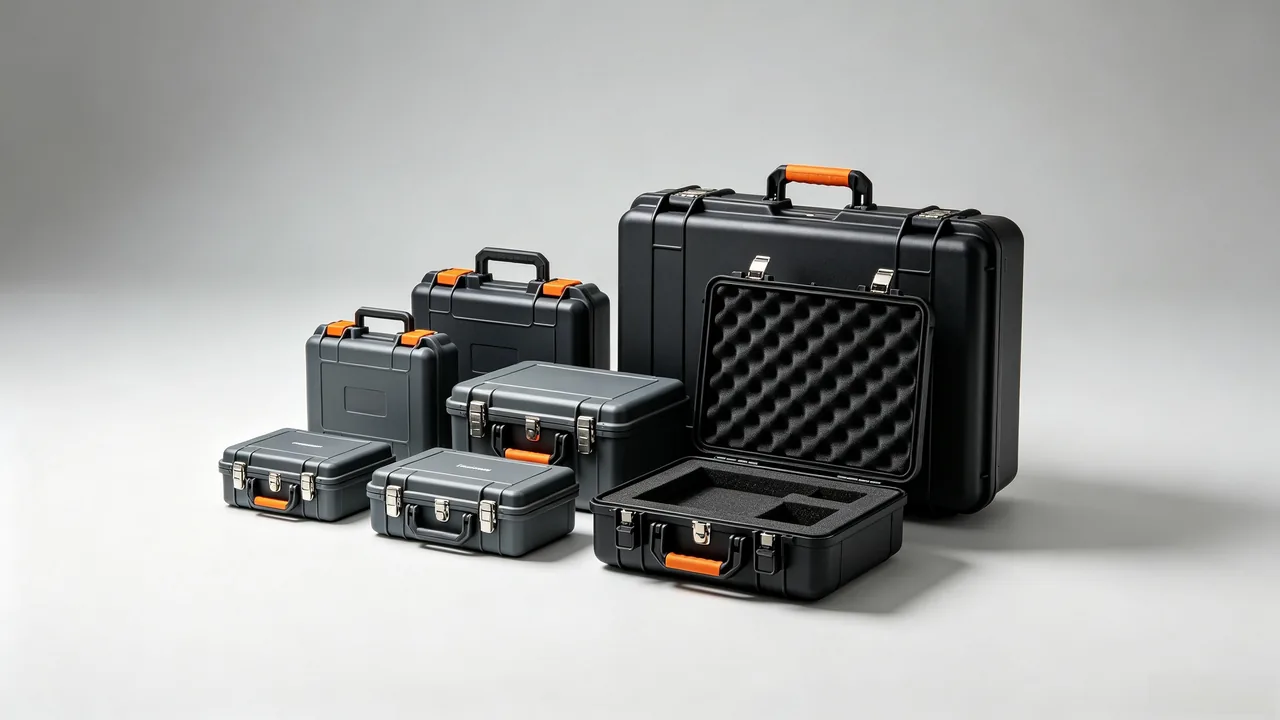
The word "tool box" covers an extraordinarily wide band of products. At one end sits a cheap moulded plastic organiser; at the other, an industrial container whose load rating has to be verified before a forklift is allowed near it. Both get called by the same name, and that naming failure causes real procurement damage. A buyer asks for a sturdy tool box, the seller quotes an injection-moulded hand carry case, and the mismatch only surfaces when the delivered goods have to survive rain on an outdoor pad or be lifted by machine. The only reliable way to avoid this is to establish a classification framework first, place the requirement inside it, and discuss materials and price last. This article follows that order.
JUNZHJIA builds protective containers and has seen a great deal of re-work caused by unclear classification. The pattern is consistent: once three axes are fixed, the choice of material and process largely resolves itself, and the remaining argument is about cost against service life. Everything below concerns the container only, covering shells, cabinets, liners, latches, seals, cushioning, stacking, lifting, marking and the associated approvals.
Why Classification Comes Before Material Choice
Most procurement conversations open on material: plastic or metal, how thick, how strong. Those questions cannot be answered in isolation, because material is a means rather than an objective. The same injection-moulded shell that serves for a decade in a workshop can chalk and embrittle within two years on an open storage pad exposed to sunlight and rain. The same stainless steel sheet that is over-specified for a small instrument box has to be re-checked entirely when the container grows large enough for two people to lift.
Classification matters because it forces three questions to be answered first: where the product will be used, how it will be moved, and what it must be protected against. Those three answers map cleanly onto three groups of design parameters. Carry method governs handles, telescopic arms, wheels and load path geometry. Working environment governs sealing grade, temperature window, ultraviolet resistance and corrosion strategy. Protection requirement governs wall thickness, liner design, cushioning and latch strength. Once those are settled, only one or two material options survive, and that is the right moment to compare prices. Comparing quotations before classification produces two figures that are not actually comparable.
Sorting by Carry Method: Hand, Shoulder, Towed and Fixed
Carry method is the easiest axis to judge because it corresponds directly to a human action. Hand carry is structurally the simplest: a short load path, low cost, suited to short and infrequent moves, limited by grip strength. Shoulder carry transfers load onto the torso, allowing greater mass and longer distances, at the price of a strap, buckles, and tension-bearing features on the shell, which need particular care when they sit near a sealing face. Towed transport hands the load to the ground and effectively removes the vertical limit, but introduces wheels, a telescopic arm and questions of ground compatibility, all of which complicate the base structure.
Fixed containers are a different category: not designed to be carried regularly, but to sit in place for long periods while resisting stacking load and external forces, such as workshop cabinets and storage bins. Their design emphasis shifts from carrying to static load, stability and access flow. The four categories are not mutually exclusive. Many products combine hand and shoulder carry, or towing with hand carry, but a hybrid always requires two sets of load-bearing structure and therefore carries somewhat more mass and cost than a single-mode product. The specific balance between weight and volume on hand-carried products is addressed in Portable Tool Box: Balancing Carry Weight and Capacity.
Sorting by Work Environment: Household, Industrial, Outdoor and Vehicle
Environmental classification exists to write physical stress into the requirement. Household use is mild: indoor, ambient temperature, occasional light knocks, no hard sealing requirement, so the design emphasis falls on organisation and appearance. Industrial maintenance adds oil, chemical solvents, metal dust and frequent handling, which raises demands on chemical resistance, cleanability and structural durability, and usually requires the box to work as part of a wider system with cabinets and carts. Outdoor use layers on rain, ultraviolet radiation, thermal cycling and ground impact, making the sealing grade and ageing resistance decisive criteria.
Vehicle use is often lumped in with outdoor work, but its stress profile is genuinely different. The dominant threats are sustained vibration, high summer cabin temperatures, and displacement under emergency braking. Continuous vibration loosens fasteners and accelerates liner wear; heat causes creep in some polymer shells under sustained load; braking displacement requires either restraint points or a high-friction base. Once these stresses are separated, it becomes clear that no single box optimises all four environments. The better strategy is to select for the primary environment and cover secondary needs with accessories. A comparison of type against scenario is given in What Are the Common Types of Tool Boxes? How to Choose by Use Scenario.
Sorting by Form: Single Unit, Stackable and Drawer Cabinet
Form classification is about how space is organised. A single-unit box has one interior volume or an upper and lower tier; it is simple, easy to seal, and convenient to carry alone, but its space efficiency depends entirely on the liner, and retrieval slows down as the tool count grows. A stackable system consists of units that locate on one another, letting the user build the set they need, carry it layer by layer and store it densely; the cost is that the interlocking features must carry the stacking load, and the system as a whole cannot be sealed. Drawer cabinets use slides and give the fastest access and the clearest division, suited to fixed workstations, but the slides are the weak point and need specific design attention for transport and vibration.
The selection rule can be stated simply: choose single unit where the box moves often, stackable where storage density dominates, and drawer cabinet where access speed matters and the location is fixed. Real workshops usually combine all three, with a cabinet at the fixed bench, single-unit boxes for field work, and stackable units for stock rotation. Once the form is decided, the sealing concept and liner architecture follow naturally. Set-based organisation, where the box is built around a tool list rather than a volume target, is discussed in Tool Kit Chest: Set-Based Organization Logic.
Sorting by Protection Level: Storage Box versus Protective Case
The most important line to draw within the family is between ordinary storage and genuine protection. A storage box is designed to shade, divide and ease handling; typically it claims no sealing grade, specifies no drop height and undergoes no environmental testing. A protective case is designed to safeguard contents under defined severe conditions, which means a declared IP rating, stated drop and vibration test methods, a stacking load, a temperature window, and traceable test records.
The dividing line is not visible; it lives in the technical documentation. Four questions establish which side a product sits on. Is there a declared IP rating with a stated test method? Is there a drop or vibration test report? Is the gasket a compressible continuous closed loop with latches whose engagement can be adjusted? Has the shell been checked against a defined stacking load? Only when all four can be answered is it meaningful to call something a protective case. Using a storage box in place of a protective case usually damages the contents rather than the container, and those failures typically appear in the field long after the purchase decision has been signed off.
Metal Shells: Steel, Stainless Steel and Aluminium
Metal containers have the longest history and the most obvious advantages: high stiffness, large load capacity, heat tolerance, puncture resistance, and a mature process base for welding, riveting and machining. Cold-rolled steel with paint or zinc coating is the economical mainstream choice for workshop cabinets and heavy bins; its weakness is that once the coating is breached, corrosion starts at that point and spreads, so maintenance is ongoing. Stainless steel resists corrosion far better at the cost of material price and fabrication difficulty, and it is heavy. Aluminium is lighter than steel at comparable stiffness, resists corrosion better than plain carbon steel, and offers a wide range of surface finishes, making it common for vehicle-mounted and mobile containers; its weakness is low local bearing strength, so bolted joints tend to crush and loosen.
The critical design points in metal construction are joints and corrosion protection. Welding creates a heat-affected zone and should be kept away from highly stressed regions, because a continuous weld there concentrates stress. Riveted and bolted joints require control of bearing stress at the hole. On corrosion, coating systems are only part of the answer: drainage and ventilation matter too, because a sealed metal container that accumulates condensation will begin rusting from its lowest point. Practical treatment and maintenance guidance for rusted metal boxes appears in Rust on a Metal Toolbox: How to Remove It and How to Stop It Coming Back.
Plastic Shells: Injection, Blow and Rotational Moulding
Plastic containers are not one process but three, and they differ substantially. Injection moulding forces molten polymer into a closed tool, giving high dimensional accuracy, good surface finish, support for complex features and low unit cost at volume; it dominates small and mid-size tool boxes, and its limitation is that large parts need very large tools and presses, so cost climbs steeply with size. Blow moulding inflates a parison inside a mould, producing a hollow single-piece body at a lower cost than injection moulding at the same size, though wall thickness uniformity is harder to control and interior geometry is less precise.
Rotational moulding charges powder into a mould and rotates it through heat, building wall thickness layer by layer. It suits large formats and double-wall structures particularly well and allows metal inserts to be moulded in place. Wall thickness can be varied by region, and the air gap between outer skin and inner liner adds insulation and cushioning value, which is why rotomoulded bodies dominate higher-protection large containers. The cost structures differ: injection moulding concentrates cost in the tool, rotational moulding leans toward labour and energy, and blow moulding sits between. Selection should follow the combination of size, volume and protection level rather than a ranking of processes. Process comparisons are covered in Rotomolded vs Injection-Molded Cases: Double-Wall, Cost & Lifespan Comparison and Rotomolded Protective Cases: Rotational Molding Process, Double-Wall Structure & Load Capacity.
Composite and Hybrid Construction
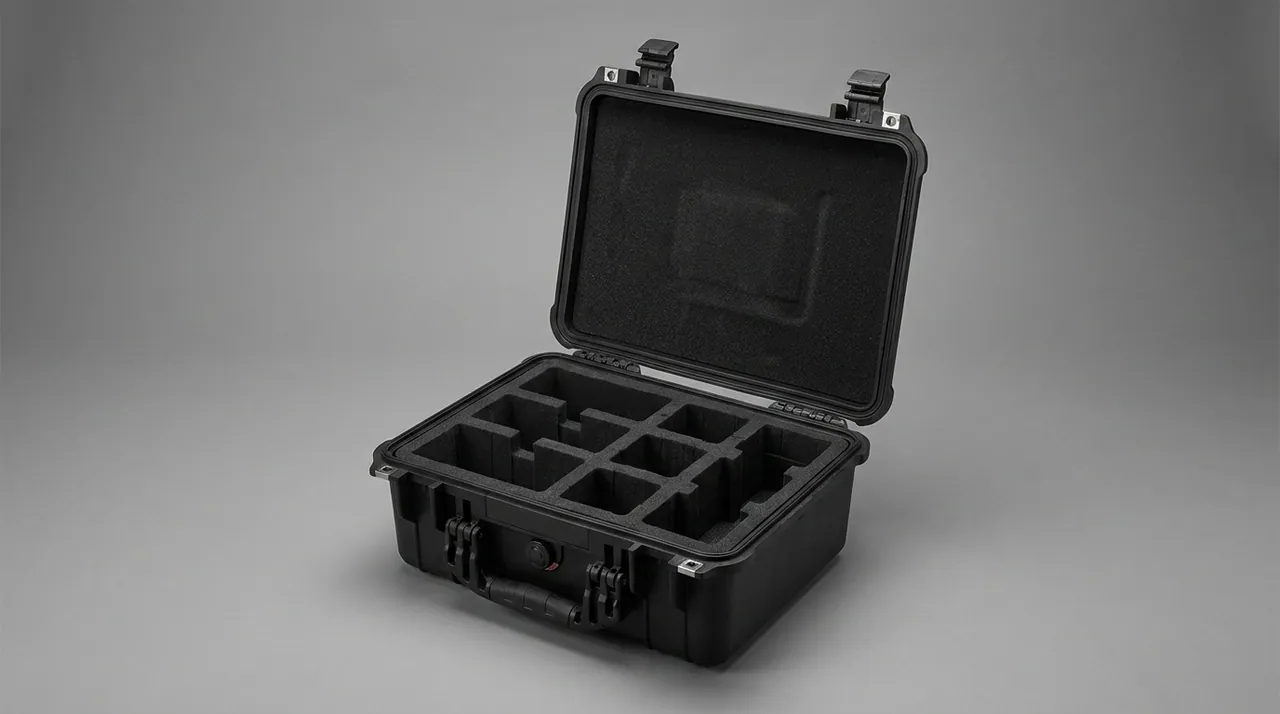
When no single material satisfies stiffness, mass and corrosion resistance simultaneously, a hybrid structure becomes a practical answer. A common pattern uses a metal frame to carry primary load and provide structural location, with plastic panels or skins handling form, sealing and corrosion-resistant appearance. The reverse also exists: a polymer shell reinforced by metal parts moulded into the corners and hinge seats. The value of the approach is that each material is placed where it works best, with metal in tension and fatigue-critical positions and polymer in positions exposed to corrosion and impact.
The risk concentrates at the interfaces. Dissimilar materials have different coefficients of thermal expansion, so temperature cycling applies shear stress across the joint. If the connection relies on screws alone, bearing stress at the holes and long-term relaxation gradually weaken it. Where different metals touch, galvanic corrosion becomes possible, especially in damp conditions. The design effort therefore belongs at the interface rather than in the material selection: insert form and embedment depth, a combination of adhesive bonding and mechanical fastening, isolation layers where needed, and a drainage path. A well-executed hybrid can cut total mass noticeably; a poorly executed one develops loosening and leakage within two years, and almost all of that difference lives in those interface details.
The Hardware Inventory: Hinges, Latches, Handles, Corners and Wheels
Take a tool box apart and the user experience turns out to rest on a handful of small components. The hinge provides the pivot for opening; it needs a wear-resistant pin, controlled clearance, and mounting points that spread the load, and it should never be fixed directly into a thin unsupported panel. The latch both closes the box and compresses the gasket, so engagement should be adjustable, closable with one hand, and fitted with a secondary retention feature. The handle carries the case, so its mounts must sit on the shell's load path and offer alternative grip positions for empty and loaded states.
Corner pieces take the most concentrated impact during drops and stacking, and making them replaceable extends shell life considerably. Wheels and telescopic arms belong to towed products, where the priorities are matching wheel diameter to ground conditions, ensuring the arm-to-shell connection is strong, and confirming that mounting does not breach the sealed envelope. Check hardware in order of failure consequence: sealing-related parts first, carry-related parts second, cosmetic parts last. The relationship between hinge, latch and gasket is described further in What Do the Hinge, Latch and Gasket on a Toolbox Actually Do?.
Sealing and Dust Protection
Sealing performance depends on three things working together: the profile and material of the gasket, the source and evenness of compression, and how much the shell deflects under load. On profile, a single lip is simple but highly sensitive to compression loss, while a twin-lip design retains contact even when compression falls short, which suits frequently opened cases. Hollow sponge cord conforms at low compression and suits less rigid polymer shells. On material, nitrile and EPDM each trade oil resistance against weather resistance and compression set, so the choice follows the environment.
Even compression depends on two further factors: whether latches are spaced closely enough, and whether the lid is stiff enough to resist the reaction of the compressed gasket. Widely spaced latches inevitably leave under-compressed zones between them, and that is the most common origin of leakage. Pressure equalisation deserves attention as well: temperature and altitude changes create a differential across the shell, and without a vent the differential squeezes the gasket and makes the case hard to open. Dust and water protection are often required together but they are achieved differently, with dust relying on joint fit and labyrinth geometry and water relying on gasket continuity and compression, so each needs its own verification.
Interior Organisation: Trays, Dividers, Foam and Straps
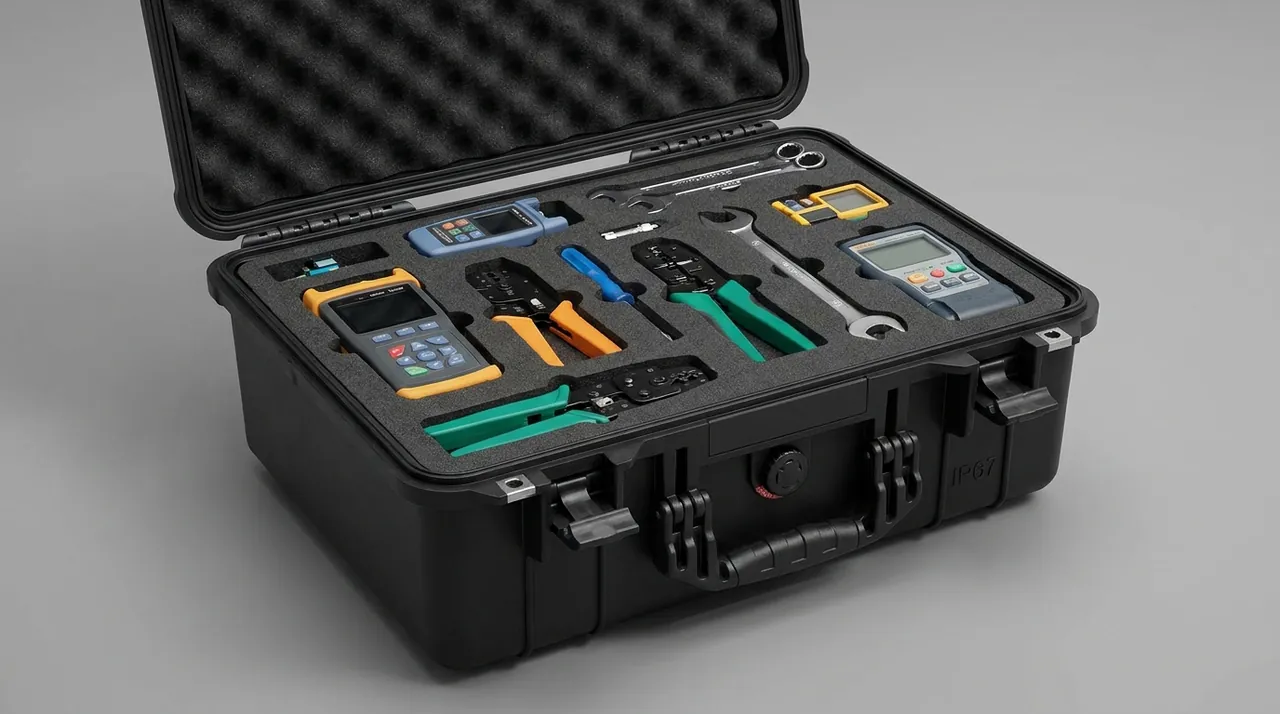
The interior system determines both access speed and how stable the contents stay in transit. Trays create layers, letting frequently used tools sit on top while freeing space below. Dividers cut a large volume into functional zones at low cost and can be rearranged. Foam cavities give the highest locating accuracy and the best cushioning for precision tools. Straps and clips hold individual items at minimal cost. These four are usually combined, and the skill lies in allocating them according to tool geometry and access frequency rather than dividing space equally.
One principle deserves emphasis: make empty positions visible. When every tool has a dedicated cavity shaped to it, a missing item becomes immediately obvious, which in a liner context is more effective than any label. For set-based kits this often matters more than raw capacity, because the time lost hunting for a tool exceeds anything saved by fitting one more piece into the box. The organisation logic behind set-based storage is explored in Tool Kit Chest: Set-Based Organization Logic.
Criterion One: Volume, Footprint and Loading Efficiency
The first volume-related mistake is treating the external envelope as capacity. That envelope includes walls, ribs, liner and unavoidable voids, so the space genuinely available for tools is usually only sixty to seventy percent of it, and less when the contents are irregular loose items. The second mistake is looking at volume without looking at shape: at equal volume, a long flat box suits bar-shaped tools while a deep square box suits bulky assemblies, and when the shape does not match the tool list, a bigger volume figure buys nothing.
The recommended purchasing routine is to group the tool list by dimension, note the longest item, the bulkiest item and total weight, then compare these against the internal cavity dimensions of each candidate instead of comparing headline volume figures. Weight and carry method should be checked in the same pass, so that a case which fits the tools but cannot be moved does not slip through. Quantified selection methods are set out in Four Core Parameters for Choosing a Toolbox: Durability, Portability, Function and Materials and What Is a Toolbox? Main Types, Materials, and Use Cases.
Criterion Two: Load, Fatigue and Whole-Life Cost
Load capacity is not a static number; it is a statement about temperature, duration and permissible deformation. Polymer shells creep under sustained load combined with elevated temperature, so a short-term test pass does not prove that a long stacking duty will hold; metal shells creep little but their welds and bolted joints fatigue under repeated loading. Evaluating load capacity therefore requires test conditions from the supplier, including load, temperature, duration and permitted deformation, rather than a single headline figure.
Whole-life cost is usually under-scoped as well. Beyond purchase price it should include consumable parts with their replacement intervals and prices, such as gaskets, latches, wheels and liners; maintenance labour; and the cost of failure, covering damaged or damp contents, downtime caused by a missing tool, and premature replacement of the container itself. Placing these curves on a common timeline, many apparently cheap options turn out to be expensive over the middle years. The comparison is only valid if both sides use the same duty cycle and the same service period.
Criterion Three: Environmental Durability
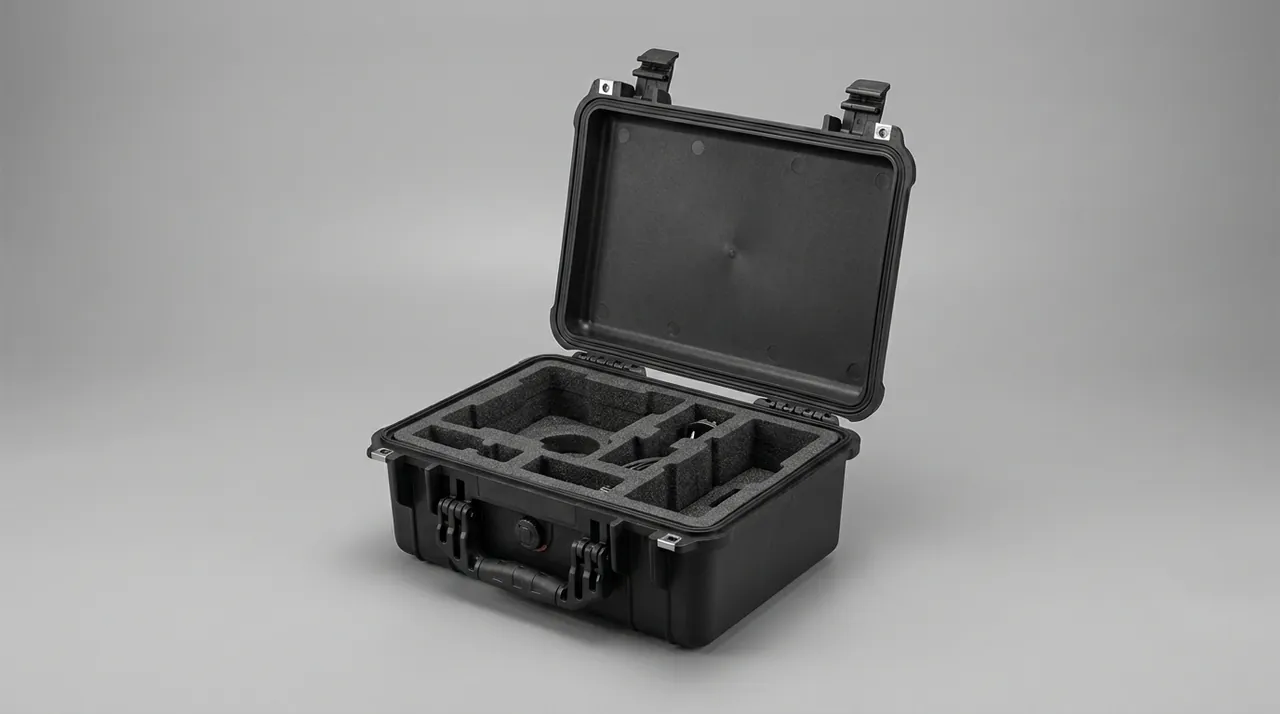
Environmental durability is about how materials behave over years in real climate. Ultraviolet radiation degrades most polymers at the surface, showing up as chalking, colour change and falling toughness. Low temperature embrittles plastics and stiffens rubber gaskets until they lose elasticity. Humidity and salt fog accelerate corrosion of metal parts and inserts. Thermal cycling applies repeated shear stress at the interfaces between dissimilar materials. None of this is mysterious; the problem is that procurement often checks only room-temperature data.
The practical route is to define the environment by its harshest combination, for example long-term outdoor exposure with salt fog, wide temperature swing and direct sunlight, then require the supplier to describe the formulation and the corresponding test evidence, and to state the replacement plan for wear parts. For metal components and inserts, ask about the corrosion protection system and the measures taken against galvanic corrosion. Good environmental durability rarely shows itself in year one, but it decides whether the product is still dependable in year five, which is precisely why outdoor and vehicle applications hinge on it. The outdoor behaviour of plastic and metal shells is compared in Plastic Tool Box vs Metal Tool Box: What Is the Difference?.
Criterion Four: Task Efficiency and Ergonomics
Task efficiency measures how many actions separate a tool from the hand that needs it. It rarely appears in a specification yet decides whether a box is welcomed on site. Contributing factors include whether opening needs two hands, whether the upper tray lifts out independently, whether common tools sit where the hand reaches without thinking, and whether the opened case stays stable rather than tipping. A few seconds per access sounds trivial, but repeated dozens of times a day it accumulates into real time.
Ergonomics is about the physical burden on the user: whether the grip suits a gloved hand, whether the loaded centre of gravity stays stable, whether the strap loads the shoulder and neck uncomfortably, and whether the towed handle suits the operator's height. These are hard to express in a datasheet. The most dependable evaluation is a trial with the real tools, watching how the user naturally handles access, lifting and closure. Including efficiency and burden in the scoring often eliminates products that look strong on paper but feel awkward in use. In short, a well-chosen tool box is one whose classification was settled first, whose material followed from that classification, and whose numbers were then confirmed against a real tool list.
Frequently Asked Questions
Q: What is the most direct way to tell an ordinary storage box from a protective case? A: The most direct evidence is whether the technical documentation states protection figures together with the method used to verify them, rather than the appearance or the price. Four documents decide the question. First, a declared IP rating with the standard and method behind it: spray, immersion or dust only, with duration and depth stated. Second, drop and vibration test reports that specify height, attitude, how the payload was simulated, and the acceptance criteria. Third, a sealing description covering gasket profile, whether the loop is continuous and closed, and whether latch engagement can be adjusted. Fourth, stacking verification records giving load, temperature, duration and permitted deformation. Only when all four exist is it meaningful to call a container a protective case. A box lacking them may still be well built, but its strength cannot be verified and therefore cannot be written into an acceptance clause. One caution: a declared rating is still not the same as field reliability, because ratings are static while drops and stacking in service cause momentary shell deflection, so combined spray or immersion with vibration and drop data is worth requesting as well.
Q: How should plastic and metal tool boxes be compared? A: Compare the failure mechanisms side by side rather than the marketing adjectives. Polymer shells are light, do not rust, insulate electrically, and tend to deform rather than produce sharp edges on impact, and moulding allows complex interior features and integrated inserts. Their weaknesses are creep under sustained load, changes in properties from ultraviolet exposure and low temperature, and lower local puncture resistance than metal. Metal shells offer high stiffness and load capacity, heat tolerance and puncture resistance, and they can be welded and machined; their weaknesses are mass, the tendency of a breached coating to start localised corrosion, and ongoing maintenance, with weight often becoming the binding constraint on common steel grades. Three tests settle most cases. If the box is moved often over long distances, favour polymer. If load capacity is high and the position is largely fixed, metal has the advantage. If the environment includes salt fog or persistent damp, calculate the corrosion strategy and the maintenance burden together. In many workshops the best answer is both, with metal cabinets for fixed high-load positions and polymer boxes for field work and rotation.
Q: How do injection, blow and rotational moulding differ in suitability? A: Three variables separate them quickly: part size, production volume and required protection level. Small parts, high volume and complex internal features point to injection moulding, because tooling cost amortises well, dimensional accuracy is high, and intricate ribs and inserts can be formed. Hollow single-piece bodies at moderate volume and cost sensitivity point to blow moulding, which creates a closed cavity with modest investment at the cost of less uniform wall thickness and less precise interior geometry. Large formats, lower volume and a need for double-wall construction with a higher protection level point to rotational moulding, which can vary wall thickness by region, accept metal inserts during forming, and gain cushioning and insulation from the air gap between skins. Note that the cost structures differ: injection moulding front-loads the tool, rotational moulding leans on labour and energy, so the relative advantage shifts with volume. The same part may have a different optimal process at a different volume, which is why the expected lifetime quantity should be given to the supplier so that process advice and a cost curve follow from it rather than a process being fixed before quotations are requested.
Q: Does a more elaborate interior liner always produce a better product? A: Liner complexity should match how stable the tool list is and how often tools are accessed, so more detail is not automatically better. Where the list is stable, tools are uniform and locating accuracy matters, investing in a moulded tray or finely cut cavities pays back over years by cutting retrieval time and tool damage. Where the list changes often and the contents are general-purpose items, an over-fitted liner becomes a liability: every change requires rework, and the fixed cavities leave no place for the additional items that inevitably appear, so tools end up piled on top of the liner and locating accuracy is lost anyway. A layered compromise works well. Keep the base layer general and adjustable, using dividers and movable trays to absorb change; locate high-frequency tools in the middle layer; and leave a general-purpose zone in the upper layer for items that come and go. A practical test is to count accesses over a working week and note how often other tools must be moved aside to reach the target. A high proportion means the layout contradicts the access sequence, and the answer is to change the zoning rather than to add more cavities.
Q: What should a complete whole-life cost calculation include? A: A reasonably complete calculation contains five groups. The first is purchase price and associated costs, including liner customisation, marking and spare-part kits. The second is consumable parts, discounting replacement intervals and unit prices for gaskets, latches, wheels, liners and corner pieces year by year, a line that often exceeds expectations over a long service life. The third is maintenance, covering cleaning, re-tightening fasteners and corrosion protection for metal parts, in both labour and materials. The fourth is the cost of failure, including damp or damaged contents, downtime while a missing tool is found, and early replacement of the container. The fifth is ancillary cost such as stacking frames, restraint fittings or specialised handling equipment. Placing all five on one timeline under one duty cycle frequently reverses the conclusion drawn from purchase price alone. Consistency of assumptions matters as much as the method: both sides must use the same usage frequency, environmental conditions and service period, or the comparison proves nothing. Polymer boxes with replaceable consumables usually show a flatter maintenance curve with more replacement events, while metal boxes show fewer but costlier maintenance interventions.
Q: In outdoor or damp conditions, which failure points are most often overlooked? A: The overlooked points are usually the ones sitting just outside the sealing rating. The first is pressure equalisation: temperature and altitude changes create a differential across the shell, and without a vent the differential compresses the gasket and makes opening difficult, eventually taking a permanent set out of the seal. The second is corrosion of fasteners and inserts, particularly where a metal insert meets polymer or a dissimilar metal, since galvanic attack can progress unseen while joint strength quietly falls. The third is drainage: without a guiding path at the base, condensation that does enter collects at the lowest point and sits against contents and structure. The fourth is non-uniform ultraviolet ageing, where exposed faces and loaded corners develop fine cracks first, and those are exactly the load-bearing locations. The fifth is compression set in the gasket, accelerated by cold stiffening and sustained compression, which reduces sealing force year by year. The countermeasure is a scheduled inspection list covering those five points, together with replacement interval guidance for gaskets and wear parts issued at delivery.
Q: What hidden issues do not appear on a tool box quotation? A: Quotations usually reflect price and headline parameters while leaving several things unsaid. First, test evidence: many quotes state an IP rating and a load figure without the method or the raw records, making verification impossible at acceptance. Second, liner fit: cavities are quoted from drawings, and the mismatch only appears when the tools cannot be inserted or rattle in place, a problem normally caught by one trial fit at prototype stage. Third, consumable availability: some products perform well within the warranty period, yet their gasket and latches are proprietary and cannot be bought separately, so a single failure condemns the whole container. Fourth, undefined stacking conditions: a quote that says the product is stackable without a layer count and a load leaves nothing to hold anyone to when lids begin to sag. Fifth, missing interface detail in hybrid construction, where joints between dissimilar materials without isolation and drainage fail first. The remedy is to write the acceptance method, consumable supply, stacking conditions and critical dimension records into the contract, converting verbal assurances into checkable clauses.
Q: How can a buyer assess a supplier's design capability rather than only its production capability? A: Four lines of questioning separate a contract manufacturer from a supplier with genuine design capability. The first is design input: does the supplier ask for the tool list, weight distribution, carry method and environmental conditions, and then propose structural options, rather than waiting for a drawing? The second is failure analysis: ask which failures have occurred on comparable products and what structural changes followed. A supplier able to describe hinge-seat cracking or insufficient gasket compression in specific terms usually has real field data behind it. The third is verification capability: ask about test equipment and methods, particularly whether combined-condition testing is possible rather than single-item tests. The fourth is change management: when the tool list or the outer dimensions change, can the supplier produce an impact assessment covering tooling, liner and test rework together with its cost? None of these questions depends on price, yet together they predict mid-term product behaviour far better than a discount does. Putting them into a supplier evaluation form is worth more to a buyer than repeated haggling over unit cost.