

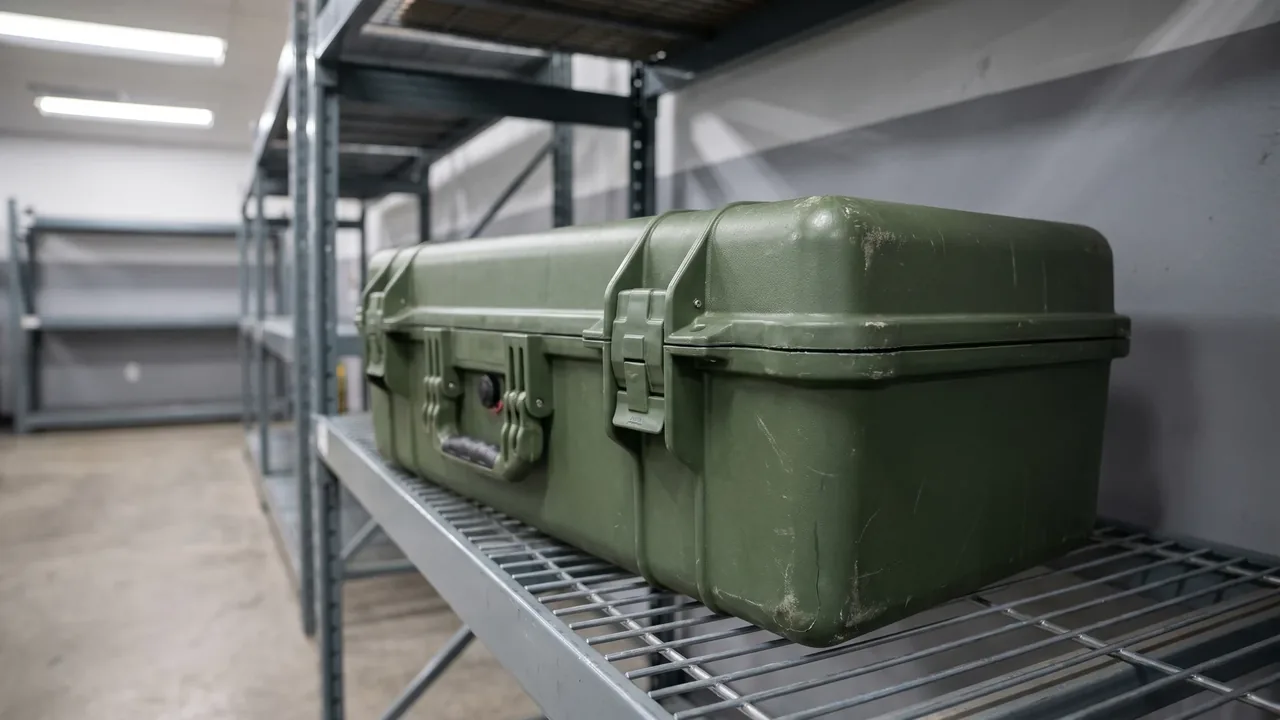
Inside any strategic stockpile program, the War Reserve Case — sometimes discussed under the label Combat Readiness Box — plays a fundamentally different role from an ordinary turnover container. What it seals inside is not freight destined to move within days, but equipment and supplies that may sit untouched for five, ten, or even more years, and that must work the moment the lid comes off. This quadruple demand — store for years, see the status without opening, open fast, and use immediately — turns reserve packaging into an engineering discipline of its own. As a protective case manufacturer, JUNZHIJIA finds that the most frequent questions in long-term storage projects are never "is the box strong enough," but rather "will the metal parts be rusted after ten years," "will the textiles be moldy," and "will the security seal still prove nobody touched the case." This article takes the manufacturer's viewpoint and works through the sealing and corrosion-inhibition strategy of the War Reserve Case, its tolerance of humidity and temperature cycling, stacking creep, storage visibility and inventory rotation, open-and-use design, and the validation testing that certifies sealed status. All references to military trade are subject to local regulations and export control requirements; this article discusses only packaging containers.
Defining the Boundary: What War Reserve Case and Combat Readiness Box Actually Mean
Start with definitions. In stockpile documentation, a War Reserve Case usually refers to a dedicated sealed container assigned to war reserve materiel, with emphasis on "sealed storage duration" and "ready upon unsealing." A Combat Readiness Box appears more often in readiness-management language, stressing "available for immediate commitment." Physically the two converge on the same object; the difference lies in the management axis. The former rotates stock around a storage-duration timeline, while the latter is drawn down against readiness levels. On the packaging engineering side they share one identical set of requirements: long-life sealing, corrosion inhibition, recognizable status, and traceable unsealing.
Three lines separate a War Reserve Case from an ordinary military transit case. The first is the time scale. A transit case is designed in units of missions — a few hundred hours of vibration, drop, and stacking prove it fit. A reserve case is designed in units of years: gaskets, desiccants, corrosion inhibitors, and cushioning are all selected against five-to-ten-year service lives. The second is status management. A transit case finishes its job at delivery; a reserve case only begins its sealed cycle at delivery and must stay auditable, inspectable, and verifiable for years. The third is the cost of failure. Losing one transit case costs one shipment; losing the seal of a reserve case can downgrade an entire stock of materiel, and the recovery cost dwarfs the container itself. Readers comparing protective case categories side by side can consult our guide to selecting military protective cases, and the material evolution from metal to engineering plastics is traced in how military storage box materials evolved. With these boundaries set, the packaging strategy that follows has a firm reference frame.
Four Adversaries of Multi-Year Storage: Moisture, Oxygen, Salt Fog, and Cycling
The degradation drivers inside a sealed reserve container fall into four families. The first is moisture vapor. Day-night temperature swings in a warehouse condense water films on cold inner walls, and above all on metal surfaces — the common starting point of both rust and mold. The second is oxygen. Even with humidity under control, slow oxidation keeps building oxide films on bare metal over years; for precision fitting surfaces, a few microns of oxide are enough to cause functional failures the moment the case is opened. The third is salt fog. In coastal and island warehouses, chloride ions find every weak point of the protection and trigger pitting that outruns ordinary atmospheric corrosion by a wide margin. The fourth is the cycling itself. Materials fatigue under repeated moisture absorption and drying, expansion and contraction: gasket compression set accumulates, cushioning loses resilience, coating adhesion drops, and the fit between shell and lid drifts out of tolerance.
These four rarely act alone; they amplify one another. Condensation accelerates oxidation, oxide layers hold moisture and accelerate corrosion, and every temperature-humidity cycle restarts the whole process. Long-term storage practice with metal canisters tells the same story — see the lessons compiled in long-term storage of military steel ammo cans. That is why a War Reserve Case strategy is never "pick one good gasket." It is a layered defense: the outer layer uses the shell and its seals to block liquid water and dust; the middle layer uses desiccant and vapor corrosion inhibitors to govern the internal microclimate; the inner layer uses liners and spacers to break face-contact corrosion paths. The mechanics of condensation inside closed cases are treated separately in controlling condensation in protective cases. The following chapters unpack each layer in engineering terms.
Rotomolded HDPE Shells: The Material Foundation of Long-Term Storage
For the shell material, long-duration storage converges almost universally on rotational molding. A rotomolded shell forms in one piece without parting-line seams; unlike injection-molded halves, it has no weld lines, and unlike sheet-metal boxes it has no hundreds of rivet holes and solder joints acting as moisture pathways. Measured against a service life counted in years, every potential leak path you eliminate moves reliability up a full step. On resin selection, rotomolding grades of HDPE built on medium-density base stock with carbon black or long-life UV stabilization are the norm, and environmental stress crack resistance (ESCR) is the first-priority figure — a reserve case on a warehouse rack experiences far less stress than one in transit, so what truly tests the material is creep and aging under low load for years, not short impact peaks.
Shell structuring usually does three things. First, it thickens the load-bearing zones: the base and the stacking interfaces gain local wall thickness so that multi-year static loads produce only millimeter-scale creep. Second, it rounds everything: generous radii on all internal and external corners remove stress concentrators and keep the shell from cracking under forklift knocks. Third, it validates the weathering package: carbon black content and antioxidant systems must pass xenon-arc or UV acceleration, with the results folded against real warehouse light exposure so the shell neither chalks nor embrittles — whether it sits in dim indoor racks or spends short spells outdoors. For humid-climate depots, mold resistance and chemical-agent assessments are added, because cleaning agents and insecticides in prolonged contact can induce surface stress cracking. The full process-level argument for this material family is developed in rotomolded protective cases.
Color and surface treatment deserve a word too, because reserve programs live with their cases for a decade. Pigment systems age along with the resin: organic pigments can fade under the weak warehouse lighting that barely concerns an ordinary consumer product, and more importantly, some fillers accelerate photo-oxidation of the polymer matrix itself. Standard practice for storage containers is carbon-black masterbatch at a controlled loading, which serves three duties at once — UV screening, neutral stockpile coloration, and dimensional stability of the pigment over years. Where marking must survive the decade, molded-in boss fields and recessed nameplate pockets beat surface printing: paint and ink sit on the surface and wear, whereas a recessed pocket protects whatever label or metal plate the depot applies. Neither detail changes the case price much; both decide how the case looks and reads in year eight.
Sealing System: Dual-Lip Gaskets, Pressure Equalization Valves, and Case Breathing
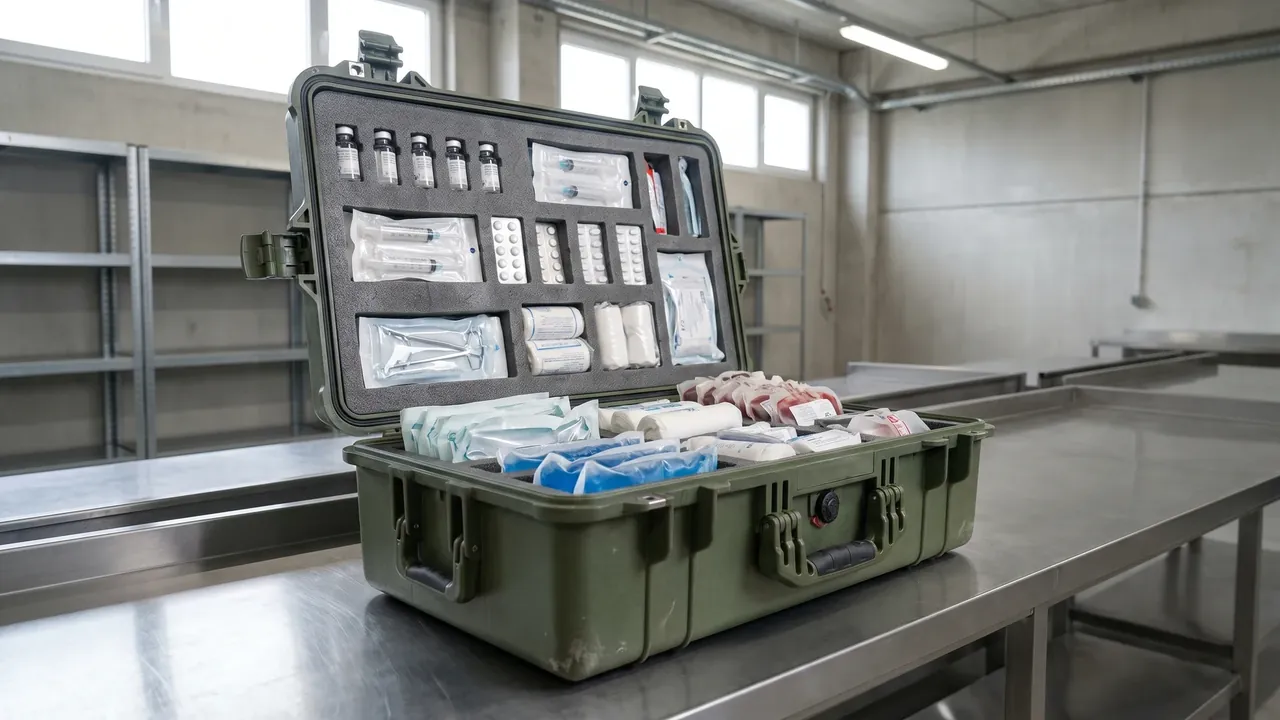
The sealing system sits at the center of reserve packaging because it must simultaneously achieve two things on a ten-year scale: keep things out, and keep nothing from going wrong inside. Keeping things out means liquid water, dust, and insects. Keeping nothing from going wrong means the pressure differential across the shell must never slowly peel the gasket open or collapse it inward. The mature engineering answer pairs a dual-lip gasket with a pressure equalization valve. Dual-lip profiles in silicone foam or EPDM form a labyrinth: even if the outer lip is briefly fouled by dust, the inner lip still holds the seal. Silicone's compression-set figures clearly outperform ordinary rubber, and its resilience retention across a decade of storage is the decisive selection parameter. Mounting matters as much as material: a gasket seated in a retaining groove beats an adhesive-backed one, because the adhesive itself has an aging life, and peeling adhesive-backed gaskets after years in storage is a failure mode warehouses really do see.
The pressure equalization valve addresses the hidden half of the problem. When a case moves from a humid depot to a dry one, or rides through strong seasonal temperature swings, internal pressure drifts away from ambient. That differential is sufficient to work a gasket slowly out of its groove and open a one-way leak path — the classic root cause behind "the seal checked perfect at packing, yet moisture got in within six months." A breathable hydrophobic membrane valve or one-way valve core lets gas exchange freely while blocking liquid water and dust, so the case keeps breathing without ever letting a drop through. Gasket upkeep must also be written into the storage routine: inspect compression marks and cracks at every rotation audit, and replace the entire gasket ring at the manufacturer's stated interval rather than waiting for a leak. The aging mechanisms and rejection details are covered in gasket aging in protective cases and the hands-on procedure in the seal ring replacement guide.
VCI Corrosion Inhibitors and Desiccants: The Combined Play for Metal Components
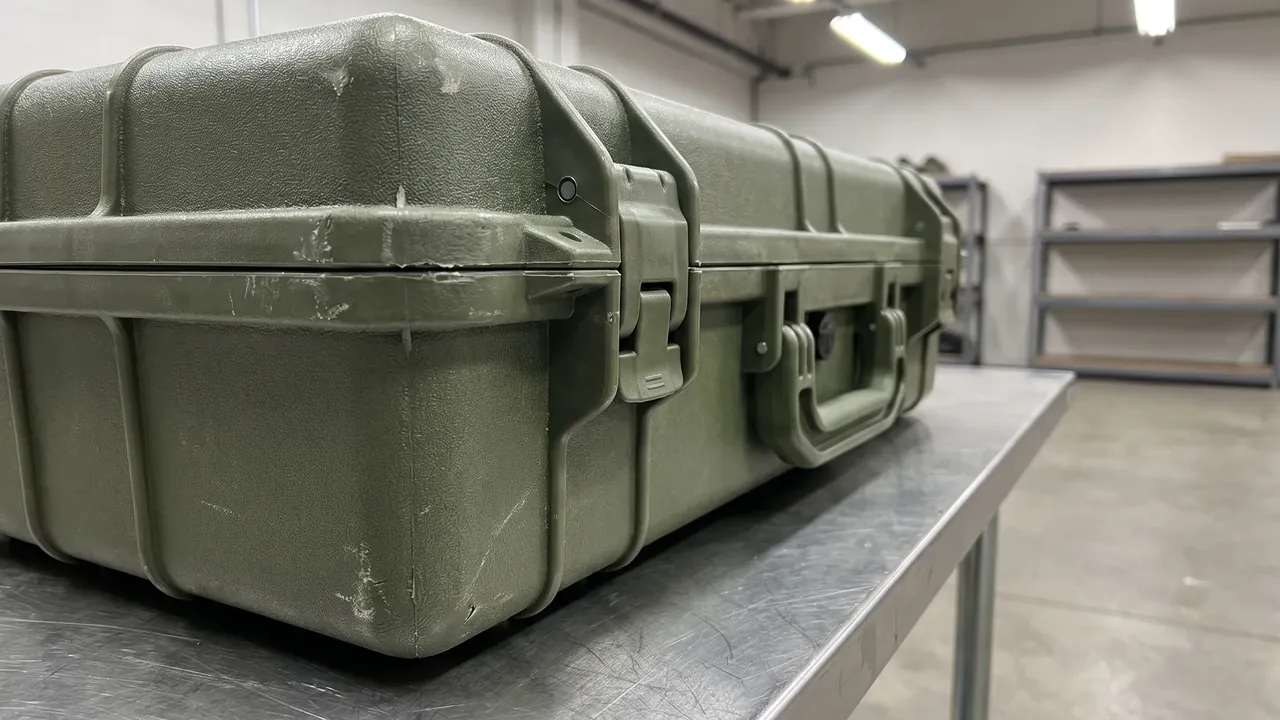
Where the shell seals out the outside world, the internal microclimate is governed by the pairing of desiccant and vapor corrosion inhibitor (VCI). The desiccant drives internal relative humidity below the critical corrosion threshold for steel — commonly targeting under forty percent — using high-capacity silica gel or montmorillonite, dosed against the case volume, liner materials, and expected air exchange, with a deliberate safety margin. The critical variable in the dose calculation is liner moisture release: EVA foam and fabric liners keep desorbing their absorbed water through the early months of storage. If you dose desiccant from air volume alone, it saturates and dies within months — the most common dosing mistake in long-term storage projects.
VCI covers what desiccant cannot. Vapor-phase inhibitor molecules sublimate continuously at room temperature, travel with the internal atmosphere, and adsorb onto metal surfaces as a monomolecular protective film, reaching the seams, bores, and complex profiles that a bag of desiccant cannot shield. The two tools are complements, not substitutes: desiccant manages the water; VCI ensures that even a trace moisture film does not turn into rust. In practice VCI ships as bags, papers, or foam carriers placed in direct contact or close proximity to metal parts, and the closed case must stay relatively airtight for the inhibitor concentration to persist — a leaking seal flushes molecules out faster than they can replenish. Compatibility comes next: optical elements, elastomers, and electronic assemblies should be screened against the specific VCI chemistry before packing. Finally, align service lives — the effective life of both desiccant and VCI carrier should match the storage cycle, with rotation dates written into the storage ledger.
Seals, Locks, and Tamper Evidence: The First Proof of Storage Integrity
A reserve case sits in a rack for years, and the question "has anyone opened it" must be answered by the case itself. That answer is a physical evidence chain of storage integrity. The first layer is the high-security seal. Numbered cable or one-piece plastic seals fail permanently once cut, so any opening leaves irreversible marks; seal numbers map one-to-one onto the storage ledger, and an auditor verifies integrity in minutes by checking numbers and eyeballing seal bodies. The second layer is the lock — a mechanical combination lock or padlock hasp paired with the seal as double protection: the seal proves "not opened," the lock discourages "trying to open." The third layer is seal-status recognition: storage date, batch, sealer identity, and seal number are printed on weatherproof labels bound to the internal packing list, so any warehouse clerk can read the storage metadata without touching the contents.
The manufacturer's contribution spans all three layers: standardized lock and seal mounting points, hasp positions that stay operable even when cases are stacked, and label faces treated against UV and abrasion so they remain legible for a decade. Hardware selection follows the same decade logic as the gasket: stainless or coated fasteners at the hasp, locks sized so keys and combinations can be managed across personnel rotations, and seal loops routed through points that cannot be bypassed by slipping a blade under the lid edge. A bypass route defeats the whole chain — if the lid can be flexed enough to extract an item without cutting the seal, the seal's number proves nothing, so the sealing path must pass through structural features, not just decorative loops. One point deserves emphasis: tamper evidence aims at detection, not absolute prevention. No system stops a determined opener with tools and time, but a proper system guarantees that every opening leaves evidence that cannot be erased — and for stockpile management, that is exactly the guarantee that matters.
Humidity and Temperature Cycling: From Accelerated Testing to Warehouse Equivalence
A warehouse is not a climate chamber. Across its service life a War Reserve Case endures hundreds of humidity-temperature cycles — winter-summer contrasts, wet and dry seasons — each one working on the shell, the gaskets, and the liners. The manufacturer's tool for proving endurance is accelerated equivalence: a high-low temperature cyclic humidity test chained to seal performance checks, run through cycle counts far beyond the real service life, then inspected for gasket compression set, cushion resilience, coating adhesion, and dimensional stability. The pass criterion is not "nothing broke during the test" but "the initial seal rating still holds after the test" — and that distinction is precisely where storage thinking separates from transit thinking.
Honesty is required in translating acceleration back to the warehouse. Accelerated tests shorten time by magnifying stress, and the translation factor rests on the assumption that the failure mechanism does not change. If the accelerated profile triggers modes that never occur in real service — thermal degradation of gasket material at excessive temperatures, for example — the extrapolation is fiction. A responsible manufacturer discloses the test profile and its equivalence logic in bid and delivery documents, and keeps field tracking data to close the loop. When purchasers audit this section, the value is never on the conclusion page of a test report; it is in the derivation: how the cycle count was set, why those temperature limits were chosen, and what counts as failure. When those three are written down plainly, a ten-year promise on a War Reserve Case finally has engineering behind it.
Instrumentation closes the loop on the warehouse side. Cases slated for the most demanding climates can carry compact temperature-humidity loggers in a dedicated interior pocket, read out at each annual audit; a handful of instrumented cases per rack row gives the depot a real microclimate record against which the accelerated-test assumptions can be checked year by year. Where loggers are impractical, humidity indicator cards inside the case still tell the auditor, through a small inspection window, whether the desiccant has held its ground. Both routes convert "we believe the seal held" into a recorded reading — and recorded readings, accumulated over years, are what eventually prove or correct the equivalence math this chapter describes.
Static Stacking Loads and Multi-Year Creep: Long-Term Compression at the Bottom of the Stack
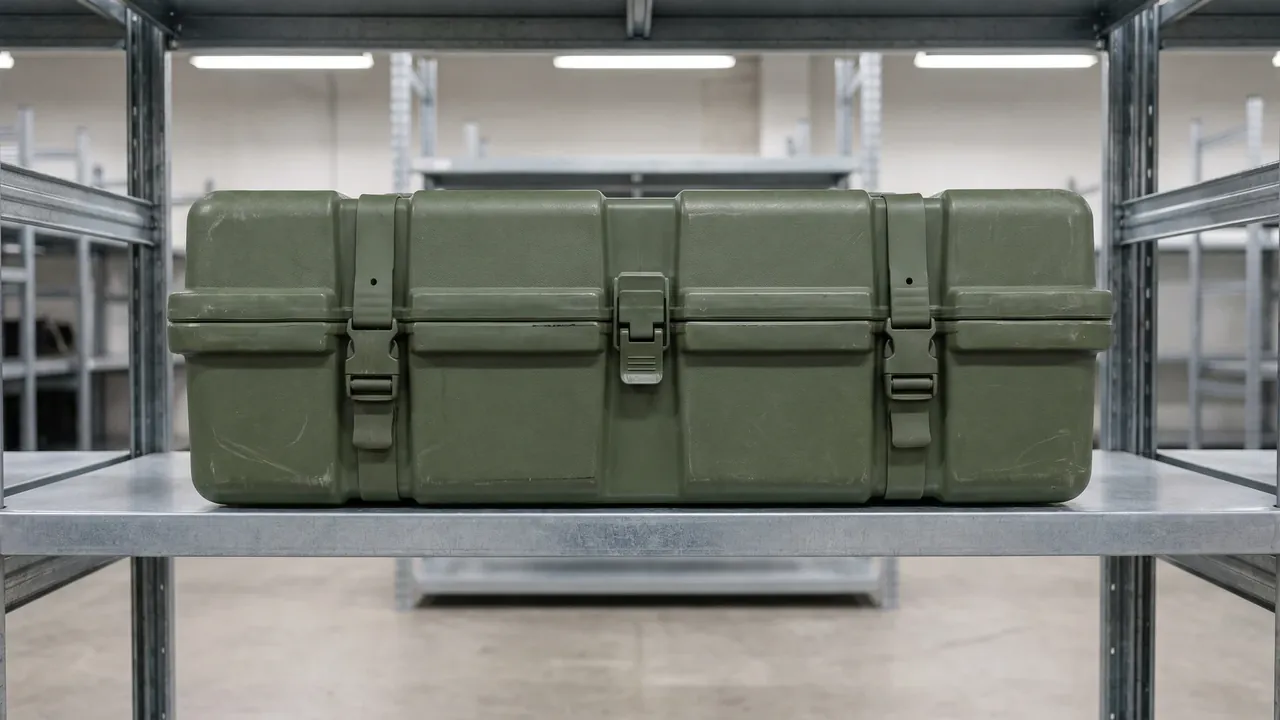
Warehouse space economics make multi-tier stacking inevitable, and stacking poses a challenge unique to storage containers: creep — the continuous deformation of plastics under sustained static stress. Rotomolded HDPE shows ample strength under short-duration loads at room temperature, but if a bottom-tier case is held near its design limit for years, its walls bulge slowly, stacking interfaces lose register, and the gasket groove distorts — and with it, the seal. Reserve case stacking design therefore cannot copy the transit-case notion of a "maximum stack count" established by short tests. It must be designed to an allowable stress under multi-year static load: hold the sustained stress inside the steady-state region of the creep curve, never near the short-term strength limit.
Three engineering measures deliver this. First, decouple stacking from the wall: load-bearing posts or bosses at the four corners or along the edges carry stacking loads straight down through dedicated contact points, leaving the walls carrying only self-weight and steering the load path away from creep-sensitive surfaces. Second, register the interfaces: guiding features on the stacking bosses prevent lateral slip between cases across years of load. Third, change the verification method to a sustained-load test: apply static load well beyond the design stack for weeks to months, record the deformation-versus-time curve, extrapolate the ten-year deformation, and confirm it stays inside the seal safety margin. The methodology and acceptance criteria are laid out in stacking load testing for cases. If a supplier can offer only short-term compression data and no creep assessment, the stacking plan should be treated conservatively or sent back for supplementary validation.
Storage Visibility: RFID, Barcodes, and Seal-Status Recognition
Hundreds of locations, dozens of item types, years between touches — the pain of stockpile management is not losing the case, but being unable to know contents and condition without opening it. Storage visibility solves exactly this "information without opening." The first layer is identity: every War Reserve Case carries a unique code on an RFID tag or weatherproof barcode fixed at the nameplate position, letting a handheld terminal sweep a rack aisle and complete a batch inventory — replacing box-by-box manual transcription with one pass down the lane. The second layer is content visibility: a transparent document pouch or card slot on the side face holds the laminated packing list and storage record, so contents and batch can be verified before the seal is ever cut. The third layer is seal-status recognition: seal number, sealing date, and storage grade are printed in large weatherproof type, so auditors can read status from floor level without climbing or moving cases.
Choosing between RFID and barcode depends on the facility: in dense metal racking RFID read range degrades while barcodes stay stable; for high-positioned cases, RFID's long-range bulk reading clearly wins. The manufacturer's role is structural — metal walls shield RF, whereas rotomolded HDPE needs interference-resistant, abrasion-proof tag pockets or inserts positioned so the tag still faces the aisle after stacking. More digitalized depots integrate RFID reads into the inventory system so that "storage expiry reminders," "seal number verification," and "rotation sequencing" become automatic tasks — the technical floor beneath the Combat Readiness Box idea of "always known, always callable." A full build-out of a QR-based tracking system is described in asset QR code tracking for cases.
One failure mode in visibility projects comes from over-engineering the electronics while under-engineering the physical carrier. A tag that survives the reader trial can still fail in year three because its adhesive gave up, its protective film clouded over, or its mounting boss cracked under stacking loads. Treat the tag as a consumable with its own aging life: specify its expected legibility years, its replacement procedure, and a mounting pocket that can be serviced without tools. Equally, define what happens when a read fails — an unreadable tag must never stall an audit, which is why the printed backup code molded or engraved beside the electronic label is not redundancy theater but the element auditors actually use most often. Visibility is judged at the worst box in the rack, not the best one.
Rotation and Inventory Audits: Inspection Frequency and Rejection Criteria
Sealed storage never means "seal it and forget it." Disciplined reserve management runs a tiered audit system. Routine inspection every quarter or half-year checks stacking stability, seal condition, and label legibility. The annual audit samples a fixed percentage of locations, recording internal temperature and humidity where loggers are fitted, desiccant status indicators, and the external condition of each case. At the five-year mark, or at whatever interval the storage grade dictates, an unsealing sample check opens cases from a batch to verify corrosion inhibition, cushion state, and unsealing smoothness, then reseals or rotates the stock.
Rejection criteria must be written into the procedure before storage begins, so audits never descend into subjective argument. At the case level: a through-cracked gasket or compression set beyond limit, creep deformation at stacking points that breaks interface register, or any through-crack in the shell — any single hit demotes the case or retires it and transfers the contents. At the storage level: a missing seal or mismatched number, illegible status labels, or a saturation-flagged desiccant indicator triggers repackaging. The point of these criteria is converting "it looks fine" into executable thresholds; the warehouse-side handling and stacking rules align with the practices in warehouse storage rules for cases. The manufacturer supports the system with consumable kits — gaskets, desiccant, seals, labels — plus replacement work instructions, so depots can standardize part swaps on the audit floor instead of shipping cases back to the factory. For reserve networks spread across many sites, field maintainability directly determines the cost of rotation.
Open-and-Use: Unsealing Workflow, Record Keeping, and Resealing
The endpoint of a War Reserve Case is unsealing, and open-and-use design starts at packing time. "Open and use" carries three meanings. Physically smooth: the operator may be gloved and working in low light, so the case guides the hands with color-coded unseal points — where to cut the seal, where to work the lock, where to lift the lid — minimizing or eliminating tools. Internally ready: the packing method must hold items in position through transit shocks and years of stillness; contour-molded cushioning keeps every item at its documented location so the first glance after opening matches the packing list without re-sorting. Information complete: an unsealing checklist inside the case lists visual items — corrosion, mold, displacement, damage — plus functional spot checks, and the completed record closes the file on that case's life cycle.
The resealing plan is preset too. Cases consumed in exercises or opened for sample checks must return to sealed status: one-time seals are replaced, desiccant is re-dried or swapped based on exposure time, and VCI carriers are checked against their expiry. Manufacturers typically provide a dual workflow card — unseal and reseal — stating which steps require original parts and which allow depot-purchased standard parts, so reserve units can hold rotation costs within a rational band. Training cadence belongs here as well: an unsealing procedure that reads perfectly in an office can stumble at the rack if the last practice run happened two years earlier, so programs that fold a brief unseal-and-reseal drill into every annual audit keep the skill current at near-zero cost. A case that can cycle through sealing and unsealing repeatedly without degradation carries a far lower total life-cycle cost than a single-use sealing scheme, and that total-cost view belongs in every procurement evaluation.
Manufacturer-Side Validation: The Pre-Shipment Test Matrix
Between the production line and a storage release note, a War Reserve Case must clear a test matrix. Structural block: sustained stacking-load tests verify creep margin; drop and vibration tests confirm that transit-stage damage leaves nothing behind in the storage stage. Environmental block: cyclic hot-cold humidity testing validates the gasket and material cycling endurance; salt spray testing grades the corrosion resistance of hardware and inserts (the method is detailed in salt spray corrosion testing); UV aging covers outdoor staging, with the military test framework mapped in MIL-STD-810H compliance for cases. Sealed-function block: seal integrity is verified at its initial rating by water immersion or pressure-decay, then a microclimate storage simulation packs representative materiel or dummy loads, runs accelerated humid-heat cycles, and opens the case to assess the internal state. Information block: label weathering and abrasion trials, plus RFID or barcode read-rate verification under real stacking and racking conditions.
The matrix exists to cover the full chain — transit, stacking, storage, unsealing — because whatever segment is left untested becomes the failure point. The most common gap is transport-only testing: the case survives drops and vibration, yet nobody ever verified how its seal behaves after five simulated years of humid heat. As a manufacturer, JUNZHIJIA writes the storage verification as an independent acceptance block in the factory documentation, reported separately from transit testing, so reserve units see two independent bodies of evidence before anything enters the warehouse. Consistency between test samples and production batches matters just as much: the resin formulation and process parameters that passed first-article testing must be locked for production, otherwise the test evidence and the delivered article are not comparable at all.
What a War Reserve Case Specification Should Spell Out
Finally, procurement practice. A specification that lets a manufacturer quote and design a War Reserve Case accurately should state, at minimum, the following clauses. Usage profile: depot region and climate zone, intended storage duration, stacking tiers and static load, handling methods — forklift, crane, manual — and the unsealing environment. Materiel parameters: the contents list or representative load, the proportion of metal parts and the types of precision components, whether optical and electronic assemblies are included (this drives VCI selection and antistatic requirements), and the weight and envelope of each packed case. Performance figures: seal rating and its verification method, the service-life commitment for desiccant and VCI, the ten-year creep deformation limit under stacking, and the legibility years for labels and seals. Acceptance and documentation: the test matrix list, the accompanying documents (packing list card, unsealing checklist, resealing instructions), and consumable supply with replacement intervals. Compliance boundary: for foreign military trade deliveries, local regulations and export control requirements prevail; this article discusses only packaging containers, and licensing and declaration matters for specific projects fall outside the technical clauses of a specification.
The more concrete the specification, the more comparable the quotes. A common evaluation bias in reserve projects is overweighting unit price, when the real cost of a War Reserve Case concentrates across its ten-year life — gasket replacement, desiccant rotation, audit labor, unsealing rework. Writing those into the evaluation lets genuinely durable solutions win, and gives stockpile availability the continuous engineering guarantee it depends on.
Frequently Asked Questions
Q: What is the most essential difference between a War Reserve Case and an ordinary military storage or transit case? A: The essential difference lies in time scale and the cost of failure. An ordinary transit case is designed in units of missions: a few hundred hours of vibration, drop, and stacking testing prove it fit for service. A War Reserve Case is designed in units of years — gaskets, desiccants, vapor corrosion inhibitors, and cushioning are all selected against five-to-ten-year service lives, and the testing emphasis shifts from short-duration impact toward creep under years of static load, compression set of gaskets, and fatigue under humidity-temperature cycling. The failure economics differ just as sharply: a failed transit case usually costs one shipment, whereas a failed reserve seal or an exhausted inhibitor can downgrade an entire case of stockpiled materiel, with recovery costs far exceeding the container itself. Practically, this means an ordinary case can be selected on protection ratings and impact figures alone, while a reserve case demands three additional reviews: the sealed-life commitment, a stacking creep assessment, and audit maintainability. Those three decide whether the container can genuinely fulfill its mission of storing for years and opening ready for use.
Q: Why does a War Reserve Case need a pressure equalization valve — isn't the tighter the seal, the better? A: A tight seal blocks liquid water and dust, but pressure balance across the shell is a requirement on a different axis. Reserve warehouses see pronounced seasonal and day-night temperature swings, and the gas inside the case expands and contracts against them; moving a case from a humid depot to a dry one magnifies the differential further. If the shell were rigidly sealed, that pressure differential would act continuously on the gasket, slowly working it out of its groove and opening a one-way leak path — the true root cause behind cases that "checked perfectly sealed at packing, yet took in moisture within six months." A pressure equalization valve built on a hydrophobic breathable membrane or a one-way valve core allows free gas exchange while blocking liquid water, dust, and insects, so the case keeps breathing without ever admitting a drop. The valve also relieves the negative-pressure suction that would otherwise make lids hard to open. Note that the valve itself has a service life and a clogging failure mode, so it belongs on the rotation audit checklist rather than being treated as fit-and-forget hardware.
Q: How should desiccant quantity be estimated — and is more desiccant always safer? A: Desiccant quantity cannot be estimated from the air volume inside the case alone; dosed that way it will almost certainly fall short. A correct estimate adds four demands: the initial moisture held by the internal air, the moisture released by liner and cushioning materials, the long-term ingress through the seal, and the moisture carried in by every opening. Liner release is the term most often underestimated — EVA foam and fabric liners keep desorbing their absorbed water through the early months of storage, and that contribution can run to several times the moisture in the air itself. As for "more is safer," it does not hold. Excess desiccant over-dries the internal environment, which actually ages moisture-bearing non-metallic items such as leather and certain sealing elastomers; the practical constraints are internal volume and rotation cost. Sound engineering works backward from a target relative humidity — usually below forty percent — calculates the dose, and adds thirty to fifty percent margin, ideally with humidity indicator cards so auditors can read replacement needs directly instead of guessing.
Q: How do VCI inhibitors and desiccants relate — can you choose just one of them? A: They solve different stages of the same problem and are complements rather than substitutes. The desiccant governs internal relative humidity, driving water vapor below the critical rusting threshold so liquid films never form in the first place. The vapor corrosion inhibitor works at the next line of defense: its molecules sublimate, diffuse with the internal atmosphere, and adsorb onto metal as a monomolecular layer that suppresses electrochemical corrosion even if trace moisture remains. Rely on desiccant alone and the dead corners — seams, bores, complex profiles the desiccant cannot radiate into — can still rust from localized condensation. Rely on VCI alone and, if humidity runs uncontrolled, the inhibitor is consumed far faster than it can replenish, so the protective concentration cannot be sustained. Standard long-term storage therefore runs both: desiccant manages the water, VCI manages the trace film that survives. One selection caution applies — compatibility. Optical elements, elastomers, and electronic assemblies should be screened against the specific VCI chemistry before packing, because inhibitor formulations can adversely affect some of those materials.
Q: Why can't the stacking tier count of a War Reserve Case be copied straight from a transit case's rating? A: Because the two face completely different load durations. A transit case's stacking rating comes from short-duration static tests plus dynamic transit loads, and plastic exhibits far higher strength under short loading than it is allowed under sustained stress. In a reserve warehouse, the bottom-tier case may carry the identical static load continuously for years, and there the governing behavior is creep — the continuous deformation of material under long-term stress. A rotomolded HDPE case under years of static load slowly bulges at the walls, the stacking interfaces lose register, and the gasket groove distorts, dragging seal performance down with it. Copy the transit rating and nothing looks wrong at first, yet two or three years later the bottom tier may show visible deformation. Proper reserve case design decouples stacking from the walls with load-bearing posts or bosses that pass loads through dedicated contact points, and verifies the margin with a sustained-load test whose deformation curve is extrapolated to ten years. If a supplier offers only short-term compression data, treat the stacking plan conservatively or require supplementary creep validation before accepting it.
Q: How do you choose between RFID and barcodes for reserve case management, and which warehouse suits each? A: The two technologies serve different site conditions and management models. Barcodes cost almost nothing, ignore metal interference, and tolerate modest lighting, which suits budget-limited depots with low-positioned cases and the labor to scan box by box; their weakness is one-at-a-time reading, so inventory pace follows human rhythm. RFID reads at distance and in batches — a handheld terminal swept down an aisle inventories a whole rack row — and it enables system features such as storage-expiry reminders and seal-number verification; its costs are higher tags and readers plus degraded read range in dense metal racking, so the pass rate must be measured on site before committing to a density. Large reserve facilities commonly run a hybrid: RFID at case level for fast inventory and system linkage, laminated barcodes on seals and packing lists as the low-cost fallback so a human-readable channel survives even when an electronic tag fails. The manufacturer's obligation is structural — providing interference-resistant, abrasion-protected tag pockets or inserts positioned so the tag still faces the aisle after the cases are stacked.
Q: Once the sealed storage period expires, does a War Reserve Case mean the whole box is scrapped? A: No. The sealed-storage expiry is the life commitment of the consumable elements — desiccant, vapor corrosion inhibitor, gaskets — and expiring triggers a rotation assessment, not a scrapping order. The disciplined flow sends expiring locations into sample unsealing: open a sample from the batch, inspect metal corrosion, cushion resilience, liner condition, and unsealing smoothness. If the sample passes, the whole batch gets fresh desiccant and inhibitor, new gaskets and seals, and returns to sealed storage with the shell still in service; if the sample fails, sampling widens and the rejection criteria decide the fate of shells and contents separately. Only when a shell itself shows through-cracking or deformed stacking points does it retire, and even then the hardware — locks, hasps, valves — is often harvested for spares. The shell itself outlives the consumables by far — a rotomolded HDPE case serves well beyond ten years in normal warehouse conditions, and what actually rotates on schedule are gaskets, desiccant, VCI carriers, and labels. That is precisely why buyers should require consumable kits and on-site replacement instructions from suppliers: the controllability of rotation cost determines the whole-life economics of the reserve system.
Q: Which storage-related validation tests should a manufacturer complete before shipping? A: A complete sealed-storage validation matrix covers four blocks. The structural block: sustained stacking-load tests extrapolate long-term creep deformation, while drop and vibration tests confirm that transit-stage damage leaves nothing behind. The environmental block: cyclic hot-cold humidity testing verifies gasket compression set and shell dimensional stability; salt spray grading covers hardware and inserts; UV aging covers outdoor staging. The sealed-function block: seal integrity is verified at its initial rating by immersion or pressure-decay, then a microclimate simulation packs representative materiel or equivalent dummy loads through accelerated humid-heat cycles and opens the case to grade rust, mold, and desiccant consumption — proving the inhibitor system actually works. The information block: label weathering and abrasion trials, plus RFID or barcode read-rate verification under real stacking and racking. When purchasers review test reports, the leverage is in the derivation of the test profiles and the failure criteria, not the conclusion page; and the formulation and process parameters of the tested first article must be locked for production, so the evidence keeps covering the batches that actually ship.
Related Reading:
- Military protective case selection
- Stacking load testing for cases
- Long-term storage of military steel ammo cans
Closing
Reserve packaging turns a ten-year promise into engineered evidence: shell, seal, inhibitor, marking, and audit each carry one link of the chain. Specify all five, verify each, and the case opens ready.