

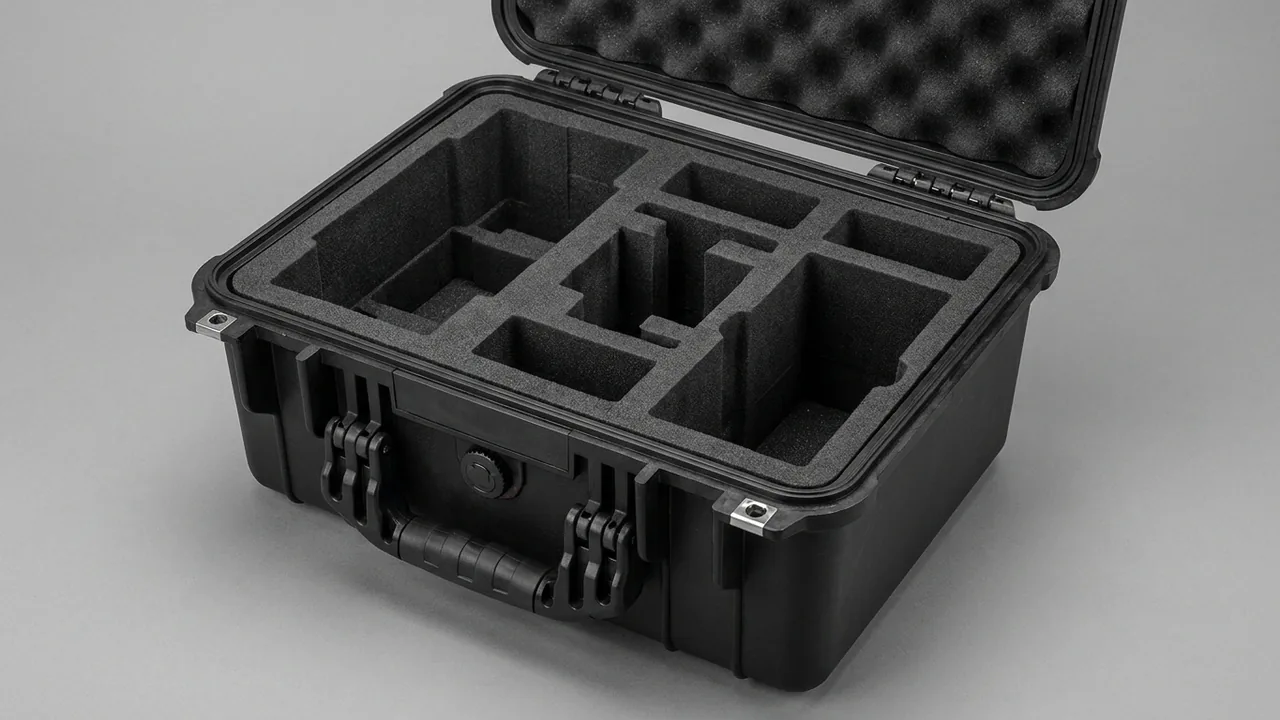
When anodizing line tanks, rectifiers, busbars and jigs are stripped for repair or moved between plants, the most common failures are not drop damage. They are pitting caused by trapped acid, insulation degradation caused by moisture, and scratches or distortion on plastic linings and titanium jigs. JUNZHIJIA treats the protective case as a small managed environment: neutralize and dry the part until it is genuinely storable, lock its degrees of freedom with a machined insert, then hold that condition with sealing and humidity control until the part goes back on the line. For anodizing hardware, the case is really a corrosion and insulation tool, not just a bumper.
This guide follows the order a maintenance planner actually uses: teardown, risk mapping, insert design, cleaning procedure, then test and acceptance. Everything is written so it can be pasted into a purchase specification. MIL-STD-810H is referenced here only as an environmental test method, not as a military certification. Because anodizing is a wet surface treatment, the packing and shipping stage must also respect chemical handling rules for tank liquor residue and acidic vapour. If you are specifying cases for a line upgrade, a plant relocation or aftermarket spare parts, jump straight to the insert zoning and the test and acceptance sections.
Contents
- Which anodizing line components need their own case
- Tank liquor residue: why a rinsed part still corrodes
- Scratch-free fixturing for tanks and plastic linings
- Moisture and static protection for rectifiers, busbars and cables
- Controlling distortion on titanium jigs, clamps and conductive beams
- Transport protection for heat exchangers and cooling coils
- Choosing insert zoning and fixturing methods
- Case material, sealing and chemical resistance requirements
- Suppressing humidity and acidic atmosphere inside the cavity
- Cleaning, neutralizing and drying before packing
- Transport testing and incoming acceptance
- Packing, stacking and pre-start unpacking
- FAQ
- Conclusion and related reading
Which anodizing line components need their own case
A complete sulfuric acid anodizing line contains far more than the crane and the main frame. The parts that genuinely need their own protective case fall into six families: tank units including PP, PVC or PVDF linings and flanges; rectifier power units including IGBT stacks, transformers and control panels; current-carrying systems such as copper busbars, titanium bars and conductive beams; jigs and clamps; heat exchange and cooling units including titanium shell-and-tube exchangers, plate exchangers and cooling coils; and pump, valve and filtration units.
Each family has a completely different transport sensitivity. Tank units fear sharp contact and flange face impact, because a through-thickness scratch in the lining becomes a leak once the tank is filled. Rectifiers fear condensation and terminal stress, and a damp terminal that is re-energized can flash over. Busbars fear bending and damage to the surface oxide or plating, because a bent copper bar simply will not fit the cabinet. Jigs and titanium beams fear impact distortion, since contact point positions set the coating thickness uniformity across the rack. Heat exchangers fear deformed tube ends and residual acid inside the tubes. Pumps and valves fear dry-running shaft seals and damaged flange faces.
A dependable anodizing line case is therefore not a pallet with a foam collar. It is a structure divided into independent cavities per component family, each with its own locating features and contact face protection. Mixing strongly acidic residue parts with electrical parts in one cavity is the most common hidden mistake on site, because acidic vapour slowly attacks rectifier terminal plating inside a closed box.
A practical rule: divide the load into "wet residue parts", "electrical precision parts" and "distortion-sensitive parts", separate them physically, and seal each group independently. That is the baseline division of labour for anodizing line packaging.
Tank liquor residue: why a rinsed part still corrodes
When the shop floor says a part has been rinsed, it usually means visible liquid film was flushed away with tap water in a few seconds. But sulfuric anodizing liquor forms a trapped reservoir inside the micropores of a plastic lining, in flange joint gaps, and in dead corners around tube sheets and tube ends. Under vibration and temperature rise in transit, that reservoir bleeds out slowly and creates a pocket of liquid that can sit at pH 1 to 2.
Deciding whether a part is genuinely storable should follow three checks rather than a visual inspection:
- Neutralize. Treat all surfaces and dead corners that may hold acid with a weak alkaline solution, typically 3 to 5 percent sodium carbonate, instead of surface rinsing alone.
- Rinse and confirm conductivity. Holding the final rinse water below a working value of about 10 microsiemens per centimetre is a practical indicator that residual ions have been carried away.
- Dry. Flange faces, tapped holes, tube ends and weld recesses must be fully dry. Anhydrous ethanol can assist dewatering, followed by clean compressed air.
For dead corners that cannot be opened for cleaning, such as the tube side of a heat exchanger, the safer approach is inerting before packing: drain the liquid, purge with dry air, and place a separate vapour corrosion inhibitor pack inside the case, with pH paper or a humidity indicator card as the incoming verification record. The same logic applies to plating and electrolysis equipment, and the zoning practice described in electroplating equipment component protection for tank and electrode parts follows the same principle.
Scratch-free fixturing for tanks and plastic linings
Tank units are large, thin-walled and low in rigidity, so an insert must support them rather than clamp them. The working surface of a plastic lining is relatively soft, and any hard support point creates a localized indentation during a long trip that can progress into stress cracking.
Three fixturing rules matter:
- Take the load on stiffeners and flanges. Never let the lining working surface carry weight.
- Use soft materials at every contact face. Closed-cell EVA at roughly 40 to 60 kilograms per cubic metre, or polyethylene foam, is typical; very hard foams transfer shock.
- Limit horizontal creep rather than locking vertically. Leave 5 to 10 millimetres of compressible clearance between case and part so impact is not delivered straight into a thin wall.
Flange faces are both the weakest and the most critical feature on a tank. Cut a dedicated pocket for each nominal flange size and add protective plates or L-shaped corner guards so the guard absorbs impact. If the tank carries a level gauge, temperature probe boss or other protrusion, remove it before packing and place it in a small parts box so it never becomes a load path.

Moisture and static protection for rectifiers, busbars and cables
The rectifier is the heart of an anodizing line. Its transport sensitivities match a normal industrial electrical cabinet but with extra emphasis on terminals and condensation:
- Terminals and busbars must not carry load. Fixture the cabinet upright with the base on load-bearing beams; never let a busbar act as a support.
- Prevent condensation. Use desiccant sized by cavity volume, working at roughly one unit per 30 litres for silica gel types, together with a humidity indicator card. For shipments crossing climate zones, choose a case with a pressure equalization valve so differential pressure does not draw moisture in at unpacking.
- Control static. Rectifier control boards are electrostatic-discharge sensitive. Choose insert materials whose surface resistance sits in a controlled band or add antistatic shielding bags; the design logic is covered in ESD shielding and static-dissipative case design.
When cables ship in the same case as busbars, coil the flexible cables separately from rigid bars so vibration does not rub the cable against busbar plating. Copper bar contact faces are normally tin or silver plated at the factory, and any scratch raises contact resistance, so each bar should have its own sleeve and its own retaining slot.
Controlling distortion on titanium jigs, clamps and conductive beams
Jigs and conductive beams are a classic anodizing line family: high count, meaningful unit cost, and unrepairable once distorted. Titanium is strong, but jigs are usually slender rods with cantilevered hooks, giving low bending stiffness. If they are simply stacked, hooks shift and spring fingers change their opening angle before the crate is even opened.
The effective method is to reproduce the load direction the jig sees inside the tank. Stand each jig vertically in a locating groove so self-weight travels along the axis and the cantilever does not carry bending moment. For spring-finger jigs, shape the insert pocket so fingers rest near their free position; keeping them compressed for weeks reduces spring force permanently.
The same applies to conductive beams and copper bars. Above 1.5 metres, provide at least three support points and wrap the contact zones in soft material. If a beam carries hooks or studs, confirm first that those protrusions cannot press against each other inside the case.
Transport protection for heat exchangers and cooling coils
Heat exchangers and cooling coils are the most under-estimated parts on an anodizing line. Deform a tube sheet or nozzle flange and the joint will leak after installation. Leave acid inside the tubes and it will corrode the wall slowly during transit.
| Feature | Main risk | Recommended protection | Incoming recheck |
|---|---|---|---|
| --- | --- | --- | --- |
| Tube sheet and nozzle flange | Crushing, seal face scratches | Blind plate or soft cover, stand upright | Flatness and witness marks |
| Tube side interior | Residual acid corrosion | Drain, dry air purge, VCI material | Liquid or rust in tubes |
| Fins and coil exterior | Bent or flattened fins | Perimeter foam wrap, no stacking load | Count and extent of fin damage |
| Brackets and lifting lugs | Load deformation | Support lugs separately, never fixture by them | Bent or twisted lugs |
| Threaded connections | Rust seizure | Thread protectors plus anti-seize | Corrosion and hand-turn check |
Locating a heat exchanger inside a case follows the thinking described in heat exchanger component impact protection: the goal is not to tie it down hard, but to ensure support exists in every direction and every protrusion has somewhere to go.
Choosing insert zoning and fixturing methods
The insert is the core engineering item in a protective case. For anodizing line components there are three common routes:
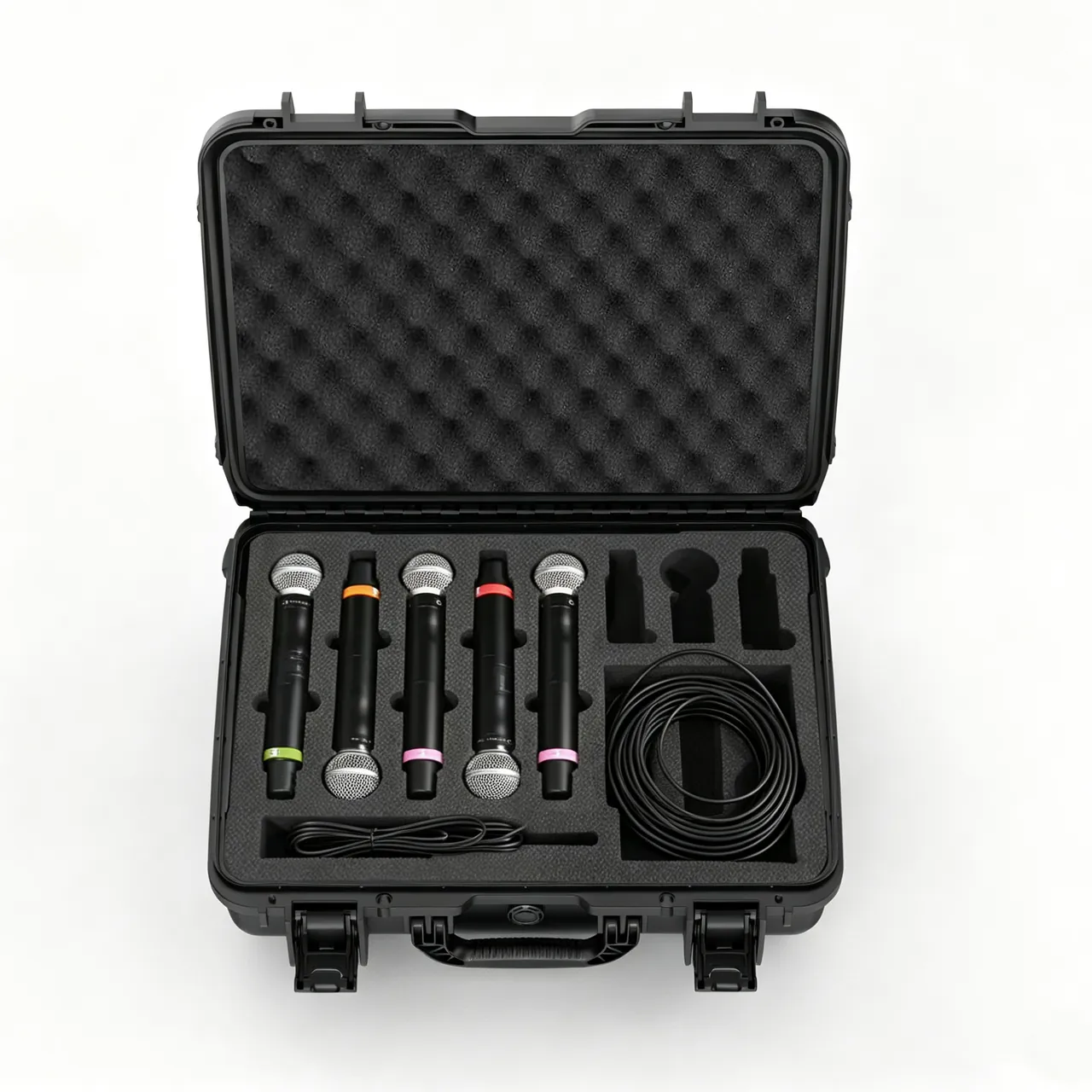
- CNC-routed EVA or PE inserts. Best for small to medium parts with regular geometry such as jigs, nozzles, busbars and control boards. Short lead time, high locating accuracy, single or multi-layer depending on shape complexity. Recommended pocket spacing and compression allowance are covered in the custom foam insert design guide.
- Moulded inserts in EPP, EPS or thermoformed EVA. Best for stable, repetitive shapes such as powder hopper lids or standard flanges. Low unit cost and consistent cushioning.
- Modular inserts with rigid dividers. Best when one case must carry several component types. Rigid dividers in PVC sheet or aluminium composite create independent cavities, with soft material providing secondary restraint.
Before choosing, answer three questions: does any single part exceed 25 kilograms, which decides whether lifting hardware is needed; is any part thin-walled or slender, which decides whether contoured support is needed; and does any part carry chemical residue, which decides whether an independently sealed cavity is required. For material, closed-cell PE or EVA is preferred because anodizing parts may carry alkaline or acidic residue; open-cell materials absorb moisture and should be avoided.
Case material, sealing and chemical resistance requirements
The case body must satisfy both structural strength and chemical atmosphere tolerance. Anodizing components can release trace acidic vapour, so interior surface resistance to chemicals matters more than for a general equipment case.
| Case type | Structure | Typical IP rating | Best fit | Watch out for |
|---|---|---|---|---|
| --- | --- | --- | --- | --- |
| Injection moulded hard case | One-piece shell, light, impact resistant | IP67 | Small parts, jigs, control boards | Size limited, not for oversized parts |
| Rotomoulded or blow moulded case | Large format, adjustable wall thickness | IP65 to IP67 | Tanks, rectifier cabinets, exchangers | Confirm seal compound resists acids |
| Aluminium magnesium case | Stiff, good heat path, shieldable | IP65 to IP67 | Precision electrical parts, shielding | Interior surfaces need corrosion treatment |
| Plywood or timber frame crate | Low cost, fully sizeable | Not sealed | One-way shipment of large items | No moisture barrier, needs liner and bag |
Seal compound choice is equally important. Nitrile rubber handles oils well but is weak against strong acids, silicone tolerates temperature but is average against some solvents, and EPDM performs well against water and a range of acidic and alkaline media. A media-by-media comparison is given in protective case seal material selection. If the case will store parts with liquid residue for long periods, add a pressure equalization valve so cavity differential pressure stays bounded and the seal is not pushed open.
One frequently missed detail: a seal that sits against acidic residue in the closed position ages faster. Put the contact zone at a high point that does not collect liquid, or mould a dedicated sump into the case floor.
Suppressing humidity and acidic atmosphere inside the cavity
Getting the part into the case is only step one. Holding low humidity and low acid vapour inside the cavity is what protects it over months.
- Desiccant. Silica gel or molecular sieve sized by cavity volume, with a humidity indicator card visible at unpacking.
- VCI materials. Vapour corrosion inhibitors suit steel fasteners, pump shafts and threaded ports, forming a protective film inside gaps that cannot be fully dried.
- Acid vapour absorption. For cavities at risk of acid mist, a modest amount of alkaline absorbent can be used, physically isolated from the parts.
- Inert gas purge. For high-value parts on long ocean voyages, dry nitrogen displacement before sealing is the top tier moisture strategy.
Desiccant and VCI only delay, they do not replace cleaning and neutralizing. Doubling desiccant on a wet part is useless, because the absolute water content of the liquid dwarfs the water content of the cavity air.
Cleaning, neutralizing and drying before packing
Turning cleaning into a signed checklist measurably reduces corrosion claims. Run the steps below in order and keep records:
- Remove and log every vulnerable protrusion: probes, level gauges, nozzles, fittings.
- Drain tanks and piping, recording the method and the standing time.
- Neutralize with a weak alkaline solution, emphasizing dead corners and tapped holes.
- Rinse until final rinse water conductivity meets target.
- Dry using compressed air with anhydrous ethanol assistance, confirming no liquid on flanges or in tapped holes.
- Fit the insert, seat the parts, tighten restraints.
- Add desiccant, VCI and a humidity indicator card.
- Close and label with the parts list, cleanliness state, closing date and lifting points.
Pre-pack cleanliness affects installation quality too. Some rectifiers and busbars ship as part of an electrical cabinet package, and the practices in pump and valve component oil seal and rust protection transfer well, particularly flange seal face and threaded port protection.
Transport testing and incoming acceptance
Specify verifiable transport performance in the purchase document. The usual references are:
- ISTA procedures. Suitable for parcel and less-than-truckload shipment validation.
- GB/T 4857 series. Vibration, impact and stacking methods common in domestic road transport.
- ASTM D4169. A distribution-cycle based programme suited to multi-leg, multi-region logistics.
- MIL-STD-810H methods 514 and 516. Usable as method references for vibration and shock, cited as environmental test methodology only, not a military certification.
Incoming acceptance should run appearance, cleanliness, dimensions and function in sequence, with explicit rejection criteria:
| Dimension | What to inspect | Typical rejection trigger | Action |
|---|---|---|---|
| --- | --- | --- | --- |
| Appearance | Case, insert, part surfaces | Through cracks, crushed insert | Reject or claim |
| Cleanliness | Liquid, rust, pH indicator | Liquid on flange or in tubes | Rework, clean, re-inspect |
| Dimensions | Flange flatness, busbar straightness | Out of drawing tolerance | Deviation report |
| Function | Seal faces, threads, terminals | Seized threads, blackened terminals | Replace or concession |
Treating cleanliness as its own acceptance dimension is what separates an anodizing line case from a general equipment case. The sampling and disposition framework in protective case acceptance and AQL sampling can be applied directly.
Packing, stacking and pre-start unpacking
The last stage is execution on the floor. Packing has to answer how a human places the part without knocking it; unpacking has to answer how long after opening the line can be started.
Packing:
- Lift large items with slings rather than letting fork tines touch the tank or case wall, and use the marked lifting points.
- Number small parts boxes and accessories, and include a list so nobody spends a day hunting for one nut.
- Before closing, do a shake test. A faint knocking sound means the restraint is insufficient.
Stacking:
- Heavy cases low, light cases high, and never exceed the marked stack limit.
- Add anti-slip mats and lashing inside sea containers so cases cannot slide in heavy weather.
- Cases with chemical residue must not be stacked directly against or beside electrical cases.
Unpacking:
- Read the humidity indicator card first. If it shows moisture uptake, ventilate and dry before energizing anything.
- Open chemical residue parts under ventilation or water rinse conditions, with eye protection and acid-resistant gloves.
- Before energizing a rectifier, measure terminal-to-earth insulation to confirm there is no condensation.
Manufacturer capability. Kexin New Materials (Guangdong) Co., Ltd. builds protective cases for anodizing line components under the JUNZHIJIA brand. Tank flanges, rectifier cabinet profiles and jig suspension geometry can be surveyed part by part and matched to a machined insert, with OEM and ODM programmes, wholesale, agency and global supply. Insert material reports and case sealing test documents can be supplied with each shipment under contract.
FAQ
Q: Can anodizing tanks be shipped in an ordinary wooden crate?
A: They can be moved that way, but it is not advisable, because a timber crate provides neither sealing nor cushioning and the wood itself can absorb moisture and release it later, creating a humid microclimate on a long trip. The real risks for a tank are scratches on the lining working surface from hard contact and flange face distortion under load, and both rise sharply when a timber frame has no contoured internal support. If cost forces a timber solution, do three things at minimum: protect the flange face with a soft cover and a dedicated pocket, line the crate with closed-cell foam, and use stretch film to stop the tank from rubbing against the frame. For PP or PVC lined tanks, also check that no nail tips or rough timber burrs press into the lining. If the tank has a level gauge or temperature probe, remove those parts first. For ocean freight or repeated handling, move to a rotomoulded or blow moulded case with a pressure equalization valve, raise the rating above IP65, and contract for GB/T 4857 or ASTM D4169 validation.
Q: A rectifier arrived with blackened terminals. What caused it and how do we prevent it?
A: Blackened terminals are usually the combined result of acidic atmosphere and condensation rather than simple oxidation. If a rectifier shares a case with tank parts that still carry acid residue, acidic vapour slowly accumulates inside the sealed cavity. When the shipment crosses a day-night temperature swing, the vapour condenses on cavity walls and drips onto the terminals, forming a thin liquid film that attacks the plating. Prevention has three parts. First, separate physically: put the rectifier cabinet in its own sealed cavity, apart from anything that may carry liquid residue. Second, control humidity: size desiccant to the cavity volume, include a humidity indicator card, and choose a case with a pressure equalization valve for climate-zone shipments. Third, protect the terminals themselves: sleeve terminals and busbar contact faces in soft material and never allow a busbar to carry any structural load. At incoming inspection, read the indicator card, measure terminal-to-earth insulation, and only then energize. If blackening has occurred, decide on busbar or terminal replacement based on contact resistance test results rather than appearance alone.
Q: What insert method best prevents distortion in jigs and conductive beams?
A: The key is to reproduce inside the case the load direction the jig experiences inside the tank. Stand jigs vertically in locating grooves so self-weight travels axially. Slender rods and cantilevered structures suffer most from sustained bending moment, and if they are simply laid flat and stacked, hooks and spring fingers take on permanent offset from self-weight and vibration. Practical measures include contouring the CNC-routed insert to the jig outline; for spring-finger jigs, pocket geometry that lets fingers rest near their free position so long-term compression does not reduce spring force; at least three support points for conductive beams longer than 1.5 metres, with closed-cell foam wrapping at contact zones; and for beams carrying hooks or studs, checking first that no two protrusions press against each other. Closed-cell PE or EVA is preferred for chemical resistance, since open-cell materials absorb moisture. After packing, shake the case lightly. A knocking sound means restraint is inadequate, so add locating blocks or adjust the compression allowance to keep 5 to 10 millimetres of compressible clearance.
Q: What IP rating should an anodizing line component case actually have?
A: There is no single answer. It depends on the component family, the shipping mode and the storage duration, and a simple tiering works well. For small parts that only shuttle inside one plant and arrive the same day, such as nozzles, clamps and control boards, an IP65 injection moulded or aluminium case is normally enough. For electrical parts that travel interprovincially and may see rain, snow or open-air transshipment, such as rectifier cabinets, control panels and busbars, IP67 is preferable. For tank parts and heat exchangers that go by sea, are handled repeatedly, or are stored for months, add a pressure equalization valve on top of IP67 so cavity differential pressure stays bounded and unpacking does not draw moisture in. Seal compound must match the media it may touch. EPDM handles water and many acidic or alkaline media reasonably, while nitrile rubber is oil tolerant but weak against strong acids. Note also that an IP rating describes dust and water only, not chemical resistance or static control, so for rectifier control boards specify the insert surface resistance band or add antistatic shielding bags to create a three-way specification covering water, chemistry and static.
Q: How should the pre-pack cleaning standard be defined, and can it be quantified?
A: It can be quantified and should be written into the work instruction so different shifts apply the same rule. Step one is neutralization: treat surfaces and dead corners that may hold acid with a 3 to 5 percent weak alkaline solution such as sodium carbonate, rather than surface rinsing. Step two is rinsing with a confirmed conductivity target; holding final rinse water below about 10 microsiemens per centimetre is a practical indicator that residual ions have been carried off. Step three is complete drying, with flange faces, tapped holes, tube ends and weld recesses as the priority areas, using anhydrous ethanol to assist dewatering followed by clean compressed air. For dead corners that cannot be opened, such as the tube side of a heat exchanger, drain the liquid, purge with dry air, and place a vapour corrosion inhibitor pack in the cavity. Record the drain method and standing time, the neutralizing concentration, the final rinse conductivity, the drying method and the closing date. At the receiving end, use pH paper and a humidity indicator card as the recheck, closing the loop between the packing record and the incoming verification.
Q: Can tank parts and electrical parts share one case, and how should it be divided?
A: They can share a case, but only with physical zoning and independent sealing, never in one common cavity. A workable split uses three groups. Parts with liquid residue risk, such as tank fittings, pumps, valves and piping, go into the wet zone, ideally in a cavity with its own sump and acid-resistant liner. Rectifier cabinets, control boards and sensors go into the electrical precision zone, which needs moisture and static control and benefits from antistatic shielding bags. Jigs, conductive beams and slender rods go into the distortion-sensitive zone and need contoured support. Separate the three groups with rigid dividers in PVC sheet or aluminium composite, and give each its own seal and desiccant. One constraint is frequently overlooked: cases holding chemical residue must not be stacked in the same layer immediately beside electrical part cases, and at sea they should be lashed separately. If the mix is genuinely complex, splitting into two cases, one for chemical residue parts and one for electrical parts, is usually cheaper to procure and to manage on site.
Q: What compliance points matter when exporting anodizing line cases by sea?
A: Three areas dominate: chemical residue, wood packaging quarantine, and transport test evidence. On chemistry, if components carry sulfate type residue, confirm against the intended use whether the shipment falls under dangerous goods rules and mark the outer packaging with the correct handling information. Residue must be drained, otherwise it can bleed out in a hot container and corrode both the case and neighbouring cargo; the general packaging and marking expectations are outlined in ADR and IMDG hazmat transport case compliance. On wood, any timber packing or dunnage must meet ISPM 15 heat treatment or fumigation requirements and carry the correct mark. On testing, sea freight is best validated to ISTA or ASTM D4169 at whole-case level with the report retained for claims and customer audits. Finally, sealed cases experience real temperature and pressure swings on a cross-climate voyage, so a pressure equalization valve is effectively mandatory; without it, unpacking can draw in moist air or the seal can be pushed open.
Q: What does a protective case actually add over open storage for long-term spare tanks, and what should we watch?
A: The dominant threat in long-term storage is sustained humidity plus slow acid vapour attack, and the value of a case is that it creates a small environment you can actively manage. Compared with open storage or a tarpaulin, a case offers three advantages: after sealing you can control humidity with desiccant and read it on an indicator card; workshop dust and oil mist cannot settle on the lining working surface or flange faces, reducing pre-installation cleaning; and cases can be stacked, saving floor space while cutting the chance of accidental impact. Several points deserve attention. Neutralizing and drying must be finished before the part goes in, because doubling desiccant on a wet part achieves nothing. A seal that sits against liquid residue ages quickly, so the contact zone should sit high where liquid does not collect. Inspect the humidity indicator card on a fixed cycle, for example quarterly, and replace desiccant as needed. For very long storage, consider a dry nitrogen purge before sealing. Finally, label spares carefully with the closing date, part number and cleanliness state, so nobody discovers at installation time that the part must be reprocessed first.
Conclusion and related reading
Designing a case for anodizing line hardware really means extending the corrosion and cleanliness problems of a surface treatment shop into transport and storage. Three commitments cover most of the risk: pre-pack cleaning, neutralizing and drying must be documented; the insert must be zoned and located according to how each component family carries load; and humidity and static inside the cavity must be actively managed. Rectifier insulation, tank flange flatness and jig contact point positions are the three inspection points most likely to trigger rework on arrival, and should be fixed items on every acceptance checklist.
Related reading