

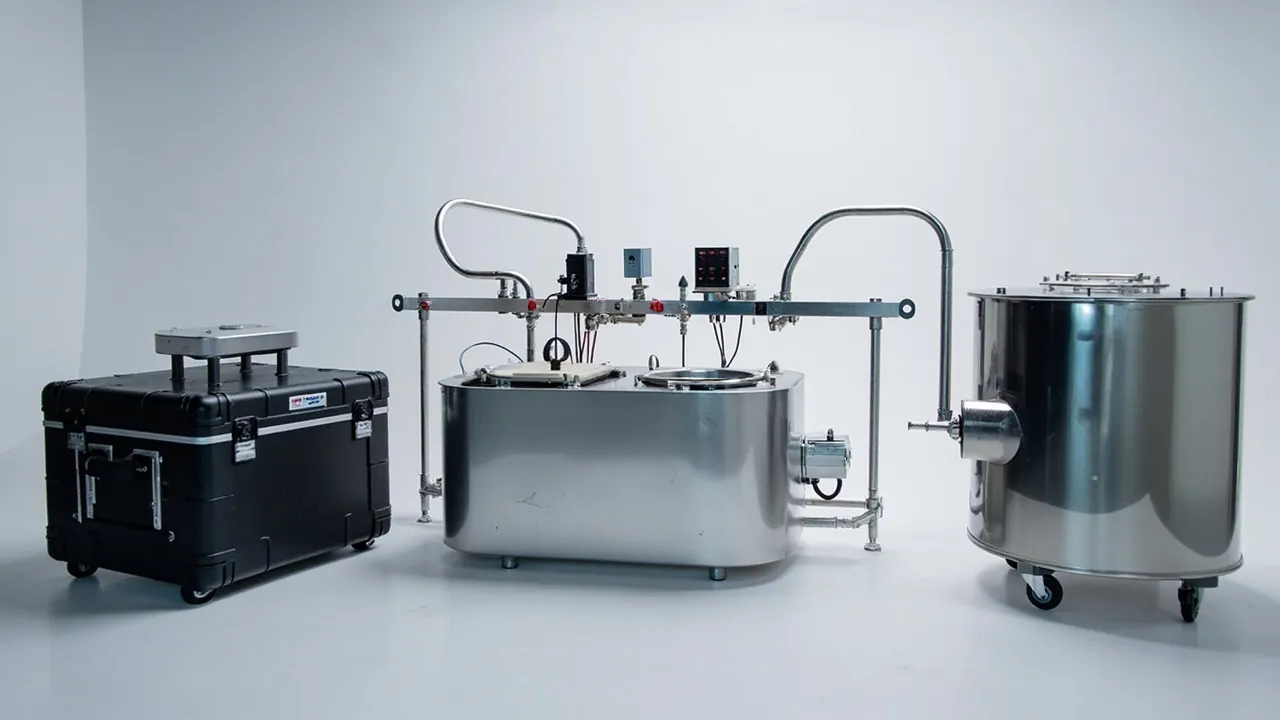
There is one word at the center of every electroplating and surface-finishing case: corrosion. The headline conclusion is that the first design objective for this equipment class is not impact resistance but corrosion resistance and liquid separation. Rectifier transformers and busbars fear moisture, acid mist and vibration; titanium baskets and anodes carry residual bath chemistry; racks and barrels carry conductive-surface contamination. Any residual liquid left inside a sealed case degrades both the case and the equipment at the same time. Sealing to IP65 or better under IEC 60529 and GB/T 4208 is only the sealing threshold. What determines service life is the case material's tolerance of acid mist and salt fog, and how the liquid-residue boundary is expressed structurally rather than left to operator discipline.
This article is written for equipment engineers and buyers at plating shops, anodizing lines and coating operations. It works through rectifiers, bath components, racks and barrels, and pumps and piping item by item, and provides a material tolerance comparison table, a standards reference list and acceptance steps whose values can be written straight into a procurement technical agreement.
Table of Contents
- 1. Transport Risk Profile: Corrosion Is the First Enemy
- 2. Rectifiers: Vibration and Moisture Protection for Transformers, Busbars and Power Devices
- 3. High-Frequency Switch-Mode Power Supplies and Control Cabinets: ESD and Condensation
- 4. Anodes, Titanium Baskets and Anode Bags: The Residual Bath Boundary
- 5. Filters, Pumps and Heat Exchangers: Draining Lines and Controlling Residual Liquid
- 6. Racks, Barrels and Fixtures: Conductive Surface Protection and Busbar Distortion
- 7. Nozzles, Heating Elements and Level Sensors: Compartmenting Slender and Brittle Parts
- 8. Corrosion-Resistant Design: Salt Fog, Acid Mist and Case Material Selection
- 9. Corrosion Testing and Verification: The Boundaries of GB/T 10125 and ASTM B117
- 10. Environmental Awareness: GB 21900 and the Residual Bath Responsibility Boundary
- 11. Liners, Seals and Pressure Equalization: Material Compatibility and IP Rating
- 12. Standards Cross-Reference, Acceptance Points and AQL Sampling
- 13. Volume Supply and OEM/ODM Collaboration Models
- Frequently Asked Questions
- Conclusion & Related Reading
1. Transport Risk Profile: Corrosion Is the First Enemy
Plating shop equipment shares one characteristic: it works continuously in acidic or alkaline mist, so it is already at the threshold of corrosion. Transport simply accelerates the process. A rectifier that has run for three years may look fine, while chlorides and sulfates have already accumulated in the bolt heads, busbar joints and heat-sink gaps. Once it enters a humid sealed case, those residual salts absorb moisture and form an electrolyte, and the corrosion rate rises sharply.
Four risk categories need separate treatment.
First, electrochemical and crevice corrosion. Residual acid, alkali and salt form local galvanic cells in humid conditions. Crevice corrosion is the dangerous one, because it occurs at busbar stacks, bolted joints and flange gaskets where it goes unnoticed until structural strength has already dropped.
Second, moisture and condensation. A rectifier contains transformers, reactors and power devices whose insulation performance depends on staying dry. Condensation lowers insulation resistance, and on power-up it can cause tracking or breakdown. Day-night temperature cycling during transport is the main driver.
Third, vibration and fastener loosening. Rectifiers, filters and pumps contain many bolted joints and terminal connections. Sustained vibration relaxes preload torque, and a loosened busbar joint raises contact resistance, which increases heating during operation and creates a vicious cycle.
Fourth, residual liquid seepage and cross-contamination. Bath chemistry left in titanium baskets, anode bags, filter cartridges, pump bodies and lines seeps during transit, contaminating the liner and other equipment. Some bath chemistries contain heavy metal ions and fall under dangerous goods classification and marking requirements.
Put these four together and it becomes clear why a plating equipment case must be designed from material tolerance outward, not from shell thickness inward. For seal material selection in this environment, see protective case seal materials.
2. Rectifiers: Vibration and Moisture Protection for Transformers, Busbars and Power Devices
The rectifier, whether a thyristor type or a high-frequency switch-mode unit, is the core power supply of a plating line. It comprises a transformer, thyristor or IGBT power modules, a control board, a cooling system and copper busbars. Its weight concentrates in the transformer, and its fragility is distributed across three locations.
Transformers and reactors are high-density heavy items, and the main risk in transit is displacement and loss of fixation. A transformer typically has four or more mounting feet, and if the liner support surface is not flat, load concentrates on one or two feet and sustained vibration can crack them. Use a CNC-cut PE liner for rigid support, with at least 80 percent contact between support face and transformer base, and add a wooden skid underneath to spread impact. Place the center of gravity near the geometric center of the case and toward the hinge side.
Copper busbars are the components most likely to deform. A busbar is typically a long copper bar 3 mm to 10 mm thick and 30 mm to 120 mm wide, and it bends easily under lateral impact when unsupported. Once bent, the mounting holes no longer align, forcing assembly stress during installation and abnormal heating in operation. The critical measure is to remove busbars and pack them separately, or at minimum provide rigid support along the full length to limit displacement. Never fix only the two ends and leave the middle span free.
Power devices and control boards are mainly at risk from static discharge and condensation. IGBTs and MOSFETs are ESD-sensitive, as are the CMOS chips on control boards. Use anti-static bags or anti-static liner material and include adequate desiccant. See ESD shield case design for material requirements.
Cooling systems, meaning heat sinks, ducts and fans, need two details handled. Fan blades are thin plastic and break easily, so remove and pack them separately. Heat-sink fins trap metal debris and dust, so clean them before packing.
The table below gives reference protection parameters for plating and surface-finishing equipment.
| Equipment | Typical weight | Primary risk | Recommended liner | Buffer thickness | Notes |
|---|---|---|---|---|---|
| --- | --- | --- | --- | --- | --- |
| Rectifier main unit | 30-200 kg | Transformer displacement, busbar distortion | PE cut liner plus 20 mm wooden skid | 30-50 mm | Support contact at least 80 percent |
| Copper busbar, removed | 2-20 kg | Bending | Rigid channel supporting full length | 15-25 mm | Never fix ends only |
| Thyristor or IGBT module | 0.5-5 kg | ESD, lead deformation | Anti-static EVA individual cell | 15-20 mm | Original packaging preferred |
| Control board | under 2 kg | ESD, moisture | Anti-static bag plus anti-static liner | 10-15 mm | Add desiccant |
| Filter unit | 20-80 kg | Residual liquid seepage | PE liner plus absorbent pad | 30-40 mm | Must be drained and capped |
| Pump and heat exchanger | 5-40 kg | Residual liquid, flange deformation | EVA 40D plus dedicated liquid bay | 25-35 mm | Cap all ports |
| Titanium basket and anode | 2-30 kg | Residual bath, impact | Divided cells plus liquid isolation bay | 15-25 mm | Fix individually, never stack |
| Rack and barrel | 3-30 kg | Conductive surface scratching, distortion | EVA 30D shallow channel plus non-woven separator | 15-25 mm | Conductive face up, no rubbing |
| Nozzle and heating element | under 2 kg | Breakage, bending | PU foam individual cell | 10-15 mm | Rigid sleeve for slender parts |
3. High-Frequency Switch-Mode Power Supplies and Control Cabinets: ESD and Condensation
High-frequency switch-mode power supplies, typically running at 20 kHz to 100 kHz, are far smaller than line-frequency thyristor rectifiers and carry much higher power density, with a larger proportion of electronics. The protection logic changes accordingly.
First, vibration requirements are stricter. A high-frequency supply contains magnetic components, capacitor banks and cooling structures, some of which are soldered to the PCB by their leads alone. Sustained vibration causes solder joint fatigue cracking, a failure that appears months after delivery and is hard to localize. Use at least 30 mm of buffer thickness and eliminate hard points inside the case.
Second, moisture requirements are higher. PCB surfaces usually carry a conformal coating for moisture, salt fog and fungus resistance, but coating edges, connectors and terminals remain weak points. Provide adequate desiccant, with a working ratio of 100 g of silica gel per 50 L of internal volume, adjusted for transit duration and climate.
Third, ESD protection. Control and driver boards are easily damaged by static during handling. Wear a wrist strap during work and use anti-static bags for packing.
Fourth, settling time after transport. Let the unit equilibrate at room temperature for 4 to 8 hours before powering up, so the equipment reaches thermal equilibrium and avoids a condensation-driven short circuit.
Control cabinets are another common transport item. Their main risks are cabinet deformation and internal component displacement. Cabinets are large and structurally compliant, so stacking loads deform them, after which doors no longer close or gaskets fail. Ship control cabinets upright or in a dedicated frame, and never stack them under other heavy items.
4. Anodes, Titanium Baskets and Anode Bags: The Residual Bath Boundary
Anodes, titanium baskets and anode bags are high-turnover items on a plating line and the main source of liquid residue in transit.
Residual bath chemistry on titanium baskets and anodes must be handled. After removal from the tank, a titanium basket carries plating solution on its surface. Packed as-is, that solution seeps during transit, corrodes the liner and contaminates other components in the case. The recommended sequence is: let it drip in a recovery tank after removal, with roughly 10 to 15 minutes as a working figure, then rinse with clean water, then air-dry or blow dry with compressed air, and only pack once no water marks remain.
Anodes split into two categories with different priorities. Soluble anodes such as nickel and copper plates fear surface oxidation and scratching, so wrap them in anti-rust paper or VCI film. Insoluble anodes carry coatings such as iridium-tantalum that are markedly brittle and sensitive to impact and abrasion, so give them individual compartments with soft wrapping.
Anode bags in polypropylene or polyester filter cloth are bag- or sleeve-shaped, and their risks are creasing and contamination. A crease creates a local stress concentration and shortens service life, while oil and metal debris clog the filter pores. Store them flat or rolled in a dedicated cell, and never compress them under load.
The liquid separation boundary must be structural, not a matter of operator discipline. Provide a dedicated liquid bay inside the case, line it with a replaceable absorbent pad, and put a solid divider between wet and dry zones. That way, if a component still seeps, contamination stays local. Where residual bath chemistry falls under dangerous goods classification, follow the classification, packaging and marking rules in ADR/IMDG hazmat transport case.
5. Filters, Pumps and Heat Exchangers: Draining Lines and Controlling Residual Liquid
This group shares one trait: internal liquid passages. Draining is therefore the most important preliminary action and must be executed systematically.
Filter units, comprising cartridges or cloth, pump body, piping and pressure gauges, should be drained as follows: close the inlet and outlet valves, open the vent valve and let gravity drain the liquid; remove cartridges and filter cloth and pack them separately; blow the lines through with compressed air; cap all ports; and remove and separately pack detachable pressure gauges. A used cartridge must be handled as hazardous waste and must never travel in the case.
Pumps, including centrifugal, magnetic drive and metering types, risk residual liquid and mechanical seal damage. After draining, inspect the mechanical seal for damage, and where the shaft can be turned by hand, confirm it rotates freely and mark the position. Pumps are mid-weight items, so fix them with an EVA 40D liner and hold support contact at 80 percent or better.
Heat exchangers, whether plate, shell-and-tube or immersion type, are rarely drained completely, because liquid lingers between plates and inside tube bundles. Disassemble to drain or use repeated blow-through cycles. Gaskets in rubber or PTFE deform under compression and age, so store them separately and keep them unloaded.
Residual liquid control is a boundary question, not a capability question. What a protective case can do is confine liquid locally, prevent contamination of other equipment and the liner, and make cleanup practical. It cannot substitute for wastewater treatment, hazardous waste management or chemical storage compliance. The procurement agreement should state explicitly that the case is not a chemical or hazardous waste storage container, which keeps responsibility boundaries clean. This aligns with the corrosive-residue handling principles in how to clean a protective case.
6. Racks, Barrels and Fixtures: Conductive Surface Protection and Busbar Distortion
Racks, barrels and fixtures are the most numerous tooling items on a plating line, and the ones that look sturdy while failing quietly.
Racks consist of copper busbars, titanium hooks and insulating coatings. Their governing specifications are conductive surface condition and hook position accuracy. Once a conductive surface oxidizes or scratches, contact resistance rises and plating thickness uniformity degrades. Pack conductive faces upward so they do not rub against metal parts, wrap hooks in soft material to prevent deformation, and keep insulating coatings away from sharp items in the same cell.
Barrels are typically PP, PVC or acrylic, with thin walls and marked brittleness. Their risks are wall cracking and gear deformation. Use a half-round cradle liner that makes line contact rather than surface contact, and where a barrel is long, provide three support points at both ends and the middle so the span does not sag under load.
Fixtures, including plating jigs, baskets and contact clamps, are numerous and varied in shape, which suits a hybrid liner of zoned cut cells plus local elastic restraint. Give each fixture its own cell, matched in width with 1 mm to 2 mm clearance, and cell depth of at least 60 percent of fixture thickness.
Long bars such as copper busbars deserve repeating: deformation in long items comes almost entirely from fixing only the two ends and leaving the middle span free. The correct approach is full-length support, with support spacing not exceeding roughly 20 times the smallest cross-sectional dimension of the bar, a common working ratio for long-item support. For removable divider and long-item support structures, see case removable divider system.

7. Nozzles, Heating Elements and Level Sensors: Compartmenting Slender and Brittle Parts
This group is low in unit cost but high in impact, because a failure stops an entire line.
Nozzles, including spray and atomizing types, commonly have orifices between 0.5 mm and 3 mm, and any impact that deforms the orifice changes the flow distribution. Give each nozzle its own cell with a soft pad on the floor and a protective cap over the orifice.
Heating elements, whether electric, quartz or titanium, are classic slender brittle parts. Quartz is the most brittle; metal sheathed elements resist impact better but still bend. Use PU foam individual cells with a rigid outer sleeve, and add soft end stops so the element cannot slide lengthwise inside the case. The terminal ends of a heating element must be capped to prevent impact deformation.
Level sensors, including glass tube, ultrasonic and magnetic float types, vary in fragility. Glass tube types are the most fragile and need a rigid sleeve and individual fixation. Ultrasonic and magnetic float types contain electronics or a magnetic float, so vibration control and magnetic zoning apply, with at least 150 mm between the float and any strong magnetic source.
Three general principles govern slender parts: support along the full length rather than only at the ends; limit axial sliding; and apply soft end stops rather than hard clamping.
8. Corrosion-Resistant Design: Salt Fog, Acid Mist and Case Material Selection
Plating and surface-finishing shops generally have acid and alkaline mist, and coastal plants add salt fog on top. The corrosion resistance of the case in that environment directly determines service life.
Corrosion resistance of metal hardware is the first threshold. If hinges, latches, rivets and caster brackets are ordinary carbon steel, red rust often appears within months in a plating shop. Specify 304 or 316 stainless steel, and note that 316 contains molybdenum and resists pitting better in chloride environments, which covers both salt fog and chloride-bearing acid mist. Where cost constrains the choice, at least specify galvanized plus passivated, or coated carbon steel hardware, and state a salt spray hour requirement explicitly.
Plastic case body material depends on both base polymer and additives. Common bases include PP, PE, ABS, PC and their alloys. As a rule of thumb, PP and PE resist acids and alkalis better than ABS; ABS has relatively weaker chemical resistance and can stress-crack under prolonged acid mist exposure; PC is strong but sensitive to stress corrosion. Evaluate against the specific medium and concentration, and run an immersion test where necessary.
Seal chemical compatibility is the second threshold. EPDM tolerates polar media such as dilute acids and alkalis well but performs poorly with mineral oils and aromatic solvents. Silicone covers a wide temperature range but has only moderate oil resistance. FKM has the strongest chemical resistance at the highest cost. The choice must follow the actual shop chemistry rather than the word "waterproof" alone. See case foam material comparison.
Liner corrosion resistance matters equally. EVA can hydrolyze and swell with prolonged acid contact, while PE resists chemicals better and suits the liquid-contact layer. Where a liner must contact solvent-bearing or strongly acidic components, specify PE or a surface-treated material and provide a replaceable corrosion-resistant absorbent pad in the liquid bay.
Cleaning and maintenance also affect corrosion life. Clean the gasket and liner after each use to remove residual salts and dust. See how to clean a protective case and protective case service life.
9. Corrosion Testing and Verification: The Boundaries of GB/T 10125 and ASTM B117
Salt spray testing is the most direct way to verify the corrosion resistance of case hardware and surface treatments.
| Test method | Full scope | Typical conditions | Application to plating equipment cases |
|---|---|---|---|
| --- | --- | --- | --- |
| GB/T 10125 | Artificial atmosphere corrosion test, salt spray | Neutral salt spray commonly 5 percent NaCl at 35 C | Verifies corrosion resistance of metal hardware such as hinges, latches and rivets |
| ASTM B117 | Operating salt spray fog apparatus | 5 percent NaCl at 35 C, continuous spray | Common salt spray basis for export orders, used to compare surface treatment options |
| IEC 60529 / GB/T 4208 | Enclosure ingress protection, IP code | Dust level 6, water level 5 or 7 | Verifies sealing class, which is independent of corrosion resistance |
| MIL-STD-810H | Environmental test methods, non-military | Includes salt fog, humidity, vibration and shock methods | Used as an environmental test method reference only; it does not constitute military certification |
Three boundaries must be stated.
First, a salt spray result is a relative comparison, not an absolute life prediction. Surviving 48 hours of neutral salt spray without rust does not mean two years of real-world service without corrosion; it means one surface treatment outperforms another under the same conditions. A technical agreement should specify method, duration and acceptance criteria, not a generic claim of salt spray resistance.
Second, IP rating and corrosion resistance are independent dimensions. IP67 means the case seals well, not that the hinges will not rust. Conversely, stainless hinges do not turn an IP54 case into IP67. The two must be specified separately.
Third, MIL-STD-810H is a test method standard, not a certification standard. The correct wording is that a case "uses the salt fog and humidity test methods defined in MIL-STD-810H." The incorrect wording is "MIL-STD-810H certified." See MIL-STD-810H case compliance.
10. Environmental Awareness: GB 21900 and the Residual Bath Responsibility Boundary
Electroplating is a priority sector for environmental regulation, and GB 21900, the Electroplating Pollutant Discharge Standard, sets explicit limits on water pollutant discharge from plating operations. The standard is cited here for compliance awareness only, not as a technical basis for case design: it serves as a reminder that the transport of equipment and tooling can itself generate heavy-metal-bearing residual liquid that needs to be managed.
Three practical requirements follow for case procurement.
First, bath-wetted components must be processed immediately on removal. Titanium baskets, anodes, filter cartridges, pump bodies and lines must complete the drip, rinse and dry sequence before packing. This is both a corrosion control measure and an environmental one. Carrying residual bath chemistry into the logistics chain spreads contamination risk across the entire chain.
Second, residual liquid must be isolated from people and other cargo. Provide a dedicated liquid bay, lay a replaceable absorbent pad, and put a solid divider between wet and dry zones. After use, dispose of the absorbent pad according to the nature of the medium it absorbed and local hazardous waste requirements.
Third, residual bath chemistry subject to dangerous goods classification must be transported accordingly. Some heavy-metal-bearing or strongly corrosive bath components fall under dangerous goods rules, so classification, packaging, marking and documentation requirements apply. See ADR/IMDG hazmat transport case.
The responsibility boundary must be written into the contract: a protective case is a carrier for mechanical protection and liquid separation. It is not a chemical tank, not a hazardous waste container, and it provides no leak-handling compliance function. Stating that in the technical agreement prevents later disputes.
11. Liners, Seals and Pressure Equalization: Material Compatibility and IP Rating
All three parts of the sealing system, meaning gasket, latches and pressure equalization valve, need chemical compatibility consideration in a plating environment.
Gaskets need, beyond a compression set target of 25 to 35 percent, an assessment of medium compatibility. EPDM tolerates dilute acids and alkalis well and is a common choice in plating shops. Where solvent media are present, evaluate an FKM option. Salt crystals adhering to a gasket surface accelerate aging, so clean it after each use.
Latches and hinges should be 316 stainless where possible, and their moving parts trap salts and dust, so clean them periodically and lubricate with a product compatible with the shop chemistry. For structural details, see toolbox hinge latch and seal structure.
A pressure equalization valve is also necessary in plating cases, for two reasons. First, transport temperature differentials create 20 kPa to 40 kPa across a sealed case, which makes the lid hard to open. Second, if equipment carries residual moisture, internal humidity rises with temperature, and an equalization valve lets humidity equilibrate with the outside rather than accumulate. See case pressure equalization valve.
IP rating selection: plating shops are humid and often washed down, so specify at least IP65. Export sea freight and open-air storage justify IP67. Note again that an IP rating describes dust and water resistance only, not corrosion resistance, and the two must be specified separately. See waterproof and IP rating explained and IP67 protective case.
Transport format matters for heavy items. Rectifiers and control cabinets that move frequently suit heavy-duty cases with casters and a trolley handle to reduce handling impact; see case wheels and trolley handle and portable transport box. For extreme temperature scenarios such as summer open-air storage, see extreme temperature case design and shock-resistant case structure.

12. Standards Cross-Reference, Acceptance Points and AQL Sampling
Turning protection requirements into auditable clauses requires citable standards. The table below maps common standards to plating and surface-finishing cases.
| Standard | Scope | Application |
|---|---|---|
| --- | --- | --- |
| IEC 60529 / GB/T 4208 | Enclosure ingress protection, IP code | Defines IP65 and IP67 dust and water ratings and test methods |
| GB/T 10125 | Artificial atmosphere corrosion test, salt spray | Verifies corrosion resistance of hinges, latches, rivets and other metal hardware |
| ASTM B117 | Operating salt spray fog apparatus | Common salt spray basis for export orders |
| GB 21900 | Electroplating pollutant discharge standard | Cited for environmental compliance awareness only, to explain the residual bath management boundary |
| MIL-STD-810H | Environmental test methods, non-military | Methods reference for salt fog, humidity, vibration and shock; does not constitute military certification |
| ISTA 2A / 3A | Packaged-product and LTL transport testing | Validates vibration and drop performance for single-case shipments |
| ASTM D4169 | Performance testing of shipping containers | Sets test intensity from distribution cycle and assurance level |
| GB/T 4857 series | Basic tests for transport packages | Drop, stack and vibration basis for domestic routes |
| UL94 | Flammability of plastic materials | Flammability rating for liner and shell materials |
| IEC 62262, IK code | Degree of protection against mechanical impact | Expresses external impact resistance |
Acceptance points, in priority order:
- Residual liquid check. Immediately on opening, check the liquid bay for seepage traces, whether the absorbent pad is saturated, and whether corrosive liquid has reached other zones. This must happen before any equipment is removed.
- Metal hardware corrosion check. Inspect hinges, latches, rivets and caster brackets for red rust, white rust or pitting. Where a salt spray requirement applies, verify the report.
- Busbar and long-item straightness check. Check copper bars and similar long items for bending with a straightedge or surface plate; typical allowance is 1 mm to 2 mm per meter, stated on the drawing.
- Sealing check. Close the empty case and immerse for 5 minutes watching for continuous bubbles, or pressurize to 20 kPa and observe decay.
- Fit tolerance check. Liner cell to equipment fit at plus or minus 0.5 mm, or plus or minus 1 mm for heavy items, with support contact at 80 percent or better.
- Marking check. This-way-up, keep-dry, corrosive substance warnings and serial number markings.
For sampling, reference AQL: critical defects such as liquid seepage, hardware corrosion, out-of-tolerance busbar bending or seal failure take AQL 0.65 or tighter; major defects such as fit deviation or cosmetic flaws take AQL 1.5 or 2.5. See custom case acceptance and AQL. For domestic transport, cite GB/T 4857 transport packaging testing; for international distribution cycles, cite ASTM D4169 distribution cycle testing and ISTA transport testing procedure.
13. Volume Supply and OEM/ODM Collaboration Models
There are three procurement models for plating and surface-finishing cases:
- Standard case plus custom liner. Short lead time and low cost, suited to production lines with a stable equipment fleet. When equipment is added, only the liner panel needs rework, not the case tooling.
- Modified case, semi-custom. Adjust latches, hinges, casters, nameplate provisions and color on a standard case size, and upgrade to stainless hardware or corrosion-resistant liners as required. Suits private-label programs and group-wide identity.
- Full new tooling. For cases with specific brand identity requirements or rectifiers and control cabinets that exceed standard case sizes. Mold cost and MOQ need separate calculation; see custom case mold cost analysis.
JUNZHJIA, manufactured by Kexin New Materials (Guangdong) Co., Ltd., serves B2B customers with wholesale, distribution, OEM/ODM and global supply. In electroplating and surface finishing, typical capabilities include reverse-modeling liners from 3D scan data or drawings, configuring dedicated liquid isolation bays with replaceable absorbent pads, matching chemically compatible gaskets and pressure equalization valves to the case model, issuing test reports or third-party inspection documents to a customer-specified standard such as GB/T 10125 neutral salt spray, and scheduling small-batch repeat orders. For plating lines that iterate equipment models, the liner drawing updates alongside the equipment list without repeated tooling.
Evaluate suppliers on liner engineering capability, metal hardware material and surface treatment, test resources and delivery stability rather than shell price alone. See how to choose a case OEM factory and identifying genuine versus imitation cases. For further liner trade-offs, see custom foam inserts guide and EVA foam insert custom process.
Frequently Asked Questions
Q: What is the biggest difference between a plating equipment case and an ordinary equipment case? A: The biggest difference lies in corrosion resistance rather than impact strength. An ordinary case is designed around vibration, drop, dust and water. A plating case must additionally solve three things. First, residual liquid: bath chemistry left in titanium baskets, anodes, filters, pumps and lines seeps in transit, corrodes the liner and contaminates other components, so a dedicated liquid isolation bay with a replaceable absorbent pad is required. Second, corrosion resistance of metal hardware: ordinary carbon steel hinges, latches, rivets and caster brackets show red rust within months in acid mist, so specify 304 or 316 stainless steel, with 316 containing molybdenum for better pitting resistance in chloride environments. Third, chemical compatibility of gaskets and liners: EPDM tolerates dilute acids and alkalis but performs poorly with oils, and EVA can hydrolyze and swell with prolonged acid contact, in which case PE or a surface-treated material is the better choice. So beyond an IP rating, the agreement must separately specify salt spray requirements and hardware material.
Q: Why must copper busbars be removed and packed separately? A: Because a busbar is a long item, and deformation in long items comes almost entirely from incorrect fixation. A busbar is typically 3 mm to 10 mm thick and 30 mm to 120 mm wide, and it bends easily under lateral impact when unsupported. If packing fixes only the two ends and leaves the middle span free, transport impact concentrates at mid-span and produces permanent bending. The immediate consequence is misaligned mounting holes, and forcing installation introduces assembly stress; in operation, joint contact resistance rises and heating increases, which over time can cause overheating or even burning. There are two correct approaches. The preferred one is to remove the busbar and pack it separately in a rigid channel that supports the full length, with soft end stops. The secondary one is to leave it mounted but constrain displacement along the full length, with support spacing not exceeding roughly 20 times the smallest cross-sectional dimension. Straightness belongs in the acceptance checklist, commonly at 1 mm to 2 mm per meter, stated on the drawing.
Q: What handling do titanium baskets and anodes need before packing? A: The core principle is to process them immediately on removal, in three steps: drip, rinse and dry. A titanium basket or anode leaving the tank carries plating solution on its surface, and if packed as-is the solution seeps in transit, corrodes the liner and contaminates other components. Let it drip in a recovery tank first, with roughly 10 to 15 minutes as a working figure so recoverable solution is captured, then rinse with clean water, then air-dry or blow dry with compressed air, and pack only once no water marks remain. Soluble anodes such as nickel and copper plates fear surface oxidation and scratching, so wrap them in anti-rust paper or VCI film. Insoluble anodes with coatings such as iridium-tantalum are markedly brittle and sensitive to impact and abrasion, so give them individual compartments with soft wrapping. Anode bags are fabric and fear creasing and contamination, so store them flat or rolled and never compress them. All of these actions also serve environmental compliance, because carrying residual bath chemistry into the logistics chain spreads contamination risk.
Q: What does GB 21900 have to do with case selection? A: The relationship is about compliance awareness, not technical specification. GB 21900, the Electroplating Pollutant Discharge Standard, sets explicit limits on water pollutant discharge from plating operations and is an environmental regulatory instrument, not a packaging standard. It is cited to remind buyers that equipment and tooling transport can itself generate heavy-metal-bearing residual liquid that needs to be managed. Three practical requirements follow. First, bath-wetted components must be processed immediately on removal, completing the drip, rinse and dry sequence before packing. Second, residual liquid must be isolated from people and other cargo through a dedicated liquid bay, a replaceable absorbent pad and a solid divider, with the pad disposed of under local hazardous waste rules. Third, residual bath chemistry subject to dangerous goods classification must be transported under the applicable classification, packaging, marking and documentation requirements. Finally, write the responsibility boundary into the contract: a case is a carrier for mechanical protection and liquid separation, not a chemical tank, not a hazardous waste container, and it provides no leak-handling compliance function.
Q: Does a rectifier need to settle after transport, and what should be checked? A: Allow 4 to 8 hours of settling before powering up, mainly because of condensation. A rectifier contains transformers, reactors and power devices whose insulation performance depends on staying dry, and day-night temperature cycling during transport produces condensation on internal air and surfaces. Powering up immediately can lower insulation resistance and cause tracking or breakdown. Settling lets the unit reach thermal equilibrium with the room, and combined with opening the case to ventilate, it substantially reduces risk. Check in this order: appearance and fasteners, looking for cracks in transformer mounting feet and loose bolts, plus any sign of busbar joint displacement; insulation, measuring main and control circuit resistance with a megohmmeter and comparing against factory values; busbar straightness with a straightedge or surface plate; control boards and power modules, confirming no ESD damage marks and that connectors are fully seated; and the cooling system, clearing heat-sink fins and confirming fan blades are intact, with blades removed and packed separately where practical. Only then power up.
Q: How should the IP rating for a plating case be specified? A: Specify it from two dimensions: the operating environment and the transport route. On environment, a plating shop is humid and often washed down, so specify at least IP65, combining dust level 6 with water level 5 for protection against water jets; where equipment moves in and out of the tank area frequently, IP67 is reasonable. On route, export sea freight, open-air storage and multimodal transport justify IP67, combining dust level 6 with water level 7 for short-term immersion, because standing water on a container floor and deck spray during loading are real conditions. Two points need clarifying. First, IP65 and IP67 have identical dust performance, differing only in water. Second, an IP rating describes dust and water resistance only, not corrosion resistance, and the two must be specified separately. An IP67 case does not mean the hinges will not rust, and stainless hinges do not turn an IP54 case into IP67. List the IP rating and the salt spray requirement as separate clauses in the agreement.
Q: Is 48 hours of salt spray testing enough? A: There is no simple yes or no, because the answer depends on the test purpose and the acceptance criteria. First, a salt spray result is a relative comparison, not an absolute life prediction. Surviving 48 hours of neutral salt spray without rust does not mean two years of service without corrosion; it shows how two surface treatments compare under identical conditions, for example 304 stainless hardware versus galvanized and passivated carbon steel. Second, the technical agreement should specify three elements: test method, duration and acceptance criteria, rather than a generic claim of salt spray resistance. GB/T 10125 defines artificial atmosphere corrosion testing with neutral salt spray conditions commonly at 5 percent sodium chloride and 35 C, while ASTM B117 is a common basis for export orders. Acceptance criteria should be concrete, specifying allowable corroded area percentage, whether red rust on the base metal is permitted, and whether pitting is permitted. Third, remember that salt spray testing and IP rating are independent dimensions: the former verifies hardware and surface treatment, the latter verifies sealing, and neither substitutes for the other.
Q: What should be considered when choosing liner material for a plating environment? A: The two keys are chemical compatibility and cleanability. On material, EVA can hydrolyze and swell with prolonged acid contact, while PE resists chemicals better and suits the liquid-contact layer; where the liner must contact solvent-bearing or strongly acidic components, specify PE or a surface-treated material. On structure, provide a dedicated liquid bay lined with a replaceable corrosion-resistant absorbent pad and separated from the dry zone by a solid divider, so contamination stays local rather than depending on operator discipline. On cleanability, avoid open-cell foam, which absorbs liquid and metal debris like a sponge and cannot be cleaned; specify closed-cell material or one-piece cut construction that minimizes seams so the surface can be wiped. On maintenance, clean the liner and gasket after each use to remove residual salts and dust, because salt crystallization accelerates gasket aging. For a quantitative material comparison and a selection decision tree, see the case foam material comparison and the custom foam inserts guide.
Q: Is small-batch custom liner work expensive, and which plating shops does it suit? A: Not expensive, provided the right path is chosen. Liner customization has two investment models. The first is CNC cutting or die cutting, requiring only a drawing and a program with no steel mold, which suits runs of tens to hundreds of units, especially where equipment models may still be added. The second is heat-formed tooling, which carries a mold cost and suits larger volumes, complex geometry and stable long-term models. For most plating shops and surface-finishing lines, standard case plus custom liner is the best-value combination: the outer case uses a mature standard size with low amortized cost and short lead time, while the liner is reverse-modeled from the actual equipment geometry to hold support contact at 80 percent or better and fit tolerance within plus or minus 0.5 mm, or plus or minus 1 mm for heavy items. The case that genuinely needs cost evaluation is full new tooling, meaning rectifiers or control cabinets that exceed standard case sizes, or a program with specific brand identity requirements. There, amortize the mold cost over an assumed three-year volume. JUNZHJIA supports liner modeling from 3D scan data or drawings, configures liquid bays and stainless hardware on request, and small-batch repeat orders need no new tooling.
Conclusion & Related Reading
A plating and surface-finishing case is fundamentally a boundary engineering problem against three pressures at once: corrosion, residual liquid and vibration. The insulation condition of a rectifier, the straightness of a copper busbar, the residual bath chemistry on titanium baskets and anodes, the cleanliness of a rack's conductive surface and the completeness of line draining will not improve because the shell is thicker. They improve because hardware material selection, gasket chemical compatibility, liquid bay separation and liner support were designed deliberately. The practical order of work is: build the equipment and tooling list and classify items as wet or dry first, then set the IP rating and salt spray requirement, then design the liner and liquid bay, and finally write tolerances, tests and acceptance rules into the technical agreement. Doing those four steps properly lowers both the unpacking contamination rate and the equipment re-inspection rate.
JUNZHJIA, manufactured by Kexin New Materials (Guangdong) Co., Ltd., supplies protective cases, tool cases and equipment cases to B2B customers worldwide through wholesale, distribution and OEM/ODM programs. To have a liner plan, corrosion-resistant configuration and protection rating assessed for a specific equipment model, send the equipment list and transport route and we will return structural recommendations with a document checklist.
Related Reading