


Transport protection for asphalt mixing plant components has to solve three problems at once: the self-weight impact of hard, heavy wear parts; adhesion and contamination caused by bitumen and dust residue; and moisture-driven corrosion during open yard storage or sea freight. Dryer drum liners and mixer paddles are high-chromium castings, sometimes several dozen kilograms per piece, and their worst enemy is edge-to-edge collision plus lifting damage. Baghouse filter bags cannot be creased or damped, and pulse valves cannot let dust into the valve chamber or allow the solenoid to shake loose. Burner nozzle orifices are measured in fractions of a millimetre, so any deformation or carbon blockage destabilises ignition and flame shape. The working principle is to sort the consignment into heavy castings, soft filter media and precision valving, clean and cool every item before packing, then restrain each piece by hard support with soft cushioning in separate compartments, and finally control humidity with an adequate desiccant charge behind a sealed enclosure. JUNZHIJIA, manufactured by Kexin New Materials (Guangdong) Co., Ltd., builds this class of custom protective case for the mixing plant and road machinery sector and can issue insert drawings with packing instructions against a customer parts list.
In procurement and maintenance practice, transit damage on mixing plant parts is rarely caused by a single heavy blow. It accumulates from small effects: liners shifting inside the case and scuffing each other, filter bags creased into permanent folds that leak dust once installed, solenoid coils shaken loose, nozzle orifices scored by debris. None of this is obvious at unpacking. It surfaces a few hundred operating hours after installation, when the cost of correction is far higher than the packaging investment would have been. The sections below follow a sequence of part categories, residue cleaning, insert design, enclosure construction and acceptance, and are written to be inserted directly into a purchase technical agreement.
Table of Contents
- Why asphalt plant components are so easily damaged in transit
- Positioning, lifting and collision protection for dryer drum liners
- Moisture and crease protection for baghouse filter bags and pulse valves
- Residue cleaning and impact protection for mixer paddles and liners
- Orifice protection and deformation control for burner nozzles
- Temperature assessment and cleaning criteria before crating hot wear parts
- Insert design: isolating dust, oil and sharp casting edges
- Case strength, stacking and container load planning
- Sealing and IP rating selection for dusty and rainy duty
- Vibration and shock control: restraining heavy abrasive parts
- Marking, packing lists and pre-installation storage guidance
- Custom process, tooling investment and batch consistency
- Frequently Asked Questions
- Conclusion and Further Reading
Why asphalt plant components are so easily damaged in transit
Three characteristics separate mixing plant parts from ordinary machinery items. The first is high hardness with sharp, angular geometry. Dryer drum liners, mixer paddles and bowl liners are usually high-chromium cast iron or wear-resistant alloy steel. High hardness means comparatively low toughness, so edge-to-edge impacts chip corners or open hairline cracks that later propagate under thermal cycling. The second is sticky surface residue. Bitumen, aggregate dust and fuel deposits set hard and brittle at ambient temperature, then soften and become tacky in summer heat. That residue not only contaminates packaging but also masks cracks that already exist. The third is dust and metal debris travelling together. Baghouse components, pulse valves and nozzles all operate in a high-dust environment, and fine grit reaching a precision fit does damage far out of proportion to its size.
From a logistics standpoint, mixing plant parts usually move as full-plant relocations, project-based supply lots or complete export consignments, which means multiple handling stages and long open-air storage. During a plant relocation the parts are stripped from the machine still carrying oil and accumulated dust, and loading them straight onto a truck is the root cause of most downstream problems. Export consignments face high container temperatures, high humidity and long storage, so casting corrosion and media dampness occur together.
It is worth noting that mixing plant protection differs from protection practice in the adjacent crushing and screening field. There the priority is wear face integrity and heavy lifting, as covered in transport protection for crushing and screening plant parts. What mixing plant hardware adds is residue cleaning discipline and media shape retention. A liner smeared with bitumen costs labour to clean on site no matter how well it was packed, and a filter bag with a hard crease leaks dust no matter how soft its cradle.
Positioning, lifting and collision protection for dryer drum liners
The lifting flights and liners inside a dryer drum are among the heaviest and hardest items in a mixing plant. Individual liners commonly weigh between 15 and 60 kilograms, are cast in high-chromium iron, and are shaped as curved plates or L-section flights with mounting holes and counterbores on the back face. Transit risk concentrates on three points: corner chipping from mutual impact, hole deformation that prevents installation, and surface scoring from using the wrong lifting gear.
For case layout, use vertical slot dividers. Each liner occupies its own slot with a profiled base support that lets the curved back face sit on the cushion rather than transferring load through an edge. Dividers separate slots completely, and two liners must never be packed face to face. For eccentric shapes such as L-section flights, add a lateral lip to the slot so the part cannot pivot about its base edge under vibration. After a full layer is loaded, fit a full-sheet top plate to close the restraint in both vertical directions.
On lifting, most liners have no dedicated lifting eye, and crews habitually pass a wire rope through a mounting hole. That concentrates stress at the hole edge and distorts it. A sling with a soft sleeve, or a dedicated clamp gripping the plate faces, is far safer. If a mounting hole must be used, fit a shackle matched to the hole diameter, and never pass a bare wire rope through it. Reserve a stowage pocket inside the case for lifting gear so it does not travel loose against the castings.
Mounting and counterbored holes are the most commonly overlooked feature. Any peening or local upset at the hole edge prevents a bolt from seating properly. Keep the hole-dense face turned inward and supported by cushioning rather than bridging an unsupported span, and fit plastic plugs into holes on liners with tight positional tolerance.
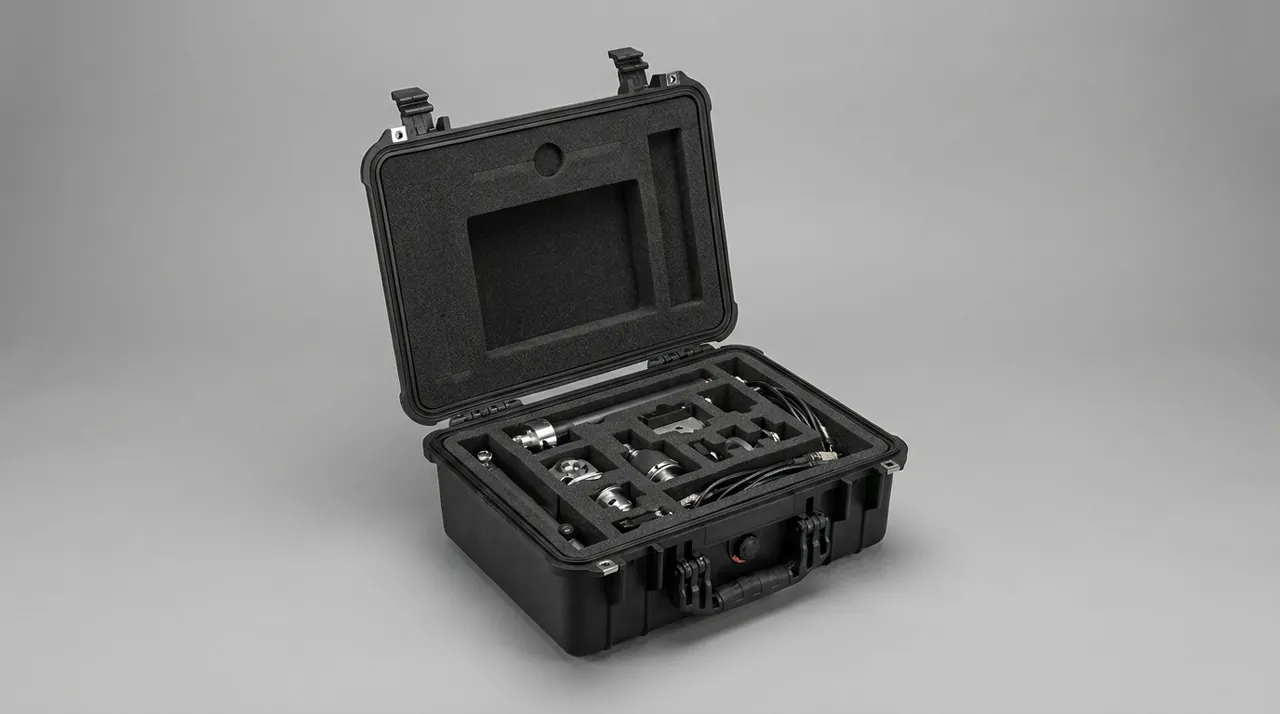
For full-plant relocation projects, liners are often stripped in mixed batches of new and used parts. JUNZHIJIA normally recommends colour-coded tags between new and used items plus slot numbering built into the insert, which prevents wrong-position installation and gives the site team a clear count of what must be replaced.
Moisture and crease protection for baghouse filter bags and pulse valves
The baghouse is the most packaging-sensitive subsystem in a mixing plant. Filter bags are typically polyester, aramid or PPS needle felt with a PTFE surface membrane and a snap-band or spring-ring collar, while pulse valves contain a diaphragm, spring, pilot orifice and solenoid coil. Their transport risks are almost opposite: bags suffer from dampness, creasing and compression, while pulse valves suffer from dust, moisture and vibration.
Bag packaging rests on three rules. First, no hard creases. Needle felt forced into a fold takes a permanent set; the fibres crush at the crease and the fold becomes a dust leak path after installation. Bags should stay naturally coiled or laid flat on a curved cradle. Where bending is unavoidable, keep the radius as large as practical and never hold the same bend over a long period. Second, moisture comes first. Damp media loses strength and the surface membrane can separate from the scrim, so include desiccant and wrap in a moisture barrier film rather than packing bags with uncleaned metal parts. Third, no compression. Bags should never sit under heavier parts or be cinched tight by straps; strap positions need soft padding.
Pulse valve packaging centres on cleaning and vibration control. The diaphragm and pilot orifice inside the body are extremely dust-sensitive, and a single grain of grit causes leakage or failure to actuate, so the valve must be blown clean and its ports plugged before packing. Solenoid coils are fragile: sustained vibration loosens lead wires or shifts the coil, so they belong in their own compartment with soft padding. Springs, diaphragms and other consumable spares travel separately with size and quantity marked.
The table below compares protection priorities across four mixing plant part families and can serve as a starting point for the packaging technical agreement.
| Part family | Dominant failure mode | Insert and restraint method | Humidity and cleanliness control |
|---|---|---|---|
| --- | --- | --- | --- |
| Dryer drum liners and flights | Corner chipping, hole deformation | Vertical slots, profiled base, top cover plate | Rust preventive, hole plugs |
| Mixer paddles and bowl liners | Residue adhesion, mutual scuffing | Separate compartments, curved support, dividers | Clean residue before packing |
| Baghouse filter bags | Creasing, dampness, membrane separation | Curved cradle, natural bend, no load on top | Barrier film plus desiccant |
| Pulse valves and nozzles | Grit ingress, orifice deformation | Padded compartments, plugged ports, dedicated cavity | Blow clean, port protection caps |
Note: filter bags and pulse valves should never share a case with castings. Once rust debris or grit reaches filter media or a valve chamber, the consequence only appears after installation, and tracing the cause on site is practically impossible.
Residue cleaning and impact protection for mixer paddles and liners
Mixer paddles and bowl liners contact the asphalt mix directly and normally arrive after a long service period. Their first packaging problem is not strength but residue. Bitumen residue is brittle at ambient temperature, and vibration during packing and handling knocks fragments loose, which then contaminate the case interior. In summer heat the residue softens and turns tacky, bonds to the insert, and has to be pried apart at unpacking, which adds risk rather than reducing it.
Cleaning has two stages. Stage one is mechanical: remove thick bitumen lumps with a scraper or dedicated tool, and avoid hammering, because hammer blows chip the edges of high-chromium castings. Stage two uses heat or solvent: soften the remaining film with hot air and scrape it off, or apply a bitumen-compatible cleaning agent, then dry completely before packing. The cleaning agent must be compatible with any subsequent coating and with site conditions, and formulations that leave an oil film should be avoided.
On impact protection, paddles and liners share two traits: large flat faces and thin edges. Large flat faces should not be stacked face to face, because the contact area traps moisture that cannot escape and creates scuffing; thin edges cannot carry load. The practical arrangement is to support each piece along one end or one side with the remainder bridging unsupported, separate pieces with dividers or vertical compartments, and avoid face contact entirely. Liners with counterbores or threaded holes need the same hole protection as drum liners.
Used parts with heavy wear deserve a visual assessment before packing. Pieces with through cracks, excessive corner loss or badly elongated holes should be individually tagged as pending rejection and not mixed with new stock, otherwise the site cannot tell which parts remain serviceable. Related cleaning and maintenance thinking appears in protective case cleaning and maintenance practice.
Orifice protection and deformation control for burner nozzles
The burner nozzle is one of the most dimensionally precise items in a mixing plant. Oil and gas nozzle orifices commonly range from a fraction of a millimetre to a few millimetres, and multi-orifice designs carry strict requirements for diameter consistency and spray angle. A scored orifice, a carbon blockage or a raised burr degrades atomisation, which shows up as an abnormal flame pattern, incomplete combustion and uneven drum temperature distribution. Orifice zero-damage is therefore the whole purpose of the package.
There are three layers. The first is cleaning: remove carbon with a dedicated nozzle cleaning needle or ultrasonic cleaning, and never ream the orifice with a wire brush or a sharp metal tool. The second is orifice protection: fit a soft protective cap or dedicated shroud over the orifice face, keep it clear of every hard surface, never stack nozzles, and never pack a nozzle with valve bodies or fittings. The third is attitude restraint: a nozzle is a slender part whose unsupported length bends easily under vibration, so use two-point support positioned near the flange or thread root and keep load off the middle.
Nozzle accessories need their own discipline. Atomiser discs, swirl cores, sealing washers and locating pins determine spray performance, and any wrong or missing item multiplies site commissioning time. Pack all accessories for one nozzle in a single sealed bag, mark the bag with nozzle model and item number, and place it in the matching insert compartment, which prevents cross-mixing on projects with several models.
Gas nozzles add valve trains and ignition electrodes to the picture. The ceramic insulator on an ignition electrode is brittle, and impact can leave an invisible crack that only shows up when power is applied. Keep electrodes in dedicated compartments wrapped in soft foam. Related practice is covered in burner nozzle packaging and protection.
Temperature assessment and cleaning criteria before crating hot wear parts
Cleaning and packing often happen in the gap between shutdown and maintenance restart, when parts removed from the machine may still be warm. Packing at that point causes two problems: residual heat drives a heat and moisture cycle inside the closed case, so water vapour condenses on the insert and metal surfaces as it cools; and the insert material softens or deforms at elevated temperature and loses its restraining function.
Temperature assessment therefore belongs in the packing procedure, and the acceptable threshold is set jointly by insert and case materials. EVA foam softens at a comparatively low temperature, PE foam tolerates slightly more heat but still deforms under prolonged exposure, and rubber pads need separate evaluation where heat and oil act together. Common practice is to confirm that surface temperature has fallen close to ambient before crating. Where a project must shorten the wait, the correct response is a higher-temperature insert material or an insulating layer, not a judgement call by hand.
Cleaning hot wear parts has one easily missed detail: residue redistributes while cooling. Bitumen and oil that are liquid at high temperature flow downhill and set in place as they cool, so cleaning before full cooling deals with the wrong location and leaves lumps elsewhere. After cleaning, check holes, threads and recesses for remaining residue, because fragments retained there shake loose in transit and contaminate neighbouring parts.
For plant relocations, a simple classification step before packing pays for itself. Mark parts that need re-machining, parts that must be replaced, and parts fit for continued service.
| Pre-packing check | Method | Action if not satisfied | Record required |
|---|---|---|---|
| --- | --- | --- | --- |
| Surface temperature | Contact thermometer or temperature strip | Delay packing or switch to high-temperature insert | Record measured value |
| Bitumen residue | Visual plus scraper spot check | Re-clean and dry | Photograph for file |
| Dust and grit | Air blow then white cloth wipe | Re-blow and plug ports | Record blow pressure |
| Holes and threads | Go gauge spot check | Tag as repair item, pack separately | Mark item number |
| Cracks and chips | Visual plus dye penetrant spot check | Tag as rejected, keep separate | Attach verdict |
| Insert condition | Visual check for compression set | Replace insert | Record replacement batch |
Insert design: isolating dust, oil and sharp casting edges
Insert design for mixing plant parts is less about wrapping items softly and more about separating three factors that interfere with each other: dust and grit, oil and bitumen, and sharp casting edges. Once those three mix, no cushioning design survives.
Material selection depends on what the insert touches. Surfaces in direct contact with high-chromium edges need higher density and good resilience, such as cross-linked foam or high-density EVA. Low-density foam should be avoided, because an edge gradually cuts into it under vibration until the part reaches the case floor. Surfaces touching filter bags need a material that does not shed particles, does not leach, has a smooth face and resists moisture, which usually means a film-faced product. Surfaces touching pulse valves and nozzles need soft, low-shedding material with controlled surface resistivity, and an anti-static grade where instrumentation is nearby.
Structurally, a skeleton plus soft pads arrangement works well. PP honeycomb board or laminated board forms the divider skeleton and delivers a hard separation between items, while soft pads bonded to the skeleton absorb vibration and protect surfaces. The advantage is containment: any dust generated stays inside its own compartment instead of migrating through the whole case under vibration. Material and process comparisons are discussed in foam material comparison and selection and in the custom EVA foam insert process.
For used parts whose oil cannot be fully removed, place a replaceable barrier film between the part and the insert. That film catches oil bleed and keeps the insert itself cleanable. Without it, oil soaks into the foam, becomes almost impossible to remove, and turns the insert into a contamination source on its next trip.
Case strength, stacking and container load planning
Weight distribution across mixing plant consignments is far from uniform. One shipment may contain liners of a few dozen kilograms each alongside composite assemblies of similar weight and a full case of filter bags. Case strength must be checked against the heaviest item in the least favourable stacking arrangement, not against an average weight.
Structurally, heavy-part cases are better built with a steel or composite frame carrying the load while the shell provides sealing and dust exclusion, which prevents side wall distortion under stacking. The base should be a full load-bearing panel or a ribbed construction, and forklift pocket positions should line up with the location of heavy contents so lifting does not bend the base locally. For dense consignments such as bulk liners, check volumetric versus actual weight and split into several smaller cases rather than concentrating everything in one large unit.
Mark the maximum stacking tiers and permitted top load on the case. Mixing plant shipments run against tight project schedules and yard staff stack by available space, so unclear marking directly causes base-layer deformation. Working practice is no more than two tiers for heavy-part cases, and cases holding filter bags or other soft goods placed at the top where nothing presses on them.
Container planning adds a few specific points. Put heavy items low and toward the middle so the centre of gravity stays low and rolling produces less lateral force. Load items needed first at the door to avoid re-handling on site. Brace or fill between case and container wall to stop the whole load shifting at sea. Where castings and filter bags share a container, place bag cases on top and protect them against moisture, so condensation cannot drip onto filter media.
Sealing and IP rating selection for dusty and rainy duty
The service environment for mixing plant parts is dominated by dust, while transport and storage add rain and open yard exposure. Sealing design therefore has to address two distinct threats: fine dust ingress and direct rain entry.
Under IEC 60529 and GB/T 4208, dust protection runs from level 0 to 6 and water protection from level 0 to 8. For mixing plant component cases the usual combination is IP55 to IP66. The IP5X dust level means dust cannot be entirely excluded but the quantity entering does not interfere with operation, while IP6X means dust tight. On the water side, IPX5 resists water jets and IPX6 resists powerful jets. Cases stored outdoors for long periods justify IP66 or higher, whereas cases that only circulate inside the works are adequately served by IP54 splash protection.
High sealing classes must be paired with structural reliability and pressure equalisation. As internal air expands and contracts with temperature, a differential builds across the gasket, and without a pressure equalisation valve or breather arrangement, that differential can draw dusty damp air in the moment the case is opened. In dusty duty, pay attention to gasket groove geometry as well: a recessed groove collects dust, and over time a hard crust forms on the sealing face and reduces performance, so a raised profile or a wiper lip is preferable. Hinge, latch and gasket coordination is covered in hinge, latch and seal design for protective cases.
One further point tends to be overlooked: in a dusty environment, latches and hinges on a frequently opened case are maintenance items. Supply lubrication and cleaning guidance at handover, and mark wearing part numbers on the case so spares can be sourced without guesswork.
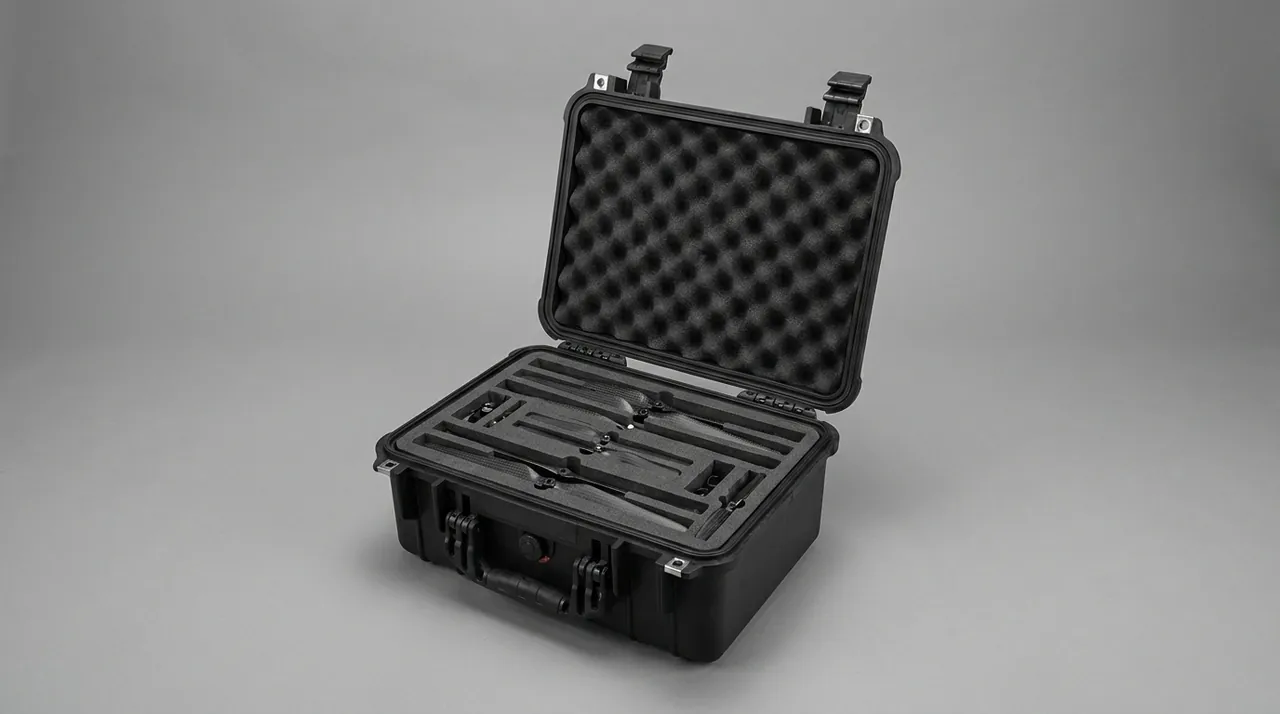
Vibration and shock control: restraining heavy abrasive parts
Transport damage to heavy abrasive parts comes from two sources: items colliding after shifting inside the case, and items lifting vertically and dropping back. Dividers and lateral limit stops address the first; top restraint addresses the second. Skip either one and the protection is incomplete.
Three restraint methods can be combined. The first is profiled support, where the insert is shaped to the part so there is no free travel in the horizontal plane. This works best for regularly shaped liners and valve bodies, but demands accurate insert machining, otherwise a gap remains between support face and part. The second is vertical compartmentalisation, using dividers to split the internal volume into cells holding one item or one same-size group, with cell width slightly greater than part width so the walls limit lateral movement. The third is top clamping, using a cover plate, pressure bar or strap to hold the part against its support and eliminate vertical travel. Straps need soft padding at contact points to prevent chafing.
Filter bags cannot tolerate compression, so top clamping does not apply. Use containment rather than clamping: allow a bag limited movement inside its own compartment while walls and soft filler blocks bound that movement and keep the bag away from case walls and metal parts. For bags, the creasing risk from over-clamping far exceeds the risk from slight movement.
For validation, the GB/T 4857 series covers stacking, drop and vibration methods, and ASTM D4169 offers a framework for selecting test sequences by distribution cycle. Test conditions should be chosen around the weakest element in the consignment rather than applied as a single fixed severity. A case containing filter bags and precision valves warrants a lower vibration level than a case of heavy castings, but a duration long enough to reveal loosening of the insert.
Experience shows three failures surfacing most often in testing. First, profiled support gaps are too large, so the part strikes repeatedly under vibration. Second, divider stiffness is insufficient, so heavy parts bow the divider and touch each other. Third, the pressure bar clamps only part of the item, so it pivots about the clamped point. Correcting these at sampling costs far less than dealing with them after a production batch ships.
Marking, packing lists and pre-installation storage guidance
Mixing plant projects are frequently built at remote sites with limited warehouse facilities, so components often sit outdoors for a period. Marking and packing lists therefore do more than identify contents: they tell the site how to store them.
Marking should follow GB/T 191 and GB/T 13384 and include at minimum: this way up, keep dry, do not roll, centre of gravity, stacking limit and item number. Cases holding filter bags benefit from additional "avoid direct sunlight" and "do not stack on top" marks, and cases holding precision valves and nozzles from "handle with care" and "check shock indicator before opening". Marks belong on two adjacent faces and need rain protection, because site conditions quickly cover any printed mark with mud and water.
Packing lists should state item number, description, quantity, equipment tag and installation location. For full-plant relocation work, arrange the list in the order of machine assembly and place a sealed copy inside the case, so the site team is not re-checking contents because the paperwork was lost. Complete supply packages also justify a system-level summary list for issue by system.
Storage guidance belongs in the accompanying instructions: permitted outdoor storage duration, whether the case needs raising off the ground, whether filter bag items must move indoors, the desiccant replacement interval, and how to check shock indicator labels. One specific reminder for mixing plants: open yard storage is very dusty, so the case lid should be cleaned before opening, otherwise dust drops straight onto the contents.
Custom process, tooling investment and batch consistency
Mixing plant parts lists tend to include many sizes and change from project to project, so the custom process has to stay flexible. JUNZHIJIA normally works in this sequence: the customer supplies the parts list and 3D models of critical items, we sort them into heavy castings, soft filter media and precision valving and propose insert geometry with case options, then confirm restraint performance with a physical prototype.
Tooling investment should match batch size. For regularly shaped liners and impellers, a standard compartment scheme with replaceable dividers keeps tooling cost low and adaptability high. For complex geometry or tight precision requirements, a profiled insert protects better but needs a mould, which suits larger batches. The middle route is a skeleton with modular pads, where the standard skeleton provides stiffness and replaceable pads accommodate different part shapes.
Batch consistency is a recurring pain point on mixing plant projects. When one project ships in several lots, insert dimensions, pad hardness and desiccant charge must stay identical between lots, otherwise one case accepts the intended part and the next does not. Useful controls include freezing insert drawings as controlled documents, specifying hardness and density ranges for pad material, performing and photographing first-article confirmation for every batch, and marking an insert revision number on the case.
Export projects also need wood packaging quarantine confirmed. Solid wood requires ISPM 15 heat treatment or fumigation with the compliant mark applied, while plywood or composite cases fall outside that requirement. For larger export lots, confirm destination country packaging rules in advance so a missing mark does not generate detention charges at the port of discharge.
Frequently Asked Questions
Q: Must bitumen residue be fully cleaned off used liners before packing? A: Cleaning is strongly recommended. Under transport vibration, residue breaks into sharp fragments that scatter inside the case, contaminating filter bags and valves and potentially scoring the mounting faces of neighbouring liners. Work in two stages: scrape off thick lumps first, then remove the thin film with hot air softening or a compatible cleaning agent, and dry completely before packing. Cleaning must follow full cooling, because liquid bitumen at high temperature flows downhill and sets elsewhere as it cools, so early cleaning addresses the wrong locations. After cleaning, inspect mounting holes, counterbores and tapped holes specifically, since debris trapped there is the most likely to shake loose in transit. Where a project schedule leaves no time for full cleaning, at minimum ship residue-bearing parts in a separate case from filter bags and precision valving. Note that cleaning also reveals hidden damage: a scraper pass along a liner edge often exposes a crack that bitumen had been hiding, which is a safety finding as much as a packaging one.
Q: Can filter bags be folded inside a case, and how is the minimum bend radius set? A: Forced folding should be avoided in principle, with bags kept naturally coiled or laid flat. Needle felt held in a forced fold for a long period takes a permanent set, the fibres crush at the crease and the surface membrane can delaminate, so the crease typically becomes a dust leak point after installation. Where case dimensions force a bend, keep the radius as large as possible and avoid holding the same bend position over time. Set the limit from the bag maker's recommended minimum bend radius, or estimate from an empirical multiple of bag diameter, and accept the arrangement only if unfolding after a trial fit shows no visible crease. Bags must also never sit under heavier items, and any strap must carry soft padding so it cannot cinch a local indentation. Bags removed from a baghouse after service deserve a separate decision from new stock, because dust-caked media is heavier, stiffer and more likely to crack along an existing fold line.
Q: Can pulse valves and solenoid coils travel in the same case? A: Yes, provided they occupy separate compartments. Pulse valves are extremely dust-sensitive, and a single grain of grit reaching the diaphragm or pilot orifice can cause leakage or failure to actuate, while solenoid coils suffer from vibration and moisture, with sustained vibration loosening lead wires or shifting the coil. The workable arrangement is separate cells for body and coil, soft padding around the coil with leads secured, and protective caps over every port. Springs, diaphragms and gaskets are consumable items and should be packed separately with size and quantity marked rather than left loose in the case. Blow the valve clean before packing, using dry oil-free compressed air. For full-lot deliveries, include a valve specification cross-reference sheet in the case so the site does not fit parts by appearance. On used valves, replace the diaphragm and spring during the same maintenance window rather than relying on a visual check, since an aged elastomer can pass inspection and still fail within weeks of restart.
Q: How should burner nozzle orifices be protected without affecting atomisation? A: The core requirement is that the orifice face never touches a hard object and that nothing enters the orifice. Before packing, remove carbon with a dedicated cleaning needle or ultrasonic cleaning, and never ream with a wire brush, drill bit or sharp tool, since these alter orifice diameter and the inlet chamfer and directly change atomisation quality. Fit a soft cap or dedicated shroud over the orifice face, never stack nozzles, and avoid packing them with valve bodies, fittings or fasteners. Support the nozzle at two points near the flange or thread root so the slender unsupported section cannot bend under vibration. Atomiser discs, swirl cores and locating pins should be bagged by nozzle model to prevent mixing on multi-model projects. Where a nozzle is returned for service, record the model, the operating hours and the fuel type on the bag, so the workshop can tell an atomisation complaint caused by wear from one caused by handling.
Q: How can I tell whether a part has cooled enough to be crated? A: Use a measured temperature rather than a hand check. The acceptable threshold follows from both insert and case materials: EVA foam softens at a relatively low temperature and takes compression set under prolonged heat, PE foam tolerates slightly more but collapses under sustained exposure, and rubber pads need separate evaluation where heat and oil act together. Common practice is a contact thermometer or temperature strip, with packing permitted once surface temperature approaches ambient. Where a project must shorten the wait, the correct response is a higher-temperature insert material or an added insulating layer, not an early judgement call. Record the measured temperature and humidity in the packing record so later batches can be compared against the same baseline. In hot climates the practical wait can be long, so schedule cleaning and inspection first and packing last, rather than letting packed cases sit open while parts cool down. A simple two-point check, one reading on the wear face and one on the hub, catches parts that cool unevenly because of their mass.
Q: Does a mixing plant component case need to be IP67? A: Usually not, and the decision should follow the storage scenario. The dominant threats for mixing plant parts are dust and rain, and under IEC 60529 and GB/T 4208 a combination between IP55 and IP66 is generally sufficient, with IP6X providing dust tightness and IPX5 to IPX6 covering water jets. IP67 becomes relevant where a case could be briefly immersed, for example on a poorly drained open yard in the rainy season or where a route passes through standing water. Raising the class unnecessarily has two side effects: the pressure differential problem becomes more pronounced and requires a pressure equalisation valve, and the sealing geometry becomes more complex to open and maintain. In dusty duty, also look at the gasket groove profile, because compacted dust reduces sealing performance. Whatever class is chosen, state the intended storage scenario in the technical agreement, so the case is not judged against a requirement it was never designed for.
Q: What are the risks of mixing new and used parts in a full-plant relocation? A: Three main risks. The first is wrong installation, since new and used parts look similar but differ in wear allowance, so clearances or runout can fall outside tolerance after assembly, which is especially visible on mixer paddles and bowl liners. The second is assessment difficulty, because once mixed, the site cannot distinguish serviceable parts from those due for rejection, and usable items get discarded while failed items stay in service. The third is contamination spread, since residue, dust and rust debris from used parts migrate onto new parts and filter media in the same case. The workable approach is to complete classification before packing, tag parts needing re-machining, replacement or continued service separately, number the insert slots to match, and ship a classification list with the consignment. Photograph each classified group before loading, so the record survives independently of any paper list that may be lost in transit. Mark rejected items permanently, not with tape, because tape falls off in a dusty yard and an unclear part tends to be refitted by default.
Q: Can the cases be reused on an asphalt plant site? A: Yes, and full-plant relocations plus project-based supply make reuse particularly attractive. Three points need attention. First, establish a return inspection routine covering case distortion, hinge and latch looseness, gasket hardening or nicks, and whether the insert still restrains its contents. Second, define insert scrapping criteria: cradles carrying heavy castings take compression set, and once a part can visibly move inside its cavity the insert must be replaced rather than packed out with shims, because shims create extra surfaces for dust to collect on. Third, account for dusty-duty maintenance, since sealing faces and latches need periodic cleaning and hardened dust accelerates gasket wear. Supplying a wearing part list with spare recommendations and engraving a serial number on each case makes usage tracking practical. Cases that return with the lid still sealed and the humidity card inside range can go straight back into service after an exterior wash.
Conclusion and Further Reading
The hard part of protecting asphalt plant components is not case strength but the two steps crews skip: residue cleaning and shape retention. Liners need cleaning, vertical compartments and top restraint; bags must not be creased, damped or pressed; valves and nozzles need clean, plugged ports in padded compartments.
JUNZHIJIA supplies compartment skeletons, profiled inserts, matched seals and OEM or ODM tooling for mixing plant buyers.
Further Reading