

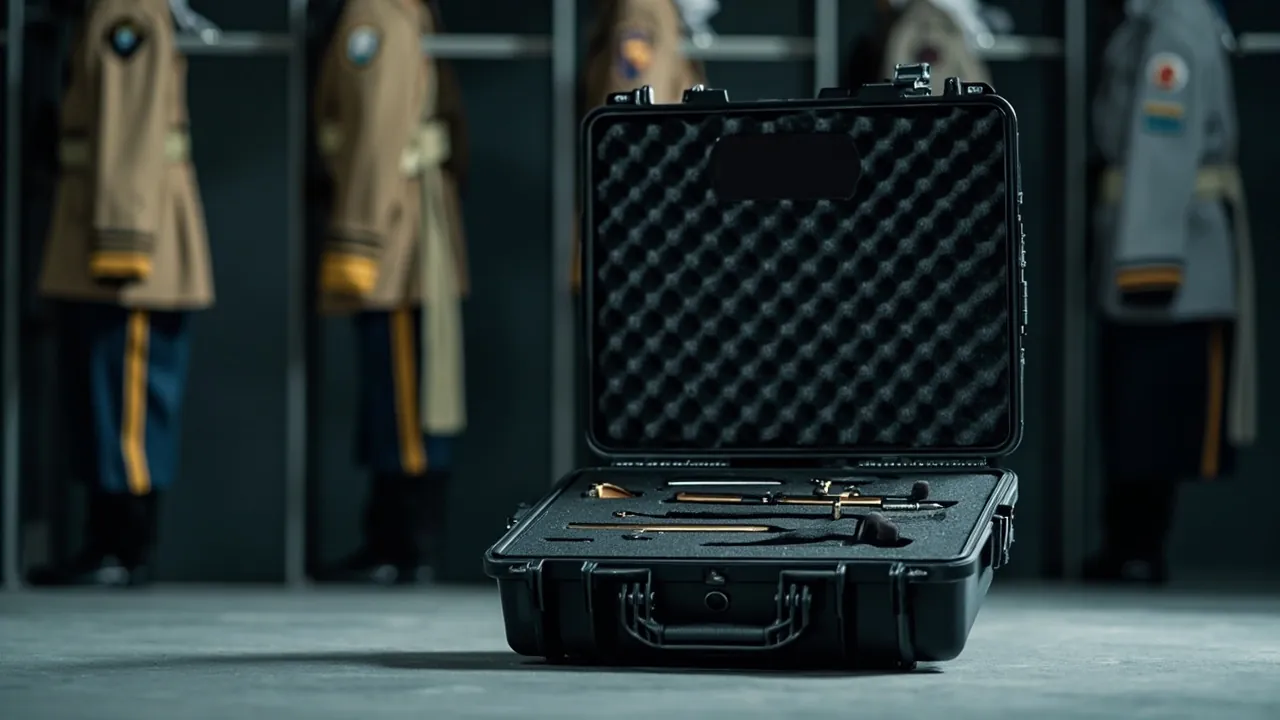
The core problem a ceremonial uniform case solves is delivering uniforms, insignia and ceremonial equipment to a parade, flag ceremony, welcome line or formal event in a state that is flat, crisp, bright and complete after long-distance transport and repeated handling. This equipment is judged by a standard that ordinary clothing never faces: appearance is the quality. A shoulder line crease that will not press out, a dull oxidised insignia, a mould spot on a ceremonial shoe, a slightly bowed flag pole: in a formed line every one of these is visible item by item, and each one degrades the alignment of the whole formation and the impression of the ceremony. Worse, most of these failures are irreversible. Crease memory in fabric, oxidation on metal and mould on leather generally cannot be remedied on site.
Protecting ceremonial equipment involves three sets of competing demands. The first is "no pressure" against "carry more." Uniforms stay flat best when nothing presses on them, yet a full set usually has to fit uniforms, footwear, headwear, insignia, belts and equipment into one case, so space is inevitably tight. The second is "seal it" against "let it breathe." Ocean freight and rainy-season transport demand moisture exclusion, but uniforms and leather carry some moisture of their own, and over-sealing grows mould instead. The third is "issue by unit" against "fit the individual." Uniforms are issued by size and insignia by role, so internal partitioning and labelling must both guarantee that the right set reaches the right person and allow fast counting and replenishment.
This article is written for procurement and logistics managers for ceremonial equipment, uniform and ceremonial goods manufacturers and exporters, equipment managers at ceremonial service companies and performance groups, and project teams coordinating ceremonial equipment for large events. It covers category composition and failure modes, crease and colour protection for textiles, insignia and metal fitting protection, rolled packing for flags and textiles, humidity control for leather goods, liner material selection, the trade-offs between the three packing geometries, sealing class selection, transport test references, and packing and goods-in verification procedures. All figures are industry-typical or empirical ranges; product technical conditions, contract requirements and destination regulations always take precedence. JUNZHJIA can support ceremonial equipment applications with combined hanging and flat-pack insert design, removable partition systems, humidity-control and sealing configurations, labelling and counting schemes, and OEM/ODM supply with inspection documentation.
Table of Contents
- 1. Transport pain points: from creasing to loss of lustre
- 2. Category map and failure-mode comparison
- 3. Dress uniforms: crease, pressure and colour protection
- 4. Insignia, ribbon bars and metal fittings: oxidation and scratch protection
- 5. Ceremonial equipment: sidearms, poles, belts and headwear
- 6. Flags and textiles: rolling, acid-free interleaving and crease memory
- 7. Leather goods and footwear: relative humidity and mould control
- 8. Moisture and humidity control: RH stability, desiccants and indicator cards
- 9. Sealing and ingress protection: IEC 60529 versus GB/T 4208
- 10. Liner material selection: EVA, PE, XPE, PU and textile facings
- 11. Hanging, flat packing and rolling: engineering trade-offs
- 12. Complete-set cases: issue lists, partitioning and labelling systems
- 13. Transport test references: ISTA, GB/T 4857, ASTM D4169 and MIL-STD-810H
- 14. Packing SOP and goods-in verification
- 15. Procurement evaluation and the OEM/ODM customisation path
- Frequently Asked Questions
- Conclusion & Related Reading
1. Transport pain points: from creasing to loss of lustre
Ceremonial equipment rarely gets "broken". It degrades slowly. Understanding the mechanisms behind these failures explains why this category needs its own packaging logic.
The first failure class is crease memory. Fabric fibres deform plastically under sustained pressure and form a crease at the loaded position. If moisture and temperature fluctuation are also present, stress relaxation accelerates and the crease deepens. The critical point is that once a crease becomes memory, on-site pressing usually improves the surface only and cannot restore the original crispness and line. Structural lines such as shoulder, lapel, sleeve and pleat lines show this most clearly.
The second failure class is metal tarnish and oxidation. Insignia, ribbon bars, shoulder boards, cap badges, buttons and belt buckles are usually copper alloy, zinc alloy or plated. Three enemies act on them: moisture, which drives oxidation and discolouration; sulphides, which blacken copper alloys; and friction, which scratches plating and exposes the substrate. Chlorides and organic acids in fingerprints are another localised corrosion origin.
The third failure class is mould. Uniforms, leather goods and textiles held in a closed environment above roughly 65 percent relative humidity show a marked rise in mould risk. Mould affects appearance, and some mould leaves pigment and odour inside the fibre that is difficult to remove. This damage is irreversible and often continues to develop for days after opening, which makes responsibility hard to establish.
The fourth failure class is deformation. Headwear such as peaked caps and formal hats distorts under compression. Poles and sidearms bow. Footwear takes a set under sustained load. Belts develop a curl. Even after recovery, these deformations usually leave a residual that affects line alignment.
The fifth failure class is kit error. Ceremonial equipment is issued as a set with multiple components. A single shipment with the wrong insignia, mismatched ribbon bar or incorrect shoe size costs far more to remedy on site than the packaging itself. The three-part combination of partitioning, labelling and a manifest is therefore a defining feature of ceremonial equipment cases compared with ordinary garment cases.
A field observation: among complaints about ceremonial equipment, visible minor damage and kit errors each account for a substantial share, and the latter is often overlooked by packaging designers. Building correctness into the structure of the case is more reliable than relying on human counting at the delivery point.
The underlying principles are covered in shock-absorbing case design logic and cushion liner and case base plate coordination.
2. Category map and failure-mode comparison
Ceremonial equipment spans a wide range, from a ribbon bar weighing a few grams to headwear and sidearms weighing several kilograms. The table below maps typical form, weak points, dominant failure modes and preferred protection by category, as a starting point for partition design.
| Category | Typical form | Primary weak points | Dominant failure mode | Preferred protection |
|---|---|---|---|---|
| --- | --- | --- | --- | --- |
| Dress and service uniforms | Fabric garment | Shoulder line, lapel, sleeve line, buttons | Crease memory, wrinkling, dye transfer | Hanging or loose flat packing, acid-free interleaving |
| Shirts and underlayers | Fabric garment | Collar, cuffs, front placket | Pressure creasing, collar deformation | Folded with rigid board, limited stack height |
| Headwear, peaked caps and formal hats | Rigid moulded item | Crown shape, brim, cap badge | Compression distortion, brim warping, badge damage | Individual head position, crown support, no stacking |
| Insignia, ribbon bars and shoulder boards | Metal or textile ornaments | Plating, enamel face, stitching | Oxidation discolouration, scratching, enamel chipping | Separate compartments, sulphur-free padding, anti-friction |
| Buttons and metal fittings | Small metal or alloy parts | Plating, threads | Oxidation, scratching, loss during handling | Compartmented trays, magnetic or slot retention, counting |
| Belts and waist belts | Leather or textile | Belt set, metal buckle | Curl set, creasing, buckle oxidation | Large-diameter rolling or flat packing, separate buckle protection |
| Ceremonial footwear | Finished leather shoes | Upper, shape, stitching | Compression set, mould, loss of surface lustre | Individual shoe positions, shoe trees, humidity and mould control |
| Flags and unit colours | Large textile | Flag face, printed layer, pole sleeve | Creasing, dye transfer, print layer blocking | Rolling, acid-free interleaving, no fold across the design |
| Poles and supports | Metal or composite tube | Straightness, surface finish | Bowing, coating damage, thread damage | Individual tube positions, end protection, anti-bow support |
| Ceremonial sidearms and props | Long metal or wooden items | Surface, joints, fittings | Impact damage, loosening, lost fittings | Individual retention, joint support, compartmented fittings |
| Gloves and textile accessories | Small textile items | Shape, colour consistency | Creasing, staining, loss | Flat compartmented storage, paired retention |
One design principle follows from this table: a ceremonial equipment case must provide both a hanging zone and a partitioned zone. The hanging zone solves garment creasing, while the partitioned zone solves retention and counting for small parts, metal items and rigid items. Trying to solve both needs in one flat plane means sacrificing one of them.
3. Dress uniforms: crease, pressure and colour protection
Dress and service uniforms are the largest share of ceremonial equipment and the part most easily ruined by packing method.
The key to crease prevention is reducing pressure, not adding cushioning. Cushioning addresses impact; creasing comes from sustained pressure. They are not the same problem. The preferred geometry for garments is therefore hanging: a crossbar inside the case, garments suspended on hangers, and the case kept upright in transit. In this geometry the garment is barely loaded and shoulder and sleeve lines are preserved. The limitation is lower space efficiency and a case height greater than garment length, which suits high-value dress uniforms over short and medium distances at low to medium volumes.
Where volumes are large and space efficiency matters, loose flat packing is the alternative: fold along designed fold lines, interleave acid-free tissue between layers, limit the stack to three to five layers, and use rigid boards to spread the upper weight. The critical detail is fold line placement. Folds should fall on permitted lines such as side and back seams, and never across the chest, lapel or sleeve line, which are visual focal points.
Colour protection depends on interleaving materials and relative humidity. Dark and light fabrics in direct contact can transfer dye under humid conditions, and a white or light uniform once stained is essentially unrecoverable. Layers should be separated with acid-free paper or inert film. At the same time, holding the microclimate at 45 to 60 percent RH and keeping it stable is the basis for preventing both dye transfer and mould. Stability matters more than the absolute figure.
Metal fittings need separate treatment. Buttons, shoulder boards and ribbon buckles sit against fabric for long periods. Where metal is adjacent to sulphur-bearing material, sulphides attack the metal and discolour the adjacent fabric at the same time. Liner and padding materials should therefore be confirmed low-sulphur or sulphur-free, and an isolation layer should sit between metal and fabric.
4. Insignia, ribbon bars and metal fittings: oxidation and scratch protection
Insignia, ribbon bars, shoulder boards and metal fittings are the smallest items in ceremonial equipment, the highest in unit value and symbolic significance, and the easiest to fail on detail.
Three causes of tarnish and dulling need separate responses:
- Moisture. Rising relative humidity accelerates surface reaction. The response is humidity control, holding the microclimate at 45 to 60 percent with desiccant and an indicator card.
- Sulphides. Copper alloys, silver and some platings are sensitive to sulphides, showing as uniform darkening or blackening. The response is to confirm that inserts, interleaving and cushioning are sulphur-free, and to keep these items out of the same case as leather, wool, low-grade rubber and some recycled paper products.
- Friction. Plating is thin, and repeated micro-movement scratches it and exposes the substrate. The response is individual compartments with low-friction inert fabric facings, and no metal-to-metal contact.
Fingerprints are a fourth cause and the most easily overlooked. Chlorides and organic acids in hand perspiration form localised corrosion origins on metal and appear as marks weeks later. Wearing clean powder-free gloves throughout insignia and metal fitting handling is the lowest-cost, highest-return measure available.
Enamel and soft decorative faces need extra care. Some insignia use enamel or soft coatings that chip or crack under impact. Retention should be close-fitting without compression, with no form of point contact. The compartment lining should support the item across its whole area rather than at the corners alone.
Loss prevention for small parts matters just as much. Buttons, ribbon pins, screws and clips are easily scattered during opening and counting. Practical measures include a removable compartmented tray for each set so small parts return to their place; a transparent lid or viewing window so counting is possible without opening; and an illustrated manifest inside the case showing the item and quantity for each position. Removable partition system structures are covered in removable divider system design.
5. Ceremonial equipment: sidearms, poles, belts and headwear
Ceremonial equipment comprises long items and rigid items, and follows entirely different protection logic from textiles.
The core risks for long items are bowing and end damage. Poles, supports and sidearm shafts fail mainly through loss of straightness, coating damage and damaged threads or interfaces at the ends. Three requirements follow:
- Individual tube positions with multi-point support. A long item should be supported at two or more points, with support spacing not too wide, so the middle cannot sag into a bow. Supports should be curved cradles matching the tube diameter, not flat rigid surfaces that create line contact.
- Separate end protection. Threads, bayonet fittings and interfaces are functionally critical and should carry protective sleeves or end caps, kept clear of case walls and other items.
- Limit axial movement. Under vibration a long item slides axially until it strikes an end. Axial retention should be provided at both ends, with compliant contact faces.
The core risk for headwear is compression. Once a peaked cap or formal hat distorts under pressure, the crown and brim rarely recover fully. Practical measures include an individual head position with internal crown support, which may be a slow-release support pad or a purpose-made hat former, to maintain the profile; sufficient clear height above the hat position with no stacking; and separate protection for the cap badge so that it cannot load and mark the crown.
Belts are best rolled at a large diameter or laid flat. Rolling at a small diameter sets a permanent curl that is hard to reverse, while folding under pressure leaves a permanent crease at the fold. The core diameter should not be smaller than the practical lower limit at which no set occurs, otherwise flat packing with no stacking load is preferable.
Joints on sidearms and props need focused protection. Threads, clips and plug-in interfaces on break-down items loosen or wear under vibration. Supports and retention at the joint prevent the interface itself from carrying dynamic load.
6. Flags and textiles: rolling, acid-free interleaving and crease memory
Flags, unit colours and large textiles such as table runners, backdrops and drapes require particular handling.
Creasing is the most conspicuous problem on a flag. Flag designs and lettering usually span the face, so a fold falling across design or lettering is highly visible and difficult to reverse. Two rules therefore govern the packing geometry: roll rather than fold wherever possible; where folding is unavoidable, place folds on designated lines and clear of design and lettering areas.
Specific requirements for rolling:
- Use acid-free paper or inert film as the inner layer so the flag face does not contact the core directly.
- Keep the core diameter from being too small, since a small core sets a permanent curl.
- Apply even winding tension to avoid localised stretching.
- Wrap the finished roll in acid-free paper and place it in an individual tube position or curved cradle so it cannot roll or be compressed.
- Keep the design face inward to reduce friction against the outer wrap.
For flat packing: interleave acid-free paper between layers, limit the stack to three layers or fewer, and use rigid boards to spread upper-layer weight. Avoid stacking flag faces of different colours directly against each other, which risks dye transfer in humid conditions.
Printed and coated flag faces need extra attention. Some flags use digital printing or coating processes, and the printed layer can block, meaning it sticks to itself, under high temperature and humidity. An isolation layer should be placed between printed faces, and prolonged high-temperature storage avoided.
Long-distance hanging transport should be avoided. A textile's own weight under vibration applies sustained tension along warp and weft, which can distort it, especially in large formats. Rolled or flat packing is preferable for long journeys; hanging suits only short, low-vibration movements.
7. Leather goods and footwear: relative humidity and mould control
Leather goods include ceremonial shoes, belts, gloves and leather accessories, and their requirements differ noticeably from textiles.
Leather is a hygroscopic material. Its moisture content tracks ambient relative humidity. Excessive drying costs it flexibility and produces desiccation cracking, while excessive moisture causes mould, hydrolysis and surface layer loss. The suitable band is generally 45 to 60 percent RH, held stable.
Mould is the classic leather failure. Mould proliferates where relative humidity stays above roughly 65 percent at a suitable temperature. Leather contains proteins and oils and is an excellent mould substrate, so mould prevention for leather is harder than for ordinary textiles. Practical measures include:
- Confirm the leather is completely dry before packing, with no water marks or soil residue.
- Use padding with moisture buffering capacity and fit an appropriate desiccant quantity with a humidity indicator card.
- Avoid long-term sealing in a humid environment; if a highly sealed case is used, complete drying and humidity control before packing.
- Avoid sharing a case with items that may carry mould or moisture.
Footwear also needs shape retention. Shoe trees or forming supports keep the upper in its normal shape, and dividers should separate shoes from each other and from rigid items. Soles and uppers should not press against each other, because sole materials may contain plasticisers or rubber compounds that can mark or discolour the upper over prolonged contact.
Surface protection and cleaning matter too. Ceremonial shoe uppers lose lustre or scratch through friction in transit, so wrapping in nonwoven or soft material and keeping them clear of rigid items is advisable. Cleaning and care methods on arrival, including material compatibility principles, are covered in how to clean and maintain a protective case.
8. Moisture and humidity control: RH stability, desiccants and indicator cards
Humidity is the most persistent and least visible destructive factor in ceremonial equipment transport.
Condensation is the accelerator. The air inside a case holds moisture, and when the temperature falls below the dew point, that vapour condenses on surfaces. The typical pattern is a case warming in sunlight during the day and cooling sharply at night, so internal air crosses the dew point repeatedly in a breathing cycle. Cross-climate ocean chains make this pronounced. One condensation event may cause no visible damage. A few dozen cycles are enough to oxidise metal, mould textiles and degrade leather surfaces.
Practical control measures, in priority order:
- Reduce the water carried in at packing. Ensure garments, leather, liners and the case are fully dry; avoid packing in rain or during high-humidity periods; and allow pressed garments to cool and release moisture completely before packing.
- Use desiccant. Size the quantity from free internal volume, transit duration and destination climate, using grams per cubic metre per day as an empirical basis.
- Fit humidity indicator cards. A combined card at 40, 50 and 60 percent RH allows immediate judgement at opening. The card must sit where air can circulate, not pressed against a garment or crushed under a liner.
- Choose the sealing class deliberately. Too loose and the desiccant saturates quickly; too tight and pressure change may make opening difficult or load the seal. The trade-offs are covered in IP rating and sealing structure selection.
- Limit temperature swing. Avoid prolonged direct sunlight and hot trailers to reduce condensation cycles. For cases carrying substantial metal content, temperature control matters equally.
One practical recommendation: distribute desiccant by zone. A ceremonial equipment case typically has a hanging zone and a partitioned zone with different air circulation conditions. Desiccant should be fitted separately in the partitioned zone, particularly where metal and leather items sit, with an indicator card in the hanging zone, so that the situation where one zone is already abnormal while the card reads normal cannot arise.
9. Sealing and ingress protection: IEC 60529 versus GB/T 4208
Ingress protection is the most frequently misused specification in case selection. IEC 60529, with GB/T 4208 as the corresponding Chinese standard, describes enclosure protection with two digits: the first for solid foreign objects and dust, the second for water. IP65 means dust tight and protected against water jets. IP67 means dust tight and protected against short immersion. IP6X denotes the highest dust protection class.
For ceremonial equipment the selection logic runs as follows:
| Scenario | Dust risk | Water and moisture risk | Recommended class | Notes |
|---|---|---|---|---|
| --- | --- | --- | --- | --- |
| Indoor storage and short transfer | Low | Low | IP54 class is adequate | Focus on dust, soiling and compression |
| Intercity road transport | Medium | Medium | IP65 | Rain and dust protection at reasonable cost |
| Ocean and multimodal freight | Medium-high | High | IP67 | Deck humidity, rain and prolonged high humidity |
| Chains with sharp or large diurnal temperature swings | Medium | Medium-high | IP65 or IP67 plus pressure equalisation valve | Accommodates sealing and pressure difference |
| Long chains carrying leather goods | Medium | High | IP67 plus humidity control | Sealing must pair with humidity control, mould first |
A principle that must be stressed: ingress protection describes the enclosure's protection against the outside. It does not describe the internal microclimate. An IP67 case excludes external moisture while also locking internal moisture in. If garments or leather carry moisture at packing, a highly sealed case becomes a mould incubator. In high-sealing schemes, drying, desiccant sizing and a humidity indicator card are all mandatory.
10. Liner material selection: EVA, PE, XPE, PU and textile facings
Liner materials determine three key properties: conformity, friction behaviour, and outgassing and migration. The comparison is set out below.
| Material | Main characteristics | Advantages | Limitations | Typical use |
|---|---|---|---|---|
| --- | --- | --- | --- | --- |
| EVA | Closed-cell foam, density and hardness adjustable | Good formability, high conformity, fine partitioning possible | Formulation varies widely, confirm low-sulphur and low-migration | Insignia compartments, headwear forming, precision retention |
| PE (polyethylene) | Closed-cell, chemically fairly inert | Low cost, water resistant, low outgassing | Higher hardness, moderate conformity | Structural support, dividers, bases |
| XPE | Cross-linked polyethylene, fine closed cell | Smooth surface, good resilience, no shedding | Costs more than PE | Contact facings, fine item support |
| PU (polyurethane) | Open or semi-open cell | Soft, good energy absorption | May absorb moisture, some formulations hydrolyse | Cushioning layers, subject to moisture and ageing assessment |
| Inert textile facing | Nonwoven or low-lint fabric | Low friction, does not scratch metal | Provides no structural support | Insignia, plated items, surface contact |
| Acid-free paper | Acid-free or buffered paper | Blocks dye transfer, protects textiles | No cushioning capacity | Interleaving, wrapping |
| Silica gel buffering material | Absorbs and releases moisture | Humidity buffering, reusable | Compatibility with objects must be assessed | Zones with tight humidity control requirements |
Two selection principles apply. First, materials in direct contact with metal fittings and light-coloured textiles must be confirmed low-sulphur, low-migration and acid-free, otherwise metal discolouration or fabric staining follows. Second, structural support and contact surfaces should be built from different materials in layers. An outer layer of PE or structural foam provides support, while an inner layer of XPE or inert fabric provides conformity and low-friction contact. This layered approach satisfies support and surface protection at the same time and is common practice in ceremonial equipment cases. Material comparisons are covered in liner and case material comparison and custom insert fabrication and form-taking.
Three easily overlooked material requirements deserve separate mention.
- Acid-free and buffered materials. For uniforms of historical significance, older insignia and paper records such as issue registers and citation documents, direct-contact materials should be acid-free or buffered to prevent acid migration that yellows and embrittles. For archival and image-based items, ISO 18916 provides a standard reference framework for assessing enclosure materials, including methods such as the photographic activity test, and commemorative photographs, citation documents and numbered archives in ceremonial service can follow the same logic. The specific application should be determined together with item condition and the custodian's requirements.
- Flame retardancy. Ceremonial equipment is often stored and used in occupied venues, halls and parade grounds, so the burning behaviour of case and liner materials may be explicitly specified. UL94 is a widely used method for evaluating the burning behaviour of plastics, and a V-0 rating indicates a short afterflame time in vertical burning tests with no flaming drips that ignite cotton; buyers commonly specify V-0 or V-1. Flame retardancy and material stability must be satisfied together, and neither should be sacrificed for the other.
- Putting the relative humidity (RH) target in writing. Textiles, leather and metal have different suitable RH bands, so the specification should state the target band and permitted fluctuation amplitude, for example 45 to 60 percent RH with an agreed maximum excursion, rather than simply requiring that the case be kept dry. A written RH target is the basis for arrival judgement and for allocating responsibility.
11. Hanging, flat packing and rolling: engineering trade-offs
The three packing geometries each have a boundary of application. The table below supports combined use by scenario.
| Geometry | Suitable objects | Main advantage | Main limitation | Key control points |
|---|---|---|---|---|
| --- | --- | --- | --- | --- |
| Hanging | Dress uniforms, service uniforms, long coats | Almost no pressure, best line retention | Low space efficiency, greater case height | Crossbar strength, shoulder support, upright transport |
| Flat packing | Shirts, accessories, small to medium textiles | High space efficiency, easy set issue | Sensitive to fold line placement, stacking limits | Fold line placement, layer limit, rigid boards |
| Rolling | Flags, belts, large textiles | Avoids creasing, suits long items | Core diameter and tension must be controlled | Core diameter, even tension, acid-free inner layer |
| Individual retention | Headwear, footwear, sidearms, poles | Preserves shape, prevents compression | Uses more space | Cradle conformity, clear height above, axial retention |
Combined use is the engineering norm. A typical ceremonial equipment case contains an upper hanging zone for dress uniforms, a middle flat-pack zone for shirts and textiles, a lower individual retention zone for headwear, footwear, sidearms and poles, and side or top compartments for small parts such as insignia, ribbon bars and buttons. This zoned structure must be settled at design stage, because case height, reinforcement and hinge selection all follow from the layout. Hinge, latch and seal selection is covered in case hinges, latches and sealing structures, and case mobility in case wheels and trolley handle configuration.
One easily overlooked design detail is the opening angle. A hanging zone needs a sufficient opening angle for garments to be removed, so lid opening angle and the supporting structure such as a limit strap are specification items. If the lid opens only a little, users tend to pull garments out rather than lift them out, which deforms shoulder lines.
12. Complete-set cases: issue lists, partitioning and labelling systems
Ceremonial equipment is issued by set, so delivering the right item to the right person is a function the packaging itself must perform.
Partition design should map one-to-one onto the issue list. A three-level structure of person, set and item works well: the first level corresponds to a person or post, the second to a category such as uniform, footwear, headwear and insignia, and the third to a specific item such as ribbon bar number three or spare buttons. The benefit of the three-level structure is that any missing or misplaced component is immediately apparent from the structure itself, without relying on memory.
The labelling system must serve two purposes at once: identifiable and non-damaging. Common practice includes:
- External labelling. Mark the unit, set number range, manifest reference and total item count on the outside of the case for warehouse and carrier verification.
- Internal labelling. Use tags or slots in partitions that neither fall off nor leave adhesive residue. Never apply self-adhesive labels directly to fabric or metal items.
- Transparent window design. Use compartmented trays with transparent lids for high-value small items such as insignia and ribbon bars, enabling counting without opening.
- Illustrated manifest. Include an illustrated manifest inside the case showing the item and quantity for each position, with signature and return record fields.
This is where a removable partition system earns its place. The compartmented tray can be lifted out whole and split by set in the preparation area for issue by person, rather than rummaging item by item from a large case. Beyond the efficiency gain, it reduces the risk of secondary damage from spreading items out on a temporary table.
Return and reuse need designing too. After an event, ceremonial equipment must be returned and counted. Where the internal structure supports returning each item to its designated position, both the time and the error rate in recovery drop markedly. At design stage, ask the users which hands the equipment passes through and where it is opened, from issue to return. That information determines partition adequacy far more than a dimensional drawing.
13. Transport test references: ISTA, GB/T 4857, ASTM D4169 and MIL-STD-810H
Whether a packaging design works must finally be settled by testing and live shipments. Four reference families are commonly used for ceremonial equipment cases.
| Reference | Nature | Typical use | Value for this category |
|---|---|---|---|
| --- | --- | --- | --- |
| ISTA series | International transport packaging test procedures | Single cases, unitised loads and small parcels | Covers drop, vibration, compression and concentrated impact |
| GB/T 4857 series | Chinese basic transport packaging tests | Domestic and baseline export validation | Aligned with domestic logistics conditions and carrier communication |
| ASTM D4169 | Distribution cycle performance testing | Full distribution chain simulation | Sequences assembled by distribution cycle and assurance level |
| MIL-STD-810H | Environmental test methods | Temperature, humidity, vibration, shock, salt fog | Mature method framework, cited as an environmental test reference, not a military certification |
Three execution recommendations. First, test the worst-case combination: load both the hanging and partitioned zones as they will actually ship, focusing on whether metal items contact each other, whether headwear is compressed and whether long items bow. Second, cover the chain's temperature and humidity profile: ocean routes should include humid heat or temperature-humidity cycling, because mould and oxidation are driven by humidity rather than impact. Third, lock the outcome into the drawing: once the design passes, fix insert material and density, partition dimensions, desiccant specification and quantity, and hinge and latch part numbers, so that later cost reduction does not invalidate the validation. Test procedures are covered in ISTA transport test procedures, and case life and maintenance criteria in protective case service life and maintenance.
14. Packing SOP and goods-in verification
Before packing:
- Confirm garments are pressed, fully cooled and have released moisture; confirm leather goods are cleaned and completely dry.
- Inspect case seals for ageing and nicks; confirm inserts, compartmented trays and the manifest are complete and matched.
- Verify the issue list against actual quantities, counting insignia, ribbon bars and small parts set by set.
- Prepare clean powder-free gloves, acid-free interleaving, desiccant and a humidity indicator card.
During packing:
- Place items according to the partition drawing: heavy first, lower first, rigid first.
- Hanging zone: suspend garments on hangers with crossbar and shoulder support confirmed, leaving clearance between garments.
- Partitioned zone: place headwear, footwear, sidearms and poles in individual retention with confirmed clear height above and axial retention.
- Small parts zone: return insignia, ribbon bars and buttons to their set positions and verify counts before closing compartment trays.
- Fit desiccant and the humidity indicator card, and record the initial reading, packing date and packer.
After closing:
- Close latches to the specified torque, avoiding one-sided over-compression that locally crushes the seal.
- Fit a tamper-evident seal and mark the case with this way up, keep dry, do not invert and handle with care.
- Log the case number, set number range, manifest reference and handover person.
On arrival:
- Inspect the outer case for deformation, damage and water staining, and check seal integrity.
- Read the humidity indicator card immediately on opening to judge whether the transit environment was abnormal.
- Verify set by set against the list, focusing on shoulder and sleeve line creasing on garments, oxidation and scratching on metal items, mould on leather, and deformation of headwear and long items.
- Record the arrival condition and sign. Where an anomaly is found, complete the image record during the same opening session to avoid later disputes.
- Clean and store packaging materials properly to avoid contamination before reuse.
15. Procurement evaluation and the OEM/ODM customisation path
Procurement evaluation for ceremonial equipment cases should be structured around six dimensions, each with evidence requested.
- Liner material compliance documents. Low-sulphur, low-migration and acid-free declarations, plus compatibility statements for direct contact with metal fittings and light-coloured textiles.
- Partition and hanging structure capability. Load capacity of the hanging crossbar, partition combinations, and standardisation of removable compartmented trays.
- Humidity control and sealing configuration. Method for setting the target humidity band, basis for desiccant sizing, indicator card configuration, and the test method and report behind the ingress protection rating.
- Structure and consumable parts. Design life and spare parts availability for hinges, latches, seals, wheels and handles.
- Batch consistency. Insert density and hardness ranges, compartment dimensional tolerances and incoming inspection plan, with criteria modelled on batch acceptance sampling.
- Supporting services. Labelling and manifest schemes, illustrated partition diagrams, and delivery and training support.
On the OEM/ODM path, one efficient practice is to give the supplier an issue list plus the operating workflow. Establishing how many people and sets each case covers, in what scenario it is opened, and who counts it will produce a better design than dimensions alone. JUNZHJIA can support ceremonial equipment applications with combined hanging and flat-pack insert design, removable partition systems, humidity-control and sealing configurations, labelling and manifest schemes, and OEM/ODM supply with inspection documentation.
Frequently Asked Questions
Q: For ceremonial uniform transport, how should the choice between hanging and folding be made?
A: It depends on three variables: distance and vibration severity, batch size, and the grade of the uniform. Hanging keeps garments almost unloaded so shoulder, lapel and sleeve lines stay in the best condition, at the cost of lower space efficiency, greater case height and higher freight cost. For high-value dress uniforms over short and medium distances at low to medium volumes, hanging is the first choice. Flat packing is more space-efficient and better for issuing and counting by set, but the fold line will show compression marks, so folds must fall on designed lines such as side and back seams and never across the chest, lapel or sleeve line. In practice a tiered approach works best: dress jackets hanging, with shirts, trousers and accessories flat packed or rolled, combined in one case. Whichever geometry is used, two shared baselines apply. First, limit the stack to three to five layers with acid-free interleaving and rigid boards to spread upper weight. Second, hold the internal microclimate at 45 to 60 percent RH, because moisture and temperature fluctuation accelerate fibre stress relaxation and make creases harder to recover.
Q: Why does insignia oxidise so easily, and how can it be prevented?
A: There are three main causes, each needing its own response. The first is moisture: rising relative humidity accelerates metal surface reaction, so hold the microclimate at 45 to 60 percent RH with desiccant and a humidity indicator card. The second is sulphides: copper alloys, silver and some platings are highly sensitive and blacken or dull uniformly, so inserts, interleaving and cushioning must be confirmed sulphur-free, and items should not share a case with leather, wool, low-grade rubber or some recycled paper products, all of which may release sulphides. The third is friction: plating is thin, and repeated micro-movement in transit scratches it and exposes the substrate, so use individual compartments with low-friction inert fabric facings and prevent metal-to-metal contact. There is also a fourth, frequently overlooked cause: fingerprints. Chlorides and organic acids in hand perspiration create localised corrosion origins on metal, typically becoming visible only weeks later. Wearing clean powder-free gloves throughout handling is the lowest-cost and most directly effective measure.
Q: Should flags be rolled or folded?
A: Rolling is preferable. Flag designs and lettering usually span the face, and a fold falling across the design or lettering is highly visible and difficult to reverse, whereas rolling avoids creasing entirely. Four technical points apply to rolling: use acid-free paper or inert film as the inner layer so the flag face does not contact the core directly; keep the core diameter from being too small, since a small core sets a permanent curl; apply even winding tension to avoid localised stretching; and wrap the finished roll in acid-free paper and place it in an individual tube position or curved cradle so it cannot roll or be compressed, keeping the design face inward to reduce friction. Where a flag is too large or has a rigid pole sleeve that makes rolling impractical, flat packing is acceptable, provided folds fall on designated lines clear of the design area, layers are separated with acid-free paper and the stack does not exceed three layers. Flag faces produced by digital printing or coating can block, that is, stick to themselves, under high temperature and humidity, so an isolation layer should be placed between printed faces and prolonged high-temperature storage avoided.
Q: Why does ceremonial leather footwear develop mould so readily, and how can it be prevented?
A: Leather is harder to protect from mould than ordinary textiles for two reasons. First, leather contains proteins and oils and is an excellent mould substrate. Second, leather is hygroscopic, so its moisture content tracks ambient relative humidity, and mould proliferates when internal relative humidity stays above roughly 65 percent at a suitable temperature. Prevention therefore depends on holding relative humidity at 45 to 60 percent and keeping it stable, not on sealing alone. Practical measures include confirming the leather is completely dry before packing with no water marks or soil residue; using padding with moisture buffering capacity plus an appropriate desiccant quantity and a humidity indicator card; and, where a highly sealed case is used, completing drying and fitting humidity control before packing, because sealing otherwise traps moisture and turns the case into a mould incubator. Footwear also needs shape retention, so shoe trees or forming supports maintain the upper, and soles should not press against uppers, since sole materials may contain plasticisers or rubber compounds that mark or discolour the upper over prolonged contact.
Q: Should a ceremonial equipment case be specified to IP67?
A: Not necessarily. The ingress protection class should follow the chain and the item mix rather than simply being maximised. Under IEC 60529 and GB/T 4208, the two digits describe enclosure protection against solids and water. Indoor storage and short transfers are served by IP54 class, where the priorities are dust, soiling and compression. Intercity road transport commonly uses IP65, balancing rain and dust protection against cost. Only ocean and multimodal chains, which face prolonged high humidity together with rain and short immersion risk, warrant IP67. One crucial point: a sealing class describes the enclosure's protection against the outside, not the internal microclimate. An IP67 case excludes external moisture while locking internal moisture in, so if garments or leather carry moisture at packing, high sealing becomes a mould incubator. In high-sealing schemes, complete drying before packing, desiccant sized to the chain, and a humidity indicator card are all mandatory. For chains with sharp temperature swings that may create internal-external pressure differentials, a pressure equalisation valve reconciles sealing performance with ease of opening.
Q: For equipment issued as complete sets, how can wrong insignia and wrong shoe sizes be prevented?
A: The core idea is to build correctness into the structure rather than relying on manual counting at the delivery point. Three layers of practice apply. The first is partitioning: organise the internal space in three levels of person, set and item, with the first level corresponding to a person or post, the second to a category, and the third to a specific item such as ribbon bar number three or spare buttons. This structure makes any missing or misplaced component immediately apparent. The second is labelling: mark the outside of the case with unit, set number range and manifest reference; use internal tags or slots that neither fall off nor leave adhesive residue, never self-adhesive labels directly on fabric or metal; and use transparent-lidded compartment trays for high-value small items so counting is possible without opening. The third is an illustrated manifest showing the item and quantity for each position with signature and return fields. A removable partition system is also worth specifying, so compartment trays lift out whole and can be split by set in the preparation area, improving efficiency while reducing secondary damage from sorting items on a temporary table.
Q: In repeated event support use, which parts of a case fail first and how should they be managed?
A: In practice the seals go first, then latches and hinges, then wheels and handles. Seal failure comes from two directions: compression set, where the seal does not recover after long compression, and media attack, where repeated cleaning agent and disinfectant exposure hardens or swells it, with cosmetic and styling products adding another source of contamination in ceremonial use. Latches and hinges carry the full opening load, and during event support a case may be opened many times a day, so after accumulating thousands of cycles, loosening or wear appears as uneven gaps when closed and inconsistent seal compression. Wheels and handles carry handling loads and wear faster on steps, ramps and carpet, with telescopic handle mechanisms particularly prone to jamming under lateral load. A workable management approach is a consumable register recording in-service date and opening count by case serial number, scheduled inspection of seal compression, latch tightness and handle travel, and seal replacement on a defined interval. Because the primary structure outlives the seals by a wide margin, spare parts availability often affects total cost of ownership more than purchase price.
Q: If only one transport test can be run, how should it be designed?
A: Choose a full distribution cycle simulation including vibration, drop, and temperature and humidity conditions rather than a single impact test, because the dominant damage to ceremonial equipment comes from accumulated vibration, handling impact and humidity; a single high-energy impact is not the main risk. Three design points. First, use the worst-case combination: load both the hanging and partitioned zones as they will actually ship, focusing on metal-to-metal contact, headwear compression and bowing of poles and sidearms, and use production inserts rather than handmade samples. Second, cover the chain's temperature and humidity profile: where the route includes ocean freight, add humid heat or temperature-humidity cycling, since oxidation, mould and leather degradation are humidity-driven rather than impact-driven; where it includes multiple transshipments and manual handling, extend handling drop count and add tip-over conditions. Third, lock the outcome into the drawing: once the design passes, fix insert material and density, partition dimensions, desiccant specification and quantity, and hinge and latch part numbers, and re-validate if cost reduction or material substitution is later proposed. The ISTA series, GB/T 4857 series and ASTM D4169 all provide sequence frameworks, and MIL-STD-810H can serve as the method basis for temperature, humidity, vibration and shock, cited as a test method framework rather than a military certification.
Conclusion & Related Reading
A ceremonial uniform case is fundamentally a systems problem: building appearance into structure. It is not judged by how robust the case is, but by the condition of the equipment on parade: no creases on shoulder and sleeve lines, bright insignia and ribbon bars free of oxidation, no mould on leather, no deformation of headwear and long items, and every component of every set in place. For dress and service uniforms, the priorities are pressure reduction and stable humidity. For insignia and metal fittings, they are partitioned isolation and low-sulphur materials. For flags and textiles, they are rolling and acid-free interleaving. For leather and footwear, they are humidity control, mould prevention and shape retention. For headwear and long items, they are individual retention and multi-point support. The shared baseline is a structure that is cleanable, reusable and countable, together with an appropriate rather than maximal sealing class and sustainable humidity control.
The implementation path has four steps. First, map the issue list and the operating workflow, establishing the people, sets and opening scenarios each case covers. Second, settle the partition structure and material scheme, combining hanging, flat packing, rolling and individual retention, and confirming low-sulphur, low-migration and acid-free materials. Third, validate by transport and environmental testing, using a combination drawn from ISTA, GB/T 4857, ASTM D4169 or MIL-STD-810H methods. Fourth, establish a packing SOP, labelling system and goods-in acceptance criteria, so that the scheme is executed efficiently at event support sites. JUNZHJIA can support all four steps with combined hanging and flat-pack insert design, removable partition systems, humidity-control and sealing configurations, and OEM/ODM supply with inspection documentation.
Related Reading