


The measure of a construction machinery parts case is not whether the part fits inside it, it is whether a hydraulic pump, travel motor, swing motor or control valve still reaches design pressure, design flow and design efficiency once it is installed. In other words, the part must arrive free of both mechanical damage and contamination. Construction machinery spares display a very characteristic failure pattern: the goods-in inspection passes, and the performance requirement is not met after installation. An axial piston pump develops pressure fluctuation and falling flow within a short period. A travel motor starts making noise and bypassing internally after a few hundred hours. A cylinder exhibits stick-slip and leakage in its very first working cycle. Investigation usually shows that the cause was not manufacturing quality but transport and storage: micro-indentation on a mating face changed the clearance in the port plate pair, dust or swarf entered an oil gallery and caused a spool to stick, or a scored piston rod destroyed the seal lip.
Transport protection for construction machinery spares differs from general machinery parts because four constraints apply at once. First, hydraulic clearances are measured in micrometres. The piston-to-barrel bore, the port plate-to-barrel face and the spool-to-bore pairs are extremely contamination-sensitive, and on the machine these same components work in dust, mud and vibration, where the user has no intuitive sense of whether the interior has been contaminated. Second, value is concentrated in a small number of key parts. In a mid-size excavator parts inventory, the hydraulic pump, travel motors, swing motor and main control valve account for a large share of total value, so the packaging standard applied to those few items determines the risk profile of the whole inventory. Third, the distribution chain contains many uncontrolled steps. Distributor stores, repair workshops, site sheds and operator toolboxes all expose the part to contamination every time it is opened, counted or handed over. Fourth, the end application tolerates unreliability very poorly. Downtime on construction machinery is measured in hours, and an operator who installs a suspect part will rarely give it a second chance.
This article is written for construction machinery OEMs and distributors, equipment rental and repair businesses, hydraulic component traders and exporters, and equipment management departments at contracting companies. It covers hydraulic pumps including axial piston, gear and vane types and their control mechanisms; travel and swing motors including combined motor-reducer units; hydraulic cylinders and valves including manifolds and valve groups; lubrication and grease products; transmission and undercarriage components; attachment components such as bucket teeth, pins and linkages; and electrical and electronic control components. It covers failure modes, heavy-load retention design, cleanliness control methods, standards references, comparison tables, a packing standard operating procedure and goods-in acceptance criteria. All figures are industry-typical or empirical; drawings, technical conditions and destination regulations always take precedence. JUNZHJIA provides form-fitted insert design, heavy-load retention structures, port capping and humidity-control configurations, and OEM/ODM supply with inspection documentation for construction machinery applications.
Table of Contents
- 1. Why construction machinery spares need a dedicated case: from fitting to functioning
- 2. Category map and failure-mode comparison
- 3. Hydraulic pumps: axial piston, gear and vane types and control mechanisms
- 4. Travel and swing motors: heavy-load protection for combined motor-reducer units
- 5. Hydraulic cylinders and valves: rods, spools and manifolds
- 6. Hydraulic cleanliness control: ISO 4406, ISO 4413 and port capping
- 7. Lubricants and greases: ISO 6743 classification and shelf-life control
- 8. Transmission and undercarriage components: gearboxes, axles and track parts
- 9. Attachment components: bucket teeth, pins and linkages
- 10. Electrical and electronic components: controllers, sensors and harnesses
- 11. Heavy-load retention and partitioned insert design
- 12. Sealing, dust exclusion and humidity control: IEC 60529, GB/T 4208 and IP6X
- 13. Transport test references: ISTA, GB/T 4857, ASTM D4169 and MIL-STD-810H
- 14. Packing SOP, goods-in verification and the OEM/ODM path
- Frequently Asked Questions
- Conclusion & Related Reading
1. Why construction machinery spares need a dedicated case: from fitting to functioning
In the construction machinery industry, packing spares in a cardboard box with foam, or in a timber crate with filler, remains very common. The cost of that approach usually appears only after installation, and it is frequently misdiagnosed as a quality problem.
The first reason is that performance criteria are sensitive while performance loss is invisible. The acceptance criterion for a hydraulic pump or motor is not that it turns, it is that it delivers rated flow at rated pressure, stays within permitted volumetric efficiency, and meets noise and temperature limits. Those properties depend on internal clearances, and clearances are destroyed by two things: mechanical indentation and particle contamination. A single transit impact can leave an indentation a few micrometres deep on a port plate. Nothing is visible during inspection, yet after installation the result is pressure fluctuation and reduced volumetric efficiency. Equally, a single quartz particle between a spool and its bore causes sticking, and that sticking may not even reproduce on a manual test bench.
The second reason is that cleanliness loss is irreversible. The sensitivity of hydraulic systems to particle contamination is described by the particle contamination classes defined in ISO 4406, which uses three codes for concentrations of particles larger than 4, 6 and 14 micrometres. Construction machinery hydraulic systems normally specify a relatively strict working-fluid cleanliness requirement, with the exact class defined by the OEM's technical conditions. The critical point is that once contamination enters the system, it cannot be filtered clean. A filter only intercepts particles that pass through it; particles trapped in clearances or adhering to housing walls are released continuously, and the only remedy is repeated flushing or an oil change. Controlling particle ingress at the packaging stage is therefore the lowest-cost contamination control point available.
The third reason is the extreme concentration of value. In a mid-size excavator's spare parts inventory, the hydraulic pump, travel motors, swing motor and main control valve represent a large proportion of total value. This means the marginal return on packaging investment is high: fitting proper inserts, plugs and humidity control to those few items costs a small fraction of their value but materially reduces the risk carried by the entire inventory.
The fourth reason is that the end application tolerates unreliability very poorly. Construction machinery is billed by the hour, so downtime is a direct loss. If an operator or technician installs a part of uncertain provenance and it fails shortly afterwards, the part is usually written off as poor quality rather than given a second chance. For an OEM or distributor, the reputational cost of that outcome is far higher than the cost of the part itself.
An industry observation worth repeating: among goods-in disputes for construction machinery spares, "cosmetically perfect but below performance after installation" is the hardest category to resolve and the most damaging to customer relationships. The objective of a packaging scheme should therefore be performance retention, and the acceptance criteria should be appearance, cleanliness and function rather than appearance alone.
Once these four points are understood, it becomes clear why construction machinery parts cases need form-fitted inserts, port capping and rigorous humidity control. The underlying principles are covered in shock-absorbing case design logic and the custom foam insert design guide.
2. Category map and failure-mode comparison
Construction machinery spares range from multi-tonne drive axles to seals weighing a few grams. The table below maps typical weight class, primary weak points, dominant failure modes and preferred protection measures by category.
| Category | Typical weight class | Primary weak points | Dominant failure mode | Preferred protection |
|---|---|---|---|---|
| --- | --- | --- | --- | --- |
| Axial piston pumps with control mechanisms | Medium to heavy (tens to over 100 kg) | Piston and barrel bore, port plate, control mechanism | Port-face indentation, falling volumetric efficiency, control sticking | Form-fitted insert plus port plugs plus shaft sleeve plus clean packaging |
| Gear and vane pumps | Light to medium | Gear faces, bearings, housing | Face scoring, shaft damage | Individual compartments plus port capping plus anti-roll |
| Travel motors with reducers | Heavy (100 to several hundred kg) | Output shaft, splines, brake, reduction gears | Spline damage, output shaft bending, internal contamination | Heavy cradle plus spline sleeve plus output shaft cover |
| Swing motors and slew bearings | Heavy | Output pinion, raceway, brake | Raceway indentation, pinion damage | Dedicated cradle plus raceway guard plus retention |
| Hydraulic cylinders | Heavy | Piston rod, bore, ports | Rod scoring, bore impact damage | Rod sleeve plus port plugs plus horizontal support |
| Main control valves and manifolds | Medium | Spool and bore, port threads, pilot galleries | Sticking, internal leakage, thread damage | Overall cover plus individual compartments plus port capping |
| Hydraulic hoses and tubes | Medium | Tube ends, crimped fittings, bend zones | End deformation, crimp damage | End caps plus support rack plus anti-kink support |
| Gearboxes and torque converters | Heavy | Input and output shafts, joint faces, oil galleries | Journal scoring, joint-face damage | Heavy base plus shaft-end sleeves plus joint-face plates |
| Drive axles and propeller shafts | Very heavy | Flange faces, splines, bearing seats | Flange damage, spline damage | Dedicated cradle plus flange covers plus anti-roll |
| Track components and track rollers | Heavy | Seals, raceways, link bores | Seal failure, raceway indentation | Individual compartments plus anti-roll plus rust prevention |
| Bucket teeth and adapters | Medium | Tooth tip, mounting holes, pin bores | Tip damage, hole-edge burrs | Tip caps plus compartments plus numbering |
| Pins and bushings | Light to medium | Plating, mating surfaces | Scoring, corrosion, part-number mixing | Compartmented trays plus labelling plus rust prevention |
| Filter elements and oils | Light | Media, sealing face, shelf life | Media moisture, fluid contamination | Sealed packaging, dark storage, shelf-life control |
| Controllers and sensors | Light | Connectors, circuit boards, probes | ESD damage, connector deformation | ESD packaging plus individual compartments plus humidity control |
| Harnesses and instruments | Light | Plugs, terminals, displays | Plug deformation, screen scoring | Coiled and secured plus screen guard plus compartments |
Two rules can be drawn from the table. The first is that hydraulic parts are protected by capping while structural parts are protected by cradles. Pumps, motors, valves and cylinders depend on port capping and clean inserts, whereas structural items such as drive axles, gearboxes and slew bearings depend on heavy cradles and retention. The second is that performance parts are protected through cleanliness while appearance parts are protected through isolation. Pumps, motors and valves fail in performance terms, so cleanliness is the battleground. Bucket teeth, pins and harnesses fail in appearance and geometric terms, so isolation and securing are the priority.
A note on terminology. In practice the terms construction machinery parts case, hydraulic pump transport case, travel motor case, excavator parts case and construction equipment spare parts box are used interchangeably, and enquiries often say only "parts case". The structures required differ substantially. A hydraulic pump transport case for axial piston pumps and main control valves must be built around form-fitted inserts, port capping and clean packaging. A travel motor case for travel and swing motors must be built around a heavy cradle and output shaft protection. An excavator parts case for bucket teeth, pins and harnesses should be built around compartments and numbering. If only the generic term "parts case" is provided, the supplier can only quote a generic solution, and the result is normally under-protected hydraulic parts and over-designed structural parts. Specify category, weight and cleanliness class by part-number family in the enquiry and technical agreement.
3. Hydraulic pumps: axial piston, gear and vane types and control mechanisms
The hydraulic pump is the heart of a construction machine's hydraulic system, and one of the highest-value and most packaging-sensitive spare parts.
The two fatal areas of an axial piston pump: the port plate pair and the control mechanism. Internally, an axial piston pump contains several mating pairs including the pistons and barrel bores, the port plate and barrel end face, and the slippers and swashplate, with clearances typically in the micrometre range. Once the port plate surface is indented or scored, internal leakage rises, volumetric efficiency falls and pressure fluctuates. These symptoms are usually not obvious in the early stage after installation, and by the time the user notices, machine efficiency has already dropped. The control mechanism, such as a servo valve, stroking cylinder or adjusting screw, is usually exposed, slender and fragile, and a single impact can delay the displacement response or jam it at a fixed displacement. Five packing requirements follow. First, a form-fitted insert that fully constrains the pump body in three axes. Second, capping of every port, including inlet, outlet, drain and control ports. Third, a protective sleeve on the shaft extension with guards on splines or keyways. Fourth, a separate protective cover for the control mechanism, which must never be used as a support point. Fifth, leaving the factory rust-preventive packaging intact, with desiccant and a humidity indicator card inside the case.
Gear pumps and vane pumps. These types are structurally simpler and lower in unit cost, but equally contamination-sensitive. The critical areas of a gear pump are the gear faces and bearings; in a vane pump they are the cam ring inner profile and the vanes. Packing requirements: individual compartments, port capping, shaft protection, and avoiding the use of housing corners as load-bearing points. Because these pumps are usually bought in larger quantities, the risk of mixing part numbers is high, so compartmentalise by model and number the items.
The particular case of the control mechanism. Variable-displacement pumps carry a transport risk that is easily overlooked: if the control mechanism is left at maximum displacement for a long period, internal springs and actuating elements may take a permanent set or lose preload. Adjustable control mechanisms should therefore be set to the position specified by the manufacturer and marked, so that vibration cannot allow them to drift.
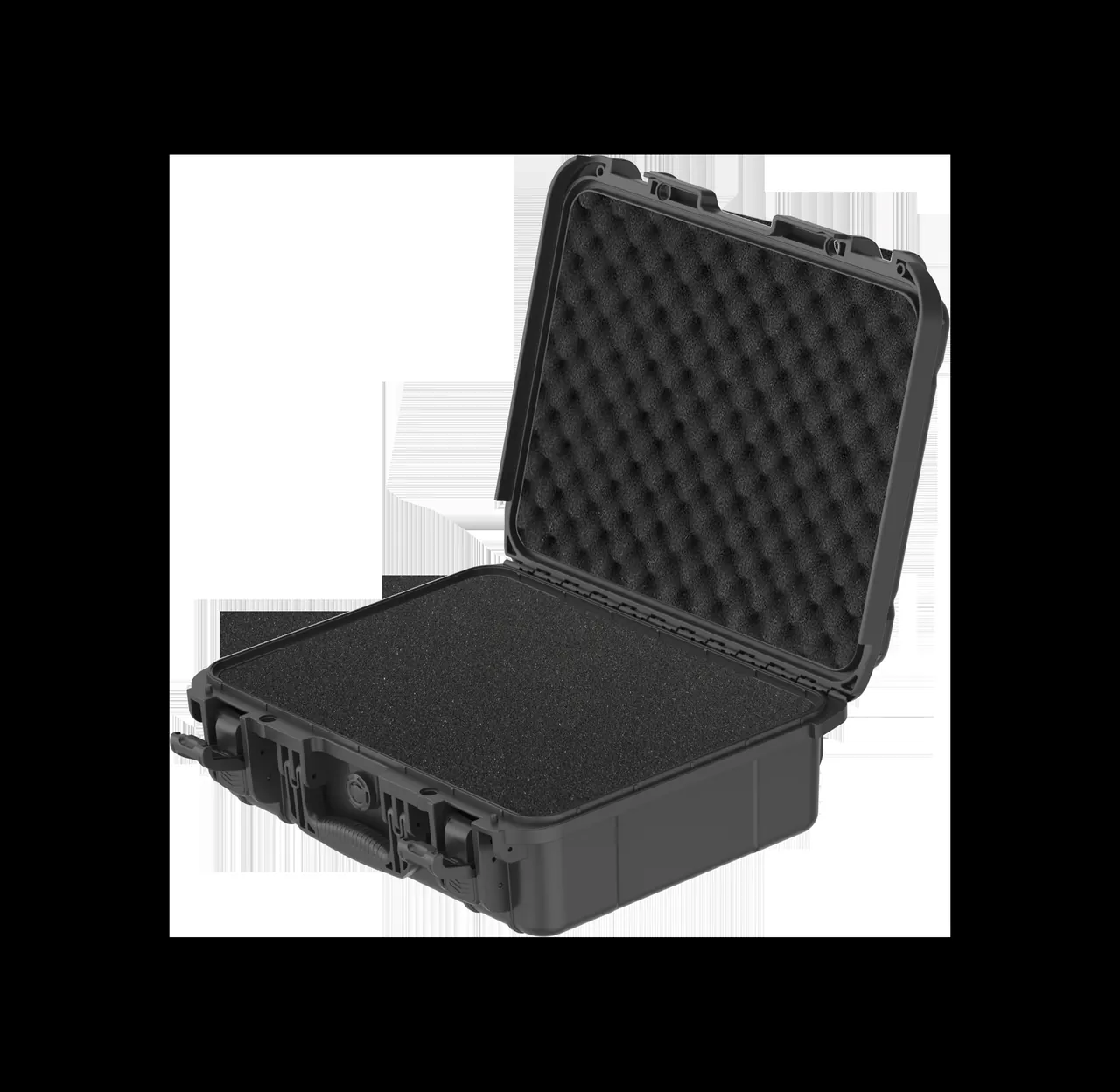
Material selection for pump packaging. Inner packaging for hydraulic parts should be carried out in a clean environment, and insert materials should be selected for low shedding and low dust generation. This is why EVA and PU inserts outperform ordinary expanded polyethylene in hydraulic applications, where the latter's debris becomes a contamination source for the hydraulic system. Material comparison methods are covered in case foam material comparison.
4. Travel and swing motors: heavy-load protection for combined motor-reducer units
Travel and swing motors are usually combined hydraulic motor and reducer units, which means they carry both the cleanliness requirements of a hydraulic component and the weight and geometric requirements of a heavy mechanical part.
Output shaft and splines. The output shaft and splines are assembly mating surfaces, and once spline teeth are deformed by impact, the fit with the drive sprocket or swing pinion is compromised after installation, producing abnormal wear and noise. Splines must therefore have protective sleeves, the shaft end must have a cover, and the output shaft must never be used as a lifting point. On travel motors with an integral brake, the brake release port must be plugged so that foreign matter cannot enter in transit.
Protection of the reduction gear section. A travel reducer typically contains multiple planetary stages and bearings, and its internal cleanliness requirements resemble those of a hydraulic component. Packing requirements are to keep the factory sealing intact, cap all ports, and protect the housing from impact. Where the motor and reducer are supplied separately, pack them individually with clear pairing identification so that they cannot be mismatched on site.
Heavy cradle design. Travel motors commonly weigh from over one hundred to several hundred kilograms and require a dedicated cradle to carry the load. Cradle design requirements: load-bearing points land on rigid features such as the housing flange or the area adjacent to the bearing housing; contact surfaces have compliant padding; the cradle is positively connected to the case floor or pallet; and cylindrical housings get wedge-shaped anti-roll blocks. Components with a markedly offset centre of gravity should be stored in a low-centre-of-gravity attitude or given a larger base footprint.
Swing motors and slew bearings. Swing motors are often supplied together with a slew bearing, and slew bearing raceways are extremely impact-sensitive. An indentation from a single impact produces periodic noise during slewing and progressively increases clearance. Packing requirements: a guard over the bearing, no lifting load applied through the raceway region, and a tooth-flank guard on the motor output pinion. Large slew bearings should be carried on a vertical cradle with multi-point support.
Lifting and handling markings. This category is heavy and off-centre, so centre-of-gravity position, lifting points and permissible tilt angle must be marked on the outside of the case. These are not decorative requirements; they are a direct means of reducing damage during handling.
5. Hydraulic cylinders and valves: rods, spools and manifolds
Hydraulic cylinders and valves are the most numerous and most varied hydraulic spares in construction machinery.
Hydraulic cylinders. The three critical features of a cylinder are the piston rod with its plating and surface finish, the honed bore, and the ports. Rod scoring is the most common goods-in defect on hydraulic cylinders, and the one most easily overlooked on site. Minor scoring may not leak during the first days of operation, but under high pressure and repeated stroking it rapidly damages the seal lip and eventually causes leakage. Packing requirements: a rigid rod sleeve, port plugs, horizontal support of the body at both mounting ends, and never using the rod as a support point. Where the cylinder travels with the rod extended, the sleeve must be stiff enough to resist bending as well as impact.
Main control valves and manifolds. A main control valve is usually an assembly of valve body, multiple spools and pilot galleries, and the spool-to-bore fit is extremely precise. The small damping orifices in the pilot galleries are especially prone to blocking by particles. Packing requirements: an overall protective cover so that spool ends are not exposed to impact, capping of every port, individual compartments, and never using the valve body as a load-bearing point. On valve groups with solenoid pilot valves, the solenoids and connectors also need protection.
Hydraulic hoses and tubes. Hose and tube failures take the form of end deformation, crimp fitting damage and excessive bending. Packing requirements: caps on tube ends; hoses coiled naturally with a bend radius no smaller than the manufacturer's stated minimum, which is the single most frequently violated rule; rigid tubes fixed in a support rack so that unsupported spans cannot suffer vibration fatigue; and no compression or torsion applied at the crimped fitting.
Filter elements and oils. Hydraulic filter media are sensitive to moisture and compression and should be sealed, not stacked under load, and managed against a shelf life. Oils and greases are liquid products whose packaging requirements centre on sealing, leak prevention, protection from light and shelf life, as discussed under ISO 6743 in the following section.
Seal kits and repair kits. Hydraulic repair kits containing O-rings, oil seals, wiper seals and backup rings are rubber and engineering polymer items that fail through lip damage, ageing and permanent set. Packing requirements: flat storage, no sharp-edge compression, protection from light and heat, individual packaging and shelf-life control. Mixing up repair kits is a common problem in hydraulic maintenance, so compartmentalisation by size and clear labelling are essential.
6. Hydraulic cleanliness control: ISO 4406, ISO 4413 and port capping
Transport protection for construction machinery hydraulic spares can be summarised in one sentence: everything is organised around keeping particles out.
Definition of the cleanliness metric. ISO 4406 uses three codes to describe the concentration classes of particles larger than 4, 6 and 14 micrometres. Construction machinery hydraulic systems normally specify a relatively strict working-fluid cleanliness requirement, with the exact class defined by the OEM's technical conditions. Packaging is the lowest-cost point in the contamination control chain, because blocking contamination there requires only plugs, inner packaging and clean working practice, whereas once contamination enters the system the cost becomes flushing, oil changes and possibly component replacement.
System-level rules and safety requirements. ISO 4413 sets out general rules and safety requirements for hydraulic fluid power systems and their components, and its content on cleanliness, component protection and installation requirements directly supports the engineering practice that components must remain clean before entering the system. Packaging protection is therefore not an optional improvement; it is a natural extension of system safety and reliability requirements.
Standardising port capping. Port capping looks simple, yet execution in the field is often poor. The technical documentation should therefore specify four things: material, avoiding brittle or shedding materials; interface type, choosing threaded plugs, snap-on caps or heat-shrink caps to suit the port; sealing method, with a sealing washer or sealant, because an interference-only cap can vibrate loose; and removal timing, specifying that plugs are removed only immediately before assembly and are never reused. The most common field error is removing the plugs for inspection convenience and putting them back loosely afterwards, which destroys the capping altogether.
Cleanliness requirements for inner packaging. Inner packaging for hydraulic parts should use rust-preventive film, vapour-phase inhibitor film or foil bags, and should be completed in a clean environment. For high-value pumps and valves, a combination of double inner packaging, individual compartments and desiccant is recommended.
Clean unpacking requirements. Even with intact inner packaging, opening the case in a dusty site environment will destroy cleanliness. The technical documentation and work instructions should specify an unpacking environment requirement and state that any part not immediately installed must be returned to the case or covered with a clean drape. Related sealing and pressure-compensation measures are covered in pressure equalisation valve and sealing configuration for protective cases.
7. Lubricants and greases: ISO 6743 classification and shelf-life control
Lubricants and greases are often regarded as low-value, unimportant items, yet they are numerous in a spare parts store, slow-moving, and in practice the category most likely to cause problems.
What ISO 6743 classification means here. ISO 6743 is the classification standard for lubricants, industrial oils and related products, using a letter-code system to distinguish applications and performance requirements, with separate categories for hydraulic oils, gear oils, greases and so on. Its direct significance for packaging and inventory management is that different categories must not be mixed in use or in shipment, because a smeared label or a damaged container can render an entire batch unusable. Oil packaging must therefore provide independent containers, labels that are clear and resistant to water and oil, and outer cases marked with the category code.
Packaging requirements for grease. Grease is sensitive to temperature and contamination, and develops oil separation and hardening in long storage. Packing requirements: sealed, protected from light and heat, and not compressed to the point of package deformation. Tubed and small-pack greases must be protected against crushing in transit.
Three shelf-life control measures. First, goods-in registration: record production date and batch and maintain a register by ISO 6743 category. Second, first-in-first-out: reflect batch order in storage locations and labels so that stock does not accumulate. Third, periodic inspection: for oils and greases held beyond a defined period, check appearance, oil separation and contamination, and where necessary confirm performance before deciding whether they can be used.
The interface with hydraulic components. One linked risk deserves attention: if contaminated oil is used to top up a system, all the cleanliness control carried out during packaging and assembly is wasted. Cleanliness and packaging protection for oils should therefore be managed under the same set of requirements as the hydraulic components themselves.
8. Transmission and undercarriage components: gearboxes, axles and track parts
Transmission and undercarriage components are heavy structural items, and their protection priorities are mating-face protection, shaft anti-bending and anti-roll restraint.
Gearboxes and torque converters. The critical areas are the input and output shafts, the joint faces and the oil galleries. Packing requirements: a heavy base that transfers weight to the case floor, shaft-end sleeves, joint-face protection plates and port capping. A torque converter is a thin-walled rotating component and must be protected against local compression distortion.
Drive axles and propeller shafts. A drive axle is a very heavy item whose flange faces, splines and bearing seats are mating surfaces. Packing requirements: dedicated cradle support, flange covers, spline sleeves and anti-roll restraint for the whole assembly. A propeller shaft is a slender item and must be supported at multiple points to prevent bending and flexure in transit, with the unsupported span length being the key parameter that determines the number of support points.
Track components and track rollers. Track links, track shoes and track rollers are heavy and numerous. The seals and raceways of a track roller are its weak points, so individual compartments and anti-roll restraint are basic requirements. Link bores and pins are mating components and should be rust-protected and clearly labelled to prevent mixing.
Protection of painted and cosmetic surfaces. Construction machinery structural parts are often painted, and transit impacts cause coating damage that is read on site as a goods-in quality problem. For painted components, add protective film or corner guards at contact points and prevent hard items inside the case from rubbing directly against finished surfaces.
9. Attachment components: bucket teeth, pins and linkages
Attachment components such as bucket teeth, adapters, pins, bushings, linkages and bucket plates are high-turnover items whose failure modes are primarily appearance and geometric damage.
Bucket teeth and adapters. The tooth tip is both the working surface and the sharpest feature of the part. Tip damage does not shorten wear life directly, but it distorts the mounting face and degrades the fit. Packing requirements: protective caps on tips, which also protect the case and other parts; compartments by model; and individual numbering. The mounting and pin bores of an adapter need edge protection so that hole burrs cannot affect assembly.
Pins and bushings. The plating and mating surfaces of a pin are functional areas, and scoring accelerates bushing wear. Packing requirements: compartmented trays, individual numbering, rust prevention, and no mixing with hard items. Pins of similar diameter but different length are very easily confused, so numbering and weight verification are essential.
Linkages and bucket plates. These are plate and weld fabrications whose main risks are bending and hole distortion. Packing requirements: flat placement, separate layers with dividers, no heavy items on top, and guards on lifting holes.
Where removable dividers make sense. Because attachment components come in many models, in small batches and with frequent model changes, a removable divider system allows one case to accommodate different model combinations, which is more practical for distributors and repair businesses than a fixed insert.
10. Electrical and electronic components: controllers, sensors and harnesses
Modern construction machinery electronic components are high in value, small in size and sensitive to electrostatic discharge and moisture, so their protection requirements differ completely from those for mechanical parts.
Controllers (ECUs) and displays. These contain circuit boards and connectors, and their main failure modes are ESD damage, connector deformation and moisture ingress. Packing requirements: ESD packaging such as antistatic bags or conductive foam, individual compartments, no compression on connectors, and humidity control. Displays also need screen protection against scoring and compression.
Sensors. Pressure, speed and position sensors are precision small parts whose probes and connectors are the fragile areas. Packing requirements: individual compartments, a protective cap on the probe, and no repeated flexing or tension on the cable.
Harnesses and connectors. The main risks for a harness are connector deformation, terminal push-out and insulation abrasion. Packing requirements: coil and secure the harness at its designed bend radius, cap the connectors, avoid too small a coil diameter, and prevent contact with hard items.
ESD and humidity control. Packaging for electronic components should state explicit ESD protection requirements and include desiccant. It is worth noting that ESD packaging and humidity control are not in conflict, but the compatibility of antistatic materials with humidity-control materials should be confirmed. Related antistatic and shielding design approaches are covered in ESD shielding case design.
11. Heavy-load retention and partitioned insert design
The design difficulty in a construction machinery parts case is that a single case often holds both heavy items and precision items, and the two require opposite approaches.
How to handle heavy items. The weight of a heavy item must be transferred to the case floor and pallet through structural members, and cushioning material must not carry load. The usual approach is a load cradle shaped to the part, made from timber, laminated plywood or engineering polymer, connected to the case floor by bolts or keys. The cradle provides load carrying and location; the cushioning material provides isolation and damping. The two are not interchangeable.
How to handle precision items. The protection priority for precision items such as pumps, valves, motors and sensors is full constraint plus clean isolation. A form-fitted insert constrains the part in three axes so that it cannot move in transit. Individual compartments separate different part numbers to prevent impact damage and mixing. Low-shedding materials prevent particle contamination.
Three workable mixed-loading layouts. The first is vertical zoning: heavy items at the bottom, precision items above, separated by a rigid divider that is checked for load capacity. The second is lateral zoning: heavy items on one side, precision items on the other, with the case reinforced. The third is separate cases: heavy and precision items packed in different cases, then palletised and strapped together. Where a project wants multiple items in one case, the third or the first layout should be preferred over simply mixing the two categories together.
| Insert material | Density and hardness | Rebound and energy absorption | Processability | Typical use in construction machinery spares |
|---|---|---|---|---|
| --- | --- | --- | --- | --- |
| EVA | Medium density, adjustable hardness | Good rebound, retains properties over repeated impacts | Easy to cut, easy to heat-form, supports complex form-taking | Axial piston pumps, main control valves, sensors, irregular precision parts |
| PE (expanded polyethylene) | Low density, light | Good single-impact absorption, collapses under sustained load | Easy to laminate, low cost | Bucket tooth dividers, cosmetic part protection, single-use inserts |
| XPE | Medium-low density, fine cells | Reasonable rebound, better weathering than PE | Easy to heat-form | Small and medium part compartments needing weather resistance |
| PU foam | Adjustable density, pourable in place | Excellent energy absorption, conforms fully to irregular shapes | Requires tooling or on-site pouring | High-value irregular parts, close-fitting pump body retention |
| Rubber including EPDM | High density, good elasticity | Excellent vibration damping | Limited formability, usually used as pads | Heavy cradle padding, damping nodes |
A note on material fire performance. Construction machinery spares are often stored in quantity in closed warehouses, equipment sheds and containers, where packaging materials represent a real fire load. UL94 is the widely used flammability test method for plastics, and a V-0 rating indicates that in the specified vertical burning test the specimen self-extinguishes within a short time after the ignition source is removed and does not produce dripping material. For export projects, for customers with fire review requirements, or where spares must be stored long term in relatively enclosed spaces such as equipment sheds, ask the insert supplier for UL94 test documentation where available and record the material grade and burning class in the technical agreement.
12. Sealing, dust exclusion and humidity control: IEC 60529, GB/T 4208 and IP6X
Construction machinery spares are typically stored and transferred in poor conditions: temporary sheds, open yards and workshop corners, with dust and moisture present together. The sealing and humidity-control capability of the case therefore determines how long the protection scheme holds up.
How to select the IP rating. Ingress protection is defined by IEC 60529, with GB/T 4208 as the corresponding Chinese standard. The first digit indicates protection against solid foreign objects and dust; the second indicates protection against water. For construction machinery spares the first digit should be 6, that is IP6X dust tight, because dust is the most widespread threat; the water digit is then chosen according to the environment.
| IP code | Dust and water meaning | Suitability for construction machinery spares |
|---|---|---|
| --- | --- | --- |
| IP5X | Dust protected: limited ingress that does not affect operation | Indoor storage, short-haul transport, clean workshops |
| IP6X | Dust tight: no dust ingress | Site sheds, open yards, off-road transport |
| IP65 | Dust tight plus protection against water jets | Loading in rain, routine open storage |
| IP67 | Dust tight plus protection against temporary immersion | Water-crossing work, heavy rain, extreme humidity |
Three essentials for achieving IP6X. First, the gasket: continuous around the full perimeter, with corners moulded or properly butt-joined, and with a sensible compression ratio, since too little leaks and too much makes the case hard to close and permanently deforms the gasket. Second, pressure equalisation: a fully sealed case develops an internal-to-external differential as temperature changes, which can draw the gasket out of position, so a pressure equalisation valve should be fitted to let air exchange through an oleophobic, dust-blocking membrane. Third, structural dust exclusion: latch, hinge and handle interfaces should avoid straight-through paths into the case interior; the relevant details are covered in case hinge, latch and seal systems.
Humidity control configuration. Construction machinery spares may remain in storage for many months, so humidity control is a long-term task. Size the desiccant and add a humidity indicator card according to internal volume and expected storage period, and establish a periodic inspection and replacement regime, because saturated desiccant shows no visible change yet is completely ineffective. For sea export, salt spray and wet-dry cycling must also be considered; relevant methods are described in case design for extreme temperature environments and IP67 protective case configuration.
Unpacking procedure. Even an IP6X case loses internal cleanliness if it is opened in a dusty site environment. The technical documentation should specify an unpacking environment requirement and state that any part not immediately installed must be returned to the case or covered with a clean drape.
13. Transport test references: ISTA, GB/T 4857, ASTM D4169 and MIL-STD-810H
The credibility of a packaging scheme comes from test data rather than descriptive claims. Four frameworks are commonly used for construction machinery parts cases.
ISTA procedures. Published by the International Safe Transit Association and graded by transport mode and package weight, these procedures are built around real distribution chains and are well suited to validating a package along a specific route. Export projects frequently require an ISTA procedure as the baseline packaging validation; see ISTA transport testing procedure explained.
The GB/T 4857 series. These Chinese standards define basic test methods for transport packages, covering vibration, impact, drop, stacking and compression. This is the most commonly cited framework for domestic transport packaging validation and suits domestic project acceptance; see GB/T 4857 transport packaging testing essentials.
ASTM D4169. This standard organises test sequences by distribution cycle and emphasises combining tests according to the actual distribution stages. It is frequently used for North American projects; see ASTM D4169 distribution cycle testing.
MIL-STD-810H, with an important non-military note. The vibration, shock, temperature and humidity, and mould methods in this standard are widely used by industry as a methodological basis for environmental testing. It must be stated clearly that citing MIL-STD-810H means only that its test methods are adopted; it does not imply any military certification and does not place the product on any military list.
A recommended test sequence. Construction machinery spares typically pass through road, ocean and site-shuttle legs, so the recommended sequence is: temperature and humidity preconditioning, random vibration, shock or drop, stacking compression, vibration again, then unpacking inspection and functional verification. Acceptance criteria should cover three layers: packaging integrity, part geometry and appearance, and part function and cleanliness, including a port contamination check on hydraulic parts. Because performance damage to hydraulic parts is delayed, bench performance confirmation before installation is recommended for high-value pumps and valves.
Reminder: every test conclusion is bound to a specific packaging configuration, payload weight and set of test parameters. A "passed testing" statement without those parameters has no engineering meaning, which is why test conditions must be recorded in the acceptance file.
14. Packing SOP, goods-in verification and the OEM/ODM path
A recommended packing SOP is as follows:
- Part confirmation: verify part number, quantity, weight and factory packaging condition, and record whether the rust-preventive packaging and factory plugs are intact.
- Cleanliness check: confirm freedom from dust, swarf and moisture; hydraulic ports must remain plugged.
- Weak-point marking: mark piston rods, port faces, spool ends, splines and connectors as areas that must not carry load.
- Cradle and insert assembly: install and secure the cradle first, then fit the form-fitted insert, confirming recesses match and that there are no sharp corners or hard objects.
- Part placement: place heaviest to lightest and bottom to top; a heavy part must be fully restrained before the next part is added.
- Retention and fixing: constrain all three axes with blocks, wedges, clamp plates or straps, keeping straps off machined surfaces.
- Humidity control and ESD configuration: add desiccant, a humidity indicator card and ESD packaging as specified.
- Closing and seal inspection: check gasket continuity, pressure equalisation valve condition, and hinge and latch function.
- Marking and records: apply centre-of-gravity, this-way-up, keep-dry and stacking-limit markings, photograph the case and complete the packing record sheet.
- Lifting and dispatch: lift from the marked points and confirm the case is secured on the transport unit.
Goods-in verification should follow a three-layer criterion:
- Layer one, the package. Check case deformation, gasket failure, humidity indicator colour change, desiccant saturation, and signs of water or contaminant ingress.
- Layer two, appearance and geometry. Check piston rods for scoring, port faces and spool ends for condition, splines and shaft extensions for damage, threads and ports for condition, and coatings for damage.
- Layer three, function and cleanliness. Perform port contamination and rotation checks on hydraulic parts; bench-confirm pumps and valves before installation; check sensor continuity and signal; check seal hardness and appearance. Apply a sampling plan where necessary; methods are discussed in custom case acceptance and AQL sampling.
A procurement scorecard and the OEM/ODM path:
| Evaluation dimension | Key questions | Suggested weight |
|---|---|---|
| --- | --- | --- |
| Insert precision and form-taking | Can inserts be formed from physical parts or 3D data? How is handling clearance controlled? | High |
| Cleanliness and capping package | Are plug selection advice and low-shedding insert materials offered? | High |
| Sealing and dust class | Is IP6X or IP67 stated explicitly? What is the gasket construction and joint treatment? | High |
| Heavy-load structural capability | Has the supplier designed cradles for pumps, motors or drive axles? | High |
| Humidity control and ESD | Desiccant sizing, humidity indicator cards, ESD packaging options? | Medium |
| Standards and documentation | Are IP and vibration test reports available? | Medium |
| Delivery and capacity | Lead time, batch consistency, tooling investment? | Medium |
| Service life and spares | Gasket replacement, wear-part supply, expected case life? | Medium |
JUNZHJIA capability note. For construction machinery applications, the manufacturer provides three categories of support. First, form-fitted inserts and heavy-load cradle design, formed from drawings, 3D data or physical parts, with isolation and sleeve solutions for piston rods, output shafts and port faces. Second, port capping, humidity control and clean packaging configuration, including plug selection advice, desiccant and humidity indicator cards, low-shedding insert materials and ESD packaging options. Third, OEM/ODM and documentation, with customised branding and marking plus packing work instructions and supporting inspection records. The final scheme must follow the part drawing, weight and centre-of-gravity data and the regulations of the destination market.
Frequently Asked Questions
Q: Why are hydraulic pumps so sensitive to packaging? Does a timber crate with foam not prevent impact?
A: Impact prevention is only part of the problem. The real weak points of a hydraulic pump are its internal clearances and its cleanliness. An axial piston pump contains several mating pairs, including the pistons and barrel bores, the port plate and barrel end face, and the slippers and swashplate, all with clearances typically in the micrometre range. A timber crate with foam absorbs some impact energy but cannot solve two things. First, once the foam compresses it pushes the pump into one localised position, and the impact force still transmits through the housing into the mating faces, potentially leaving an indentation a few micrometres deep on the port plate. Nothing is visible externally, yet after installation the result is pressure fluctuation and reduced volumetric efficiency. Second, ordinary foam, paper dust and timber fragments are themselves shedding materials, and once they reach a port they become a contamination source. The correct approach is the three-part combination of a form-fitted insert, port capping and clean packaging: the insert fully constrains the pump in three axes and spreads the load onto rigid features, the plugs seal the inlet, outlet, drain and control ports, and clean inner packaging materials prevent shedding.
Q: How is hydraulic cleanliness actually measured, and how can packaging affect it?
A: Hydraulic cleanliness is normally expressed as the solid particle contamination class defined in ISO 4406, which uses three codes corresponding to concentrations of particles larger than 4, 6 and 14 micrometres. Construction machinery hydraulic systems normally specify a relatively strict working-fluid cleanliness requirement, with the exact class set by the OEM's technical conditions. Packaging affects cleanliness because the main particle ingress path occurs before assembly: dust and swarf inside the case, port plugs removed too early, scored piston rods and threads, and unpacking in a dusty site environment all introduce contamination before the part reaches the system. That loss is irreversible. A filter only intercepts particles that pass through it, while particles trapped in clearances and adhering to housing walls are released continuously, so the only remedy is repeated flushing or an oil change. This is precisely why the rules in ISO 4413 on cleanliness, component protection and installation for hydraulic systems and components underpin good packaging practice rather than being a separate topic.
Q: Why can travel and swing motors not be treated simply as ordinary hydraulic components?
A: Because they are usually combined hydraulic motor and reducer units, carrying two sets of protection requirements at once. As hydraulic components they need port capping, clean packaging and contamination exclusion. As heavy mechanical parts they need a heavy cradle, anti-roll restraint, and protection for the output shaft and splines. The most commonly overlooked area is the output shaft and spline: once spline teeth are deformed by impact, the fit with the drive sprocket or swing pinion is compromised after installation, producing abnormal wear and noise, and this damage is often misdiagnosed as a gear quality problem in the early stage. Splines must therefore be sleeved, shaft ends covered, and the output shaft must never be used as a lifting point. In addition, travel motors commonly weigh from over one hundred to several hundred kilograms and must be carried on a dedicated cradle with load-bearing points on rigid features such as the housing flange or bearing housing area. Off-centre units should be stored in a low-centre-of-gravity attitude, and centre-of-gravity and permissible tilt markings should be applied to the case exterior, since these markings are a direct means of reducing handling damage.
Q: What matters for main control valves and manifolds, and why is an overall cover so important?
A: A main control valve is typically an assembly of a valve body, multiple spools, pilot galleries and solenoid pilot valves. Its two weak points are the micrometre-level spool-to-bore fit, which is extremely contamination-sensitive, and the damping orifices in the pilot galleries, which block very easily. The reason for insisting on an overall cover is that spool ends and solenoids are usually exposed and protruding, so they are easily struck by other parts in transit. Once a spool end is deformed or a solenoid is damaged, it cannot be repaired on site, and the cover isolates those protruding features completely from everything else in the case. Further requirements are that every port, including work, pilot and return ports, must be capped; that the valve must be in its own compartment so it cannot contact other metal parts; and that the valve body must never be used as a load-bearing point, because manifold wall thickness is limited. On valve groups with solenoids, the connectors need separate protection as well.
Q: Lubricants and greases look unimportant. Why emphasise packaging and shelf life?
A: Because they are numerous, slow-moving, and the category with the highest risk of mixing and contamination. ISO 6743 is the classification standard for lubricants and related products, using letter codes to distinguish applications and performance requirements. Its direct implication for packaging management is that different categories must not be mixed in use or in shipment, because a smeared label or a damaged container can render an entire batch unusable. Oil packaging therefore requires independent containers, labels that are clear and resistant to water and oil, and outer cases marked with the category code. Greases additionally need protection from light and heat and must not be crushed to the point of package deformation. Shelf-life control matters even more: register production date and batch on receipt, maintain a register by category, enforce first-in-first-out, and inspect overdue stock for appearance and performance. One linked risk is easily forgotten: if contaminated oil is used to top up a system, every cleanliness control applied during packaging and assembly is wasted.
Q: How should the IP rating be chosen for a construction machinery parts case? Is IP67 always better than IP65?
A: No. The goal is to match the actual environment rather than to choose the highest number. Ingress protection is defined by IEC 60529, with GB/T 4208 as the corresponding Chinese standard; the first digit covers solid foreign objects and dust, the second covers water. The primary threat to construction machinery spares is site dust, so the first digit should be 6, that is IP6X dust tight, and the water digit is then selected according to storage and transport conditions. IP65 suits routine loading in rain and open storage, while IP67 suits water-crossing work, heavy rain or extreme humidity. IP67 is not universally better, because tighter sealing usually means higher opening resistance and stricter gasket maintenance, and where the case is opened frequently and handled roughly the gasket may fail sooner. Two further points matter. First, a fully sealed case develops an internal-to-external pressure differential as temperature changes, so a pressure equalisation valve should be fitted or the gasket may be drawn out of position. Second, even an IP6X case loses internal cleanliness when opened in a dusty site environment, so the operating procedure must include an unpacking environment requirement.
Q: Port plugs look like a trivial item. Why are they emphasised so heavily?
A: Because they are the cheapest and most easily defeated link in the entire cleanliness control chain. A plug blocks particles from entering a port at negligible cost, but poor selection or poor execution reduces its effect to zero. Four things should be specified in the technical documentation. On material, avoid brittle or shedding materials so the plug itself does not become a contamination source. On interface type, choose threaded plugs, snap-on caps or heat-shrink caps to suit the port. On sealing method, require a sealing washer or sealant, because an interference-only cap vibrates loose. On removal timing, specify that plugs are removed only immediately before assembly and are never reused afterwards. The most common field error is removing the plugs for inspection convenience and putting them back loosely, which destroys the capping completely. Plug management should therefore be written into the packing SOP and work instructions and included in the goods-in verification checklist.
Q: Can heavy parts and precision parts travel in the same case?
A: Yes, but they must be separated structurally rather than simply mixed, because the two require opposite approaches. A heavy part's weight must be carried by structural members and cannot be carried by cushioning material, while a precision part needs full constraint and clean isolation. Three workable layouts exist. First, vertical zoning with heavy items at the bottom and precision items above, separated by a rigid divider whose load capacity is verified; this is the most common arrangement. Second, lateral zoning with heavy items on one side and precision items on the other, with the case reinforced, taking care to balance the load. Third, separate cases for heavy and precision items, palletised and strapped together. In engineering practice, the third or the first is preferred. One further detail matters: where a case contains both metal parts and electronic components, the electronic items should be in ESD packaging and physically separated from the metal parts, so that movement of the metal items cannot damage connectors.
Q: We buy hydraulic pumps, bucket teeth and harnesses together. What is a reasonable way to control packaging cost?
A: Use tiered configuration on a shared platform. Three tiers work well. Tier one, hydraulic precision parts such as axial piston pumps, main control valves, travel motors and sensors: use form-fitted EVA or PU inserts with clean inner packaging, concentrating investment on cleanliness and constraint accuracy. Tier two, general mechanical parts such as gear pumps, cylinders, pins and track rollers: use individual compartment inserts with rust prevention, concentrating on isolation and securing. Tier three, low-value consumables and cosmetic parts such as bucket teeth, track shoes and harnesses: use compartmented trays or removable dividers in standard returnable boxes, concentrating on labelling and quantity verification. All three tiers share the same case platform and sealing system, which substantially reduces tooling investment. If an enquiry quotes only the generic term "construction machinery parts case", the supplier can only offer a generic solution, and the result is usually under-protected hydraulic parts and over-designed low-value parts. Specify category, weight, cleanliness class and protection class by part-number family in the technical agreement.
Conclusion & Related Reading
Transport protection for construction machinery spares is fundamentally about eliminating latent damage in the packaging stage, because such damage can neither be detected nor repaired in the field. The acceptance criterion for a hydraulic pump, travel motor or main control valve is not appearance but pressure, flow, volumetric efficiency and cleanliness, and whether those properties survive depends on whether the part is fully constrained inside the case, whether every port is capped, and whether the inner packaging is clean. For axial piston pumps, the priorities are form-fitted inserts, port-face protection and control mechanism guarding. For travel and swing motors, they are heavy cradles and output shaft and spline protection. For cylinders and valves, they are rod sleeves, port capping and overall covers. Across every category, the shared baseline is IP6X dust exclusion, sustainable humidity control and disciplined unpacking practice.
The implementation path has four steps. First, map categories and failure modes by part-number family, separating hydraulic precision parts from heavy structural parts. Second, fix capping, inserts and protection classes, defining the plug scheme, insert material, IP class and desiccant configuration. Third, validate by testing, using a combination drawn from ISTA, GB/T 4857, ASTM D4169 or MIL-STD-810H methods. Fourth, establish a packing SOP and goods-in acceptance criteria, implementing the three-layer criteria of appearance, cleanliness and function as a working process. JUNZHJIA can support all four steps with form-fitted inserts and heavy-load cradle design, capping and humidity-control configuration, and OEM/ODM supply with inspection documentation.
Related Reading