

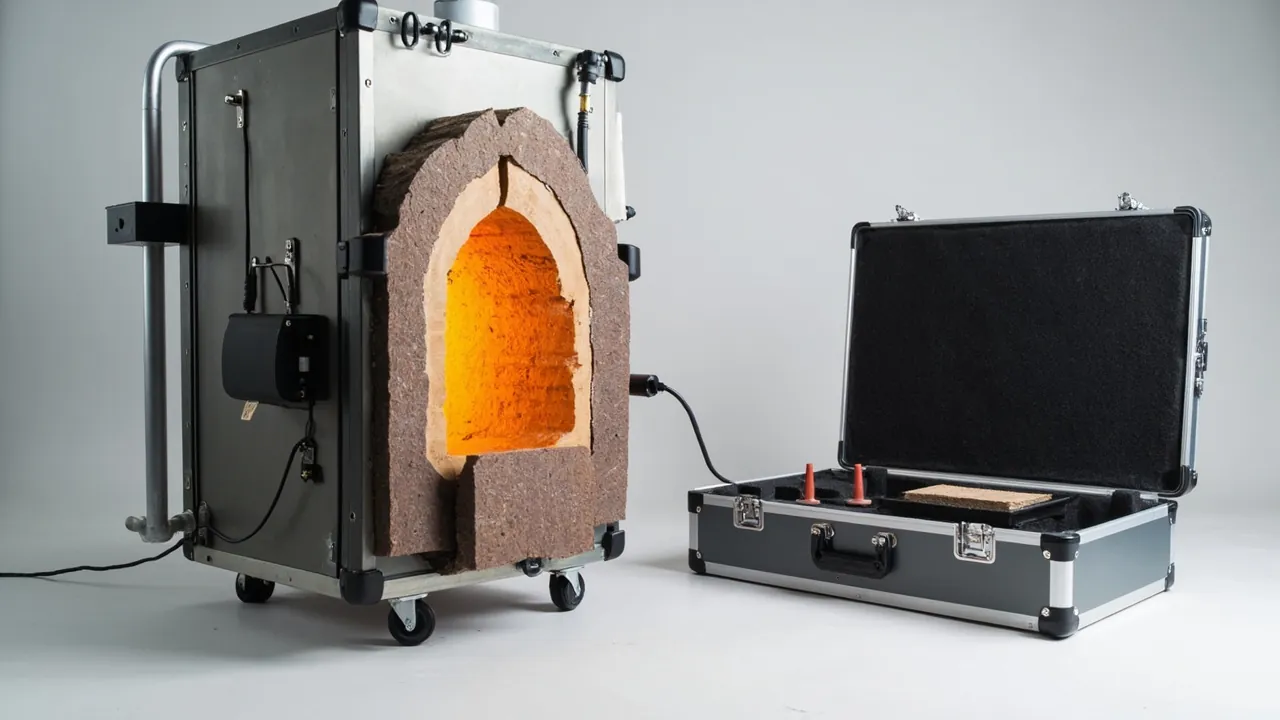
The conclusion for industrial furnace case selection fits in one sentence: metal precision parts such as burners fail from impact and shaft distortion, while refractory parts fail from moisture uptake and edge damage, so the two families must be separated by zone, material and humidity strategy inside a single logistics unit. When a reheating furnace, annealing furnace or aluminium melting furnace is overhauled or newly built, the burner body, air-damper actuator, ignition transformer, flame sight glass, castable precast blocks, ceramic fibre modules and lightweight insulating bricks frequently ship together. Unit value is high, individual weights vary widely, and the goods often sit in storage for weeks or months before installation. Packaging therefore cannot be designed for a single transport leg; it must be calculated for transport plus mid-term storage as a combined duty.
This article is written for packaging engineers at furnace OEMs, overhaul contractors and equipment buyers at end-user plants. It sets out how to fixture a burner assembly in a profiled liner, how to build a layered moisture barrier around refractory parts, how to estimate desiccant quantity, how to match case ingress protection to the transport route, and it closes with an unpacking checklist that can be copied directly into a project procedure. Figures quoted are typical industry values; confirm against your specific model, transport mode and contractual technical specification, and treat supplier inspection or material certificates as the governing evidence for material properties.
Table of Contents
- The Two Risk Families an Industrial Furnace Case Must Solve at Once
- Anatomy of a Burner Assembly and Where It Is Fragile
- How Refractory Parts Absorb Moisture and Where the Limit Sits
- Matching Case Ingress Protection to Material Selection
- Profiled Liners: Locating Nozzles, Dampers and Ignition Hardware
- Layered Packaging and Moisture Barriers for Refractory Parts
- Desiccant Sizing and the Internal Humidity Budget
- Engineering Practice for Shock and Vibration Isolation
- Test References: GB/T 2423, ISTA and MIL-STD-810H
- Ocean Freight, High Humidity and Open Storage Yards
- Marking, Documentation and the Unpacking Acceptance Checklist
- Customisation, OEM Supply and Volume Delivery Workflow
- Frequently Asked Questions
- Conclusion and Related Reading
The Two Risk Families an Industrial Furnace Case Must Solve at Once
Spare-part logistics for industrial furnaces has a distinctive feature: a single packing list carries both metal motion parts toleranced to hundredths of a millimetre and brittle refractory parts with porosity above seventy percent and modulus of rupture measured in a few megapascals. The failure modes of these two families barely overlap, yet they must be protected within one shipment.
On the metal side there are three dominant risks. The first is damage to mating surfaces from impact: the coaxiality of a burner nozzle and flame stabiliser, the straightness of a damper shaft, and the flatness of an actuator mounting face all depend on geometry that local plastic deformation will destroy. Once that happens the site must rework or replace the part, and burner commissioning slips. The second is bearing contamination. Burners firing heavy oil or dust-laden fuel often carry precision bearings and sliding pairs; once grit enters, service life shortens sharply. The third is moisture uptake in electrical items, where the insulation resistance of ignition transformers, flame detectors and servo actuators can fall below the acceptance value after absorbing water vapour.
The refractory side also has three risks. The first is moisture uptake. Castable precast blocks and ceramic fibre products absorb water from ambient air during transport and storage, and a moisture content above specification changes the dry-out curve after installation, extending commissioning at best and causing spalling at worst. The second is edge and corner breakage, because brick and block corners concentrate stress and a single drop can scrap an entire piece. The third is chemical contamination: sulphur, chlorine and alkali species accelerate low-temperature attack on refractories in damp conditions, and if co-packed with metal parts they carry corrosive media onto burner surfaces.
The case must therefore define three explicit zones: a metal precision zone, a brittle refractory zone, and an accessory and document zone. Separate the zones with rigid dividers rather than foam alone, give each divider its own load path, and never let the weight of upper metal parts bear on refractory below. Only then should each zone select its sealing, cushioning and drying strategy according to its own risk ranking. This zoning discipline is the essential difference between an industrial furnace case and a general-purpose equipment case.
Anatomy of a Burner Assembly and Where It Is Fragile
Before discussing packaging, carry out a teardown-level fragility survey. A typical industrial burner, whether gas proportioning or heavy-oil mechanical atomising, breaks down into the following transport units:
- Nozzle and flame stabiliser: atomisation quality depends entirely on orifice geometry and stabiliser grooves, so any squeeze changes the spray angle.
- Burner body casting or weldment: irregular in shape with an offset centre of gravity, and the reference piece for locating everything else in the case.
- Air damper and linkage: slender rods with small bending section modulus, and the parts most likely to bend in transit.
- Servo actuator and cam group: contains reduction gearing and position feedback elements, sensitive to both shock and moisture.
- Ignition transformer and high-voltage harness: high-voltage insulation parts that dislike moisture, oil and crushing.
- Flame detector and sight glass: once the optical surface is scratched or oiled, the flame signal becomes unstable during commissioning.
- Gas train valves: contain spools, diaphragms and springs; vulnerable to foreign matter and to seal hardening at low temperature.
Rearranging these parts by what they fear yields the packaging strategy. Nozzle, sight glass and detector form a surface-and-geometry sensitive group that must be isolated by area contact rather than point contact. Damper linkage and high-voltage harness form a bending-sensitive group that needs axial restraint. Actuator, transformer and valve group form an electrical-and-sealing sensitive group that needs moisture protection and low-temperature consideration.
One detail is routinely overlooked: the consistency between centre of gravity and lifting direction. A burner body casting normally has its centre of gravity displaced toward the flange side. If the liner is designed symmetrically to the outline rather than to the centre of gravity, the case develops a significant overturning moment when lifted, and contents press against each other. The correct approach is to thicken the support block under the flange side and print the centre-of-gravity mark on the short side wall rather than on the lid.
How Refractory Parts Absorb Moisture and Where the Limit Sits
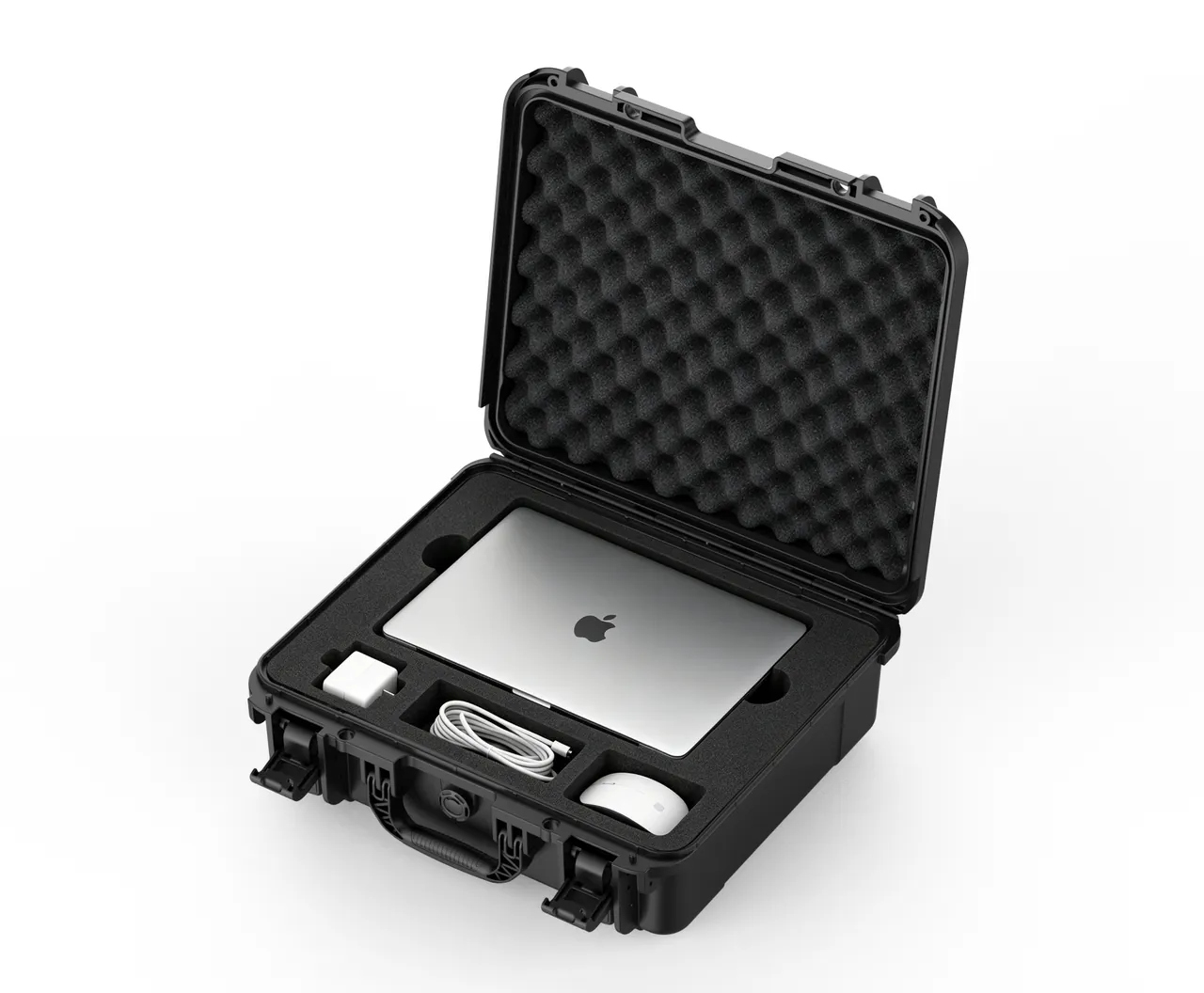
Moisture uptake inside a packing case is not a rain-soaked event; it is a slow equilibrium process. Water vapour in the atmosphere enters through the case wall, diffuses through micro-gaps at gaskets, and is drawn in by the breathing effect of temperature cycling. It is then adsorbed onto the open porosity of the refractory and migrates inward by capillary action. For low bulk density, high apparent porosity products, this process can raise surface moisture content appreciably within a few weeks under normal ambient conditions.
In engineering practice the absolute value matters less than the margin to the installation requirement. The following intervals are useful as experience references:
| Refractory type | Typical apparent porosity | Transport and storage concern | Recommended packaging strategy |
|---|---|---|---|
| --- | --- | --- | --- |
| Dense firebrick | 14%-20% | Edge breakage, freeze-thaw | Rigid returnable frame plus corner guards |
| Lightweight insulating brick | 45%-70% | Rapid uptake, low strength | Aluminium foil composite barrier plus desiccant |
| Castable precast block | 12%-22% | Uptake affects dry-out, corner loss | Shrink film plus barrier film plus dedicated pallet |
| Ceramic fibre module | above 85% | Extremely hygroscopic, poor compression recovery | Vacuum barrier bag plus rigid shell |
| Refractory castable (bagged) | not applicable | Caking when damp | Moisture-proof paper bag plus pallet stretch film |
Two hard limits follow. First, refractory parts must never be packed bare. There must always be a dedicated barrier layer, and the lower its water vapour transmission rate the better; aluminium foil composite film is a common choice. Second, refractory parts must not share a humidity volume with metal precision parts, because no single desiccant charge can serve both humidity targets, and the water released by the refractory raises relative humidity in the metal zone.
One further point is easily missed: fibre products have limited recovery after compression. If a fibre module sits under other heavy goods for an extended period, thickness recovery drops and the insulating performance of the finished furnace wall degrades. Fibre modules therefore belong on the upper layer of a case or in a dedicated case type, and the side wall must carry a stacking limit mark.
Matching Case Ingress Protection to Material Selection
Higher ingress protection is not automatically better. The correct level matches the transport mode, storage duration and cargo value. Over-specification raises unit cost and tare weight sharply, which is uneconomic for air freight and multi-leg handling; under-specification fails in high-humidity ocean freight.
The following matrix gives a fast starting position:
| Typical scenario | Suggested protection | Case material | Sealing structure | Drying measure |
|---|---|---|---|---|
| --- | --- | --- | --- | --- |
| Domestic full truckload, install on arrival | IP54 class dust and splash | Reinforced PP or steel | Single gasket | None or minimal |
| Domestic LTL, two or more transfers | IP55-IP56 | Reinforced PP or FRP | Dual gasket plus pressure equalisation valve | Silica gel packs |
| Export ocean freight, storage 1-3 months | IP67 class immersion | Rotomoulded PE or FRP | Dual gasket plus breather valve plus desiccant | Metered desiccant |
| Export ocean freight plus open yard beyond 3 months | IP67 plus barrier inner bag | Rotomoulded PE plus foil inner bag | Three-level seal (gasket, valve, inner bag) | Desiccant plus humidity indicator card |
| Precision burner, air freight | IP67 plus anti-vibration liner | Rotomoulded PE or dedicated air case | Dual gasket | Desiccant plus isolation mounts |
Note that IP ratings judged under IEC 60529 or GB/T 4208 describe dust and water ingress, which is not the same as long-term moisture resistance. An IP67 case will still breathe under thermal cycling because of the differential pressure across the wall, drawing external moisture in gradually. That is precisely why a pressure equalisation valve and a barrier inner bag are needed; the structural reasoning is set out in how the pressure equalisation valve works in a protective case.
On material selection, rotomoulded PE offers impact resistance and chemical tolerance, and supports thicker walls and ribs. FRP suits very large and irregular geometries. Steel cases provide the highest strength but require internal corrosion protection, and in coastal high-humidity environments the demand on the internal coating is higher. Combine the general framework in the instrument case selection guide with furnace-specific adjustments rather than applying either in isolation.
Profiled Liners: Locating Nozzles, Dampers and Ignition Hardware
The liner is the heart of burner protection. Its purpose is not merely to fill the void; it must convert every sensitive surface from a loaded condition to an unloaded one while limiting relative movement between parts.
A practical design sequence runs as follows:
- Fix the reference part and reference face. The burner body flange face normally serves as the datum, with all other parts located from it so that multiple datums do not fight each other.
- Prefer area contact over line contact. For surface-sensitive items such as nozzles, sight glasses and detectors, the cradle should follow the actual contour so that contact stress is distributed.
- Restrain both axially and radially. Radial slots alone are insufficient; slender rods also need end stops, otherwise they travel under longitudinal shock and strike neighbours.
- Leave a removal path. Provide lift notches or finger recesses so that a gloved technician can extract a part one-handed instead of forcing the case open.
- Isolate electrical items. Actuators and ignition transformers should sit in a dedicated cavity, with an antistatic facing where needed to prevent static build-up during handling.
On materials, EVA foam suits fairly regular cradles and offers good recovery and machinability; PE foam is harder and better for static loads; PU foam can be poured in place to match extremely irregular castings. A multilayer build, with fine closed-cell foam at the surface, high-density foam in the middle and a rigid support board beneath, behaves most consistently for burner assemblies, and the process detail is covered in the custom EVA foam insert process.
One engineering detail deserves separate emphasis: fit a protective cap over the nozzle and flange sealing face before packing. The purpose is not appearance but preventing grit from embedding in the soft metal of the sealing face during handling. The cap material should be softer than the sealing face, typically plastic or soft aluminium.
Layered Packaging and Moisture Barriers for Refractory Parts
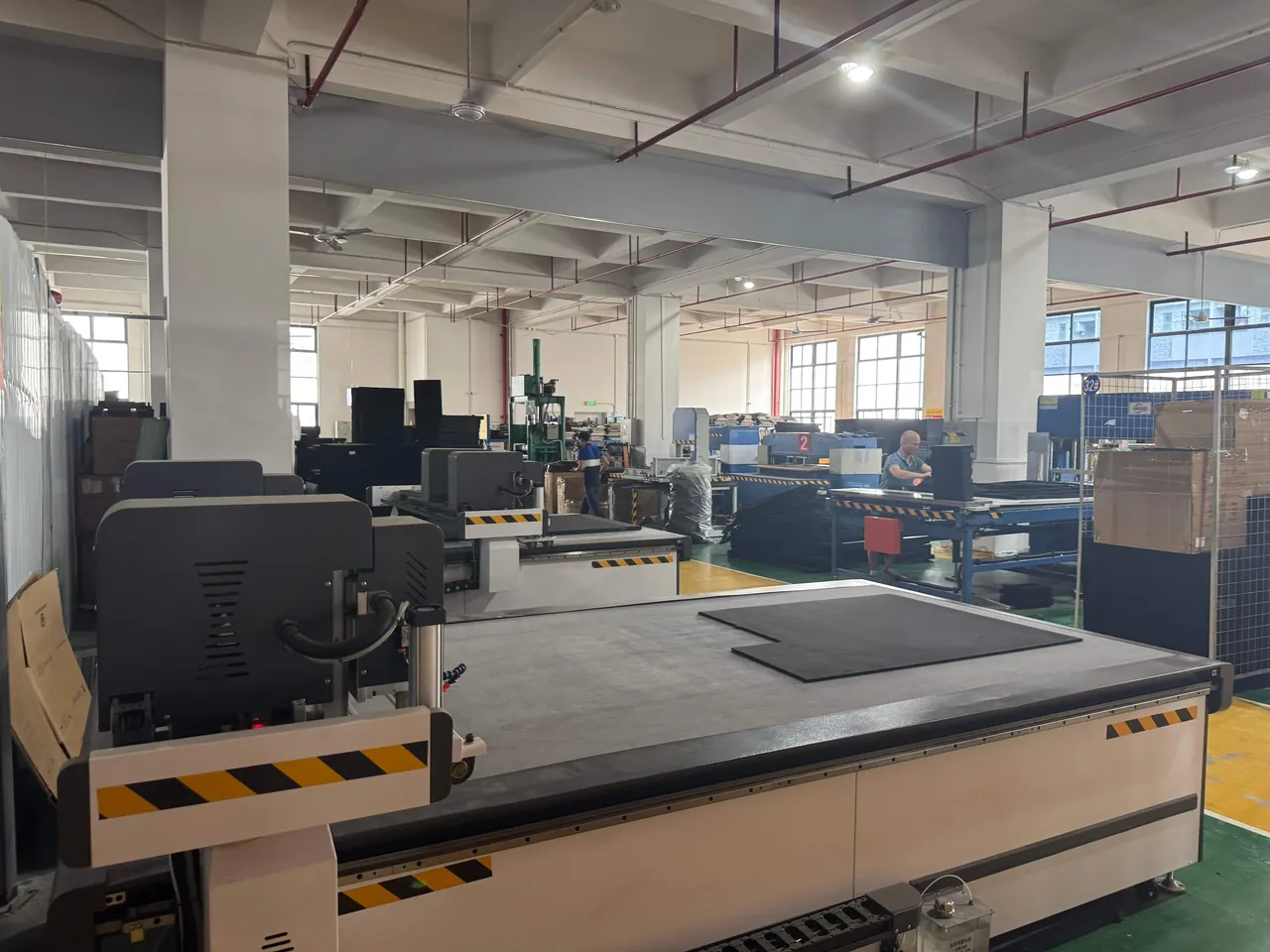
The packaging logic for refractory parts is the inverse of the metal approach: metal parts want structural rigidity, refractory parts want compliant restraint plus humidity isolation. Clamping refractory parts rigidly produces stress concentrations and corner loss.
A three-layer structure is recommended:
- Inner layer (contamination barrier): PE shrink film or moisture-proof paper, excluding dust and oil while keeping small debris out of the case.
- Middle layer (moisture barrier): aluminium foil composite film or a high-barrier vacuum bag, suppressing water vapour transmission. This layer decides whether moisture control succeeds.
- Outer layer (mechanical protection): paper corner guards, honeycomb board or a wooden pallet board, absorbing impact and distributing stacking loads.
For castable precast blocks, pay additional attention to the choice of pallet board. Under vibration the block frets against a hard board, so a thin foam or felt layer on the board is advisable. For irregular blocks, low-density foam can fill local voids, but filling never replaces the barrier layer.
Ceramic fibre modules need special handling. Long storage under compression degrades recovery, so modules should not be over-compressed at packing, and the case needs a clear "do not stack on top" mark. If they must share a case, place them uppermost with a rigid shell so that stacking pressure does not act directly on the fibre.
One more rule applies to refractory cases: do not mix refractories with different moisture sensitivity in one case. If lightweight insulating brick and dense firebrick share a case, their uptake rates differ widely, the desiccant is consumed preferentially by the former, and the dense brick ends up in a higher humidity environment than intended. Separate cases with separately sized desiccant charges are the more robust arrangement.
Desiccant Sizing and the Internal Humidity Budget
Desiccant is not a matter of throwing in a few sachets; it should be sized quantitatively. A simplified estimate is:
Required desiccant mass approximately equals (target water to be adsorbed) divided by (effective adsorption capacity)
The target water includes three components: free water introduced by packaging materials, water vapour permeating through the case wall and seals over the transport period, and moisture released by the goods and packaging themselves. The third term is usually the largest in a case containing refractory parts, and it is the reason many schemes fail.
The following experience intervals apply, based on silica gel and a 100 litre internal volume:
| Cargo type | Transport period | Suggested desiccant charge (experience value) | Humidity indication |
|---|---|---|---|
| --- | --- | --- | --- |
| Metal parts only, well sealed | 30 days | 200-400 g | Optional |
| Small refractory content, well sealed | 30 days | 500-800 g | Recommended |
| Refractory content, export ocean freight | 60 days | 1000-1500 g | Mandatory |
| Fibre products included | 60-90 days | 1500-2500 g | Mandatory, dual indicator cards |
Placement matters as much as quantity. Desiccant should hang or be fixed where internal air can reach it, typically in the upper part of the case, rather than being buried under the goods. For large volumes, distribute multiple points to avoid humidity stratification. Fit humidity indicator cards at internal corners and either provide an inspection window or apply a label stating "read the indicator card before opening". For deeper background, see protective case service life and replacement.
A high-value enhancement is to add a barrier inner bag. The bag shrinks the controlled volume from the whole case to the bag interior, letting the desiccant charge drop substantially while raising reliability. This matches the principle in IP rating logic for waterproof cases that permeation paths should be controlled before materials are upgraded.
Engineering Practice for Shock and Vibration Isolation
Mechanical loads on furnace components in transit come from four event classes: drop shock during lifting and placement, road-induced vibration, longitudinal shock during rail marshalling, and roll and slam in ocean freight. Their frequency and amplitude characteristics differ, so a single cushioning parameter cannot cover all four.
- Drop shock is a transient, high-acceleration event absorbed by compression of the cushioning material; the key is sufficient deflection travel with reserve remaining after compression.
- Road vibration is sustained and low amplitude, countered by limiting relative movement between part and liner, so contact friction and preload matter most.
- Longitudinal shock is high amplitude and unidirectional, carried by end stops and the case frame; the liner must not be the primary load path.
- Ocean roll is low frequency with large displacement, solved by overall restraint of contents and stacking stability, with a low centre of gravity being favourable.
Cushion curve selection should avoid both extremes. Too soft a cushion bottoms out on drop and transmits acceleration straight into the cargo; too hard a cushion cannot absorb energy effectively. For mixed loads with large weight differences, verify the cushion against the heaviest item, then give lighter items dedicated support instead of averaging.
For validation, the ISTA transport testing procedure series can be matched to the actual distribution mode, while domestic movements can combine the stacking, vibration and drop methods of the GB/T 4857 series. Where the contract requires it, the relevant methods in MIL-STD-810H environmental test compliance may be cited as an environmental test reference. Note that this is a reference to test methodology and not a military certification; applicability and tailoring should be agreed between the parties in the technical specification.
Test References: GB/T 2423, ISTA and MIL-STD-810H
Writing standard numbers into the technical specification is the step that turns protection from a subjective judgement into an acceptance criterion. The standards commonly applied to industrial furnace cases are:
- GB/T 4208 and IEC 60529: enclosure ingress protection (IP code) determination, defining dust and water capability.
- GB/T 4857 series: basic tests for transport packages, including stacking, vibration, impact and drop methods.
- ISTA series: transport test procedures selected by parcel, LTL, truckload or intermodal distribution.
- ASTM D4169: packaging performance testing based on a distribution cycle, suited to export projects with a defined logistics chain.
- MIL-STD-810H: environmental test methods applicable to high temperature, low temperature, humidity, vibration and shock, used as a verification basis for environmental suitability and not a military certification.
- GB/T 2423 series: environmental testing for electrical and electronic products, useful for separately qualifying the electrical items inside the case.
Three items should be explicit in the specification: the test method number and revision, the severity level (temperature, humidity, acceleration, duration), and the acceptance criteria covering permissible change in function, appearance and insulation resistance. Without acceptance criteria, a test report rarely supports acceptance.
For cases containing refractory parts, add a dedicated moisture content acceptance clause: sample and measure moisture content by the agreed method after unpacking, and treat any value beyond the limit as packaging failure. Such a clause is far more effective than visual descriptions such as "no water stains on the case surface".
Ocean Freight, High Humidity and Open Storage Yards
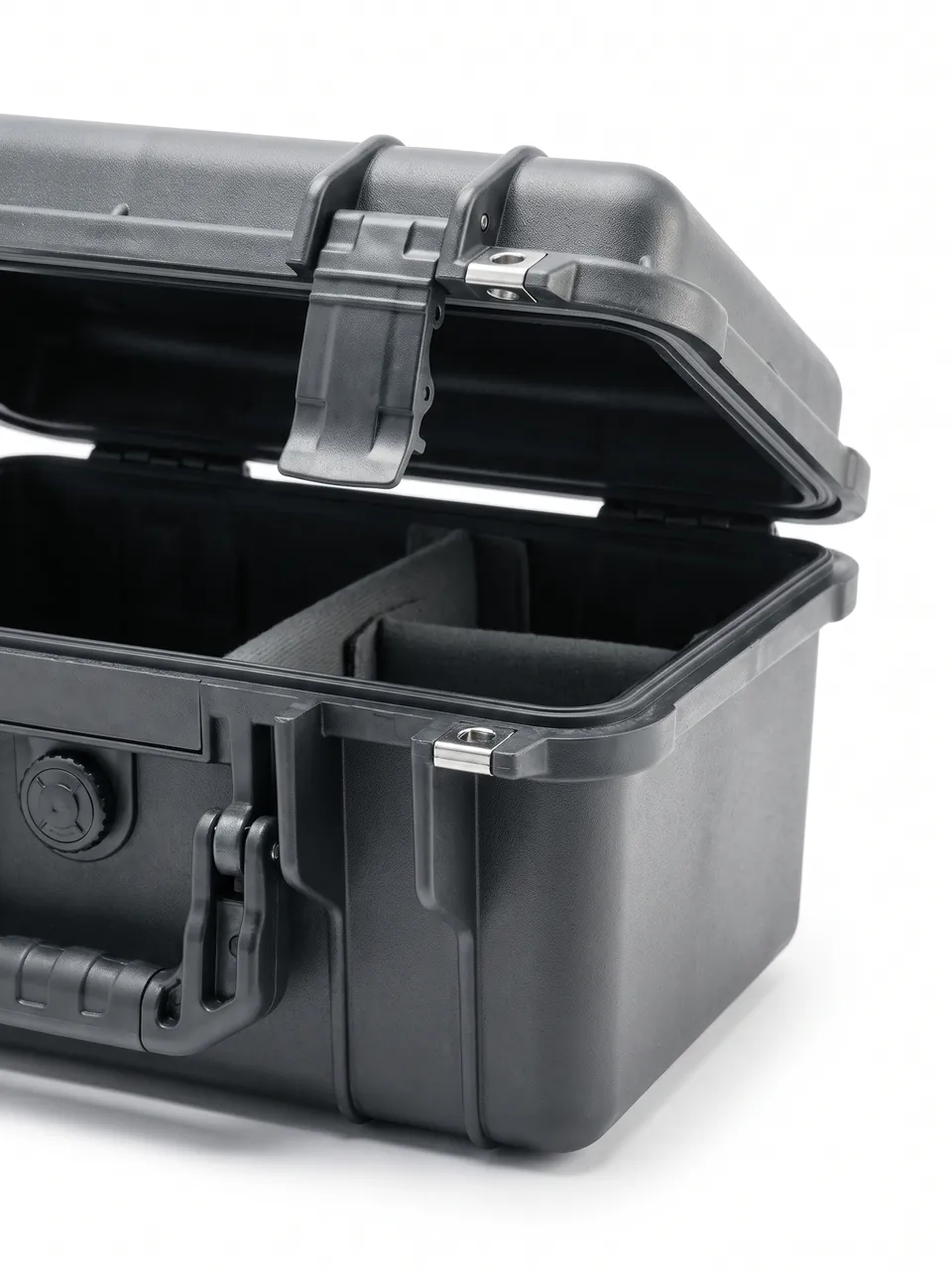
The most common failure in export projects does not occur in transit but during months of storage in an open or semi-open yard after arrival. The humidity load in that period can exceed the voyage itself, while the case is often at its most vulnerable because part of the outer packaging has been removed.
There are three layers of response. First, the case itself needs moisture headroom, meaning protection and desiccant sized for a longer period than the actual voyage. Second, a re-sealing clause should appear in the supply contract or site work instruction: after sampling inspection, the case must be closed exactly as before, with desiccant topped up and sealing-face protection renewed. Third, yard management: raise the case off the ground, keep it clear of walls, prevent water pooling on the top, and inspect the humidity indicator card periodically.
Temperature cycling is a separate concrete issue. The day-night differential makes internal pressure oscillate, so a sealed case repeatedly breathes. In regions with large diurnal swings this effect significantly accelerates moisture ingress. The answer is a pressure equalisation valve combined with a barrier inner bag, so that breathing occurs outside the bag while residual moisture inside is handled by desiccant.
In coastal high-salinity environments, corrosion protection for metal parts also deserves attention. If inner packaging uses sulphur- or chlorine-bearing materials, such as some recycled papers and low-grade foams, corrosive species are released under damp conditions. Require packaging material suppliers to confirm composition and corrosion test data, or state in the specification that packaging materials must be free of sulphur, chlorine and acidic substances.
Marking, Documentation and the Unpacking Acceptance Checklist
Marking is the only channel that carries packaging design intent to the site. Four categories are recommended for industrial furnace cases:
- Centre of gravity and lifting marks: a prominent centre-of-gravity mark, a chain symbol at lifting points, and a prohibition mark where forklift entry is not permitted.
- Stacking and orientation marks: per the GB/T 191 pictorial marking convention, including this way up, keep dry and stacking limit.
- Zone marks: each internal functional zone labelled at the corresponding position on the outer case so that contents are not mixed after opening.
- Traceability marks: case number, batch number, production date and a QR code for the item list, so overhaul projects can reconcile by equipment train.
Recommended documents travelling with the case include the packing list with item number, quantity, material and unit weight; a liner layout drawing for repacking; a desiccant dosing record and humidity indication note; and, where required, copies of material certification and inspection reports. For overhaul projects, a one-page recommended storage condition sheet stating temperature and humidity range and maximum storage duration is also useful.
A ready-to-use unpacking acceptance checklist follows:
| Check item | Judgement point | Action if non-conforming |
|---|---|---|
| --- | --- | --- |
| Case integrity | No puncture, no structural distortion, sealing faces intact | Record and photograph, then full unpack |
| Humidity indicator card | Has not reached the colour-change threshold | Retest moisture content of all refractory parts |
| Metal part appearance | No dents, no rust bloom, no scratches on sealing faces | Decide rework or replacement |
| Refractory appearance | No corner loss, no cracks, no caking | Assess concession by batch |
| Electrical insulation | Insulation resistance not below the agreed value | Dry and retest |
| Liner condition | No displacement, no collapse, no debris | Check whether parts contacted each other |
| Documentation | Packing list matches physical contents | Release to store only after completion |
Customisation, OEM Supply and Volume Delivery Workflow
Industrial furnace procurement is normally organised by equipment train, and burner sizes differ significantly between furnace types, so standard case types rarely cover the full range and customisation levels are high. A smooth workflow normally has five steps:
Step one, requirement confirmation. Provide 3D models or physical outline dimensions of the burner and refractory parts, unit weight, centre-of-gravity position, transport mode, storage duration and destination climate.
Step two, solution design. Issue the case structure drawing, liner layout, sealing and drying scheme, and the marking and documentation list. The solution should state explicitly which items share a case and which must be split.
Step three, prototyping and verification. Build a first article, run transport tests or physical loading trials as required, and confirm handling convenience and restraint reliability.
Step four, volume production and delivery. Number by batch and keep traceable records.
Step five, site support. Provide the liner repacking drawing and on-site storage advice, and align shipment pacing with the overhaul window where needed.
On the manufacturing side, production of this case family is undertaken by Kexin New Materials (Guangdong) Co., Ltd., which can arrange integrated delivery from structural design and liner forming through to volume supply, and supports OEM/ODM cooperation together with wholesale and agency distribution. Projects shipping into different climate zones can be configured with matching gasket and desiccant specifications, and where acceptance requirements apply, the relevant inspection documents and material statements can be provided under contract. For the general criteria used to assess a manufacturing partner, see how to choose a protective case OEM factory.
Frequently Asked Questions
Q: Can burners and refractory parts ship in the same case?
A: Yes, but only with explicit zoning rather than casual co-loading. The reason is that the two families need different humidity environments: actuators, ignition transformers and flame detectors on the burner need dry conditions, while refractory parts themselves release moisture for weeks after packing. If they share one humidity volume, the desiccant is consumed preferentially by the refractory and the metal zone ends up at a higher relative humidity than intended. The engineering approach is a rigid divider splitting the case into a metal precision zone, a refractory zone and an accessory and document zone. Each zone gets its own barrier layer and its own metered desiccant charge, and the divider must have an independent load path so that upper metal parts never bear on refractory below. If the internal volume is too small for proper dividers, split the shipment into separate cases rather than compromising both groups. Fibre products should always sit uppermost, because long-term compression reduces their thickness recovery and degrades the insulating performance of the finished furnace wall. Finally, mark each zone on the outer case so the contents are not mixed once the case is opened on site.
Q: What happens on site if refractory moisture content exceeds the limit after transport and storage?
A: The most direct consequence is a disrupted dry-out curve. A castable precast block with excess moisture releases water rapidly during heat-up, and if the heating rate has not been adjusted for the internal moisture level, steam cannot escape through the pore structure quickly enough. Internal pressure builds, and the result ranges from surface spalling to explosive failure of the block. Vigorous steam escape also carries fines out of the matrix, which permanently degrades both mechanical strength and insulating performance of the lining, so the loss is not limited to the damaged piece. Indirectly, the overhaul schedule extends because the site needs additional drying and pre-heat stages, and those often conflict with downstream activities and the planned return to production. Moisture content should therefore be written into the technical specification as a measurable acceptance criterion rather than judged visually from the outside of the case. After unpacking, sample and test by the agreed method, define a maximum storage duration and storage environment in the work instruction, and where damp storage cannot be avoided, retain the barrier layer and renew the desiccant periodically.
Q: Is IP67 enough to guarantee moisture protection?
A: Ingress protection addresses dust and the entry of sprayed or immersed water; it is not the same as long-term moisture resistance. Temperature cycling creates a differential pressure across a sealed case, so the case breathes repeatedly under day-night temperature swings, and external moisture progressively enters through gasket micro-gaps and by permeation through the wall material itself. Over a sixty-day voyage with large diurnal swings, that slow accumulation can be significant even though the case would pass a static immersion test on day one. For ocean freight or extended storage, three measures are normally stacked rather than chosen between: a dual gasket, a pressure equalisation valve, and an internal barrier bag with a metered desiccant charge. The bag greatly reduces the volume that needs humidity control, so the desiccant quantity falls while overall reliability rises, and the valve ensures that the pressure difference is equalised outside the bag instead of across it. For highly moisture-sensitive projects, fit a humidity indicator card inside and provide an inspection window in the outer case so the condition can be read without breaking the seal.
Q: Why is the burner air-damper linkage the most damage-prone part in transit?
A: Because it has a small bending section modulus and a large slenderness ratio, which makes it a classic slender rod that bends under longitudinal shock and sustained vibration. Rail marshalling and rough road sections are the usual triggers. Bending is often invisible on a visual inspection, so the defect only surfaces during commissioning, when the damper position disagrees with the servo actuator feedback and the combustion setup cannot be stabilised. By then the overhaul window is already running. The protective approach is two-way restraint rather than simple padding. A grooved cradle with a contour matching the rod limits lateral movement radially, end stops prevent axial travel along the case, and a mid-span support shortens the free span so the resonant response is less severe. Do not place the linkage immediately beside a heavy body casting, because any impact causes the casting to squeeze it. A rigid protective sleeve over the exposed rod section is worth adding, in a material softer than the rod surface so that it cannot itself scratch the plating.
Q: How should desiccant quantity be estimated so it is neither wasteful nor insufficient?
A: Work backwards from the water that must actually be adsorbed rather than dosing by case volume. The target water has three parts: free water carried in by packaging materials, water permeating through the case wall and gaskets over the transport period, and moisture released by the goods themselves, especially refractory parts. The third term usually dominates in a refractory case and is the reason so many schemes fail despite an apparently generous desiccant charge. Divide the total target water by the desiccant's effective capacity at the target humidity to obtain an approximate quantity, then apply a margin factor for the uncertainty in permeation and in the initial moisture of the goods. Placement matters as much as quantity: hang the desiccant or distribute it across several points where internal air can reach it, rather than burying it under the load where it only treats the bottom layer. Always pair the charge with a humidity indicator card so that protection status is judged from data rather than from the feel of the case.
Q: How should MIL-STD-810H be worded in a packaging technical specification?
A: Word it as an environmental test method reference and never as a certification. A sound formulation has three elements. First, the specific test method number being cited, since the standard contains many methods and citing the document alone is ambiguous. Second, the severity level, expressed concretely as temperature range and dwell time, humidity conditions, vibration magnitude and duration, and shock acceleration in multiples of gravitational acceleration. Third, the acceptance criteria, covering the permissible change in function, appearance, sealing integrity and insulation resistance after the test sequence. Also state explicitly in the specification that the citation serves as an environmental suitability verification basis and does not constitute a military certification or a claim of military standard compliance. Where no environmental test is required, GB/T 4857 series methods or ISTA procedures can substitute, selected to match the real logistics chain rather than a generic profile. Method selection and any tailoring should be agreed with the supplier and frozen in the specification before production.
Q: What should be observed when goods must be stored for a period before installation?
A: The priority is keeping the original protection effective rather than repacking later. First, avoid opening the whole case. If sampling is genuinely necessary, reseal it exactly as before afterwards, top up the desiccant and renew any sealing-face protection that was removed. Second, store the case raised off the ground and clear of external walls, with no possibility of water pooling on the lid, and never exceed the stacking limit marked on the side wall, since exceeding it is a common cause of liner collapse in the upper case. Third, read the humidity indicator card on a regular schedule and act immediately when the colour-change threshold is reached, normally by replacing the desiccant and drying the sensitive items in a controlled oven. Fourth, do not leave fibre refractory parts under compression for long periods; if anything is stacked above them, plan the adjustment before the recovery loss becomes permanent. Fifth, log ambient temperature and humidity through the storage period so that dry-out planning rests on real data rather than assumption.
Q: If a mixed load contains items of very different weight, which item governs cushioning design?
A: The heaviest item governs verification of the cushion's load capacity and deflection behaviour, and lighter items then receive their own support and restraint rather than being averaged into one soft generic layer. Cushion compression depends directly on the load applied, so a cushion sized for a light item bottoms out under the heaviest item, losing all remaining deflection travel and transmitting shock straight into the cargo. Conversely, a cushion sized for the heavy item is too stiff for a light one to compress usefully, but light items normally have low inertial loads and are better served by rigid support and positive restraint than by extra compliance. In practice, place heavy items toward the bottom close to the case structural load paths, put light items above with independent restraint, and let end stops carry longitudinal shock so that the liner never becomes the primary load path. Verify the final arrangement with a physical loading trial before committing to volume production.
Q: Can one case type serve burners of different furnace models?
A: To a useful degree, yes, but the flexibility should live in the liner rather than in the case itself. A common approach fixes a family case outline and sealing structure, which simplifies volume production, stacking stability and transport planning, while the liners become interchangeable modules for different burner models, located on the base by pins or slots for quick changeover without tools. One case family can then serve several furnace models across a plant, and the site never substitutes loose filling material for a properly formed liner. After any liner change, re-verify the centre-of-gravity position and lifting direction, and update the outer marking accordingly, since the original mark may no longer be accurate. If the models differ greatly in weight and envelope, still split the case family by weight band rather than spanning too wide a load range with a single design. Doing so keeps the cushion verification valid and preserves the intended protection margin for every variant in the family.
Conclusion and Related Reading
The design quality of an industrial furnace case is finally judged at the moment of unpacking: is the burner sealing face intact, does the damper still turn freely, are the refractory edges complete, and is the internal humidity indicator still in the safe zone? Decomposing those four questions during the design phase into zoning, barriers, metered drying and verification testing converts a transport outcome that used to depend on luck into a controlled engineering process. Select the protection level from the transport mode and storage duration first, then design the liner around the weight spread and fragility distribution, and close the loop with standard tests and acceptance clauses.
Related Reading