

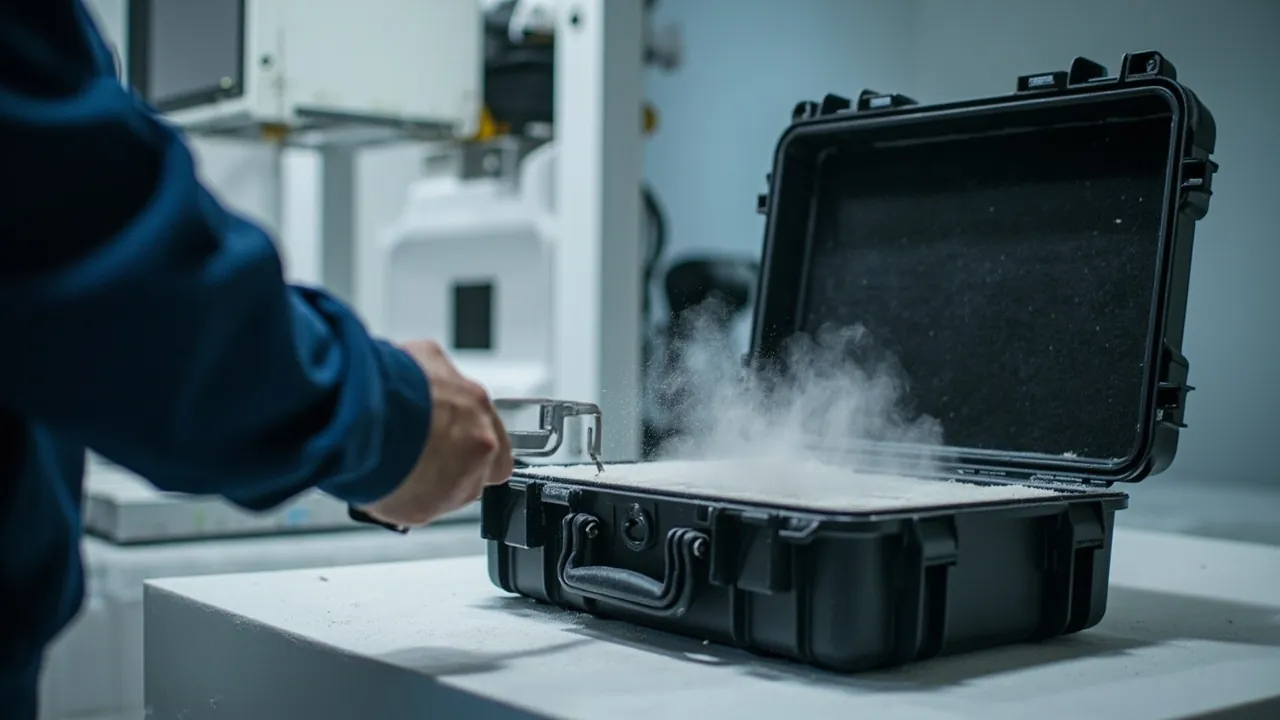
The core value of a metal 3D-printing powder storage case is that it locks three distinct risks into one manageable, traceable and transportable sealed unit: combustible dust explosion, moisture-driven oxidation, and cross-contamination between powder grades. The short answer: a compliant powder storage case is not "a sturdier drum." It is a system built from a flame-retardant antistatic shell, a bonded grounding path, a controlled breather valve, an inerting port and a purpose-made insert. Acceptance should be based on ATEX combustible dust zoning, IEC 60529 / GB/T 4208 ingress protection ratings, and transport test methods such as GB/T 4857 and ISTA.
For sites running laser powder bed fusion (LPBF), electron beam melting (EBM) or binder jetting (BJ), the powders most often handled include Ti-6Al-4V, AlSi10Mg, nickel-based superalloys, and the more reactive pure titanium and magnesium alloys. All of them combine a meaningful dust explosion hazard with a strong tendency to absorb moisture. Particle size typically falls between 15 and 60 micrometres, which means high specific surface area and high surface energy. The moment powder is sieved, reclaimed or poured in an open area, the operator faces ignition sources, static accumulation and humidity ingress at the same time. This article is written for additive manufacturing engineers, EHS managers and procurement specialists. It covers structural selection, parameter boundaries, standards references and an acceptance checklist, so that powder safety becomes deliverable hardware rather than a verbal procedure.
Table of Contents
- 1. Why Metal Powder Is Dangerous: The Physics of Combustible Dust
- 2. The Compliance Framework: ATEX, NFPA and Combustible Dust Rules
- 3. The Five Core Functions of a Powder Storage Case
- 4. Moisture and Oxidation Control: From Water and Oxygen Content to Dew Point
- 5. Choosing an IP Rating: IP65, IP67 and Real-World Differences
- 6. Static Control and Ignition Source Management: Bonding and Grounding
- 7. Inerting Ports and Pressure Equalisation Valves
- 8. Inserts and Containers: Locating, Stabilising and Swapping Powder Drums
- 9. Capacity Grades and Stacking Design: From 5 kg to 200 kg
- 10. Shell Materials, Flame Retardancy and Antistatic Performance
- 11. Transport Compliance: UN Packaging, GB/T 4857 and ISTA
- 12. Cleaning and Powder Changeover: Controlling Cross-Contamination
- 13. Site Management: Zoning, Labelling and Record Keeping
- 14. Procurement and Acceptance: AQL Sampling and Shipping Documents
- 15. Common Misconceptions and Engineering Recommendations
- Frequently Asked Questions
- Conclusion and Further Reading
1. Why Metal Powder Is Dangerous: The Physics of Combustible Dust
A dust explosion requires five conditions at the same time: combustible dust, an oxidiser (oxygen in air), an ignition source, a dust cloud (suspended particles), and a confined space. Metal powder makes it far easier to satisfy all five than most people assume.
Take titanium powder. The minimum ignition temperature of a dust cloud often sits in the 400 to 500 degrees Celsius range, while the minimum ignition temperature of a dust layer sits in the 200 to 300 degrees Celsius range. That means a component that has just been removed from a build chamber, still warm on the surface, can ignite settled powder. Aluminium powder is more violent still; its maximum explosion pressure and rate of pressure rise (the Kst value) are among the higher bands in metal dusts, and common classification places it in St 2 or even St 3.
There are three key engineering consequences.
First, settled dust is more dangerous than suspended dust. A layer of powder on the floor, on top of equipment, or on a cable tray looks harmless. But a single disturbance can form a high-concentration cloud, and if a still-hot ignition source is present, a primary explosion follows. That primary event lofts more settled dust, producing a secondary explosion that is usually more destructive. A storage case must therefore be a closed unit, not an open tote.
Second, smaller particles mean higher risk. Powder used in additive manufacturing is repeatedly sieved and reclaimed, so the proportion of fines below 20 micrometres gradually accumulates. More fines means lower minimum ignition energy and a lower explosion limit.
Third, reactive metals are more sensitive. Titanium, magnesium, aluminium and aluminium-bearing titanium aluminides (TiAl) are all more sensitive to moisture and friction sparks. In some situations, contact between powder and water does not improve safety at all; it can generate hydrogen. This is why water is a prohibited extinguishing medium in metal powder areas.
From these facts the first design principle follows: keep the powder enclosed in a flame-retardant, antistatic, pressure-relievable and inertable container, and ensure the operator never has to leave powder exposed in an open space for long periods.
2. The Compliance Framework: ATEX, NFPA and Combustible Dust Rules
A powder storage case is not a "military-certified product." Its design basis belongs to the explosion protection and dangerous goods framework. The following reference systems appear most often in engineering practice.
The European ATEX framework has two parts. ATEX 137 (Directive 1999/92/EC) governs the employer's assessment and zoning of explosive atmospheres. ATEX 114 (Directive 2014/34/EU) governs the equipment itself. In zoning terms, dust atmospheres are divided into Zone 20 (a dust cloud present continuously or for long periods), Zone 21 (occasional during normal operation) and Zone 22 (not normally present, and only briefly if it occurs at all). A powder storage case is usually required to satisfy the requirements applicable to Zone 21 or Zone 22 depending on its position in the production area. If opening the case creates a dust cloud, the interior should be treated as Zone 20, and grounding and antistatic measures must be selected accordingly.
In North America, NFPA 652 (fundamentals of combustible dust) and NFPA 484 (combustible metals) are commonly referenced. NFPA 652 requires a dust hazard analysis (DHA) to establish Kst, Pmax, minimum ignition temperature, minimum ignition energy (MIE) and the explosion limit, and then to design protection measures from that data. NFPA 484 adds detailed chapter-level requirements for reactive metals such as titanium, zirconium and magnesium, including prohibitions on water-based extinguishing, strict limits on wet collection, and dedicated storage and transfer rules.
In China, combustible dust safety regulations for industrial and trade enterprises impose housekeeping, zoning, temperature control, static protection and training requirements on sites handling explosive dusts. Dangerous chemicals management regulations and dangerous goods transport rules govern packaging and marking when powder moves between sites. If powder is shipped as dangerous goods, the packaging must pass performance tests under UN packaging requirements.
One boundary must be stated clearly: ATEX directives apply to electrical and non-electrical equipment with CE marking and category classification. A storage case is a non-electrical container and in most scenarios forms part of the explosion atmosphere control measures rather than being classified as typical Ex equipment. When purchasing, request the material flame retardancy rating (UL94), surface or volume resistance test data, IP rating test reports and transport test reports, and retain these documents as inputs to the DHA.
| Framework | Applies to | Relationship to this topic | Typical deliverable |
|---|---|---|---|
| --- | --- | --- | --- |
| ATEX 137 (1999/92/EC) | Employer's explosion risk assessment and zoning | Determines whether the storage area is Zone 21 or Zone 22 | Area classification drawing, DHA report |
| ATEX 114 (2014/34/EU) | The equipment itself | Fans, lighting and sensors inside the case must meet the relevant category | Component CE / Ex certificates |
| NFPA 652 | Fundamentals of combustible dust management | Requires baseline data such as Kst, Pmax, MIE and MIT | Dust characterisation test report |
| NFPA 484 | Combustible metals | Storage, transfer and extinguishing restrictions for titanium, magnesium, aluminium | Dedicated operating procedure |
| GB/T 4208 / IEC 60529 | Enclosure ingress protection | Defines dust and water capability (IP65 / IP67) | Third-party IP test report |
| GB/T 4857 / ISTA | Transport packaging testing | Verifies case and stacking reliability in transit | Vibration, drop and stacking test reports |
3. The Five Core Functions of a Powder Storage Case
Breaking "explosion-proof storage case" down into verifiable functional modules is the most effective way to avoid procurement mistakes. A complete system should provide all five of the following capabilities.
First, containment and dust retention. With the lid closed, there should be no escape path for powder. Every opening, including the lid joint, breather valve, inerting port and handle mounting holes, needs its own seal. Gasket material must be chemically compatible with the powder so that it does not crack or harden after prolonged contact.
Second, antistatic behaviour and a groundable path. The surface resistance of the shell and insert should sit in the static-dissipative range, and the exterior should include a defined grounding point or stud so that the operator can equalise potential before opening the case.
Third, controlled relief and pressure equalisation. A sealed case develops a pressure differential whenever temperature, ambient pressure or inert gas fill changes. Long-distance transport involving gradients, air freight and hot summer cargo spaces all shift internal pressure significantly. Without an equalisation mechanism, gaskets deform or the case bulges, and opening the case then produces a sudden pop or a suction effect. The engineering answer is a shielded breather valve or pressure equalisation valve.
Fourth, inerting capability. For highly reactive powders, the case interior can be purged with nitrogen or argon to bring oxygen content below a safe threshold, removing both oxidation and combustion conditions at the source. The inerting port should include a check valve and a quick connector so that on-site cylinders or a central gas supply can be used easily.
Fifth, inserts and containment structure. Powder normally sits inside an original metal drum or a dedicated canister, and the storage case carries that container. The insert limits container movement, absorbs shock and prevents drum-to-drum contact that could generate sparks, while also supporting ergonomic handling by hand or forklift.
In this product family, the JUNZHJIA approach is to treat these five capabilities as configurable modules. Customers select whether an inerting port is needed, which breather valve specification applies and how firm the insert should be, based on powder type and site zoning. Kexin New Materials (Guangdong) Co., Ltd. then matches the structure to the customer's drum model and provides the corresponding test documents.
4. Moisture and Oxidation Control: From Water and Oxygen Content to Dew Point
Moisture absorption by metal powder is not simply a matter of caking. For titanium and aluminium alloy powders, water vapour and hydroxyl groups adsorbed on the surface cause three problems: reduced flowability, producing streaks and voids in the recoated layer and directly affecting as-built density; increased oxygen content, which changes melt pool viscosity and increases spatter and balling tendency; and out-of-specification oxygen in the finished part, which reduces ductility and introduces variability in fatigue performance.
Moisture control design should therefore revolve around two measurable quantities: relative humidity (RH) inside the case and dew point. A commonly used tiered framework looks like this.
| Target tier | Internal relative humidity | Approximate dew point at ambient pressure | Suitable scenario | Typical implementation |
|---|---|---|---|---|
| --- | --- | --- | --- | --- |
| Basic protection | 45 percent RH or below | Above roughly +6 degrees Celsius | Short-term transfer, aluminium-silicon powders | Seal plus desiccant sachet |
| Standard protection | 25 percent RH or below | Above roughly minus 4 degrees Celsius | Routine titanium alloy storage | Seal plus replaceable desiccant cartridge plus humidity indicator card |
| Enhanced protection | 10 percent RH or below | Above roughly minus 12 degrees Celsius | Reactive metals, long-term sealing | Seal plus inerting plus desiccant plus humidity logger |
| Long-term preservation | 5 percent RH or below | Above roughly minus 18 degrees Celsius | High-value powders, seasonal storage | Double sealing plus continuous inerting plus data logging |
Note that relative humidity is highly temperature sensitive. The same absolute moisture content can produce readings that differ by more than ten percentage points between 20 and 35 degrees Celsius. Relying on a humidity indicator card alone is therefore misleading. The case should record both temperature and humidity, or record dew point directly. For high-value powder, place a single-use temperature and humidity logger inside the case so that it travels with the powder. When the case returns, the curve can be read and used as quality traceability evidence.
Desiccant selection also matters. Silica gel suits general absorption but has limited capacity and needs frequent regeneration. Molecular sieve performs better at low humidity and suits enhanced protection. Montmorillonite clay is inexpensive but less efficient. Desiccant must never contact the powder directly; it belongs in a separate vapour-permeable bag or cartridge so that powder and desiccant particles cannot contaminate each other. This point is especially important in workshops that handle several powder grades.
5. Choosing an IP Rating: IP65, IP67 and Real-World Differences
IEC 60529 and GB/T 4208 define ingress protection using two digits. The first digit covers protection against solid foreign objects and dust; the second covers protection against water. Common levels include IP5X (dust protected; limited ingress that does not affect function), IP6X (dust tight; no dust ingress), and, for the second digit, 5 (protected against water jets), 6 (protected against powerful water jets), 7 (protected against temporary immersion) and 8 (protected against continuous immersion).
| Rating | Dust capability | Water capability | Fit for powder storage | Notes |
|---|---|---|---|---|
| --- | --- | --- | --- | --- |
| IP54 | Partial dust protection | Splash resistant | Dry, clean indoor transfer only | Not recommended for long-term storage |
| IP65 | Dust tight | Water jet resistant | Routine in-plant storage, hosing of the exterior | Most common cost-effective choice |
| IP66 | Dust tight | Powerful water jet resistant | Sites with washdown or steam cleaning | Higher gasket compression required |
| IP67 | Dust tight | Temporary immersion | Outdoor transfer, rainy loading, cold chain | Requires pressure equalisation design |
| IP68 | Dust tight | Continuous immersion | Rarely used for powder storage | High cost and ergonomic penalty on opening |
Three engineering details deserve emphasis.
First, an IP rating is a result under as-shipped conditions. Once users repeatedly open and close the case, once gasket surfaces pick up powder particles, and once latch pressure decays, actual protection falls noticeably. Insert and sealing design must therefore prevent powder from reaching the sealing face. A common solution is a dust lip outside the gasket groove, or a removable cleaning ring at the case mouth.
Second, IP67 and pressure equalisation are in natural tension. A fully airtight case develops a pressure differential under temperature change, and over time the gasket can be drawn into the case. The answer is not to abandon the high rating but to use a breather valve with a hydrophobic membrane, so gas passes while liquid water and dust do not.
Third, dust-tightness is not the same as preventing an explosive dust cloud from escaping. IP6X means dust struggles to get in, but a powder storage case must also keep internal dust from getting out. Both directions require the sealing structure and the handling procedure to work together. For structural detail on this, see the JUNZHJIA technical note on case seal materials and sealing structures.
6. Static Control and Ignition Source Management: Bonding and Grounding
Static discharge is one of the most frequent ignition sources in dust explosion incidents, and in metal powder environments it is significantly amplified. Powder acquires charge through friction during pouring, sieving and pneumatic conveying. If that charge cannot drain away, it accumulates on the container surface and on the operator's body, eventually producing a spark discharge.
Static control is an engineering practice with three layers.
Layer one: materials. The shell surface and the insert should be static-dissipative. Antistatic modified PP, antistatic PE, conductive EVA and conductive PE foam can all bring surface resistance into the 10^4 to 10^6 ohm range or the 10^6 to 10^9 ohm range. Note that "antistatic" and "conductive" are not synonyms. Antistatic materials prevent charge accumulation; conductive materials provide a drainage path. Powder applications generally want the insert to be conductive or static-dissipative and to be bonded to the metallic parts of the case.
Layer two: bonding. The insert, the drum support and the metal case parts need reliable electrical bonding. If the insert floats in isolation, even a conductive insert has nowhere to send its charge. Design should include a bonding point or conductive pad between the insert and the metal panel.
Layer three: grounding. The exterior should provide a defined grounding terminal, and the procedure should require grounding before opening. Where many cases are stored side by side, a grounding bus can link all cases and connect to the site grounding network.
Ignition source control also includes prohibiting non-explosion-protected power tools in the storage area, prohibiting metal tools that can strike sparks against powder drums, controlling internal temperature by avoiding direct sunlight and heat sources, and allowing sufficient settling time before opening so that suspended fines can fall. For related structural thinking, see JUNZHJIA's discussion of ESD shielding case design.
7. Inerting Ports and Pressure Equalisation Valves
Inerting is one of the most direct ways to suppress combustion in metal powder. Reducing internal oxygen content well below ambient air removes the combustion condition for a dust cloud. In practice, an inerting system contains four elements: a gas supply connection, an inlet valve, an outlet valve (or breather valve), and an oxygen measurement point.
Choosing a purge method. There are two common approaches. The first is vacuum and refill cycling, which is efficient but requires the case to withstand negative pressure. The second is continuous sweep, which is structurally simple and demands less of the case but consumes more gas. For most storage scenarios, continuous sweep with a check valve is sufficient. For long-term preservation, a vacuum and refill cycle followed by maintenance of slight positive pressure is recommended.
Maintaining slight positive pressure. Holding 0.5 to 2 kPa of internal positive pressure continuously blocks moist outside air from seeping in, and it makes any seal defect show up as an outward leak rather than an inward draw. Because powder must not be discharged to the environment with the gas, the exhaust path needs filtration, usually a high-efficiency element selected for the specific powder so that fines cannot penetrate.
The role and selection of a pressure equalisation valve. A pressure equalisation valve, often called a breather valve or relief valve, lets internal pressure follow ambient changes while a hydrophobic and oleophobic membrane blocks liquid water and dust. Selection should consider the opening differential pressure in pascals, the flow rate in litres per minute or cubic metres per hour, membrane compatibility with the powder, and whether the valve body can be removed for cleaning. Once a valve body is clogged with fines, the case degenerates into a sealed can and the pressure differential risk returns. This component is discussed in more detail in the role and selection of case pressure equalisation valves.
Safety note. After inerting, the interior of the case is a low-oxygen environment. Personnel must not put their heads inside. Before opening, confirm that oxygen content has recovered or follow the ventilation procedure. This point appears repeatedly in nitrogen-related incidents and should be stated permanently on the case itself.
8. Inserts and Containers: Locating, Stabilising and Swapping Powder Drums
Powder is rarely poured directly into a case. It goes first into a metal drum, a plastic canister or the original powder bottle, and the storage case carries that container. Insert design therefore has three objectives: limit movement, isolate shock, and make loading and removal easy.
A comparison of common insert approaches.
- Moulded EVA inserts. Die-cut or thermoformed to follow the drum contour, with good vibration damping and consistent dimensions, well suited to volume production. The trade-off is tooling cost, and any change in drum specification requires redesign.
- PU foam inserts. Pour-in-place or moulded foam wraps complex shapes well and accommodates irregular drums, but it demands tight process control, and the wrong density produces an insert that is too hard.
- PE foam build-ups. The lowest cost and most flexible option, suitable for high-mix low-volume work, but compression set reduces resilience over time and the drum can work loose.
- Adjustable divider systems. Movable dividers and slots accommodate different drum diameters in one case, which suits mixed specifications, but damping is weaker than with a moulded insert.
Two further requirements apply to drum retention: tip-over prevention and rotation prevention. A drum that tips during transport delivers impact to the lid and can cause seepage, while rotation makes charge-carrying powder churn more inside the drum. A bottom locating recess combined with a top pressure plate addresses both at once.
For further engineering detail and cost trade-offs, see custom foam insert solutions and moulding processes and the EVA foam insert customisation process.
9. Capacity Grades and Stacking Design: From 5 kg to 200 kg
Case capacity should match real powder throughput. Oversized cases hold powder under pressure for long periods, and although the case is opened less often, each exposure lasts longer. Undersized cases require frequent opening, which increases the number of opportunities to disturb dust.
| Grade | Typical payload | Suitable scenario | Handling method | Structural focus |
|---|---|---|---|---|
| --- | --- | --- | --- | --- |
| Small | 1 to 5 kg | R and D builds, precious metal powders | Carrying by hand | One-hand opening, built-in desiccant cartridge |
| Medium | 5 to 25 kg | Routine production powder changes | Hand carry plus shoulder strap | Dual latches, pressure equalisation valve |
| Large | 25 to 80 kg | Bulk reclaimed powder | Dual side handles or trolley | Thicker walls, ribs, inerting port |
| Heavy | 80 to 200 kg | Central storage, inter-site transfer | Forklift or pallet | Base locating recess, stacking stops, UN packaging structure |
Stacking design has to satisfy two competing goals at once: stacking upward to save space, and preventing lower cases from carrying excessive static load that deforms the sealing face over time. The engineering answer is a stacking stop that routes load through structural columns of the shell rather than through gaskets or the lid. Where external shipment is required, verify vibration, impact and stacking performance under GB/T 4857 transport packaging testing and ISTA transport test procedures, confirming that cases do not deform and seals do not fail at the worst stacking layer.
10. Shell Materials, Flame Retardancy and Antistatic Performance
A powder storage case shell must balance six factors: strength, flame retardancy, antistatic behaviour, chemical resistance, weight and cost. The common material families perform as follows.
| Material system | Typical flame retardancy | Antistatic approach | Strengths | Limitations |
|---|---|---|---|---|
| --- | --- | --- | --- | --- |
| Modified PP hard shell | Can reach UL94 V-2 or V-0 | Antistatic masterbatch | Good chemical resistance, moderate cost, easy to mould | Low-temperature brittleness, antistatic performance decays |
| Modified PE hard shell | Usually HB, needs modification | Conductive carbon black | Tough, good low-temperature behaviour | Mechanical properties drop after flame retardant modification |
| ABS composite shell | Can reach UL94 V-0 | Surface coating or masterbatch | Good surface finish, dimensional stability | Moderate solvent resistance |
| Glass-filled nylon | Can reach UL94 V-0 | Conductive filler | High strength and stiffness | Higher moisture absorption, higher cost |
| Aluminium or stainless steel | Non-combustible (Class A) | Inherently conductive | Non-combustible, thermally conductive, shielding | Heavy, costly, potential friction sparks |
When reading UL94, remember that it tests the burning behaviour of a plastic material, not the fire performance of an assembled case. UL94 V-0 means a vertical specimen self-extinguishes within 10 seconds with no flaming drips that ignite cotton; HB is a lower grade. In powder storage, UL94 V-0 is the more defensible starting point, particularly where a dust cloud may briefly exist inside the case during opening.
It is worth noting that although an aluminium alloy shell is non-combustible and naturally conductive, it can produce friction sparks when struck against steel structures or tools. In reactive metal powder areas, aluminium shells and aluminium tools should be evaluated carefully, and some company DHAs conclude that bare aluminium components should be avoided in powder handling zones.
Antistatic performance decays with time and environment. Surface-migrating antistatic agents typically lose effectiveness within months to two years, while conductive filler systems (carbon black, carbon fibre) are more stable but change colour and mechanical properties. Specifications should state both the initial antistatic target and durability requirements, and suppliers should provide re-test data after ageing.
11. Transport Compliance: UN Packaging, GB/T 4857 and ISTA
When powder must move between sites or be exported, the problem expands from storage to dangerous goods packaging. The transport classification of metal powder depends on the specific metal, particle size distribution, whether it has been passivated, and the requirements of each jurisdiction. Titanium and aluminium powders are classified as flammable solids or water-reactive substances in many regulatory systems and require UN packaging selected to the corresponding packing group.
Key compliance points in practice:
- Packaging performance testing. UN packaging must pass drop, stacking and, where applicable, airtightness tests and obtain a packaging performance certificate. If the storage case serves as outer packaging, it must be verified along this path.
- Marking and labels. Dangerous goods packaging requires correct UN markings, packing group identification and hazard labels, and label positions must not be blocked by handles, latches or stacking stops.
- Modal differences. Sea, air and road transport operate under different rule sets (IMDG, IATA, ADR and others) with different limits and documentation requirements. Classification should be confirmed before booking any cross-border shipment. For a general framework, see ADR and IMDG hazmat transport case compliance.
- General transport reliability. Even outside dangerous goods rules, the case and insert should pass vibration, drop and stacking tests confirming that drums do not shift and do not leak. GB/T 4857 and ISTA methods can be used here.
One compliance boundary bears repeating: in this context MIL-STD-810H is used only as a reference for environmental test methods, such as temperature, humidity, vibration and shock procedures. It does not mean the product holds any military certification, and it does not replace explosion protection or dangerous goods regulations. Procurement wording should be precise and should avoid turning "tested with reference to a method" into "certified to a standard." For more, see MIL-STD-810H environmental testing and case compliance.
12. Cleaning and Powder Changeover: Controlling Cross-Contamination
Changeover is the most failure-prone step in a powder workshop. Mixing different grades, different particle size fractions, or even different batches of the same grade produces compositional drift in the printed part, and that drift is often discovered weeks later.
A recommended changeover sequence, per case:
- Preparation. Confirm that the powder inside has been logged. Prepare dedicated cleaning tools (non-metallic and antistatic is preferable), desiccant, new gaskets and disposable gloves.
- Grounding and opening. Connect the ground first, then open the case in a clean environment away from strong air currents.
- Recovery. Recover powder into the designated drum using dedicated tools and avoid spillage. Spilled powder must not be blown with compressed air; use explosion-protected vacuum equipment. Note that wet vacuuming is generally prohibited for reactive metals.
- Cleaning. Work from top to bottom and inside to outside across the case walls, insert, gasket groove and breather valve. Fines trapped in the gasket groove are the leading cause of seal failure and require dedicated attention.
- Inspection. Check gaskets for cracks, permanent set or embedded powder; check the insert for compression marks and damage; check the breather valve for free flow.
- Rebuild. Replace the desiccant, insert a fresh humidity indicator card and logger, and replace gaskets if needed.
- Record. Log the changeover time, powder grade, batch number, case number and operator.
General cleaning principles are covered in protective case cleaning and maintenance. A quarterly gasket inspection plus a quick check at every changeover is a practical baseline, with gaskets held in spare parts inventory and included in a replacement plan.
13. Site Management: Zoning, Labelling and Record Keeping
Beyond hardware, management practice determines long-term safety performance.
Zoning. Powder storage should be separated from ignition sources, heat sources, oxidisers and flammable solvents, and kept at an appropriate distance from printing equipment so that radiant heat does not raise internal temperature. The area should be well ventilated, but strong air currents should not blow directly across an open case.
Labelling. Every case should carry clear permanent identification covering powder grade, main composition, particle size range, batch number, filling date, case number and hazard prompts such as combustible dust, avoid inhalation, and do not extinguish with water. Labels should be in the languages used by site personnel.
Records. The log should follow the powder life cycle: receipt, opening, use, recovery, cleaning, sealing and disposal. For reactive metal powders, oxygen or water-and-oxygen analysis spot results should also be recorded.
Training. Run at least one dedicated combustible dust training session per year, covering the five elements of a dust explosion, the test data conclusions for the site's own powders, extinguishing prohibitions, emergency egress and reporting.
Emergency preparedness. Define the response principles for metal powder fires: use Class D metal fire extinguishing media or dry sand, and never use water. Provide appropriate extinguishing equipment and inspect it on schedule, and define evacuation routes for personnel exposed to a dust cloud.
14. Procurement and Acceptance: AQL Sampling and Shipping Documents
The most common procurement error is evaluating only the shell and ignoring the system. The specification should state the following items, and each should be verified on delivery.
Recommended technical documents shipped with the case:
- UL94 flame retardancy test report or material certificate for the shell material
- Surface resistance or volume resistance data for the insert material
- Full-case IP rating test report where IP65 or IP67 is claimed
- Transport reliability test report covering vibration, drop and stacking, with reference to GB/T 4857 or ISTA
- Gasket material description and chemical compatibility statement
- Opening differential pressure and flow data for the pressure equalisation or breather valve
- Grounding terminal location drawing and grounding resistance requirement
- Operating manual covering opening, cleaning, changeover and inerting procedures
On-delivery inspection points:
| Check item | Method | Acceptance point |
|---|---|---|
| --- | --- | --- |
| Appearance and dimensions | Visual inspection plus gauges | No sharp edges, no sink marks, continuous gasket groove without gaps |
| Latches and hinges | Open and close cycles (50 to 200 recommended) | Smooth action, no latch pressure decay, no abnormal noise |
| Sealing | Water spray or immersion test according to the IP rating | No leakage, internal indicator card unchanged |
| Grounding continuity | Multimeter measurement of bonding resistance | Resistance from insert support to grounding terminal within the set threshold |
| Insert fit | Load the actual drum | No drum movement, no hard-point compression marks |
| Breather valve | Slight positive and negative pressure test | Opening differential within design range, no blockage |
For volume procurement, introduce an AQL sampling plan and apply tightened sampling to critical characteristics such as sealing, latch durability and grounding continuity. For the methodology, see case acceptance and AQL sampling plans.
15. Common Misconceptions and Engineering Recommendations
Misconception one: "IP67 is always better than IP65." A higher rating means tighter sealing and greater opening effort. In routine indoor transfer, the additional benefit of IP67 is limited, while reduced opening convenience increases the likelihood of non-standard handling. Choose based on real conditions.
Misconception two: "With desiccant inside, moisture is not an issue." Desiccant is a consumable. Without a replacement schedule and humidity indication, internal humidity rises quickly once the desiccant saturates, and by then nobody notices. Use a desiccant change label showing the last replacement date.
Misconception three: "Once the lid is closed, there is no dust cloud." The moment of opening and the moment of pouring are exactly when dust cloud concentration peaks. Protection must cover these transient conditions rather than assume powder is always at rest.
Misconception four: "It is metal, so it cannot burn." Bulk metal being non-combustible does not mean the powder is non-combustible. Specific surface area determines reactivity, and this point needs repeating in training.
Misconception five: "One inerting cycle lasts a long time." Inert gas also leaks slowly through sealing faces. Without oxygen monitoring and replenishment, inerting effectiveness decays. Long-term preservation should include a verifiable oxygen record.
Summary of engineering recommendations:
- Include the storage case within the scope of the dust hazard analysis rather than treating it as ordinary packaging.
- Make antistatic behaviour and grounding mandatory acceptance items rather than options.
- Add gaskets, desiccant and breather valve filter elements to the scheduled spare parts replacement list.
- Establish a traceable log for every case, mapping powder batch to case number.
- Select a supplier able to provide custom inserts and matched seals for the specific powder type and drum size. Drawing on the moulding and tooling capability of Kexin New Materials (Guangdong) Co., Ltd., JUNZHJIA can configure inserts, gaskets and inerting interfaces as an integrated package based on drum geometry, powder reactivity class and transport mode, and supports OEM/ODM and wholesale supply.
Frequently Asked Questions
Q: Is an explosion-proof case mandatory for storing metal 3D-printing powder?
A: It depends on powder characteristics, site zoning and local regulations, but from a risk management standpoint, any metal powder with combustible dust properties in meaningful quantities should be stored in a container that can be sealed, grounded and relieved, rather than in an open tote. The first step in deciding is dust characterisation testing to obtain minimum ignition energy, minimum ignition temperature, explosion limit and Kst values, followed by a zoning assessment under ATEX 137 or NFPA 652 to determine whether the storage location is Zone 21 or Zone 22. That zoning then drives the grounding, antistatic and inerting requirements for the case. Titanium, magnesium, aluminium and aluminium-bearing titanium alloys are more reactive and usually call for the strictest configuration. Even where powder volumes are small laboratory quantities, a sealed storage case with static protection is advisable, because the most frequent ignition source on a small test bench is the operator's own static discharge, and that risk is higher with open containers.
Q: Should a powder workshop choose IP65 or IP67 cases?
A: The decisive question is whether the case will encounter liquid water. Under IEC 60529 and GB/T 4208, IP65 provides protection against water jets while IP67 provides protection against temporary immersion; both are IP6X for dust, so the difference lies in the second digit. For dry indoor workshops where the exterior is only wiped down, IP65 is sufficient. Where floors are hosed, where loading happens in the rainy season, or where outdoor and cold chain staging occurs, IP67 is appropriate. Remember that an IP rating reflects as-shipped condition; repeated opening and powder accumulation degrade actual sealing performance, so the case mouth should include a dust lip and gasket groove cleaning should be part of the standard procedure. Because the high airtightness of IP67 amplifies the pressure differential problem, pair it with a pressure equalisation valve so that temperature swings do not draw the gasket inward or bulge the case. Where both indoor and outdoor routes are used, one IP67 configuration with a pressure equalisation valve is usually more practical than splitting the fleet by rating.
Q: Does the storage case need nitrogen inerting, and how much is enough?
A: Whether inerting is needed depends on powder reactivity, storage duration and the site's risk tolerance. For highly reactive titanium or magnesium powder, or for long-term preservation of high-value powder, inerting is an effective measure. For routine short-term transfer of aluminium-silicon powder, sealing plus desiccant is often sufficient. The engineering goal of inerting is to break the combustion condition, typically by reducing internal oxygen content well below ambient air and maintaining slight positive pressure. Note that inert gas itself leaks slowly through sealing faces, so without oxygen re-checks the effect decays over time. Practical recommendations are to configure the inerting port with a check valve and quick connector, to provide an oxygen measurement point, and to place a permanent warning on the case stating that the interior is a low-oxygen environment and that the ventilation procedure must be followed before opening. These human-safety details are often overlooked in acceptance checklists but should be explicitly required in the procurement specification.
Q: What flame retardancy level should a powder storage case achieve?
A: UL94 tests the burning behaviour of plastic materials, with common grades including HB, V-2, V-1 and V-0. V-0 requires a vertical specimen to self-extinguish within 10 seconds of removing the flame, with no flaming drips that ignite cotton. For powder storage, UL94 V-0 is a reasonable design starting point for the shell material, because a dust cloud may briefly form inside the case during opening and any shell material that sustains combustion becomes both an additional ignition source and additional fuel. That said, UL94 is not equivalent to whole-case fire performance; the real outcome also depends on wall thickness, gasket material, insert material and metallic content. A non-combustible metal shell contributes least to combustion but requires an assessment of friction spark risk, particularly for aluminium components. When purchasing, request material data for both the shell and the insert, and write the initial and post-ageing antistatic targets into the contract. Where a metal shell is chosen, request coating adhesion and surface conductivity data as well, because those determine whether the external grounding path remains effective over the service life.
Q: How securely must a powder drum be held inside the case?
A: The criterion is that the drum must not shift, tip or strike another container under expected transport conditions. Two acceptance methods are commonly used. The first is to run a vibration test on a fully loaded case under transport test conditions, referencing applicable GB/T 4857 or ISTA procedures, then check whether the drum shifted, whether the lid loosened and whether any powder escaped. The second is a drop and tilt test confirming the drum cannot escape the insert when dropped in the least favourable orientation. Beyond displacement, check for hard points: an insert that is too hard transmits impact through local contact points directly into the drum weld, while an insert that is too soft lets the drum oscillate throughout transit and increases triboelectric charging of the powder. The ideal fit is a slight interference with a large, uniform contact area. For stacked storage, confirm that the sealing face of lower cases does not carry long-term static load, which is normally achieved by routing load through structural columns via stacking stops.
Q: Can a powder storage case be used for dangerous goods transport?
A: It can serve as transport packaging, provided classification, packaging performance testing and marking are completed. The transport classification of metal powder depends on the specific metal, particle size, whether it has been passivated and the determinations of each regulatory system. Titanium and aluminium powders fall into flammable solid or water-reactive categories in many systems and require packaging selected and verified to the corresponding packing group. If the storage case is used as outer packaging, it should pass drop and stacking performance tests under dangerous goods packaging requirements, obtain certification, and carry correct UN markings, packing group identification and hazard labels whose positions are not obstructed by moving parts. Different transport modes operate under different rule sets with different limits and documentation, so classification should be confirmed before booking any cross-border shipment. Even for in-plant transfer only, GB/T 4857 and ISTA methods are recommended to verify reliability and avoid leakage that could trigger a cascading risk.
Q: How can cross-contamination between different powders be controlled?
A: The core principle is one case per powder, or a strict changeover cleaning procedure. The safest approach is to dedicate cases to a single powder grade and particle size fraction, mark them permanently, and avoid alternating a case between titanium and aluminium powder. Where changeover is unavoidable, run the full cleaning sequence: ground the case and open it, recover residual powder with non-metallic antistatic tools, clean with explosion-protected vacuum equipment (wet vacuuming and compressed air blowing are generally prohibited for reactive metals), pay particular attention to the gasket groove, breather valve and insert channels, then replace desiccant and gaskets before the next batch. Log the changeover time, powder grade, batch number, case number and operator for traceability. Cross-contamination affects part composition, and reactive metal fines mixed into other powders can also change the overall dust explosion characteristics, so this discipline has a safety dimension as well as a quality one.
Q: How often should the gaskets in a powder storage case be replaced?
A: There is no single fixed interval. A practical approach is scheduled inspection plus replacement on condition, with a time limit as a backstop. A common baseline is a quarterly gasket-specific inspection and a quick visual check at every powder changeover, examining for cracks, permanent set, embedded powder, hardness change and surface tackiness. Replace immediately if a gasket shows compression marks in the groove that do not recover, or if embedded fines cannot be cleaned out. Material compatibility matters: different elastomers behave very differently against powders, cleaning agents and inert gases, so request a chemical compatibility statement during selection. Because gaskets are low-cost consumables with a large impact, keep stock on hand and include them in a replacement plan. JUNZHJIA can match gasket specifications to the customer's case model and operating conditions and provide the corresponding material statements for safety management and acceptance purposes. Gaskets should also be replaced whenever a case is reassigned to a different powder grade, because residual fines trapped in the old gasket can contaminate the next batch.
Q: Why is "ground before opening" so strongly emphasised?
A: Because static discharge is a frequent ignition source in dust explosion incidents, and the moment of opening is precisely the highest-risk moment. Powder continuously acquires triboelectric charge during pouring, sieving and pneumatic conveying, and that charge accumulates on the drum, the insert and the operator. If a potential difference exists between the case and the ground, a spark discharge can occur at the instant the case is opened, a metal part is touched, or a tool strikes it. Grounding brings the case, insert and drum to the same potential as the ground, removing the discharge condition at its source. In practice, the exterior should provide a defined grounding terminal or stud used with a grounding clamp or bus. Where many cases are stored side by side, a grounding bus can connect them to the site grounding network. The procedure should make "ground first, then open" an indispensable first step, and bonding resistance should be measured periodically to confirm the conductive path has not failed through corrosion or contamination.
Conclusion and Further Reading
Metal 3D-printing powder storage safety is fundamentally an engineering problem of converting a transient hazard into a static, controllable one. The combustibility and hygroscopicity of the powder itself cannot be eliminated, but a sealed shell, a conductive grounding path, controlled pressure equalisation, verifiable inerting and a purpose-made insert can compress the risk into a manageable range. The decisive factor is not buying a case, but correctly including that case in the dust hazard analysis, making antistatic behaviour and grounding mandatory acceptance items, adding gaskets and desiccant to the replacement plan, and establishing a traceable log for every powder batch.
When selecting a supplier, evaluate whether they can match inserts and gaskets to the powder type, drum size and transport mode as an integrated package, and whether they can provide complete and verifiable material and test documents. Through the manufacturing and moulding capability of Kexin New Materials (Guangdong) Co., Ltd., JUNZHJIA supports custom inserts, matched seals, OEM/ODM and volume supply across its protective case, tool case and equipment case product lines, so that safety requirements can be converted into hardware specifications that pass acceptance the first time.
Further Reading