


Mining sites impose three combined pressures on the storage and transport of equipment: high concentrations of airborne dust, continuous mechanical vibration, and frequent handling impact. Rock powder and coal dust are fine and adhesive; once they enter a gap between parts, vibration and temperature change turn them into a grinding medium that slowly wears bearings, connectors, and display assemblies. At the same time, the broadband vibration produced by drilling rigs, crushers, and haul trucks keeps disturbing the relative position of anything stored nearby. A mining protective case is a containerized storage and transport solution designed precisely for these conditions. On the rigid skeleton provided by the Case Shell: Structural Materials and Molding Process of Protective Cases, it combines the Case Seal Strip: The Key Waterproof and Dustproof Accessory for Protective Cases with a cushioning lining to build coordinated protection against dust, vibration, and impact. Compared with a general toolbox, a mining case is judged by whether it keeps its contents usable through roadway rockfall, sustained equipment vibration, and the jolts of inter-mine transfer, so material, sealing, lining, and stacking must be evaluated as one system rather than as separate features chosen on price or appearance alone.
Dust and Vibration Demands at Mining Sites
The demands that a mining environment places on a storage container differ fundamentally from those of an ordinary industrial workshop. Open pits, underground roadways, and concentrator buildings all contain dust of varying particle size, and the respirable fine fraction is the most destructive because it can pass through ordinary gaps and keep migrating under vibration. When the lid is opened and closed repeatedly and pressure fluctuates inside and outside the case, dust slowly penetrates through micro-channels at the joint face and, after long accumulation, becomes an abrasive medium that damages moving pairs and contacts. Meanwhile, the broadband vibration of drilling jumbos, crushers, and mine trucks acts continuously on nearby equipment; if the container lacks stiffness and cushioning, internal items loosen, shift, or suffer structural damage.
The design starting point should therefore be to isolate the environment first and fix the contents second. Build a reliable physical barrier with the Case Shell: Structural Materials and Molding Process of Protective Cases, then absorb residual vibration energy with the internal cushioning. In protection logic, dust control solves chronic degradation while shock control solves acute damage, and neither can be omitted. When defining requirements, buyers should state the dust concentration range, the dominant vibration frequency, and the road conditions of a typical trip so that the case grade matches the real working condition, instead of applying a generic grade to a severe dust or vibration scenario and creating a protection mismatch. Turning the environment into a short written table of particle size, vibration spectrum, and daily handling frequency gives suppliers a common input and prevents different manufacturers from interpreting the same requirement in different ways.
Shell Material and Structural Selection
The shell material of a mining protective case directly determines its baseline ability to resist impact, deformation, and corrosion. Common engineering-plastic shells formed by injection or rotational molding are light, non-rusting, and electrically insulating, which suits the electrical test gear carried underground, while aluminum shells are lighter at equal strength and dissipate heat better but need surface treatment to resist oxidation in humid roadways. Whatever the material, wall-thickness distribution, rib layout, and corner radius all affect overall stiffness, and insufficient stiffness causes local deflection when the latches compress, which weakens uniform seal compression.
Within the selection logic of the Case Shell: Structural Materials and Molding Process of Protective Cases, mining should prioritize resistance to denting under rockfall and equipment crush, and resistance to creep at corners under repeated stacking. For cases kept near the working face, the shell should also tolerate rock-powder abrasion so that early surface scratches do not accelerate aging. Once the material is fixed, a reasonable load boundary should be set from the internal mass distribution to prevent concentrated shell stress during manual handling, a point that matters especially on inclined shafts and sloped roadways where a carrier must balance and dodge within a narrow space. For inspection cases that are opened very often, a metal insert at the lid-to-body junction can reduce wear on plastic threads from repeated opening and extend the maintainable life of the shell.
Foam Lining Cushioning and Customization
The lining is the core cushioning and locating layer of a mining case. Its role is to further dissipate residual vibration after the shell has taken most of the impact, and to fix the relative position of each item. Closed-cell foam, with low water absorption and stable rebound, is the preferred material in humid roadways; through computer-aided layout or hand cutting, odd-shaped items such as laser rangefinders, gas detectors, and electric wrenches can each be embedded in a dedicated cavity and prevented from colliding in transit. In the practice of the Case Foam Lining: Cushioning and Customization of Case Interiors, mining users often adopt a layered and partitioned approach: heavy tools on the bottom layer, precision instruments above, with dividers and elastic straps limiting vertical bounce. When the case meets the continuous jolting of roadway transport, foam compression and rebound convert high-frequency vibration into controlled micro-movement and protect fragile sensing elements. Note that lining effect depends closely on item mass: foam that is too soft collapses under heavy tools and loses its locating ability, while foam that is too hard transmits impact energy straight to the contents, so density and thickness must match the per-item mass band.
Lining maintenance must not be overlooked. Mine dust is highly adhesive, and long-used foam accumulates rock powder that adds weight and worsens the handling feel, so a regular cleaning and replacement system is necessary. For cells that hold grease-contact tools, oil-resistant foam or a separation film prevents oil from changing material hardness. In districts with large temperature swings, the compression set of foam rises with thermal cycling, so aging data for the relevant temperature band should be requested from the supplier to keep a stable cushioning curve throughout the service life. Finally, the lining must not be treated as a substitute for sealing; its job is damage reduction rather than waterproofing, and true dust and water exclusion still depends on the shell and seal strip working together as designed.
Seal Strip and Dustproof Design
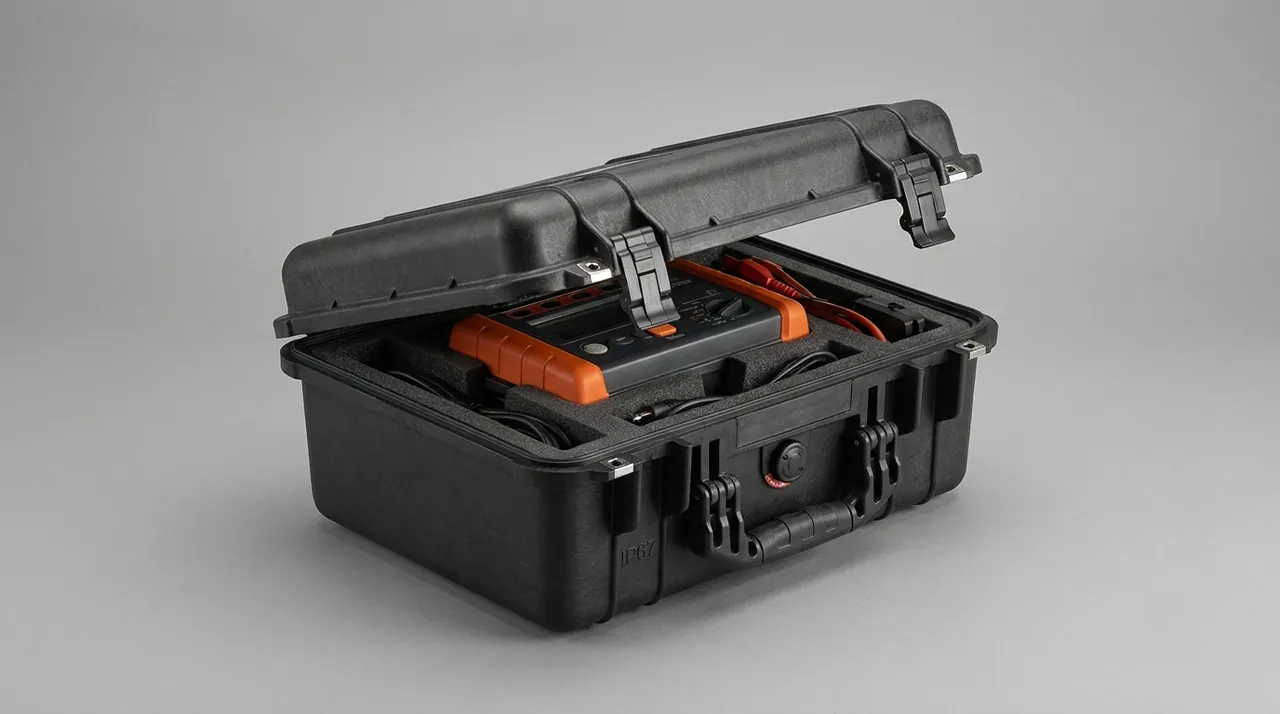
The seal strip is the first movable barrier that blocks dust and moisture from entering a mining protective case, and its cross-section shape, material hardness, and compression together set the overall protection level. In selecting the Case Seal Strip: The Key Waterproof and Dustproof Accessory for Protective Cases, mining should prioritize dust exclusion over pure water resistance, because continuous fine dust is more destructive than occasional spray. Common foamed-rubber or thermoplastic-elastomer strips conform well and fill the micro-unevenness of the joint face when the lid closes, forming a continuous gap-free barrier. Latch compression must be distributed evenly around the perimeter of the closure so that the gasket compresses uniformly and no local under-compression becomes a leak path.
At corner transitions, the strip should bend smoothly rather than fold sharply, since a sudden change of curvature invites micro-gaps. During roadway dust-suppression spraying or open storage in the rainy season, water resistance also matters, so the declared grade should be aligned with real spray and dust conditions using the grading explained in IP Rating: Decoding Ingress Protection Grades for Protective Cases, avoiding the mismatch where a rated case still admits dust in practice. In addition, the seal strip is an aging item; after long exposure to compression, oil, and temperature difference it gradually loses resilience, so it should be included in the periodic inspection and replacement plan to keep the case at its designed sealing level after years of service.
Stacking Corners and On-Site Stack Storage
Mining sites hold many items and call on them frequently, so storerooms and pithead waiting areas often stack several cases to save space. Here the Case Stacking Corner: Load-Bearing and Alignment Hardware for Stacked Cases carries the dual duties of locating and load bearing: the protruding corner aligns the force points of upper and lower cases to prevent misalignment and slip, while routing vertical load through shell ribs to the ground so that internal items are not crushed. A well-designed stack structure also has anti-slip and limit features, staying stable even on a slightly inclined roadway floor.
It must be noted that the number of stacked layers should be determined by the rated stack load of a single case together with the long-term load capacity of the bottom shell. The bottom case bears the cumulative weight of everything above it, and exceeding the design boundary can cause shell creep or even collapse. For cases stored near the working face, the disturbance of rockfall to the whole stack should also be considered, and lashing or wall fixing may be used to reduce tip-over risk. A clear stacking order also helps crews locate equipment quickly during shift handover, reducing the number of lid openings and thus the chances for dust to enter. For cases that turn over frequently, a numbered nameplate beside the stacking corner lets warehouse staff identify the contents of an upper case without lifting it, further improving turnover efficiency and reducing mis-picks.
Latches and Pressure Equalization Valve Sealing
The latch is the actuator that provides sealing compression, and its count, position, and stroke directly determine how evenly the gasket is compressed. A multi-point lock design spreads the closing force around the whole perimeter and avoids far-end under-compression, while the pressure equalization valve balances the pressure difference inside and outside the case during elevation change or abrupt temperature shift, preventing negative pressure from drawing dust in or pulling the gasket off the joint face. In mines with inclined-shaft hoisting and large surface temperature swings, the latches and the Case Stacking Corner: Load-Bearing and Alignment Hardware for Stacked Cases together keep the case in position, while reliable valve closure is an independent safeguard. If the valve stays exposed in a dusty environment, its ventilation passage may clog and fail, so a valve with a sealable structure should be chosen and kept closed when not venting. The latch itself should also have dust caps or a built-in design to keep grit out of threads and catches. In the impact scenarios addressed by the Drop Test: Structural Verification of Protective Cases Under Shipping Impact, a latch that stays shut and does not spring open preserves the last container barrier for the contents.
In daily upkeep, the moving parts of the latch should be de-gritted periodically and given a small amount of grease to prevent rock powder from caking and seizing the mechanism. For cases with metal latch tongues, local shell strength near the lock seat should be watched so that repeated impact does not loosen the seat. The pressure equalization valve should be placed on the inspection checklist, and before every descent the operator should confirm that the valve core moves freely and that the sealing plug is present. Importantly, both latches and valves are movable seals whose long-term reliability often decides case life more than the static gasket, so supplier evaluation should require cyclic-life and dust-test data rather than a single closure result.
Vibration Isolation and Impact Resistance
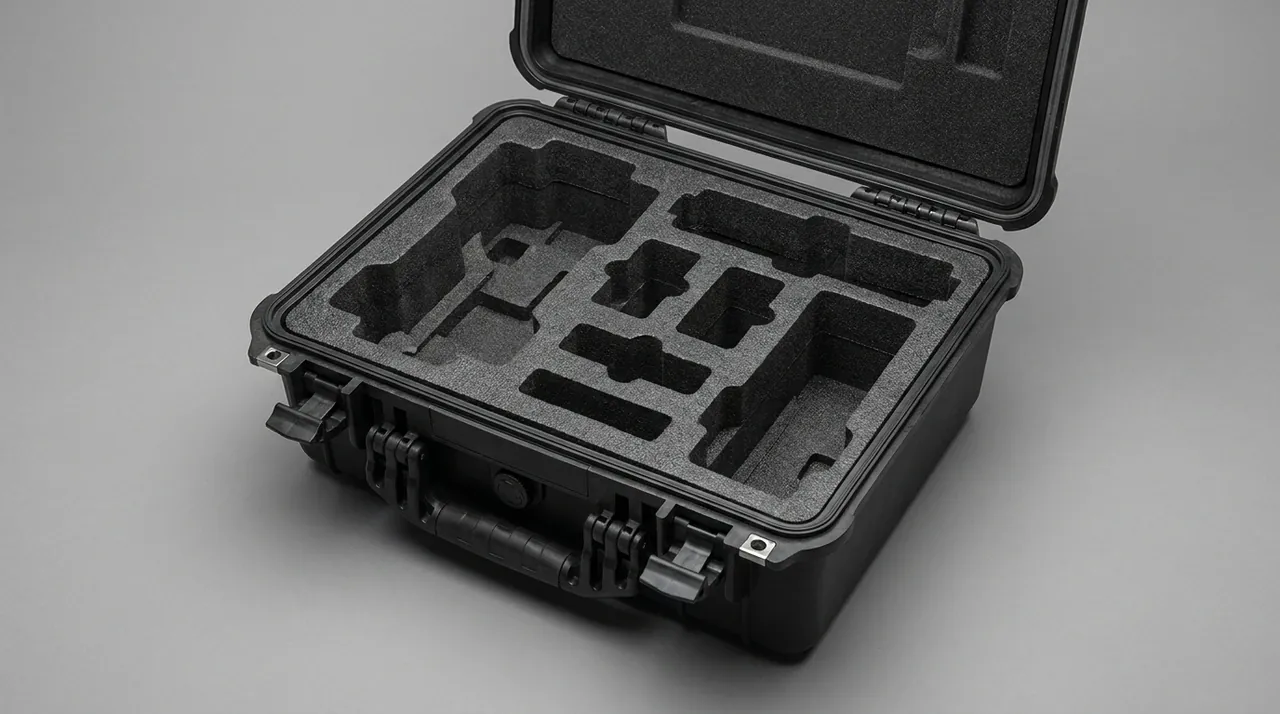
Vibration energy from mine trucks running on gravel roads, temporary tracks, and rails is transmitted through the case base and walls to internal items. A useful way to evaluate this transmission is the Vibration Test: Endurance Assessment for Long-Haul Transit, which simulates a random vibration spectrum to check loosening and failure risk under long jolting. At the container level, isolation comes from two paths: a moderate gap between the shell and the lining that uses foam elasticity to cut rigid high-frequency transmission, and the locating of items within the lining that removes relative movement and secondary collision.
For cases mounted on mining equipment, the overlap of equipment vibration and transport vibration must be considered, and rubber isolation feet or suspended brackets can be added to move the main frequency band away from the sensitive range of the contents. On the impact side, beyond the toughness of the shell material itself, structural reinforcement at corners and edges can absorb energy during accidental knocks. It should be clear that vibration protection is a system: the container handles transmission and fixing, while the vibration resistance of the equipment and the reliability of its internal wiring matter equally, and the two should be verified together rather than substituted for each other. On long downhill sections, braking and road joints add low-frequency impact, and this energy is more likely to be absorbed by fasteners inside the equipment, so in addition to container locating, the tightening torque of the equipment's own screws should be checked.
Drop and Rockfall Impact Protection
Both underground mines and open pits carry the risk of falling rock, dropped objects, and human drops, and these instantaneous high-energy impacts directly test the structural integrity of a protective case. The verification method for this risk is the Drop Test: Structural Verification of Protective Cases Under Shipping Impact, which uses a specified height and attitude to check whether the shell suffers irreversible deformation or the latch springs open. In container design, mining cases often embed metal or high-strength engineering-plastic protectors at the top corners and bottom edges to spread local impact load over a larger area, and wall thickness is increased where strike probability is high.
For cases that must be carried by hand through narrow drifts, total weight should be controlled so that a carrier who loses balance does not add extra impact. Note that even a cosmetically intact case after a fall may have hidden shifts in its seal interface and lining locators, so any case that has suffered a clear drop or knock should be re-checked for lid gap and gasket compression before it is returned to service. Only by aligning drop tolerance with the real handling path can the container turn survival of the case into protection of the contents across actual mine movement lines. For rail transport underground, the attitude of the case inside the mine car should also be secured, and a replaceable bumper strip on the edges can concentrate damage on an easily renewed part.
Zoned Storage for Tools and Instruments
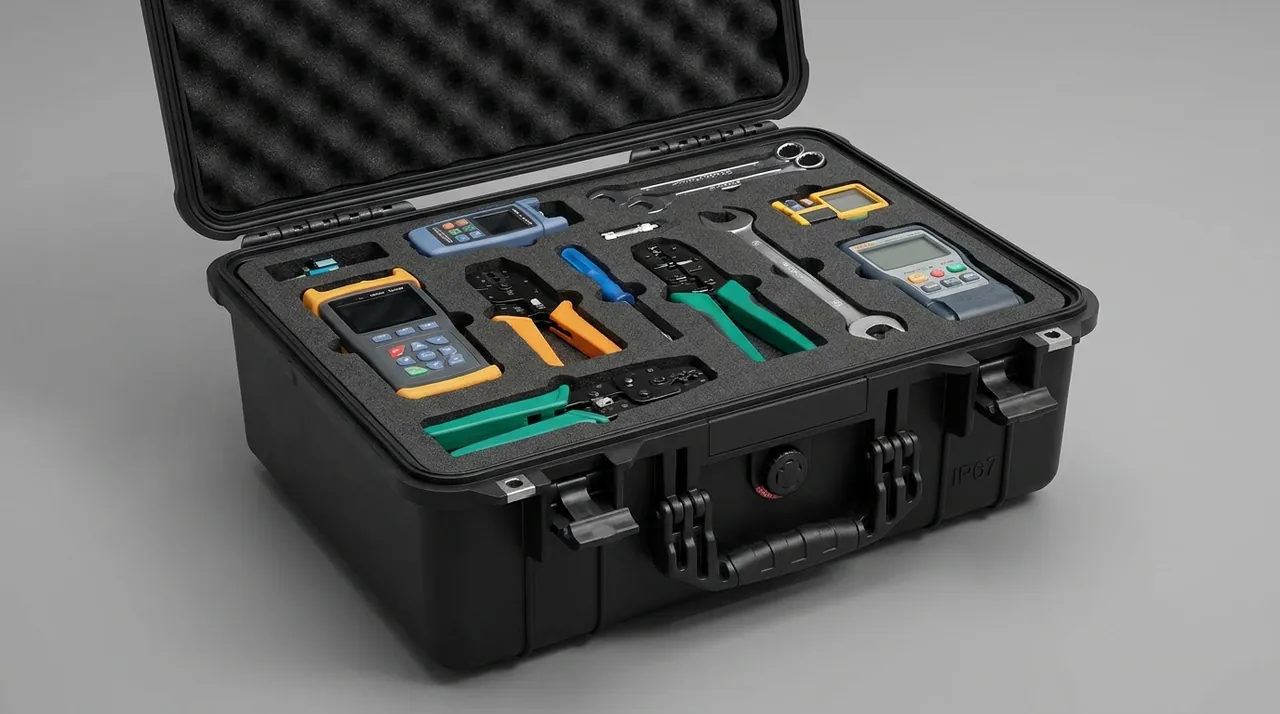
Mining equipment is diverse, ranging from gas detectors and noise meters to rock-bolt drill accessories, with great differences in shape and fragility, so rational zoning significantly reduces interference and mis-pick risk. The zoning idea emphasized in the Optical Instrument Case: Zoned Protection and Shock Isolation for Precision Optics also fits mining precision instruments: keep high-value, high-fragility survey and test gear in separate cells, physically isolated from heavy tools, and avoid crush and knock. In practice, the layout can be divided by use frequency into a frequent layer and a spare layer, putting the portable instruments needed every shift at the open-and-grab position and the calibration spares at the bottom. For soft accessories such as cables and probes, ties or separate pouches prevent tangling. Zoning also makes it easier to keep an equipment list and locator marks, so that in time-sensitive scenarios such as emergency response the position of key gear is confirmed quickly.
One point to remember is that zoning must not break the overall continuity of cushioning; the dividers between cells should themselves absorb some energy so that impact in one cell does not travel straight to a neighboring item. Once the zoning plan is fixed, it is advisable to document the standard position of each item with a diagram and to mark the lining surface correspondingly, so that different shifts follow the same logic. For battery-powered devices, the battery bay should be given independent heat dissipation and insulation to avoid short-circuit hazards from mixed storage with metal tools. In multi-person shared cases, zoning also clarifies responsibility boundaries, making missing or misplaced items easy to spot when the lid is opened. As equipment is updated, the layout should be reviewed periodically, removing obsolete placeholders and adding dedicated cavities for new devices so the lining always matches the real inventory.
Daily Access and Label Management
Mining inspection gear is taken out and returned far more often than long-stored supplies, and frequent opening means more chances for dust entry and misplacement, so daily operating discipline and label management matter a great deal. An inventory list and diagram posted inside the lid or on the side let every opening be checked against it and shorten the time the case is open. For instruments with the same name but different ranges, color tags or serial numbers reduce the probability of picking the wrong one. Under the framework of the Transport Marking: Handling Pictograms and Regulatory Labels for Cases, the exterior can also carry pictograms such as this way up, keep dry, and handle gently to remind handlers and warehouse staff to follow the rules.
Label adhesion must also withstand roadway dust and moisture, so wear-resistant and weather-resistant printing or etching should be preferred to prevent color from fading and blurring after repeated wiping and spraying. Daily management should also keep an opening log and count how often each item goes in and out, and use that data to optimize the lining layout and stacking position. Good labeling and access habits extend container protection from passive dust blocking to actively reducing exposure, improving internal reliability without changing any hardware. They also let shift handover checks finish faster and reduce the temporary downtime that occurs when an item is found to be missing.
Protection in Humid and Corrosive Roadways
Many mine roadways have seepage, spray, and high humidity, and some districts contain corrosive constituents such as sulfides that over time attack metal latches, hinges, and shell surfaces. Against this risk, the material-corrosion evaluation approach established by the Salt Spray Test: Corrosion Resistance for Marine and Humid Environments can be referenced, and the surface-treatment grade of the shell and hardware should be checked at selection. For aluminum shells, anodizing or a coating effectively isolates moisture; for engineering-plastic shells, although the body itself resists corrosion, its metal fittings still need protection.
Inside the case, a humidity indicator card or an optional drying unit allows maintainers to read the internal humidity state directly. In face waiting areas with long-term high humidity, the case should not be stored flat on the ground; a pallet or the off-ground gap formed by the Case Stacking Corner: Load-Bearing and Alignment Hardware for Stacked Cases can reduce floor-water attack on the shell bottom. Scheduled de-rusting, lubrication, and seal-strip inspection are necessary to slow corrosion and maintain the protection grade, especially on older cases that have been in service for years and have suffered many drops. Under combined high humidity and dust, the gasket groove may collect a mixture of dust and water, and cleaning with a strong solvent should be avoided because it accelerates aging; a neutral cleaner followed by prompt drying is more appropriate.
Packaging for Transport and Inter-Mine Transfer
Mining equipment often has to shuttle between the pit, the concentrator, and the repair center, and that journey usually tests the container more than stationary storage underground. The distribution-environment simulation of the ISTA Test: Simulation and Verification of Distribution Environments can be borrowed to verify the packaging according to the real transport mode. At the container level, the outline of the case should be checked against the carrier, for example whether it can be secured on a mine car, a corridor maintenance platform, or a road pallet without sliding and striking on hard braking or cornering.
When several cases are shipped together, straps, limit frames, or a shared outer cage can turn mutual collision into controlled collective movement. Long-distance transfer across mining areas may cross different climate zones, so condensation from temperature difference should be anticipated in the sealing and drying design. It should be clear that the goal of transport packaging is not to make a single case survive everything, but to use the container, the fixing, and the cushioning together to keep whole-journey vibration, impact, and humidity within the tolerable range of the contents. This requires that the case selection and the transport plan be designed together, rather than being patched at the last moment before dispatch and thereby weakening the protection margin accumulated in earlier stages.
Standards Basis and Compliance Notes
This article discusses only the application methods of the protective case as a container structure in mining scenarios, covering container-level technical points such as shell material, sealing, lining, stacking, and handling, and it does not involve the nature, formulation, or use of any stored item. Mine operators procuring and deploying such cases should measure dust concentration, vibration intensity, and ambient humidity against their own working conditions. Where cross-border transport or export is involved, local laws and regulations together with export-control requirements must be followed separately, and a qualified responsible party should carry out a separate compliance assessment; the content of this article does not constitute any compliance conclusion.
A passing container only means that the container itself has the corresponding dust-resistance and shock-resistance capability under specific conditions, and it cannot replace the user's own protection specification and operation training for the contents. Buyers are advised to include shell-structure verification, seal inspection, and lining fit in arrival acceptance and periodic re-inspection, so that the case keeps its designed container performance throughout its service life. At the same time, the Stacking Test: Compliance Verification of Warehouse Stack Load and the IP Rating: Decoding Ingress Protection Grades for Protective Cases can serve as quantified references for external communication, allowing container metrics from different suppliers to be compared on the same scale and reducing both communication cost and later disputes. Container protection capability and the fit of the contents are two independent tasks: the former is verified by the manufacturer, and the latter is confirmed by the user according to the characteristics of the equipment.
Frequently Asked Questions
Q: What is the core difference between a mining case and an ordinary toolbox? A: The core difference is that a mining protective case is systematically designed around high dust, strong vibration, and high drop risk, while an ordinary toolbox usually solves only storage and portability. Specifically, the shell material and reinforcement emphasize impact and creep resistance, the seal strip and pressure valve together form a dust and water barrier, the lining is customized by item mass band to absorb transport vibration, and the stacking corner ensures load transfer and alignment when several cases are piled. An ordinary toolbox often lacks these coordinated designs for harsh conditions, so under continuous roadway dust or vehicle jolting its contents more easily lose accuracy, loosen, or get damaged. Therefore selection should treat mine conditions as a clear constraint rather than substituting a generic box grade, and it should not compare a single specification in isolation. Looking at the container as a system of shell, seal, lining, and stacking is what separates a real mining case from a rebranded household box.
Q: Why is the seal strip more critical than waterproofing under high dust? A: Because mine dust is mostly fine and persistent particles that slowly seep through the micro-gaps of the joint face with every lid opening and every pressure fluctuation, and over time they form an abrasive and blocking effect that is more destructive than occasional spray. Waterproofing handles short-term liquid intrusion, while dustproofing handles long-term particle isolation, and the two mechanisms differ. The seal strip as the first movable barrier has its cross-section fit and compression uniformity directly deciding the dust-exclusion result; local under-compression creates a dust path. So in a high-dust shaft, selection should prioritize the dust grade and combine even latch compression with smooth corner transitions to keep the gasket effective along its whole length. Looking only at the declared waterproof grade while ignoring the continuous accumulation of dust leads to a case that passes the label yet lets equipment become contaminated in real service. In practice, the strip cross-section should be chosen so that closing force is spread evenly, and the groove depth should be matched to the strip so it is neither crushed flat nor left loose after years of opening and closing under mine conditions.
Q: Is softer foam always better for protecting the contents? A: No. The lining effect is closely related to item mass; foam that is too soft collapses under heavy tools and loses its locating ability, letting items move freely and collide in transit, while foam that is too hard transmits impact energy straight to the equipment and absorbs nothing. The correct approach is to choose foam density and thickness that match the per-item mass band, so that after closure the item is held stably with a moderate compression margin. Mining practice often applies a layered and partitioned layout, with heavy tools on the bottom, precision instruments above, and dividers plus elastic straps limiting vertical bounce. Only in this way can the foam balance fixing and energy absorption instead of pursuing softness alone. Matching the foam to the actual load is what makes the lining a working part of the protection system rather than a filler that merely occupies space inside the case.
Q: What exactly does the stacking corner do in a mine storeroom? A: The stacking corner is a protruding locating and load-bearing structure on the top and bottom of the case with two main duties: first, aligning the force points of stacked cases so they do not slip or misalign, and second, routing the vertical load through the shell ribs to the ground so that internal items are not crushed. In pithead waiting areas and temporary storerooms, stacking several cases saves considerable floor space, but the bottom case bears the cumulative weight of everything above it, so the number of layers must follow the rated stack load. If the corner also has anti-slip and limit features, the stack stays stable on a slightly inclined roadway floor. The stacking corner is therefore not decoration but the key container fitting that turns piling from a risk into a workable storage method, and it interacts with the shell structure to decide how much weight a stack can safely carry.
Q: What should be noted when using the pressure equalization valve in mines? A: Inclined-shaft hoisting and surface temperature swings create a pressure difference between the inside and outside of the case, and the pressure equalization valve exists to balance that difference, preventing negative pressure from drawing dust in or pulling the gasket off the joint face. In use, a valve with a sealable structure should be chosen and kept closed when not venting so that its passage does not clog with dust over long exposure. Before every descent, the operator should confirm that the valve core moves freely and that the sealing plug is present, and the valve should be placed on the inspection checklist. It must be clear that the valve is a movable seal whose long-term reliability often decides case life more than the static gasket, so supplier evaluation should require cyclic-life and dust-test data rather than a single closure result. That data is what truly reflects how the valve behaves in dusty mine conditions over months of service.
Q: If a case looks fine after a drop, can it keep being used? A: It cannot be judged on appearance alone. A drop is a high-energy instantaneous impact; even when the shell has no visible dent, the seal interface and the lining locators may have hidden shifts that cause uneven gasket compression or deformed equipment cavities. Any case that has suffered a clear drop should be re-checked for lid gap, gasket compression, and lining position before it is put back into service. In narrow-drift manual carrying, losing balance and dropping is not rare, so beyond choosing cases with protectors and thickened strike zones, a discipline of inspecting after every drop should be established. Only by making post-drop inspection a fixed step can the container barrier stay reliable after cumulative impacts, instead of being misled by an intact exterior. Surface appearance reflects only the outer shell, while the sealing and locating functions inside can degrade invisibly. For high-value cases, a short post-drop check should be written into the operating procedure so that the practice does not depend on individual memory or on what a particular shift happens to notice.
Q: How can internal condensation be prevented in humid roadways? A: It should be attacked from sealing, drying, and off-ground storage together. For sealing, a qualified shell and gasket block continuous external moisture; for drying, a humidity indicator card inside the case and an optional drying unit let maintainers read the internal humidity directly; for off-ground storage, a pallet or the gap formed by stacking corners prevents direct contact with roadway water. For aluminum shells the surface-treatment grade should be checked, and the metal fittings of plastic shells should be protected against rust. Cases in long-term high-humidity service should include de-rusting, lubrication, and seal inspection in periodic maintenance, especially older cases that have suffered repeated drops, so that protection downgrade is detected early. Keeping condensation within the tolerable range of the equipment prevents slow moisture damage that may not appear until an instrument is needed on site. Recording internal humidity on a simple log also helps to spot a slow upward trend before it turns into visible moisture on the stored equipment.
Q: Does the case need extra packaging for inter-mine transport? A: It depends on the transport mode, but transport-grade fixing is usually advisable. When mining equipment is transferred between the pit, the concentrator, and the repair center, the jolting of the journey often tests the container more than stationary storage underground, so it should be confirmed that the case can be secured on a mine car, a maintenance platform, or a road pallet without sliding and striking under hard braking or cornering. Multiple cases shipped together can use straps, limit frames, or a shared outer cage to turn mutual collision into controlled collective movement. If different climate zones are crossed, condensation caused by temperature difference should be anticipated in advance. The goal of transport packaging is not to make one case survive everything, but to keep whole-journey vibration and impact within the tolerance of the contents through coordinated container, fixing, and cushioning, which means case selection and the transport plan should be designed together.
Q: What data should buyers most demand from the supplier? A: The data most worth demanding is verification and aging information directly tied to container performance: the impact-resistance description of the shell material and reinforcement, the compression set of the seal strip across the mine dust and temperature bands, the density and rebound curve of the lining foam, the cyclic life and dust-test records of the latch and pressure valve, and the rated load of the stacking corner. If transport is involved, vibration and drop results verified against the real distribution environment should also be required. This data lets buyers turn an abstract claim of durability into comparable and acceptable metrics. It is also advisable to write shell verification, seal inspection, and lining fit into arrival acceptance and periodic re-inspection procedures, so that the case keeps its designed container performance through the whole service life instead of relying on factory appearance as the only basis for accepting a container intended for severe mining duty.