

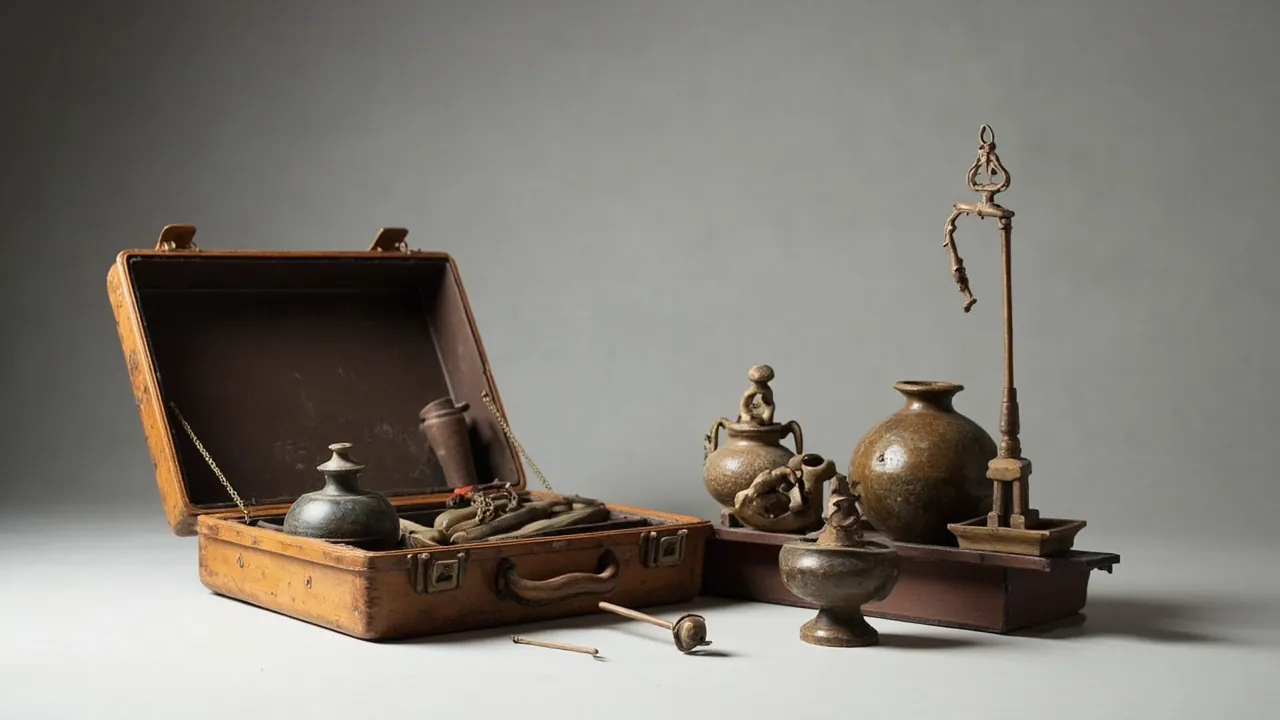
The core problem a religious artifact case solves is preserving the form, material condition and ceremonial integrity of ritual implements, offering vessels and scriptures after they leave their accustomed storage environment and travel long distances. Religious artifacts differ fundamentally from ordinary craft objects in one respect: a substantial proportion of them are objects in active use. They are not permanently static in a storeroom but are repeatedly brought out, used and returned in religious practice. That means they absorb two classes of degradation at once: physical risk from handling and transport, and material ageing driven by repeated environmental temperature and humidity fluctuation. The first appears as impact damage, scratches, breakage and deformation. The second appears as metal corrosion, cracking in wood, embrittlement of textiles, acidification of paper, and mould. What makes this difficult is that neither class is usually obvious at goods-in inspection. Real damage is often discovered only once the object is in a user's hands.
Protection for this category involves a genuine tension. On one side, respect for the object argues for simple, direct handling, without layers of wrapping that make use cumbersome. On the other, preservation argues for multiple isolation layers and a stable microclimate. Good case design does not compromise between these ends. It makes the stable preservation environment the default state and the handling action as simple as possible. In practice that means: reusable insert slots that hold objects without re-wrapping each time; partitions and dividers instead of loose fill that sheds particles; latches that open easily with one hand to shorten the operation; and a humidity indicator card that replaces guesswork at opening.
This article is written for artifact custodians at religious communities and temples, religious goods manufacturers and wholesalers, staff at museums and heritage custodial bodies, and logistics providers handling loans and relocations of religious artifacts. It covers material families and sensitivity, specific protection for metal and wooden objects, retention of brittle items, acid-free enclosure for textiles and paper, microclimate and humidity control, pest and mould prevention, material compliance, sealing class trade-offs, transport test references, and packing and handover procedures. All figures are industry-typical or empirical ranges; condition assessments, custodian requirements and destination regulations always take precedence. JUNZHJIA can support religious artifact and collectible applications with part-specific soft retention inserts, acid-free and low-migration padding configurations, microclimate humidity-control schemes, and OEM/ODM supply with inspection documentation.
Table of Contents
- 1. Positioning this discipline: respect, restraint and engineering rigour
- 2. Category and material map
- 3. Metal implements: corrosion protection for copper, gilt, silver and bronze
- 4. Carved and lacquered wood: moisture equilibrium and crack prevention
- 5. Ceramics, stone and figures: retention and isolation of brittle objects
- 6. Silk, banners, hangings and embroidery: flat packing, rolling and acid-free padding
- 7. Sutras, paper and thangka: acid-free materials and the ISO 18916 reference
- 8. Microclimate control: relative humidity, temperature stability and buffering materials
- 9. Pest and mould prevention: pre-packing treatment and in-transit monitoring
- 10. Shock isolation and retention: soft restraint design for brittle objects
- 11. Material compliance: acid-free, sulphur-free, PVC-free and UL94
- 12. Sealing and ingress protection: IEC 60529 versus GB/T 4208
- 13. Transport and handling validation: ISTA, GB/T 4857, ASTM D4169 and MIL-STD-810H
- 14. Packing SOP, handover and goods-in verification
- 15. Procurement evaluation and the OEM/ODM customisation path
- Frequently Asked Questions
- Conclusion & Related Reading
1. Positioning this discipline: respect, restraint and engineering rigour
Before discussing any structural parameter, the positioning of this type of packaging needs to be stated clearly.
First, the objective is to preserve the existing state, not to restore. The only correct goal in transport protection is that an object arrives in the condition in which it left. That imposes one governing principle on every material choice and every handling action: irreversibility takes priority. Any practice that could leave residue, migrated compounds, indentations or chemical reactions on an object should be excluded, even if it appears to hold the object more securely in the short term. Reversible, removable and residue-free is the first acceptance criterion for this category.
Second, active-use objects and stored objects require different schemes. Packaging for stored objects can pursue maximum environmental stability: long-term sealing, low-oxygen environments, tight humidity control. Active-use objects must account for retrieval frequency, handling convenience and cumulative wear. Applying a storage scheme to an active-use object ends with the user abandoning the packaging as too cumbersome. Applying an active-use scheme to a stored object leaves environmental control inadequate. The first step in any design is therefore to establish the object's use pattern.
Third, respect lives in details, not in statements. In real projects, what most clearly demonstrates respect for an object and for the tradition it belongs to is usually a handful of unglamorous engineering details: no adhesive residue on insert surfaces; no need to invert an object to remove it; no materials inside the case whose odour conflicts with the object; a clear diagram for the opening sequence; and packaging materials that are themselves clean, neat and dust-free. These details convey more than any wording.
One criterion has been validated repeatedly in practice: if a packaging scheme makes the user feel that retrieval is a chore every time, the scheme will eventually be abandoned. Designing packaging for religious artifacts therefore means treating handling convenience as a design criterion of equal weight to protection performance.
The underlying principles are covered in shock-absorbing case design logic and cushion liner and case base plate coordination.
2. Category and material map
Religious artifacts span an enormous material range, and a single case may contain bronze, wood, textile and paper together. The table below maps typical objects, dominant sensitivity, principal failure modes and preferred protection measures by material family, as a starting point for partition design.
| Material family | Typical objects | Dominant sensitivity | Principal failure mode | Preferred protection |
|---|---|---|---|---|
| --- | --- | --- | --- | --- |
| Copper and copper alloys | Censers, candlesticks, gongs, bells, offering vessels | Humidity, sulphides, chlorides, fingerprints | General oxidation, pitting, plating discolouration | Sulphur-free isolation, humidity control, gloved handling |
| Gilded and gold-leaf items | Figures, implements, ornaments | Friction, moisture, adhesives | Gold layer wear and lifting, substrate corrosion pushing through | Soft padding, no adhesive contact, low-friction insertion |
| Silver | Offering vessels, ornaments, implement fittings | Sulphur-bearing atmosphere, humidity | Sulphide tarnish, loss of lustre | Sulphur-free packaging materials, anti-tarnish cloth |
| Wood and lacquered wood | Wooden fish drums, drum bodies, shrines, table components | RH fluctuation, insect attack | Cracking, distortion, lacquer lifting and loss | Stable RH, protection from light and heat, pest treatment |
| Ceramics and porcelain | Offering bowls, incense holders, water vessels | Impact, localised stress | Chipping, cracking, glaze damage | Individual compartments, double soft restraint |
| Stone and jade | Figures, stele components, ornaments | Impact, edge stress | Edge chipping, fracture, surface abrasion | Full wrapping, thickened corners, heavy-load cradle |
| Silk and embroidery | Banners, hangings, curtains, robes, embroidered panels | Light, humidity, folding stress | Fibre embrittlement, dye transfer, crease and thread breakage | Acid-free padding, rolled or flat, light protection |
| Paper and sutras | Books, scrolls, documents, thangka | Humidity, acidic materials, insects and mould | Acid yellowing, mould spots, insect damage, blocking | Acid-free enclosure, humidity control, pest and mould prevention |
| Bone, horn and ivory | Prayer beads, ornaments, implement fittings | Humidity fluctuation, desiccation | Desiccation cracking, warping, delamination | Stable mid-range RH, avoid abrupt change |
| Composite and mixed material | Inlaid or assembled figures and vessels | Differential response of each material | Joint adhesive failure, displacement, detached parts | Whole-object soft restraint, avoid point loading |
One important pattern emerges: composite objects carrying multiple materials are the highest-risk group. When an object combines wood, metal and textile, for example a lacquered shrine with metal fittings or a carved figure with silk hangings, the different materials respond to relative humidity at different rates and amplitudes. Joints are the first place where adhesive fails, parts shift and assemblies loosen. For such objects, the humidity target is not the optimum for one material but the stable band that minimises differential response between them.
3. Metal implements: corrosion protection for copper, gilt, silver and bronze
Metal is the most common material in religious artifacts and also the most slowly and silently attacked by environment.
Corrosion in copper alloys begins with moisture and pollutants. Copper, brass and bronze discolour progressively in atmospheres with elevated relative humidity together with sulphides, chlorides or organic acids. The early stage is uniform darkening, followed by localised pitting. Incense burning in religious settings releases smoke containing sulphur compounds and organic acids. Metal objects kept in such an atmosphere for years often carry a surface reaction layer sitting at a critical threshold, and a modest rise in humidity during transport can push it further. Objects should therefore be cleaned and fully dried before packing, with desiccant inside the case and no sulphur-bearing materials in contact.
Fingerprints are an overlooked corrosion origin. Hand perspiration contains chloride ions, lactic acid and fatty acids. After bare-hand contact with copper, brass, silver or uncoated metal, the fingerprint becomes a localised corrosion site and appears within weeks as a light or dark mark. Wearing clean, powder-free gloves throughout handling is the lowest-cost and most directly effective measure available. Powder-free nitrile or clean cotton gloves are preferable; sulphur-cured natural rubber gloves should be avoided.
The risk to gilded and gold-leaf items is friction. The gold layer is thin and its bond to the substrate depends on an interlayer and adhesive. Repeated micro-movement in transit abrades and lifts the gold, and if the substrate corrodes under moisture, the expanding corrosion products push the gold off from beneath. Retention for gilded items must therefore be close-fitting without compression, and the insertion path must be low-friction, dust-free and free of adhesive residue. A smooth inert fabric facing on the contact surface is advisable.
Silver is highly sensitive to sulphur-bearing atmospheres. Silver sulphidation occurs at very low sulphide concentrations and shows as loss of lustre followed by blackening. Insert materials, interleaving papers and cushioning for silver should all be confirmed sulphur-free, and leather, wool, low-grade rubber and some recycled paper products should not share the case, since any of them may release sulphides.
4. Carved and lacquered wood: moisture equilibrium and crack prevention
Wooden objects are a large share of religious artifacts, from wooden fish drums and drum bodies to shrines and altar components. Their principal failure is cracking, distortion and lacquer degradation, rooted in the dynamic equilibrium between wood moisture content and ambient relative humidity.
Wood moisture content tracks ambient relative humidity. When RH falls, wood loses moisture and shrinks; when RH rises, it absorbs moisture and swells. Because tangential and radial shrinkage differ, and because core and surface lose moisture at different rates, rapid or large excursions generate internal stress that opens cracks at the weakest points. Lacquered objects are more complex still: the wood substrate shrinks while the lacquer layer shrinks at a different rate, so the coating lifts, crazes and flakes.
Three basic requirements follow:
- Stable, not extremely dry. The suitable band for wood is generally 45 to 60 percent RH. Deliberately driving humidity very low desiccates and cracks the wood, so the goal is stability within the band rather than the lowest achievable figure.
- Avoid abrupt temperature change. Rapid temperature change alters local relative humidity and indirectly drives wood moisture fluctuation. Prolonged direct sunlight, proximity to heat sources, and opening a case immediately after moving it from a cold to a hot and humid environment should all be avoided.
- Avoid sustained load. Wood creeps under continuous load, particularly slender and thin-walled components such as drum bodies and shrine columns. Retention should fit closely without preload.
The concept of an acclimatisation period is worth introducing into relocation practice. When an object moves between climate zones, for example from a dry region to a hot and humid one, it should not be put into service immediately after opening. It should stand, closed or partly opened, for a period so that it adapts gradually to the new conditions. The length depends on the magnitude of the climate difference and the sensitivity of the material, and in practice ranges from several hours to several days, with wooden and composite objects generally needing longer.
5. Ceramics, stone and figures: retention and isolation of brittle objects
Ceramics, stone carvings, jade and some sculptural figures are brittle objects whose failure mode is simple and severe: impact and localised stress concentration.
The protection logic for brittle objects differs completely from metals and wood. Metals absorb energy through plastic deformation and wood has some toughness, but ceramics and stone absorb almost nothing. Energy must therefore be redirected, or it becomes a crack. The core of the approach is two things: extend the duration of the impact to lower peak acceleration, and avoid localised stress concentration.
Practical measures include:
- Full wrapping rather than point contact. The object should be fully supported by compliant material, with no corner or protrusion bearing directly against a rigid insert. For objects with feet or a base, assess whether the existing structure can safely carry the weight and, where necessary, build an auxiliary cradle to share the load.
- Double soft restraint. An inner layer conforms to the object geometry and an outer layer provides some resilience, with slight relative movement permitted between them so that a proportion of impact energy is dissipated through sliding.
- Heavy low, brittle central. When items share a case, heavy items go on the lower level with individual retention and brittle items in the middle level, so that upper heavy items cannot compress downwards under vibration.
- Never use loose fill as retention. Wedging a brittle object with loose fill is the most dangerous common practice: the fill redistributes under vibration, creating localised hard points, and may shed particles onto the object surface.
A second risk for stone and jade is surface abrasion. Microscopic relative movement between the surface and the packaging material, accumulated over tens of hours of transport vibration, can produce visible abrasion marks. Contact-surface friction coefficient and cleanliness are therefore specification criteria, not details. Insert surfaces should be dust-free and free of hard particles, and dense inert materials are preferable.
6. Silk, banners, hangings and embroidery: flat packing, rolling and acid-free padding
Textile objects include banners, hangings, curtains, robes, embroidered panels and various ornaments. They degrade through light, humidity, folding stress and their own weight.
Creasing and thread breakage are the most common textile transport damage. A textile folded under sustained pressure accumulates stress at the fold line, causing local fatigue and thread breakage, and the process accelerates markedly in a humid environment. The approach for textiles should therefore be built on reducing folds and reducing compression:
- Rolling suits large-format textiles without rigid support, such as banners and hangings. Use acid-free paper or inert film as the inner layer, keep the core diameter from being too small, apply even winding tension, and avoid localised stretching.
- Flat packing suits smaller textiles, or those with embroidery or rigid ornaments. Interleave acid-free tissue, limit the stack to three layers or fewer, and use rigid interleaving boards to spread upper-layer weight.
- Avoid long-distance hanging transport. A textile's own weight under vibration applies continuous tension along warp and weft, which can distort it, so hanging is unsuitable for long journeys.
Dye transfer and metal ornaments are the two additional risks. Dark and light textiles in direct contact can transfer dye under humid conditions. On textiles with metal ornaments, an isolation layer should sit between metal and fabric to prevent corrosion products staining the textile, while sulphur-bearing materials must not contact the metal.
Choice of acid-free padding matters equally. Materials in direct contact with textiles and paper should be acid-free or buffered, preventing acid migration that yellows and embrittles over time. Material differences are compared further in liner and case material comparison.
7. Sutras, paper and thangka: acid-free materials and the ISO 18916 reference
Sutra books, scrolls, documents, thangka and painted images, the paper-based and image-based objects, impose the strictest requirements on environment and contact materials.
Paper degradation is a chemical process. Cellulose in paper hydrolyses under acidic conditions and oxidises under oxidative conditions. Both yellow the paper, embrittle it and reduce its strength. Moisture, temperature and acidic substances in the environment accelerate both pathways. Enclosure of paper objects therefore has two basic requirements: contact materials must be acid-free or buffered, and the microclimate must be stable with no frequent humidity fluctuation.
On material selection, the frameworks used for archival and imaging enclosure materials are a useful reference. ISO 18916 addresses enclosure materials for imaging materials, including methods such as the photographic activity test used to assess whether a material releases harmful substances. The same logic applies to any material that will sit in long-term contact with paper and image-based objects. The specific application should be determined together with the object's condition and the custodian's requirements.
Choosing between rolling and flat packing depends on the object's condition.
| Object type | Recommended form | Reasoning | Notes |
|---|---|---|---|
| --- | --- | --- | --- |
| Intact scroll in original roll | Maintain the original roll | Avoids introducing new stress by changing form | Core diameter must not be reduced, outer acid-free wrap |
| Single-leaf sutra or document | Flat | Avoids creasing and bending stress | Limited stack height, rigid boards, acid-free interleaving |
| Thangka and silk-mounted painting | Assess by condition | Roll when mounting provides support, flat when fragile | Image face inward, cushioning layer, no fold across the image |
| Already embrittled paper | Flat on a support board | Avoids any bending or unsupported loading | Handle by the board, never lift by one corner |
| Objects with rods or rollers | Maintain the existing structure | Avoids deforming rods under load | End retention separately, never suspend the roll |
One easily overlooked detail is surface accretion. The surface of a scroll or thangka may carry incense ash, oil staining, old repair material or mould residue. During transport vibration such accretion can detach and relocate, or reactivate as humidity rises. A qualified conservator should assess condition and carry out any necessary treatment before packing. A packaging scheme is not a substitute for professional conservation judgement.
8. Microclimate control: relative humidity, temperature stability and buffering materials
Microclimate control is the most central and most frequently oversimplified part of religious artifact transport.
Why stability matters more than the absolute value. For most materials, the damage is caused not by a particular humidity level but by a rapid change in humidity. Wood and bone crack under abrupt humidity change, textiles develop stress, metals undergo repeated condensation and drying cycles, and paper hydrolyses faster. The first objective of humidity control is therefore to reduce the amplitude and frequency of fluctuation, and only second to hold the average within a suitable band.
The role of buffering materials is often underestimated. Silica gel materials, acid-free boards and certain natural fibres have some capacity to absorb and release moisture, buffering ambient fluctuation. Their value is not in lowering humidity but in slowing the rate of change inside the case, so that the object experiences a smaller excursion.
A humidity control scheme normally has four components:
- Setting the target band. Determine it from the most sensitive material present. Metal and textile objects generally sit at 45 to 60 percent RH; wooden objects are best at 45 to 55 percent; paper and image-based objects should be held stable at 45 to 55 percent.
- Desiccant sizing. Calculate from free internal volume, transit duration and destination climate. Note that desiccant continuously lowers humidity, and for wooden and paper objects an excessive quantity can over-dry the contents, so slow-uptake products combined with humidity indicator monitoring are preferable.
- Humidity indicator cards. A combined card at 40, 50 and 60 percent RH allows an anomaly to be identified at opening. The card should sit where air circulates.
- Temperature control. Temperature change drives humidity change. Avoiding direct sunlight and heat sources reduces the diurnal humidity swing inside the case.
Temperature and humidity coupling is discussed further in case design for extreme temperature environments, and the difficulty of opening a well-sealed case after pressure change is covered in pressure equalisation valve configuration.
9. Pest and mould prevention: pre-packing treatment and in-transit monitoring
Pest and mould damage is the least recoverable category of loss for religious artifacts, because by the time it is identified it has usually removed material irreversibly.
Mould requires three conditions simultaneously: suitable humidity, suitable temperature and a usable nutrient source. The packaging stage can directly control humidity. Where relative humidity inside a case stays above roughly 65 percent, mould risk rises markedly, and high humidity combined with temperature fluctuation and condensation amplifies it further. Humidity control is therefore not only physical protection but biological protection.
Pest risk comes from two directions. First, an object may already carry eggs or larvae that hatch in favourable conditions. Second, packaging materials, particularly timber outer cases, paperboard and natural fibre padding, may themselves carry or attract pests. Outer cases and insert materials should therefore come from suppliers with fumigation or heat-treatment records, and materials should be confirmed clean and pest-free before packing.
Practical preventive measures include:
- Inspection and cleaning before packing. Inspect the object externally, particularly crevices, joinery, the interior of rolls and textile folds. Remove surface dust with low-vacuum suction rather than solvents that may leave residue.
- Complete drying. Any cleaning must be followed by complete drying before packing, so that moisture is not sealed into the case.
- Material selection. Prefer inorganic or inert materials as direct-contact padding, and avoid natural fibre materials that could serve as a pest nutrient source in contact with the object.
- Avoid chemical fumigation residue. For religious artifacts, chemical treatments that carry residue risk should be approached cautiously. Any fumigation or insecticidal treatment should be carried out by qualified personnel under the custodian's requirements, and the packaging scheme itself should not include chemical treatment steps that could affect the object or its users.
- Monitoring in transit and on arrival. Fit a humidity indicator card inside the case and, where appropriate, place temperature and humidity logging and pest monitoring devices in the use or storage environment so anomalies are detected early.
10. Shock isolation and retention: soft restraint design for brittle objects
Brittle religious artifacts (ceramics, jade, stone carvings, embrittled paper) require a completely different retention philosophy from industrial spares.
Industrial spare parts aim for zero displacement. Brittle artifacts aim for low-stress constraint. The industrial approach uses rigid retention blocks and preload to lock an item in place. Applied directly to a brittle object, that logic creates localised stress through preload and hard contact, increasing rather than reducing crack risk. The correct approach for brittle objects is:
First, conform to the form. The insert slot should match the object's actual geometry, with the largest feasible contact area. The larger the contact area, the lower the stress per unit area. This is the most fundamental point in brittle-object protection.
Second, replace rigid retention with soft restraint. Use a compliant structure with some compressibility and resilience that permits slight movement, dissipating energy through displacement and deformation. The restraint should be sufficient to prevent large movement under normal transport conditions without applying sustained pressure to the object.
Third, keep restraint away from weak points. Rims, narrow necks, thin walls, protruding handles and joints are all weak points. Restraint should act on structurally stronger areas such as the base, the body or a designed load-bearing face.
Fourth, control acceleration, not only impact. Understood in terms of equivalent drop height and peak acceleration, extending the cushioning stroke and lowering peak acceleration protects a brittle object better than adding rigidity. The underlying principles are covered in shock-absorbing case design logic.
Fifth, retention design must be validated. Small live shipments on representative objects, followed by condition inspection by qualified personnel, are advisable rather than relying on appearance alone. Latent damage in brittle objects, such as micro-cracks, often requires dedicated inspection methods to detect.
11. Material compliance: acid-free, sulphur-free, PVC-free and UL94
Material selection for religious artifact packaging has a clear negative list and positive list.
Negative list (should not contact objects directly):
- Acidic materials. Ordinary kraft paper, some corrugated board and recycled paper products release acidic substances that yellow and embrittle paper and textiles.
- Sulphur-bearing materials. Low-grade rubber, some foams and recycled paper cause discolouration of copper, silver and plated surfaces.
- Chlorine-bearing materials. Polyvinyl chloride materials may release chlorides in long-term contact, corroding metal, while plasticisers may migrate and contaminate object surfaces.
- Soft plastics containing plasticisers or residual monomers. These may migrate and leave print marks on object surfaces or soften coatings.
- Adhesives and labels. Adhesives and self-adhesive labels should not be used on surfaces contacting objects.
Positive list (recommended for direct contact):
- Acid-free and buffered papers. For interleaving and wrapping of paper, textile and metal items.
- Inert films. Polyethylene and polyester films for isolation and moisture barrier layers, used as an outer barrier rather than in direct object contact.
- Cross-linked polyolefin foams such as XPE, and some EVA formulations. For structural cushioning, confirmed acid-free, low-sulphur and low-migration.
- Silica gel buffering materials. With moisture buffering capacity, suitable where humidity stability is required.
- Inert fabric facings. For low-friction contact with gilded items and polished metal surfaces.
Flame retardancy requirements. Some storage environments impose explicit requirements on the burning behaviour of packaging materials. UL94 is a widely used method for evaluating the burning behaviour of plastics, and a V-0 rating indicates a short afterflame time in vertical burning tests with no flaming drips that ignite cotton. For cases stored long-term in occupied spaces, buyers commonly specify V-0 or V-1. Flame retardancy and material stability must be satisfied together, and neither should be sacrificed for the other. Foam fabrication and formulation differences are covered in custom insert fabrication and form-taking.
12. Sealing and ingress protection: IEC 60529 versus GB/T 4208
IEC 60529, with GB/T 4208 as the corresponding Chinese standard, describes enclosure protection with two digits: the first for solid foreign objects and dust, the second for water. IP65 means dust tight and protected against water jets. IP67 means dust tight and protected against short immersion. IP6X denotes the highest dust protection class.
For religious artifacts, ingress protection selection needs particular care, because a real tension exists between sealing and microclimate control:
| Scenario | Main risk | Recommended class | Notes |
|---|---|---|---|
| --- | --- | --- | --- |
| Short transfer within a building or temple | Dust, minor impact | IP54 class is adequate | Focus on insert and retention, high sealing unnecessary |
| Intercity road transport | Dust, rain, humidity fluctuation | IP65 | Dust and water jet protection at reasonable cost |
| Ocean and multimodal freight | Deck humidity, rain, prolonged high humidity | IP67 | Long-term exclusion of external moisture |
| Long-term storage in humid regions | Mould, metal corrosion | IP67 plus humidity control | Sealing must be paired with humidity control |
| Chains with wide temperature and humidity swings | Condensation, pressure change | IP65 or IP67 plus pressure equalisation valve | Accommodates sealing and internal-external pressure difference |
One principle must be stressed: an ingress protection rating describes the enclosure, not the internal microclimate. An IP67 case that seals well also traps whatever moisture is inside. If the object or the insert carries moisture at packing, a highly sealed case becomes a mould incubator. In high-sealing schemes, drying, desiccant sizing and humidity indicator cards are therefore all mandatory, not optional. The logic parallels funeral and ceremonial material protection, and is covered further in IP rating and sealing structure selection.
13. Transport and handling validation: ISTA, GB/T 4857, ASTM D4169 and MIL-STD-810H
Validation of religious artifact transport has one special feature: substitute-load testing cannot be used to clear every risk. For objects of well-defined material and regular structure, equivalent masses can be used for vibration and drop testing. For unique objects, risk must be reduced through design margin, process control and live shipment validation.
The four commonly used reference families are:
| Reference | Nature | Application to this category |
|---|---|---|
| --- | --- | --- |
| ISTA series | International transport packaging test procedures | Structural validation of the case itself, covering drop, vibration, compression and concentrated impact |
| GB/T 4857 series | Chinese basic transport packaging tests | Domestic and baseline export validation, and easier alignment with carriers |
| ASTM D4169 | Distribution cycle performance testing | Sequences assembled for a full distribution chain, suitable for multimodal routes |
| MIL-STD-810H | Environmental test methods | Provides temperature, humidity, vibration and shock method frameworks, cited as an environmental test reference, not a military certification |
Handling also requires defined rules and validation:
- Match case weight to handling method. Total case weight should be within what two people can handle safely, or be moved with handling equipment, with the centre of gravity and lifting points marked on the case.
- Limit tilt. In a case with internal retention features, tilting beyond the design angle may displace contents, so tilt indicator labels should be fitted.
- No single-point lifting and no inversion. For brittle objects and objects with rods, inversion and single-point lifting are high-risk actions and should be prominently marked on the case.
- Handover records. A three-stage handover covering packing record, seal condition and opening record clarifies where responsibility sits.
Test procedures are covered in ISTA transport test procedures and GB/T 4857 transport packaging essentials.
14. Packing SOP, handover and goods-in verification
Before packing:
- Complete a condition assessment and record it, capturing baseline images and noting pre-existing damage.
- Have qualified personnel carry out any necessary cleaning and stabilisation, and confirm complete dryness.
- Confirm the case and insert are dry, clean, odour-free and pest-free, and that seals are sound.
- Prepare clean powder-free gloves, acid-free interleaving, inert padding, desiccant and a humidity indicator card.
During packing:
- Place items according to the partition drawing: heavy first, large first, inner first.
- Confirm each object contacts the insert over a conforming area with no hard points, no unsupported spans and no excessive preload.
- Handle composite objects separately, avoiding contact between differing materials.
- Fit desiccant and the humidity indicator card, and record the initial reading, packing date and packer.
After closing:
- Close latches to the specified torque, avoiding one-sided over-compression.
- Fit a tamper-evident seal and mark the case with this way up, keep dry, do not invert and handle with care.
- Log the case number, object list, image record and handover person.
On arrival:
- Inspect the outer case for deformation, damage and water staining, and check seal integrity.
- Read the humidity indicator card immediately on opening to judge whether the transit environment was abnormal.
- Allow acclimatisation. Where the destination climate differs substantially from the origin, allow the case to stand closed or partly opened for a period before removing objects.
- Check against the list and inspect each object, focusing on joints, corners, lacquer, gold layers and textile fold lines.
- Have qualified personnel confirm condition, complete the image record and sign acceptance.
- Clean and store packaging materials properly to avoid contamination before reuse. For cases in long-term circulation, keep a maintenance record, covered in how to clean and maintain a protective case and protective case service life and maintenance.
15. Procurement evaluation and the OEM/ODM customisation path
Procurement evaluation for religious artifact cases should be structured around six dimensions, each supported by evidence.
- Material compliance documents. Acid-free, low-sulphur and low-migration declarations; flammability basis such as UL94 rating; composition statements for direct-contact materials.
- Customisation and form-taking capability. Three-dimensional form capture for irregular objects, soft retention design capability, and sampling lead time.
- Microclimate capability. Method for setting the target humidity band, basis for desiccant sizing, and humidity indication configuration.
- Structural reliability. Design life and spare parts availability for hinges, latches and seals; pressure equalisation configuration.
- Batch consistency. Insert material density and hardness ranges, tolerance control and incoming inspection plan, with acceptance criteria modelled on batch acceptance sampling.
- Service and confidentiality. Confidentiality requirements for unique objects, plus delivery and installation support.
On the OEM/ODM path, one efficient practice is to give the supplier an object list with material composition and use pattern. Whether each object is stored long-term or in active use, whether it is single-material or composite, and whether it is retrieved frequently will do more to determine the scheme than a dimensional drawing alone. JUNZHJIA can support religious artifact and collectible applications with part-specific soft retention insert design, acid-free and low-migration padding configurations, microclimate humidity-control schemes, sealing and pressure equalisation structure selection, and OEM/ODM supply with inspection documentation.
Frequently Asked Questions
Q: How does a religious artifact transport case compare with a museum art transport case?
A: They share the same protection principles: acid-free, low-migration, reversible and residue-free materials, a stable microclimate, soft restraint for brittle objects, and a traceable handling process. They differ in three main ways. First, use pattern. Museum objects are generally held long-term or moved for loans, so transport is a low-frequency event. A substantial share of religious artifacts are objects in active use, retrieved and returned repeatedly, so handling convenience and durability carry more weight in the design. Second, environmental context. Religious settings may have an atmosphere containing sulphur compounds and organic acids from incense burning. Metal objects kept in such conditions for years may sit at a critical threshold on their surface chemistry, and a humidity rise during transport can push corrosion further. Third, the decision chain. Museums usually work within defined conservation standards and approval processes, while decisions about religious artifacts are often made by custodians within the community, so a packaging scheme needs clearer written instructions and simpler operating steps to actually be followed. These three differences explain why a museum scheme cannot simply be transferred.
Q: A bronze object already has a layer of oxidation. Should it be removed before transport?
A: Removal is not advisable as part of the packaging stage. In conservation terms, oxidation on bronze falls into two categories: stable, uniform surface layers that are part of the object's history and can be protective; and unstable, active corrosion products such as powdery corrosion or pitting, which continue to develop. The two require entirely different treatment, and distinguishing them needs professional judgement and instrumentation. Removing material with chemical agents or abrasives risks losing surface information, wearing away decorative detail, and leaving reagent residue that initiates new corrosion. The correct sequence is: have a qualified conservator assess the nature of the layer and decide whether stabilisation is required; if the layer is judged stable, the packaging objective becomes not to advance it, which means controlling humidity, excluding sulphur-bearing materials and avoiding bare-hand contact. The packaging designer should treat the treatment question as a matter for professional handover rather than something to resolve at the packing bench.
Q: Why should wooden objects not be packed with a large quantity of desiccant?
A: Because wood needs to stay in equilibrium with its environment rather than becoming as dry as possible. Wood moisture content tracks ambient relative humidity: in very dry conditions the wood loses moisture and shrinks, and because tangential and radial shrinkage differ and core and surface lose moisture at different rates, rapid or excessive drying generates tensile stress at weak points and causes cracking and warping. The risk is higher for lacquered wood, where the substrate shrinks while the coating shrinks at a different rate, causing lifting, crazing and flaking. For wooden objects, the humidity scheme should therefore target a stable 45 to 55 percent RH rather than the lowest achievable figure. The problem with large desiccant quantities is that in a sealed volume they keep absorbing, potentially driving internal humidity below 30 percent and creating exactly the conditions that cause cracking. Slow-uptake humidity products, humidity indicator monitoring, and buffering materials with moisture absorption and release capacity inside the case are the workable combination. It is also worth noting that when wooden objects move from a humid region to a dry one, the acclimatisation period after arrival matters more than aggressive dehumidification.
Q: Should sutras and thangka be rolled or laid flat?
A: It depends on the object's condition and cannot be decided by rule of thumb. An intact scroll already accommodates being rolled, and changing its form introduces new stress, so the original roll should be maintained with the core diameter unchanged and an acid-free outer wrap. Single-leaf sutras and documents are better laid flat, avoiding creasing and bending stress, with acid-free interleaving, limited stack height and rigid boards to spread the load. Thangka and silk-mounted paintings need assessment by condition: where the mounting is sound and provides structural support, rolling is feasible, but the image should face inward, a cushioning layer should be added, and the fold must not fall across an important part of the image. Where the painting already shows cracking, lifting pigment or embrittled silk, it should be laid flat on a support board, avoiding any bending or unsupported loading. Paper that is already visibly embrittled must be handled on a board at all times and never lifted by a single corner. In every case, a qualified conservator should assess condition before packing, because surface accretion such as incense ash, oil staining or old repair material can relocate under vibration or reactivate as humidity rises.
Q: Incense is burned regularly in religious settings. How does that affect metal object transport protection?
A: More directly than most people expect. Incense smoke contains sulphur compounds and various organic acids. Copper, brass and silver kept in such an atmosphere over years develop a surface reaction layer that sits in a dynamic equilibrium. That layer may be relatively stable in its original environment, but once internal humidity rises during transport, or the object contacts sulphur-bearing materials, the equilibrium is disturbed and corrosion continues, appearing as pronounced discolouration and pitting. Three measures follow. First, clean the surface and dry the object completely before packing, removing particles that could hold moisture. Second, confirm that all materials in the case, whether in direct or indirect contact, are sulphur-free, particularly inserts, interleaving and cushioning. Third, implement a humidity control scheme holding relative humidity at 45 to 60 percent with a humidity indicator card for arrival assessment. Wearing powder-free gloves throughout also matters, because chlorides and organic acids in fingerprints create localised corrosion origins, and such marks often appear only weeks later, by which time they are attributed to other causes.
Q: Is a higher sealing class always better?
A: No, and this is the most common misjudgement in religious artifact packaging. Ingress protection under IEC 60529 and GB/T 4208 uses two digits to describe an enclosure's protection against solids and water. A higher sealing class keeps external moisture out more effectively, but it equally traps internal moisture in. If the object or the insert carries moisture at packing, a highly sealed case locks that moisture inside and establishes a stable high-humidity environment, directly raising mould and corrosion risk. This is especially dangerous for wooden and paper objects. The correct approach is to design sealing and humidity control as one system: complete cleaning and full drying first, then size desiccant from transit duration and destination climate, fit a humidity indicator card, and only then determine the sealing class. For short in-building or in-temple transfers, IP54 class is adequate. Intercity road transport commonly uses IP65. Ocean freight and long-term humid storage are where IP67 becomes appropriate. Where significant temperature difference may create pressure differentials, a pressure equalisation valve can reconcile sealing with ease of opening.
Q: How can transport be validated for a unique object? The original cannot be used as a test specimen.
A: Correct, destructive testing on the original is not an option, but confidence can be built three ways. First, validate the structure with an equivalent. Build a ballast equivalent matching the original in weight, centre of gravity and envelope, then run vibration, drop and compression testing with the same case and insert design to verify that retention holds and that the insert produces no displacement or hard points. Second, build in margin. For unique objects, retention and cushioning should not be sized to just meet the requirement but should carry reserve for more severe conditions, with independent protection for the weakest features. Third, control the process. Three-stage handover records, security seals, tilt indicator labels and humidity indicator cards expose anomalies in transit so that risk surfaces at handover points instead of being hidden. On test references, the ISTA series suits structural validation, the GB/T 4857 series suits domestic chains, ASTM D4169 suits sequences assembled by distribution cycle, and MIL-STD-810H provides a method framework for temperature, humidity, vibration and shock, cited as an environmental test reference rather than a military certification.
Q: Why are composite objects the highest risk, and how should they be handled?
A: Because different materials respond to environmental change at different rates and amplitudes. Take a lacquered wooden shrine with metal fittings. The wood swells and shrinks with relative humidity, the metal barely responds to humidity at all, and the lacquer layer shrinks at yet another rate. When humidity fluctuates, relative movement and stress develop between the three, and joints are the first place to show adhesive failure, displacement and loosening. Where nails or pins are used, wood shrinkage can reduce their grip as well. Three responses apply. First, set the humidity target not to the optimum of one material but to the stable band that minimises differential response, typically 45 to 55 percent RH with tightly controlled amplitude. Second, restrain the object as a whole with compliant material rather than concentrating restraint on one material's components, and especially avoid loading protruding metal fittings or slender wooden members. Third, allow a slightly looser fit and add friction damping so that joints are not subjected to additional shear from excessive restraint stiffness. Where an object carries earlier repairs, have a qualified conservator assess the stability of the repair materials before the transport scheme is finalised.
Conclusion & Related Reading
A religious artifact case is fundamentally a systems problem: using engineering means to preserve an object's existing state. It is not judged by how robust the case is, but by whether the object still carries the form, material condition and ceremonial integrity it had when it left: no new oxidation or fingerprint marks on metal, no new cracks in wood, intact lacquer and gold layers, no new creases or dye transfer in textiles, no moisture or mould on paper, and no adhesive failure or displacement at composite joints. For metal implements, the priorities are sulphur-free isolation, humidity control and gloved handling. For wood and lacquered wood, they are humidity stability in the mid band and avoidance of sustained compression. For brittle objects, they are conforming soft restraint and avoidance of localised stress. For textiles and paper, they are acid-free materials and fewer folds. The shared baseline is acid-free, low-migration, reversible materials, a stable microclimate and a traceable process.
The implementation path has four steps. First, complete a condition assessment and item list, establishing material composition and use pattern and flagging unique objects separately. Second, determine materials and the microclimate scheme, settling acid-free and low-sulphur materials, the humidity target band, desiccant sizing and indicator cards. Third, validate structural reliability, using equivalent specimens on ISTA, GB/T 4857 or ASTM D4169 sequences, with MIL-STD-810H methods for temperature, humidity and vibration where relevant. Fourth, establish packing, handover and goods-in verification SOPs, so that respect is expressed in concrete actions. JUNZHJIA can support all four steps with part-specific soft retention insert design, acid-free and low-migration padding configurations, microclimate humidity-control schemes, and OEM/ODM supply with inspection documentation.
Related Reading