

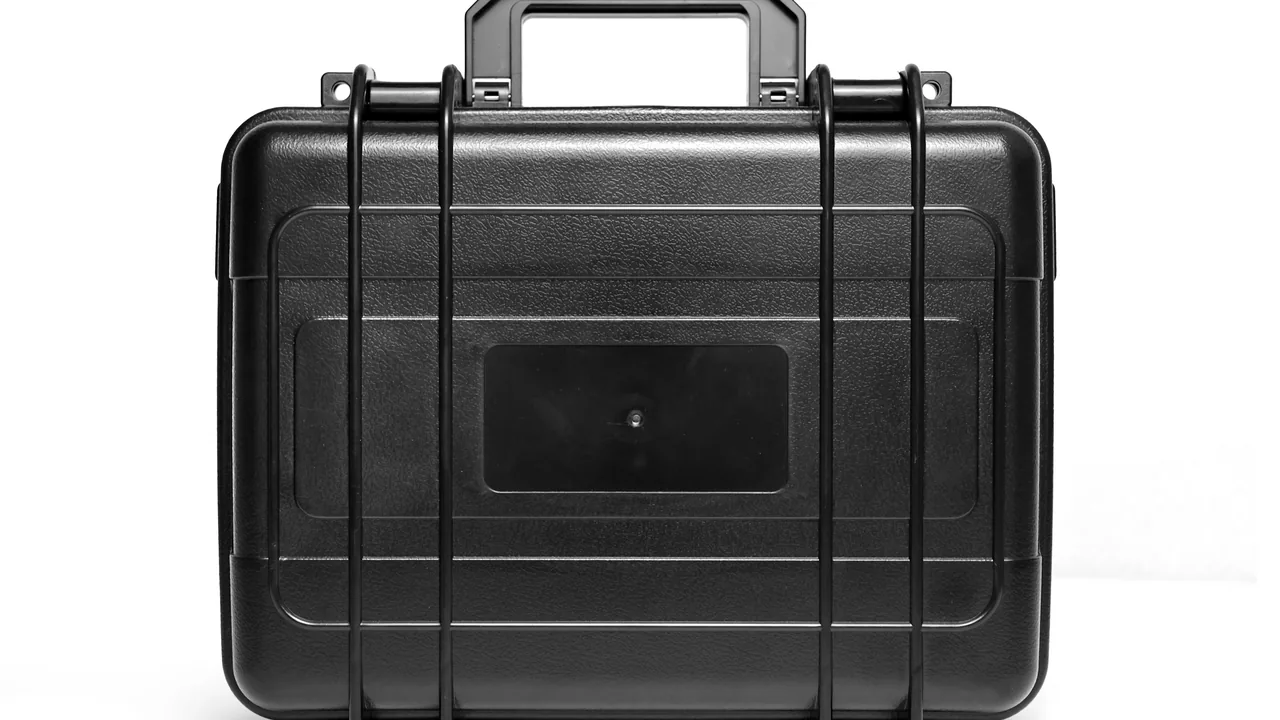
A rice transplanter is a precision planting machine whose field performance depends heavily on the geometric accuracy and fit condition of core components such as planting needles, pickup cams, seedling-tray rails and electronic control modules. During the journey from the original equipment manufacturer to regional dealers, cross-regional transfer between planting zones and after-sales spare-part flows, these components face long-distance trucking, repeated handling, open-air storage and wide swings in temperature and humidity. As a protective-case manufacturer, our team has observed over years of serving agricultural machinery suppliers that transit damage to transplanter parts rarely comes from severe crashes; it usually stems from micro-deformation of precision mating surfaces, slow corrosion of metal parts and moisture intrusion into electronic modules. This article, written from a manufacturer's perspective, systematically reviews the transit risks of planting needles and pickup mechanisms and presents targeted case solutions. For broader agricultural parts packaging ideas, see our articles on agricultural machinery parts cases and planter seeder parts cases.
Transport Risks and Three Damage Mechanisms for Transplanter Spare Parts
Spare parts for a rice transplanter can be grouped into three categories with very different logistics profiles: metal structural parts, precision moving parts and electronic control parts. Metal frames and seedling boxes mainly worry about denting and bending. Precision moving parts such as planting needles, pickup cams and shifting reversers are extremely sensitive to dimensional accuracy. Electronic control units, harnesses and sensors are classic moisture- and vibration-averse assemblies. Packing these dissimilar parts into a single shipping unit is difficult with traditional wooden crates or cartons, which struggle to combine isolation, cushioning and sealing at the same time, often producing either hard-on-hard contact or moisture seeping through gaps.
The seasonal nature of transplanter sales makes the problem worse. Spare parts frequently sit in warehouses for months between seasons. In southern rice-growing regions with high humidity and long monsoon periods, floors rebound moisture and day-night temperature swings condense water droplets, allowing barely visible rust spots to form on exposed precision metal surfaces. By the time parts are installed, the clearance between the needle and the seedling gate has already drifted because of rust or slight deformation, causing seedling damage, missed planting or inconsistent depth. A protective case should therefore be viewed not merely as a moving container but as a miniature climate-controlled cabin for precision parts across the entire chain from factory to field.
From a failure-physics standpoint, transit damage to precision transplanter parts falls into three classes. The first is plastic deformation and micro-cracks from mechanical shock and vibration, typically curled needle tips and bent camshafts. The second is surface damage from friction and contamination, typically rail scratches and abrasive particles mixed into mating faces. The third is environmental erosion causing rust and electronic moisture, typically metal-surface rust spots and damp circuit boards. These three often overlap: a single rough handling event can both cause impact deformation and shake open a gap that lets moisture in.
Understanding these mechanisms is the foundation of case design. Our engineering method performs a transit hazard analysis for each target part: first identify the most vulnerable feature of each part, then choose restraint method, cushioning material and sealing grade accordingly. This part-by-part customisation mindset suppresses damage probability at the source far better than generic cartons with bubble wrap, and aligns with the goal of controlling after-sales quality cost. It is also useful to separate reversible from irreversible damage. A scratched rail can often be polished in the workshop, whereas a curled needle, a bent camshaft or an oxidised control board usually means a full replacement, and those cases dominate after-sales cost. When the protection budget is limited, we advise directing it first at the parts whose damage cannot be repaired. The same logic applies to other precision assemblies, as discussed in our precision instrument case guide.
Planting-Needle Accuracy: The Core Vulnerability of the Pickup Mechanism
The planting needle is one of the most front-end and accuracy-critical parts of the transplanter pickup mechanism. Its tip shape, curvature and the relative clearance with the seedling gate directly determine seedling pickup volume and the rate of seedling injury. A qualified needle is produced by precision stamping or fine casting, with tip-profile tolerances held within a very tight band. In transit, however, bundled or loose needles lacking individual restraint easily press against each other, suffer lateral squeeze and micro-bend, or collide with the hard case bottom and curl at the tip.
This kind of micro-deformation is almost invisible to the naked eye in a warehouse, yet it surfaces immediately after installation: the tip scrapes the seedling gate, tears seedling roots during pickup, or produces unstable planting depth. In analysing after-sales return data, we found that many cases attributed to needle quality defects were in fact secondary damage created during transport and storage. Protection for needles must therefore follow the first principle of individual restraint, soft support and zero tip loading, rather than simply tossing them into loose foam chips.
Needle damage also has a strongly collective character. Because needles are mounted in rows and in large numbers on the pickup mechanism, a single curled or bent needle hidden inside a bundle can silently degrade the whole row if the operator does not inspect each piece. The visible symptoms are a rising rate of missed planting between rows and more torn seedling roots. The most effective way to avoid that hidden cost is to separate needles from one another at the transport stage, so that damage cannot spread from part to part. In practice this means the case interior, not the workshop bench, is where needle quality is finally decided.
Pickup Cam and Crank Mechanism Protection
The pickup cam, swing-arm crank and connecting links together generate the transplanting motion trajectory. These parts often feature carburised or induction-hardened working surfaces with good wear resistance, but the dimensional accuracy of mating bores, cam profiles and bearing seats must not be compromised. A strong impact in transit can bend the camshaft or create micro-cracks in the link pin holes, hazards that are hard to detect statically but accelerate wear or even cause shaft breakage once running.
For such parts, the case needs rigid support rather than pure soft padding. Our approach is to design dedicated cradle cavities inside the case for the camshaft and crank assembly, so the component's centre of gravity rests on support points and the suspended sections do not swing under inertial loads on rough roads. At the same time, a non-corrosive buffer layer is laid between metal contact faces to prevent hard-on-hard pressure marks and paint loss, cutting off the starting point of corrosion.
One detail that is regularly overlooked is the cleanliness of the cam working profile. Although a carburised surface is hard, once sand, metal chips or packaging debris become embedded in the profile, running clearance turns the particle into an abrasive that grinds hollows into a previously smooth lift curve and shifts pickup timing. We therefore require liners in the corresponding cavity to be non-shedding and grit-free, and we blow the profile clean with dry compressed air before packing, so the cam arrives at the assembly line in as-built condition.
Seedling-Tray Rail Straightness and Sliding Surface Care
The seedling-tray rail guides the lateral conveying of seedlings and the shifting reversal, and its straightness, surface roughness and parallelism between the two rails directly affect the uniformity of needle pickup. Rails are mostly slender aluminium extrusions or precision machined parts that fear two things: overall bending deformation and scratching or contamination of the sliding surface. If a rail is pressed under heavy loads or mixed and rubbed with rough parts, grooves appear on the surface, leading to shifting jam and reversing noise after installation.
The protection logic for rails is rigid positioning plus clean isolation. We typically use partitioned compartments that secure the rail alone in a flock-lined slot, with limit blocks locking both ends so it cannot move axially or rotate inside the case. Before packing, the rail surface can be sleeved with anti-dust air-cushion film, and the case interior is kept clean of metal debris, preventing scratches and abrasive wear at the source.
It is worth noting that a rail's slenderness ratio makes it practically incapable of resisting heavy compression through its own stiffness. Where several rails must travel in one case, we recommend a full rigid divider between layers, so the weight above is carried by the divider rather than by the rails underneath. Handled this way, even a reasonably high stack will not cause the bottom rails to sag plastically in the middle over time. Section dividers of this type are described further in our case divider versus foam comparison.
ECU Modules and Wiring Harness Moisture Control
Modern high-speed transplanters are widely equipped with electronic control modules, stepper-motor drivers, position sensors and waterproof harnesses to realise planting-spacing adjustment, automatic levelling and fault diagnosis. These electronic parts are extremely sensitive to humidity; even a thin film of condensed water on the circuit board, or moisture drawn into a connector, can cause signal drift, short circuits or even module burnout in the high-humidity field environment. When shipping passes through coastal, riverside or rainy-season areas, outside moisture slowly penetrates through packaging gaps. Our general approach to sensor electronics is detailed in the sensor transport case article.
Our strategy for electronic modules combines an independently sealed chamber with drying media. The control unit and harness connectors are placed in a small compartment with a sealing gasket, a controllable-humidity desiccant pack is added inside, and a pressure-equalisation valve is fitted on the compartment lid to block outside moisture while avoiding sucking damp air in when box pressure differs across temperature swings. For connector gold fingers, an anti-static shielding bag provides extra protection against oxidation and electrostatic damage.
A second, quieter threat to electronics is solder fatigue caused by vibration. Connectors, relays and large capacitors inside a control unit are held to the board by soldered joints, and prolonged high-frequency vibration slowly opens micro-cracks in those joints. The early signature is an intermittent fault that is hard to reproduce; the later one is a complete open circuit in the field. Sealing alone does not address this, so the electronic chamber must also provide damping that keeps the vibration level transmitted to the board inside a safe band.
Compartmentalised Case Design with IP67 Sealing
Addressing these risks, we developed a modular compartmentalised case for transplanter spare parts. The shell is injection-formed from high-strength engineering plastic with impact resistance and ageing resistance, while the interior is zoned according to the customer's part list, placing needles, pickup cams, tray rails and control modules into independent cavities that do not touch or compress each other. The compartment structure prevents hard-part collision and eases warehouse picking and inventory by part.
Structurally, reinforced ribs around the case disperse drop impact, the lid carries a dual sealing gasket for dust and water resistance, and the latches use alloy hardware for repeated open-close life. A top-cover pocket holds manuals, warranty cards and small spare items separately from precision parts. The whole solution expresses the design philosophy of rigid outside, soft inside, independent zones and controllable sealing.
IP67 means the enclosure survives immersion in one metre of water for thirty minutes without ingress. For agricultural spare-part shipping, the value of this grade lies not only in surviving a soak but in comprehensively blocking common wet hazards such as rain, road splash and floor moisture rebound. We explain the rating mechanics in our IP67 protective case overview. Our case uses a dual sealing structure between shell and lid; once latches close, a continuous seal line forms, protecting internal parts during open-air transfer, temporary yards and even accidental drops into water. It must be emphasised that the IP grade depends on the integrity of the seal and correct closure. We perform water-spray and air-tightness sampling on every batch before shipment and print closure reminders on the lid; users should also confirm latches are fully engaged and the gasket free of debris each time they pack. Correct usage habits combined with a qualified case turn the IP67 potential into real part integrity.
Precision Needle Compartments with Soft Liners
The needle is the priority-protected object in the compartment plan. We design a matrix of individual needle slots, each needle held in its own channel. The slot is CNC-carved from high-rebound EVA or PE foam matching the needle contour; the tip zone is thickened for support and stored suspended so it never bears load or scrapes the wall throughout transit. The compartment cover lightly clamps the needle mid-body after closing, fixing it without inducing stress bending.
Liner material choice matters too. We prefer sulphur-free, low-bleed environmentally friendly foam that will not release corrosive substances against metal surfaces over long contact, and the liner surface is fine and non-shedding to avoid fibres or dust sticking to the tip and affecting installation cleanliness. For high-end coated needles, a rust-prevention paper or VCI vapour-phase rust-inhibitor bag can be added to further suppress oxidation during storage and transit.
Slot density also needs balancing. Pack slots too tightly and the wall between neighbouring channels becomes thin enough to collapse under drop load and press on the needles; space them too loosely and the case wastes volume, which raises freight cost per part. Our standard approach is to split needles into a small number of length classes and keep a fixed wall-thickness allowance in each class, then assemble these slot modules into one shell. That preserves protection margin and loading density at the same time.
Vibration Damping for the Pickup Mechanism
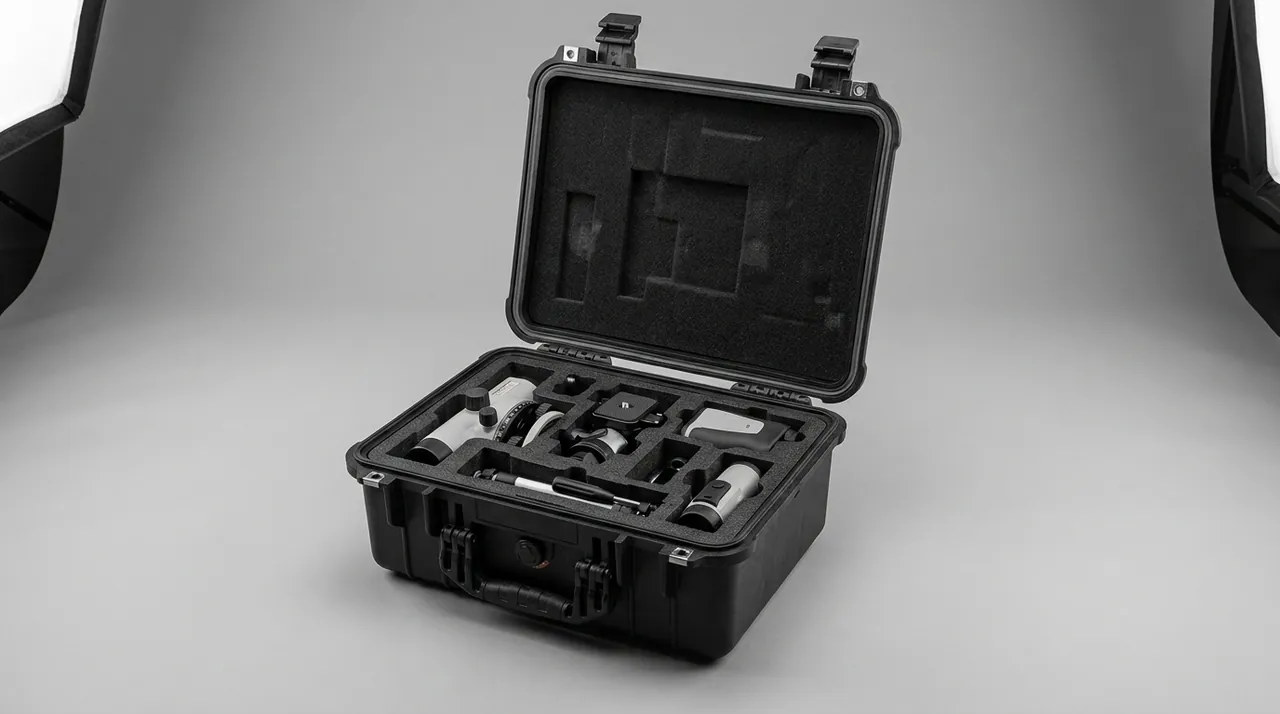
The pickup cam, crank and link assembly is vibration-sensitive. We adopt a rigid cradle plus soft-edge damping structure in the corresponding cavity: the part's main weight is carried by a rigid bracket that fits its contour, and the bracket perimeter is wrapped with elastic material to absorb and dissipate high-frequency vibration from the road. This prevents the part from jumping inside the case while avoiding the rigid support itself becoming a new impact source.
For drop protection, buffer margin is reserved at the outer corners and key liner nodes, so that when the case falls from a specified height the impact energy is first absorbed by the shell and corner foam and then attenuated to a safe range by the time it reaches the part. We select the corresponding drop-test standard according to the part weight class and perform sampled drop verification on cases loaded with the pickup assembly, ensuring reliability in real logistics environments. Background on the test methods is available in our drop test height by weight reference.
Thicker cushioning is not automatically better. An over-thick soft pad gives the part more room to travel inside the cavity, so during a drop it can accelerate to a higher relative velocity and strike with more energy; too thin a pad cannot absorb the shock at all. Our design rule is to keep free play extremely small and let the cushioning layer dissipate energy rather than yield space. Degrees of freedom are constrained first, and energy absorption is tuned afterwards.
Rigid Support and Rust Prevention for Tray Rails
Slender rails must be handled mainly with rigid strong constraint inside the case. We configure a straight slot with limit blocks for the rail; both ends are clamped by blocks and the middle is supported by contour-fitting strips, so no deflection occurs. The slot liner uses a wear-resistant, low-powder material with anti-soil treatment, keeping the rail sliding surface clean and new before installation.
For rust prevention, rails without long-life surface treatment should be lightly oiled or sleeved with VCI film before packing, and the case interior kept dry. For anodised or hard-oxide aluminium rails, clean isolation and moisture-proof sealing mainly prevent pitting. For cross-season long-term storage, a humidity indicator card inside the case lets warehouse staff visually judge whether the desiccant needs replacement. The chemistry behind vapour-phase protection is covered in our metal toolbox rust prevention notes.
Sealed ECU Chamber with VCI Moisture Control
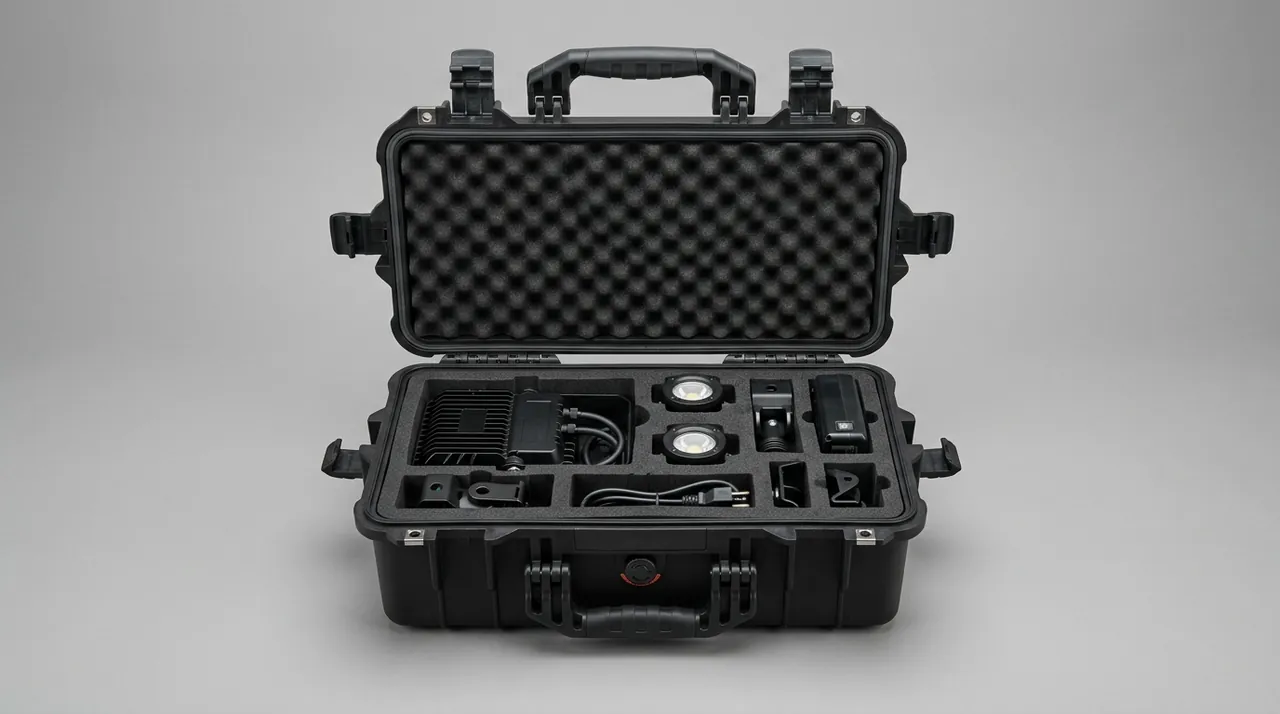
Electronic protection is the technical high ground of the whole solution. We place the control unit, driver and connectors into an independent sealed sub-chamber whose lid uses an embedded gasket to reach a dust- and water-resistant grade; desiccant is pre-loaded inside and configured with different absorption capacities according to transit duration and destination humidity. To cope with pressure differences in air or high-altitude transport, the sub-chamber is fitted with a micro pressure-equalisation valve to avoid pushing outside damp air into the cavity.
For metal connectors and module housings, we provide dual protection of VCI vapour-phase rust inhibition and anti-static shielding: the vapour-phase inhibitor forms a molecular-level protective film inside the closed space to suppress metal oxidation, while the shielding bag isolates external electrostatic discharge threats to the circuit board. We recommend users open the package in a dry environment and complete installation within a set time, minimising the risk of moisture re-intrusion.
Desiccant sizing should match the actual logistics route rather than a rule of thumb. A short domestic haul at moderate temperature usually needs only a small pack to hold the chamber at low humidity, whereas sea freight, cross-latitude shipping or a long monsoon-season journey requires the allowance to be scaled by transit days, destination mean humidity and the permeation rate of the case. During the proposal stage we confirm transport mode and expected duration with the customer, then specify desiccant weight and a replacement interval, avoiding both under-protection and wasted cost.

Custom Foam Insert Materials and Tooling
The foam insert is the soul of the protective case and directly decides whether parts are treated gently. Common liner materials include EVA, PE, PU and XPE, each with different traits: EVA has good rebound and fit, suited to precision parts like needles; PE foam is pressure-resistant and less deformable, suited to heavy support for rails and cams; XPE is closed-cell, moisture-proof and easy to clean, suited to electronic chambers. After material selection, CNC precision carving builds the mould from the part's 3D data or physical scan. Our broader reference on custom foam inserts covers material comparison in depth.
During tooling, we confirm with the customer each part's placement posture, pick-and-place direction and tolerance fit, avoiding liner cavities so tight they scratch on handling or so loose the part jumps. For cases shared across multiple transplanter models, replaceable liner modules can be designed so one shell adapts several part combinations, reducing procurement cost and improving storage flexibility.
Loading, Stacking and Climate Considerations
Even the best case needs correct logistics operation. When loading, we recommend placing cases with electronic modules on upper layers or away from heat sources, avoiding bottom-layer compression and engine-compartment residual heat affecting electronics; multiple cases should stack on a flat base with centred gravity and be fixed with straps to prevent sliding in transit. External precision instrument and moisture-proof labels remind handlers to be careful.
For temperature and humidity, although the case is sealed and moisture-proof, long-term storage should still use cool, dry shelving off the floor and wall to avoid rebound moisture and condensation from day-night swings. Before cross-season storage, check desiccant status and gasket ageing. After sea freight or rainy-season long hauls, open the case in a clean environment on arrival, first observe the humidity card and part appearance, then install only after confirmation, keeping potential risk outside the workshop. General stacking and shelving requirements are set out in our warehouse storage rules article.
Selection Checklist and Manufacturer Capabilities
We summarise a practical selection checklist for users. Step one, list parts and classify them as precision moving parts, slender structural parts and electronic control modules. Step two, measure the largest part's external dimensions and weight to determine interior clear space and load capacity. Step three, choose protection grade by transport distance and mode; long cross-region or sea-inclusive routes prioritise IP67. Step four, confirm liner material and compartment layout, requiring independent restraint for critical parts. Step five, evaluate whether add-ons like desiccant, pressure valve and anti-static bag are needed. Step six, provide the manufacturer with physical parts or drawings for accurate tooling.
When receiving such requirements, we usually issue a liner layout sketch and protection proposal for confirmation before tooling and sampling; the sample case passes drop and seal verification before mass production. This proposal-before-mould flow significantly reduces rework and loss from selection mistakes.
Our brand manufactures custom protective cases with a complete chain from hazard analysis, liner design, mould development to batch delivery, serving not only transplanter parts but also combine harvesters, planters, rotary tillers and sprayers. We persist in a part-risk-centred design principle, translating each precision part's vulnerability into concrete cavity, material and sealing parameters so the case truly acts as an insurance box in transit. If your operation struggles with curled needles, rusty rails or damp control boards, our team is glad to work through the specific configuration with you. For related topics on agricultural and precision protection, you may also read our articles on agricultural machinery parts cases, combine harvester parts cases and precision instrument case.
Frequently Asked Questions
Q: What problems do rice transplanter planting needles most easily encounter in transit, and how does a protective case solve them? A: The most common transit problems for needles are micro-bending of the tip, curled tips and contour deformation from mutual stacking. These defects are almost impossible to see on a warehouse shelf, yet after installation they immediately cause seedling injury, missed planting and an unstable planting depth, so the damage only becomes visible at the worst possible moment. Our answer is a matrix of individual needle slots in which every needle is separately restrained: the tip zone is thickened and stored suspended, the mid-body is softly clamped by the compartment cover, and no needle ever bears load or scrapes a wall throughout the journey. The liner uses sulphur-free, low-bleed foam so that long contact with metal releases no corrosive substances and the surface does not shed fibres or dust onto the tip. For coated or plated needles we add rust-prevention paper or a VCI vapour-phase inhibitor bag to suppress oxidation. Before packing, operators inspect each needle individually for burrs and stacking marks, because a single bent needle hidden in a bundle can degrade an entire installed row. Combining structural restraint, material protection and an incoming check removes the damage at its source, and it costs far less than replacing a full row of needles after a single bad shipment.
Q: Should transmission parts like the pickup cam and crank assembly use soft padding or hard support? A: These parts have both precision mating bores and a heavy body, so neither extreme works on its own. Pure soft padding lets them swing under inertial loads on bumpy roads, gradually wearing the bores and stressing the pin joints, while pure hard support creates hard-on-hard pressure marks and paint loss that become the starting points of corrosion. We therefore combine a rigid cradle with soft edges. The main weight rests on a contour-fitting rigid bracket so the centre of gravity sits on defined support points, and the bracket perimeter is wrapped with elastic material that absorbs and dissipates high-frequency road vibration. Buffer margin is reserved at key nodes, and the part is left with almost no free play inside the cavity, which keeps it from accelerating into a harder impact during a drop. After loading the pickup assembly we perform sampled drop verification according to the weight class, then check camshaft run-out and inspect the link pin holes for cracks. The result is a transmission assembly that survives long road vibration while remaining dimensionally true, so the camshaft does not bend and the pin holes do not crack under real logistics conditions, even after several cross-region transfers in a single planting season.
Q: Tray rails are long and slender; how do you prevent bending and scratching in transit? A: Slender rails fear heavy-load bending and sliding-surface scratches more than anything else. We configure a straight slot with limit blocks that clamp both ends and contour-fitting strips that support the middle, so the rail cannot deflect, rotate or shift axially inside the case. The slot liner is wear-resistant, low-powder and anti-soil treated, and the case interior is kept free of metal debris, which keeps the sliding surface clean and new before installation. Because a rail's slenderness ratio makes it practically unable to resist compression through its own stiffness, whenever several rails must travel together we add a full rigid divider between layers so the weight above is carried by the divider rather than the rails underneath. Rails without a long-life surface treatment can be lightly oiled or sleeved with VCI film before packing, and anodised aluminium rails rely on clean isolation and moisture-proof sealing to prevent pitting. For cross-season storage, a humidity indicator card inside the case lets warehouse staff judge visually whether the desiccant needs replacement, so bending, scratching and rust are controlled together inside a single transport unit rather than being traded off against one another.
Q: The transplanter control unit is moisture-sensitive; how far can a protective case go? A: We place the control unit, driver and connectors into an independent sealed sub-chamber whose embedded gasket reaches a dust- and water-resistant grade, with pre-loaded desiccant configured to the destination humidity. Sizing is matched to the route rather than a rule of thumb: a short domestic haul at moderate temperature needs only a small pack to hold the chamber at low humidity, while sea freight, cross-latitude shipping or a long monsoon-season journey requires the allowance to be scaled by transit days, mean humidity and case permeation rate. To cope with air or high-altitude pressure differences, the sub-chamber carries a micro pressure-equalisation valve that avoids pushing outside damp air into the cavity during temperature swings. Electronics also suffer from vibration: soldered joints on connectors, relays and large capacitors fatigue under prolonged high-frequency excitation, first as intermittent faults and later as open circuits, so the chamber includes damping that keeps board vibration inside a safe band. Metal connectors additionally get dual VCI vapour-phase rust inhibition and anti-static shielding bags, and users only need to open in a dry environment and install within a set time to minimise moisture risk before the desiccant is exhausted.
Q: Is an IP67 protective case really necessary for agricultural spare parts? A: Very much so, and the cost argument is straightforward. Agricultural spares routinely face open-air transfer, temporary yards and rainy-season long hauls, and the dual sealing structure of IP67 comprehensively blocks rain, road splash and floor moisture rebound, even protecting internal parts during an accidental drop into water. Replacing a set of curled needles, a rusted tray rail or a damp control module typically costs more than the protective case itself, so the protection premium pays back the first time a shipment is caught in bad weather or left uncovered at a transfer yard. Remember that the IP grade depends entirely on seal integrity and correct closure. We perform water-spray and air-tightness sampling on every batch before shipment and print closure reminders on the lid, and users must confirm latches are fully engaged and the gasket is clear of debris and free of ageing cracks each time they pack. Correct habits plus a qualified case are what convert rated protection potential into real part integrity, and that conversion is what the purchase is really paying for.
Q: What foam material is best for custom liners, and is tooling complicated? A: We commonly use EVA, PE, PU and XPE, and the right choice depends on the part rather than on a single best material. EVA offers good rebound and contour fit, so it suits precision parts such as planting needles. PE foam is pressure-resistant and resists permanent set, which makes it the natural choice for heavy support under rails and cam assemblies. XPE is closed-cell, moisture-proof and easy to clean, so it belongs in the electronic chamber. PU sits between hardness and rebound and is used where a part needs moderate firmness. After material selection, CNC precision carving builds the mould from the part's 3D data or a physical scan, and during tooling we confirm placement posture, pick-and-place direction and tolerance fit with the customer so cavities are neither so tight that handling scratches the part nor so loose that it jumps. The flow normally runs through drawing approval, sample case build, trial fitting and then batch production. Multi-model shared cases can use replaceable liner modules so one shell fits several part combinations, cutting procurement cost and improving storage flexibility without compromising the protection of any individual part type.
Q: When one case holds several part types, how do you balance isolation, cushioning and sealing? A: The core idea is independent compartments, because the three requirements pull in different directions and cannot be solved by one material. We zone needles, pickup mechanism, tray rails and control modules into separate cavities that never touch or compress each other, and each cavity can then use its own liner: high-rebound foam for precision needles, pressure-resistant foam for heavy rails and cams, and closed-cell material for the electronic chamber. The shell carries reinforced ribs around its perimeter to disperse drop impact, a dual lid gasket provides dust and water resistance, and alloy latches deliver the open-close life needed for repeated warehouse handling. A top-cover pocket holds manuals, warranty cards and small spares apart from precision parts so they cannot migrate into a needle slot. Together these choices express the principle of rigid outside, soft inside, independent zones and controllable sealing, which balances isolation, cushioning and sealing inside a single case rather than forcing a compromise between them.
Q: For long cross-season storage of transplanter spares, what else should the case observe? A: Even with a sealed case, cross-season storage still needs sensible warehouse discipline. Choose cool, dry shelving off the floor and away from walls to avoid rebound moisture and condensation driven by day-night temperature swings, and keep the stack height moderate because a bottom case under sustained compression will deform its gasket over time. A limit of around three layers with periodic restacking is a practical rule. Before packing for storage, check desiccant status and inspect the gasket for ageing, hardening or cracks, replacing it if the seal no longer closes cleanly. After sea freight or a rainy-season long haul, open the case in a clean environment on arrival, inspect the humidity indicator card and the appearance of the parts, and only then proceed to installation. We recommend keeping a humidity indicator card inside every case so warehouse staff can decide visually whether the desiccant needs replacement, which keeps rust and moisture risk outside the workshop instead of discovering it during the busy planting window.
Q: What supporting services can a protective-case manufacturer provide for transplanter parts? A: A qualified manufacturer offers a full chain from transit hazard analysis and liner design through mould development to batch delivery, supporting both single-item customisation and serialised standard cases across transplanters, harvesters, planters and rotary tillers, guided by a part-risk-centred principle. In practice this means we first identify the most vulnerable feature of each part, then translate it into a specific cavity, liner material and sealing grade rather than starting from a catalogue. On receiving a requirement we issue a liner layout sketch and protection proposal for confirmation, build a sample case, and only release mass production after the sample passes drop and seal verification. We can also advise on desiccant sizing by route, gasket replacement intervals and incoming inspection points, and we are glad to work through specific problems such as curled needles, rusty rails or damp control boards with your team. For further reading on agricultural and precision protection, see: agricultural machinery parts cases, planter seeder parts cases, combine harvester parts cases.