

A starch syrup plant — glucose syrup, high-fructose syrup, maltose syrup and maltodextrin — is a chain of unit operations: liquefaction, saccharification, decolourising filtration, ion exchange, multi-effect evaporation and blending. What actually determines dextrose equivalent, colour, clarity and yield is not the building but a set of small, temperamental components: the nozzle plate and mixing chamber of the jet liquefier, the agitator and heat-exchange coils inside the saccharification tank, the filter plates and cartridges of the decolourising stage, the distribution headers and collection pipes of the ion-exchange columns, and the heating tube bundles and separator internals of the evaporators. They are simultaneously heavy, long, thin-walled and precise. A nozzle hole is measured in millimetres or fractions of one, a heating tube wall may be only 1.2–2 mm thick, and an agitator shaft carries a demanding dynamic balance specification. One knock, one bend or one damp chloride pit can escalate, once the line restarts, into a whole batch of downgraded syrup.
JUNZHIJIA's position: protecting starch syrup line parts means modelling three things at once — component geometry, process medium and transport route — locking out deformation and pitting first, preserving hygienic cleanliness second, and discussing packaging cost last. Only when cavity division, cushioning, moisture sealing and food-contact safety are designed together can a six-metre heating bundle and a three-millimetre nozzle arrive safely in the same case.
Table of Contents
- Component Mix and Transport Risk on a Starch Syrup Line
- Protecting Jet Liquefier Nozzles and Mixing Chambers
- Securing Saccharification Agitators and Coil Assemblies
- Syrup Corrosion and Anti-Corrosion Packing for 304/316L Parts
- Divided Cavities for Filtration and Ion-Exchange Parts
- Evaporator Heating Bundles and Long-Item Protection
- Hygienic Cleaning and Food-Contact Liners
- Sealing Levels: IP65/IP67 and GB/T 4208 in Practice
- Cushion Selection: EPE, EVA, PE and IXPE
- Latches, Hinges and Pressure Equalisation Valves
- Stacking Loads, Warehousing and Cross-Border Logistics
- Temperature, Humidity and Salt Spray (GB/T 10125)
- Transport Testing, Tooling and Acceptance Criteria
- Frequently Asked Questions FAQ
- Conclusion and Related Reading
Component Mix and Transport Risk on a Starch Syrup Line
Starch syrup components span an enormous range: high-precision small parts at one end, metre-long heavy parts at the other. Before a case is specified, geometry, material and medium must be aligned, because only then can anyone decide whether two items may share a case, how many cavities are needed and how many cushion stages are required. Liquefaction runs at 105–110 °C and pH 5.8–6.2; saccharification drops to 58–62 °C and holds for tens of hours; decolourising involves activated carbon and resin; evaporation operates under vacuum at 70–85 °C. Parts that have seen these conditions often carry a film of syrup, a scorched deposit or a layer of decolourising powder — residue that itself absorbs moisture, turns tacky and, under vibration, polishes contact faces into scratches.
| Stage | Typical parts | Common material | Dominant transport failure | Protection focus |
|---|---|---|---|---|
| --- | --- | --- | --- | --- |
| Liquefaction | Nozzle plate, mixing chamber, steam injection ring | 316L / duplex | Hole crushing, chamber scoring, flange knocks | Individual cavities + port plugs + face film |
| Saccharification | Agitator shaft, impellers, heat-exchange coil, baffles | 304 / 316L | Shaft bending, balance loss, coil port ovality | Continuous supports + centring cradles + port caps |
| Decolourising filtration | Plates, cartridges, screens, gaskets | 316L / reinforced PP | Plate warping, screen collapse, gasket ageing | Vertical dividers + face load spreading |
| Ion exchange | Distribution headers, collection pipes, sight glasses | 316L / PVC-U | Header scoring, pipe distortion, glass breakage | Isolated cavities + soft wraps + no vibration |
| Evaporation | Heating tube bundle, separator internals, circulation pump casing | 316L / titanium | Bundle deflection, tube-end ovality, lifting-point damage | Multiple cradles + span control + reinforced lugs |
| Blending | Rotary pumps, metering parts, inline instruments | 316L / hygienic alloys | Rotor seizure, instrument zero drift, probe damage | Divided cavities + magnetic shielding + conductive liner |
A practical way to rank risk is to tag every part with three coefficients: stiffness (long, slender parts bend), precision (tight tolerances bruise) and cleanliness (food-contact surfaces contaminate). Multiply the three and place the result on a quadrant matrix. Jet liquefier nozzles land in high-precision plus high-cleanliness; evaporator tube bundles land in low-stiffness plus high-cleanliness. Even if both ship on the same truck, they demand entirely different fixing and cushioning strategies.
Protecting Jet Liquefier Nozzles and Mixing Chambers
The jet liquefier is the gate of the whole line: steam and starch slurry collide at high velocity inside the chamber, and the hole pattern on the nozzle plate governs atomisation and gelatinisation. Hole diameters typically run from 3 to 12 mm, with tightly controlled edge radii and entry angles. A crushed edge or a burr will skew the steam jet, causing local overheating, protein coagulation and drift in the liquefaction DE value. The mixing chamber bore is usually polished to Ra ≤ 0.8 µm; a scratch does not weaken the part, but it becomes the starting point for syrup scorching.
Design points for packing:
- Port protection. Insert a food-grade PE plug or soft silicone bung into every hole so neighbouring parts cannot enter, and so the hole edge never touches bare metal.
- Chamber centring. Cradle the mixing chamber in two EVA half-round supports, with relief slots so the flange face hangs free and never rests on the case floor.
- Face protection. Apply a self-adhesive PE film to the sealing face, then a 3 mm EVA pad, covering both scratch and impact risk.
- Dry and inert. Place silica gel in the chamber and seal the assembly in an aluminium-foil laminate bag to suppress pitting driven by residual moisture.
- Separate cavities. Never stack the nozzle plate on the chamber; heavier parts must not sit on precision parts.
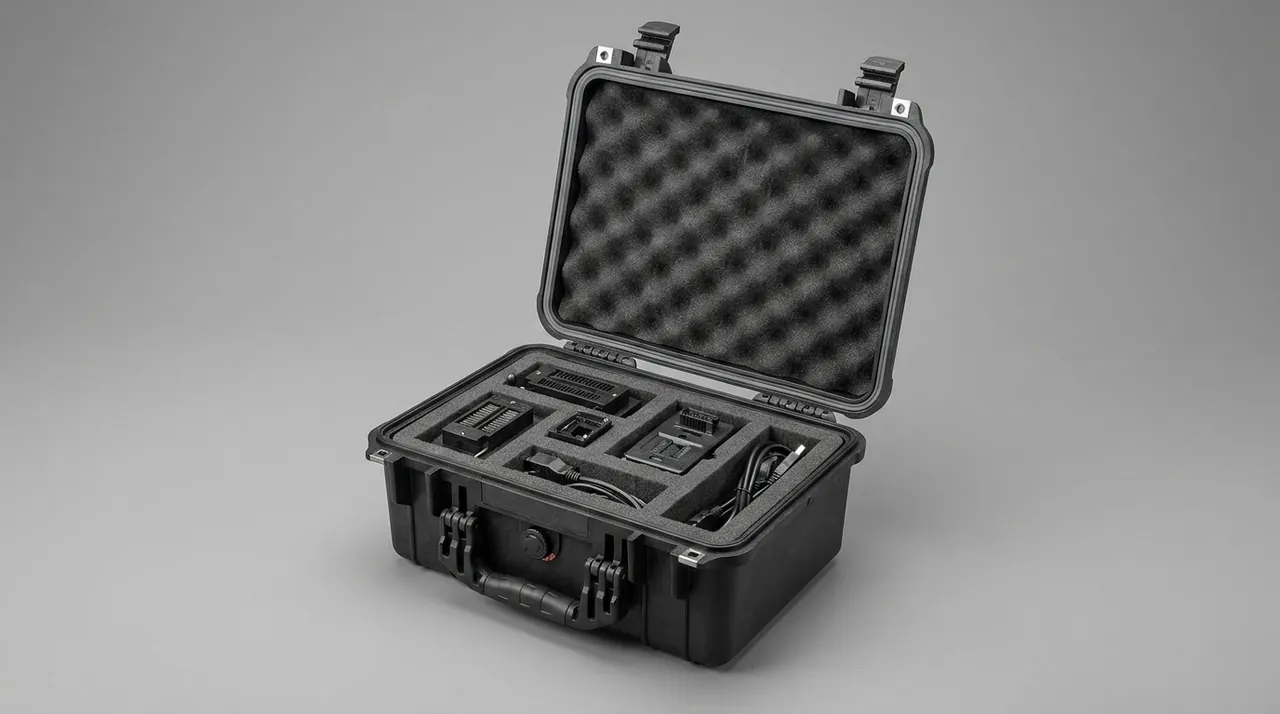
Steam injection rings and static mixing elements from the same stage may share the case, but must be layered by stiffness: ports facing up, support faces down, with IXPE separators rather than bubble wrap between layers.
Securing Saccharification Agitators and Coil Assemblies
The saccharification agitator shaft is a classic aspect-ratio-sensitive item. A 4–6 m shaft supported only at its ends accumulates deflection quickly under road vibration. Even if nothing is visible at the time, an out-of-straightness condition after installation causes seal rubbing and premature bearing failure. The accepted engineering fix is to tighten support spacing so that no span exceeds 1.2 m, using V-shaped soft cradles machined from EVA or high-density PE and lined with fabric to take the radial restraint.
Coils and serpentines are difficult at the ports. Coil connections are usually welded flanges or tri-clamp ferrules, both with roundness requirements. A sensible sequence is:
- Cap each port with a same-diameter PE cap, then wrap with self-adhesive protective film.
- Wrap the coil body with two passes of PE stretch film so turns cannot rub against each other.
- Band the coil in its wound direction to keep the bundle from opening in transit.
- Place the whole coil in its own long cavity, fill the perimeter with EPE foam strips, and leave no movable gap.
Impellers should be positioned impeller-up with the load taken by the hub, never touching a hard surface. If an impeller has already been balanced, ship the balance record and weight list with it and keep the weights in their original positions — a dismantled weight set means rebalancing on site. The packing logic for agitators and shaft seals follows the same rules described in Chemical Reactor Parts Cases: Transport Protection for Agitators & Seals.
Syrup Corrosion and Anti-Corrosion Packing for 304/316L Parts
Corrosion of stainless steel in a starch syrup environment does not come from the sugar. It comes from chlorides in the syrup, residual cleaning agents (chlorinated sanitisers) and acidic media. Grade 304 has a noticeably lower pitting and crevice corrosion threshold in chloride service than 316L; the 2–3% molybdenum in 316L raises that threshold. "The part is corrosion resistant" and "the packing stage prevents corrosion" are therefore two separate matters, and one cannot substitute for the other.
| Item | 304 | 316L | Packing countermeasure |
|---|---|---|---|
| --- | --- | --- | --- |
| Chemistry | 18Cr-8Ni, no Mo | 16–18Cr-10–14Ni-2–3Mo | Segregate by grade to avoid galvanic pairs |
| Chloride pitting resistance | Moderate | Better | Low-chloride, halogen-free liner materials |
| Crevice corrosion sensitivity | Higher | Lower | Film on sealing faces, no trapped liquid |
| Sensitivity to cleaning residue | High | Medium | Dechlorinated rinse plus full drying |
| Packing focus | Extra desiccant + VCI | Desiccant + face film | Foil bag + vapour-phase inhibitor film |
Three rules govern the packing side. First, dry completely. Anything that can be oven-dried or blown dry with compressed air must not go into a case wet; blow out blind spots such as flange bolt holes, port bores and hub cavities. Second, exclude halogens. Cushioning, stretch film and label adhesives must be confirmed halogen-free and low in chloride, because in a damp environment they release chloride ions. Third, build a desiccant gradient. Size silica gel by net case volume and transit duration, increase the quantity for long sea legs, and monitor with a humidity indicator card. Where the surface has been polished for food contact, add a vapour-phase inhibitor (VCI) liner inside the pack: VCI molecules deposit uniformly on metal surfaces and form a monomolecular barrier, effective for the 30–90 day window of a typical shipment, and require no cleaning at unpacking. For a broader comparison of how metals behave in damp and chloride-bearing conditions, see Stainless Steel vs Cast Aluminium Corrosion Resistance.
Divided Cavities for Filtration and Ion-Exchange Parts
Decolourising filtration and ion exchange are the most delicate purification stages and the most delicate packing job. Filter plates are thin-walled with tight flatness requirements; cartridges and screens collapse under point loads; ion-exchange distribution headers are perforated with a dense field of small holes. None of these parts is heavy, yet all of them fear a localised concentrated load.
The cavity rule should be "one part per cavity, different part types in different cavities". In practice:
- Filter plates. Stand them upright with a 20–30 mm cushion between plate face and case wall, and clamp both sides with adjustable dividers so they cannot topple. Never lay them flat and stack them — the plates below take a permanent load and warp.
- Cartridges and screens. Slip each unit into a paper tube or PE sleeve before it enters its compartment so mesh faces cannot hook each other; for larger quantities use a honeycomb grid to position every item.
- Headers and collection pipes. Wrap the body in PE stretch film, cap both ends in soft material, and place them port-up in a dedicated long cavity with EVA end supports.
- Sight glasses and column internals. Wrap glass separately, keep it away from heavy items, and prevent broken fragments from scoring other parts.
Dividing cavities is not a matter of adding more dividers; it means keeping free travel below 5 mm in every cavity. A simple checklist works: a hand push should produce no visible movement, a case inversion should not change any part's orientation, and removal should never require a pry tool. For the holding methods used on thin plates and screens, see Filter Press Cases: Plate & Hydraulic Closing Protection.
Evaporator Heating Bundles and Long-Item Protection
The heating bundle of a multi-effect evaporator is among the hardest parts on the line to case. It often measures 4–8 m, individual tube walls are thin, tube ends must stay round, and the complete bundle is heavy. Long-item failures almost all reduce to deflection and end damage, so the design logic differs completely from that of short parts.
Spans and cradles. Support the bundle every 1.0–1.2 m with a U-shaped cradle machined from EVA or high-density PE and lined with soft material, giving line contact rather than point contact with the tube wall. Cradles must be fastened to the case reinforcement, never merely bedded in floor foam, or the whole assembly sinks under stacking load.
Ends and tube mouths. Cap every tube individually with a PE cap and add a 20 mm EVA end plate at each end of the bundle to spread axial shock. If the bundle carries a tubesheet, film the tubesheet flange face as well.
Lifting points and marking. Mark the centre of gravity and lifting points on the outside of the case. For long cases, provide four lifting apertures rather than two so a single-point lift cannot bend the load, and include a lifting diagram inside the case.
Stacking restrictions. Long-item cases should not be stacked at all, or only in a single homogeneous layer with matching length and width and faces up, with a defined maximum layer count. If stacking is unavoidable, add longitudinal reinforcement ribs and verify the load on the bottom case.
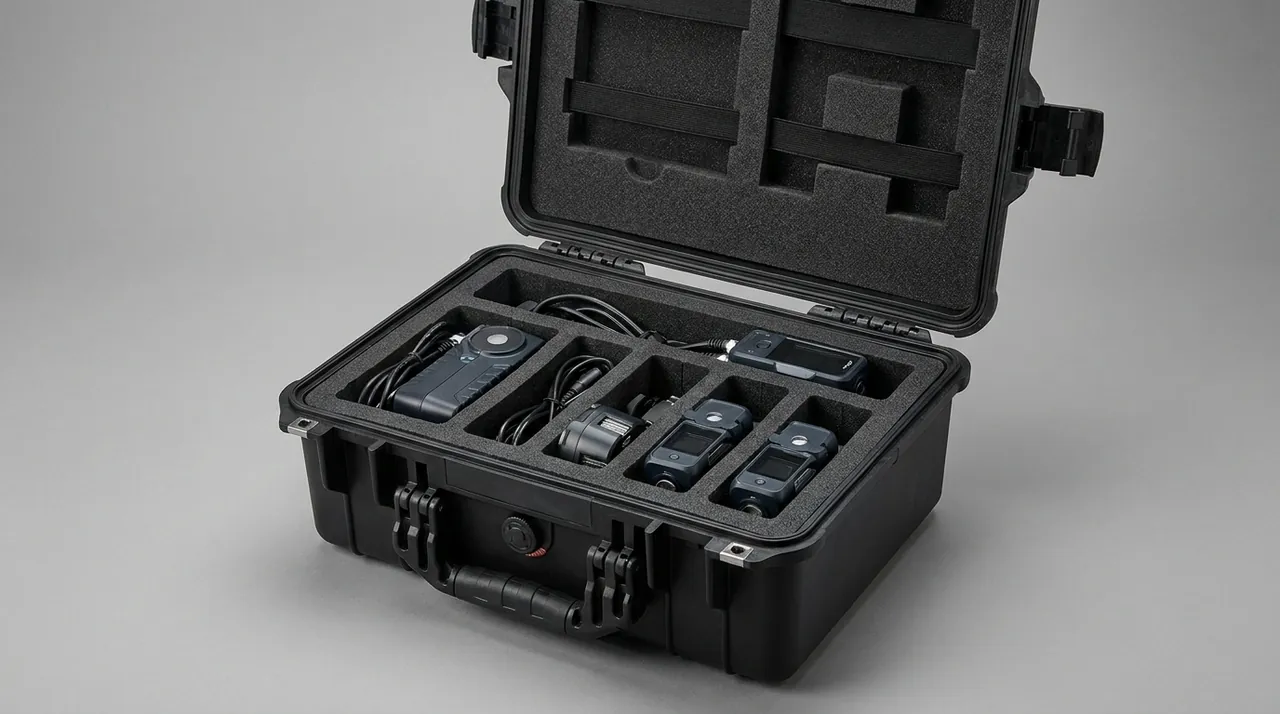
Bundles that exceed normal transport dimensions can be split into two sections for site re-assembly, or moved to a steel-framed case with an inner liner and a cushion layer between frame and case.
Hygienic Cleaning and Food-Contact Liners
Starch syrup is food, so the liner and packing materials that touch the parts sit on a food-safety boundary. Three requirements define it: no odour, no migration, cleanable. Regrind, halogen-containing foams and adhesives with a strong solvent smell have no place in direct contact with hygienic stainless surfaces.
Preferred materials are food-grade EPE (low-density polyethylene foam), food-grade PE sheet, food-grade EVA and compliant IXPE. These have high closed-cell content, low water absorption and no pronounced odour. Where a liner is bonded from several pieces, choose low-VOC adhesives that cure without residual smell and let the liner air before packing.
Supporting hygiene actions include:
- Cleanliness verification of the liner before assembly, with no swarf, dust or oil;
- Physical separation of the packing area from general production to avoid cross-contamination;
- Clean gloves for operators, with bare hands kept off polished surfaces;
- Material certificates and food-contact declarations shipped with the case.
For customers with audit obligations, include a packing cleanliness record inside the case showing the cleaning time, method (for example purified-water rinse followed by oil-free compressed-air drying), the inspector and the reviewer. During an overseas factory audit this document frequently settles more questions than the packaging itself. Agitators and sensors on fermentation and saccharification duty carry similar cleanliness requirements and can be planned alongside Bioreactor & Fermentation Parts Cases: Agitator & Sensor Component Protection.
Sealing Levels: IP65/IP67 and GB/T 4208 in Practice
A seal is not achieved by applying more sealant. It depends on one complete path: mating face, seal groove, gasket, latch preload, pressure equalisation. Remove any link and the rated protection level is only a number on paper. IEC 60529 and the Chinese equivalent GB/T 4208 separate ingress protection into dust and water categories; the highest dust level is 6 (dust-tight), water level 6 denotes protection against powerful water jets and level 7 denotes short-term immersion. The verdict also depends on sample condition, test duration and the pressure differential across the seal.
| Level | Dust | Water (summary) | Suitable starch syrup scenario |
|---|---|---|---|
| --- | --- | --- | --- |
| IP54 | Partial dust protection | Splash | In-plant short moves, dry-stage transfer |
| IP65 | Dust-tight | Water jets | Domestic road transport near steam and washdown |
| IP67 | Dust-tight | Short immersion | Sea freight, open yards, rainy-region transfer |
| IP68 | Dust-tight | Continuous immersion (agreed conditions) | Special duties, not a default choice |
The practical rule is to select for the worst condition on the transport route, not the normal condition in the workshop. If parts go by sea or wait in the open, IP67 is the sensible floor. If everything moves inside a dry workshop, IP54 is enough and the extra rating is money spent for nothing. Note too that the rating describes the case itself; whether the contents stay dry also depends on condensation from temperature swings and residual internal moisture, and those are managed by desiccant and a pressure equalisation valve working together. JUNZHIJIA therefore confirms sealing level, breather valve and desiccant as one parameter group in every specification.
Cushion Selection: EPE, EVA, PE and IXPE
No cushioning material is universally best; each either matches a part's characteristics or does not. Selection rests on three dimensions: rebound speed, compression set and formability. Fast rebound throws impact energy back into the part; slow rebound fails to recover and degrades over repeated stacking; high compression set means the material collapses under sustained load and reopens the very gap that had been closed.
| Material | Density and feel | Rebound | Forming process | Best-fit parts |
|---|---|---|---|---|
| --- | --- | --- | --- | --- |
| EPE pearl foam | Light, soft, closed-cell | Fast | Cutting, laminating, thermoforming | High-volume compartments, fills, end pads |
| EVA | Medium-high density, good resilience | Medium | CNC routing, thermoforming | Precision locating slots, profiled cavities |
| PE board | Hard, stiff | Slow | Routing, bending, welding | Structural support, dividers, load bases |
| IXPE (electron cross-linked) | Fine, thin | Even | Die-cutting, laminating | Thin separators, face protection, layering |
A typical starch syrup build-up is "PE shaping base, EVA locating layer, IXPE face layer, EPE gap fill". The gradient lets each material do one job: PE supplies structural stiffness, EVA holds the part precisely, IXPE protects the surface, EPE takes up variable clearance. For a single part with simple geometry, a solid routed EVA block is often better because it removes joints and slip paths. Cushion thickness should not be guessed: estimate part weight and drop height, size the thickness from an energy-absorption calculation, then verify with a drop-hammer test on a sample. Nozzle plates and cartridges often need only 15–25 mm of EVA, while a hub weighing tens of kilograms calls for 40 mm or more of combined cushioning. Comparative rebound and compression-set data for common foams appear in Protective Case Foam Material Comparison: EVA vs EPE vs XPE vs PU.
Latches, Hinges and Pressure Equalisation Valves
The moving parts of a case decide whether protection survives repeated use. Latches apply preload, hinges locate the lid through opening and closing, and the pressure equalisation valve balances differential pressure; together they close the mechanical reliability loop.
Latches. Starch syrup parts cases commonly weigh 15–80 kg, so two or four wide-body latches are appropriate, with a preload travel that compresses the gasket by 30–50% of its rebound. After closing, inspect the mating line with a feeler gauge and open and close three more times to confirm consistent feel. Hinges. Heavy cases should use metal pins or reinforced engineering-plastic hinges with ribbed transitions to avoid stress concentration. On cases opened frequently the hinge is the first wear item and belongs on the spare-parts list. Pressure equalisation valve. This is the most commonly omitted component. In transit, and especially by air or on high-altitude roads, external pressure changes create a differential across the case; at best the lid is hard to open, at worst the gasket is drawn in or rolled outward. A breather valve uses a waterproof breathable membrane so air passes but water does not, and it removes the vacuum that snaps the lid shut on opening. Specify venting rate, protection level, temperature range and membrane chemical compatibility. Membrane data and selection guidance are covered in Pressure Equalization Valve Selection for Protective Cases.
| Component | Key parameters | Common failure | Check method |
|---|---|---|---|
| --- | --- | --- | --- |
| Latch | Preload travel, clamp force, material | Loosening, fracture, seizure | Three-cycle consistency, feeler gauge |
| Hinge | Pin strength, opening angle | Loose pin, cracked base | Visual plus shake test |
| Breather valve | Venting rate, IP rating, temperature | Blocked or torn membrane, leak | Immersion observation, flow test |
Stacking Loads, Warehousing and Cross-Border Logistics
In warehousing and logistics a starch syrup parts case meets three load classes: static stack load, dynamic vibration and handling shock. Load paths should run from the case skin into the reinforcement ribs and then into the stacking face, never through the gasket or the latches.
A stacking plan should state numbers: permitted layer count, maximum load per case, stacking-face material and whether a pallet is required. Long-item and overweight cases normally travel as a single layer on a pallet with stretch wrap rather than stacked vertically. Pallet selection must match the case base, which should carry anti-slip feet or locating slots that engage the pallet deck.
Cross-border work raises several practical points. Timber pallets and crates may fall under phytosanitary rules and need fumigation or heat-treatment markings. Temperature and humidity inside a sea container swing widely, so desiccant and breather valve sizing should be based on the longest plausible transit, not the average.
For customs and handover, attach a packing list with part-number cross reference listing drawing number, quantity, material and installation position for every item inside. For multi-case projects, the outer label should carry the project number, case sequence and total case count so the site team can open cases in order and kit them by process stage. Roller and drive components travelling alongside follow comparable practice, as described in Conveyor Roller & Parts Cases: Roller & Drive Component Protection.
Temperature, Humidity and Salt Spray (GB/T 10125)
The transport environment attacks metal parts through two routes: condensation from temperature swings and salt-laden aerosol deposition. The first happens on long road legs and inside containers with large day-night swings; the second appears at coastal ports, on sea voyages and in coastal storage. If neither is handled explicitly in the packing specification, it is usually discovered only when the case is opened and the parts are already corroded.
Condensation is managed by reducing moisture and damping fluctuation: size the desiccant properly to hold relative humidity inside a safe band, use aluminium-foil laminate or a high-barrier liner to slow heat transfer through the case wall, and apply VCI film on critical surfaces. Desiccant quantity cannot come from volume alone; it must account for transit days, the water-vapour transmission rate of the packaging materials and the initial moisture content.
Salt spray is addressed by GB/T 10125, which specifies artificial-atmosphere corrosion testing and is widely used to evaluate coatings, platings and hardware in saline conditions. The value of a protective case is that it keeps salt aerosol outside: sealing level, hardware grade (stainless hinges and latches outperform zinc-plated parts) and the case's own salt-spray treatment together determine the outcome. One caveat matters: passing a salt-spray test for a given duration does not guarantee that the contents will stay corrosion-free under every transport condition, because test conditions and real service differ. Actual anti-corrosion performance still relies on desiccant and barrier measures, and the binding acceptance terms should be those agreed in the contract rather than an unconditional reading of a test report.
| Factor | Mechanism | Packing countermeasure | In-case verification |
|---|---|---|---|
| --- | --- | --- | --- |
| Temperature-swing condensation | Internal moisture condenses on cold surfaces | Desiccant + high-barrier liner | Humidity indicator card |
| Salt aerosol deposition | Chlorides attack the passive film | Sealing + stainless hardware + surface treatment | Salt-spray coupons |
| Prolonged high humidity | Crevice liquid, incipient pitting | VCI film + film-sealed seams | Unpacking inspection record |
| Vibration wear | Fretting at contact faces | Cushion restraint + free-travel control | Post-test re-inspection |
Transport Testing, Tooling and Acceptance Criteria
A design is not a result until it has been verified by test or by comparable existing data. The usual frameworks are the ISTA series for packaged-product transport performance, GB/T 4857 for the Chinese family of basic transport-package test methods covering vibration, shock, drop and stacking, and ASTM D4169, which builds a test sequence from the distribution cycle. Their appropriate uses differ: ISTA leans toward general package validation, GB/T 4857 aligns with the domestic standards system, and ASTM D4169 composes sequences by distribution stage. Which to choose depends on the customer's acceptance habit and the destination market. Any test simulates specific conditions on a specific sample and cannot stand as a guarantee for every transport scenario; the tested plan and acceptance criteria confirmed by both parties govern.
On tooling, JUNZHIJIA runs the full chain from requirement modelling to volume delivery: the customer supplies part drawings or physical samples, a liner concept and case structure are designed, CNC-routed prototypes verify fit where needed, tooling or forming follows on approval, and first-article confirmation precedes volume production. Under OEM/ODM, case printing, nameplates and document templates are all customised to the customer's brand.
Acceptance criteria are best written as a checklist. At minimum it should cover:
| Acceptance item | Criterion | Method |
|---|---|---|
| --- | --- | --- |
| Liner-to-part fit | Free travel ≤ 5 mm, no movement | Hand push and case inversion |
| Sealing performance | Agreed IP level achieved | Spray or immersion test |
| Latches and hinges | Smooth, consistent over three cycles | Feel plus feeler gauge |
| Cushion thickness | Within drawing tolerance | Sampling with calipers |
| Appearance and cleanliness | No swarf, oil or odour | Visual and olfactory |
| Documents | Packing list, material certificate, cleanliness record | Document review |
For volume delivery, agree a sampling plan, for example an AQL scheme, with appearance, dimensions and fit as mandatory checks and functional tests as periodic sampling. That controls quality without subjecting every case to a destructive test.
Frequently Asked Questions FAQ
Q: Jet liquefier nozzle holes are only a few millimetres across. How do you prevent deformation and blockage in transit?
A: The principle is that a nozzle hole must carry no load, touch nothing and admit no debris. Before packing, plug every hole with a food-grade PE plug or soft silicone bung sized slightly larger than the bore but never tight enough to expand it. Place the nozzle plate in its own divided cavity, centre it with EVA on all four edges, apply protective film to the sealing face and let the flange hang free so it never rests on another metal part. Seal the assembly in an aluminium-foil laminate bag with desiccant to stop residual syrup from absorbing moisture. If several plates share a case, separate them with IXPE or EVA sheets at least as large as the plate face, so local pressure never concentrates. After packing, invert the case once and confirm that no plate has changed orientation and that every plug is still seated. Record the check on the packing sheet before the case is closed and sealed. Where the plate carries fine edge geometry, protect those edges with a soft PE profile rather than relying on the plug alone.
Q: Can 304 and 316L stainless parts be shipped in the same protective case?
A: They can share a case, provided the cavities are separated and everything is dry. In a dry state the two grades do not form a meaningful galvanic couple, but if syrup or cleaning liquid residue creates an electrolyte, the potential difference between 304 and 316L can drive galvanic corrosion, particularly where the two touch directly. The safe route is to rinse both to remove chlorides and dry them fully before packing, paying special attention to flange bolt holes, port bores and hub cavities where liquid collects unnoticed. Place the two grades into separate cavities with a PE or EVA barrier so they never contact, and include adequate desiccant plus a humidity indicator card in the case. Where parts will be stored rather than shipped quickly, add VCI film to the 304 items specifically, compensating for their weaker resistance to chloride pitting and crevice attack. Where the plant runs under a formal hygiene regime, also record the grade held in each cavity on the packing list, so the receiving team can confirm that segregation was maintained when the case is first opened.
Q: What is the most reliable way to protect the flange sealing face of a saccharification coil?
A: Work in the order cap first, protect the face second, fix the shape last. Cap each port with a same-diameter PE cap to keep debris and moisture out of the tube. Apply a self-adhesive PE film to the flange sealing face, add a 3 mm EVA pad over it, then wrap the whole assembly twice with stretch film. Band the coil in its winding direction so the bundle cannot open in transit. Place the coil in a dedicated long cavity and fill the perimeter with EPE strips so a hand push produces no movement at all. For long coils with wide spans, add a shaping block in hardwood or PE inside the coil so the bundle cannot gradually unwind under vibration. After packing, check for lifted edges on the flange film and press any lifting section back down before the case is finally closed and latched. If the coil carries a temperature sensor pocket or an instrument ferrule, treat that small fitting as a port in its own right and protect it separately.
Q: Can a six-metre evaporator heating bundle be shipped in a protective case?
A: Yes, but it must be designed as a long item from the start. Support the bundle every 1.0–1.2 m with U-shaped EVA cradles that make line contact with the tube wall and are fastened to the case reinforcement rather than merely bedded in floor foam. Add a 20 mm EVA end plate at each end to spread axial shock, and cap every tube individually with a PE cap. Mark the centre of gravity and the lifting points on the outside of the case, and provide four lifting apertures rather than two so that a single-point lift cannot bend the bundle. Long-item cases should travel as one layer, or be stacked only in a homogeneous layer with matching orientation; if stacking is unavoidable, verify the load on the bottom case and add longitudinal reinforcement ribs. Where the bundle exceeds normal transport dimensions, split it into two sections for site assembly, or use a steel-framed case with an inner liner and a cushion layer between frame and liner.
Q: What documents and declarations are needed for a food-contact liner?
A: Three groups are typical. The first is a material description and composition declaration identifying the EPE, EVA, PE or IXPE grades used, their additives, and confirming the absence of prohibited plasticisers and halogens. The second is a food-contact compliance statement confirming that the material suits food-contact use and stating the applicable temperature and contact-condition range, including whether it may be used against acidic or warm surfaces. The third is the in-case cleanliness record and packing list, recording the cleaning method, time and inspector together with the drawing numbers and quantities of every part inside. Where a customer has stricter audit requirements, low-odour and low-VOC test reports can be added, along with declarations covering recyclability and restricted substances. JUNZHIJIA supplies material certificates, a cleanliness record and a packing list as standard, and additional documents can be added by project agreement. The compliance statement should identify the specific grade rather than the material family, because additive packages differ between suppliers even within the same polymer type. This is checked most often during overseas customer audits.
Q: Should a starch syrup plant choose IP65 or IP67 protective cases?
A: Choose by the worst condition on the transport route, not the normal condition in the workshop. If parts only move short distances inside a dry workshop, IP54 is sufficient. If they travel by road domestically and the handling environment involves washdown or steam, IP65 is the safer choice. If parts cross by sea, wait in open yards or transfer through rainy regions, go straight to IP67 and treat short-term immersion as a design boundary. Note that the protection rating describes only the case's own sealing capability; whether the contents stay dry also depends on condensation from temperature swings and residual internal moisture, and those are handled by desiccant and a pressure equalisation valve working together. Sealing level, breather valve and desiccant should therefore be confirmed as one parameter group during selection, and the agreed standard recorded in the purchase specification. Where a plant runs several products on the same line, keep that record in the equipment file so replacement cases ordered later match the original specification.
Q: How should salt spray and high humidity be handled for sea-freight exports?
A: Address three layers at once. At the sealing layer, the case and liner form the physical barrier, and hardware should be stainless rather than zinc-plated, since plated parts lose their coating first at scratches and edges. At the humidity layer, size the desiccant by the longest transit period rather than the average, and monitor with a humidity indicator card placed where it can be read without opening the case. At the surface layer, apply VCI film to critical metal faces so a monomolecular barrier forms against humidity and chloride. Where required, the case hardware can be salt-spray tested using the GB/T 10125 approach, but bear in mind that test conditions differ from real service and a report is not an unconditional guarantee for every route. Actual corrosion protection still depends on drying and barrier measures, and binding acceptance standards should follow the contract terms. Consumables such as desiccant and VCI film carry a shelf life, so check the production date before packing and replace any material that has been stored open.
Q: What does a custom tooling project typically involve in terms of schedule and acceptance criteria?
A: The workflow normally has four steps: requirement confirmation and structural design, liner sampling and fit verification, tooling or forming, and first-article confirmation before volume production. Design freeze follows the first-article sign-off, and any later revision to a part drawing reopens the fit verification step. Acceptance criteria are best written as a checklist covering liner-to-part fit with free travel under 5 mm, sealing performance at the agreed IP level, latches and hinges consistent over three open-close cycles, cushion thickness within drawing tolerance, appearance and cleanliness free of swarf, oil and odour, and a complete document set of packing list, material certificate and cleanliness record. Volume delivery can adopt AQL sampling with appearance, dimensions and fit as mandatory items and functional tests as periodic samples. JUNZHIJIA supports both ODM and OEM, with case printing, nameplates and document templates customised to the customer's brand.
Conclusion and Related Reading
Starch syrup line protection means three outcomes at once: long parts unbent, precision parts unstruck, metal parts dry. JUNZHIJIA, by Kexin New Materials (Guangdong) Co., Ltd., delivers design, tooling, OEM/ODM and in-case documents.
Related Reading