

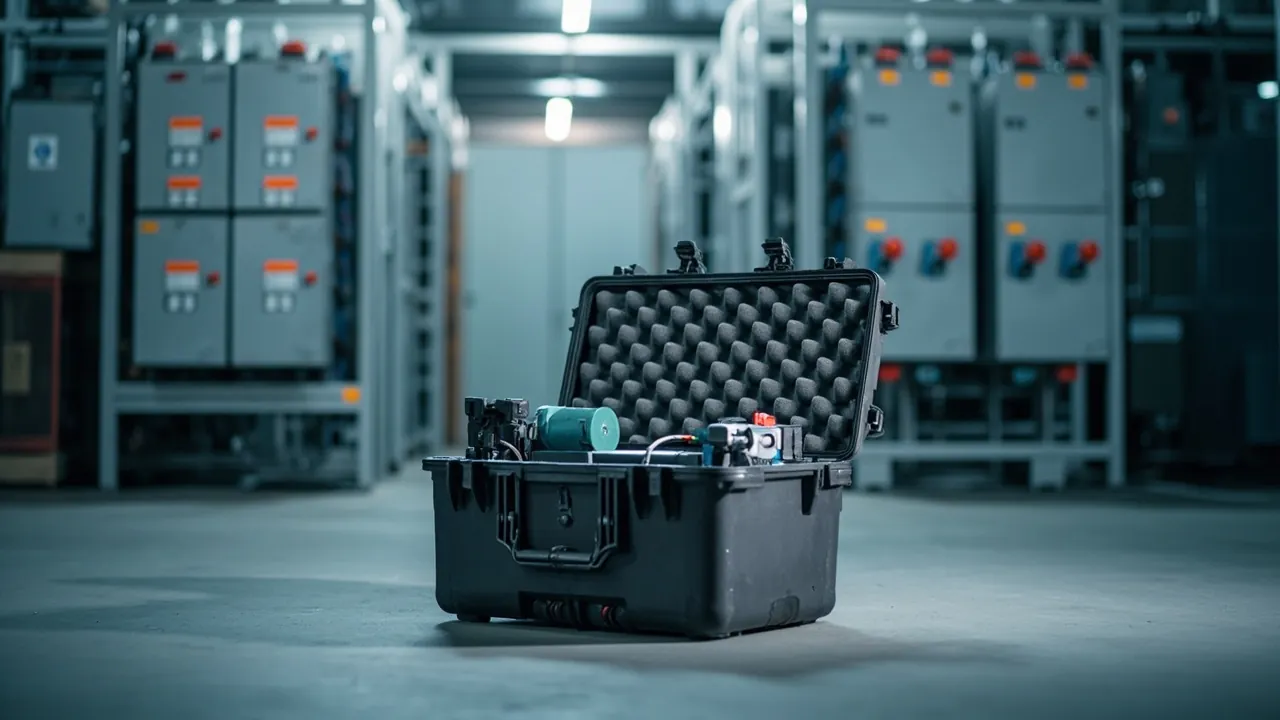
The most expensive switchgear transport incidents tend to happen in the parts that look the strongest. A breaker that will not close properly after unpacking, busbars found twisted on site, secondary terminal blocks that fail an insulation resistance test after absorbing moisture, and frame diagonals that drift out of tolerance during lifting so that lineup assembly becomes impossible are all routine outcomes of packaging decisions made months earlier. Switchgear and distribution equipment is built from sheet metal and metal structures, which creates the intuition that it cannot really be damaged in transit. For medium-voltage equipment and above, however, insulation margins, mechanical operating characteristics and secondary circuit reliability are all sensitive to transport conditions.
The real risk is not impact damage. It is moisture, vibration and small structural distortion. Moisture condenses on insulation surfaces and oxidises secondary terminals, which turns directly into failed pre-commissioning insulation tests. Vibration displaces trip half-shafts, stored-energy springs and auxiliary switch positions inside breaker mechanisms, showing up as characteristic curves that deviate from factory values during site commissioning. Distortion shifts the parallelism of withdrawable truck rails and jams shutter mechanisms, and ends up as rework in which one problem is traded for another.
This article is written for packaging, procurement and logistics engineers at switchgear manufacturers, electrical assembly companies, power installation contractors and overseas EPC firms. It breaks down the transport protection requirements for circuit breakers, busbars, instrument transformers, secondary devices and ring main units, and provides a structured case design method, material selection tables, a decision path for ingress protection ratings and acceptance criteria. The core conclusion is this: a switchgear transport case should prioritise structural restraint and humidity control, with impact resistance as a secondary line, and internal cabinet restraint must be designed as a system separate from the case cushioning.
Experience in power transmission and distribution programmes at JUNZHJIA (Kexin New Materials (Guangdong) Co., Ltd.) shows that separating internal restraint from case cushioning reduces mechanism displacement issues to a negligible level while allowing one case design to serve several cabinet models, improving returnable utilisation.
Table of Contents
- 1. Three Dominant Risks in Switchgear Transport: Moisture, Vibration and Frame Distortion
- 2. Circuit Breaker Cases: Vacuum, SF6 and Air Circuit Breakers
- 3. Busbar Cases: Copper Bar, Tubular and Busway Protection
- 4. Instrument Transformer, Surge Arrester and Bushing Component Cases
- 5. Secondary Circuits and Protection Relay Cases: Cleanliness and ESD
- 6. Ring Main Units and Prefabricated Substations
- 7. Moisture Control: Insulation Parts, Secondary Terminals and Condensation
- 8. Vibration Isolation and Cushioning: From Frame Stiffness to the Transport Spectrum
- 9. Sealing and Ingress Protection: IP54, IP65 or IP67
- 10. Internal Restraint and Inserts: The Value of a Removable Divider System
- 11. Case Construction and Hardware: Hinges, Latches and Gaskets
- 12. Lifting, Stacking and Transport Markings
- 13. Test Verification: IEC 62271, ISTA and GB/T 4857
- 14. Procurement and Acceptance: Drawings, Samples and AQL Sampling
- Frequently Asked Questions
- Conclusion & Related Reading
1. Three Dominant Risks in Switchgear Transport: Moisture, Vibration and Frame Distortion
Many buyers classify switchgear as a metal structure and write packaging requirements accordingly, then pay the price in the insulation and mechanism areas. Understanding why requires looking at the three risk mechanisms separately.
Moisture is the most underestimated. A switchgear cabinet contains a large amount of insulation: epoxy-cast poles and cylinders, SMC and DMC insulation barriers, heat-shrink insulating sleeves, insulators and wall bushings. Once these surfaces condense moisture or adsorb water, surface resistivity falls by several orders of magnitude, which appears directly as failed insulation resistance tests and elevated partial discharge. Secondary terminals, auxiliary contacts and relays are even more sensitive, because damp conditions accelerate silver tarnish and tin plating corrosion, raising contact resistance. Inside an ocean container, day-night temperature differentials above 20 degrees Celsius make condensation almost certain.
Vibration affects mechanisms and precision parts. A vacuum circuit breaker operating mechanism contains stored-energy springs, cams, trip half-shafts, opening springs and dampers. An SF6 breaker adds gas compartments, density monitors and pressure gauges. These parts are extremely sensitive to displacement: a fraction of a millimetre can change opening and closing times and pole discrepancy. Road transport excites broadband random vibration rather than a single clean impact, so accumulated micro-movement presents as wear.
Frame distortion is specific to large assemblies. Medium-voltage switchgear is normally assembled into a lineup, and the parallelism of withdrawable truck rails and shutters depends on the diagonal accuracy of the frame. If a cabinet is unsupported at the ends or carried on uneven support points during transport, the sheet metal frame takes elastic or even plastic deformation, and the lineup shows the classic symptoms of uneven gaps between cabinets and trucks that will not seat.
| Equipment class | Typical items | Dominant failure mode | Protection priority | Key control |
|---|---|---|---|---|
| --- | --- | --- | --- | --- |
| Circuit breakers | Vacuum, SF6 and air circuit breakers | Mechanism displacement, pole discrepancy, gas pressure anomaly | Vibration > moisture > impact | Transport locking device, random-vibration transmissibility |
| Busbars | Copper bar, tubular busbar, busway | Overall twist, surface scratching, joint face oxidation | Distortion resistance > cleanliness > moisture | Support spacing, end restraint |
| Instrument transformers and arresters | CT, PT, surge arrester | Porcelain or epoxy cracking, polarity displacement | Impact > vibration | Profiled insert, cavity separation |
| Secondary devices | Protection relays, terminal boxes, meters | Card loosening, terminal oxidation, ESD damage | Moisture and vibration | Barrier bag, desiccant, antistatic packaging |
| Complete cabinets | Ring main units, prefabricated substations, switchgear lineups | Frame distortion, door distortion, paint damage | Structural restraint > moisture | Support point distribution, rigid base |
2. Circuit Breaker Cases: Vacuum, SF6 and Air Circuit Breakers
Circuit breakers are the core component of switchgear and have the most specific transport requirements. Although breakers usually travel mounted inside their cabinet, a significant share of spare-parts supply, remote assembly and repair work involves standalone packed transport.
Vacuum circuit breakers depend on transport locking. Most designs include transport locking screws or pins that hold the stored-energy spring or main shaft in a safe position. Before packing, confirm the locking devices are installed exactly as specified by the manufacturer, and include a locking device list plus unlocking instructions inside the case. If locking devices are missing, or removed in transit, random vibration will hammer the mechanism repeatedly, causing opening spring fatigue, damper seal damage and auxiliary switch drift. Structurally, the breaker body should transmit load through its mounting base, with the profiled insert providing lateral restraint only, so that the mechanism housing is never a load-bearing surface.
SF6 breakers and GIS bays add one more variable: the gas compartment. If shipped with gas, confirm the pressure matches the transport specification and treat the density monitor and pressure gauge as separate precision components with their own vibration isolation. If shipped without gas, fit every gas port with a blind flange plus gasket and include a dry nitrogen purge record in the case. For cases containing gas compartments, stacking strength and lifting methods require specific marking, and concentrated loads must never be applied above a gas compartment. Blind flange and seal integrity should be a line item on the unpacking checklist.
Air circuit breakers and moulded case breakers concentrate mass at the contact and mechanism side, and their worst condition is lying on their side under load. Pack them upright, bearing on the base and rear, and never use the front panel as a load-bearing surface. The insert should provide relief on the contact side so that arc chute plates are never compressed.
For breakers, the case exterior should carry a prominent notice that operation is prohibited until transport locking devices are removed, together with a mechanism state diagram. This is a direct cause of transport damage turning into field failure: site personnel who do not know the locking state force a closing operation, and the resulting loss far exceeds the value of the transport itself.
3. Busbar Cases: Copper Bar, Tubular and Busway Protection
Busbars are the category that looks hardest to damage and in practice causes the most trouble. The dominant failure in transport is not fracture but overall twist, local bending and lap joint damage.
Rectangular copper bars normally ship in groups. Support distribution is the critical factor: if only the two ends are supported, the long mid-span deflects visibly under self-weight and stack load. Engineering practice calls for support spacing not exceeding 800 mm with all support faces level within about 1 mm. Bars should be separated by acid-free and chlorine-free soft interleaves so that they cannot rub against each other and scratch the surface. Lap joint areas that are tin or silver plated must be covered with a neutral protective film; sulphur-containing and chlorine-containing packaging materials must be avoided, because they accelerate plating discolouration and raise contact resistance.
Tubular busbars have high section stiffness but are very sensitive at the pipe end and weld preparation. Once an end is struck and the ovality goes out of tolerance, field welding or assembly becomes a problem. The case must therefore provide annular end seats lined with polyurethane of Shore 30 to 40 hardness, and the lining must not contact the pipe end face directly. Tubes should be laid along the long axis of the case with 20 to 30 mm of axial buffer allowance at the ends.
Busways and compact busbar systems are long assemblies that most fear overall twisting. Provide at least three lateral clamps inside the case, spaced according to busway height, generally not exceeding 1.2 m. The connection side of a busway should face upward so that foreign objects cannot fall into the plug-in interface. The case also needs sufficient stiffness, and for long units a steel frame case is often preferable to a plastic housing, because the deflection of the case itself becomes the dominant variable at length. For ocean freight, cleanliness requirements rise sharply: copper oxidises quickly in hot, humid, salt-laden air, so an aluminium-foil barrier bag with desiccant and humidity indicators is the correct combination. Material selection is discussed further in case foam material comparison and selection.
4. Instrument Transformer, Surge Arrester and Bushing Component Cases
Current transformers, voltage transformers and surge arresters share a common structure of porcelain or epoxy external insulation over windings or metal-oxide blocks, which makes them classic brittle components. Their protection logic closely parallels transformer bushing cases, but switchgear accessories are smaller and more numerous, so cavity separation matters more.
Epoxy-cast instrument transformers are mechanically strong but sensitive to local stress concentration. The insert should use partial rather than full encapsulation, so that the cast body does not develop internal stress from an interference fit. Oil-filled or gas-filled transformers require attention to transport attitude and pressure state; oil-filled units should be shipped with the oil level within the manufacturer's specified range, and the case needs upright-transport markings plus axial restraint.
Surge arresters consist of stacked metal-oxide discs and are sensitive to axial shock. Provide axial pre-compression inside the case at 5 to 8 percent compression to reduce axial movement in transit. The pressure relief device and the surge counter are separate small parts and should be packed individually.
When multiple items share one case, cavity separation is critical. Stacking instrument transformers of different ratings into a single cavity is the single most common cause of transport damage. A removable divider system allows the number of cavities to be adjusted to the packing quantity, which makes it one of the highest-value structural options for electrical accessory cases. Implementation approaches are described in removable divider systems for protective cases.
5. Secondary Circuits and Protection Relay Cases: Cleanliness and ESD
Secondary equipment is often treated as inexpensive small items and packed casually, yet it determines the pace of site commissioning. Protection relays, bay control units, terminal boxes, indicator panels, meters and communication modules all belong to this group.
Cleanliness requirements exceed mechanical strength requirements. Relay and terminal block contact surfaces are extremely thin, and dust plus moisture produces poor contact. Contamination of fibre jumpers, RJ45 interfaces and communication terminals causes communication errors directly. Use clean-grade foam that does not shed particles inside the case, and fit dust caps on interfaces.
Static protection matters equally. Relay cards are sensitive to electrostatic discharge, particularly during dry winter transport and handling. Control boards and plug-in modules should go into antistatic shielding bags, and plain EPS foam should be avoided inside the case because it generates static readily. Material pairing logic is covered in ESD shielding case design essentials.
Vibration requirements are moderate but cannot be omitted. Protection devices are typically plug-in chassis designs in which cards are retained by rails and connectors. Sustained vibration loosens connectors. Restrain the complete unit rather than only the enclosure, and provide internal limits so the device has no free displacement space inside the case.
Where communication modules or backup power supplies contain lithium batteries, transport also raises dangerous goods compliance questions involving UN numbers, packing instructions and documentation. That scenario is addressed in ADR and IMDG compliance for hazmat transport cases.
6. Ring Main Units and Prefabricated Substations
Ring main units and prefabricated substations are whole-cabinet shipments. Their size and mass dictate a completely different protection strategy from loose components: the case itself must carry the structural support function, and internal restraint is only supplementary.
The critical weak point of a ring main unit is its operating mechanism and interlock. The load-break switch and fuse combination normally includes a mechanical interlock that enforces a safe operating sequence. If collision or stacking pressure distorts the mechanism geometry, the interlock logic can be compromised without any visible external sign, creating a serious safety hazard after commissioning. The transport protection must therefore reserve protective space on the operating panel side, explicitly prohibit stacking loads in that direction, and mark orientation prominently on the case. Two further points matter: because the unit ships as a whole, the base must be a continuous rigid support rather than point supports, otherwise the frame develops diagonal deviation; and removable parts in the cable compartment and operating mechanism must be individually restrained so they cannot become free bodies inside.
For a prefabricated substation, which combines a cabinet, a transformer, high-voltage switchgear and low-voltage distribution, mass can reach several tonnes to more than ten tonnes. Transport protection focuses on three things. First, rigid bottom support using a steel transport base or dedicated transport frame, never timber blocking at isolated points. Second, clear centre-of-gravity marking and lifting point identification. Third, protection of doors and ventilation louvres, because door distortion is the most common cosmetic defect found on arrival.
For very large units, a lightweight shielding approach may be appropriate: a waterproof dust cover plus localised rigid corner guards rather than a full hard case. The deciding factor is the route and the number of transfers. A single factory-to-site movement usually justifies a cover solution, while multiple transfers and open storage justify a reusable hard case or a rigid transport frame with cover.
7. Moisture Control: Insulation Parts, Secondary Terminals and Condensation
Moisture protection for switchgear operates on three levels, each with a different treatment.
The first level is moisture protection of insulation parts themselves. Epoxy castings, SMC barriers and insulators lose surface resistance once a water film adsorbs on the surface. The treatment is a barrier bag plus desiccant plus humidity indication, with case sealing at IP65 or better.
The second level is corrosion protection of metal parts. Copper lap joints, silver-plated contacts, bolts and fasteners oxidise or rust in humid conditions. Treatments include neutral anti-rust film, vapour phase corrosion inhibitor paper and desiccant combinations. VCI paper performs well for copper and steel, but compatibility with insulation materials must be checked so that volatile compounds do not deposit on insulation surfaces.
The third level is condensation control. This is the layer most often skipped. Even if the absolute moisture content inside the case does not change, water vapour condenses on cold surfaces the moment temperature drops below the dew point. Container walls, cabinet sheet metal and bolts are typical condensation sites. Controlling condensation requires two parallel paths: reduce the absolute moisture content inside the case through desiccant and barriers, and allow pressure equalisation so that external moist air is not drawn in. That returns to the function of the pressure equalisation valve, described in how a protective case pressure equalisation valve works.
A common misconception is that a higher ingress protection rating is always better. For large-volume cases holding switchgear, a perfectly sealed case actually amplifies the breathing effect: internal pressure rises during the day and pushes air out, then falls at night and draws moist external air in. An IP67 case fitted with a pressure equalisation valve typically outperforms a plain sealed IP67 case over long ocean voyages.
8. Vibration Isolation and Cushioning: From Frame Stiffness to the Transport Spectrum
Cushioning design for switchgear operates on two levels: internal restraint and case cushioning. The division of labour must be explicit.
Internal restraint aims to keep every movable item, including withdrawable trucks, breakers, drawers and instruments, stationary relative to the cabinet during transport. Methods include using the original transport locking devices, fitting temporary retaining brackets, adding limit blocks to drawer units, and bracing unrestrained panels with removable support rods. If this layer is done poorly, no amount of case cushioning helps, because the damage originates in relative movement between items inside the cabinet.
Case cushioning aims to reduce the acceleration transmitted to the cabinet frame. The design path matches general cushioning practice: establish the input spectrum for road, rail and sea freight, establish the allowable acceleration, size the support area from static load, check thickness against shock conditions, and verify with real hardware.
For high-mass items such as switchgear cabinets, one constraint is specific: support stiffness influences the overall response. If the base of the case is not rigid enough, the case itself becomes a flexible element with a low-frequency bending mode that amplifies the response at certain frequencies. Heavy cases should therefore use a rigid base such as steel or high-density plastic sheet, with a continuous support surface between base and housing rather than point supports.
Test programme selection and execution for random vibration and drop testing are covered in how to select and run ISTA transport testing procedures. Where environmental robustness needs to be assessed, the relevant MIL-STD-810H methods provide a useful methodology, but note that the standard is used here purely as a test-method reference and does not represent any military certification of the product. The correct wording is explained in MIL-STD-810H and protective case environmental testing.
9. Sealing and Ingress Protection: IP54, IP65 or IP67
Ingress protection selection for switchgear cases has to consider two dimensions: the severity of the transport environment and the sensitivity of the equipment. Under IEC 60529 and GB/T 4208:
| Rating | Dust | Water | Typical application | Notes |
|---|---|---|---|---|
| --- | --- | --- | --- | --- |
| IP54 | Partial dust protection | Splash resistant | In-plant movement, covered warehouse, short road haul | Lowest cost, not suitable for sea freight |
| IP65 | Dust tight | Water jet resistant | Domestic road transport, general transhipment warehouses | Common baseline for electrical accessory cases |
| IP67 | Dust tight | Temporary immersion, 1 m for 30 min | Ocean freight, open yards, multimodal | Use with a pressure equalisation valve |
| IP67 plus valve | Dust tight | Immersion plus differential pressure equalisation | Long trans-climate ocean shipments | Best overall protection outcome |
The decision reduces to three questions: ocean freight, open storage, possible standing water. If any answer is yes, specify IP67 with a pressure equalisation valve. Note carefully, however, that an IP rating covers water and dust ingress only. It does not cover cushioning and vibration isolation, internal humidity control, salt-spray corrosion that must be verified separately on hardware, or stacking strength.
Treating the IP rating as the complete measure of protective capability is a common misconception in procurement negotiations. For a case holding switchgear, insert and restraint design usually has a larger effect on the final protection outcome than the IP rating itself. Structural and verification details for IP67 are set out in IP67 protective cases: structure, sealing and verification.
10. Internal Restraint and Inserts: The Value of a Removable Divider System
For electrical accessory cases, a removable divider system is the key structure that improves versatility, for three reasons. First, accessory models are numerous while batch quantities are small, and a fixed cavity means one insert design per model, which drives tooling and machining cost. Second, removable dividers adapt to different component sizes without changing the case. Third, after recovery they can be folded for storage, reducing return-transport volume.
Design points for a removable divider system:
- Slot tolerance: the fit between divider and case should be controlled between 0.5 and 1.0 mm; too loose and the divider rattles, too tight and it cannot be installed or removed.
- Divider material: laminated EVA sheet, or a PP hollow-board and foam composite, balances stiffness against cushioning.
- Base cushion: every cavity should sit on a continuous cushion pad so that load is distributed and local pressure stays low.
- Top compression: the lid should carry an overall compression foam so that every item in every cavity is lightly compressed once the case is closed, at 5 to 10 percent compression.
For breakers, instrument transformers and similar parts that require strict geometric restraint, a dedicated profiled insert remains the right choice. Removable dividers suit medium and small items such as busbar accessories, terminal boxes, insulators and fittings. The two approaches can coexist in one case system: a common case shell with category-specific inserts. This is standard practice in electrical accessory case programmes at JUNZHJIA, and it lowers the customer's overall packaging cost through the common-case, classified-insert model.
11. Case Construction and Hardware: Hinges, Latches and Gaskets
The right case construction for electrical transport depends directly on component size, mass and transport frequency.
- Injection-moulded PP or ABS cases offer good dimensional accuracy and appearance, suit secondary devices, fittings and insulators, and require higher tooling investment.
- Rotational-moulded HDPE cases suit medium and large parts such as busbars, breakers and instrument transformers, with good impact and weather resistance and the ability to scale up.
- Steel or aluminium frame cases suit whole-cabinet shipments and very heavy items, offering the highest stiffness, but they need corrosion protection and careful gasket assembly.
Hardware determines long-term reliability. For electrical industry transport cases:
- Use stainless steel hinge pins with anti-backout features such as retaining rings or thread locking, so pins do not walk out under sustained vibration.
- Space latches according to case edge length, at least one per 400 to 500 mm, with closer spacing at corners.
- Use a replaceable gasket design with spares supplied, and control gasket compression between 25 and 35 percent.
- Validate all metal parts by salt spray, targeting at least 96 hours of neutral salt spray with no red rust for ocean freight.
- Provide a wire seal position on the case exterior so that any opening during transport is traceable.
The matching relationship between hinges, latches and gaskets, and their common failure modes, are described in toolbox hinge, latch and gasket structure explained.
12. Lifting, Stacking and Transport Markings
Switchgear is large, heavy and has a high centre of gravity, so errors in lifting and stacking cause far more damage than transport vibration. Five marking groups and four operating rules are required.
Five marking groups:
- Centre of gravity, including a height-direction indication.
- Lifting point positions with a lifting angle diagram.
- Permitted stacking layers, or a do-not-stack instruction.
- Transport locking device status and removal method.
- Handling symbols to GB/T 191 for keep-dry, this-side-up and fragile.
Four rules:
- Never use cabinet door handles, panels or busbars as lifting load points.
- When cases are mixed, heavy cases go at the bottom, and a large case must not bridge across the mid-span of a smaller one.
- Long busbar cases require axial end stops so contents cannot travel along the case.
- Stacking inside a sea container must be designed around actual container accelerations and lashing points, and lashing straps must not bear directly on panels or doors.
For multimodal projects, stacking strength should be verified by physical test. Methods and pass criteria are covered in GB/T 4857 transport packaging test methods explained.
13. Test Verification: IEC 62271, ISTA and GB/T 4857
Switchgear has its own product standards framework. IEC 62271-1 specifies common requirements for high-voltage switchgear and controlgear, IEC 62271-100 covers alternating-current circuit breakers, and IEC 62271-200 covers metal-enclosed switchgear for rated voltages above 1 kV up to and including 52 kV. Low-voltage assemblies can reference the IEC 61439 series. Those standards address the product itself, while packaging and transport verification normally references the ISTA procedures, the GB/T 4857 series and IEC 60721 environmental condition classification.
One point deserves emphasis: product standards and manufacturer instructions may impose transport and storage requirements, such as permitted temperature and humidity ranges, tilt limits and transport locking conditions, and the packaging design must be consistent with them. If a breaker mechanism must be shipped in the open position with locking devices fitted, that requirement belongs in the packing work instruction.
Recommended transport packaging verification items:
| Test | Reference | Typical condition (example) | Pass criteria |
|---|---|---|---|
| --- | --- | --- | --- |
| Random vibration | ISTA 3E / GB/T 4857.23 | Road spectrum, 60-120 min | No internal displacement, mechanism characteristics re-test within specification |
| Drop and shock | ISTA 2A / GB/T 4857.5 | Height by weight class | No through-wall damage, no cabinet distortion |
| Stacking | GB/T 4857.3 | Specified load, 24 h or more | Case deformation recovers, no permanent door or frame distortion |
| Dust and water ingress | IEC 60529 / GB/T 4208 | IP65 / IP67 | No dust ingress, no harmful water entry |
| Temperature and humidity cycling | IEC 60721-3 climate classes | High-temperature and humidity cycling | No condensation, insulation resistance within specification |
| Salt spray (ocean freight) | Neutral salt spray test | 48-96 h | No red rust on hardware |
| Environmental methods (reference) | MIL-STD-810H methods | Vibration, shock, humidity | Methodology reference only, not a military certification |
The post-test re-inspection stage must be emphasised: inspecting only the exterior of the case is not sufficient to declare a pass. After opening, re-measure breaker mechanism characteristics such as opening and closing times, pole discrepancy and travel curves, inspect busbar lap joint condition, and measure insulation resistance, comparing against factory values. This is the only way to link packaging verification to product conformity.
14. Procurement and Acceptance: Drawings, Samples and AQL Sampling
Procurement management for switchgear transport cases should place control points at three stages.
At the drawing stage, lock down the case outline and stacking orientation, the insert or divider layout, the position and form of internal restraint points, lifting points, marking content and placement, hardware specification and material, gasket material and hardness, and whether a pressure equalisation valve is required. Ask the supplier for insert section drawings and a load-path explanation for the restraint points, not just rendered images.
At the sample stage, carry out a physical loading check covering three things: whether all movable items inside the cabinet are reliably restrained; whether the case support surface contacts the cabinet base beams fully, using a feeler gauge to confirm no obvious gap; and whether closing the lid produces any abnormal noise or gap. Where possible, run a short-haul transport trial and inspect displacement and indentation on opening.
At batch acceptance, apply differentiated sampling. Use variable inspection for critical dimensions such as insert cavity size, restraint point positions and gasket compression ratio, attribute inspection for appearance and marking, and batch-level type verification for material and structural strength. The sampling logic can follow GB/T 2828.1, with a worked approach in custom case acceptance and AQL sampling methods.
The documentation package belongs in the purchase order as well: material certificates covering case material, foam density and UL94 flammability grade; gasket material and hardness reports; ingress protection self-test or third-party reports; vibration, drop and stacking test reports; a packing work instruction including transport locking device procedures; and a spare parts list. For switchgear and distribution equipment case programmes, JUNZHJIA can supply this package against a customer acceptance checklist and coordinate third-party inspection on a sampling basis.
Frequently Asked Questions
Q: Should a switchgear transport case be IP65 or IP67, and what is the deciding criterion?
A: The criterion is the severity of the transport route, not the price of the equipment, and it reduces to three questions. First, does it travel by ocean container? Container day-night temperature differentials across climate zones frequently exceed 20 degrees Celsius, making internal condensation almost unavoidable, so IP67 is required. Second, is it stored or transhipped in the open? Open yards bring rain and standing water, again calling for IP67. Third, could it encounter washdown or immersion during transport, for example on roll-on roll-off decks or during port yard washdown? If any answer is yes, specify IP67. Conversely, if equipment moves only between covered warehouses on short hauls, IP65 is entirely adequate and saves 15 to 25 percent of cost. One further point must be stressed: for large-volume cases such as switchgear cabinets, a plain sealed IP67 case without a pressure equalisation valve often performs worse over long ocean voyages than IP67 with a valve, because full sealing amplifies the breathing effect and draws external moist air in as the case cools at night.
Q: Busbar copper bars often distort in transport. What causes it and how is it prevented?
A: Three causes dominate. The first is support spacing that is too wide, or support faces that are not level, allowing bars to bow under self-weight and stack load; engineering practice is to keep support spacing below 800 mm with support face height tolerance within about 1 mm. The second is the absence of axial end restraint, so bars slide along the case and strike the end wall, producing local bending. The third is inappropriate interleaf material, specifically packaging containing sulphur or chlorine, which discolours the plating on lap joints; this is not distortion as such but it significantly raises contact resistance. Prevention measures include acid-free and chlorine-free soft interleaves between layers, equally spaced supports of equal height, end restraint seats with 10 to 20 mm of buffer allowance, a neutral protective film on tin or silver plated joint faces, and an aluminium-foil barrier bag with desiccant to control humidity on long ocean voyages. At acceptance, measure straightness and inspect lap joint appearance in addition to dimensional checks.
Q: What preparation does a circuit breaker need before packing, and how important are transport locking devices?
A: Transport locking devices are the first and most important protective measure for breaker transport. Most vacuum circuit breakers, and some SF6 designs, include transport locking screws or pins that hold the stored-energy spring or main shaft in a safe position, preventing random vibration from repeatedly hammering the operating mechanism. Before packing, confirm the devices are installed exactly as the manufacturer specifies, and include a locking device list plus unlocking instructions inside the case. If they are missing, or removed mid-journey, random vibration will fatigue the opening spring, damage damper seals and shift auxiliary switch positions, which shows up on site as opening and closing times and pole discrepancy that deviate from factory values. Three further steps are needed: isolate and protect precision accessories such as density monitors and pressure gauges; fit gasketed blind flanges on all gas ports and confirm tightness; and place a prominent notice on the case exterior stating that operation is prohibited until transport locking devices are removed.
Q: Where do ring main units most often run into trouble during transport?
A: The critical weak point of a ring main unit is its operating mechanism and mechanical interlock. The load-break switch and fuse combination normally relies on a mechanical interlock whose safe operating sequence depends on precise positional relationships. If the unit takes an impact on the operating panel side, or receives stacking pressure in that direction, the interlock geometry can be compromised in a way that leaves no visible external sign, creating a serious safety hazard after commissioning. Transport protection must therefore reserve protective space on the operating panel side, explicitly prohibit stacking loads in that direction, and mark orientation clearly on the case. Two further points matter. Because the unit ships as a complete assembly, the base must be a continuous rigid support rather than point supports, so that the frame does not develop diagonal deviation. And removable parts in the cable compartment and operating mechanism must be individually restrained so they cannot move freely inside the cabinet. At unpacking, in addition to visual inspection, manually operate the switching and interlock once to confirm smooth action.
Q: How are cleanliness and ESD requirements applied to secondary circuit and protection relay cases?
A: These two requirements matter more than mechanical strength, and the practical measures are specific. On cleanliness: use clean-grade foam that does not shed particles; fit dust caps on fibre interfaces, RJ45 ports and communication terminals; and avoid plain EPS foam inside the case, since it generates static readily and breaks into debris. On ESD: pack control boards and plug-in modules in antistatic shielding bags; use antistatic foam or matting with a surface resistivity in the range of 10 to the 6 up to 10 to the 9 ohms inside the case; and require operators to wear wrist straps. On vibration: protection devices are typically plug-in chassis designs in which cards are retained by rails and connectors, and sustained vibration loosens connectors, so restrain the complete unit rather than only the enclosure and provide internal limits so the device has no free displacement space. On moisture: use a barrier bag with desiccant and humidity indicator cards, with case sealing at IP65 or better.
Q: How does switchgear transport packaging relate to the product standards?
A: The two are complementary rather than interchangeable, and confusing them leads to gaps in both directions. Product standards define the technical requirements and type tests for the equipment itself. IEC 62271-1 specifies common requirements for high-voltage switchgear and controlgear, IEC 62271-100 covers alternating-current circuit breakers, IEC 62271-200 covers metal-enclosed switchgear, and low-voltage assemblies reference the IEC 61439 series. Those standards usually impose transport and storage conditions such as permitted temperature and humidity ranges, tilt limits and transport locking states. The packaging design is responsible for ensuring those conditions are met throughout the logistics chain, including transhipment warehouses where nobody is watching the case. The method is to extract the transport and storage conditions from the product standard and the manufacturer instructions first, then design and verify the packaging against the ISTA procedures, the GB/T 4857 series and IEC 60721 environmental classification. The essential step is writing that correspondence into the packing work instruction, because otherwise the standard reference exists in the purchase order while shop-floor practice quietly diverges from it. A useful check is to ask which document tells a packer, in one line, that the breaker must ship locked in the open position: if no document does, the link between standard and packaging has not been made.
Q: What capabilities does JUNZHJIA offer for switchgear and distribution equipment transport cases?
A: JUNZHJIA (Kexin New Materials (Guangdong) Co., Ltd.) provides switchgear manufacturers, electrical assembly companies and overseas EPC firms with four areas of capability. First, insert and restraint design: profiled inserts, removable divider systems and internal cabinet restraint schemes are designed from the dimensions of breakers, instrument transformers and busbars, with section drawings and restraint load-path explanations issued for approval. Second, case construction: injection moulding, rotational moulding and metal frame options are selected according to part type and mass, and heavy cases can be supplied with rigid steel bases that balance stacking strength against weather resistance. Third, protection and testing: IP65 and IP67 verification can be completed to IEC 60529 and GB/T 4208, pressure equalisation valves and desiccant systems can be specified, and third-party random vibration, drop, stacking, salt spray and humidity cycling testing can be coordinated with reports. Fourth, OEM and ODM supply with global delivery, including customer branding, packing work instructions with transport locking procedures, volume delivery scheduling, and long-lifecycle spare hardware and gaskets.
Q: Which items should sampling inspection focus on during transport case acceptance?
A: Divide items into three groups with different treatment. The first group covers structure and function critical items: insert cavity dimensions and geometric tolerances, restraint point positions, gasket compression ratio, hardware mounting strength and case stacking height. These warrant variable inspection with a tighter sampling level under GB/T 2828.1, typically AQL 1.0 or even 0.65. The second group covers appearance and marking: case surface defects, marking content and placement, print clarity and gasket seating consistency. These are attribute characteristics and can use AQL 2.5. The third group covers material and process verification: case material and wall thickness, foam density and UL94 flammability grade, hardware material and pressure equalisation valve actuation pressure, normally handled as batch-level type verification rather than piece-by-piece inspection. In addition, the first production batch should always include a physical loading plus short-haul transport trial, inspecting displacement, indentation marks and cabinet diagonal dimensions on opening. This is the single most effective step and the one most frequently skipped.
Conclusion & Related Reading
Designing switchgear and distribution equipment transport cases requires moving past the intuition that metal parts cannot really be damaged. What determines whether commissioning runs smoothly is the moisture state of insulation components, the positional retention of operating mechanisms, the cleanliness of busbar lap joints, and the geometric accuracy of cabinet frames. Treating internal restraint and case cushioning as two separate systems, and treating moisture control as mandatory rather than optional, are the two guiding principles for this class of project.
The practical sequence has four steps. Before packing, verify transport locking devices and internal restraint item by item. At the design stage, decide the ingress protection rating and pressure equalisation valve configuration. At the test stage, make random vibration and stacking mandatory rather than optional. At acceptance, write materials, testing and the documentation package into the technical agreement. Do these four things and the great majority of transport-induced site rework is eliminated before it can occur.
Related Reading