

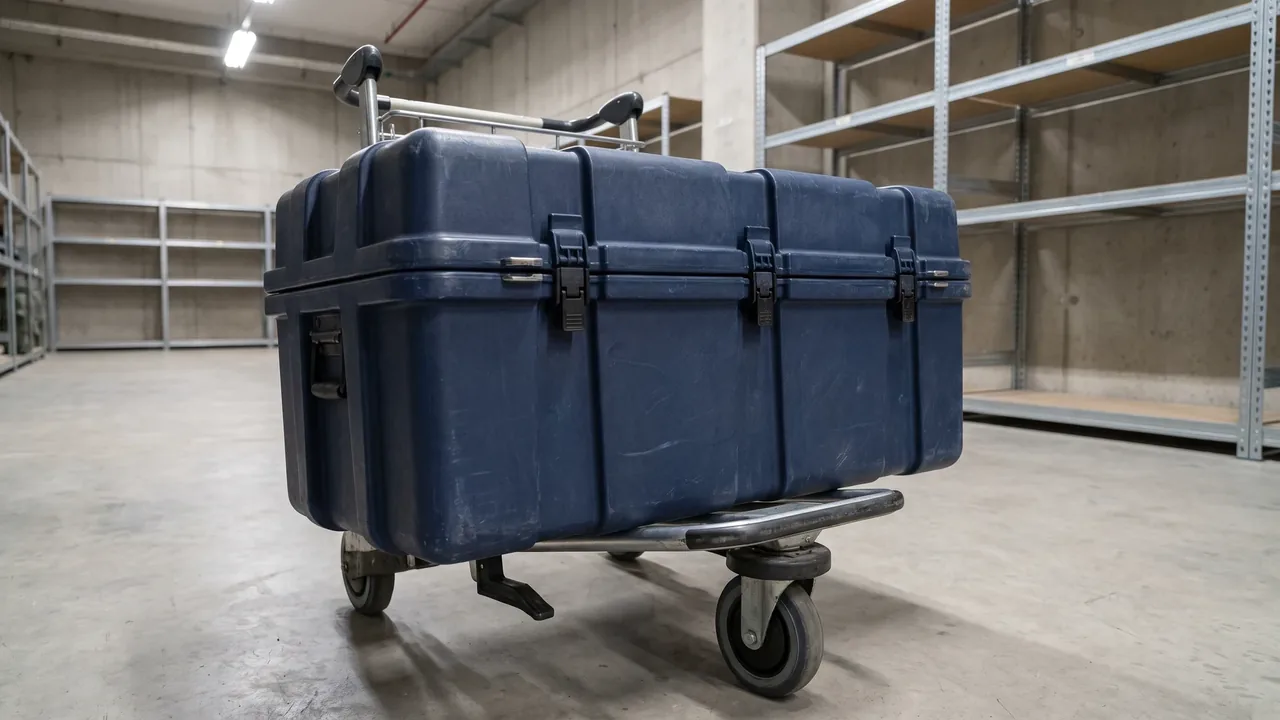
Storing and moving large-caliber materiel places demands on a container that go far beyond an ordinary industrial tote. A loaded unit can weigh tens of kilograms or more, and it must stay sealed and structurally sound through stacking, lifting, long road and sea legs, and repeated transshipment. At JUNZHIJIA we group this product family under one heading — the artillery shell case programme — whose technical core is heavy-container engineering built around the Artillery Shell Storage Box: how wall material, reinforcement ribs, bearing plates, lifting lugs, stacking height and moisture-control hardware work together. This article discusses packaging containers only, and does not cover projectiles, propellant, fuzes or ballistics.
Treating an artillery shell case as nothing more than a sturdy box is a common misjudgement. What actually determines field performance is whether a wall bulges after several tiers are stacked, whether a lug spreads lifting load evenly into the shell, and whether internal humidity stays low enough for corrosion protection across years of warehousing. Those questions sit in structural mechanics, ergonomics and materials science at once, and they need one shared engineering vocabulary. Years of heavy-container development have given JUNZHIJIA a working method built on four principles — a clear load path, predictable stacking, controllable lifting, verifiable moisture control — and the sections below take each facet of container engineering in turn.
What Large-Caliber Storage Logistics Demands from a Container
The first constraint on a heavy munitions container is the tug-of-war between weight and stiffness. The shell must carry the payload's own mass, the load of tiers above it, and the concentrated forces introduced by forklifts and crane hooks, while keeping its own mass low enough for manual or semi-mechanised handling. Engineers therefore select by specific stiffness — stiffness divided by mass — rather than raw material strength, because an overweight box that is awkward to carry or rig creates fresh hazards even when its strength is more than adequate.
The second constraint is closure. A container held in long-term storage has to resist water vapour, salt spray and dust, while repeated opening and closing steadily erodes seal resilience. Good practice treats sealing performance as a curve that decays over time rather than a fixed number stamped at dispatch. A third constraint is stacking consistency: warehouse capacity is set by tier count, so if dimensional tolerances drift between production lots, stacks go eccentric or topple. JUNZHIJIA controls dimensional tolerance, stack-locating features and load capacity on the same drawing so that container behaviour is predictable at inbound, outbound, loading and unloading.
One further constraint is easy to overlook: the container is an information carrier. Traceability requirements make the markings, lock, seal and electronic tag a chain that does not depend on human memory. Stiffness, closure, stacking consistency and traceability together form the basic scorecard for any artillery shell case programme.
Material Selection for Artillery Shell Storage Boxes
Steel is the traditional choice for heavy duty. Low-carbon or low-alloy steel offers high strength, puncture resistance and weldability, which suits containers that see high compressive demand over long service. Its drawbacks are mass and corrosion, so it needs a surface-treatment and rust-prevention package. On steel boxes JUNZHIJIA typically grit-blasts, applies an epoxy primer and topcoat, and builds extra film thickness at welds and folded edges, because those are the spots where moisture collects and rust starts.
Aluminium trades density for handling friendliness. At equal stiffness an aluminium shell can be markedly lighter than steel, and its natural oxide layer provides baseline corrosion resistance. Aluminium welding is less forgiving, and the design must avoid sharp corners and stress raisers, or vibration loads will start cracks at the weld toe. Wooden shells are common in one-trip or semi-reusable export packaging: cheap and cushioning, but with wide strength scatter and poor weather resistance, so they are usually combined with steel members.
Composite shells — glass- or carbon-fibre reinforced polymer — marry high specific strength with corrosion resistance and can be moulded as one piece with fewer joints, which suits weight-sensitive, long-term weather-exposed duties. The trade-off is cost, and local impact and puncture resistance is usually below metal, so metal inserts are needed at critical load points. JUNZHIJIA layers materials by duty: engineering plastic with metal for short-haul high-frequency cycling, steel or composite for long-term outdoor storage, and wood-steel combinations for one-trip export, so spending lands where load actually travels. For more on skeleton design, see reinforcement rib design for heavy-duty cases.
Reinforcement Ribs and Load-Bearing Plates
A large, flat wall under compression does not crush first; it bulges and buckles. When in-plane compressive load passes the critical value, a thin plate suddenly bows outward. Ribs work by dividing one large panel into several short spans, lowering each span's aspect ratio and raising the critical buckling load. Spacing is a trade-off, not a case of denser being better: overly tight ribs add weld volume, heat distortion and lost internal volume.
Bearing plates extend the rib system. During stacking, the weight of the upper box reaches the lower lid through its bottom corners and edges, and if the lid has no bearing structure in the middle, the load dents it permanently. A bearing plate turns a point load into a distributed one. It is normally placed at lid and base corners, aligned with the wall ribs, so upper load travels down the ribs to the floor rather than through the contents. JUNZHIJIA holds to one rule in bearing-plate design: align top and bottom, and make the path continuous inside and out. The lid bearing point and the base support point sit on the same vertical axis, so the load path stays straight.
Another easily missed detail is the wall-to-base transition. It carries bending and shear at the same time and is a favourite site for fatigue cracks. A common fix is a triangular gusset or a turned flange at the internal corner, turning an abrupt stiffness change into a gradual one. In finite-element work JUNZHIJIA treats the stress-concentration factor in this zone as a release criterion, rather than sacrificing service life for a cleaner silhouette.
Lid Sealing Architecture and IP Ratings
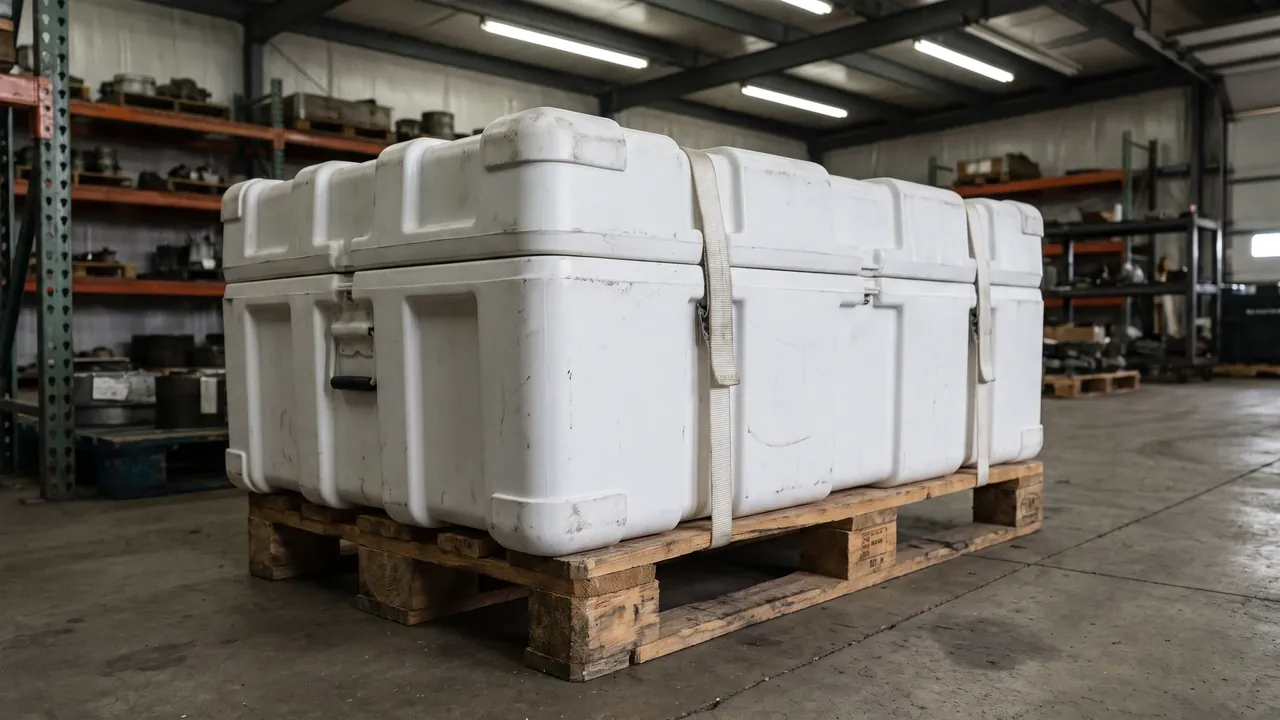
Sealing is the first line of moisture defence. The usual arrangement for a heavy shell is a grooved gasket: the mating face is milled with a continuous channel, the gasket sits inside it, and closing compresses the rubber to a designed squeeze. Too little squeeze leaves the sealing line discontinuous; too much ages the gasket faster. Practice keeps squeeze within a sensible band of the gasket section height and arranges latches so that clamping force is as even as possible along the joint — with too few latches, the gasket lifts between them and opens a leak path.
Ingress protection ratings describe dust and water resistance with two digits. Long-term munitions storage containers normally call for a high dust rating, with the water digit chosen by duty: boxes that transit frequently and may meet rain need to withstand spray or even short immersion. It is worth stressing that IP is a whole-box figure. Any opening — a pressure-equalisation valve, a drain port, a label rivet — can become the weak point, and the test must be run on the complete container.
Sealing also interacts with stacking through differential pressure. Air-freight cabin pressure swings, high-altitude transport and seasonal temperature shifts can leave the interior in partial vacuum, making the lid hard to open or squeezing the gasket until it loses resilience. Fitting a pressure-equalisation valve caps the differential within a safe band while keeping dust and water out. On valve selection and upkeep, see how pressure equalisation valves work.
Lifting Lugs and Forklift Interfaces
Lifting lugs are where a heavy container honestly reveals its design quality. The lug itself almost never fails; what fails is the joint between lug and wall. Lifting injects load through the lug in a concentrated way, and if the wall below has no matching reinforcement, tensile stress forms a tear origin at the weld or bolt hole. JUNZHIJIA makes the lug base a thickened plate spanning two ribs, spreading tension across several ribs, and places the hole near the centre-of-gravity projection to cut the tilting moment.
Lug geometry has to match the shackles and hooks actually used. Too small a hole will not take the shackle; too thin a wall around the hole concentrates stress under sharp contact. The inner edge is normally radiused and smoothed so slings are not damaged. Sling angle matters too: with multi-point lifts, the greater the angle from vertical, the higher the lug load, so the design load must be checked at the worst angle rather than the ideal vertical case.
The forklift interface is a second load path. Fork pockets sit in the base or the pallet gap, and without guiding geometry the fork tips can strike the wall or liner. A guide angle at the base and a thickened pocket upper edge resist the local pressure when the fork lifts. Where pockets and lifting lugs coexist, the two paths must not interfere: pocket rib direction should be offset from the lug base plate so stress concentrations do not stack up.
Stacking Layers and Load Calculations
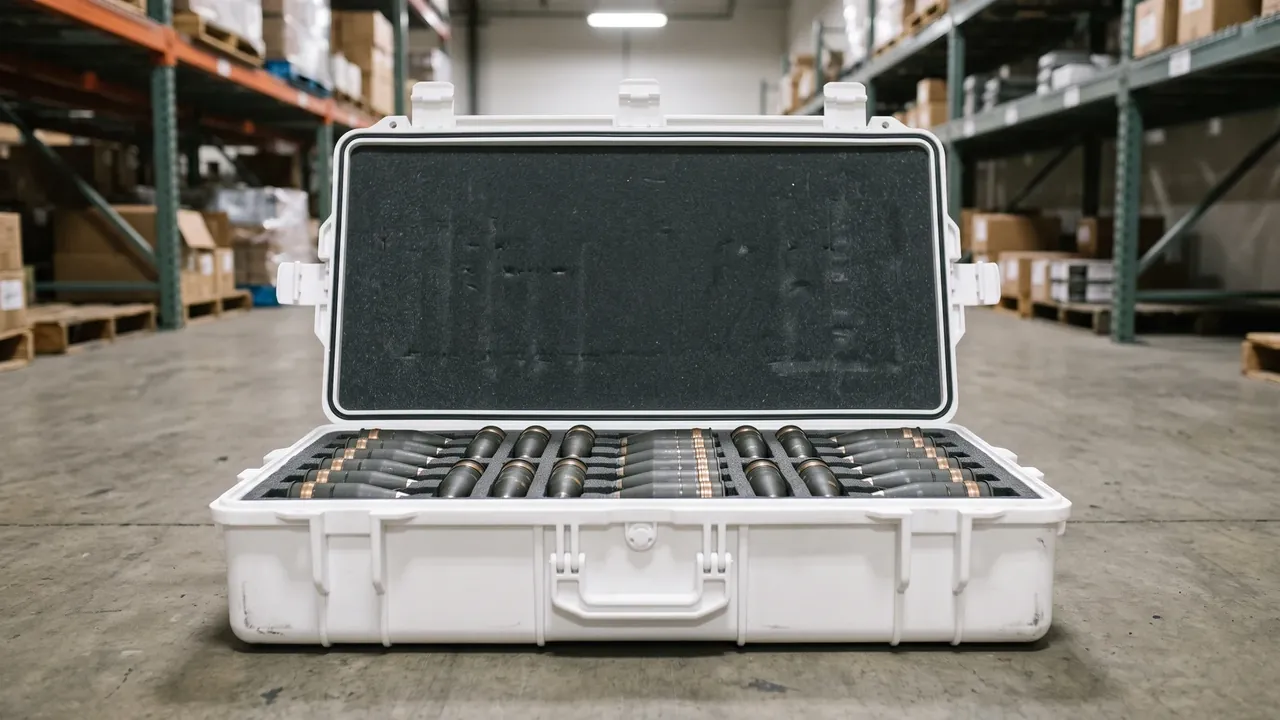
Stack height is not a number to be set by feel. It follows from container mass, payload mass, the compressive capacity of the bottom tier and storage duration. The basic method divides the total weight above by the effective bearing area of the bottom unit to get unit-area load, then compares it with allowable compressive strength. Heavy containers cannot be judged on short-term strength alone, because plastics and some composites creep: a load carried briefly may exceed limits after months of sustained force.
Creep means "how many tiers" and "for how long" must be decided together. In plastic or composite shells, deformation accumulates under sustained load, so the design either limits long-term tier count or increases bearing area. Steel resists creep better, but contact pressure between base corner and bearing plate must be watched so coating is not crushed and corrosion seeded.
Stack stability is also a load question. The taller the stack and the more the upper centre of gravity strays beyond the lower support face, the faster the overturning moment grows with tier count. Cross-bonding and a base locating frame raise stability in practice, and units in one stack should be of similar height so an upper box does not bridge two boxes of different height and load eccentrically. Stack tests can follow load testing methods for case stacking to verify the limit before release.
Palletization and Container Load Planning
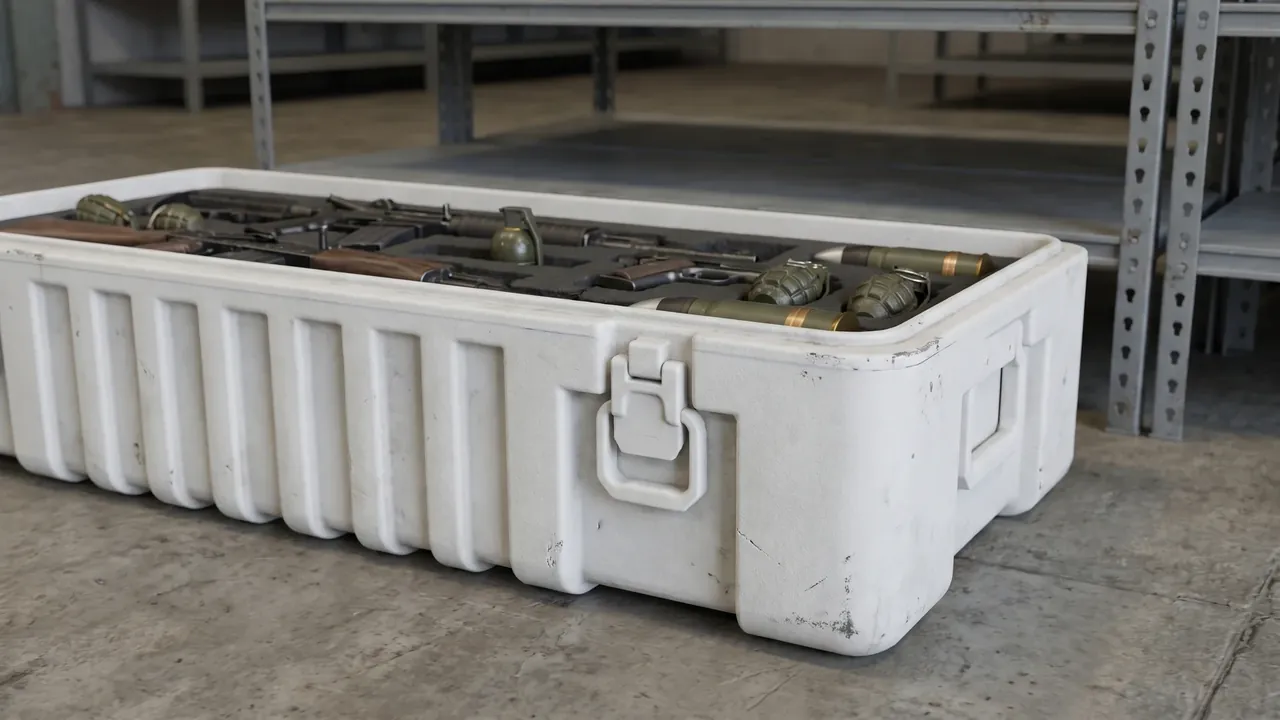
Moving boxes one at a time is far less efficient than palletising. Fixing several munitions containers to a standard pallet by strapping or shrink film, binding them as one unit with the pallet, cuts handling steps sharply and makes orderly container stuffing easier. Modularity is the key: box footprints matching the pallet module and a tidy stack profile are what deliver high space utilisation inside the container.
Load planning has to handle three things: centre of gravity, lashing and clearance. The centre of gravity should sit near the container centreline and low, to resist roll; lashing points should use existing lugs or dedicated tie holes rather than ad-hoc drilling into walls; and gaps between stacks should be packed with air bags or timber so nothing slides fore and aft under braking. In mixed loads, heavy boxes go low and light boxes high, and units on one layer should be equal in height — a simple rule that works well.
The pallet itself belongs in the load path. Timber pallets have limited capacity, so heavy containers should use thicker deck boards or steel pallets, and the pallet feet must sit properly on the container floor. If the whole stack is to be lifted by forklift, the fork entries should face outward for easy access. On coordinating stacking with pallets, see case stackability and pallet planning.
VCI Protection and Desiccant Configuration
A moisture-control system has two mechanisms: one keeps vapour outside, the other deals with what remains inside. Sealing handles the first; desiccants and vapour-phase corrosion inhibitors handle the second. Desiccants absorb free moisture and push relative humidity below the critical value for metal corrosion, while VCI molecules released into the air form a protective film on metal surfaces so that corrosion is slowed even if the seal is briefly breached.
The two are not substitutes but redundancies for each other. With desiccant alone, humidity rebounds fast once the box is opened or the gasket ages; with VCI alone, condensation can still appear if the starting humidity is high. JUNZHIJIA typically specifies a combination — a calculated desiccant charge plus a VCI liner or rust-prevention bag — with the charge sized by internal volume, transit duration and climate along the route. Under-dosing is the most common mistake: users often add a few sachets by habit, far short of the design duration.
Desiccant failure is visible, since most products carry a humidity indicator that changes colour at saturation and prompts replacement. VCI service life depends on seal condition and handling frequency, so boxes opened often need shorter replacement intervals. Note that inhibitor materials should go in immediately after parts are cleaned and dried: oil residue or fingerprints prevent the protective film from attaching evenly and blunt the effect. For humid-warehouse practice, see stacking and moisture control in high-humidity warehouses.
Salt Spray and Temperature-Humidity Cycling Tests
Moisture and corrosion design must be proven by test, not accepted from a datasheet. The most common environmental test is neutral salt spray: the container or a specimen sits in a chamber where brine of a set concentration is atomised continuously or cyclically, and failure modes such as coating blistering, rust spots and creep from scratches are observed. Salt spray reproduces the high-salt conditions of coastal transit and island storage and is especially effective at screening steel coatings and metal hardware.
Temperature-humidity cycling reproduces a different mechanism: repeated expansion and contraction. Shell material, gasket and metal inserts have different thermal expansion coefficients, so temperature cycles drive tiny movement at the joint, while humidity cycles trigger condensation at the cold end. A typical programme sets several temperature-humidity plateaus with defined ramp rates and, after a number of cycles, checks sealing, coating adhesion and structural distortion. This exposes long-storage risks better than a constant condition does.
At the qualification stage JUNZHIJIA combines tests according to the customer's environment and sets severity levels with reference to environmental testing compliance for military cases and the relevant military standards. Samples should be drawn at random from production, not hand-finished showcase units, or the results will not represent batch quality. Test data and failure photographs should be archived together as the basis for later improvement.
Cushioning, Restraint and Liner Engineering
The liner of a heavy container does more than fill space: it limits the freedom of the payload and spreads impact energy into the shell. Common liner materials include polyethylene foam, EVA, polyurethane foam and honeycomb board, whose density, resilience and compression set differ widely and must be chosen against payload mass and allowable acceleration. Heavy items usually need denser material so they do not crush it under moderate impact.
Cushioning and restraint are separate goals and often need separate design. The cushion absorbs energy; the restraint stops movement. If a heavy item is wrapped only in soft foam, the foam compacts over time, the item gains play, and impacts become progressively harsher. A more reliable pattern pairs hard restraint with soft cushioning — a rigid cradle to limit large displacement, a thin cushion layer to absorb energy at small displacement.
The liner also has to be compatible with the moisture system. Materials that absorb water hold vapour and release it as temperature changes, so in containers needing long-term rust protection the liner should be closed-cell and low-absorbency, or a corrosion-inhibiting barrier should sit between liner and payload. Where a cavity forms between liner and wall, avoid low pockets that collect water. JUNZHIJIA considers drainage slope, material absorbency and inhibitor layout together in liner design rather than treating them as three separate problems.
Locks, Tamper Seals and RFID Traceability
On a munitions container, the lock's job is to make status confirmable. It must resist accidental opening, but its real management value is leaving a visible trace when it is opened. Common forms include hasp locks, bolt locks and numbered seals. The design should separate locking load from sealing: the lock secures, while the gasket and clamping structure seal, so even a deformed lock does not directly break the sealing face.
A tamper seal is a single-use management element with a unique number that cannot be restored once removed. Its purpose is to make "was this box opened" a checkable fact rather than a matter of recollection. The seal seat should have a defined mounting point; tying a seal to a lug or handle invites friction wear in transit and a false reading of tampering.
Electronic tags upgrade traceability from manual logging to automatic capture. An RFID tag bonded or embedded in the shell can be read in bulk at warehouse doors and loading bays, automating inbound and outbound records. Metal shells interfere with radio signals, so anti-metal tags or isolated mounting are necessary, and the tag position should avoid lifting and forklift friction zones so it is not scraped off. Combined with the physical number and QR code, this forms dual traceability of physical marking plus electronic record. For related practice, see QR-code asset tracking for cases.
UN Packaging Certification and Export Compliance
Containers used for dangerous goods transport generally need to be verified against the packaging performance test system established by the United Nations Recommendations on the Transport of Dangerous Goods. The system classifies packaging by construction type and confirms through drop, stacking and leakproofness tests that it can withstand normal transport risk; packaging that passes receives a corresponding mark showing the type, performance level and manufacturing information. For export users, the packaging mark is one of the prerequisites for customs clearance and carriage.
Export work also has to handle destination-country import requirements. Some countries require packaging to meet national standards or to come with third-party test reports, and some air routes add separate airworthiness documentation for packaging. When taking export orders, JUNZHIJIA usually helps customers map the chain of transport mode, packaging level and required documents so that a missing file is not discovered at the port.
It is worth stating plainly that packaging compliance and the transport control of the goods themselves are two different rule systems: the former belongs to packaging engineering, while the latter is administered by national authorities under law. This article discusses container structures only, and all specific operations should follow local regulations and export-control requirements. On packaging and load planning in international transport, see cross-border packaging and load planning.
Life-Cycle Maintenance and Container Reuse
A heavy container is an asset, not a consumable. Keeping one in service for years means folding maintenance into routine work. The gasket ages first: check periodically for permanent set, cracking or obvious hardening, and replace the whole gasket rather than patching it locally. Hinges and latches are moving parts; dust in the pin and spring raises opening force, and a user forcing them damages the shell, so they need periodic cleaning and lubrication.
Coating upkeep matters equally. Once a steel box is scratched, corrosion creeps along the scratch and lifts the surrounding film if it is not repaired promptly. Routine inspection should focus on base corners, lug roots and fork-pocket edges — the three zones where impact and standing water concentrate. Where film is broken, remove rust before recoating rather than painting over it.
Reuse depends on stable dimensions and interfaces. After many cycles a container may distort enough that stack locating features no longer align, and it must be assessed for downgraded use or retirement. JUNZHIJIA recommends a service record for each batch, archiving test data, deployment date, maintenance history and retirement, so the state of the whole container fleet is traceable. For containers held in long-term storage, sealing and liner condition should be spot-checked on a schedule so design performance holds through the service life.
Artillery Shell Storage Box FAQ
Q: Why can't an artillery shell case be treated as just a thicker version of an ordinary tote?
A: Because the failure modes are entirely different. An ordinary tote usually fails by cracking on impact or snapping a latch, while a heavy munitions container tends to fail gradually: walls creep and bulge under long stacking, gaskets lose resilience after repeated opening and closing, and lug-root welds crack slowly under alternating load. None of this shows up in a single use, yet it all surfaces together after months or years of service. That difference changes what the drawing has to prove. JUNZHIJIA therefore designs the container as a structural system that evolves over time, satisfying short-term strength while controlling long-term deformation and seal decay. In practice that means aligning bearing points and support points on one vertical axis, blending stress concentrations into gradual transitions, treating the gasket as a replaceable wear part rather than a permanent fitting, and putting dimensional tolerance together with stack-locating features on the same drawing so container behaviour stays predictable across its whole service life. Users should also ask suppliers for creep data and seal-decay curves, not only a single burst-strength figure, because the slow mechanisms are the ones that eventually empty a warehouse of usable containers.
Q: How should the shell material for an Artillery Shell Storage Box be chosen?
A: Choose by duty rather than by a single metric, because no material wins on every axis. Steel offers high strength, good puncture resistance and strong creep resistance, which suits long-term outdoor storage and heavy frequent handling, at the cost of mass plus an ongoing coating and rust-prevention programme. Aluminium is lighter and easier to handle, with natural corrosion resistance that fits weight-sensitive transit, though its welding is demanding and its local impact resistance sits below steel. Wood is inexpensive and cushions well and is mostly used for one-trip or semi-reusable export packaging, but it shows wide strength scatter and poor weather resistance, so it is usually combined with steel members. Composite shells deliver high specific strength, corrosion resistance and one-piece moulding for weight-sensitive, long-life outdoor duties, at higher cost and with weaker local puncture resistance, so metal inserts are needed at critical load points. JUNZHIJIA layers materials by duty: engineering plastic with metal for short-haul high-frequency cycling, steel or composite for long-term warehousing, and wood-steel combinations for one-trip export.
Q: What do reinforcement ribs and bearing plates each do in a heavy container?
A: Ribs solve plate buckling. A large flat wall does not crush first under compression: past the critical load it suddenly bows outward and loses stability, and ribs divide the panel into short spans to raise that critical load substantially. Spacing is a genuine trade-off, since overly dense ribs add weld volume, heat distortion and lost internal volume, while overly sparse ribs fail to divide the panel at all. Bearing plates solve load spreading. They turn the point load arriving through the upper box's bottom corners into an area load, then route it down the ribs to the floor rather than through the contents. JUNZHIJIA insists on top-to-bottom alignment and an inside-out continuous path, keeping the lid bearing point and base support point on one vertical axis so the load path stays straight. The wall-to-base transition also carries bending and shear at the same time and is prone to fatigue cracking, so triangular gussets or turned flanges convert an abrupt stiffness change into a gradual one. Together these two features decide whether a stack stays square or sags.
Q: Where do lifting lugs most often fail, and how is that avoided?
A: The lug body itself almost never fails; the joint between lug and wall is the real weak point. Lifting injects load through the lug in a concentrated manner, and without matching reinforcement below, tensile stress creates a tear origin at the weld or bolt hole. JUNZHIJIA answers this by making the lug base a single thickened plate spanning two ribs so tension is shared across several ribs, and by placing the hole near the centre-of-gravity projection to reduce the tilting moment. Geometry must also match the shackles and hooks actually used on site: too small a hole cannot take the shackle, and too thin a wall around the hole concentrates stress under sharp contact, so the inner edge is radiused and smoothed. Sling angle must be calculated as well, because in multi-point lifts a larger angle from vertical raises lug load, so design load should be set at the worst angle rather than the ideal vertical case. Users should also inspect the weld toe before each lift, since that zone carries the entire load.
Q: How is stacking height determined, and why not judge by short-term strength alone?
A: Stack height follows from container mass, payload mass, the compressive capacity of the bottom tier and storage duration. The basic calculation divides the total load above by the effective bearing area of the bottom unit to obtain unit-area load, then compares it with allowable compressive strength. A heavy container cannot be assessed on short-term strength alone, however, because engineering plastics and some composites creep: a load carried briefly may exceed limits after months of sustained force, showing up as slow wall bulging and sagging stack faces. The design therefore either limits long-term tier count or enlarges bearing area, and both levers should be recorded on the container label. Steel resists creep better, but contact pressure between base corner and bearing plate still has to be controlled so coating is not crushed and corrosion seeded. Stability is a load question as well, addressed in practice with cross-bonding and a base locating frame, and by keeping units in one stack at similar height so an upper box does not bridge boxes of different height.
Q: Are desiccants and VCI inhibitors a redundant duplication?
A: No — they are two mechanisms acting as redundancy for each other, which is precisely why both are used. Sealing keeps vapour outside, desiccants handle residual internal moisture and hold relative humidity below the critical value for metal corrosion, and VCI molecules released from a liner or bag form a protective film on metal surfaces. With desiccant alone, humidity rebounds quickly once the box is opened or the gasket ages; with VCI alone, condensation can still form if the starting humidity is high, because the inhibitor does not remove water. JUNZHIJIA usually specifies a calculated desiccant charge together with a VCI liner or rust-prevention bag, sized by internal volume, transit duration and route climate, and under-dosing is the most frequent mistake users make. Desiccant saturation is visible through a colour-change indicator, while VCI service life depends on seal condition and handling frequency, so boxes opened often need shorter replacement intervals. Both should be installed immediately after parts are cleaned and dried, since oil residue or fingerprints stop the protective film attaching evenly.
Q: What do salt spray and temperature-humidity cycling tests each reveal?
A: They expose different failure mechanisms, so a programme normally needs both. Neutral salt spray places a specimen in a chamber where brine of a set concentration is atomised continuously or cyclically, reproducing the high-salt conditions of coastal transit and island storage, and is used to screen steel coatings and metal hardware for blistering, rust spots and creep outward from scratches. Temperature-humidity cycling reproduces failures driven by repeated expansion and contraction: shell material, gasket and metal inserts have different thermal expansion coefficients, so temperature cycles drive small movement at each joint while humidity cycles trigger condensation at the cold end, and after a defined number of cycles sealing, coating adhesion and structural distortion are inspected. Cycling exposes long-storage risk better than a constant condition can. JUNZHIJIA combines test projects according to the customer's environment and draws samples at random from production rather than hand-finished units, so the conclusion represents batch quality rather than a showcase specimen, and archives the data with photographs for later comparison.
Q: How do locks, seals and RFID divide the work on a munitions container?
A: Each element addresses a different layer of the same problem. The lock handles securing and status confirmation: it must resist accidental opening and leave a visible trace when opened, and its load should be separated from sealing so the lock secures while the gasket and clamping structure seal, preventing a deformed lock from breaking the sealing face. A tamper seal is a single-use element with a unique number that cannot be restored once removed, making the question of whether a box was opened a checkable fact rather than a recollection; its seat needs a defined position and should never be tied to a lug or handle, where friction can wear it through and give a false tamper reading. RFID moves traceability from manual logging to automatic capture, reading tags in bulk at warehouse doors and loading bays for automated records. Metal shells interfere with radio signals, so anti-metal tags or isolated mounting are required, positioned away from lifting and forklift friction zones and combined with the physical number and QR code.
Q: How should a heavy munitions container be maintained across its life cycle?
A: Fold maintenance into routine work and watch three nodes. The gasket ages first, so inspect it periodically for permanent set, cracking or obvious hardening, and replace the whole gasket rather than patching it locally. Hinges and latches are moving parts: dust in the pin and spring raises opening force, users force them, and the shell suffers, which makes periodic cleaning and lubrication necessary rather than optional. On coating, a scratched steel box will let corrosion creep outward and lift the surrounding film unless it is repaired promptly, so inspection should target base corners, lug roots and fork-pocket edges, the zones where impact and standing water concentrate, removing rust before recoating instead of painting over it. Reuse depends on stable dimensions and interfaces: after many cycles distortion can misalign stack locating features, and the container must be assessed for downgraded use or retirement. JUNZHIJIA recommends a per-batch service record archiving test data, deployment date, maintenance history and retirement, so fleet condition stays traceable over the years.
Related Reading
- Stacking rules for ammunition storage boxes
- Heavy case stacking and bearing design
- Case stackability and pallet planning
- Long-term storage for steel ammunition cans
- Cross-border packaging and load planning
Operations must follow local regulations and export-control requirements; this article covers packaging containers only. JUNZHIJIA is supplied by Kexin New Materials (Guangdong) Co., Ltd.