

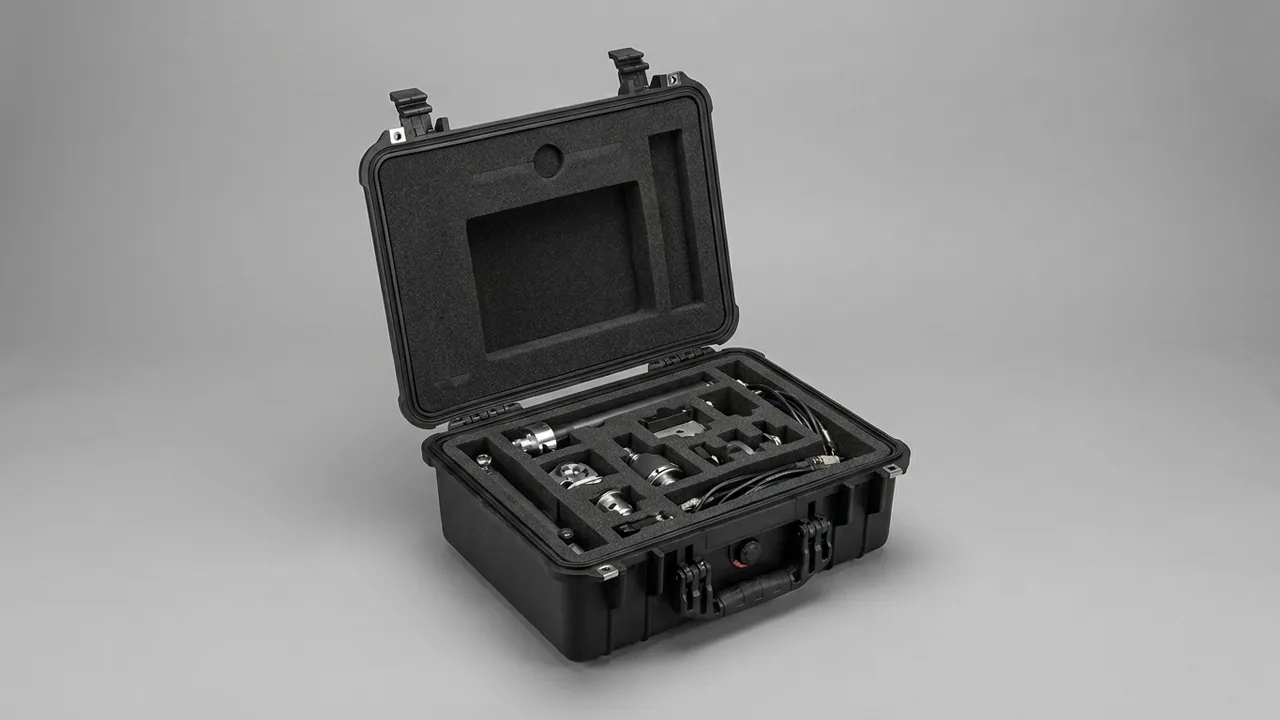
A batch of thirty-millilitre serum glass bottles spent two summer days in a box van. On arrival the outer carton was intact and the liner showed no crush marks, yet the sorting line kept finding hairline cracks on the base of three bottles. Worse, one had already leaked, and the serum had run along the liner seam into the neighbouring eyeshadow pan, destroying an entire pressed powder compact. At retail value the direct loss was under two thousand yuan, but the shipment missed its shelf window, and channel penalties plus a second production run cost several times the value of the goods.
The goal of cosmetic protection is not "packaging did not break" but "saleable on arrival": the case must hold drop acceleration, the temperature and humidity window, cap torque decay and chemical compatibility inside the limits the product itself allows, without changing the form, odour or colour of a single item. JUNZHIJIA breaks the cosmetic case into four layers: the shell carries stacking and puncture loads, the liner carries location and energy absorption while meeting appearance and chemical resistance demands, compartment trays carry isolation and secondary containment, and the sealing and desiccant system carries humidity and mould control. Miss any one layer and the loss will not appear on the goods-in note; it will appear on the shelf.
Table of Contents
- Cosmetic Failure Map: From Glass Bottle Hairlines to Emulsion Phase Separation
- Protection Requirement Matrix by Category and Pack Format
- Temperature and Humidity Boundaries: Heat Softening, Freeze-Thaw and Phase Stability
- Leakage Control: Cap Torque Decay, Top Compression Foam and Secondary Containment
- Case Materials and Liner Appearance: ABS Gloss, Aluminium Frame and Flocked Surfaces
- Chemical Compatibility of Liners: Ethanol, Oils, Ketones and Plasticiser Migration
- Compartment and Tray Structures: Drawer Trays, Accordion Trays and Removable Dividers
- Cushioning Design: Drop Height, Permitted Acceleration and Fit Clearance
- Latches, Hinges and Locks: Cycle Life, Theft Protection and Key Management
- Transport Compliance Boundaries for Aerosols and Alcohol-Based Perfume
- Transport Testing and Acceptance Criteria: Thermal Cycling, Leak Testing and AQL
- Stacking, Warehousing and Retail Display
- Cleaning, Mould Prevention and Retirement Criteria
- Frequently Asked Questions FAQ
- Conclusion and Related Reading
Cosmetic Failure Map: From Glass Bottle Hairlines to Emulsion Phase Separation
Cosmetic failures divide into visible breakage and invisible deterioration. The first is caught at goods-in; the second usually reaches the consumer before anyone notices. Sorting returns and channel claims into categories yields seven dominant failure modes.
| Failure Mode | Direct Cause | Field Evidence | Structural Countermeasure |
|---|---|---|---|
| --- | --- | --- | --- |
| Glass hairlines and breakage | Point impact, thermal shock, base load concentration | Hairline against light, leakage | Full-perimeter support plus base cushioning plus bottle separation |
| Pressed powder cracking | Drop shock above powder and binder strength | Cracks, shedding, loose fragments | Low acceleration design plus full-plane pan support |
| Lipstick softening, sweating, deformation | Temperature above wax base softening point | Skewed stick, oil beads, stiff winding | Temperature control plus upright storage plus light-shielded cavity |
| Emulsion breaking and separation | Freeze-thaw cycling, prolonged heat | Oil bleed, layers, coarser particle size | Temperature window control plus phase stability verification |
| Perfume and nail polish leakage | Cap torque decay, pressure change | Crystals at the neck, odour in the carton | Top compression foam plus secondary containment plus upright marking |
| Brush mould and shedding | Wet sealed storage, bristle compression | Black spots, odour, splayed tufts | Drying plus bristle guard plus breathable barrier |
| Beauty device appearance and battery faults | Crushing, moisture, battery short | Case dents, no power-up | Dedicated cavity plus insulated battery box plus desiccant |
What these seven share is that none of them announce themselves at goods-in. Acceptance criteria therefore have to move from "did it break" to "did it change", writing re-measurable quantities such as appearance, odour, colour, winding torque and separation state into the purchase specification, and re-measuring them after every round of transport testing rather than only checking whether the case is dented.
Protection Requirement Matrix by Category and Pack Format
Cosmetics are not one class of goods but a collection of items with entirely different damage mechanisms. Glass bottles fear shock, pressed powder pans fear acceleration, lipstick fears temperature, emulsions fear freeze-thaw, aerosols fear pressure, perfume fears evaporation, brushes fear moisture. Mixing them in one cavity means designing the whole structure to the standard of the most fragile item present.
| Category | Pack Format | Dominant Sensitivity | Engineering Reference Limit | Storage Requirement |
|---|---|---|---|---|
| --- | --- | --- | --- | --- |
| Serum, essential oil, perfume | Glass bottle with dropper or sprayer | Shock, torque decay, evaporation | No hairlines, cap torque decay under 30 percent | Full-perimeter fit, upright, top foam, light-shielded |
| Powder and eyeshadow pans | Pressed powder in metal or plastic pan | Shock acceleration | No cracks, no shedding | Full-plane support, no point load on the pan face |
| Lipstick, lip glaze | Twist-up tube | Temperature, upright posture | Storage below 40 degrees Celsius, stick not skewed | Upright slots, light-shielded, temperature control |
| Cream, lotion | Wide-mouth jar or tube | Freeze-thaw, heat | Storage 5 to 30 degrees Celsius, no separation | Temperature window control, upright |
| Aerosols such as sunscreen spray | Pressurised metal can | Temperature, pressure | Storage below 50 degrees Celsius, can not deformed | Dedicated cavity, no inversion, away from heat |
| Nail polish, remover | Glass bottle with solvent | Flammability, solvent compatibility | No leakage, no odour spread | Secondary containment, solvent-compatible liner |
| Makeup brushes, sponges | Bristle tuft or sponge | Moisture, compression | No mould spots, tuft intact | Dry, protective sleeve, separate cavity |
| Beauty devices | Electronics with battery | Crushing, moisture, battery | Self-test passes first time | Dedicated cavity, insulated battery box |
Once the classification is settled it belongs in the packing technical file and must be maintained with product revisions. Beauty SKUs turn over extremely fast, and a significant share of real-world cases where "it used to work fine" begins with a new specification being launched and simply pushed into a cavity designed for the old one.
Temperature and Humidity Boundaries: Heat Softening, Freeze-Thaw and Phase Stability
Temperature is the most underestimated variable in beauty logistics. A box van in direct summer sun can pass fifty degrees Celsius within an hour, while a northern winter line-haul hold can fall to more than ten degrees below zero, and most cosmetic formulations are designed for a window of only five to thirty degrees.
| Condition | Affected Categories | Typical Symptom | Engineering Countermeasure |
|---|---|---|---|
| --- | --- | --- | --- |
| Heat above 40 degrees Celsius | Lipstick, balm, wax-based products | Softening, sweating, stiff winding | Temperature-controlled transport, insulation, light-coloured shell |
| Heat above 50 degrees Celsius | Aerosols | Rising can pressure, leak risk | Banned shipping windows, away from heat, dedicated cavity |
| Cold below 0 degrees Celsius | Lotions, creams, gels | Emulsion break after freeze-thaw | Insulation, phase change material, winter lane management |
| Humidity above 65 percent RH | Brushes, sponges, paper cartons | Mould, odour, carton deformation | Desiccant, humidity indicator card, breathable barrier |
| Temperature cycling | Glass bottle and contents | Thermal shock hairlines, seal failure | Ramp rate control, condition to room temperature before opening |
Phase stability verification belongs inside transport validation, not in a separate development trial. The normal method is high-low temperature cycling to the product specification, for example twenty-four hours at minus fifteen degrees and twenty-four hours at forty degrees, repeated three to five times, then checking for separation, oil bleed, coarser particle size or viscosity drift once the sample returns to room temperature. Wax-based products additionally need forty-eight hours of upright storage at forty degrees to check for sweating and skewing.
Humidity control is simpler but must be systematic. Desiccant quantity is calculated from sealed cavity volume and expected transit duration, and humidity indicator cards are read at goods-in; cases over the limit are dried internally before shelving. Paper cartons and leaflets should be bagged separately so they cannot absorb moisture, deform and soil the liner. Shell and seal selection for extreme environments is covered in Outdoor Cases in Temperature Extremes and Outdoor Case Protection in Rain and Humidity.
Leakage Control: Cap Torque Decay, Top Compression Foam and Secondary Containment
Leakage is the most asymmetric failure in cosmetics: a leaking bottle of serum has limited value itself, but it contaminates everything else in the same cavity, and the loss is counted by the whole cavity.
Cap torque decay works through relative slip of the thread under lateral vibration. Transport vibration is rarely parallel to the cap axis, and that lateral component makes the thread pair fret repeatedly while preload falls away; thermal cycling amplifies the process because bottle body and closure expand at different rates. Three countermeasures apply. First, top compression foam: a layer of low-hardness closed-cell foam on the liner top face or inside the tray lid applies continuous axial preload to the cap and resists lateral fretting. Second, torque records: log the applied torque at packing, measure removal torque at goods-in, and treat decay beyond thirty percent as proof that the packaging concept needs revision. Third, secondary containment: every bottle goes into its own resealable bag or a tray cell with an absorbent pad, so a leak does not spread.
Secondary containment in practice means sleeving the bottle in a PE resealable bag with excess air expelled, laying an absorbent pad sized to about one and a half times the bottle volume in the cell bottom, and bagging solvent-based products such as nail polish and remover individually before placing them in a separate cavity. The outer carton should carry upright, keep-dry and stack-layer markings to GB/T 191 together with a clear instruction to transport upright.
Case Materials and Liner Appearance: ABS Gloss, Aluminium Frame and Flocked Surfaces
A cosmetic case carries both protection and display duties at once, which is the biggest difference from an industrial shipping case. A cosmetic defect on an appearance part, whether a scratch, a colour shift or dirt, is equivalent to a product defect in a retail setting.
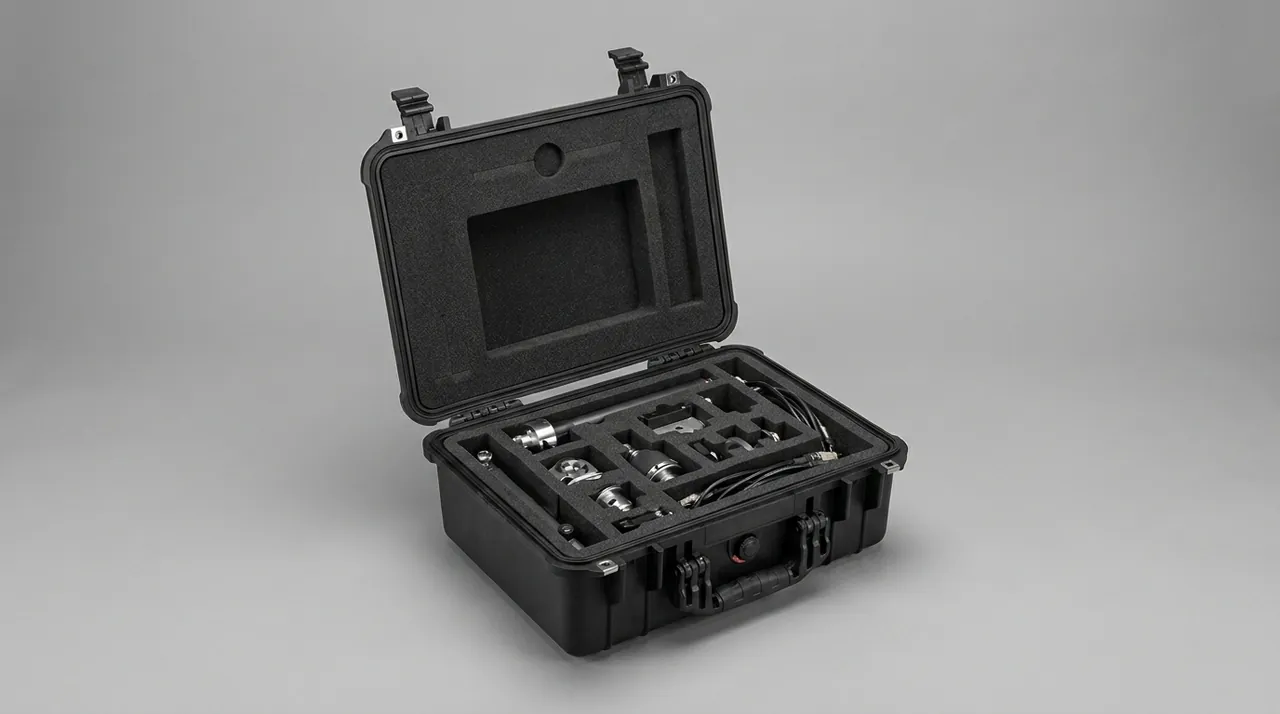
| Material or Process | Shell Character | Moulding and Tolerance | Advantage | Constraint |
|---|---|---|---|---|
| --- | --- | --- | --- | --- |
| ABS gloss injection | High surface hardness, good gloss | Injection, 2.5-3.5 mm | Best appearance, stable dimensions, easy cleaning | Needs UV-resistant grade, modest low-temperature toughness |
| PP copolymer with texture | Matt, scratch resistant | Injection, 2.5-4.0 mm | Tough, chemical resistant, low cost | Weaker gloss and feel than ABS |
| Aluminium frame with ABS panel | Metallic feel, high stiffness | Extrusion plus riveting | Strong stacking and drop behaviour, premium look | Needs anodising, higher mass |
| PC transparent lid | Visible display | Injection | Strong display effect | Scratches easily, needs hard coat |
| Rotomoulded LLDPE | Thick wall, drop resistant | Rotomoulding, 4.0-6.0 mm | Best puncture resistance | Low appearance precision, unsuitable for display |
Liner look and feel come from surface treatment. Common options are black or beige EVA moulded trays whose surface can be thermoformed into cavities matching the bottle profile, flocking with short nylon fibre applied electrostatically to improve feel and lower friction, and PU leather or fabric wrapping for a premium grade. Two cautions apply: PU and PVC leather can lose plasticiser to alcohol-based perfume over long contact and turn tacky, while fabric wrapping absorbs leaked liquid and is hard to clean, so both should be used with care in wet and liquid zones.
Colour and marking are part of brand delivery. Shell colour can be matched to a Pantone reference, and logos applied by screen print, heat transfer or a metal badge. Where a formulation is photosensitive the cavity should be light-shielded, and a light-blocking panel fitted inside a transparent lid.
Chemical Compatibility of Liners: Ethanol, Oils, Ketones and Plasticiser Migration
The chemical aggression of cosmetic products towards liner materials is far higher than that of general industrial goods, which makes liner selection the most error-prone step in building a cosmetic case.
| Liner Material | Ethanol and Fragrance | Oils and Silicone | Ketones and Esters in Remover | Overall Recommendation |
|---|---|---|---|---|
| --- | --- | --- | --- | --- |
| PE and EPE | Good | Good | Good | Preferred, closed cell, low absorption |
| EVA | Good | Slight swelling on long contact | Fair | Usable, contact test required |
| IXPE | Good | Good | Good | Preferred, fine cell, easy to clean |
| PP | Good | Good | Good | Preferred, rigid, holds shape |
| EPS polystyrene | Poor, dissolves | Poor | Very poor | Prohibited |
| PVC and PU leather | Plasticiser extracted, becomes tacky | Fair | Poor | Prohibited in wet and liquid zones |
Beyond swelling, two further directions deserve attention. The first is migration staining: colour masterbatch, plasticiser and residual monomer in the liner can be extracted by alcoholic or oily contents and migrate back onto bottle labels or cartons as discolouration, so the specification should state a contact staining test, rated after forty-eight hours of contact at forty degrees. The second is odour: the inherent volatile smell of foam is absorbed by cosmetics, especially fragrance-free products, so the liner needs an odour grade limit and a sniff check at goods-in.
Cleanability matters equally. Liner surfaces in liquid zones should be wipeable, which points to closed-cell IXPE or skinned EVA; flocked and fabric surfaces do not belong in cells that may see liquid. The general selection logic for plastic materials is set out in Protective Case Plastic Materials.
Compartment and Tray Structures: Drawer Trays, Accordion Trays and Removable Dividers
Beauty ranges carry many SKUs in mixed sizes and refresh constantly, so a single fixed moulded liner struggles to keep pace with product iteration. Tray systems and modular layouts are therefore the mainstream answer.
Drawer trays suit counter and mobile makeup use: each tray pulls out independently, the tray itself is injection moulded in PP or ABS with EVA compartments inside. The advantages are easy access and easy cleaning; the drawback is that the gap between tray and shell needs its own cushioning, otherwise the whole tray shifts during transport. Accordion multi-layer trays suit dense small-item storage such as eyeshadow, lip glaze and samples, presenting all layers when opened and packing compactly when closed, but hinge life and inter-layer retention are weak points and should be on the goods-in checklist.
Removable divider systems suit categories whose sizes change often: a slot framework with PP dividers arranged to the current SKU set over a base EVA cushion layer. The advantage is that a restyle only moves dividers instead of commissioning a new moulded liner; the cost is lower location precision than a moulded tray, so buffer strips have to fill the gap between divider and product. The trade-off between dividers and moulded foam is analysed in Case Dividers Versus Custom Foam, and the structure of removable systems is described in Removable Divider Systems for Cases.
Whichever structure is chosen, two bottom lines apply: products must never touch one another, and no item may have more than one millimetre of free movement with the lid closed.
Cushioning Design: Drop Height, Permitted Acceleration and Fit Clearance
Cushioning has to be derived backwards from the acceleration the product allows, not picked from experience. Required compression travel is estimated from the energy relation: travel is roughly 2H divided by a-max, where H is drop height and a-max is the permitted acceleration expressed as a multiple of g.
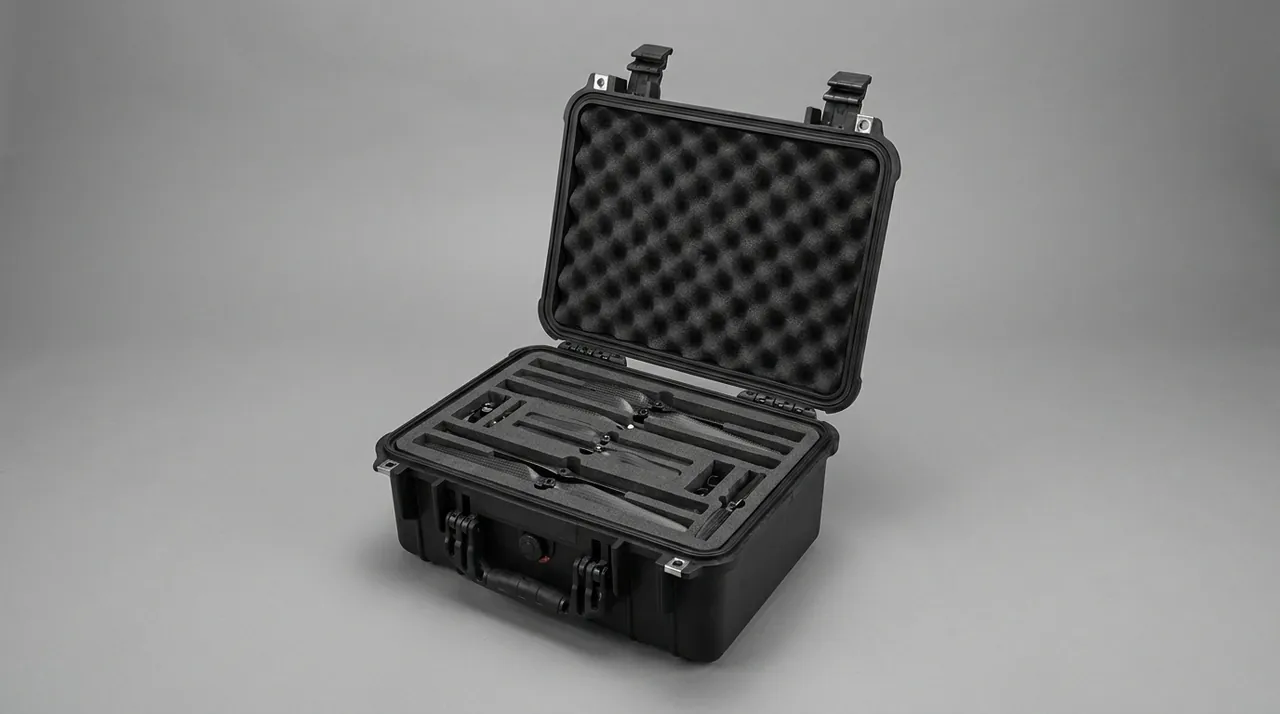
Typical engineering values are thirty to fifty g for glass bottles, twenty-five to forty g for pressed powder pans, above sixty g for metal aerosol cans, and the manufacturer limit for electronic devices. Once a drop height is chosen from the mass-to-height relationship in GB/T 4857.5, the required travel follows, and the dynamic cushioning curve of the material then fixes thickness and bearing area.
What actually decides success is fit precision. Clearance between liner and product should stay within one millimetre; a larger gap means the product travels freely before striking the liner, which is equivalent to raising the drop height and can push measured shock up by more than sixty percent. Glass bottles also need protection from sitting hard on the base: the base should rest on an annular support rib with a central relief so that shock load spreads into the side wall rather than concentrating on the base radius, one of the weakest points of a glass bottle.
Top compression foam belongs to the cushioning system but does a different job: it supplies axial preload rather than energy absorption, so it should be a low-hardness closed-cell material with low compression set, compressed by ten to twenty percent, avoiding enough force to lift a cap or deform a tube. The full design method for the cushioning layer is set out in Cushion Liner Cases.
Latches, Hinges and Locks: Cycle Life, Theft Protection and Key Management
Cosmetic cases open and close far more often than industrial shipping cases, with counter scenarios reaching dozens of cycles a day, so latches and hinges should be selected as life-limited parts rather than purely structural ones.
Three points govern latch selection. First, operating force: keep it between twenty and sixty newtons, since more hurts the user experience and less fails to compress the seal. Second, service life: injection moulded latches need verification over several thousand open-close cycles, and metal latches need their operating force rechecked after salt spray. Third, failure mode: the latch should be replaceable on its own so one failed latch does not retire the whole case.
For hinges, a one-piece living hinge has limited cycle life and cannot be replaced, while a full-length metal pin hinge lasts longer and is replaceable, although pin material and surface finish need attention. Counter display cases also need a lid stop so the lid cannot fall backwards onto the hinge or drop shut when nobody is holding it.
On locks, high-value sets and professional makeup cases usually take a key lock or combination lock for counter theft control and transport custody. Key management belongs in the delivery documents: how many keys per case, how spares are held, whether the cylinder is rekeyable. Where air transport is involved, locks on checked baggage must satisfy the relevant security screening requirements so that the case can still be opened for inspection.
Transport Compliance Boundaries for Aerosols and Alcohol-Based Perfume
Two categories of beauty product are regulated goods, and their compliance boundary has to be confirmed before packing, because no amount of protection helps a shipment that cannot legally move.
The first is aerosols, typically sunscreen spray and styling spray. Pressurised cans normally fall under the aerosol entry of the UN numbering system, with quantity, packaging and labelling constraints, and can pressure rises with temperature: by the ideal gas relation, a ten percent rise in absolute temperature raises pressure by roughly ten percent, so moving from twenty to fifty degrees pushes can pressure up substantially, and beyond a certain temperature deformation and leakage risk climb steeply. The engineering response is a dedicated cavity, no inversion, distance from heat sources, avoidance of long vehicle storage in summer, and a keep-cool marking on the outer carton.
The second is alcohol-based perfume and nail polish. Perfume is normally ethanol-based and belongs to the fragrance products containing flammable solvent class; nail polish and remover contain flammable solvent as well. In air transport these are managed under the corresponding dangerous goods entries, commonly declared as limited quantity and subject to inner packaging capacity, combination packaging and marking rules. The flash point and applicable packing group of every product should be confirmed before packing rather than judged by experience.
Beauty devices containing lithium cells must follow lithium battery transport rules, with cells insulated individually and state of charge within the specified range. These compliance items belong on the first page of the packing technical file, with safety data sheets and a transport declaration travelling with the case, so that missing paperwork does not hold the shipment at the border.
Transport Testing and Acceptance Criteria: Thermal Cycling, Leak Testing and AQL
Choosing a test plan is essentially choosing which segment of the distribution environment to simulate. A purchase specification should separate three things: whole-case transport testing, thermal testing, and product-level criteria.
| Test Item | Common Reference | Simulated Scenario | Cosmetic Case Judgement Point |
|---|---|---|---|
| --- | --- | --- | --- |
| Conditioning | GB/T 4857.2 | Pre-transport equilibration | Uniform starting state, comparable results |
| Drop | GB/T 4857.5, ISTA drop procedure | Handling mishap | No glass hairlines, no cracked powder pans |
| Swept sine vibration | GB/T 4857.7 | Road fixed-frequency excitation | Cap torque decay within limit |
| Random vibration | GB/T 4857.23 | Real road spectrum | Trays do not shift, dividers retain position |
| Stacking | GB/T 4857.3 | Warehouse stacking | Cartons undeformed, case still opens normally |
| Low pressure | GB/T 4857.13 | Aircraft hold | No bottle leakage, aerosol cans undeformed |
| Thermal performance | ISTA 7D | Temperature-controlled transport | Cavity temperature held inside window |
| Leak test | Agreed between parties | Inversion and pressure difference | No leakage after twenty-four hours inverted |
Thermal cycling and phase stability verification are not part of standard transport testing but are essential for cosmetics: run high-low temperature cycling to the product specification and re-measure separation, oil bleed and viscosity, filing the results in the same batch record.
Sampling at goods-in is best run to the single sampling plan for normal inspection in GB/T 2828.1 at general inspection level II, with AQL 1.0 for critical items such as leakage, breakage and mould, and 2.5 for general items such as appearance, colour shift and scratches. Goods-in criteria should include re-measurable quantities: cap removal torque, smoothness of stick winding, and the presence of separation or odour. A complete acceptance scheme is given in AQL Acceptance for Custom Cases.
Stacking, Warehousing and Retail Display
Cosmetic cases are stacked as full cases in the warehouse and displayed directly in the store, and these two scenarios make contradictory demands: warehousing wants stiffness and interlock, display wants appearance and feel.
For stacking, the load is calculated as the lower case carrying the full mass of everything above it, with a safety factor of 1.5 to 2.0; plastic shells creep noticeably more under sustained load at forty degrees than at room temperature, so summer warehouses should deliberately reduce the nominal number of stacked layers. The stacking face should use boss-and-recess or corner interlock features so upper cases cannot slide sideways, because sliding causes drops and also puts shear load into the side wall, a common cause of cracked latch seats.
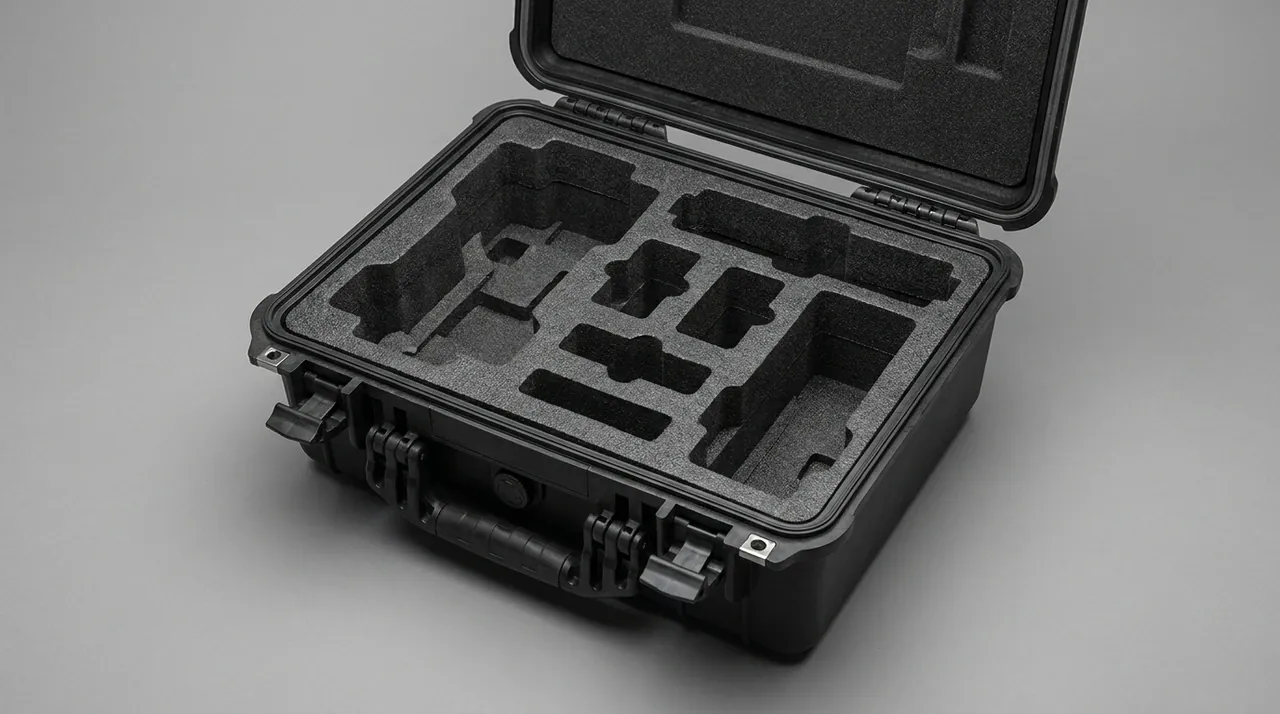
For display, the outer surface must survive repeated wiping with everyday cleaning agents, and colour tolerance should be written into the specification with upper and lower sealed reference samples. If spotlights are fitted inside a transparent lid, confirm that lamp cavity heat does not raise the cavity temperature. General principles for stackable structures are covered in Stackable Toolbox Design Benefits.
Securing in transit matters just as much: full cases should be held with strapping or stretch film, pallet units should have a central centre of gravity, and long brush cases should lie parallel to the vehicle rails with longitudinal movement restrained.
Cleaning, Mould Prevention and Retirement Criteria
The cosmetic case is one of the few protective cases that needs routine cleaning, because leakage, loose powder and oil residue accumulate and become a source of mould and odour.
A three-level cleaning routine is recommended. Daily level: wipe liner and shell with a wrung-out soft cloth to remove loose powder and fingerprints. Intermediate level: wipe rigid surfaces with seventy-five percent ethanol wipes, noting that flocked and fabric surfaces must not be wiped with solvent and should be cleaned with a lint roller instead. Deep level: remove removable dividers and trays, wash them separately, dry completely before refitting, and replace the desiccant at the same time.
Mould prevention rests on three things: humidity control through desiccant and indicator cards, structural ventilation that avoids sealed dead cavities and leaves vent paths in the liner, and prompt drying so that a case returned wet is opened and aired before it is closed for storage. The brush cavity needs particular care: bristles must be completely dry and fitted with a guard before entering the cavity, because a damp tuft in a sealed cavity shows black spots within two or three days.
Retire rather than continue service when any of the following appears: through-thickness cracking of the shell; a latch that no longer gives even compression, has failed and cannot be replaced; hinge pin looseness that skews the lid; permanent compression set, cracking or non-recovery after pressing in the liner; a tacky liner surface, which indicates plasticiser extraction; or mould that cannot be removed. Every non-conformance should be recorded and reported to the supplier rather than absorbed quietly at store level.
Frequently Asked Questions FAQ
Q: Why do glass serum bottles show hairlines inside a case that looks undamaged?
A: Glass fails in tension, and a hairline is the result of local tensile stress exceeding surface strength; it does not need a large impact energy. Three paths are common. The first is concentrated base loading: the base radius is one of the weakest points of a glass bottle, so if the liner offers a flat rigid base support, that radius becomes the only load point and all drop energy enters there. The correct approach is an annular support rib carrying the side wall with a central relief under the base. The second is thermal shock: moving a bottle straight from a cold environment into a hot one, or the reverse, creates thermal stress across the wall, and bottles already carrying micro-cracks extend them, so goods should be conditioned to room temperature before opening and shelving. The third is bottle-to-bottle contact, where neighbours knock together under vibration and concentrate stress at the contact point. Engineering requires full separation, full-perimeter support and fit clearance under one millimetre, with cushioning travel derived from a permitted acceleration of thirty to fifty g. Inspect every bottle against light before shelving; side lighting reveals hairlines best, and bottles showing them must not go on sale.
Q: Why does lipstick soften and sweat in summer transport, and can the case fix it?
A: The stick is wax-based, and while the wax softening point in the formulation is usually between fifty-five and sixty-five degrees, deformation and sweating begin well below it: extended storage at forty degrees already softens the stick and brings oil beads to the surface, and if the tube is inverted or laid on its side at the same time, gravity skews the stick inside the tube so that winding becomes stiff or the stick breaks. A case solves part of this, not all of it. What the case can do is threefold: control temperature through an insulation layer and a light-coloured shell, supported by temperature-controlled transport on hot summer lanes; keep the stick upright with vertical slots that limit shake so a softened stick cannot slump sideways; and shield light with an opaque cavity or blocking panel to reduce radiant heating. What the case cannot do is turn a sixty degree vehicle into room temperature, so process control is mandatory: avoid midday loading, avoid long vehicle storage, and let goods return to room temperature before shelving. The specification should state the maximum storage temperature and require forty-eight hours of upright storage verification at forty degrees.
Q: Why does lotion separate after freeze-thaw, and what does that have to do with packaging?
A: An emulsion is a thermodynamically unstable system in which the oil phase is dispersed as fine droplets in the water phase and held there by emulsifier and interfacial film. As temperature falls below zero the water phase freezes first, ice crystals squeeze the droplets together and puncture the interfacial film; after thawing the droplets cannot redisperse and coalesce, which appears as oil bleed, separation, coarser particle size and viscosity drift. Packaging enters the picture because it decides the temperature history the product actually experiences. A normal corrugated carton with a thin liner has almost no thermal resistance, so on a northern winter lane the product reaches ambient within hours, whereas an insulated case with phase change material can hold the window for hours to tens of hours. The packaging plan therefore does three things: state the permitted temperature window in the specification; choose thermal resistance by lane and season, adding insulation or a thermal shipper on northern winter routes; and verify, running high-low temperature cycling to the product specification, for example twenty-four hours at minus fifteen and twenty-four hours at forty, repeated three to five times, then re-measuring separation, oil bleed and viscosity at room temperature. Freeze-thaw damage is irreversible, so prevention is the only option.
Q: What is cap torque decay, and how is post-transport leakage prevented?
A: A preloaded thread pair frets in relative motion under lateral vibration and gradually loses preload; that is torque decay. Transport excitation is rarely parallel to the cap axis, so the lateral component makes the thread fret repeatedly, and thermal cycling amplifies the process because body and closure expand at different rates. Once preload falls below the compression needed for sealing, leakage appears. First, top compression foam: a low-hardness closed-cell layer on the liner top or inside the tray lid applies continuous axial preload to the cap, compressed by ten to twenty percent, working against lateral fretting rather than absorbing energy. Second, torque records: log applied torque at packing, measure removal torque at goods-in, and treat decay beyond thirty percent as a signal to revise the packaging concept rather than simply tightening the cap again. Third, secondary containment: each bottle goes into its own resealable bag or a cell with an absorbent pad so a leak cannot spread to other products. Solvent-based items such as nail polish and remover are always bagged separately and placed in a dedicated cavity, and the carton carries upright and keep-dry markings to GB/T 191 with an upright transport instruction.
Q: Why does a liner become tacky or stain, and is the material wrong?
A: In most cases the material and the contents are incompatible. Cosmetic products contain ethanol, oils, silicone, ketone and ester solvents, and these act on the liner in two ways. The first is swelling and dissolution: polystyrene materials, including the familiar EPS buffer block, dissolve outright in ketones and esters and swell in contact with alcoholic fragrance, so they are prohibited in a cosmetic case. The second is extraction: plasticiser, colour masterbatch and residual monomer in the liner are extracted by alcoholic or oily contents and migrate to the surface, which appears as tackiness and then transfers back onto bottle labels or cartons as staining, an effect especially visible with PU and PVC leather. The correct response is to use inert closed-cell materials such as PE, PP, EVA or IXPE throughout liquid and wet zones, and to write a contact staining test, rated after forty-eight hours at forty degrees, plus an odour grade limit into the specification, with a sniff check at goods-in. A liner that has already turned tacky cannot be recovered and must be replaced entirely, so one test at selection stage is far cheaper than rework later.
Q: Why do makeup brushes go mouldy, and how should the case be changed?
A: Mould on brushes needs three conditions at once: spores, nutrient and moisture, and moisture is the only variable packaging can control. Natural bristle carries keratin and residual sebum, an excellent nutrient source; if the tuft goes into a sealed cavity before it is fully dry after use or washing, relative humidity inside the cavity quickly reaches the range where mould grows, and black spots with odour appear within two or three days, while prolonged dampness splays the tuft, sheds bristles and starts corroding the metal ferrule. Four changes apply. First, drying: brushes must be completely dry before packing, ideally with a bristle guard that keeps dust off and holds the tuft shape. Second, a barrier: put a breathable layer between the brush cavity and other cavities so moisture does not spread through the whole case. Third, humidity control: place desiccant and an indicator card in the cavity and replace desiccant periodically for long-term storage. Fourth, structure: avoid sealed dead cavities, leave vent paths in the liner, and open any case returned wet to air it before closing it for storage. Where a product genuinely travels damp, such as a sponge, use a vented box rather than a sealed bag and state a mould grade requirement in the specification.
Q: Can aerosols and perfume simply be packed and shipped, or are there hard constraints?
A: They cannot, because both are regulated goods whose compliance boundary must be confirmed before packing. Aerosols such as sunscreen spray and styling spray are pressurised containers whose internal pressure rises with temperature: by the ideal gas relation, a ten percent rise in absolute temperature raises pressure by roughly ten percent, so moving from twenty to fifty degrees pushes can pressure up substantially, and beyond a certain point deformation and leak risk climb steeply; quantity, packaging and labelling constraints also apply. Alcohol-based perfume and nail polish contain flammable solvent and are managed under the corresponding dangerous goods entries in air transport, commonly declared as limited quantity and subject to inner packaging capacity, combination packaging and marking rules. Beauty devices with lithium cells must follow lithium battery transport rules with cells insulated individually. The engineering response is threefold: confirm flash point, UN number and packing group for every SKU instead of judging by experience; give aerosols a dedicated cavity, never inverted and away from heat; and ship the paperwork with the case, including transport declaration and safety data sheets. List these on the first page of the packing technical file so missing documents do not hold the shipment at the border.
Q: How many layers can cosmetic cases be stacked, and what matters in store display?
A: A nominal stack figure assumes room temperature, static load, even weight distribution and fully engaged stacking faces. Four neglected factors cause real failures. First, creep: sustained load at forty degrees creeps far more than at room temperature, so summer warehouses should reduce layers. Second, offset and sliding: without interlock the upper case shifts sideways, the side wall takes shear load, and latch seats crack. Third, load concentration: an off-centre case, or loose goods piled on top, produces far more load than the uniform assumption. Fourth, time: stack tests run twenty-four hours to seven days, while real storage lasts months and creep accumulates. Calculate stack load from the bottom case carrying the full mass above it with a safety factor of 1.5 to 2.0, use boss-and-recess or corner interlock on the stacking face, and mark maximum layers, unit mass and centre of gravity. Store display turns on three points: the outer surface must survive repeated wiping with cleaning agents, colour tolerance needs upper and lower sealed samples, and any spotlight inside a transparent lid must be checked so lamp heat does not raise cavity temperature.
Conclusion and Related Reading
JUNZHIJIA builds cosmetic cases as four-layer systems covering shell, liner, tray and humidity control, with liner sampling, tray tooling, OEM/ODM and branded colour and marking.
Related Reading