

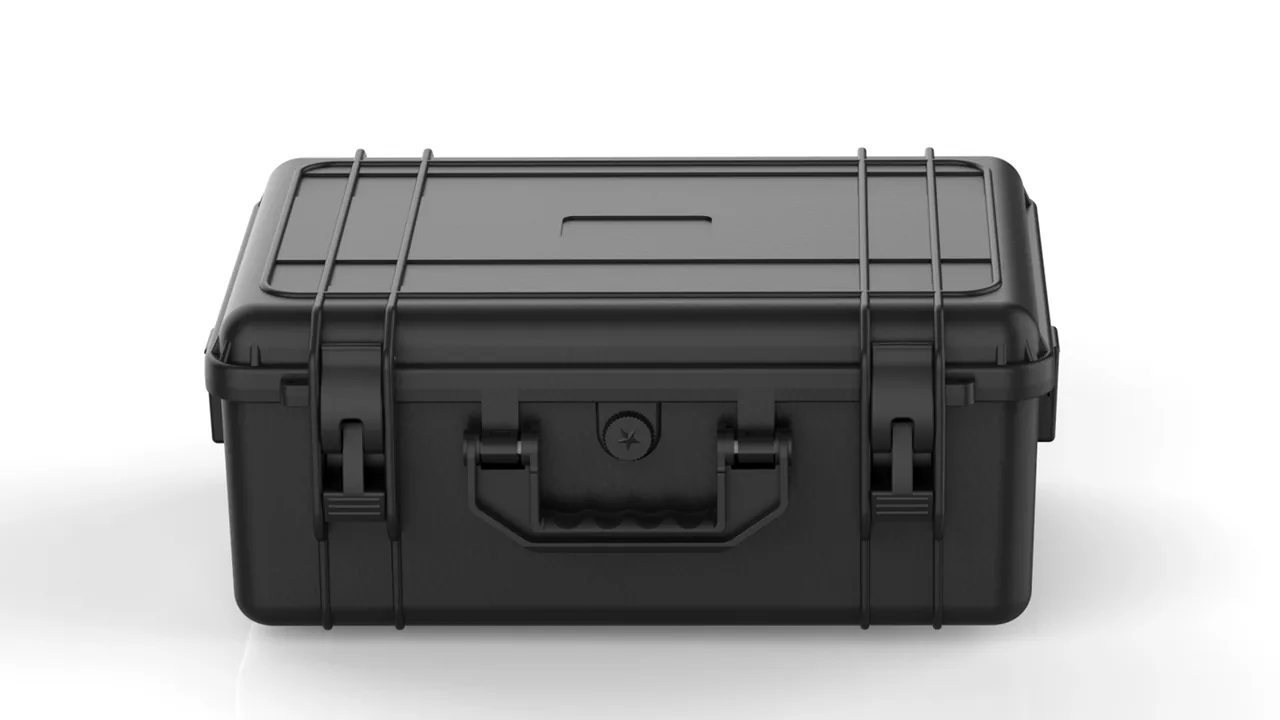
A modern greenhouse control system is really a precision electronic and electromechanical assembly. PLC master cabinets decide how the climate strategy is executed, actuator motors and vent drives convert control signals into physical motion, and sensor harnesses carry temperature, humidity, light, and carbon-dioxide data back to the controller. These parts are valuable individually but often small, so in practice they travel loose in ordinary cartons or wrapped in stretch film. The result shows up reliably: controllers fail from moisture after arrival, actuator bearings arrive bruised, vent-drive gearbox housings crack, and harness connectors oxidize. As a protective-case manufacturer, JUNZHIJIA has spent years building transport and storage protection for controlled-environment agriculture and industrial control customers. Our systems span compartment design, anti-static liners, dust sealing, condensation control, and IP67 protection, shaped specifically around the precision-electronics character of greenhouse control parts and the field conditions they meet. Written from the maker's side of the bench, this article maps how PLC controllers, actuator motors, sensor harnesses, and vent drives actually fail in logistics, then explains how a dedicated case pushes those risks back into an acceptable band.
Transport Risks to PLC Controllers and I/O Modules
A PLC controller and its analog I/O and communication modules are the brain of a greenhouse climate system. Inside sit dense surface-mount components, electrolytic capacitors, and miniature relays, with main-chip pin pitches measured in fractions of a millimetre; a stray metallic fragment or a film of moisture between pins is enough to cause a short or a drifting signal. In transit the controller does not face one dramatic threat but an accumulation of small ones. Continuous trailer vibration lets an unsecured card micro-move against its mount until the pins of a heavy component fatigue and crack, while a single drop during handling can shift the shell relative to the board and loosen or unseat a plug-in module.
Static is the quieter hazard. Controllers ship inside plastic housings, and repeated rubbing in a dry trailer builds charge on the enclosure. When a technician opens the case without discharging and touches the terminals, a few thousand volts can punch through the input protection diodes. The failure does not appear at that moment; it surfaces weeks later as a dead input point on an otherwise healthy machine. JUNZHIJIA lines controller chambers with anti-static EVA and laminates conductive foam on the inner wall so the whole cavity sits at equal potential instead of collecting charge in one spot. For customers who reprogram in the field or swap modules, we reserve a small lidded compartment for removed modules, so an old card is never dropped back alongside new stock and hit by a second static event.
Terminal blocks and communication ports are the structural weak points on a controller shell. The plastic dividers between terminal positions are thin, and lateral squeeze cracks them, shorting adjacent circuits. An RJ45 or industrial Ethernet latch that gets bumped out of shape will not hold a cable firmly, and the symptom is intermittent field communication that sends technicians chasing the wrong cause. JUNZHIJIA moulds a protective shroud over the terminal zone so the load path runs into the liner body rather than the plastic divider, and orients every port inward to keep the case wall from pressing directly on it. For controllers that ship with terminals already fitted, we recommend a shallow pocket with finger cutouts: the terminals neither hang free nor carry load, and two fingers lift the unit out without prying.
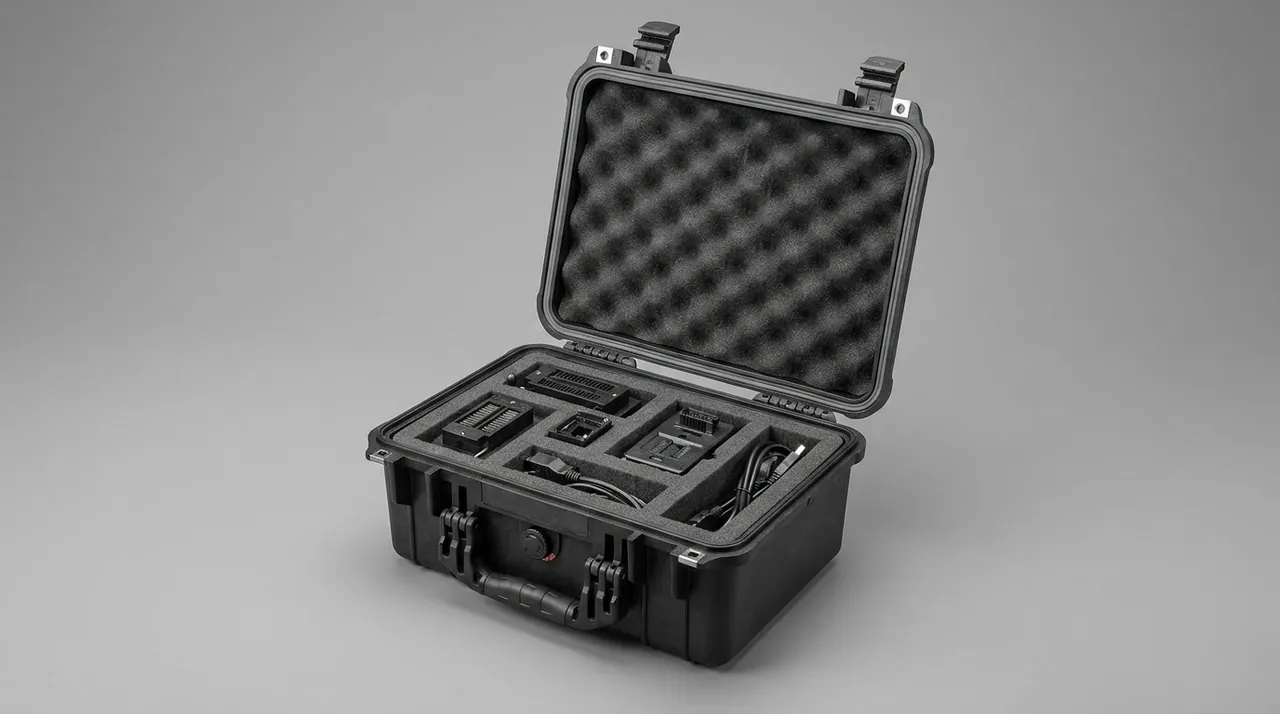
Protection Priorities for Actuator Motors and Gearboxes
The actuators found in greenhouses include window motors, film-rolling motors, shade-screen drives, and electric valve actuators. All share a motor-plus-gearbox architecture with a metal rotor, precision gear pairs, and an output shaft. Their transport damage has a signature: the exterior looks perfect while the interior has already begun to fail. A rotor bearing that takes axial or radial shock develops tiny indentations in its raceways. At first the motor turns normally, but within the first month of service the vibration signature or the starting current crosses the acceptance limit and the unit is rejected.
The gearbox risk concentrates where the output shaft leaves the housing. That shaft protrudes as a natural lever arm, so when the case tips or takes a side impact the moment transmits straight back to the bearing boss, cracking the housing or bending the shaft. JUNZHIJIA cuts a dedicated support cradle for the shaft so its end rests on a slightly compliant pad, converting a cantilever into a two-point support, and clamps the motor body in a front locating ring so the whole axis cannot swing inside the cavity. For long actuators such as film-rolling motors, we use a horizontal contoured channel that supports the full body length, so no midpoint spans unsupported and bows.
Grease distribution is a detail most people miss. In cold transport, grease thickens, and if the case sits tilted for a long period some of it drains away from the meshing faces, producing brief dry friction at the next start. That will not destroy the drive immediately, but it shortens gear life. JUNZHIJIA recommends shipping and storing actuators level or in the specified attitude, and we enforce that attitude with locating bosses moulded into the liner rather than trusting a handler to remember. The electrical interface needs separate treatment too. Most window motors use a waterproof cable gland whose plastic body turns brittle in cold and cracks on impact, losing its ingress rating. We drop the gland into its own upward-facing recess with a soft cap, so it carries no pressure from other parts and never contacts the wall. Handled this way, the motor arrives ready to install, and nobody has to investigate what looks like a mechanical fault that is really an electrical one.
How Sensor Harnesses and Connectors Fail
Sensor harnesses look like the least important item in the case, yet they consume the most troubleshooting time on site. A greenhouse control package includes temperature and humidity probe leads, light sensor cabling, CO2 transmitter lines, and actuator feedback cables. One end usually carries a locking connector and the other bare wires or crimped terminals, with lengths from half a metre to several metres. Their failure mode is nothing like a rigid part: they are not broken by impact but crushed, stretched, and contaminated.
When a cable is forced into a tight radius, the twist pitch of the conductors changes and the shield braid thins at the bend. The result is crosstalk or attenuation that shows up as periodic jumps in greenhouse data. Technicians suspect the sensor first, replace it, and find the problem still there. JUNZHIJIA gives harnesses their own shallow tray, coils each cable at close to its natural bend radius, and secures it with elastic straps positioned to avoid the most heavily flexed region. For shielded signal cable we require a coil radius of at least a defined multiple of cable diameter, and that number is written into the packing instruction rather than left to on-site judgement.
Connectors are the most expensive single item on a harness and the first to suffer. Industrial connector shells, latches, and seals depend on precise dimensional fit. Once a latch is crushed or a gasket forced out of its groove, the connector still mates, but its ingress rating is gone, and moisture creeps along the pins into the terminal block, forming an oxide layer nobody can see. JUNZHIJIA reserves a retaining pocket for each connector so the mating body is suspended, with the latch facing up where nothing can press it. When several harnesses share a case we separate them by signal type, keeping analog signal lines away from power lines so insulation rubbing in transit cannot couple static noise between them.
Harnesses also travel far more often than the sensors they serve. Field teams often remove a cable, carry it back to the depot, and mail it to the factory with other spares in the same toolbox, which is where most contamination happens. JUNZHIJIA supplies a small standalone harness box with a coiling post and a label slot so field staff can return each cable by its number. The harness then stays under control through the whole after-sales chain instead of being protected only on the outbound leg. For spares kept in long storage, we suggest a desiccant sachet inside the box with periodic replacement, because connector plating corrodes slowly in humid air and that corrosion is completely invisible to outgoing inspection.
Vent Drives and Mechanical Transmission Anti-Deformation
The vent drive is one of the most heavily loaded actuators in a greenhouse. Its push rod, rack, chain, or screw must overcome sash weight and wind pressure, so straightness and fit tolerance are essential. The push rod or rack is also the longest part in the shipment and the easiest to bend. Once the mounting holes shift because of a bow, installation produces the familiar scene of holes that will not line up, and the fix is usually to drill them oversize, which quietly weakens the joint.
JUNZHIJIA designs a full-length contoured channel with a continuous support rib rather than two-point support, so the rod's own weight cannot build a bending moment across a span. For racks and sprockets that must mesh in service, we place the rack alone in a channel with tooth relief to keep its flank from touching other metal, and store the sprocket in a separate cell so a loose chain cannot whip against the tooth flank. Tooth-flank indentations are less dramatic than a fracture, but they accelerate wear sharply and leave the drive unable to reach full travel after a few thousand cycles.
Mounting brackets and fasteners are the next most common problem area. Brackets are usually thin folded sheet with a tight bend radius and low stiffness, so they deform under stacking load; loose bolts roll around the case, scratching the rod surface or lodging in a rack tooth space. JUNZHIJIA groups all fasteners into numbered foam pockets by installation position, so assembly does not require rummaging. That single habit removes both the surface damage from loose parts and much of the time a technician spends at height on a greenhouse roof, which has a real safety dimension.
One more point deserves attention: a vent drive that shows a travel deviation after shipping has often not bent at all. The limit switch trigger point has moved. Limit switches mount to a rail with small screws, and sustained vibration lets those screws back out slightly, drifting the trigger. We recommend extra support around the switch area during packing so the rail span cannot amplify vibration, and a liner relief so the switch body carries no external force. During receiving inspection we suggest making a full manual stroke with a limit-point recheck a mandatory item, because that one test detects both mechanical deformation and switch drift, which makes it the most economical acceptance step available.
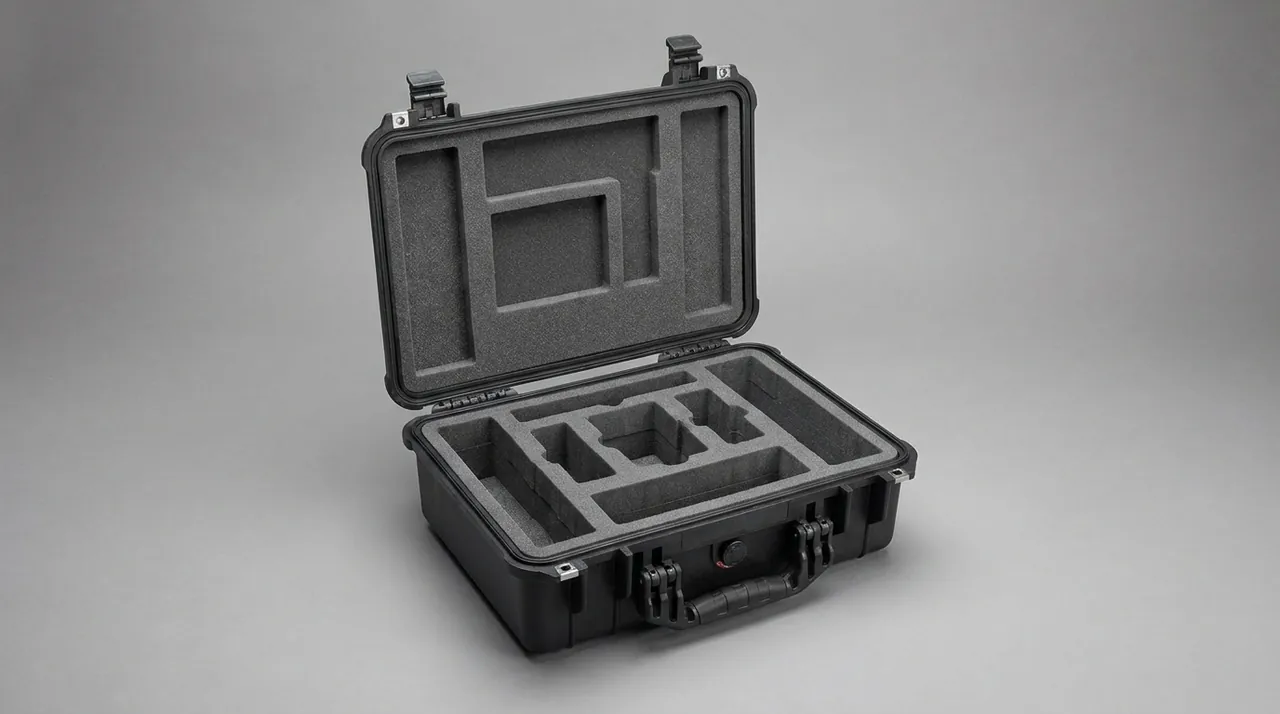
Partitioned and Modular Case Architecture
Greenhouse control spares have a distinctive profile: many categories, small quantities per item, and shifting combinations. One project may ship a heavy vent-drive rod alongside fragile sensor probes and a high-value PLC module. A single undivided case guarantees that heavy parts press light ones and metal gouges plastic. JUNZHIJIA holds the principle of compartment by part and defense by risk, dividing a control spares case into four relatively independent zones for electronics, actuators, harnesses, and accessories, physically isolated by ribs and dividers so vibration from heavy zones and vapour from humid zones never reach the electronics chamber.
Modularity is what answers shifting combinations. JUNZHIJIA builds dividers as removable plug-in elements, so a customer can repartition cavity proportions for each configuration instead of funding a new mould. For customers shipping complete project kits, we also order the cavities to follow the installation sequence, letting field staff pull parts top to bottom along the work flow and reducing the number of lid cycles that wear the gasket. A pocket map printed inside the lid, matched to colour-coded zones, lets an installer unfamiliar with that model identify the right cavity immediately.
Partitioning also makes loading density verifiable. Because each cavity has a designed volume, a packer can use empty space as a signal that something is missing, which matters most in kit shipments. On volume projects JUNZHIJIA ties the pocket map to the packing list so quality control can verify cavity by cavity instead of discovering a shortage through a customer complaint. This is where a case stops being a box and starts reducing real on-site friction.
For cases that circulate between projects, we add a modular label area so the project tag changes without replacing the case. That detail earns its keep in engineering companies that redeploy equipment frequently, because the same case may hold HVAC controllers one month and irrigation actuators the next, and a label that cannot follow the contents will eventually cause a wrong pick.
Anti-Static and EMI Shielding Implementation
Electronic parts in greenhouse control are sensitive to both static and electromagnetic interference, and transport supplies both conditions at once: a dry trailer accumulates charge, and stacked equipment creates a complex field. JUNZHIJIA uses anti-static EVA in the electronics chamber with a conductive foam lamination, draining charge through case hardware or a dedicated grounding stud so cavity potential stays within a safe band. For high-value PLC modules we offer a metallized shielding liner: a continuous conductive layer wraps the module, blocking external interference and stopping the module's own high-frequency emission from reaching neighbouring parts.
Material cleanliness matters as much as conductivity. Ordinary polyurethane foam sheds fine fibres under vibration, and those fibres inside a connector or a cooling path create faults that are extremely hard to trace. JUNZHIJIA specifies low-particulate anti-static grades for every electronics chamber and confirms cleanliness before assembly. We avoid sulphur- or halogen-bearing additives on liner surfaces that touch boards, because in a sealed cavity those substances can react with terminal plating and build a high-resistance compound layer, which shows up as contact resistance creeping upward with storage time.
Shielding performance cannot be accepted on a data sheet alone. During sampling JUNZHIJIA measures surface resistance across the liner and conductive layer with a resistivity meter to confirm the value sits in the intended anti-static-to-conductive band, and we run an internal potential test on a completed demonstration case. For customers with export certification requirements we supply material declarations and test records for their own quality files. Anti-static liners do degrade with use: repeated insertion and removal leaves wear marks where the conductive layer thins, so we advise inspection once a visibly whitened region appears rather than waiting for a field failure to prompt it.
Grounding reliability is frequently overlooked. If the shell is insulating plastic, charge collected by an anti-static liner has nowhere to go and may discharge all at once when the lid opens. JUNZHIJIA therefore offers an optional grounding terminal and marks its location on the case, prompting users to bond it to a site earth where that is appropriate. Customers who only transport and then work at a proper ESD bench can omit the ground, but should keep the liner clean and avoid rubbing the lid repeatedly in dry conditions. We confirm the use case during the proposal stage before adding grounding hardware, because over-design carries cost without benefit.
Dust Sealing and the Engineering of IP67 Structure
The dust environment on a greenhouse construction site is routinely underestimated. Seedling substrate, perlite, vermiculite, and fertilizer dust are fine enough to float onto any exposed surface. If a case seals poorly, that dust enters and settles on electronic heat sinks and connectors; it causes no immediate fault, then reduces cooling and accelerates terminal corrosion over months. JUNZHIJIA IP67 cases use a one-piece moulded shell with an embedded gasket and compression latches, forming a continuous seal band when the lid closes, delivering complete dust exclusion and short-term immersion protection.
Seal reliability depends on even pressure distribution. A warped lid, too few latches, or inconsistent gasket groove depth leaves segments with insufficient compression, which become leak paths. JUNZHIJIA analyses lid stiffness at the design stage and sizes latch count and placement to the case dimensions, adding secondary sealing at the corners. Latches carry a lock-state indicator so a handler can confirm full compression visually, eliminating the looks-closed-but-isn't scenario. For the definitions and test boundaries behind the rating, the what is IP67 rating explainer sets out the dust and water test conditions clearly.
Temperature change must enter the seal design as well. Moving a case from a cool warehouse into a sun-baked trailer heats the trapped air, raises internal pressure, and can bow the lid or force the gasket; the reverse transition creates a vacuum that pulls the lid tighter and makes opening harder. On cases bound for long routes or large temperature swings, JUNZHIJIA fits a pressure-equalization valve with a waterproof membrane that lets gas pass slowly while blocking water and dust. The valve is placed away from direct spray and marked on the case so wash-down pressure is not aimed at it.
It is worth stating plainly that IP67 is not a licence for prolonged immersion or continuous high-pressure washing. JUNZHIJIA sets the boundary with customers: after brief immersion, dry the case and check the gasket groove for standing water; if the case has been in salt-laden air, wipe the gasket with fresh water to remove salt crystals, which abrade the sealing face and accelerate rubber aging. Explaining what a rating actually means is more valuable than printing the number. The system-level view is covered further in the system-level IP67 sealing design article, which discusses sealing-path planning across multiple chambers.
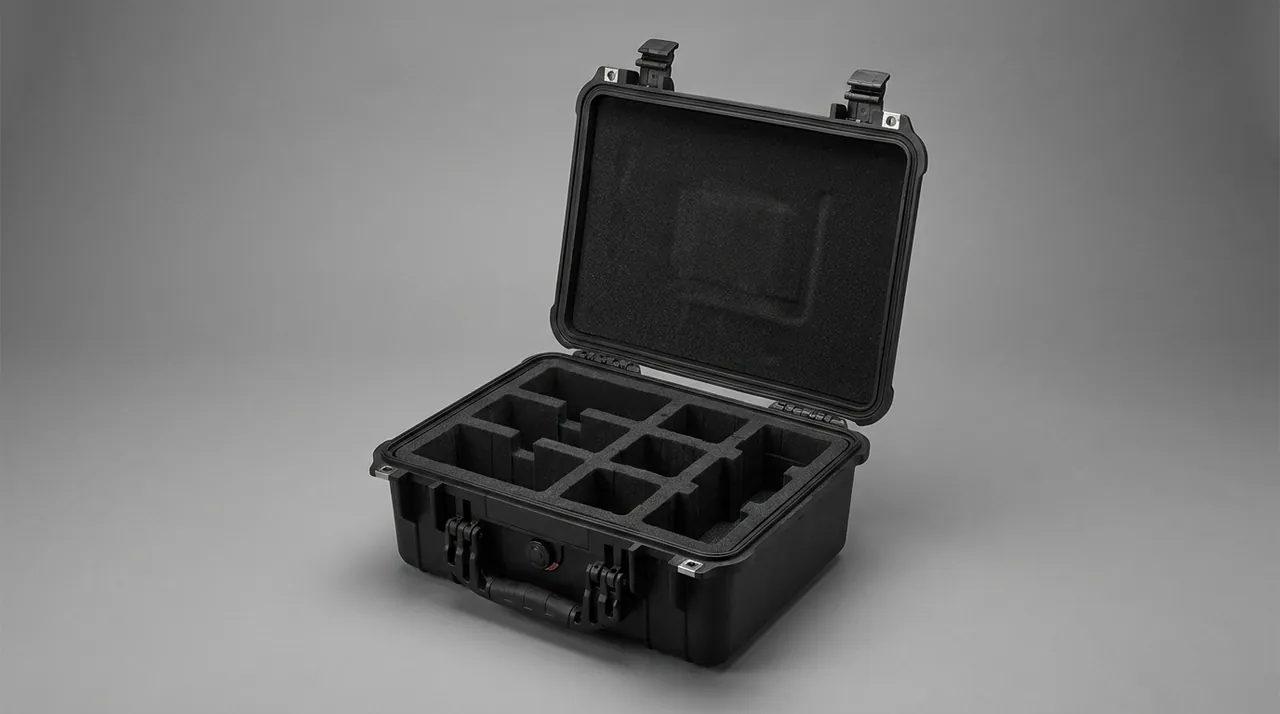
Humidity Control and Condensation Prevention
For greenhouse control equipment, condensation is more dangerous than rain because it forms inside the case. When equipment moves from a cold environment into warm humid air, the cavity wall sits below the dew point and water condenses on the wall and on metal surfaces. If the controller housing already holds a little moisture, condensation happens right beside the circuit board and creates a creepage path. JUNZHIJIA treats humidity control as equal in importance to waterproofing, using a three-part combination of sealing, desiccant, and indication. Reusable silica or montmorillonite packs change colour when saturated to signal replacement, and a humidity indicator card lets the receiver judge before opening whether the case has seen high moisture.
Desiccant quantity cannot be estimated by feel. JUNZHIJIA calculates the required mass from cavity volume, intended transit duration, climate zones crossed, and the total hygroscopic material inside the case, and we add margin for ocean freight and other long transit. For control cases with a high electronics share we laminate an aluminium-foil moisture barrier on the inner layer to cut water-vapour transmission further. Quantified practice for this is compared in the condensation control in cases article, which gives workable ranges for desiccant across climate zones.
One condensation source is easy to forget: the moisture the protected parts bring in themselves. Metal parts that retain cutting fluid after machining, or harnesses assembled during a rainy shift, release that water slowly inside a sealed cavity, so internal humidity rises even when the case seals perfectly. JUNZHIJIA advises customers to clean and dry metal parts before packing, and where a large component genuinely cannot be dried fully we increase desiccant capacity and note it in the packing record so responsibility can be traced later.
For spares held in long storage we recommend using the case itself as the storage container rather than unpacking onto a shelf on arrival. Every unpacking cycle is an opportunity for moisture to enter, and during a southern rainy season the efficiency of re-packing after inspection is far below simply leaving the case sealed. JUNZHIJIA designs latches for repeated opening and a protected gasket seat, so one case serves both transport and warehousing and removes an intermediate step. The humidity history from factory to installation then stays essentially continuous, which also makes it easier to identify where a moisture fault originated if one appears.
VCI Vapor-Phase Rust Prevention for Metal Drives
Vent-drive push rods, racks and screws, plus actuator output shafts and mounting brackets, are mostly carbon or alloy steel. They carry plating or paint, yet in the high-salt atmosphere of ocean shipping, pitting still starts at coating micropores. Traditional oil coating works, but it must be cleaned on site, and greenhouse construction sites rarely have wash-down facilities or waste-liquid handling, so residual oil ends up interfering with assembly. JUNZHIJIA introduces VCI corrosion-inhibitor paper and tablets placed in the metal-part chambers. The inhibitor molecules volatilize in the enclosed space and adsorb onto metal surfaces as a monomolecular film that suppresses electrochemical corrosion without leaving oily residue.
The VCI approach fits compartment design naturally. One VCI sheet in the drive chamber and one in the fastener chamber covers every metal surface in those cavities, and after opening the film slowly volatilizes without affecting assembly or touch-up painting. For parts that already carry zinc or zinc-flake coating, VCI also slows pitting at coating micropores, which matters particularly in coastal greenhouse projects. On export orders JUNZHIJIA often combines VCI with desiccant for both humidity and rust control, which markedly lowers the defect rate seen at destination opening. Broader rust-prevention thinking for metal parts appears in the metal parts protection case.
Material compatibility must be checked when selecting VCI. A poorly formulated volatile amine can affect certain plastics or non-ferrous metals, for example the rubber seals on actuator cable glands or the anodized layer on aluminium brackets. JUNZHIJIA therefore specifies ferrous-safe VCI for steel rods and racks and verifies that it will not harden rubber cable sleeves or cloud a transparent sight window. For cavities mixing aluminium and steel, we arrange the protection in layers: inhibitor tablets lie on the cavity floor, the metal components rest on a perforated deck above them, and a final sheet of VCI paper covers the assembly. Vapour therefore reaches metal surfaces from above and below simultaneously and recovers its concentration rapidly if the case is opened for inspection en route. The case label records the VCI grade and its protection window, typically several months in a sealed case, after which adding a fresh tablet extends protection without replacing the liner.
Selection Advice Across Transport and Storage Scenarios
The routes greenhouse control spares travel vary widely, and case selection must match. Short transfers on a construction site prioritise shock and compression resistance, so a medium-wall case with standard EVA liner suffices. Long interprovincial road freight needs dust and temperature-swing readiness, so seals are strengthened and desiccant added. Ocean export faces salt spray, stacking, and prolonged humidity, so wall thickness increases, VCI is applied, and an outer protection layer is added. Air express favours low weight, so thin-wall high-strength shells cut freight cost. Cases that will sit outdoors at a greenhouse site also need UV and rain resistance.
JUNZHIJIA first learns the customer's full transport chain: origin climate, transfer count, carrier mode, stacking height, and on-site temporary storage. Those enter the structural calculation. Bottom-position ocean stacks bear greater upper weight, so base ribs and wheel feet are reinforced accordingly, while an air-freight case that is over-reinforced simply adds freight cost. For customers who need both transport and warehousing, we satisfy both duties in one case by adding a removable pallet base and stacking location grooves so cases stack safely in a store. The selection logic is set out more fully in the industrial control box selection guide, which matches shells to control equipment types.
Climate zone differences cannot be ignored. Cases bound for hot, humid, salt-laden regions need extra work on sealing and rust prevention, while cases bound for severe cold must account for plastic brittleness, because some materials lose toughness at very low temperature and crack when dropped. JUNZHIJIA selects shell material and gasket grade from the destination's extreme temperatures and, where customers request it, supplies low-temperature drop test data. For dry, dusty destinations the priority shifts to dust exclusion and static control, which requires balancing ingress rating against static dissipation.
For weight-concentrated parts such as actuators, one scenario recommendation deserves emphasis: ship actuators and controllers in separate cases wherever possible. Their protection needs point in different directions. Actuators need impact resistance and rust prevention, controllers need static control and humidity control, and forcing them into one case means compromising one of the two. Where they must share a case, JUNZHIJIA separates them structurally and fits dedicated liners, but this increases case volume and cost. Working that trade-off at the proposal stage is far cheaper than arguing about quality problems after delivery.
Packing Rules and Field Workflow
Even the best case depends on correct packing. JUNZHIJIA supplies an illustrated packing instruction with every custom case, stating each part's chamber, liner orientation, desiccant and VCI placement, latch closing sequence, and the check points for the pressure-equalization valve. Field work follows the rule of heavy first then light, lower first then upper, and chamber-by-chamber verification: actuators and other heavy parts seat and strap first, controllers and sensors load later into upper chambers, harnesses are divided by signal type, and each chamber is checked against the list as it fills.
After packing, a unique serial label and a do-not-tip mark go on the outside, and optional asset-tracking tags enable traceability from factory to site. For returned repair items we suggest a fault description card inside, recording the equipment number, symptom, and removal date, so the factory can locate the issue quickly and reuse the original fault data. Kit shipments can include a cavity-to-list reference sheet so field staff pull parts in installation order and reduce lid cycles.
Disciplined packing also lowers transport claims directly. JUNZHIJIA suggests photographing the packed case, specifically the gasket compression line, the desiccant placement, and the latch lock indicators, because those three are the most contested points in post-transit responsibility disputes. Retaining those photos costs almost nothing and provides direct evidence if a quality argument arises. We also encourage customers to fold the packing flow into their internal work standard, because a case's designed protection only becomes real through human operation, and no structure compensates for one careless pack.
For engineering companies that redeploy equipment frequently, JUNZHIJIA recommends a simple case-follows-part ledger recording each case's destination, the equipment serial inside, and its return status. This raises case turnover and, when a batch of faults appears on one project, lets the team immediately confirm whether those units shared a case and a route, narrowing the investigation sharply.
Materials and Whole-Life Cost
Common case materials are PP polypropylene, ABS, and modified engineering plastics, and JUNZHIJIA recommends by protection grade, service environment, and budget. PP shells are tough, inexpensive, and cold-resistant, fitting high-volume standard spares and cold-region circulation. ABS is rigid with good surface quality, suitable for display items or high-accuracy equipment that opens frequently. Modified engineering plastics balance impact and weathering for long outdoor or harsh duty. The choice should not rest on unit purchase price alone; liner life, repair rate, transport loss, and cycle count all belong in the calculation.
A well-structured case cycles dozens of times, and per-use cost is usually below a one-time wooden box plus foam. Cycling, however, assumes maintenance actually happens: gaskets lose effectiveness through compression set and ultraviolet aging, latches loosen under repeated load, and liners collapse after many insertions. JUNZHIJIA suggests an inspection every twenty cycles or at each season change, and we identify the key wear parts and their replacement method at the proposal stage so maintenance becomes a routine action rather than a reaction to a failed seal. Shell-to-equipment matching is detailed further in precision instrument protective case selection.
Whole-life cost includes one item that is usually omitted: the hidden cost of damage. When a controller fails from moisture, the direct loss is the unit price, but the indirect loss includes a climate system out of control, the labour and travel of technicians returning to site, and potentially lost customer confidence. In the greenhouse industry a few hours of climate control failure can cause irreversible crop damage, so a case's value cannot be measured as packaging cost alone. JUNZHIJIA helps customers list these costs during the proposal conversation so the purchasing decision rests on complete information.
Where budgets are genuinely tight, JUNZHIJIA can also offer a tiered plan: put the most expensive and sensitive controllers and harnesses in high-specification cases, and place rods, racks, and other relatively impact-tolerant heavy parts in standard cases with local reinforcement at critical points. That differentiated allocation achieves the best overall risk control within a limited budget, and it is usually a better deal than uniformly downgrading every part, because it trims unnecessary spending without sacrificing reliability where it matters most.
Acceptance Criteria and Quality Traceability
Every JUNZHIJIA case passes outgoing inspection focused on gasket contact, latch locking force, liner conformity, cavity dimensions, and valve breathing. For IP67 batches, sampling splash and immersion tests confirm no water or dust intrusion. Cases and liners both carry batch numbers so raw-material lots and moulding parameters can be traced later. Anti-static liners additionally undergo per-batch surface resistance sampling to confirm they sit within the effective range.
On receipt, customers should run four simple checks: see whether the gasket is continuously compressed after closing; shake the case and listen for liner rattle; verify that desiccant, VCI sheets, and humidity indicator cards are complete and in date; and confirm the valve breathes freely without blockage. These four take little time yet cover the most common post-transit problems. JUNZHIJIA retains each order's 3D drawings, liner drawings, and inspection records, so any transit anomaly can be traced quickly to design, manufacturing, or use, closing a design-verify-improve loop.
Traceability matters for improvement, not only for assigning blame. When the same class of part fails repeatedly across projects, JUNZHIJIA treats it as a design input and re-evaluates liner density, cavity dimensions, or sealing structure, then folds the improvement into the standard configuration of later orders. For long-term customers we also follow up periodically to learn how easy the case is to load and how often it needs service, because many of the most useful improvement leads come not from laboratory tests but from everyday complaints in the field. Feeding that field feedback systematically into design iteration is what keeps a protection programme close to real requirements.
Field Results and Application Experience
One greenhouse engineering integrator had persistently high rework rates from controllers failing on moisture, worst of all on projects built during the rainy season. JUNZHIJIA redesigned the case into a four-zone structure: PLC and I/O modules in anti-static liners with individual shielding, actuator motors and vent-drive rods in full-length contoured channels, harnesses coiled and divided by signal type, and accessories and fasteners collected together, with desiccant, humidity indicator cards, and VCI sheets throughout. After one construction season the integrator's arrival defect rate fell clearly, on-site commissioning rework dropped, and project delivery cycles shortened with it.
Similar results appeared on export orders. A greenhouse equipment supplier serving the Middle East had been using wooden crates with EPE foam, and ocean arrival repeatedly produced actuator bearing noise and oxidized controller connectors. After switching to JUNZHIJIA IP67 cases with combined VCI and humidity control, arrival opening pass rates stabilised at a high level and complaints fell sharply. Because the Middle East combines high heat with humidity, we added a breather valve and an upgraded desiccant configuration to handle temperature cycling during open port storage. These cases show that systematic protection tailored to greenhouse control equipment pays far better than generic packaging.
One further case is worth recording, this time from spare-parts warehousing. A greenhouse maintenance service provider's problem was not transport damage but silent failure during long storage: oxidized controller terminals, green corrosion on harness connectors, and actuator output shafts rusted stiff. JUNZHIJIA supplied a storage strategy built around the case as the storage unit, grouping spares by model into cases with desiccant and VCI inside and a storage date and expiry marked on the shell. After the change, field failure rates at issue dropped significantly, and because every part had a fixed position and a clear label, picking time fell sharply as well. The case's value therefore extends from transport into warehouse management, becoming part of the maintenance system rather than a box on a shelf.
Frequently Asked Questions
Q: What damages PLC controllers most in transit, and how does the case address it? A: Because controllers hold dense surface-mount parts and miniature relays with very tight pin pitches, their real enemy is accumulated micro-damage rather than one hard blow. Sustained vibration lets an unsecured card micro-move until heavy component pins fatigue and crack; a handling drop shifts shell against board so a plug-in module can unseat; and static built up by friction in a dry trailer can punch through input protection, producing a machine that tests fine and then loses one input point weeks later in service. JUNZHIJIA answers with anti-static EVA liners plus conductive foam lamination so the cavity reaches equal potential, a moulded shroud over the terminal zone so load transfers into the liner rather than the thin plastic dividers, and port recesses that keep every connector facing inward where the case wall cannot press on it. We also reserve a lidded pocket for removed modules, preventing a second static event when a used card is stored beside new stock, and we treat communication-latch deformation as a real failure mode rather than a cosmetic issue, since a loose Ethernet latch produces intermittent field faults that send technicians chasing the wrong cause. The objective is a controller that can be powered up and commissioned straight from the case.
Q: Actuator motors look undamaged on arrival; why are they still rejected? A: These parts typically fail internally while looking perfect outside. When a rotor bearing takes axial or radial shock it develops small indentations in its raceways; the motor turns normally at first, then within its first month of service exceeds the vibration or starting-current acceptance limit. Gearbox risk concentrates at the protruding output shaft, which acts as a lever and transmits impact moment straight back to the bearing boss, cracking the housing or bending the shaft. JUNZHIJIA cuts a support cradle so the shaft end rests on a compliant pad, converting a cantilever into two-point support, and clamps the motor body in a front locating ring so the axis cannot swing inside the cavity. Long actuators such as film-rolling motors get a horizontal channel supporting the whole body so no midpoint spans unsupported and bows under its own weight. Cold-thickened grease can also drain from meshing faces if a case sits tilted for a long period, causing brief dry friction at the next start, so we enforce the correct attitude with locating bosses moulded into the liner instead of trusting a handler to remember. The brittle cable gland on most window motors also needs its own upward recess, because a cracked gland shell silently removes the ingress rating and leaves an electrical fault that looks mechanical.
Q: Sensor harnesses seem trivial, yet they consume the most troubleshooting time. Why? A: Harness failure mode differs completely from rigid parts: they are crushed, stretched, and contaminated rather than broken, and the damage only surfaces during commissioning. A cable forced into a tight radius changes conductor twist pitch and thins the shield braid at the bend, producing periodic jumps in greenhouse data; technicians replace the sensor, find no change, and burn hours. Connectors fail first, because once a latch is crushed or a gasket forced out of its groove the connector still mates but has lost its ingress rating, letting moisture creep along the pins to build an invisible oxide layer. JUNZHIJIA gives harnesses a shallow tray, coils each cable near its natural bend radius, secures it with elastic straps placed away from the most flexed region, and writes a minimum coil radius rule into the packing instruction. Each connector gets a retaining pocket with the latch facing up, and we separate analog signal lines from power lines so insulation rubbing cannot couple static noise between them. A small standalone harness box keeps cables controlled across the whole after-sales chain, not only on the outbound leg.
Q: Why do vent-drive push rods bend, and what does the case structure do about it? A: The push rod, rack, or screw is the longest part in the shipment and the most heavily loaded actuator component, and a bow shifts the mounting holes so installation relies on drilling them oversize, which weakens the joint. The real hazard is the bending moment the rod's own weight creates across an unsupported span, which is why two-point support is never enough. JUNZHIJIA designs a full-length contoured channel with a continuous support rib beneath the rod, so neither vibration nor self-weight accumulates deformation across a gap. Racks and sprockets that must mesh later are separated, with tooth relief in the rack channel to keep the flank clear of other metal and a separate cell for the sprocket so a loose chain cannot whip against the teeth. Tooth indentation is less obvious than fracture but accelerates wear sharply, leaving the drive unable to reach full travel after a few thousand cycles. Because limit-switch screws can also back out under vibration and drift the trigger point, we recommend a mandatory full manual stroke with a limit-point recheck on receipt, which catches both mechanical deformation and switch drift in one pass.
Q: Does an anti-static liner lose effectiveness with use, and how should it be maintained? A: Yes, and it is one of the most commonly overlooked long-term issues. An anti-static liner relies on a conductive layer or conductive fibres to provide a charge drainage path; repeated insertion and removal leaves wear marks, and the whitened areas conduct less well. A customer who only investigates after a real failure will misread the cause as a case design problem. JUNZHIJIA measures surface resistance across the liner and conductive layer with a resistivity meter during sampling to confirm the value falls in the intended anti-static-to-conductive band, runs an internal potential test on a completed demonstration case, and provides material declarations and test records to customers with export certification needs. For maintenance, we advise arranging an inspection once a clearly whitened region appears rather than continuing to use it, and cleaning with a neutral agent instead of a solvent that could dissolve conductive additives, followed by thorough drying. Material cleanliness matters equally: electronics chambers are specified in low-particulate anti-static grades, and sulphur- or halogen-bearing additives are avoided to prevent terminal plating from slowly building a high-resistance compound layer inside the sealed cavity.
Q: An IP67 case already blocks dust and water, so why add humidity control and condensation prevention? A: Because for greenhouse control equipment, condensation inside the case is more dangerous than rain outside, and IP67 only addresses ingress from outside, not moisture already in the cavity. When equipment moves from cold into warm humid air, the cavity wall falls below the dew point and water condenses on the wall and metal surfaces; if a controller housing already holds a little moisture, that condensation forms beside the circuit board and creates a creepage path, eventually causing insulation failure or drifting signals. JUNZHIJIA treats humidity control as equal to waterproofing, using a sealing, desiccant, and indication combination: reusable silica or montmorillonite packs that change colour when saturated, and a humidity indicator card that lets the receiver judge the exposure history before opening. We calculate desiccant mass from cavity volume, intended transit duration, climate zones crossed, and total hygroscopic material inside the case, and add margin for ocean freight and other long legs. Electronics-heavy cases also receive an aluminium-foil moisture barrier on the inner layer to cut water-vapour transmission, and we advise cleaning and drying metal parts before packing because retained cutting fluid becomes an internal moisture source.
Q: Can VCI rust prevention harm rubber seals on actuator motors or aluminium brackets? A: This is a critical question, because VCI grade must match the materials in the cavity and a poorly chosen formulation can genuinely cause harm. Volatile amines at high concentration can harden some rubber parts and discolour certain non-ferrous metals, so JUNZHIJIA specifies ferrous-safe VCI for steel rods and racks, and verifies case by case that it will not harden the rubber sleeve on an actuator cable gland or cloud a harness jacket or a transparent sight window. Where aluminium and steel share a cavity we avoid direct contact and layer the protection instead: inhibitor tablets lie on the cavity floor, components sit raised on a perforated deck, and a further sheet of VCI paper is laid over the assembly. Inhibitor vapour therefore reaches every metal face from above and below at once, creating a slow-release environment that rebuilds its concentration quickly if a case is briefly opened for inspection in transit. The case label records the VCI grade and protection window, typically several months when sealed, and adding a fresh tablet extends protection without replacing the liner. For customers whose parts mix plated and bare steel, we also confirm that the chosen grade will not stain passivation layers or leave a film that interferes with subsequent touch-up painting on site.
Q: What information is needed to customise a greenhouse control case, and how long does it take? A: Customers should provide a parts list, each part's dimensions and weight, descriptions of vulnerable areas, the target transport chain including origin climate, transfer count, carrier mode, stacking height and on-site storage conditions, and the required protection grade. Supplying 3D models or part drawings shortens modelling considerably. JUNZHIJIA then models each part's placement in 3D, generates contoured liner drawings, samples, and moves to production after drop and vibration testing. For kit-project customers we also request the installation sequence or assembly list and order the cavities to match it, so field staff pull parts top to bottom along the work flow and the gasket sees fewer lid cycles. If spare combinations change from year to year, modular dividers let one case adapt to different configurations with a new liner only, not a new shell. Customers with cases already in service can also reuse them by adding dividers and recutting liners through the removable divider retrofit approach, avoiding a full write-off. In practice a single shipping case, tested and approved, usually reaches production in a few weeks, while a multi-cavity kit case with several custom liners takes longer because every pocket needs its own sample and drop test. Tell us the annual volume as well, since that decides whether a thermoformed or CNC-routed liner gives the better cost per cycle across your fleet.
Q: How does a greenhouse control case differ from a general industrial case? A: The difference comes from both the part mix and the consequence of failure. On part mix, a greenhouse control package combines highly sensitive electronics (PLC, I/O, communication modules), electromechanical parts with precision meshing pairs (actuator motors, vent-drive gearboxes), flexible items that crush and contaminate easily (sensor harnesses), and long parts that bow (push rods and racks). Those four categories want different things: electronics need static control and humidity control, electromechanical parts need impact resistance and rust prevention, harnesses need crush and contamination protection, and long parts need straightness support. A single universal cavity must therefore compromise somewhere, and claiming otherwise is simply not credible. On consequences, a climate system that fails can cause irreversible crop damage within hours, and that indirect loss exceeds the equipment price, so the investment cannot be judged as packaging cost alone. JUNZHIJIA builds a four-zone independent design placing anti-static, humidity, rust, and full-length support measures in the chambers that need them, and adds damping structure for heavy parts as described in the shockproof case approach, which fits greenhouse control equipment far better than a generic industrial box.
Related Reading: greenhouse and irrigation equipment transport case, HVAC controller and sensor transport protection, anti-static protective case.