

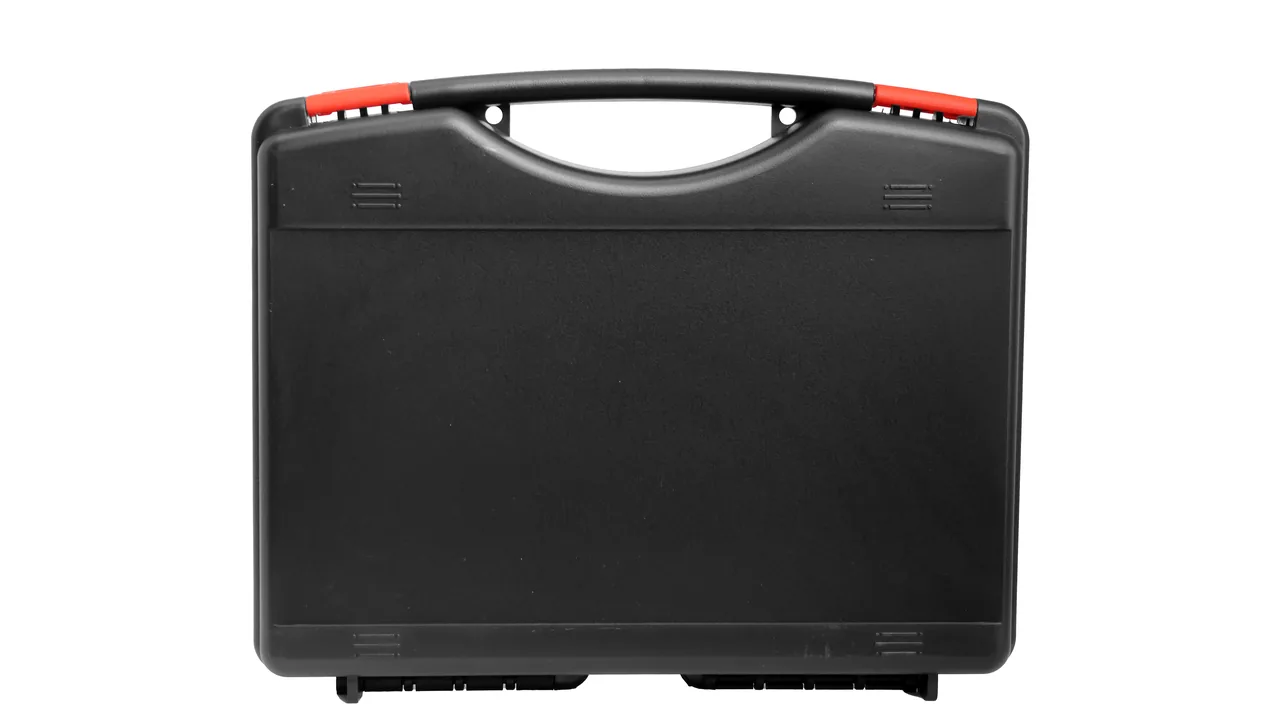
Shoe making holds hard tolerances on soft materials. A moulding press bonds the sole to the upper under heat and pressure, a cutting press punches leather, mesh and EVA sheet dozens of times a minute, and the moulds and lasts decide whether the finished shoe will ever fit. The valuable parts along this line share one awkward property: their visible and mating faces are extremely delicate. The mirror cavity of a die, the flat of a heating plate, the raceway of a cutting press rail and the parting line of an aluminium or resin mould all represent precision you can see, and a single scratch or bruise can scrap a mould whose lead time is often longer than the machine itself. The JUNZHIJIA principle is that transport protection for shoe machinery must hold three lines at once — no scratch on a mirror face, no bruise on a mating face, and no drift from vibration — and write all three into criteria that can be tested and accepted.
This article follows the real shipping structure of a shoe plant and sets out the case materials, sealing levels, liner builds, compartment logic and test evidence that lift packaging from a fit to an accepted deliverable.
Table of Contents
- Equipment Layout and Transport Difficulties in a Shoe Plant
- Moulding Presses: Protecting Dies, Heating Plates and Cylinder Parts
- Cutting Presses: Holding Die and Guide Rail Accuracy
- Shoe Moulds and Lasts: Preserving Aluminium and Resin Form Accuracy
- Servo Motors, Gearboxes and Drive Parts: Fixing Without Distortion
- Mirror Cavities and Polished Surfaces: Scratch Control and Micro-Vibration
- Case Materials in an Adhesive and Primer Environment
- Sealing Design: IP65/IP67 Against Glue Mist and Dust
- Cushion Selection: EPE, EVA, PE and IXPE
- Compartments, Latches and Pressure Equalization Valves
- Stacking Load, Pallets and Export Loading
- Transport Testing and Acceptance: ISTA, GB/T 4857 and ASTM D4169
- Custom Tooling and OEM/ODM Delivery
- Frequently Asked Questions FAQ
- Conclusion and Related Reading
Equipment Layout and Transport Difficulties in a Shoe Plant
A complete shoe line divides into three blocks. The front end handles cutting and preparation, with cutting presses, skiving machines and roughing units. The middle block builds the shoe, with moulding presses, lasting machines, sole attaching presses and chill setters. The back end covers finishing and inspection. On shipment the line is usually broken into dozens of modules, and press frames, heating plates, dies, cutting gantries, servo cylinders and control cabinets end up mixed in the same batch of crates and steel stillages.
Four difficulties dominate. Precision and appearance are both sensitive. A mould cavity is finished to Ra 0.4 to 0.8 micrometres, so any grit or hard chip scribes the surface once vibration starts, while mating faces demand flatness and parallelism in the 0.02 to 0.05 mm band that cannot be recovered on site. Materials are mixed. Cast iron frames, aluminium and resin moulds, stainless heating plates, fibreglass guards and plastic handles differ in stiffness, brittleness and temperature sensitivity. Chemical residue is present. Moulding stations run chloroprene and polyurethane adhesives, primers containing methyl ethyl ketone and acetone, and silicone release agents that soak into ordinary cartons and keep off-gassing through a hot, humid voyage. The delivery chain is long. Exports go mainly to Southeast Asia, South Asia and South America, so three to six weeks of ocean transit stacks salt spray on damp heat, and both rusty hardware and mouldy wood-based dies are real complaints.
Damage reviews return four repeated findings: mirror cavities scratched by crumbs or grit, heating plates bowed at mid-span, cutting gantries twisted until rail parallelism drifted, and aluminium moulds gouged after sliding loose. None of these is a thickness problem; each is a missing definition of how a part is constrained.
Moulding Presses: Protecting Dies, Heating Plates and Cylinder Parts
A moulding press breaks down into platens, heating plates, dies, hydraulic or servo electric cylinders, guide pillars and the frame. It closes the sole and upper at 160 to 220 degrees Celsius, so plate flatness and die form accuracy directly set finished quality.
The die is the most expensive replaceable item. The parting line, mirror cavity and vent grooves are no-contact zones. Ship the halves closed with a soft spacer between them, or in separate contoured EVA cavities; keep the mirror side away from the case wall and other metal parts, and cover the cavity mouth with PE film plus non-woven fabric so crumbs cannot fall in. Where the die has lifting holes, secure it to support columns cast into the case rather than letting the die body carry stacking load.
Heating plates are usually aluminium or steel electric plates with a large length-to-width ratio and modest thickness, the classic thin-plate bending part. Failure is rarely impact; it is mid-span compression. When a plate is pressed by a heavy part or stacked against a frame, the middle sags and flatness goes out, and the sole receives uneven heat once the machine runs. Support the plate from below on equal-height blocks spaced no more than one third of the plate length apart, add corner limit blocks against sliding, and place a PE separator between adjacent plates so aluminium and steel faces cannot rub.
Cylinders and servo electric cylinders are weakest at the piston rod coating and the seals. Hard chrome plating scratches easily and pits in humid sea freight air, while a seal held under load takes a permanent set. Retract the rod or fit a protective sleeve, blank the ports against dust, grease the screw of an electric cylinder and sleeve it in PE, and fix the unit to floor rails.
| Component | Typical failure mode | Trigger | Protective measure | Acceptance criterion |
|---|---|---|---|---|
| --- | --- | --- | --- | --- |
| Die cavity | Mirror scratch, chipped mouth | Crumbs, hard contact | Contoured EVA cavity + PE cover | No visible scratch on mirror face |
| Parting line | Bruise, flatness drift | Misaligned closing, drop | Closed with soft spacer + corner stops | Flatness deviation no more than 0.03 mm |
| Heating plate | Mid-span bow, aluminium rub | Stacking load, face friction | Equal-height blocks + PE separator | Flatness deviation no more than 0.05 mm/m |
| Piston rod | Coating scratch, pitting | Exposed transit, damp heat | Retracted or sleeved + blanked ports | No scratch, no rust spot |
| Servo cylinder | Screw corrosion, stroke drift | Humidity, no fixing | Anti-rust grease + PE sleeve + rail | Free manual rotation, no binding |
| Guide pillar | Galling, clearance drift | Side impact | Dedicated cavity + axial stops | No scoring on mating face |
Protection of finished faces and fits on machined parts follows the cone and face checklist in our machine tool holder cases note.

Cutting Presses: Holding Die and Guide Rail Accuracy
The cutting press is the throughput centre of the front end. Gantry and swing-beam designs are driven hydraulically or by servo at dozens of strokes a minute, and rail parallelism, die edge integrity and platen flatness together set cut consistency and material yield.
Cutting dies are the critical wear item. Once a steel rule edge rolls or chips, cut parts develop burrs and dimensional drift, while the wood base of a laser die absorbs moisture and shifts the rule position by 0.2 mm or more. Pack each die in a thin EVA interleaf, stand it upright with every rule edge facing inward, leave 8 to 12 mm between dies, add desiccant, and hold relative humidity below 55 percent.
The gantry and guide rails are the accuracy datum. A rail raceway and its block are a precision pair, and side impact presses dents that later show as running noise and positioning drift. Lock the gantry into a self-supporting tie-rod frame, connect both ends rigidly to the case floor, grease the rail faces and cap them with a protection strip. If the blocks are removable, take them off and pack them separately in an EVA box.
Platens and cutting pads tolerate less flatness demand, but a large thin plate still lacks bending stiffness. Lay it flat with full support and never let it bridge a gap. Blank the ports of accumulators, hoses and valve groups so oil cannot leak onto other parts.
| Component | Primary risk | Key protection | Case structure |
|---|---|---|---|
| --- | --- | --- | --- |
| Steel rule die | Rolled or chipped edge | Thin EVA interleaf, upright, edge inward | Upper drawer bins |
| Laser die | Wood base swelling | Desiccant + humidity indicator card | Separate sealed cavity |
| Linear guide rail | Raceway dents, positioning drift | Protection strip + anti-rust grease | Same cavity, independent support |
| Rail block | Ball dents, loss | Removed and boxed in EVA | Numbered upper bins |
| Gantry frame | Parallelism drift, twist | Tie-rod frame + rigid floor fixing | Extended case + longitudinal ribs |
| Hydraulic valve group | Port leakage, contamination | Blanked ports + absorbent pad | Bottom recess |
Edge and motion-pair protection on cutting equipment follows the impact grading logic in our precision instrument cases note.
Shoe Moulds and Lasts: Preserving Aluminium and Resin Form Accuracy
Shoe moulds come in aluminium, resin and steel, while lasts are usually plastic or aluminium. Aluminium is light and machines quickly but soft, so a bruise leaves a permanent notch. Resin moulds are stable and cheap but brittle and limited in heat resistance, and they crack on a drop. Steel is strong but heavy and costly.
Aluminium protection is about never touching a hard object. Aluminium sits far below steel on the hardness scale, so contact with a steel frame, a bolt or the case wall rubs a hollow into the surface once vibration starts. Wrap every aluminium mould in PE film or soft IXPE, seat it in a contoured EVA cavity with 2 to 4 mm clearance, separate moulds with PE standing boards, and never stack them. Cap locating pin holes and parting faces with soft sleeves.
Resin protection is about impact and temperature. Resin has limited impact strength and turns more brittle in the cold, so cracking risk rises sharply on a winter route. Add cushioning, keep resin moulds out of the outer layer and away from stacking load, and write a low-temperature brittleness test condition into the contract for routes below minus ten degrees Celsius.
Lasts are inexpensive individually but numerous and irregular, and their main enemy is mutual abrasion once mixed. Stand them by size in separate bins with EVA dividers, and label each bin with the last number and quantity.
| Mould type | Main weakness | Cushion | Locating method | Environment |
|---|---|---|---|---|
| --- | --- | --- | --- | --- |
| Aluminium | Soft, easily notched | Medium-density EVA + IXPE film | Contoured cavity + pin hole sleeves | Dry only |
| Resin | Brittle, cracks when cold | High-density EVA contour + closed-cell wrap | Dedicated cavity, full base support | Avoid below -10 C |
| Steel | Heavy, damages neighbours | High-density EVA load pads | Floor rails + bolts | Rust prevention |
| Last | Numerous, rub together | Thin EVA dividers | Bins by size + numbering | Dry, no distortion |
Protection of decorative surfaces after a finishing operation is covered in our surface finishing equipment cases note.
Servo Motors, Gearboxes and Drive Parts: Fixing Without Distortion
Modern shoe machinery is moving from hydraulics to servo drives. Motors, gearboxes, timing pulleys, ball screws and couplings share two weaknesses: concentricity and preload must be preserved, and bearings bruise under long micro-vibration.
Servo motors are compact with concentrated mass, so the risk is relative movement: if the motor shifts against its base, coupling alignment drifts and the machine runs with vibration and noise. Bolt the motor to rails cast into the case floor with M10 fasteners or larger, torque to the manual value, mark against loosening, cap the connectors, and coil cable at a radius of at least ten times its diameter.
Gearboxes mostly fail through their lubricant. Violent sloshing carries oil to the breather and out of the unit, and the bearings then run starved while still taking vibration. Check the oil level, confirm the breather is clear and seal against leakage before dispatch, fix the unit to the floor plate, and limit the output shaft radially.
Ball screws and timing belts dislike bending and stretch. Support a screw axially with cradles spaced no more than one third of its length apart so it cannot sag, and either release belt tension or lock the assembly so a long tension hold cannot cause plastic elongation.
| Drive part | Primary risk | Fixing method | Key point |
|---|---|---|---|
| --- | --- | --- | --- |
| Servo motor | Concentricity drift | Floor rails + torque mark | Blanked connectors, large cable radius |
| Gearbox | Oil loss, starved bearing | Floor fixing + shaft limit | Oil level and breather check |
| Ball screw | Sag, surface rust | Multi-cradle support + grease | Cradle spacing no more than one third of length |
| Timing pulley | Tension loss, tooth damage | Released or locked | Teeth must not take hard contact |
| Coupling | Bruise, alignment drift | Separate fixing + guard | Elastomer must not be compressed |
Mirror Cavities and Polished Surfaces: Scratch Control and Micro-Vibration
Mirror and polished surfaces are the most expensive real estate on a shoe mould and the part most easily ruined by something invisible. The two main causes of mirror scratching are not drops but crumb abrasion and micro-vibration fretting: crumbs slide across the surface under vibration like an abrasive, and any tiny relative movement between part and liner polishes a misty track.
Address it on three levels. Cleanliness first. Do not use crumb-shedding carton or low-density foam inside the case. Choose closed-cell PE, IXPE or film-faced EPE wherever a mirror face is contacted, and wipe the mould and blow it clean with filtered air before closing. Zero displacement second. Restrain the part by the geometry of a contoured cavity in every direction rather than by straps or packed filler, and cover at least 60 percent of the projected area on critical parts. Vibration isolation third. Add a damping layer between case and pallet and between liner and wall so high-frequency road input is attenuated before it reaches the surface.
For especially vibration-sensitive moulds and rails, add rubber damping pads or a composite mat inside the case, and avoid rigidly bolting the case to a high-vibration truck bed. The division of labour between damping and foam is discussed in our EPE versus EVA foam comparison.
Case Materials in an Adhesive and Primer Environment
A shoe workshop is chemically busy. Chloroprene and polyurethane adhesives carry organic solvents, primers contain methyl ethyl ketone, acetone and ethyl acetate, release agents carry silicone oil, and roughing stations generate leather dust and EVA powder. Equipment test-run before dispatch keeps a film of adhesive and primer inside its cavities, and that residue soaks into cartons, softens some plastics and slowly corrodes metal.
Case material therefore has to resist organic solvents, exclude dust and glue mist, and survive UV exposure.
| Material | Organic solvent resistance | Glue mist and dust | UV aging | Impact | Relative cost | Best role |
|---|---|---|---|---|---|---|
| --- | --- | --- | --- | --- | --- | --- |
| PP (polypropylene) | Good | Excellent | Moderate (needs UV masterbatch) | Moderate | Low | General returnable transit, glue mist |
| HDPE | Moderate | Excellent | Moderate | Excellent | Low | Short-haul transport, repeated cycles |
| ABS | Poor (stress cracks) | Good | Moderate | Excellent | Medium | Appearance parts with no solvent contact |
| PC (polycarbonate) | Poor | Good | Good | Excellent | High | Applications needing a window |
| PVDF | Excellent | Excellent | Good | Moderate | High | Cavities in strong solvent contact |
| 316L stainless | Excellent | Excellent | Excellent | Moderate | Very high | High-value moulds, dry cavities |
| Aluminium alloy | Excellent | Good | Excellent | Moderate | Medium | Lightweight frames |
One warning deserves emphasis: ABS and PC are sensitive to ketones and esters and will stress-crack under long contact, so neither should form the body of a case that may meet primer residue. For gaskets, nitrile resists oil but is mediocre against ketones, and silicone handles heat but not oil, so specify fluoroelastomer or EPDM against the actual medium. Choose 316L or dacromet-treated carbon steel for hardware and isolate it galvanically, because stainless touching aluminium forms a corrosion cell. The compatibility matrix in our case seal materials note is a useful cross-check.
Sealing Design: IP65/IP67 Against Glue Mist and Dust
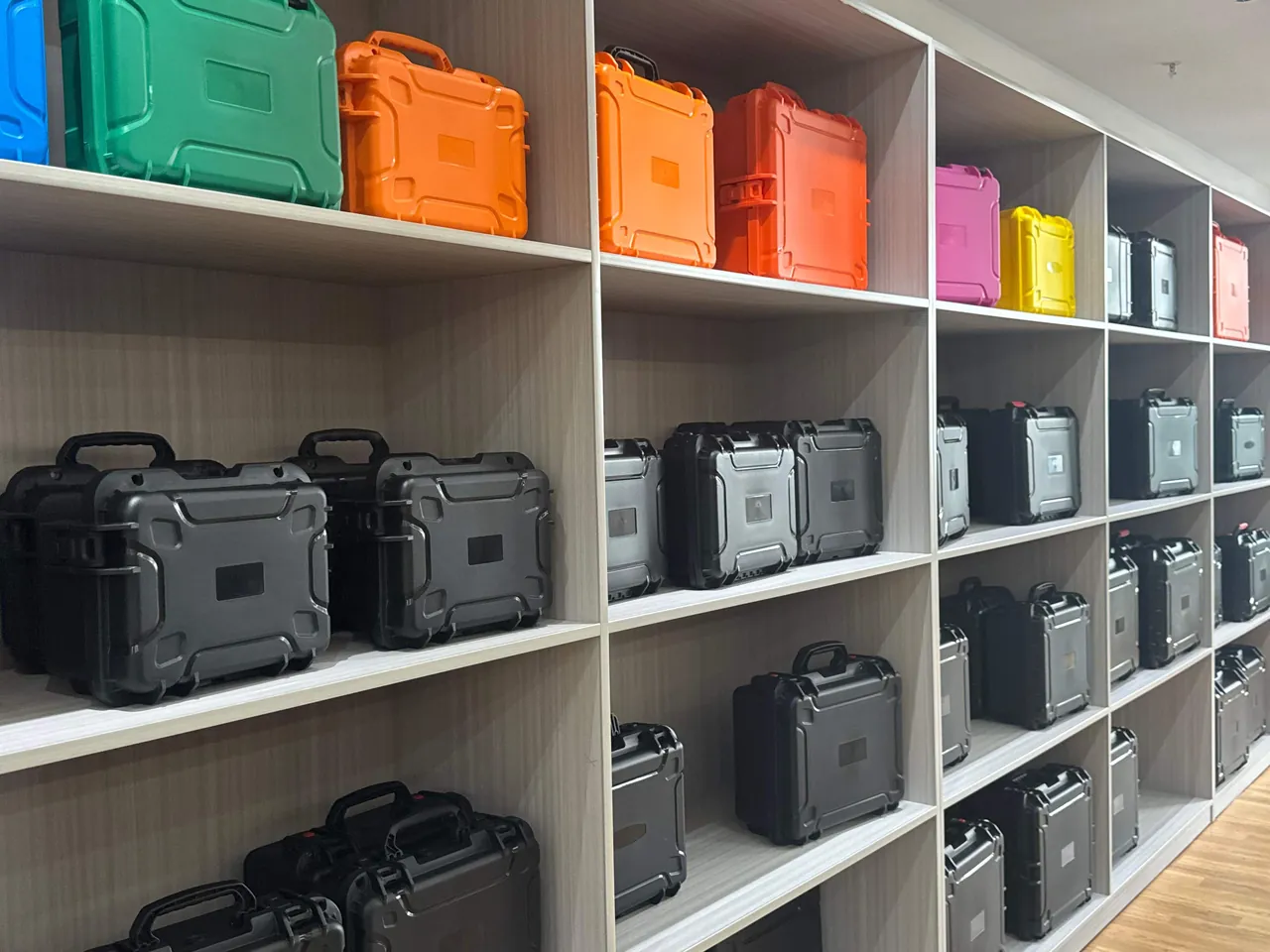
What invades a shoe plant is not only water. Glue mist builds a tacky film on the inner wall, dust blocks sealing faces and abrades rails, and silicone vapour contaminates a mirror. The protection level should follow real exposure rather than the highest available number.
For ordinary road transport plus indoor storage, IP65, dust-tight with protection against water jets, is usually enough. If the equipment will sit outdoors or under a light shelter for months, or may meet rain and standing water during handling, specify IP67, remembering that its immersion test is one meter for thirty minutes and does not imply permanent underwater service. Only high-pressure hot washdown justifies IP69K. Apply IEC 60529 or GB/T 4208 for definitions and verification.
Three structural lessons matter. Use two sealing lines: for IP67 and above, pair the main gasket with an auxiliary dust lip so the case stops both water and powder. Control compression: design 15 to 30 percent compression, since too little leaks dust and too much ages the gasket quickly. Design pressure balance: a valve with a waterproof breathable membrane removes opening suction and vents expansion pressure, but it is not a drain and standing water inside the case is never acceptable. The differences between classes are set out in our IP65, IP66 and IP67 differences note.
Cushion Selection: EPE, EVA, PE and IXPE
Shoe machinery parts span a huge mass range, from a few hundred grams of cutting die to a press frame over a tonne, so the liner must match the mass. Too hard and it cushions nothing; too soft and it crushes and loses locating function, and either way the shock reaches the precision face.
| Material | Density (kg/m3) | Rebound | Cushion vs support | Tear resistance | Typical use |
|---|---|---|---|---|---|
| --- | --- | --- | --- | --- | --- |
| EPE | 25-35 | High | Cushion-biased | Medium | Broad wrapping, surface protection |
| EVA | 60-150 | Low, good energy absorption | Support-biased | High | Mould contour locating, load blocks |
| PE foam | 30-80 | Medium | Balanced | Medium | Case lining, anti-scratch |
| IXPE | 30-60 | Closed cell, stable | Balanced | High | Mirror soft wrap, returnable liners |
| PU foam | 40-120 | Wide adjustable range | Customizable | Medium | Contoured liners for lasts |
| Rubber/EVA composite | Not applicable | Strong damping | Support-biased | High | Rails, vibration-sensitive parts |
We build three layers. The outer layer uses PE foam or EPE for surface contact. The middle layer uses EVA or PU foam for contour locating, restraining degrees of freedom by geometry. The load layer uses high-density EVA or rubber composite to carry weight and damp shock. Every surface that touches a mirror face uses closed-cell IXPE or film-faced material, never crumb-shedding foam. Set drop height by total mass and confirm at least forty percent of the original liner thickness remains at the highest drop energy. Rebound and compression set data appear in our case foam material comparison.
Compartments, Latches and Pressure Equalization Valves
A shoe line often ships as one case per line, and mixing parts of different weight, stiffness and precision carries risk: heavy items hammer the light ones every kilometre, small parts migrate into gaps and jam, and dust travels between cavities to contaminate a mirror. Compartmenting gives every part one defined position restrained in all directions.
Four rules govern the layout. Weight grading: press frames and steel moulds go low and near the geometric centre, while cutting dies and servo motors go high. Precision isolation: mirror moulds and mating-face parts get their own cavity and never share with frames or bolts. Cleanliness isolation: dust-sensitive mirror parts are separated from cast iron parts by a divider or a separate case. Identification: every cavity carries a number and icon matched to the packing list. Leave 10 to 20 mm assembly clearance around each part. Dividers may be PP honeycomb, EVA standing board or PVC foam board, and the trade-off is discussed in our dividers versus foam note.
Latches and hinges set reliability and life. Operators wear gloves, so a latch should open one-handed and close with a clear feel of engagement. Elastic draw latches suit small and medium cases, rotary latches suit heavy and stackable cases, and cam latches generate the compression an IP67 gasket needs; cycle life is usually rated at 5,000 to 10,000 cycles. Prefer a metal hinge pin with a bushing to cut wear and noise. Mount the equalization valve at mid-height on a side wall, clear of the lid top and the floor, and replace the membrane every two to three years. General selection rules are in our pressure equalization valve guide.
Stacking Load, Pallets and Export Loading
Floor space is tight at both the machine builder and the shoe plant, so finished cases are stacked two to four high. Stacking capacity comes from the compressive stiffness of the case structure, the mid-span support of the lid and the overall rigidity of the pallet, not from wall thickness alone. Capacity must be established by calculation and test in three steps: single-case static load for lid deflection, full-stack static load at the actual number of tiers for the bottom case, and transport dynamic load, which adds the equivalent of vibration and shock on top of the static figure. Testing may follow the GB/T 4857 series, typically holding the load for 24 to 72 hours with deformation inside the design limit and no permanent crush.
Export loading adds several rules. Match the pallet to the case feet and keep it inside the case footprint so a pallet corner cannot lever the case. Strap with polyester or steel banding placed clear of latches and valves. Load heavy low, large low and frequently used parts near the door, and leave no gap that lets cases slide. Mark the side wall with the centre of gravity and a no-tipping symbol, add desiccant for sea freight and rust-proof the metal parts, applying the salt spray requirement for coastal routes. Securing detail appears in our shipping and loading precautions note.
Transport Testing and Acceptance: ISTA, GB/T 4857 and ASTM D4169
Protection reliability has to be supported by test data. For moulds, where a single part is expensive and repair lead time is long, complete four verification blocks before volume supply: vibration, drop and shock, stacking and environmental.
Vibration testing simulates sustained road excitation and matters most for thin heating plates, long cantilever gantries and mirror mould brackets. Run a modal check first, confirm the first natural frequency is not inside the three-to-fifteen-hertz road band, and if it cannot be moved, add supports, raise damping or change the fixing method until the response amplitude falls inside the allowable range. Drop and shock tests validate the energy absorption of the liner and the case corners, usually with one corner, one edge and one face each. Environmental testing covers high-temperature storage, low-temperature brittleness and damp heat, verifying resin mould behaviour in the cold and the dimensional stability of wood-based laser dies in damp heat.
On standards, export projects may use the ISTA series for package performance, the GB/T 4857 series for case strength and stacking, and ASTM D4169 for a North American distribution cycle simulation; salt spray and damp heat interpretation appears in our salt spray corrosion test note. Write criteria so they bind to the contract, for example: after a 600 mm corner drop to GB/T 4857.5, the case shows no cracks, the gasket stays attached, latches function normally, no new scratch appears on a mould mirror face, and heating plate flatness deviation stays within 0.05 mm/m.
Custom Tooling and OEM/ODM Delivery
Shoe machinery models turn over quickly and moulds and fixtures iterate often, so the same press may differ in heating plate size, mould interface and closing stroke from one customer to the next. A protective case therefore almost always has to be custom. The workflow runs through five stages: requirement confirmation, structural design, sample review, pilot production and volume delivery.
Requirement confirmation collects the 3D model or measured dimensions, weight and centre of gravity, fragile features such as mirror faces, mating faces and coatings, the expected transport environment, stacking tiers, open-close frequency and service life, and records the cleaning state of any adhesive or primer residue. Structural design produces the case assembly drawing, liner drawing, cavity layout and bill of materials, together with the design values for sealing level, stacking load and drop height. Sample review is where projects most often go wrong, so always trial-fit the real machine or an equal-weight dummy, verifying removal clearance, latch torque and stacking stability. Pilot production verifies tooling and process stability. Before volume delivery, sample to AQL for appearance, dimensions and sealing, using the scheme in our custom case acceptance and AQL note.
JUNZHIJIA supports a full OEM/ODM scope from case structure, liner, colour and printing through to the documents that ship inside the box, including new tooling, tooling modification, logo and QR spraying, cavity layout drawings, packing lists, and desiccant and humidity indicator cards. As the manufacturer, Kexin New Materials (Guangdong) Co., Ltd. keeps structural design, injection and blow molding, liner fabrication and final assembly inside one delivery chain.
Frequently Asked Questions FAQ
Q: Why are mirror mould cavities so easily scratched in transit, and why is a carton plus foam not enough?
A: The decisive cause is not impact but crumb abrasion and micro-vibration fretting. Cartons shed flakes continuously once vibration starts, and low-density foam crumbles as well, so crumbs land on the mirror face and then slide back and forth under road vibration exactly like an abrasive. A run of a few hundred kilometres is enough to polish a misty scratch that no shoe plant can restore locally, so the mould has to go back for refinishing or be scrapped. Protecting a mirror part therefore needs three conditions at once. The contact material must be closed-cell IXPE or film-faced EPE, never crumb-shedding board or cheap foam. Restraint must come from the geometry of a contoured cavity, giving zero displacement in every direction, not from packed filler or straps. And a damping layer between case and pallet must attenuate high-frequency vibration before it reaches the surface. Wipe the mould and blow it clean before closing, and write the outcome into acceptance, for example by accepting the lot only when no visible new scratch appears on any mirror face at unpacking.
Q: A moulding press heating plate deforms in transit; is that a cushioning problem?
A: In most cases it is a support problem rather than a cushion thickness problem. A heating plate is usually an aluminium or steel plate with a large length-to-width ratio and modest thickness, which makes it a classic bending-sensitive part. If it is only wrapped around the edges and left bridging a gap in the middle, the mid-span sags under stacking load or the weight of a part placed above, flatness goes out of tolerance, and the result on site is uneven heat across the sole. Support the plate from below with equal-height blocks spaced no more than one third of the plate length apart so the load reaches the case floor evenly, add corner limit blocks against sliding, and place a PE separator between plates so aluminium and steel faces cannot rub. Cushioning absorbs impact energy and support structure resists static deflection; the two cannot substitute for each other. Verify by measuring flatness deviation rather than inspecting only for visible bruises, and record the value on a flatness map for comparison with the as-built figure.
Q: Should a cutting press linear guide rail ship assembled or removed and packed separately?
A: It depends on the accuracy grade and the transport route, but on protection effectiveness, removing the blocks and packing them separately is usually the safer choice. A rail raceway and its block are a precision pair, and side impact presses dents into the raceway that later show up as running noise and positioning drift and are almost impossible to repair on site. If the gantry ships assembled, lock it into a self-supporting tie-rod frame, connect both ends rigidly to the case floor, grease the rail faces and cap them with a protection strip, and limit the number of stacked tiers so the gantry never takes extra bending. If the blocks can be removed, take them off and pack them in a dedicated EVA box away from the gantry, numbering the cavities so the site can refit them in order. Whichever route is chosen, record the rail installation datum before dispatch and re-measure parallelism on arrival, making that measurement an acceptance clause rather than waiting for noise at commissioning.
Q: Should a shoe machinery case be made of ABS, PP or stainless steel?
A: Look at the medium and the service life, not just appearance strength. A shoe workshop contains ketone and ester solvents such as methyl ethyl ketone and acetone plus silicone release agents, and ABS and polycarbonate are sensitive to ketones and will stress-crack under long contact. Neither should therefore form the body of a case that may meet primer residue; they suit appearance parts with no solvent contact. For general returnable transit and glue mist, PP or HDPE is the first choice because it is low cost and chemically robust, and PP needs a UV masterbatch if the case is stored outdoors. For high-value moulds, whole-case washing or a long-life dry cavity, a 316L stainless frame with panels is worth considering, provided the hardware is galvanically isolated so stainless and aluminium never touch and form a corrosion cell. On gaskets, nitrile resists oil but is mediocre against ketones, so specify fluoroelastomer or EPDM against the actual medium. Making material compatibility an acceptance item beats explaining cracks afterwards.
Q: Why do exported shoe moulds go mouldy or rusty, and how much desiccant is enough?
A: Mould and rust share one root cause: relative humidity stays high inside the case for weeks, and a sea container breathes with every day-night cycle. The case warms and its air expands outwards by day, then cools overnight and draws marine moisture back in through the same path, so condensation forms on the inner wall and on the mould at dawn, metal rusts and wood-based laser dies and leather absorb water and grow mould. Handle it in three steps. Clean off adhesive film and primer and drain thoroughly first, so solvent and water are not sealed in together. Place 500 to 1,000 grams of silica gel or molecular sieve per cubic meter of free volume, wrapped in breathable non-woven fabric so dust cannot reach a mirror face, and add a humidity indicator card. Structurally, fit a valve with a waterproof breathable membrane so the pressure difference equalizes slowly and the suction that pulls in moisture is reduced. Write acceptance as an unchanged humidity indicator card and no rust spots at unpacking.
Q: Should the cushion liner be EPE or EVA foam?
A: They play different roles and are normally combined rather than chosen one over the other. EPE has low density, high rebound and low cost, which suits surface contact protection and broad wrapping so the case wall cannot scratch the equipment. EVA has higher density, lower rebound, good energy absorption and strong tear resistance, which suits mould contour locating and load blocks that restrain the equipment by geometry. We generally build three layers: an outer layer of PE foam or EPE for surface protection, a middle layer of EVA or PU foam for contour locating, and a load layer of high-density EVA or rubber composite for weight carrying and damping. For high-gloss surfaces such as shoe mould cavities, the contact material must switch to closed-cell IXPE or a film-faced product. Set drop height by total mass, and always confirm at least forty percent of the original liner thickness remains at the highest drop energy, because otherwise the acceleration peak climbs sharply and the precision face takes the shock directly.
Q: How do I decide how many cases can be stacked, and can I just stack by experience?
A: No, stacking capacity must come from a load calculation and a test, not from habit. Capacity depends on the compressive stiffness of the case structure, the support across the middle of the lid and the overall rigidity of the pallet, not on wall thickness alone. We verify in three steps. Single-case static load checks lid deflection under a uniformly distributed load. Full-stack static load applies the actual number of tiers to check the bottom case. Transport dynamic load adds the equivalent of vibration and shock on top of the static figure, which is what matters when a truck hits a pothole at speed. Testing may follow the GB/T 4857 series, holding the load for 24 to 72 hours with deformation inside the design limit and no permanent crush. Keep the pallet inside the case footprint, place strapping clear of latches and balance valves, and separately check tipping stability on cases carrying a high centre of gravity such as a press frame or steel mould. Finally, fill every unavoidable void with an airbag or a foam block before dispatch.
Q: What are the key review points from requirement to volume delivery for a custom case?
A: The chain runs through requirement confirmation, structural design, sample review, pilot production and volume delivery, and sample review is where projects most often fail, so it deserves the most time. Requirement confirmation collects the 3D model or measured dimensions, weight and centre of gravity, fragile features such as mirror faces, mating faces and coatings, transport environment, stacking tiers, open-close frequency and expected service life, and records the cleaning state of any adhesive or primer residue. Structural design outputs the case assembly drawing, liner drawing, cavity layout and bill of materials, fixing the design values for sealing level, stacking load and drop height. Sample review must trial-fit the real machine or an equal-weight dummy to verify removal clearance, latch torque and stacking stability, and to confirm low-temperature brittleness on resin moulds. Pilot production confirms tooling and process stability. Before volume delivery, sample to AQL for appearance, dimensions and sealing.
Conclusion and Related Reading
Protecting shoe machinery means converging scratching, bruising, micro-vibration and stacking load in one case, part by part, backed by JUNZHIJIA custom liners and OEM/ODM service.
Related Reading