

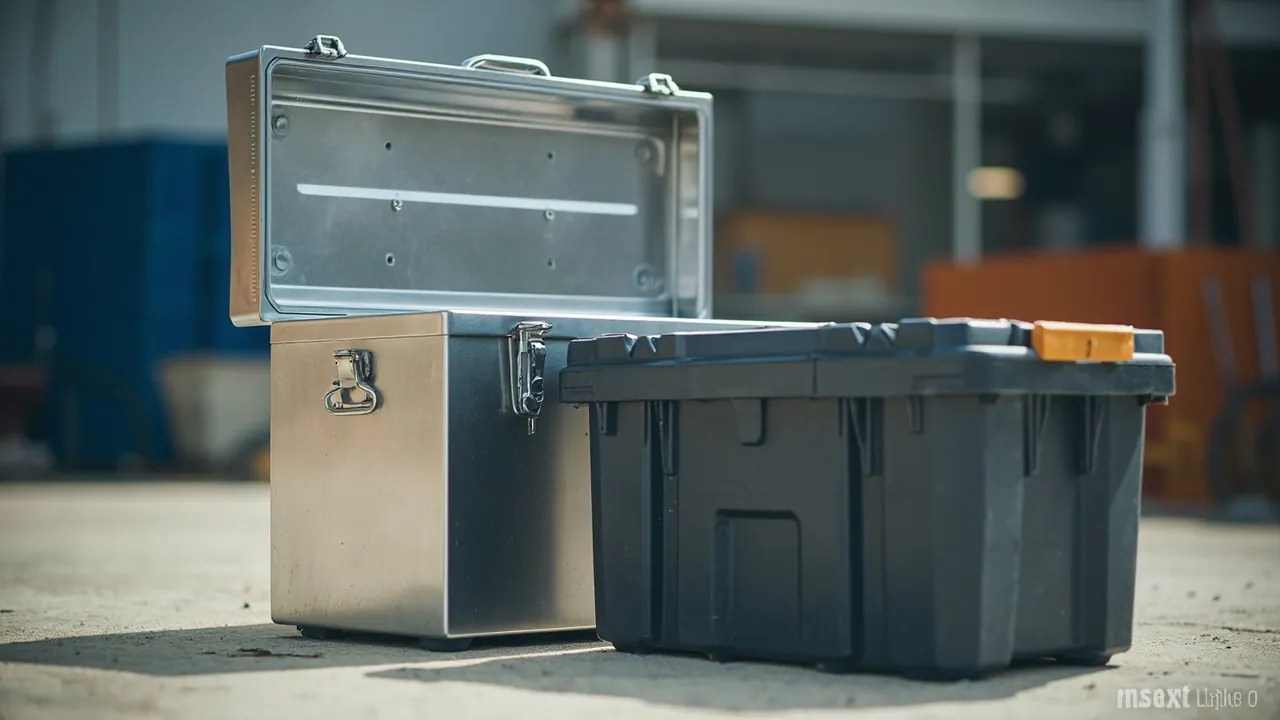
Short answer: in long-term outdoor service, a stainless steel toolbox outperforms a plastic one on three dimensions — weathering and corrosion, structural strength and stiffness, and whole-life cost. First, what kills equipment outdoors is not one storm but the combined long-term action of ultraviolet radiation, heat and humidity, salt aerosol and thermal cycling. Stainless steel resists electrochemical attack through a chromium-rich passive film, and in chloride-bearing environments grades such as 316 (06Cr17Ni12Mo2) raise the pitting resistance equivalent number through their molybdenum content; plastics depend on UV-stabilising additives and, after long exposure, chalk, fade and embrittle in the cold. Second, the elastic modulus of steel is roughly two orders of magnitude above that of engineering plastics, so a stainless body deflects far less under stacking loads, foot traffic or falling objects, and its sealing faces are far less likely to warp out of plane. Third, over a five to ten year horizon, a stainless case costs materially more to buy but is replaced less often, costs less to repair and retains real scrap value, so total cost of ownership is frequently lower.
That is not, however, a claim that stainless wins everywhere. Plastic toolboxes retain clear advantages in weight, electrical insulation, resistance to certain chemicals, thermal insulation, purchase price and freedom of form, and for vehicle mounting, air freight, live working, frequent manual handling and tight budgets, plastic is often the better answer. The value of this article lies not in taking a side but in separating the three dimensions, giving standard references, quantified comparisons and judgement methods for each, so that you can reach your own conclusion for your own duty.
Table of Contents
- Start with the conclusion: who wins on each of the three dimensions
- Dimension one: weathering and corrosion, the combined attack of UV, humidity and salt
- Stainless grades and surfaces: 304, 316, PREN and passivation
- How plastics age: UV degradation, hydrolysis and low-temperature embrittlement
- Dimension two: strength and stiffness under stacking, foot traffic and long-term load
- Impact resistance and the IK code: drops, blows and energy absorption
- Dimension three: whole-life cost, purchase, maintenance and residual value
- Weight and handling: the real price of stainless
- Sealing and ingress ratings: can a metal case reach IP67
- Temperature extremes: blazing sun and severe cold
- Five situations where plastic is the better choice
- Decision matrix and procurement: writing it as technical clauses
- FAQ
- Closing remarks and related reading
Start with the conclusion: who wins on each of the three dimensions
| Dimension | Stainless | Engineering plastic | Winner | Note |
|---|---|---|---|---|
| --- | --- | --- | --- | --- |
| UV resistance | Excellent (metals are unaffected) | Fair to good (additive dependent) | Stainless | Plastics need carbon black, HALS, absorbers |
| Salt spray corrosion | 316 excellent, 304 good | Excellent (no electrochemical attack) | Depends on grade | Plastics do not corrode, but seals still age |
| Low-temperature toughness | Excellent | Fair (PP needs modification) | Stainless | Embrittlement risk for plastics |
| Structural stiffness | Excellent (modulus orders of magnitude higher) | Fair | Stainless | Affects stacking and flange flatness |
| Impact energy absorption | Fair (dents rather than cracks) | Good to excellent | Depends on design | Plastics absorb by deforming |
| Weight | Poor (roughly six to eight times the density) | Excellent | Plastic | Decides the handling method |
| First cost | High | Low to medium | Plastic | — |
| Whole-life cost | Excellent (long life, high residual) | Fair | Depends on horizon | Stainless often better outdoors |
| Electrical insulation | Poor (conductive) | Excellent | Plastic | Mandatory for live working |
| Chemical resistance | Grade dependent (good in alkali, poor in some acids) | Grade dependent | Split decision | Check a compatibility table |
| Form freedom | Fair (sheet, bend, weld) | Excellent (injection moulding) | Plastic | Complex cavities and snaps favour plastic |
| Thermal insulation | Poor (conducts quickly) | Good | Plastic | Affects internal temperature and touch feel |
The "winner" column reflects typical duty, and any row can reverse with a different grade, wall thickness, structural design or usage pattern. The rigorous approach is to rescore this table against your own conditions rather than memorising the sentence "stainless suits the outdoors better".
Dimension one: weathering and corrosion, the combined attack of UV, humidity and salt
Outdoor attack is composite; single-factor laboratory data usually underestimates real damage. Four agents normally act together.
1. Ultraviolet radiation. The UV bands in sunlight, particularly UV-A and UV-B, carry enough energy to break chemical bonds in many polymer chains. Metals are entirely unaffected — the single most unambiguous advantage stainless has. Plastics must be protected with carbon black, hindered amine light stabilisers (HALS) and UV absorbers. Assessment follows the GB/T 16422 series (plastics — methods of exposure to laboratory light sources, corresponding to ISO 4892), using xenon-arc or fluorescent UV lamps, or natural weathering.
2. Heat, humidity and electrochemical corrosion. This is the only failure mode stainless must take seriously. Carbon steel corrodes markedly faster once relative humidity passes the critical threshold (industry commonly cites around 60% as a reference). Stainless relies on a chromium-rich passive film and barely corrodes in clean air, but chloride ions break that film locally and trigger pitting and crevice corrosion. On coasts, islands, in ports and along roads treated with de-icing salt, grade selection is decisive.
3. Salt deposition. The reference is **ISO 9227, *Corrosion tests in artificial atmospheres — Salt spray tests*, which defines neutral salt spray (NSS), acetic acid salt spray (AASS) and copper-accelerated acetic acid salt spray (CASS). It must be stressed that salt spray is a comparative test**: ISO 9227 itself warns against extrapolating results into service life. Its value is in ranking grades and finishes under identical conditions.
4. Thermal cycling and mechanical stress. Daily and seasonal temperature swings produce repeated expansion and contraction, generating micro-cracks at stress concentrators such as welds, screw holes and bend radii. Plastics additionally suffer creep — slow permanent deformation under sustained load. Metals are markedly more stable here.
Taken together, one judgement follows: if your outdoor exposure is dominated by sun, dryness and temperature swing (inland plateaus, arid regions, inland sites), stainless wins mainly through UV immunity and stiffness; if it is dominated by humidity and salt (coastal, port, chemical), stainless must be specified in the right grade or pitting will cancel the advantage.
Stainless grades and surfaces: 304, 316, PREN and passivation
"Stainless" is a large family, and picking the wrong grade is a more common error than picking the wrong material class.
| Grade (China / equivalent) | Composition character | Pitting resistance | Suitable environment | Relative cost |
|---|---|---|---|---|
| --- | --- | --- | --- | --- |
| 201 / 12Cr17Mn6Ni5N | Manganese replacing nickel | Low | Dry indoor, decorative | Low |
| 304 / 06Cr19Ni10 | 18Cr-8Ni | Medium-high | General outdoor, mild coastal | Baseline |
| 304L / 022Cr19Ni10 | Low-carbon 304 | Medium-high | Welded fabrications | Slightly higher |
| 316 / 06Cr17Ni12Mo2 | Molybdenum added | High | Coastal, chemical, de-icing salt | High |
| 316L / 022Cr17Ni12Mo2 | Low-carbon 316 | High | Welded plus high corrosion resistance | High |
| 2205 duplex | Duplex structure | Very high | Severe corrosion, marine engineering | Very high |
PREN, the pitting resistance equivalent number, allows quick comparison between grades. A common formula is PREN = %Cr + 3.3 × %Mo + 16 × %N; higher means better resistance to chloride pitting. Grade 304 usually lands around 19, grade 316 above 24 thanks to molybdenum, and duplex steels can exceed 35. In coastal and high-salt environments, that difference in PREN translates directly into a difference in service life.
Surface condition and treatment matter just as much:
- Surface roughness. A rough surface traps salt and dirt and raises the probability of pitting initiation. Polishing or a fine finish extends life significantly.
- Passivation. A chemical treatment, commonly nitric or citric acid based, removes free iron and promotes formation of the chromium-rich film. It is a standard process for raising corrosion resistance; ask suppliers whether components are passivated and to which standard.
- Weld treatment. Welding destroys the passive film and creates a chromium-depleted heat-affected zone. Welds should be ground and re-passivated, or they become the first place to rust.
- Periodic washing. Stainless is not maintenance-free. Rinsing salt deposits off with clean water is the cheapest and most clearly effective life-extension measure available.
Galvanic corrosion is the other major risk in mixed assemblies. Stainless in direct contact with aluminium, carbon steel or copper in a damp environment accelerates attack on the less noble metal. Countermeasures include choosing materials close in the galvanic series, adding insulating washers or coatings, and sealing joints to exclude electrolyte. This matters especially for the very common pairing of a stainless body with carbon-steel fasteners — the fasteners are usually the first thing to fail.
How plastics age: UV degradation, hydrolysis and low-temperature embrittlement
Plastics do not rust outdoors; they fail by three slowly accumulating mechanisms.
1. Photo-oxidation (UV ageing). UV photons absorbed by chromophores in the polymer start free-radical chain reactions that break or cross-link chains. Macroscopically:
- early stage: loss of gloss, fading, chalking;
- middle stage: surface micro-cracking, falling tensile and impact strength;
- late stage: embrittlement, cracking, structural failure.
Sensitivity varies by polymer:
- PP (polypropylene): tertiary carbon-hydrogen bonds are UV-sensitive; among common engineering plastics it is relatively poor in weathering and must be modified for outdoor use.
- ABS: the butadiene phase contains double bonds and is readily attacked; UV-stabilised grades are required.
- PC: intrinsically better weathering, but prone to stress cracking, so moulded-in residual stress matters.
- PC/ABS blends: good overall balance, a common choice at the mid-to-high end outdoors.
- Glass-filled materials: the fibre itself is unaffected, but once the resin matrix ages you get fibre blooming.
2. Hydrolysis and damp-heat ageing. Some engineering plastics — PA/nylon, PC, some polyesters — hydrolyse in hot humid conditions, breaking chains and losing properties. The PP, PE and ABS commonly used in toolboxes are less hydrolysis-sensitive, but long-term damp heat still warrants attention, and damp-heat ageing test methods exist for assessment.
3. Low-temperature embrittlement. As temperature falls, polymer chain segment motion freezes and the material turns from tough to brittle. The governing figure is the brittle temperature, measurable by methods such as GB/T 5470.
- Homopolymer PP becomes brittle near 0 degrees Celsius, so winter outdoor drops carry a real cracking risk.
- Copolymer and impact-modified PP improve this substantially.
- ABS and PC retain better low-temperature toughness.
4. Creep and stress relaxation. Plastics deform slowly and permanently under sustained load, and heat accelerates it. Two applications feel this acutely:
- Long-term stacking: the bottom case creeps under continuous load; if that deformation reaches the flange, sealing degrades immediately.
- Gasket clamping: where clamp load depends on the elasticity of a plastic structure, stress relaxation reduces it over time and sealing fails. This is why quality waterproof cases often use metal pins or metal latches to carry the primary load.
In purchasing language: state the UV-stabilised grade or UV stabilisation level, the minimum service temperature, and the permitted number of stacked layers for long-term storage, and ask for the corresponding material statement or test data.
Dimension two: strength and stiffness under stacking, foot traffic and long-term load
This is where the stainless advantage is most visible and most often undervalued.
The order-of-magnitude difference in modulus. Steel sits around 200 GPa; common engineering plastics (PP, ABS, PC) usually fall between roughly 1.5 and 3 GPa. Under identical load and geometry, a steel component deflects roughly two orders of magnitude less than a plastic one. Put differently, a plastic case that shows visible side-wall deflection when stacked three high may show none at all in stainless.
Three practical consequences follow.
1. Ability to hold the sealing face flat. Waterproof performance depends heavily on flange flatness in the clamped state. Plastic bodies can warp after long stacking, vehicle vibration or local loading, and warping breaks seal continuity. A stainless flange barely deforms under equivalent conditions, which is one of its core advantages in long-term outdoor sealing reliability.
2. Stacking capacity. In a stack, the bottom case carries everything above it. Plastic resists side-wall buckling through ribs and wall thickness, and sustained static load accelerates creep; stainless has essentially no such issue. For sites needing tall stacks or long-term storage, that structural advantage converts directly into space utilisation. See the value of stackable toolbox design.
3. Resistance to foot traffic and accidental loads. On site, cases get stood on, used as steps and pressed by other equipment. Plastic under such localised concentrated loads tends to crack or take a permanent dent; stainless at worst takes a local dent that usually affects neither sealing nor opening.
Stiffness has a cost, though: stainless lacks elastic cushioning, so impact energy is not absorbed by the structure but transmitted to the contents. Stainless cases therefore rely more heavily on their interior for cushioning, which the next section develops.
One caution: the strength advantage presupposes sound structural design. A thin-gauge folded and welded box with poor welds and inadequate reinforcement can lose much of that advantage. Look at sheet thickness, reinforcement method, welding process and post-weld treatment, not merely at whether it is stainless. Related considerations are set out in high-strength protective case structures.
Impact resistance and the IK code: drops, blows and energy absorption
Impact is where plastic is relatively stronger, though the picture is subtler than intuition suggests.
The IK code. Defined by **IEC 62262 (in China GB/T 20138, *Protection of enclosures against external mechanical impacts*)**, it runs from IK00 (no protection) to IK10, which corresponds to 20 joules. A hammer of specified mass and geometry is dropped from a specified height, or an equivalent pendulum or spring hammer is used, and the impact energy is quoted in joules. Assessment considers whether the enclosure still provides its declared protection and whether hazardous parts become accessible.
How plastics absorb energy. Plastics, particularly tough and impact-modified grades, absorb a great deal of energy through local elastic and plastic deformation, spreading the peak force and protecting the contents. That is why many protective cases use modified PP or PC blends — they absorb drop energy through their own deformation, so the acceleration transmitted to the contents is relatively low.
How stainless responds. Stainless is stiff and absorbs little energy through macroscopic deformation. Under impact:
- below the structure's elastic limit, the case essentially does not deform and energy is reflected;
- above it, a permanent dent appears, or a weld cracks.
Stainless cases therefore depend more on their interior for cushioning, whereas plastic cases can rely partly on shell toughness. That is why interior design and retention deserve more attention on a stainless case.
Cold impact is plastic's weak point. Impact strength falls sharply at low temperature; a plastic case that passes a room-temperature drop test may crack outright at minus 20 degrees. Northern and high-altitude projects must demand cold-drop or cold-impact data, not just ambient reports. Stainless is largely unaffected by low temperature — austenitic grades retain good toughness in the cold — which is a hard advantage in severe cold.
| Impact scenario | Plastic | Stainless | Note |
|---|---|---|---|
| --- | --- | --- | --- |
| Ambient drop | Good to excellent (absorbs by deforming) | Fair to good (dents) | Plastic needs less interior help |
| Cold drop | Fair to poor (embrittlement) | Excellent | Key difference in northern projects |
| Localised concentrated blow | Fair (may crack) | Excellent (dents, does not crack) | Site foot traffic, dropped objects |
| Sustained vibration | Fair (fatigue and creep) | Excellent | Vehicle mounting, long hauls |
| Shock transmitted to contents | Excellent (shell absorbs) | Fair (needs interior compensation) | Stainless must have a good liner |
Dimension three: whole-life cost, purchase, maintenance and residual value
This is the dimension most often overlooked and frequently the most decisive.
The structure of whole-life cost:
``` LCC = purchase cost + maintenance cost + replacement cost - residual value
```
- indirect losses from failure (downtime, damaged tools, schedule delay)
Item by item:
Purchase cost. Plastics are clearly cheaper. At equal volume, a stainless case typically costs several times a plastic one, depending on sheet thickness, process complexity and quantity. This is plastic's most certain advantage.
Maintenance cost. Both need maintenance, on different items.
- Plastic: gasket replacement, interior replacement, whole-body replacement after ageing, plus corrosion of metal hardware such as hinges, latches and screws.
- Stainless: gasket replacement as well, plus periodic salt washing, weld and fastener inspection, and watching for galvanic corrosion.
- Relatively speaking, plastic cases get replaced whole more often; stainless cases need slightly more preventative maintenance.
Replacement cost. This is the dividing line. Outdoors over the long term, a plastic case without thorough UV stabilisation may age visibly within a few years, and even a well-stabilised one gradually loses performance under sustained stacking and UV exposure. A stainless case, correctly specified and maintained, usually lasts substantially longer. Over a five to ten year horizon, plastic may need replacing once or twice; stainless usually does not.
Residual value. Stainless scrap value is materially higher than plastic. A retired stainless case retains meaningful scrap value, whereas a plastic case is worth close to nothing and may even cost money to dispose of. As environmental expectations and compliance requirements tighten, this is growing in importance.
Indirect losses. The hardest to quantify and often the largest. One case failure can damage tools, stop work or put a precision instrument out of tolerance, at a cost far exceeding the price difference. For critical tasks — breakdown response, emergency service, metrology, defence — a reliability premium is entirely rational.
| Cost item | Plastic | Stainless | Note |
|---|---|---|---|
| --- | --- | --- | --- |
| Purchase | Low | High (several times) | The most certain difference |
| Gasket replacement | Required | Required | Both |
| Body replacement | Possibly once or twice | Usually not | Depends on ageing |
| Routine maintenance | Low | Medium (washing, weld checks) | Stainless slightly higher |
| Residual value | Near zero | Meaningful | Scrap steel value |
| Typical verdict outdoors | Cheaper short term | Cheaper long term | Five to ten year view |
Applying the framework is simple: estimate service life and replacement count, include residual value and indirect losses, then compare totals. For short projects, temporary sites or tightly capped budgets, plastic still wins. For fixed yards, long deployments and critical tasks, stainless usually does.
Weight and handling: the real price of stainless
This is stainless's clearest disadvantage and has to be addressed head on.
The density gap. Steel is about 7.8 g/cm³, while common engineering plastics are around 0.9 (PP), 1.05 (ABS) and 1.2 (PC) g/cm³, with foam liners lower still. Even with thin sheet, an empty stainless case of the same volume typically weighs several times a plastic one. That is physics; design cannot fully remove it.
The knock-on effects:
- The handling method must change. A 20 kg plastic case may still be within one person's range when loaded; an empty stainless case may already be near or past it. Buying stainless means planning handling at the same time: wheels, trolleys, two-person lifts or lifting points. See balancing weight and handle on a portable toolbox and industries served by trolley toolboxes.
- Transport cost rises. In volume, the empty-weight difference shows up directly in freight, especially by air and over long hauls.
- Drop risk and site safety. Greater mass means greater energy in a drop and greater risk to people and floors; factor this into site safety assessments.
- Ergonomic constraints. Where manual handling is unavoidable, check the weight against a manual handling risk assessment method such as the NIOSH lifting equation approach, and move to mechanical assistance if it is outside the acceptable range.
How to mitigate it:
- Optimise sheet thickness and reinforcement. Ribs instead of thicker sheet cut weight substantially at equal stiffness; this is standard practice in sheet-metal design.
- Size the case correctly. Unnecessary volume multiplies the weight problem; derive the minimum from the tool list (see calculating toolbox capacity).
- Fit wheels and a trolley handle. Close to mandatory on heavier stainless cases.
- Split the load. Two smaller cases rather than one large one.
- Consider a hybrid. Stainless outer shell with a plastic or aluminium inner, trading weight against weathering.
Sealing and ingress ratings: can a metal case reach IP67
A common misconception is that only plastic cases achieve high ingress ratings. That is not so.
Metal cases reach IP67 and beyond. Under IEC 60529 (GB/T 4208-2017 in China), the IP code describes the enclosure's protective capability and is material-independent. Metal waterproof cases, military containers, shipboard equipment enclosures and outdoor electrical cabinets all achieve IP66, IP67 and even IP68. What matters is the design of the sealing system, not the shell material.
How a metal case gets there:
- A continuous gasket under even clamp load. The principle is identical to plastic: a solid rubber gasket (EPDM or silicone) with multiple latches delivering uniform compression around the whole closure. Metal's advantage is flange stiffness, which keeps compression consistent because the flange does not deform.
- Weld integrity. In a fabricated sheet-metal body, welds must be continuous and sound; weld defects are the primary source of leakage, and critical seams should be inspected.
- Penetration sealing. Hinges, latches, handles, cable glands and vents each need equivalent provision, and metal cases often need more seals and more process control here.
- A waterproof vent. Metal cases breathe just as much under day-night temperature swings, so a membrane vent is required. See waterproof design for outdoor cases.
| Sealing element | Plastic | Stainless | Note |
|---|---|---|---|
| --- | --- | --- | --- |
| Flange stiffness | Fair (may warp over time) | Excellent | Stainless advantage |
| Clamp uniformity | Depends on latch count and layout | Same, and more stable | Stainless more stable |
| Weld or joint integrity | Good (one-piece moulding) | Depends on weld quality | Plastic advantage |
| Penetration sealing | Required | Required, often more of them | Comparable |
| Gasket ageing | Periodic replacement | Periodic replacement | Comparable |
| Galvanic risk | None | Yes (fasteners) | Plastic advantage |
One reminder: IEC 60529 states clearly that the water levels do not form a simple ladder — a sample passing IPX7 has not necessarily passed IPX5 or IPX6. List the water forms your site actually produces separately, for example "IP6X plus IPX5 plus IPX7", rather than a single number. Test boundaries and acceptance methods are developed in field testing IP65 waterproof toolboxes.
Temperature extremes: blazing sun and severe cold
Blazing sun. Here the metal's high thermal conductivity is a liability. A bare or dark metal surface heats quickly under strong sun, and internal temperature can exceed ambient substantially, which is unfriendly to lithium batteries, electronic instruments, lubricants and plastic grips. There is also a burn risk from touching a metal case in summer. Countermeasures:
- prefer a light-coloured finish or add insulation — the interior liner is itself an effective insulating layer;
- shade beats insulation by a wide margin, so site the case under cover where possible;
- avoid long-term storage of lithium batteries and temperature-sensitive consumables inside;
- see summer heat and toolboxes for more.
Severe cold. This is metal's territory. Austenitic stainless grades (304 and 316 families) retain good toughness at low temperature with no embrittlement, whereas plastics lose impact strength and risk brittle cracking. For northern winters, high altitudes, cold stores and low-temperature transport, that difference is decisive. One exception to note: carbon steel and some ferritic stainless grades do exhibit low-temperature brittleness, so confirm the grade's low-temperature toughness data rather than assuming "metal handles cold".
Thermal cycling and breathing. Whatever the material, day-night swings expand and contract the internal air, producing the breathing effect that draws moist outside air in (see waterproof toolboxes for outdoor storage). Because metal conducts quickly, internal temperature may change faster and further, so a waterproof vent and desiccant matter just as much for metal, arguably more.
Condensation. Metal walls follow ambient temperature quickly and, after radiating heat away overnight, are more likely to fall below the internal dew point. Condensation risk is therefore higher than in a plastic case. Countermeasures: keep the liner as a thermal break, use desiccant, and keep the case off cold ground.
Five situations where plastic is the better choice
To be fair, plastic is the more sensible answer in these cases.
1. Frequent manual handling or single-person carry. For maintenance patrols, field service and vehicle-based work, weight is the first constraint. At equal volume a plastic case weighs a fraction of a stainless one, cutting both effort and safety risk.
2. Live working or electrically hazardous environments. Plastic insulates; stainless conducts. Where work is carried out on or near live equipment in power, telecoms and rail, insulation is a hard safety requirement and plastic is close to the only option.
3. Specific chemical exposure. Chemical resistance varies enormously, so check a compatibility table for the actual medium. Generally, polyolefins (PP, PE) handle most acids, alkalis and solvents well, while stainless performs well in alkali but is pitting-sensitive to chloride-bearing acidic media. In aggressive chemical service, identify the medium first and then check compatibility — do not choose the material first.
4. Complex cavities, snap-fits and low cost at volume. Injection moulding produces complex cavities, snaps, ribs and assembly features in one operation, with unit cost falling sharply with quantity. Sheet metal has neither the freedom nor the cost position for complex forms.
5. Tight budgets or short project horizons. For temporary sites, short programmes and one-off activities, purchase price dominates, and the low first cost plus replace-if-damaged flexibility of plastic wins.
Two further situations deserve separate mention:
- Where electromagnetic transparency matters. Plastics are transparent to radio frequencies; metal shields. Communications equipment cases, antenna cases and measurement probe cases usually go plastic.
- Where low thermal conductivity and comfortable touch matter. Handling bare metal in cold conditions is unpleasant; plastic feels markedly better.
Decision matrix and procurement: writing it as technical clauses
The analysis above condenses into an executable path.
Decision matrix — score against your duty, weighting to suit:
| Judgement item | Signals pointing to stainless | Signals pointing to plastic |
|---|---|---|
| --- | --- | --- |
| Service life | Over five years, fixed yard | Under three years, temporary |
| UV exposure | Long-term unsheltered | Sheltered or intermittent |
| Salt environment | Coastal but 316 is affordable | Coastal with tight budget (needs more maintenance) |
| Minimum temperature | Below minus 10 degrees | Ambient |
| Stacking | Tall stacks, long duration | Low stacks or short term |
| Handling | Mechanical assistance, wheels | Manual, single-person carry |
| Electrical environment | No live-working requirement | Insulation required |
| Weight sensitivity | Low | High |
| Budget model | Whole-life cost | First cost |
| Value of contents | High (large downtime penalty) | Moderate |
Technical clauses you can reuse:
- Material and grade. State the stainless grade (for example 06Cr17Ni12Mo2 / 316) and require a material certificate (referencing GB/T 20878 or the corresponding ASTM A240 grade). If plastic, state the material grade, UV stabilisation level and minimum service temperature.
- Sheet thickness and structure. State gauge, reinforcement method, welding process and post-weld treatment (grinding, passivation).
- Surface finish. Brushed, polished, blasted or coated; roughness requirement; whether passivated and to which standard.
- Corrosion evidence. Salt spray report stating method (NSS, AASS or CASS), duration and acceptance basis (white rust versus red rust).
- Ingress rating. Under IEC 60529 / GB/T 4208-2017, list dust and water levels separately (for example IP6X plus IPX5 plus IPX7); X is not accepted.
- Impact. IK rating (IEC 62262 / GB/T 20138), plus cold-drop or cold-impact data where applicable.
- Flammability. UL94 classification where applicable.
- Gasket. Material, hardness, compression, replacement interval and spares availability.
- Fastener grade. Material and finish, avoiding unfavourable galvanic couples with the body.
- Handling configuration. Handle form, wheels and trolley handle, lifting points, declared weight.
- Documentation. Material certificates, test reports, RoHS/REACH declarations, spares list and maintenance instructions.
Write those eleven items into a technical agreement and the discussion shifts from "is stainless or plastic better" to "which of these are hard constraints in your duty". On wholesale, distribution and OEM/ODM programmes, JUNZHJIA normally collects duty information first — location, exposure, handling method, intended service life, contents list — then recommends material and configuration accordingly, supplying material certificates, test reports and a spares plan. For customers with several different duties, configuration can be graded by scenario rather than forcing one product to cover everything.
FAQ
Q: Will a stainless toolbox really never rust at the seaside? A: Not necessarily; it depends on grade, surface condition and maintenance. Stainless resists corrosion through a chromium-rich passive film, and chloride ions break that film locally, causing pitting and crevice corrosion — and the seaside is precisely where chloride concentration is highest. Grade 304 (06Cr19Ni10) performs well in general outdoor service but carries real pitting risk in coastal salt aerosol, especially in unventilated crevices such as flange faces, screw holes and weld heat-affected zones. Grade 316 (06Cr17Ni12Mo2) contains molybdenum, giving a materially higher pitting resistance equivalent number, and is the safer choice for coastal and chemical duty. Three further points matter equally. Surface roughness: a rough surface traps salt and raises the probability of pitting initiation, so polishing or a fine finish extends life significantly. Passivation: welds must be ground and re-passivated after welding, or they rust first. Washing: rinsing salt deposits off with clean water periodically is the cheapest and most clearly effective maintenance measure. Specify the grade and demand a material certificate rather than writing only the word "stainless".
Q: How many years will a plastic toolbox last outdoors? A: There is no single answer; it depends on the grade, the level of UV stabilisation, exposure intensity and how the case is used. The useful framing is this: outdoor ageing of plastics is driven mainly by UV-induced photo-oxidation, showing up first as loss of gloss, fading and chalking, then as surface micro-cracking and falling impact strength, and finally as embrittlement and cracking. Unmodified PP in a high-insolation region may chalk visibly within a few years; a UV-stabilised grade with carbon black, HALS and UV absorbers lasts substantially longer. Assessment follows the GB/T 16422 series (corresponding to ISO 4892), using xenon-arc or fluorescent UV exposure. The key point is not to rely on verbal claims of "X years" but to check three things: whether the material is explicitly a UV-stabilised grade, whether a minimum service temperature is declared, and whether weathering test data is available. In practice shading buys more than any material upgrade — siting the case under cover often beats specifying a better polymer. Regular gasket inspection, avoiding excessive long-term stacking and keeping the surface clean also extend real service life materially.
Q: Is a stainless case very heavy, and can it be made thinner? A: It is heavy, and that is stainless's clearest disadvantage, rooted in density: steel is about 7.8 g/cm³ against roughly 0.9 for PP and 1.05 for ABS, so even with thin sheet an empty stainless case of the same volume typically weighs several times a plastic one. It can be made thinner, but stiffness and weight have to be traded. Two common techniques are using ribs instead of thicker sheet, which cuts weight substantially at equal stiffness and is standard sheet-metal practice, and right-sizing the volume, deriving the minimum from the tool list and avoiding unnecessary size. There is a floor, though: sheet that is too thin loses stiffness, resists denting poorly and is harder to weld, undermining the very advantages you are paying for. The more practical route is therefore to plan the handling method at the same time — wheels and a trolley handle, a trolley, lifting points, or splitting a kit across two smaller cases. Where manual handling is unavoidable, check the weight against a manual handling risk assessment such as the NIOSH lifting equation approach and switch to mechanical assistance if it falls outside the acceptable range. In volume transport the empty-weight difference also shows up directly in freight, especially by air.
Q: Can a metal case reach IP67, and is it worse than plastic at sealing? A: Yes it can, and on sealing consistency metal often has the advantage. IP ratings under IEC 60529 (GB/T 4208-2017 in China) describe the enclosure's protective capability and are material-independent: metal waterproof cases, military containers, shipboard enclosures and outdoor electrical cabinets all reach IP66, IP67 and even IP68. What determines the result is the design of the sealing system, not the shell material. Metal's advantage is flange stiffness: the flange does not deform under clamp load, so flatness is maintained over a long service life better than with plastic. Its disadvantages are that welds in a fabricated body must be continuous and sound, since weld defects are the primary leakage source, and that penetrations — hinges, latches, handles, vents — often need more seals and tighter process control. Metal also conducts heat quickly, so breathing under day-night swings can be more pronounced, making a waterproof vent and desiccant just as important, if not more so. One specific caution: IEC 60529 states that the water levels are not a simple ladder, so passing IPX7 does not mean passing IPX5 or IPX6. List the water forms your site actually produces separately, for example "IP6X plus IPX5 plus IPX7".
Q: Should I choose aluminium or stainless? A: Both are metal solutions with different emphases, and three dimensions decide it. Weight: aluminium is roughly a third the density of steel, so at equal strength it is markedly lighter, making it the first choice when you want metal stiffness but cannot carry steel's mass. Corrosion: aluminium relies on its oxide film, performs well in general atmospheres, but is also pitting-sensitive to chlorides and performs poorly in alkaline conditions; stainless, especially 316, usually does better in chloride service. Watch galvanic corrosion, however — the potential difference between the two is large, so in direct contact and damp conditions the aluminium acts as the anode and corrodes faster, meaning insulating washers or coatings are mandatory. Strength and wear: stainless usually has higher strength and surface hardness than aluminium, resisting dents and scratches better in rough service; aluminium is softer and marks more easily, though anodising improves the surface. Costs are broadly comparable, depending on grade and process. A full item-by-item comparison is in stainless versus aluminium toolboxes. In short: choose aluminium when weight matters and strength demands are moderate; choose stainless for rough duty and high corrosion resistance.
Q: Do tools in a stainless case get damp more easily? A: They can, because of thermal conductivity. Stainless conducts heat quickly, so the wall temperature follows the environment closely and, after radiating heat away overnight, may fall below the dew point of the internal air, producing condensation on the inside surface. On this point metal genuinely carries a higher risk than plastic, whose insulation slows wall temperature change. Fast conduction also means internal temperature swings can be quicker and larger, making the breathing effect — internal air expanding and contracting and drawing moist air in — potentially more pronounced. That does not mean a metal case leaks more readily; it means condensation is a more significant internal moisture source. The countermeasures are clear: the interior liner is itself an effective thermal break, so keep it and avoid direct tool-to-metal contact; use adequate desiccant and a humidity indicator card; fit a waterproof vent to equalise pressure and reduce breathing; keep the case off cold ground; and seal it in dry weather with thoroughly dried tools. With those in place, humidity inside a metal case is perfectly controllable.
Q: Why do the fasteners on a stainless case keep rusting, and what can I do? A: This is the most common problem in mixed assemblies, and the root cause is usually galvanic corrosion combined with mismatched material grade. With a stainless body and zinc-plated carbon-steel screws, the screws are the less noble side and corrode preferentially; even among stainless grades there can be potential differences. The crevice geometry between screw head and body is itself a crevice-corrosion site, and salt deposits accelerate it further. Four lines of action. Standardise the grade: fasteners should not be of lower grade than the body, and in coastal service both should be 316 or better. Isolate dissimilar metals: use insulating washers, insulating coatings or sealant at the contact face to break the electrolyte path. Improve surface and assembly practice: apply grease or sealant at assembly to limit liquid trapped in the crevice. Put it on the maintenance list: inspect fasteners regularly, replace any showing red rust early, and buy spares up front. The point worth emphasising is that a case with an excellent stainless body and low-grade fasteners has its service life set by the fasteners — so pull out a "complete metal parts list" at procurement and confirm grade and finish item by item.
Q: With a limited budget, how do I choose between the two materials? A: The key is to be clear whether the budget means first cost or whole-life cost. On first cost alone, plastic is clearly lower, often a fraction of a stainless case, and it is the right answer for short programmes, temporary sites and easily replaced tool sets. Over five to ten years the conclusion often reverses: plastic may need replacing once or twice in that period, its residual value is near zero and disposal may cost money, and a single failure that damages tools, stops work or puts an instrument out of tolerance can cost far more than the price difference. A simple decision process helps: estimate the service life and expected replacement count, add residual value and indirect losses, and compare totals rather than unit prices. If plastic still wins on that basis, three compromises exist. Grade by scenario: stainless for fixed yards and critical stations, plastic for mobile and temporary work. Hybrid construction: metal for the outer shell or primary load paths, plastic elsewhere. Spend on what matters in a plastic case: a UV-stabilised grade, a better gasket and multiple latches, plus strict shading and maintenance discipline, which together extend service life substantially at modest cost.
Q: For storing precision instruments outdoors, which should I choose? A: Stainless is usually the first choice, but it must be paired with a good interior and moisture control, and one common misconception needs avoiding. The three reasons for stainless: flange stiffness means sealing-face flatness is maintained better over a long life, so sealing reliability is more stable; weathering is excellent because metals are unaffected by UV, so long-term performance decay is small; and resistance to foot traffic and accidental loads is high, which protects high-value contents better. Two weaknesses must be compensated. First, stainless absorbs almost no impact energy through macroscopic deformation, so shocks pass through to the contents; a high-quality contoured liner, usually EVA, is therefore more important than on a plastic case (see shockproof cases for precision tools). Second, fast conduction raises condensation and breathing risk, so desiccant, a humidity indicator and a waterproof vent are required, and the liner should stay in place as a thermal break. Two further checks: if the contents are electronic and the site requires insulation, or if the equipment is sensitive to electromagnetic shielding, switch to plastic; and if the instrument works in low temperatures, stainless's immunity to cold embrittlement becomes a further point in its favour.
Closing remarks and related reading
To answer the title: a stainless steel toolbox suits the outdoors better because it wins on the three decisive dimensions — weathering and corrosion (metals ignore UV, and the right grade resists chloride pitting), structural strength and stiffness (two orders of magnitude more modulus, so sealing faces do not warp after years of stacking), and whole-life cost (fewer replacements, real residual value, smaller indirect losses). Those three map precisely onto the three failure modes that dominate long-term outdoor exposure.
That conclusion has clear boundaries, however. Where manual handling is frequent, electrical insulation is required, specific chemicals are present, complex cavities and low unit cost at volume matter, or the programme is short, plastic remains the better answer. Good engineering selection does not pick a side; it separates the three dimensions and scores them against the actual duty.
Three practical recommendations. First, specify the grade rather than the word "stainless", and require material certificates plus a salt spray report stating method and acceptance basis. Second, grade the configuration by scenario — stainless for fixed yards and critical stations, plastic for mobile and temporary duty — instead of forcing one product across all needs. Third, whichever material you choose, put gaskets, fasteners, interiors and vents on a critical-parts list with replacement intervals and spares stock, because outdoor reliability is ultimately decided by those details rather than by the shell material. On outdoor and coastal programmes, JUNZHJIA typically collects duty information first — location, exposure, handling, service life and contents — then recommends material and configuration, supplying material certificates, test reports and a spares plan, so that "suitable for outdoor use" becomes an inspectable, traceable commitment rather than a line of marketing copy.
Related reading