

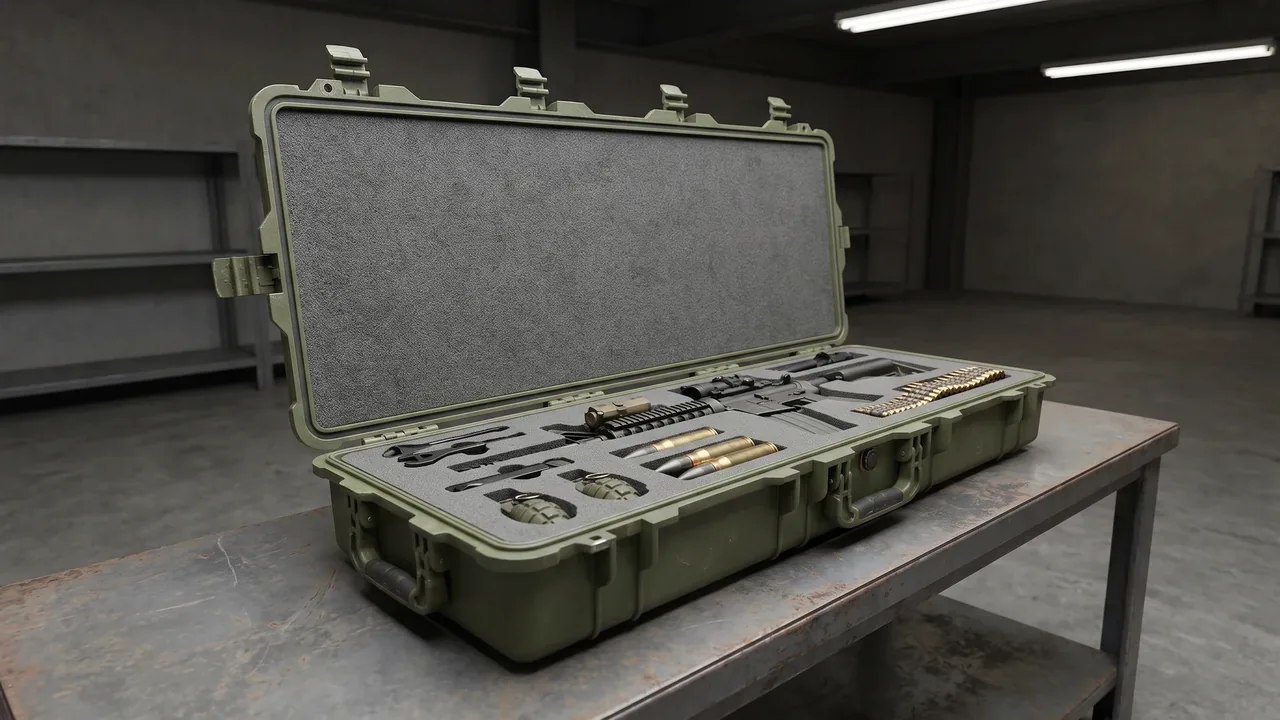
In the carry and storage chain of tactical equipment, the Tactical Hard Case plays a role that nothing else quite replaces: it moves communications gear, optics, observation instruments, medical modules, and support kit from the staging point to the mission area intact, and brings it all back the same way. Soft packs emphasize contact and mobility; rigid cases emphasize protection and order, and the division of labor between them is now well established. For tactical equipment dealers, military and police units, and outdoor channel buyers, judging whether a Tactical Hard Case is up to standard comes down to two questions: does its protection rating cover the real transport and field environment, and do its internal modules put every item in a fixed position, ready the moment the lid opens. From a manufacturer's point of view, this article breaks down IP protection ratings, MIL-STD-810H test items, drop and stacking metrics, and the internal modules — EVA custom cutouts, pick-and-pluck foam, compartment dividers, MOLLE-compatible attachment fields, and quick-access layouts — then explains the carry options across back, wheels, and vehicle mounting, the quick-release latches and anti-tamper provisions, and the identification system that makes a case recognizable at a glance. This article covers the container itself only, not the nature or use of its contents; for military trade and export situations, local regulations and export control requirements always prevail.
Where the Tactical Hard Case Sits in the Equipment System
In most unit equipment lists, the container is the last item anyone takes seriously, yet it decides the serviceability rate of everything that came before it. Soft saddle bags and modular backpacks solve the problem of a person on the move; a Tactical Hard Case solves the problem of the case carrying the load instead of the person: loaded into a vehicle, stacked, checked through, opened on arrival, and everything inside is exactly where it was left. That is why it is normally assigned to the category of gear that fears bumps, moisture, and disorder — communications terminals, observation instruments, detection and recording devices, medical modules, surveying and test tools, unmanned aircraft with their spares, and mission kits that must be drawn in a fixed sequence.
Compared with single-purpose boxes, a Tactical Hard Case is defined by "one case, many missions": the interior layout can be rebuilt as the mission list changes, and the exterior interfaces accept different carry and mounting methods. This is precisely where it separates itself from ordinary tool cases and generic protective cases. Buyers who want to map the boundary between case types can read the gun case versus ammo box comparison for a horizontal view, and see the wider family tree in tactical military equipment cases. Once the position is clear, every specification that follows has a reason.
There is also a handover dimension that procurement documents rarely capture. Equipment that lives in pouches migrates between owners; equipment that lives in a numbered case returns to the same slot every time. Training time shrinks because the layout is teachable, and accountability sharpens because the case, not the individual, is the unit of record. Dealers serving institutional customers should treat this as part of the product: a case whose interior photography, insert drawings, and numbering scheme arrive documented is dramatically easier to sell into an audited environment than one offered as an anonymous black box.
It is worth stressing how a tactical hard case should be budgeted: somewhere between capital equipment and consumable. The shell is a durable asset; the foam, gaskets, and latch parts are consumables. Buyers who treat the purchase as a one-time transaction usually discover, in year two, that inserts are unavailable and nobody will re-cut foam. Units that agree on spares and re-cut channels with the manufacturer up front keep their cases in service continuously. Once this framing is settled, budget structure, acceptance criteria, and after-sales terms all have a baseline to align against.
Protection Ratings: IP Codes and the Sealing Target
The IP code is the most frequently quoted rating for any Tactical Hard Case. Two digits: the first covers solid objects and dust, the second covers water ingress. In tactical service the common target is IP67 — total dust protection plus dryness inside after short-duration immersion. Reaching it is not the work of one strong feature but of a complete sealing chain: a continuous elastomer gasket around the case mouth, even latch pressure across the lid, flatness between lid and body, and the cooperation of drainage channels and the pressure relief valve in the base.
Many buyers treat IP67 as an on-off switch, but it is the outcome of a system. Gasket cross-section, compression, and rebound after aging all change real-world sealing performance; when latch preload is uneven, a locally under-compressed gasket becomes the leak point in an immersion test. The pressure relief valve is another overlooked detail: moving a sealed case from high altitude to sea level, or from a cold store into sunlight, changes internal pressure until the gasket is either sucked tight or distorted. The valve equalizes pressure so the case opens smoothly and the gasket is not permanently deformed by one-sided load. For field verification methods, the logic in waterproof toolbox IP65 field test transfers directly to tactical case acceptance.
One more layer of thinking usually gets skipped: not every case needs IP67. Units operating mainly from vehicles and fixed sites are well served by IP65's jetting-water rating, and the budget saved there is better spent on inserts and locks. Only water-crossing, shoreline staging, and prolonged wet-season exposure justify paying for an immersion rating. Each step up the IP ladder changes gasket section, latch count, and opening feel — higher sealing usually means more opening force and more weight. Choosing the rating from the real environment beats ranking a datasheet every time.
Acceptance testing can stay simple without losing rigor. Beyond the paper towel shower check, immerse one sample case fully for the rated duration with a moisture-sensitive card taped inside the lid; card discoloration anywhere marks the leak path. Repeat the test after a month of daily opening cycles, because gasket set develops with use, not on the bench. Units that log these two checks per delivery build a sealed-case performance record that turns future supplier disputes into five-minute conversations with evidence in hand.
MIL-STD-810H, Drop and Stacking: Reading Test Data as Field Language
Beyond the IP code, technical files for a Tactical Hard Case often cite MIL-STD-810H environmental test methods. For a packaging container, the relevant items are those describing what the shell must survive: mechanical shock and drop, vibration, temperature and humidity cycling, sunlight aging, salt fog, rain, and blowing dust. The manufacturer's job is not to photocopy the standard into a brochure but to translate each test into field language — survives sliding off a loading platform, keeps contents in position after eight hours on a convoy's rear deck, does not chalk or corrode through a coastal training season.
Drop testing is normally done on the loaded case, judging the combined behavior of shell toughness, internal cushioning, and item restraint; stacking tests answer how many layers of identical cases one case can carry, which maps directly to warehouse and vehicle load plans. For a tactical hard case, test conditions should mirror real loading: a fully loaded case and an empty one are different animals. When comparing suppliers, ask for the loading state, drop orientation, and pass criteria behind the numbers — not just the phrase "military-standard compliant." Data only has comparison value when it is returned to its scenario.
Vibration deserves its own paragraph. Broadband vibration from cross-country transport and rotary-wing transfer does not break equipment instantly; it loosens fasteners, wears connector contacts through micro-motion, and permanently compresses foam. The damage accumulates. So the random vibration profile in the lab should cover the main legs of the mission transport chain, and the post-test inspection should look beyond breakage to fastener torque and foam rebound. Low- and high-temperature endpoint checks probe material limits: gaskets stiffen in severe cold and seal poorly; shells lose impact resistance after prolonged sun. When the test sequence maps one-to-one onto the mission profile, the report finally becomes comparable.
Buyers should also understand what 810H does not promise. Compliance is invoked per method and per level, not granted wholesale, so two cases can both cite the standard while covering entirely different procedure lists. Reading the citation the way an auditor would — method number, level, duration, sample size — takes minutes and prevents the most common procurement disappointment: a case tested only as an empty box for shipping loads being fielded full of instruments into vibration-heavy service. Ask which procedures were run and on what; the honest answer is usually the whole story.
Shell Materials and Molding Processes: Rotomolded HDPE, Injection, Aluminum
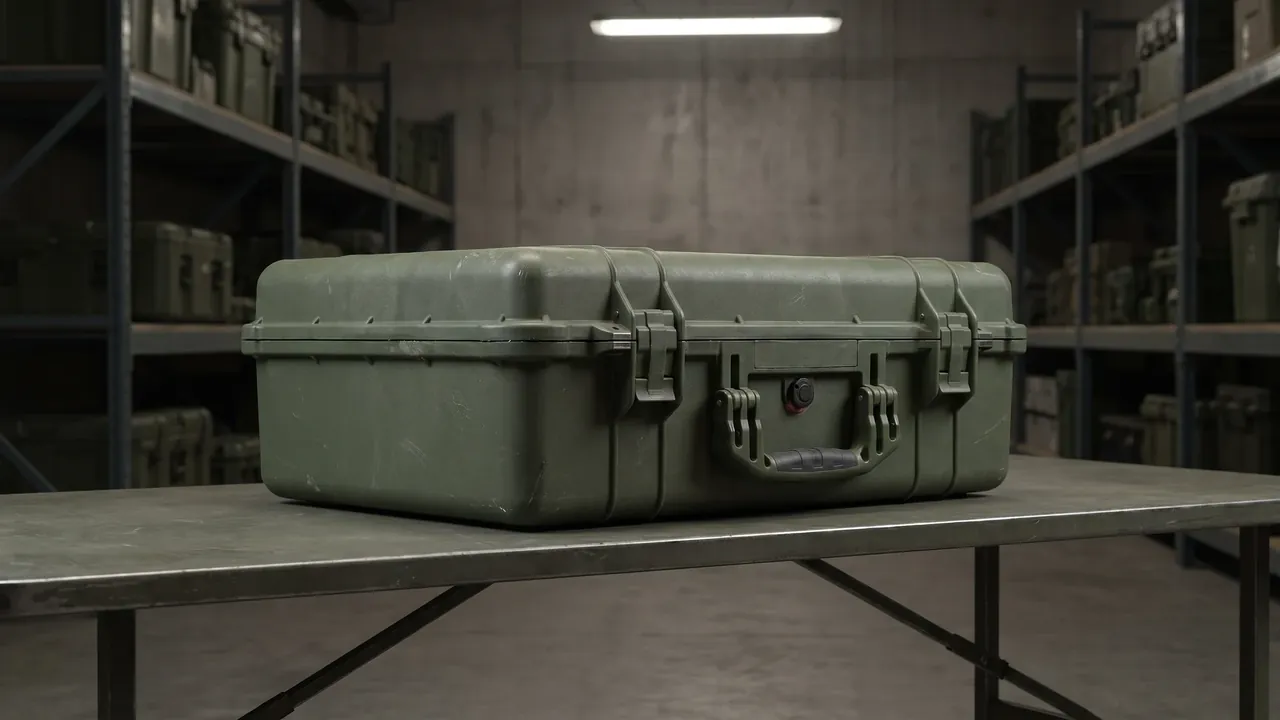
Material sets the character of the case. Rotomolded HDPE is the mainstream route for the Tactical Hard Case: molded in one piece, double-wall construction, rounded transitions without stress concentrations, resistant to impact, ultraviolet exposure, and low-temperature brittleness; after a knock it dents elastically rather than shattering. Injection-molded ABS or PC/ABS alloy cases win on tidy geometry, tighter dimensional accuracy, and lower weight, suiting sensitive instruments where volume matters. Aluminum cases offer high rigidity and potential for electromagnetic shielding, but they take permanent dents from impacts, and both weight and cost run higher.
Seen from the manufacturer's production side, the three processes imply three delivery logics. Rotational molding suits medium-to-large volumes and larger cases: low tooling investment, fast redesigns, adjustable wall thickness. Injection suits high volumes of smaller cases with low unit cost but a high tooling threshold. Aluminum cases are typically sheet-metal bends with riveting, for applications demanding stiffness and geometric stability. JUNZHJIA concentrates on the rotomolded route for a blunt reason: the most common damage to a tactical hard case comes from drops, throws, and field scrapes, and rotomolded HDPE carries the largest durability reserve, making its full-life cost the lowest. No process is absolutely superior; only the match with contents, budget, and turnover frequency matters.
Beyond shell material, hardware and reinforcement parts decide lifespan just as much. Hinges, handle seats, and latch seats should be united with the shell through metal inserts or locally thickened walls; glue-only attachment or self-tapping screws driven straight into plastic walls will work loose under repeated shock. Corners take the most concentrated stress of the whole case, and the generous fillet radius that rotational molding produces naturally is free structural credit — keep it in redesigns instead of sacrificing it for looks. Color and surface texture carry engineering meaning too: a matte texture hides scratches and cuts reflections, and a dark colorant dosed with sufficient UV stabilizer stretches the outdoor fading cycle several times over. Options that look cosmetic are, in fact, durability decisions.
Weight discipline completes the material conversation. Every handle, latch, and bracket adds mass that the user pays for on every carry, so hardware should be specified to the load it actually sees, not to the heaviest available catalog item. A well-run manufacturer publishes target empty weights per shell size and holds them in production; a rising empty weight across batches signals wall thickness drift that will surface later as user complaints. Where possible, request the weight tolerance in the purchase specification — it is a cheap line item that quietly audits the whole molding process for the life of the contract.
Internal Module One: EVA Custom Cutouts
Once exterior protection is in place, the interior becomes the dividing line of daily experience. EVA custom cutouts are the first choice for stowing precision equipment: cavities machined or die-formed to the three-dimensional profile of each item, one dedicated position per item, everything visible before the lid closes, and any gap in the set obvious at a glance. EVA foam density and hardness can be layered — a high-density base for load bearing, a mid-density face for contour fit — so items are locked in place without surface damage.
The value of custom cutouts goes beyond shock control. For military, police, and tactical dealers, it doubles as a visual management system: equipment returns to its slot on recovery, counting and handover times shrink, and anything missing is caught in the last look before the lid shuts. Cutouts also include finger reliefs so that items seated in narrow slots can be drawn out with two fingers. The design workflow requires the actual dimensions and weight distribution of every item, a 3D layout pass to judge center of gravity and lid direction, then foam layering and tolerance decisions. Because a cut foam set should not be overhauled after production, confirming the equipment list early matters more than anything else in the project.
Several underrated details sit inside cutout design. The draft angle of cavity walls decides how smoothly items release: perfectly vertical walls look tidy but grip rubber-armored housings. Cushion thickness should follow vulnerability — cavities for screens and panels need an extra foam layer at the base compared with the surrounding shell. Consumables in the list — batteries, memory cards, spare lamps — deserve their own small-cell zone with transparent pouches, so they stop migrating between main cavities. Before the cutting drawing is frozen, put it in front of the people who will actually use it: a designer's "perfect fit" is not necessarily a layout a gloved hand can work at night.
Internal Module Two: Pick-and-Pluck Foam and Reconfigurable Liners
Not every dealer keeps a fixed equipment list. Channel sellers face different customers with different combinations, and mission units swap devices as their structure changes. Pick-and-pluck foam — pre-cut into an evenly spaced grid — offers a middle path: users pluck blocks by hand to trace each item's outline, producing a quasi-custom cavity in minutes, and pressing blocks back restores the grid when the list changes.
Engineered honestly, pick-and-pluck trails full CNC cutting on cushioning continuity and contour accuracy; the gaps between blocks can become displacement channels under violent shock, so it fits medium protection needs or frequently reconfigured loads. Mature suppliers ship a combination: a full-sheet high-density base layer taking the primary impact, a pick-and-pluck face layer for flexible cell division, and a zippered lid-plate foam for documents and small accessories. For a deeper material comparison, the analysis in EPE versus EVA foam and toolbox internal foam selection applies directly.
Two field lessons improve any pick-and-pluck experience. First, press the item into the foam to leave an impression before plucking — it wastes less material and fits better than estimating; leave a one-block margin on each side so items insert easily while cushioning survives. Second, never discard the plucked blocks: bag them and keep them with the case, because they become ready-made fill stock the next time the list changes. For dealers, this reversibility is the commercial core of pick-and-pluck — the same shell fits a new customer's combination without a re-ordered insert.
Internal Module Three: Dividers, MOLLE Fields, and Quick-Access Layout
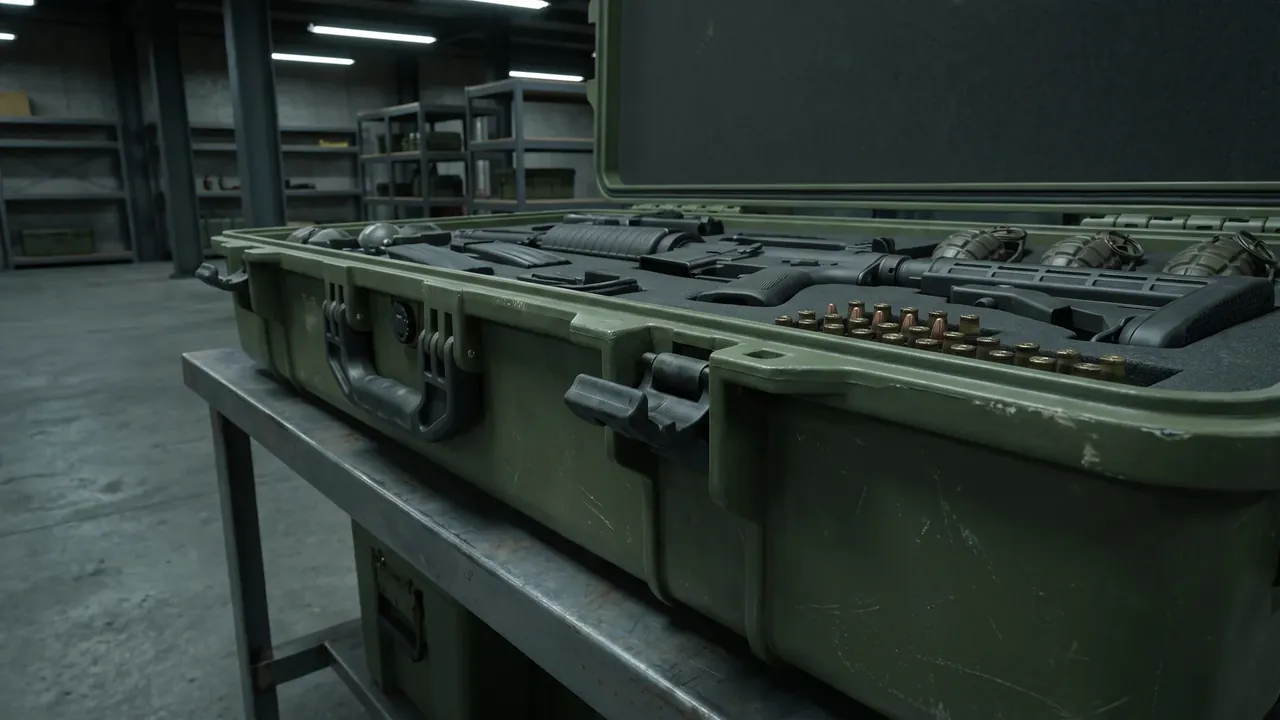
The third family of internal modules addresses loads that are irregular in shape but demand clear boundaries. Compartment dividers use slotted panels and hook-and-loop fastening to build adjustable cells inside the case, sized up or down as the equipment volume changes — the right home for cables, power packs, lamps, gloves, and paperwork that resist cutouts. The system's quality lives in stiffness and stability: panels too soft collapse when the case stands on edge, and the loop base strip must run the full length rather than stick on in segments, or positions drift after every rebuild.
MOLLE-compatible attachment fields bring the common language of tactical gear inside the case. Webbing arrays on the lid interior accept MOLLE-spec pouches, panels, and tool holders, lifting frequently used items off the case floor and onto the wall; open the lid and the pouches present face-up in the line of sight, no digging. The quick-access layout goes one step further: positions arranged by mission sequence — used first, reached first, with the first-aid module fixed in the first-glare zone and anchored by a red pull tab or similar visual cue. Stacked together, the three modules turn a container into a procedure. For a fuller treatment, see tactical gear box internal layout and toolbox compartment design.
Zoning discipline keeps the three modules from fighting each other. Dividers want the lower volume where odd shapes settle; MOLLE fields want the lid where sightlines live; cutouts want the middle layer where fragile items ride. When a load plan respects those natural layers, the case opens to an orderly vertical read — wall pouches first, loose-cell consumables second, cushioned instruments last — instead of a jumble where every module competes for the same depth. Sketch the vertical stack before ordering inserts; it is the cheapest drawing in the whole project and the one that decides whether the case feels designed or merely filled.
Carry Options: Shoulder, Wheels, and Vehicle Mounting
Across its service life, a tactical hard case spends far more time being carried by people than lying in a storeroom. Small volumes solve with side handles and a shoulder strap; mid and large sizes need multi-mode carry built into the structure: a two-stage telescoping handle with large-diameter wheels for flat-ground towing, beefy side handles for two-person lifts and vehicle handoffs, and rear webbing anchors for back carrying or fixation to a vehicle rack. Handle balance points must be proven under load — a fully packed case that twists when lifted one-handed is a failed carry design.
Vehicle integration is about restraint and cushioning. Tie-down points or channel interfaces around the case accept straps that lock it to the deck; anti-slip texture and locating bosses on stacking faces keep adjacent cases from hammering each other off-road. For units that change vehicles and aircraft often, consistency of pallet footprint and stacking interface outweighs single-case performance — a fleet of cases that stacks, locks, and lifts as a system is what actually raises logistics efficiency. Shoulder, tow, and vehicle modes switching on one shell is structural capital that separates a tactical hard case from an ordinary protective case.
One more underrated detail in carry design: center of gravity. During insert design, heavy items belong near the handles and towing axis, light and bulky items toward the far end, so the case does not sag backward while towed and two carriers share the load evenly. Wheel placement follows the same logic — axles too far center make the case weave continuously; too far out and the wheels clip doorframes and rack edges. These small tradeoffs end up baked into the mold and the insert drawing, which is why carry requirements must enter at the development stage, not after a sample exists.
Latches and Locks: Balancing Access Speed with Security
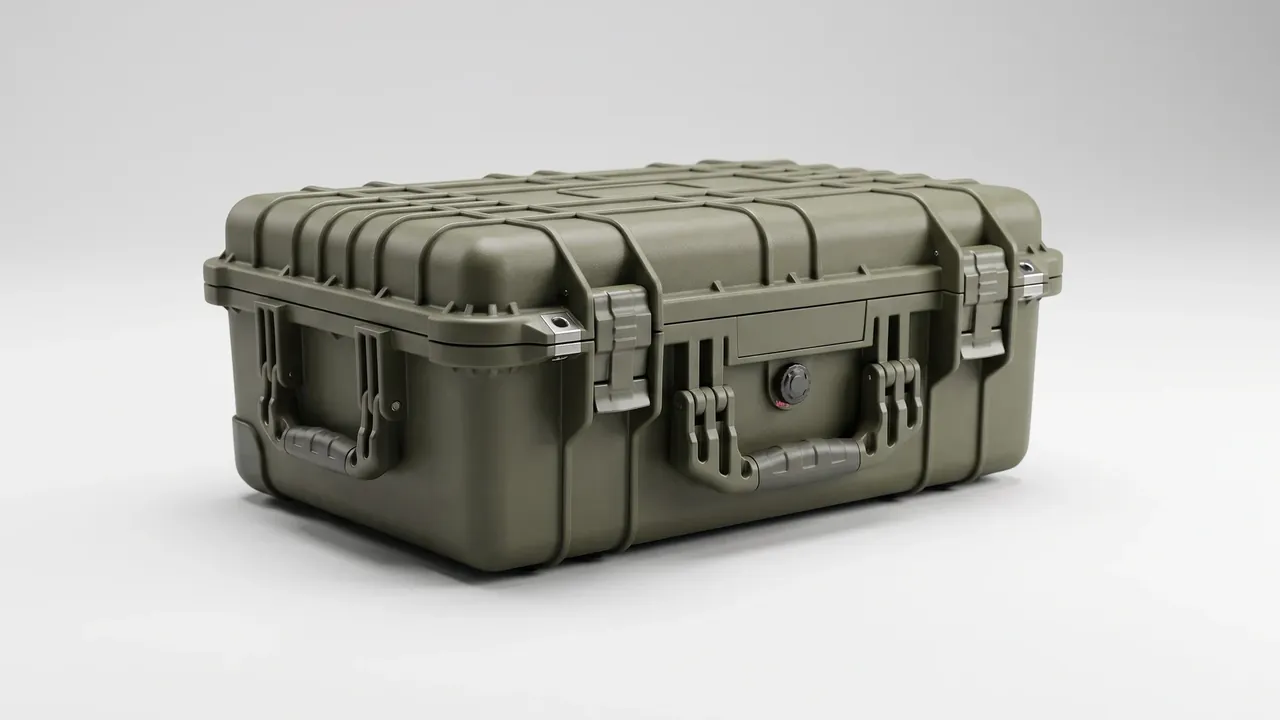
The latch is the highest-frequency moving part on the case and the first to fail. Tactical hard cases generally use double-throw compression latches: press to release, press to close, operable with gloves, with a clearly felt compression stroke at the end of travel — that feel is the signal that the gasket is fully seated. Latch hinge pins should be stainless steel or engineering polymer; cheap iron pins rust solid within one coastal season. On hinges, stainless pins plus an over-travel stop prevent lid-back fatigue of the rear panel.
On the locking side, the shell should reserve hasps and lock rods compatible with mechanical combination locks and padlocks; for cases that must pass screening or cross-border transfers, a housing that accepts an approved travel lock reduces the chance of pry damage. Tamper evidence runs on a separate track: one-time plastic seals, lead seals, or numbered tags through a sealing hole leave unrecoverable marks whenever anyone opens the case, so both parties of a handover can confirm internal state. Fast access and security seem to conflict, but the engineering answer is zoning — the frequently used cell stays unlocked for speed, the high-value cell locks independently, and a seal over the whole case completes the integrity chain.
Marking and Identification: Numbering, Color Bands, and RFID
Where many cases coexist, grabbing the wrong case costs more than losing one. A mature identification system runs on three layers. The first is the permanent number: a molded label field carries laser-etched or heat-transferred asset numbers and batch codes that last the case's life. The second is the task layer: colored tape, hook-and-loop letter blocks, or a transparent card window mark owning unit and content category, supported by glow or retro-reflective strips for night readability. The third is electronic tracking: a barcode or RFID tag seated in the label window, scanned by a handheld terminal for issue, return, and inspection records.
RFID placement is a design decision: the tag must be readable without opening the case yet survive knocks, which usually means a buffered pocket at the lid edge. For manufacturers, marking is the final production step and the retrieval index of after-sales service — cases with clean numbers and proper label windows return for repair and consumables far more efficiently. Outdoor channel buyers who care about appearance retention in harsh sun should write UV resistance of colorants and abrasion resistance of printing into the purchase specification instead of assuming "the color matches."
The hidden benefit of an identification system is that it converts cases from random assets into managed establishment units. When every case has a fixed number, defined contents, and a responsible hand, training and handover acquire a handle: new personnel learn the layout by number, pre-mission checks run case by case against the list, and after-action review traces equipment state by number. When a manufacturer offers standardized label-field dimensions, band specifications, and window templates at design stage, the user's system-building cost drops sharply; conversely, buyers who write marking requirements into the tender do far better than those who stick handwritten labels after delivery.
From the Manufacturer's Side: Custom Development to Batch Delivery
A tactical hard case travels a fixed pipeline inside a manufacturer. At requirement confirmation, the buyer supplies the equipment list with dimensions, weights, and quantities, the carry method, the use environment, and the budget band; the manufacturer runs a 3D rehearsal of case volume and insert layout. Development covers shell structure, cutout scheme, and lock selection, ending in a sample. Verification puts the sample through drop, vibration, immersion, and stacking tests with insert adjustments from real measurements. Production freezes the mold and process parameters, keeps batch samples, and runs sampling inspection. How smoothly this runs depends mostly on the effort both sides put into the list at the front — every list revision can drag the cutouts and the mold with it.
As the manufacturer, JUNZHJIA is produced by Kexin New Materials (Guangdong) Co., Ltd., with rotomolded shells, EVA cutting, sealing, and latch work closed on in-house lines, which is what makes fast redesigns and small-batch customization possible. Military and police procurement tends to arrive in batches with yearly replenishment; whether the manufacturer can reproduce the same cutouts and colors from the original drawings two years later decides the long-term relationship more than the first quotation does. For the underlying process, continue with rotomolded protective cases.
Buyers can gauge a manufacturer along three plain observation paths. Watch the sample: cutout fit, latch feel, and marking workmanship on the sample approximate the ceiling of production quality; a crude sample line never mass-produces better. Watch the records: factories willing to hand over test reports, batch retention samples, and drawing archives usually hold consistency on replenishment orders too. Watch the response: whether re-quoting a revised cutout drawing is transparent in price and lead time says more than any capacity figure in a brochure. Put those three into the supplier checklist and most downstream risk is filtered out early.
One contract clause protects both sides on long programs: drawing custody. Specify that the frozen cutout layout, mold files, and marking artwork are archived by the manufacturer and re-quoted only from those records, so a replenishment order in year three reproduces year-one geometry instead of a well-meaning memory of it. Units that negotiated this clause report almost frictionless top-ups; those that did not rediscover their own layout by reverse-engineering an aging sample. It costs nothing at signature and everything later.
Scenario Selection: From Individual Mission Cases to Modular Unit Loading
Selection advice follows three questions: who carries it, what goes inside, and how it travels. For individual infiltration or short missions, prefer a small back-carried case with a quick-access face layer, limited to medical, communications, and observation items. Squad-level tasks commonly run a mid-size towed case with divider-based inserts mixing spares and batteries. Unit and base-level support moves into modular loading logic — multiple same-spec cases sorted by content (communications case, medical case, power spares case), distinguished by numbering and color bands, stacked for shipment as one block, with any missing case locatable from its number alone.
Outdoor channel customers can use the same logic at lower intensity: rescue services, event medical support, and field survey teams face an isomorphic problem — gear that fears shock and moisture, retrieval that follows sequence, cases that must ride a roof rack. Buy by listing first and sizing second, never the reverse; size volume to the peak of the list plus fifteen percent headroom for later additions. For a systematic framework, tactical storage box selection guide walks parameter by parameter, and hard cases covers the general evaluation of rigid protective cases.
Common Mistakes and Routine Maintenance
Listing the frequent mistakes beats reciting specifications. First: trusting the IP67 number without asking the loading state of the test — an empty case passing immersion says nothing about a full one. Second: overpacking inserts until cushioning layers are squeezed out of travel, so a drop lands as if there were no foam at all. Third: greasing latches — grease traps grit and accelerates wear; the correct care is a dry cloth plus a trace of graphite. Fourth: taping the pressure relief valve shut against rain, which lets negative pressure overload and deform the gasket. Fifth: replacing engraved numbers with handwritten stickers, whose ink vanishes within a year and breaks the link between asset ledger and physical case.
Routine maintenance can stay light. After each return to storage, open the lid and air the case for half an hour, inspect the gasket for compression marks or cuts, and work every latch to confirm rebound. Each quarter, wash the shell with a neutral detergent and check hinge pins and handle fasteners. Long-term storage belongs in a cool place, lid ajar, so the gasket is not permanently compressed. Foam aging announces itself as surface powdering and slower rebound — replace the face layer when it appears; the case itself does not need retiring. The shell is a durable good; inserts and seals are consumables. Managing the two separately is what lets one tactical hard case outlast every forecast.
A short standing kit makes the routine self-sustaining: spare gasket stock in the correct section, a set of plucked foam blocks bagged and labeled, two spare latches of the fitted type, and the cleaning supplies in a marked pouch that lives inside the storeroom, not inside a working case. With those four items on the shelf, every maintenance action above becomes a ten-minute task instead of a procurement request — and tasks that take ten minutes actually get done.
Frequently Asked Questions
Q: A tactical hard case is labeled IP67 — which often-overlooked details actually cause water ingress in service? A: The usual failure points are not the shell but the details around it. First is gasket condition: a seal locally flattened by gear sitting on it, or nicked by a sharp edge during cleaning, will leak right there during immersion, so a visual walk around the gasket belongs in every return-to-storage check. Second is latch preload: a latch not fully closed, or worn past its compression stroke, removes the clamping force at that spot and opens a hairline gap in the sealing face. Third is the pressure relief valve not fully reseated — a half-open valve body admits water in deep immersion. Fourth is unplanned openings: added cable pass-throughs or label-window screws missing their seals become invisible channels. A quarterly shower test catches nearly all of this: lay a paper towel flat inside, close the lid, run a shower head over the case for two minutes, then read the paper. Two minutes confirms the entire sealing chain, and any damp spot pinpoints the exact component to service before the next wet season. Recording the result per case turns the check from a habit into an auditable record.
Q: How does MIL-STD-810H differ from an ordinary drop test, and what data should buyers demand from suppliers? A: MIL-STD-810H is a compendium of environmental test methods covering dozens of procedures — vibration, shock, temperature and humidity, salt fog, dust, rain — while an ordinary drop test samples just one facet. The real difference is systemic realism: 810H sequences tests along an expected transport and use profile, so the case must pass drop judging after thermal cycling and vibration, not score on isolated events. Buyers should request four classes of data: the specific method numbers and levels used (drop height, vibration spectrum, cycle counts); the loading state and how the case was ballasted; the pass criteria, including whether sealing was retested afterward; and the report number from the internal or third-party laboratory. Assembled, these four turn the phrase "military-standard compliant" into a comparable field capability, and they let two vendors be scored on identical evidence instead of adjectives. Any supplier unwilling to provide them should be filtered out before sample stage, because missing evidence at the start almost always resurfaces as dispute at acceptance, when the schedule no longer has room to recover. Vendors confident in their data usually volunteer it; hesitation itself is a data point worth weighing.
Q: How should one choose between EVA custom cutouts and pick-and-pluck foam, and can both be combined? A: The deciding factors are how stable your equipment list is and what protection level you need. Where the list is fixed, the devices are precise, and per-item value is high, choose full-sheet CNC-cut EVA: contours fit tightly, cushioning is continuous, and visual management stays clean — at the cost that re-cutting means a new order. Where the list changes often, adjustments must happen on site, and protection needs are moderate, choose pick-and-pluck: grid foam rebuilds by hand and suits channel dealers and trial fits. Combining them is not only possible but recommended: a full-sheet high-density base takes the primary impact and load, a pick-and-pluck face layer provides flexible cells, and a zippered lid-plate foam holds documents and small accessories. Keep grid direction aligned with item center of gravity, and return plucked blocks to empty cavities they are not using so the face layer cannot slump when the case stands on edge. Tell the manufacturer your peak list and planned additions before ordering — that single habit prevents most rework, because foam suppliers can pre-stage a spare face layer against the layout you expect to grow into.
Q: How should MOLLE-compatible attachment fields be arranged inside the case, and which structural details matter? A: The first principle is sightline reach in mission order. The lid interior is the main array: pouches for the highest-frequency items belong where the open lid puts them face-up in view; narrow webbing bands on the front and rear walls carry flat items as secondary positions. Three structural checks decide quality. Stitching must be cross-locked, so a single-point load cannot unravel a seam. The base webbing should be fixed full-length to a load-bearing backer plate rather than glued to foam or a thin wall, or the whole field will peel off once heavy pouches hang from it. Total pouch weight must match what the hinges and latches were designed to carry — an overloaded lid feels heavy to open and wears hinge pins prematurely. Also account for pouch protrusion when the lid closes: insufficient clearance crushes pouches at every latching and gradually deforms the webbing. Hand the supplier your standard pouch models at design stage so space and load can be verified before the mold is cut. Doing so also lets the factory align webbing row heights with your actual pouch sizes, which keeps every flap openable without unclipping its neighbor.
Q: When evaluating multi-mode carry structure on a tactical hard case, which details best reveal build quality? A: Evaluate each mode separately. For shoulder carry, look at strap anchors: they need metal or reinforced polymer inserts, since webbing sewn straight into a thin wall always pulls out in time; the strap itself should have a cushioned pad and quick-release buckles. For towing, examine handle and wheels: the telescoping handle should lock crisply at each stage with minimal wobble under full load, and larger wheels roll over curbs and gravel more willingly, while sealed bearings decide wet-season lifespan. For vehicle mounting, check tie-down interfaces — molded channels or metal anchors around the shell — plus anti-slip texture and locating bosses on stacking faces. Three details betray overall workmanship fastest: the balance angle of a loaded handle, the evenness of clearance along the handle rails, and the confirmation feel at the end of the latch stroke. At inspection, load the case with equivalent weight and actually shoulder it, tow it, and lift it — structural reserve announces itself immediately, and so does the absence of it in a creaking rail or a strap anchor that shifts under load. Cases that pass this hands-on pass rarely disappoint in service.
Q: Do quick-release latches and security locks conflict, and how can access speed and safety coexist? A: They do not conflict, provided you zone the case instead of applying one rule everywhere. The common engineering answer is two internal tiers: the frequently used cell stays under latch protection alone, so mission-time access stays fast, while the high-value or sensitive cell uses an independent lock — a locking box inside the insert, or a lockable divider layer that requires authorization to open. Over the whole case, add a tamper-evident layer: a one-time seal or numbered tag through the sealing hole, verified by number at every handover, so any opening en route leaves permanent evidence and the trust question "was it opened en route" answers itself. When choosing locks, look for rain caps over the keyways and prefer stainless cores in salt-fog environments; seals must match the seal-hole bore so they cannot be withdrawn whole. Layered this way, speed, security, and traceability each keep their own lane without interfering with the others. Units that also rotate cases through armories should record seal numbers in the same ledger as the asset numbers, so a broken seal surfaces at the next audit even if nobody noticed it at handover.
Q: How should an identification and tracking system be built when cases operate in groups? A: Build two layers: permanent numbering plus dynamic labels. Permanent numbering is applied at manufacture — laser-etched or heat-transferred into the molded label field, mapped one-to-one to the asset ledger, never changed. Dynamic labels belong to the task layer: color bands, letter blocks, or window cards mark the current owning unit, content category, and seal state, replaced in the field whenever missions change. Larger units add an electronic layer above these: an RFID tag or barcode per case, scanned by handheld terminals to log issue, return, and inspection, with the ledger updating automatically. Three details decide whether the system works: define the numbering grammar before the first case ships, because mid-life rule changes corrupt every record; give label windows a waterproof transparent face so paper cards survive mud and rain on the ground; and position RFID pockets for both reading angle and drop protection, preferably molded in at tooling stage rather than drilled and stuck afterward. Once the system runs, counting a full unit's equipment drops to minutes, and any case that misses an inspection cycle flags itself in the ledger instead of surfacing as a shortage on mission day.
Q: What does the custom development process for a tactical hard case look like, and what should buyers prepare? A: The pipeline runs five stages. At requirement confirmation, the buyer provides the equipment list with names, dimensions, weights, and quantities, a description of the use environment, the carry method, and the budget band. In scheme design, the manufacturer outputs a 3D layout, shell specification, and cutout proposal for mutual confirmation. Sample verification follows: the sample is trial-loaded with real equipment while drop, immersion, and stacking checks run internally, and the buyer returns fine-tuning notes. Production freezes the mold, confirms the first article, and releases the batch; delivery closes with inspection records and spares advice. The better the preparation, the shorter the cycle — an ideal input is a measured equipment list plus a few scene photographs, not a single volume figure. Flag any planned additions or device changes at requirement stage so the insert reserves adjustment space. For export and military-trade projects, schedule compliance review and packaging certification early, always per local regulations and export control requirements, since certification lead times — not production — are usually the pacing item. In short, buyers who arrive with measured data leave with shorter timelines and fewer change orders.
Related Reading: rotomolded transport case specification, deployable hard case guide, equipment gear case guide