

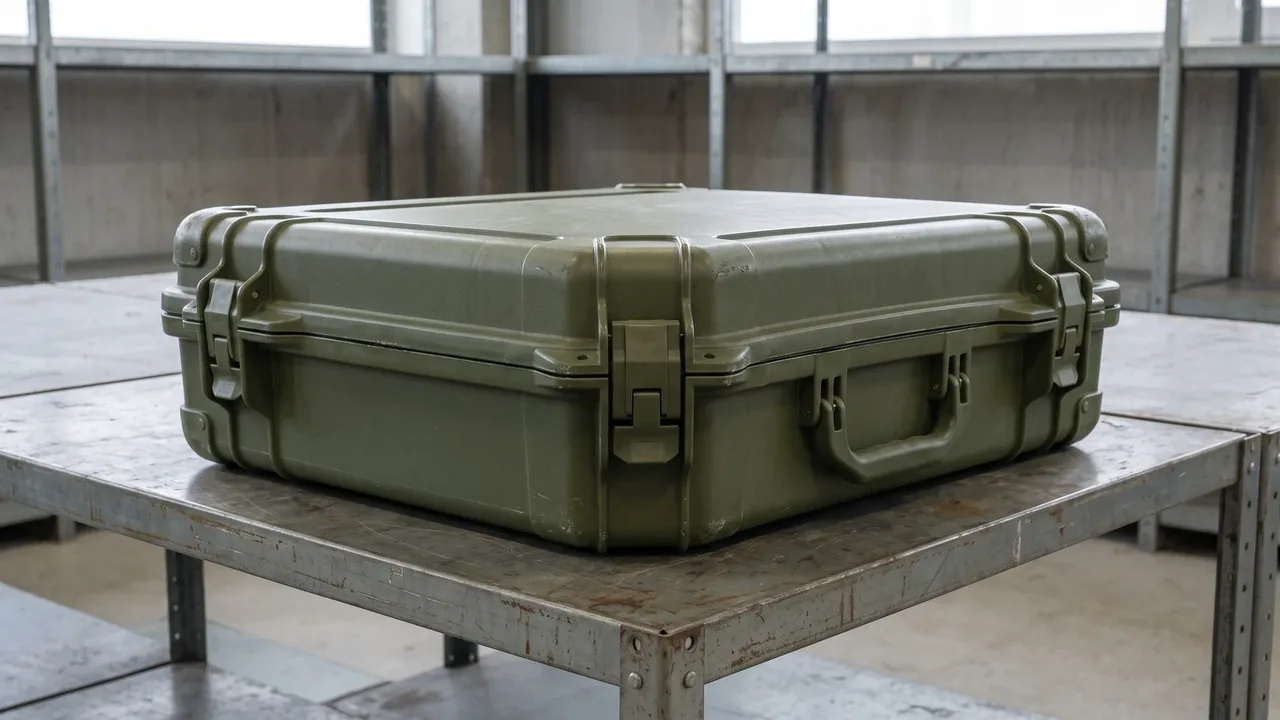
Wherever heavy transport cases are specified, the argument over process routes never really ends. The rotomolded case earns its position in the large-format protective container market through seamless one-piece shells, generous wall-thickness latitude, and modest tooling investment; meanwhile, a rotomolded transport case serving industrial logistics and defense-trade support programs — smaller production runs, high per-unit value, long service life — wins on life-cycle cost even more decisively than on unit price. This article takes the manufacturer's seat and puts rotational molding side by side with injection molding, blow molding, and sheet-metal fabrication. We work through wall-thickness and rib design, tooling cost and batch economics, repairability and service life, performance under ISTA and MIL-STD transit testing, and finally the selection logic for heavy-duty scenarios such as equipment sets, precision instruments, and dedicated materiel containers — so that buyers can lock the right route before any mold is cut.
The Rotomolded Case: One-Piece Logic That Starts From Powder
Before deciding whether a rotomolded case fits a project, buyers should understand what the process actually does. Rotational molding, or rotomolding, charges plastic powder — typically polyethylene — into an open mold, which then rotates about two perpendicular axes inside an oven. Gravity and the tumbling motion spread the melting powder evenly across the mold cavity wall; after cooling and demolding, the result is a hollow, seamless shell with an integral flange. Because the polymer never experiences the high pressures of injection molding, residual stress stays low, which is exactly why large rotomolded parts resist warping and cracking far better than their injection-molded equivalents.
For a case body, this logic delivers three practical benefits. First, the base and the lid can each be molded as single pieces, producing walls, floor, and flange in one shot — no joints, and therefore none of the classic failure points of jointed construction: seam leakage and loosening fasteners. Second, wall thickness is governed by powder charge and heating profile, so material can be concentrated at stress risers such as bottom corners and lifting points without adding a single extra part. Third, rotational molding imposes almost no ceiling on size; a two-meter-long case is routine work on a rotomolding line, while it would demand unrealistic clamp tonnage from any injection press. Those three points frame every trade-off discussed in the rest of this article.
Where the Rotomolded Transport Case Sits in the Heavy Logistics Chain
A rotomolded transport case is not simply an enlarged tote. Its job in the logistics chain is unitized protection: consolidating loose equipment, complete instrument sets, or bulk supplies into a single transport unit that can be forked, lifted, stacked, and rained on — moving from the factory gate to a reserve warehouse or a job-site store without ever being repacked in between. That positioning forces the case to be three things at once: a structural member, a sealing system, and the carrier of its own cushioning.
Seen from container loading, a rotomolded transport case is usually dimensioned to the 1200 × 1000 mm pallet module or to integer divisions of a shipping container's internal width, with stacking flanges that nest on the lid and fork pockets plus lifting interfaces at the base. The shell weighs more than a sheet-metal or blow-molded equivalent, but the payoff is a maintenance-free weathering body: UV-stabilized polyethylene merely chalks slowly under sun and rain, where steel rusts through at scratches and aluminum dents irreversibly on impact. For long ocean legs, open-air storage, and airfield transfers where conditions swing violently, the chemical inertness of the rotomolded shell is itself a protective capability — and one reason the rotomolded transport case keeps appearing at the top of heavy-logistics shopping lists.
There is an asset-management angle as well. Case surfaces accept cured identification — silkscreened numbers, molded-in labels, heat-transferred barcodes, or RF tags — that survives sun and abrasion far better than painted legends on steel. Because the shell material is uniform and takes surface treatment reliably, each case becomes the physical carrier of its own asset record: unit ownership, contents manifest, and inspection history bound to a single durable number. Fleets standardized on one shell platform also simplify spares planning, since gaskets, valves, and latches are shared across the whole inventory rather than duplicated per case style. Buyers who weigh this administrative dividend at quotation stage usually find the effective cost gap in rotomolding's favor wider than the invoice alone suggests.
Versus Injection Molding: Size Is the Hardest Divide
Injection molding and rotational molding are both plastics processes, but the decisive divide sits at the crossing of size and volume. Injection forces melt into a closed cavity under high pressure; cycle times run in tens of seconds, part precision is high, surfaces are glossy, and unit cost at volume is extremely low. But clamp tonnage and platen size cap the projected area of the part. Beyond a certain envelope, an injection-molded case must be split into pieces and joined by fasteners or welding — seams appear, and the cost curve climbs steeply.
Buyers should compare the two routes along three axes. Size: below roughly 800 mm, injection often wins; above one meter, injection is essentially out of the running and one-piece rotomolding faces little argument. Volume: injection tooling can run from tens of thousands of dollars upward, affordable only across production runs in the tens of thousands; rotomolding tools are typically cast aluminum and cost a small fraction of that, so a run of a few hundred cases can justify a mold. Performance: injection parts carry high molded-in stress and are more prone to brittle cracking in cold-condition drops, whereas the low-stress rotomolded shell in a ductile polyethylene grade holds up more predictably in cold-climate drop testing. For a deeper itemized comparison, see the site articles on rotomolding versus injection molding for cases and injection-molded cases.
Versus Blow Molding, Sheet Metal, and Welded Plastic Construction
Heavy transport cases are also weighed against blow-molded boxes, sheet-metal cases, and welded plastic-panel construction — three routes with distinct failure paths. Blow molding extrudes a parison and inflates it in a split mold, well suited to thin-walled double-skin structures with good torsional stiffness; but wall-thickness control is coarse, strength at openings and flanges depends on local design patches, and margins under heavy stacking and lifting loads generally fall short of rotomolding. Sheet-metal cases offer high stiffness and fire performance and remain the traditional mainstay for ordnance-related metal packaging; yet once the paint layer is breached, corrosion spreads from the scratch, panel joints rely on spot welds and fasteners that loosen under vibration, and weight runs markedly higher.
Welded plastic-panel cases — thick sheet cut, folded, and hot-air welded — reach very large sizes, but the weld seam is the weak link: seam quality depends heavily on operator skill, long-weld consistency in both airtightness and strength is hard to hold, and seam cracking is a recurring warranty item after years of service. A rotomolded case body has no welds and needs no paint for rust protection; its failure modes concentrate in abrasion and localized impact deformation, most of which can be repaired in the field. Set the four routes side by side and the selection logic becomes plain: choose sheet metal for stiffness and fire performance, blow molding for light weight at thin walls, and rotational molding wherever large size, seamless construction, weather resistance, and repairability dominate. The historical evolution of box materials is covered further in the material evolution of military storage boxes.
Wall Thickness: The Greatest Degree of Freedom Rotomolding Offers
Wall-thickness latitude is rotomolding's most underrated advantage. With one mold, adjusting powder charge and oven time yields shells from four to more than twelve millimeters; when different regions need different gauges, targeted heating or embedded thermal-mass details can thicken selected zones. Thickness stops being a catalog pick and becomes a calculated value: the floor, which takes full static load and fork-impact, runs thickest; side walls, whose job is the sealing flange and stacking guidance, slim down to save weight; the lid, which seats the gasket groove and latch plates, gets local reinforcement around the inserts.
Thickness decisions must also be coupled to low-temperature toughness. Polyethylene impact performance shifts as temperature falls, so cases bound for cold regions should use a low-temperature-rated rotomolding-grade polyethylene with added thickness margin, preventing brittle edge chipping during winter handling. Humidity and salt fog challenge the sealing hardware more than the shell itself. Manufacturers should ask for the transport profile at quotation stage — road, ocean, air, or multimodal; stacking tiers and static load; minimum ambient temperature — because these inputs set the thickness target and the material grade. Every added millimeter raises cost and weight, so good engineering means not blanket thickening but placing material where load actually lives. That is precisely the engineering time most worth spending in rotomolding, and no other case process offers it so cheaply.
Two long-term effects belong in the same calculation. Creep: polyethylene under permanent compressive load deforms slowly, so a floor designed exactly at its short-term limit will sag after seasons of stacked storage; leaving deliberate margin under the load map, or adding a separate load-bearing tray, protects the shell's geometry for life. Aging: UV exposure and thermal cycling toughen the surface differently over the years, and a thickness chosen with aging in mind keeps the safety factor above one even in year eight. Manufacturers who publish their thickness rationale — load assumptions, grade selection, margin policy — make the conversation with buyers dramatically shorter and the resulting cases dramatically harder to fault.
Ribs, Flanges, and Metal Inserts: Making a Big Shell Carry Stacking Loads
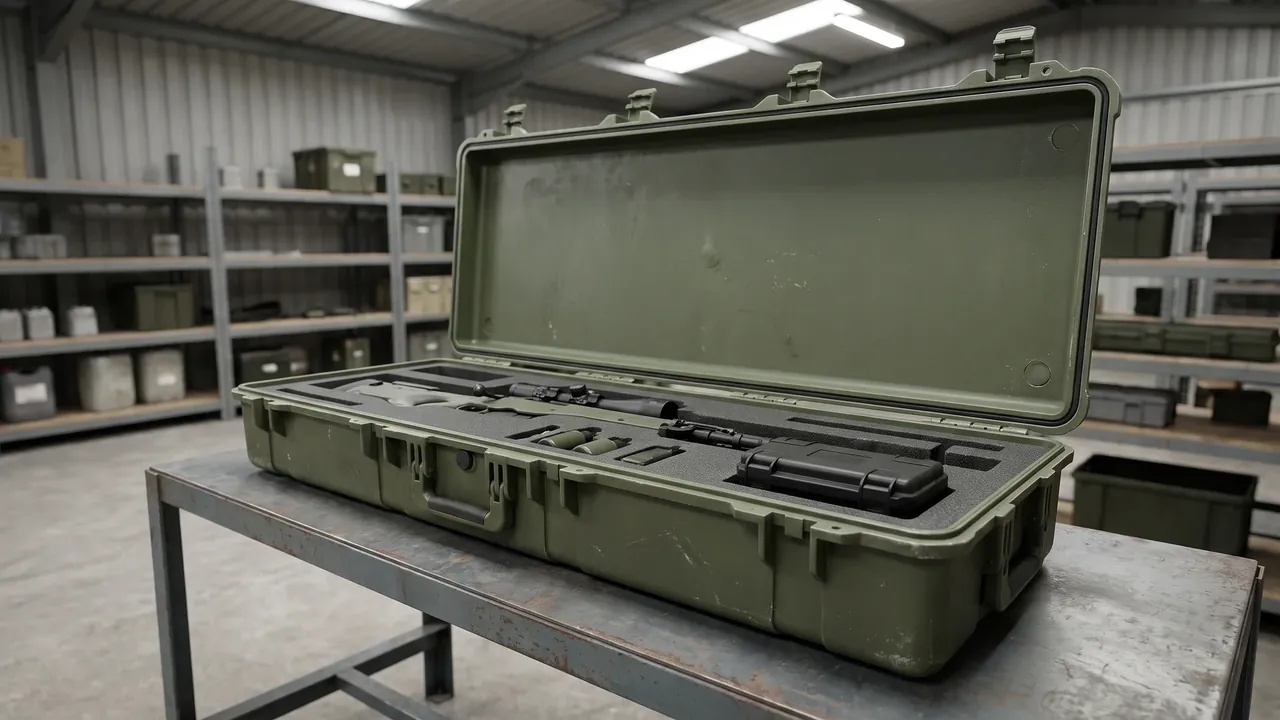
The thing a large rotomolded case body fears is not impact but buckling: broad flat panels under static stacking pressure. Because rotomolding lacks high-pressure packing, wide flat side walls can show slight sink marks after cooling shrinkage, and load capacity drops with them — so stiffening design must enter at the mold stage. Three families of solutions dominate. One is profiling the outer surface into corrugations, checker plate, or diamond reliefs that double as anti-slip texture and stiffness reinforcement. Another is running solid ribs across the interior wall; rotomolding naturally accumulates material at these features, effectively adding beams to the shell. The third is an integral stiffening ring at the flange, so that lid and base close into a closed torsional frame.
The flange is the critical region of any rotomolded case. Flange flatness decides how evenly the gasket compresses and therefore the achieved water-tightness; latch seats, hinge plates, and lifting lugs on the flange carry embedded or post-machined metal inserts, converting polyethylene's local creep sensitivity into dependable steel load paths. Insert design must manage isolation and encapsulation — the metal must fuse firmly with the powder during molding, while stress concentration around it must not tear the shell. Stacking strength is not finished once ribs are drawn: static-load testing and creep assessment at full load and maximum stacking tiers confirm that the body neither sags nor flares at the flange after long storage. This combination — stiffened shell, framed flange, insert-carried point loads — is the structural basis on which a rotomolded transport case earns heavy-duty ratings.
Tooling Cost and Batch Economics: When Rotomolding Pays
Tooling and volume are the most concrete arithmetic in route selection. Rotomolding tools are cast aluminum or fabricated sheet aluminum — simple structures with no high-pressure clamping mechanism — and a mid-to-large case tool typically costs between one-tenth and one-fifth of a comparable injection steel tool, which must survive hundreds of tons of clamp force and therefore demands expensive steel, precision machining, and heat treatment. Converted to per-unit cost, rotomolding amortizes its tooling across a run of a few hundred to a few thousand units, while injection generally needs tens of thousands.
Rotomolding's single-part cycle is long — an oven run commonly takes tens of minutes — so equal capacity means more molds and arms, and labor and energy per unit run above injection. That is why injection wins high-volume, small-part economics. Plot both cost curves and the crossover falls in the small-to-mid-volume, mid-to-large-size quadrant — exactly where heavy transport cases and the rotomolded transport case live: annual demand of a few hundred to a few thousand units, sizes around a meter or larger. Hidden costs tilt the scales further: reworking a rotomold is cheap — adding holes, bosses, or flange edits usually means local rework of a cast-aluminum tool — while any structural change to an injection tool may force recutting it entirely. For programs still iterating with requirements not yet frozen, that modification flexibility is real money. A fuller itemization appears in rotomold versus injection case selection.
A worked example makes the arithmetic concrete. Suppose a program needs eight hundred cases a year for six years. The rotomolding route amortizes a modest cast-aluminum tool across roughly five thousand units and holds a stable unit price; the injection route quotes a lower per-unit number only if the program scales far beyond that volume, otherwise the steel tool dominates the average. Add the modification scenario — a connector panel moves, a latch row shifts — and the rotomold absorbs the change as local rework while the injection quote adds weeks and a recut. Neither route is universally cheaper; the honest answer is that the crossover depends on real forecasts, which is why the request-for-quotation should always include the demand curve, not just a target unit price.
Repairability and Life Cycle: The Second Life of a Rotomolded Shell
The true cost of a heavy transport case never sits only in the purchase price; it sits in how the case ages, is repaired, and retires across a decade of service. Rotomolded bodies enjoy clear advantages here. Local shell damage is repaired in the field with matching polyethylene welding rod and a hot-air gun, and the case returns to sealed transport duty; shallow dents that leave structure and sealing surfaces intact may not need any action; hinges, latches, gaskets, and pressure valves are all standard-item replacements that a user's own maintenance staff can perform from written instructions — no factory return required. Compare that with sheet-metal cases, whose corrosion repair means stripping, repainting, and extended downtime; welded plastic cases, whose seam rework demands strict environmental control; and injection-molded jointed cases, where one damaged fastener boss often scraps a whole panel.
The back half of the life cycle matters just as much. The material itself is recyclable, and retired shells can be granulated for non-structural products; refit work — new gasket sets, re-machined flanges, weld-and-polish repairs — sends cases into a second service round or a demoted warehouse life. For defense-trade support programs, industrial-logistics operators, and equipment lessers who amortize assets over a decade, a repairable, refurbishable, recyclable life curve means higher residual value and lower annual cost of ownership. Buyers should request three documents before signing: a consumables list with prices, field-repair work instructions, and refurbishment-service quotation terms. Put the "second life" into the contract rather than leaving it to verbal assurance.
Sealing, Pressure-Relief Valves, and Achieving IP67-Class Protection
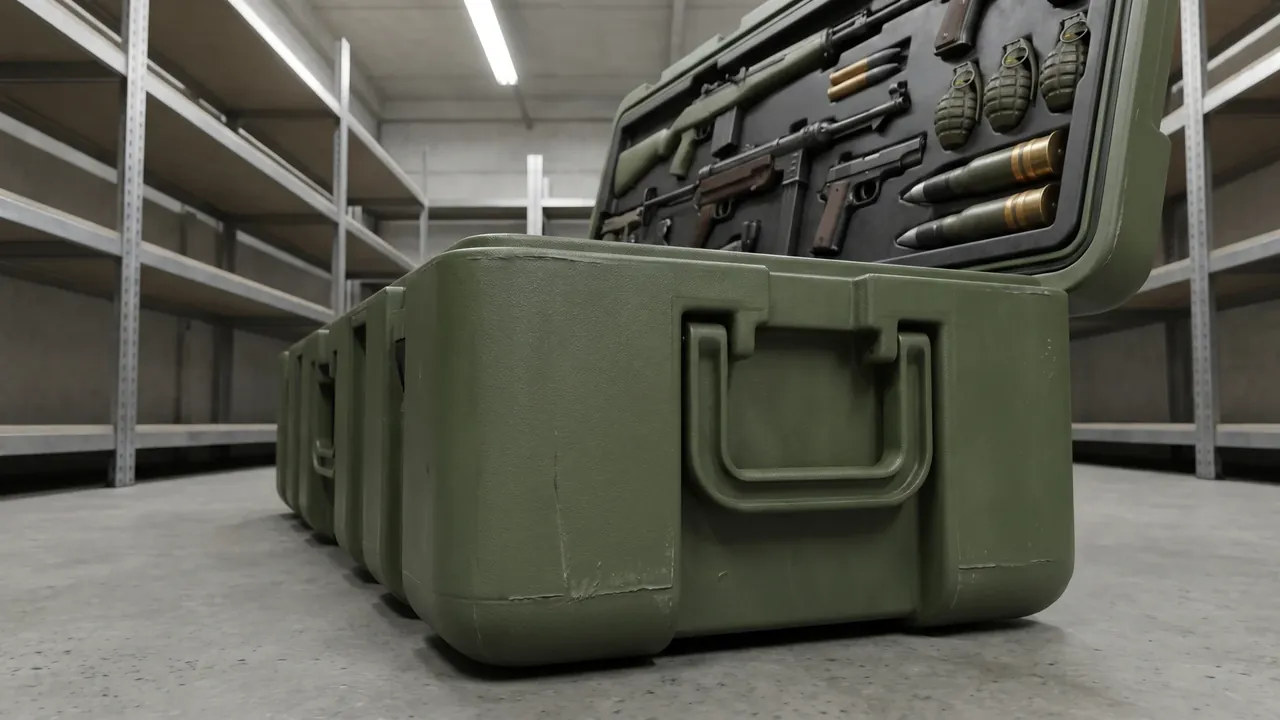
Ingress protection is a hard specification, and on a rotomolded transport case, IP67-class performance follows a proven recipe. Start with the sealing medium: a foamed neoprene or EPDM gasket runs the full flange perimeter and forms a continuous seal face under compression. The keys are flange flatness and compression control — too little compression leaks, too much accelerates permanent set in the gasket — so a sound design targets a defined compression band and enforces it with stops. Next come latch points: latches distributed evenly along the long edges, because over-spaced latches let the mid-span flange gape microscopically under stacking pressure, creating invisible leak paths.
One rotomolding-specific problem demands a pressure-relief valve. A sealed case ferried from a highland airfield to a humid coastal depot, or simply cycled through day-night temperature swings, experiences internal pressure shifts: negative pressure sucks the gasket inward and makes a large lid genuinely hard to open, while repeated pressure cycling works the seal face and opens micro-gaps. The valve lets gas pass one way to equalize the cavity while blocking liquid water and dust. Drainage matters too — the floor should carry a plugged drain hole for post-rain-test emptying and cleaning. Verification should follow water-ingress test methods: with the case loaded, spray or immersion per the protection class, then open and inspect for bone-dry interiors; if the transport chain includes high-pressure washdown, design to a higher class. For rating definitions and test detail, the site's pages on IP67 protective cases, verifying IP67 certification, and IP65, IP66, and IP67 differences make useful companion reading.
Maintenance planning completes the sealing system. Gaskets age with compression set, ozone, and cleaning chemicals, so a fleet should carry them as scheduled spares rather than failures; a simple annual check — gasket imprint continuity around the flange, latch preload, valve free movement — catches most degradation before water does. When a gasket is replaced, the flange seat should be cleaned and inspected for flatness loss, since a replaced gasket on a distorted flange only resets the clock on the same leak. Fleets that log these small interventions per case serial number build a protective-performance history that also serves as evidence during customer audits and warranty discussions.
Liners and Cushioning: Half the Engineering Lies Inside the Shell
The shell handles external threats; real equipment safety is half decided by what is inside. Interior engineering in a rotomolded transport case typically works in three layers. The load-carrying layer is a base tray or rail that routes equipment weight into the shell's reinforced zones instead of letting cargo press directly on the flat floor. The cushioning layer uses EPE, EVA, or PU foam selected by sensitivity grade and drop-energy targets, with precision instruments receiving custom die-cut inserts that suspend each unit independently. The retention layer — straps, hold-down bars, and blocks — guarantees that cargo cannot travel long distances inside the case through transport vibration.
Compartmentalization is where liner engineering shows its craft: one transport case routinely carries a host unit, cables, spares, and documentation together, and without physical separation heavy items abrade light ones while moisture migrates between contents. The sound approach is fixed bays formed by dividers and dedicated pads — each bay independently cushioned, independently labeled, with issue and inventory taken bay by bay. Moisture-sensitive cargo adds desiccant holders and humidity indicator cards; ferrous contents may carry vapor-phase corrosion inhibitor strips. Liner-to-shell attachment should be demountable so liners swap quickly between missions — one fleet of shells plus several liner sets serves multiple product lines, which is the second key to amortizing a rotomolded transport case fleet. For liner material detail, see the site's comparisons of case foam materials and custom foam insert factors.
ISTA and MIL-STD-810H: How Rotomolded Shells Perform in Transit Testing
Transit testing is the final referee of case design. Civil and industrial logistics programs lean on the ISTA series, which combines vibration, drop, stacking, and climate conditioning according to a defined distribution profile; defense and defense-trade programs commonly invoke MIL-STD-810H plus program-specific environmental test schedules, layered with road-transport and field-handling combinations. Both kinds of testing judge a loaded case, never an empty shell — a point that must be written into the test plan, otherwise laboratory reports will not map onto real transport risk.
Rotomolded transport cases show a consistent pattern across this exam. In vibration items, the one-piece low-stress shell has no weld seams or fastener rows to accumulate fatigue, and sealing and structural integrity hold through long random-vibration runs. In drop items, ductile polyethylene with locally thickened corners absorbs significant impact energy, leaving surface scuffs rather than structural failure. Stacking and static-load items interrogate rib and flange design — failures concentrate in crude designs with overly wide flat panels. Climatic and rain items favor rotomolding outright: the shell neither absorbs water nor corrodes, and a sealing system built as described above passes routinely. Two chronic risks deserve attention: cold brittleness and UV aging. A poorly chosen grade may crack at the edges in cold-condition drops, and gaskets aged by years outdoors will drag the achieved protection class down — so test schedules should include cold drop plus post-aging retest. The site's deeper treatments of MIL-STD-810H case compliance, MIL-STD-810H explained, and GJB military-standard cases systematize this landscape.
Heavy-Load Scenario Selection: Equipment, Instruments, and Dedicated Materiel Containers
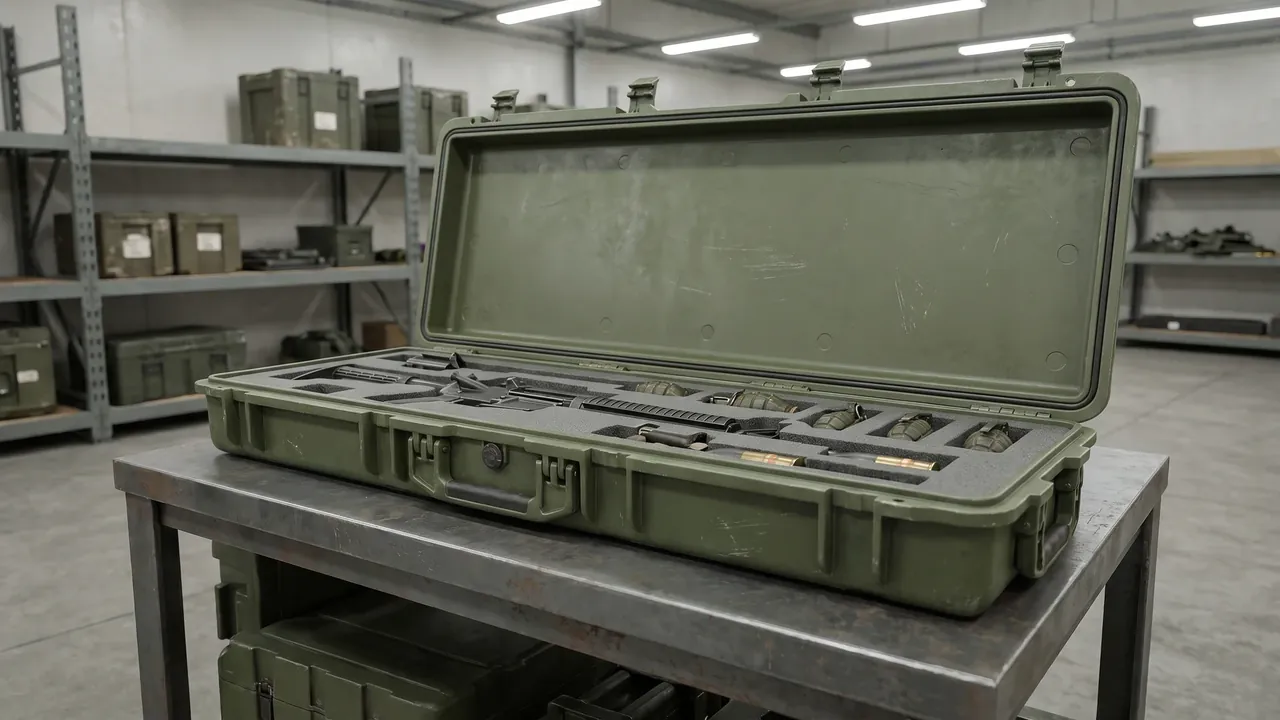
Applied to concrete scenarios, selection emphasis shifts with load type. Equipment loads — generator sets, test benches, communications-base components — are governed by stacking strength and lifting interfaces: the case carries embedded steel lifting eyes checked against a four-point sling condition, fork pockets sized to standard tines, and, because such cases are typically fully custom, flange and rib layouts are drawn around the load map. Instrument loads — optical, test, and medical equipment — are governed by cushioning and moisture control: liners are customized from equipment scan data, humidity indicators and desiccant bays are fitted, sealing reaches IP67 class with a rain-test report attached.
Dedicated materiel containers form the other demanding family: packaging for ammunition containers, fuel-system accessory boxes, and field-kitchen modules must comply with defense-trade and export-control frameworks — local regulations and export-control requirements govern, and this article discusses only packaging containers — yet the engineering points remain packaging matters: interior partitioning against cargo migration, locks and seals meeting chain-of-custody expectations, and weatherproof external marking with traceable coding. Orders in the ammunition-container category should add stacking static load and long-term preservation to the checklist, with the shell paired to a drying system holding a low-humidity cavity and metal furniture treated with vapor-phase inhibitors. Medical and food loads shift the material question to food-contact or medical-cleanliness grades. The selection logic in one sentence: draw the load map first, then the environment risk map, then let rotomolding's wall-thickness and rib freedom cover those two maps item by item — rather than forcing a catalog size onto the requirement.
A practical note on custom versus standard: many buyers overestimate the penalty for full customization. Because the tool is the cheap part of a rotomolded program, a case drawn precisely around the equipment often costs little more than a nearest-size standard shell plus the packing material wasted inside it. Conversely, where volumes are small and time is short, a standard platform shell with a custom liner module delivers most of the benefit at catalog lead times. The honest trade is tooling weeks against packing inefficiency, and it should be decided per program — not by policy. Manufacturers who keep a library of proven shell platforms with open interior interface points give buyers both options without redrawing from zero.
The Manufacturer's View: A Selection Checklist for Rotomolded Transport Cases
From the manufacturer's chair, we recommend buyers confirm the following items at project kickoff. Load side: heaviest single item and total weight, center of gravity, sensitivity grade, compartmentalization needs. Environment side: transport-mode combinations, temperature extremes, stacking tiers and static load, open-air storage, high-pressure washdown exposure. Structure side: whether the envelope must respect pallet and container modules, opening style (top, end, or double), fork and lifting interface specifications. Compliance side: target ingress class and its verification method, whether ISTA or MIL-STD reports are required, marking and traceability expectations, and the packaging compliance documents tied to defense-trade export where applicable. With the checklist settled, return to the process decision: if the size sits beyond injection economics, the volume stays under a few thousand units, service life must exceed ten years, and mid-life modification is plausible, rotomolding is close to inevitable; small sizes at high volume deserve a serious injection quote.
Execution works best as three steps: verify wall thickness and rib layout with a 3D load simulation, then run a prototype case through exploratory drop and stacking checks, then freeze the design, cut the mold, and submit samples for formal transit testing. Writing the test outline into the purchase contract — loaded condition, pass criteria, retest rules — prevents delivery-stage disputes. Programs touching defense or defense-trade support should fold the customer's inspection and acceptance nodes into the schedule as well. A rotomolded transport case is not a catalog purchase but a compact packaging engineering project, and investment at the drawing stage pays back across every handling operation for the next decade. Wider cross-case comparisons appear in heavy-duty cases, stackable cases, and military protective case selection.
Supplier evaluation deserves the same rigor as the specification itself. Look for a manufacturer who quotes the wall-thickness rationale, not just the number; who offers prototype shells before tooling; who holds gasket, valve, and latch inventory so ten-year spares remain available; and who will put test-outline language into the contract unedited. A factory visit tells more than any questionnaire: watch whether the oven profile is logged per batch, whether first-article inspection includes drop checks, and whether repair stations exist on the shop floor. These signals predict what the tenth year of ownership will look like far better than the first quotation does.
Frequently Asked Questions
Q: What is the core difference between a rotomolded case and an injection-molded case in heavy transport service?
A: The core difference sits at the crossing point of size and volume. Injection molding is capped by clamp tonnage and platen dimensions; once a case exceeds a certain projected area it must be molded in pieces and joined, and those seams introduce leakage paths and strength weak points while tooling cost climbs steeply with size. Rotational molding sets almost no size ceiling — a case two meters long is molded in one piece, and the seamless shell simply eliminates seam failure modes. On volume, rotomolding tools cost a small fraction of injection steel tooling, so a run of a few hundred units amortizes cleanly, whereas injection needs runs in the tens of thousands to reach comparable economics. Performance completes the picture: injection parts carry high molded-in stress and are more prone to brittle cracking in cold-condition drops, while the low-stress, ductile rotomolded shell behaves more predictably in severe winter handling. For heavy, long-life, small-to-mid-volume transport case programs, rotational molding is therefore the more robust route. In practice the difference surfaces during acceptance testing: jointed cases tend to weep at seams after vibration runs, while the rotomolded shell hands back a dry interior, and that distinction often decides which route survives the protocol.
Q: How should the wall thickness of a rotomolded transport case be determined?
A: Thickness should be calculated from loads, not picked from a standard size chart. The floor sees full static load plus fork-impact and therefore runs thickest; side walls mainly carry the sealing flange and stacking guidance and can slim down to control weight; the lid needs local reinforcement where gasket grooves and latch seats are molded in. Rotational molding controls overall thickness through powder charge and heating profile and can thicken targeted regions such as corners and lifting points. Thickness decisions must also be coupled to material grade and environment: cold-region cases should use a low-temperature-rated polyethylene with extra margin so winter handling does not chip brittle edges. Give the manufacturer the complete transport profile — stacking tiers, static loads, minimum ambient temperature — and let the engineering team run simulation, verify with testing, and only then freeze the thickness plan. Treat the review as a formal design step rather than a quotation afterthought: cases that inherit thickness from a previous project routinely fail stacking creep checks years later, while cases sized to the actual load map pass static and dynamic testing on the first attempt and carry less dead weight through every handling cycle that follows.
Q: Why must a rotomolded transport case be fitted with a pressure-relief valve?
A: Because a sealed case experiences real pressure and temperature differentials in service. Air transfers push the cavity between cabin and ground pressures; day-night cycles and climate changes between regions make the trapped gas expand and contract. Under negative pressure the gasket is pressed inward and a large lid becomes genuinely difficult to open; worse, repeated pressure cycling stresses the seal face and opens microscopic gaps that admit water and dust. A pressure-relief valve lets gas flow one way under differential pressure to equalize the cavity automatically, while its valve core and labyrinth passage block liquid water and particulates. A sealed case without a valve may pass a one-time rain test, yet across real transport loops the seal face endures continuous differential stress, ages faster, and loses protection class year over year. Treat the valve as an integral component of the sealing system rather than an optional accessory, and specify it at the design stage together with the gasket and latch layout. Prove it under thermal cycling before shipment, and treat any post-transfer complaint about a lid that refuses to open as evidence that the equalization path — not the operator — deserves the first look.
Q: Can a damaged rotomolded shell be repaired, and at what cost?
A: Yes — and repairability is one of the strongest life-cycle advantages of the route. Local shell damage is repaired in the field with matching polyethylene welding rod and hot-air equipment, after which the case returns to sealed transport duty. Shallow dents that leave structural integrity and sealing surfaces intact may need no action at all. Hinges, latches, gaskets, and pressure valves are standard-item replacements; the user's own maintenance personnel can complete them from written work instructions without returning the case to the factory. By contrast, sheet-metal corrosion repair means stripping, repainting, and extended downtime; welded plastic-panel seam rework demands strict environmental control; and a damaged boss on an injection-molded jointed panel often scraps the entire panel. Repair cost typically runs at a small fraction of new-case price. Combine reactive welding with preventive replacement of wear parts and a service life beyond ten years is realistic — put the consumables list and repair instructions into the contract when you buy. A quarterly visual inspection of previously welded zones, a logged repair history for each case, and spare polyethylene rod stocked at the depot then turn repair from an emergency into routine fleet maintenance with predictable downtime.
Q: Can a rotomolded transport case actually pass IP67-class water verification?
A: Yes, and the seamless one-piece shell gives rotomolding a natural head start on water protection. Achieving IP67 requires four conditions to land simultaneously: flange flatness good enough to compress the gasket evenly; a foamed neoprene or EPDM gasket designed against a target compression band with mechanical stops; latches distributed evenly along the long edges so stacking pressure cannot gape the mid-span flange; and a pressure-relief valve that removes differential-pressure attack on the seal face. Verification must be performed with the case loaded — rain spray or immersion per the protection class, followed by opening and inspection for a bone-dry interior. Only then does the rating map onto real transport risk. If the logistics chain includes high-pressure washdown, design to a higher class instead. Remember that water protection decays as gaskets age: schedule gaskets as periodic replacement items and confirm the long-term class through post-aging retesting rather than relying on the day-one certificate alone. For acceptance, agree in writing which class is tested, in what loaded state, and how results are judged — a certificate issued on an empty shell proves little about the transport mission you are actually booking.
Q: How should tooling investment and batch economics for rotomolding be evaluated?
A: Put both cost curves on one chart. Rotomolding tools are typically cast aluminum with no high-pressure clamping mechanism, so a mid-to-large case tool commonly costs between one-tenth and one-fifth of an injection steel tool, and a run of a few hundred units amortizes it; injection tooling cost escalates sharply with size and needs runs in the tens of thousands to reach comparable per-unit economics. Rotomolding's long single-part cycle, plus higher labor and energy per unit, means injection stays cheaper for high-volume small parts — but in the realistic band of a few hundred to a few thousand units per year at sizes around a meter or more, rotomolding economics are at their fullest. Count modification flexibility as real money too: editing holes, bosses, or flange details on a cast-aluminum rotomold is a local rework job, while structural changes to an injection tool can force recutting. Hand the manufacturer your annual demand, modification probability, and service life, and request a whole-life calculation rather than a unit-price comparison. Ask for the crossover arithmetic in writing with the quotation — including mold maintenance and expected tool life — so volume forecasts can be revisited annually without renegotiating the economics from scratch.
Q: What do ISTA and MIL-STD testing respectively verify for a rotomolded transport case?
A: The ISTA series serves civil and industrial logistics, combining vibration, drop, stacking, and climate items according to a defined distribution profile to verify the case survives its typical logistics environment. MIL-STD-810H and associated military test schedules cover harsher combined conditions — long-haul road transport, field handling, and extreme temperature-humidity exposure — and defense-trade support programs usually adopt them as acceptance baselines. Both families must be run with the case loaded; the test article is the case plus its real payload, never an empty shell. Rotomolded bodies consistently show three strengths: no weld seams or fastener rows to accumulate fatigue damage during vibration runs; a ductile shell with thickened corners that absorbs drop energy into scuffs rather than structural failure; and inherent resistance to water and corrosion items. The chronic risks are cold brittleness and UV aging, so a responsible test outline includes cold-condition drops and post-aging retests to catch protection-class decline that only appears after years outdoors. When both protocols apply, run ISTA first as a fast screen and reserve the full military schedule for the frozen design, sequencing the laboratory calendar so a single failed item never cascades into a missed delivery window.
Q: What compliance points matter for defense-trade rotomolded transport case programs?
A: First fix the boundary: packaging for dedicated materiel such as ammunition containers touches defense-trade and export-control frameworks, local regulations and export-control requirements govern in every case, and this article discusses only the packaging container itself. Within packaging engineering, buyers should watch four points. Design content stays confined to packaging indicators — interior partitioning against cargo migration, stacking static load, long-term preservation humidity control — and never involves any technical information about contents. Locks and seals must meet chain-of-custody expectations, with external markings and traceable coding that remain legible through weathering. Acceptance should cite specific standard versions, with the test outline stating loaded condition and pass rules. Export delivery requires packaging documentation aligned with the licensing paperwork. Align the document list with the customer's compliance office at contract stage, and have the manufacturer supply material certificates, test reports, and packaging declarations so missing paperwork never stalls the shipment itself. Document everything on the packaging side as well: shell resin certificates, gasket and valve datasheets, and the marking plan belong in the delivery dossier, because auditors on defense-trade programs examine packaging files as closely as they inspect the physical cases themselves.
Q: How can one fleet of rotomolded cases serve multiple product lines?
A: The key is decoupling the shell from the liner. Design the rotomolded case as a standardized platform — envelope, flange, stacking, and lifting structure — while interior layout lives in replaceable liner modules: each product line gets custom die-cut inserts, dividers, and retention parts shaped to its equipment, attached to the shell with demountable fasteners. Switching missions means swapping liner modules only, so one fleet of shells rotates through the transport and storage needs of different equipment — a particularly strong play for users who own many models in small quantities per model. Three implementation points matter: freeze the shell-to-liner interface dimensions early and record them on drawings; modularize the liner into labeled bays so issue and inventory run bay by bay; keep a liner archive so equipment upgrades only refresh the affected modules. Shell utilization rises sharply and whole-life cost falls with it. Related reading for wider context: heavy-duty tool case design, transit case fundamentals, and stacking and storage practice. Choose the route deliberately, and the rotomolded transport case will pay the attention back for a decade of service.