


A pharma machinery parts case exists for one reason: to carry high-value, contamination-sensitive components such as filling valves, metering pumps and tablet compression tooling through the disassembly, transfer, cleaning and reinstallation loop without damage or contamination. The direct answer to the design question is that protective packaging for pharma machinery parts is the overlap of three requirements: cleanliness, dimensional precision and cleanability. Miss any one and the system fails. A case that absorbs shock but cannot be cleaned introduces bioburden and particulate into the cleanroom. A case that stays spotless but lets tooling move will deform punches and needle holders. A case that cannot be wiped down carries residue from the previous product into the next campaign.
The typical plant situation today is unglamorous. Rotary valves, peristaltic pump heads and needle holders come off the machine and go into a cardboard box or a plastic tote with a few layers of bubble wrap. Compression tooling goes into a wooden box separated by oiled paper. That works for a short, dry, accompanied trip inside one building. It breaks down the moment a third-party carrier is involved, the route crosses provinces, the shipment is exported, or the case has to pass through an airlock into a classified area. Then the failure modes arrive together: chipped punch tips, bent needles, pitting on stainless surfaces, liner shedding, mould growth on wood in humid conditions.
This article is written for pharmaceutical equipment engineers, spare parts buyers and validation personnel. It lays out an executable method covering cleanroom classification matching, material compatibility, ingress protection class, vibration design, acceptance testing and traceability, with parameter tables and checklists you can adapt directly into an internal technical specification. JUNZHJIA supplies custom inserts, OEM/ODM programmes and model-specific seal configurations for pharma and bioprocess component cases, and the structural practices described here come from that project experience.
Table of Contents
- 1. Why Pharma Machinery Parts Cannot Travel in Ordinary Totes
- 2. Filling Component Protection: Breaking Down the Risk
- 3. Tableting Components and Tooling: Precision Protection Requirements
- 4. Matching Cleanroom Classification to Case Environment
- 5. Cleanroom Transfer: Contamination Control from Airlock to Case Surface
- 6. Material Compatibility: Case Body, Liner and Stainless Steel
- 7. Sealing Class: IP65/IP67 and Pressure Equalization Valves
- 8. Vibration and Transport Validation: ISTA, GB/T 4857 and MIL-STD-810H
- 9. Cleaning and Disinfection: Case Compatibility with CIP/SIP and Wipe-Down
- 10. Static Control and Cleanroom Compatibility
- 11. Custom Insert Design: From Parts List to Foam Machining
- 12. Acceptance and Traceability: AQL Sampling, Test Documents and Batch Records
- 13. Purchasing Decisions, Use and Maintenance
- Frequently Asked Questions
- Conclusion & Related Reading
1. Why Pharma Machinery Parts Cannot Travel in Ordinary Totes
An ordinary tote is designed to hold things and be carried. A pharma parts case is designed to hold things, be cleaned and be provable. Those two briefs collide at four points.
The first is particle and fibre shedding. Corrugated board, wooden pallets and standard bubble film all generate fibres and particulate under vibration. Inside an ISO 14644 Class 5 to Class 8 environment, and especially in Grade A and B zones, any non-clean material entering the transfer path is a direct threat to environmental monitoring results. The particle burst released when a cardboard box is opened typically far exceeds the permitted instantaneous concentration in a classified area.
The second is irreversible loss of dimensional precision. Filling needles, rotary valve spools and compression punches commonly work to micron-level fits. Once a punch tip edge chips or plastically deforms, tablet weight variation increases, tablet edges burr and ejection resistance rises. The result shows up as lower yield and poorer batch-to-batch consistency. This damage does not recover; the component is replaced.
The third is residue and cross-contamination. Even after cleaning, pharma equipment parts can retain traces of active ingredient. If the case itself cannot be cleaned and the liner cannot be replaced, residue accumulates and crosses between products. In multi-product shared lines this is an inspection focus area.
The fourth is the absence of traceability. A GMP system requires that critical spares have records for source, receipt, storage and issue. A tote with no unique identifier and no tamper evidence cannot support that record chain.
A simple test: if the component being packed wrong, dirty or broken would directly affect drug quality or require revalidation, it should have a dedicated protective case.
Compared with a general industrial toolbox, a pharma parts case must deliver three capabilities simultaneously: physical protection against shock, compression and drop; environmental isolation against dust, moisture and contamination; and cleanability with a replaceable contact layer and no liquid-trapping geometry. That combination, not the wall thickness, is what separates it from a generic equipment box.
2. Filling Component Protection: Breaking Down the Risk
Filling line components vary widely in shape and each has its own weak point. Grouping them by weak point rather than by part name is more useful.
| Component class | Typical weak point | Dominant failure mode | Protection priority |
|---|---|---|---|
| --- | --- | --- | --- |
| Filling needles and needle holders | Slender tube, chamfered tip | Bending, tip blunting, seal face scoring | Axial location, individual slots, no lateral load |
| Rotary and piston valves | Spool-to-sleeve mating surface | Surface galling, embedded particles | Split fixing, surface separation, no relative movement |
| Peristaltic pump heads and tubing sets | Rollers, tube clamps | Bearing contamination, clamp distortion | Dust exclusion first, avoid squeezing tubing |
| Metering and gear pumps | Gear mesh, shaft seal | Gear face pitting, seal damage | Vibration control first, seal protection |
| Weighing modules and load cells | Strain beam, connector block | Zero drift, cable fatigue | Overload prevention, cable restraint, moisture control |
| Stainless tubing and fittings | Seal cones, hygienic clamps | Cone damage, hygiene dead legs | Port caps, segregated placement |
What the table shows is that filling component risk concentrates in three families: slender items, mating surfaces and sensing elements. These are extremely sensitive to lateral impact and relative movement, while being comparatively tolerant of pure downward acceleration as long as components do not strike each other.
The most common mistake in practice is bundling several needle holders together with cable ties and dropping them into one compartment. Over tens of hours of road vibration, the holders micro-move against each other, leaving abrasion marks on the tubes and blunting the tip chamfers. The correct approach is that each needle holder occupies its own moulded pocket, with pocket depth covering at least 70 percent of needle length, a cushioning layer at the base, and a soft retainer strip above to limit movement rather than clamp it hard.
Load cells and sensors add a second, easily overlooked risk: static and humidity. The low-humidity condition of a cleanroom accelerates charge accumulation, and the insulation resistance of a connector block is highly moisture-sensitive. Add a desiccant compartment to the case, and where required use a liner with a conductive layer.
3. Tableting Components and Tooling: Precision Protection Requirements
Compression tooling is the highest-precision and most easily destroyed in transit category of pharma machinery parts. The working tip chamfer, the barrel diameter tolerance and the overall punch length all directly affect tablet quality. Tooling is normally used as a set: one set may contain dozens of punches plus matching dies, and damage to a single punch can shift weight variation across an entire batch.
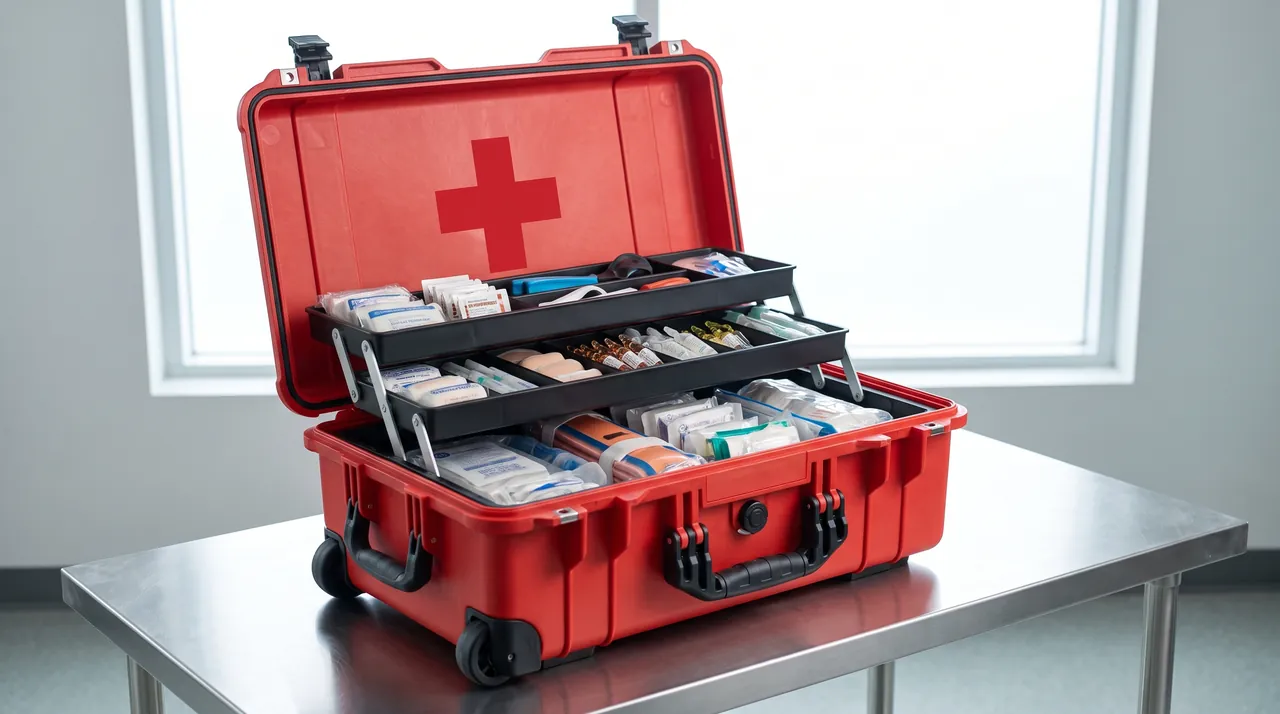
Tooling protection separates into five layers:
- Tip protection. The working end must not touch any hard material. Moulded pockets should leave 1.5 to 3 mm of clearance around the tip, or provide a bearing surface softer than the punch material.
- Axial restraint. Punches must not shuttle up and down in the pocket. Shuttling wears both the tip and the barrel guide section.
- Segregation by group. Different sizes and different wear states must be stored separately to prevent mixing. Pockets should be laser-marked with the tooling set number.
- Independent die fixing. A die bore is a precision mating surface and must be protected with a mandrel or dedicated plug gauge. Dies must never be loose-packed with punches in the same layer.
- Corrosion and fingerprint control. Punches are commonly tool steel, high-speed steel or carbide, sometimes chrome-plated or nitrided. Hand moisture and humidity cause pitting, so the liner must be low-outgassing and free of sulphur and chlorine.
A practical acceptance criterion: after a corner drop from 750 mm following a typical ISTA drop sequence, open the case and inspect. If the punch tip shows no visible damage at 10x magnification and the die bore still passes a go gauge, the insert design is fundamentally sound.
For larger items such as the turret, feeder, scraper blade and dust extraction assembly, the priority shifts from precision to deformation and contamination. Feeder augers, scraper edges and extraction duct connections are thin-walled or edge structures that need local reinforcement. Good practice is to run an envelope analysis in the 3D model first and confirm every overhanging feature has a support point before cutting foam.
4. Matching Cleanroom Classification to Case Environment
Cleanrooms are classified, and cases have to be specified against that classification. Two reference systems matter: ISO 14644-1 classes and the international GMP A/B/C/D grades. They correspond, but they focus on different things.
| Target area | Approximate ISO 14644-1 class | Where components go after removal | Recommended case configuration |
|---|---|---|---|
| --- | --- | --- | --- |
| Grade A / B (sterile core) | ISO Class 5 | Directly into the aseptic area or through RTP / alpha-beta ports | Fully sealed body, wipeable internal surfaces, sterile transfer bag, fibre-free liner |
| Grade C | ISO Class 7 | Through airlock, wiped before entry | IP65 or better, alcohol-wipeable liner, desiccant compartment |
| Grade D | ISO Class 8 | Direct entry or simple wipe | IP54 to IP65, moulded foam insert, cleanable body |
| Unclassified (workshop, spares store) | Not applicable | Must be cleaned before entry | IP65/IP67, corrosion-inhibiting liner, fully closed construction |
GB 50457, the Chinese design standard for pharmaceutical industrial cleanroom facilities, sets explicit requirements for material transfer between classified and unclassified zones. The core principles are separation of personnel and material flow and preservation of pressure differential and cleanliness through the transfer. The case functions here as a mobile clean boundary, and its sealing performance and external wipeability determine whether an additional outer wrap is needed.
Three practical rules follow:
- The external surface must be wipeable. Textures, grooves and exposed rivets all become cleaning blind spots. Prefer flat surfaces, radiused transitions and minimal parting lines.
- No liquid-trapping geometry inside. Water retained after cleaning creates a high-humidity microclimate in a closed case and triggers stainless pitting.
- Match packaging layers to the classification. A combination of an outer case for unclassified transfer plus an inner liner or bag for the classified zone is more reliable, and closer to real workflow, than one case trying to do everything.
Where EU GMP Annex 1 sterile process compliance applies, every material entering a Grade A or B zone needs a defined sterilisation or disinfection route. The case itself usually does not enter the Grade A zone; it acts as the transfer container disinfected in the anteroom. The body material must therefore withstand repeated wiping with isopropanol, hydrogen peroxide and quaternary ammonium compounds without cracking, blooming or releasing plasticiser.
5. Cleanroom Transfer: Contamination Control from Airlock to Case Surface
Contamination control on the transfer path is often reduced to "just seal the case well", but the critical moment is when it is opened. If a pressure differential exists between the closed case interior and the classified area, opening the lid produces an air exchange that draws particulate from the external surface inward. This is exactly why a pressure equalization valve has value in pharmaceutical applications as well.
A recommended transfer sequence to standardise:
- Pack, close and seal the case in the unclassified area, applying the tamper seal and batch label.
- On the dirty side before the airlock or pass-through, wipe all six faces with a lint-free cloth and disinfectant.
- Allow the required disinfectant contact time.
- Move into the pass-through or airlock and apply a second disinfection step or UV exposure.
- Open on the clean side, slowly, equalising first and then lifting the lid to avoid turbulence.
- Remove components, then immediately move the case out or into a used-case holding area; never store it alongside clean materials.
The detail that matters: seals and opening records. A single-use numbered tamper seal provides evidence that the case was not opened, without modifying the case itself. For spares subject to reconciliation, this is often worth more than the case price. JUNZHJIA can configure seal wire holes, numbered label recesses and an opening record card pocket so the case itself becomes the record carrier.
A second detail is liner replaceability. The higher the cleanliness requirement, the more the liner should be treated as a consumable: replaced on a cycle, washable or sterilisable on its own, removable without tools. A layered insert structure of frame layer, cushioning layer and contact layer is easier to maintain than a single moulded foam block because the contact layer can be replaced independently.
6. Material Compatibility: Case Body, Liner and Stainless Steel
Material selection is where pharma projects most often save money in the wrong place. A cheap case will embrittle, yellow and shed within a year; cheap foam will release acids that corrode stainless steel.
Case body materials commonly include PP, ABS, HDPE, glass-filled engineering plastics and aluminium-magnesium alloy. The selection criterion is not hardness but compatibility with cleaning agents, disinfectants and thermal cycling.
| Material | Advantages | Pharma-specific considerations | Suitable classification |
|---|---|---|---|
| --- | --- | --- | --- |
| PP (polypropylene) | Good chemical resistance, low water absorption, controllable cost | Moderate stiffness; large cases need ribs; deforms under prolonged heat | Grade C/D, workshop transfer |
| ABS | High stiffness, glossy wipeable surface | Sensitive to some solvents; long-term alcohol wiping needs validation | Grade C/D |
| HDPE | Good toughness, low-temperature performance | Marks easily; cleaning textured areas is difficult | Unclassified, cold store transfer |
| Glass-filled engineering plastic | High strength-to-weight ratio, dimensional stability | Confirm glass fibre is encapsulated and non-shedding | Grade C, precision components |
| Aluminium-magnesium alloy | Fast heat transfer, high strength, anodisable | Requires corrosion treatment; avoid direct contact with stainless to prevent galvanic corrosion | Unclassified, heavy items |
Stainless steel handling is the second focus area. Grade 316L is standard in pharma equipment and its corrosion resistance depends on an intact passive layer. If it sits in prolonged contact with chlorine-bearing materials such as certain PVC liners or chlorinated foams, or in a humid, poorly ventilated environment, the passive layer breaks down and pitting begins. Therefore:
- Liner materials should be sulphur-free, chlorine-free and low-outgassing; avoid regrind foam.
- The case should include a humidity control provision: a desiccant compartment or an optional sealed cavity.
- Interleaving between components should use non-woven fabric or clean-grade PE bags, not ordinary VCI paper, whose corrosion inhibitor can conflict with pharmacopoeial requirements.
The GB 4806 series on food-contact materials and articles is not mandatory for pharmaceutical use, but when a case is also used for food, nutraceutical or API containers, or for utensils that touch product directly, it is a useful reference for material safety. At minimum, confirm the liner is low-odour, low-migration and free of intentionally added heavy metals.
A note on hydraulic and lubricated components. After impact in transit, wear debris inside the hydraulic power units and gearboxes of filling and compression lines contaminates the lubricant, and hydraulic oil cleanliness is commonly controlled against ISO 4406 contamination codes. Where the customer specifies oil cleanliness, the most robust approach is to drain before transport and plug the ports, then refill to procedure after delivery. Where oil must travel with the unit, fix the attitude to prevent inversion, avoid severe shock, and check oil level and oil sample before handover.
7. Sealing Class: IP65/IP67 and Pressure Equalization Valves
Dust and water resistance is classified under IEC 60529 and its Chinese equivalent GB/T 4208. Pharma machinery parts cases typically specify IP65 or IP67, and the difference lies in the water test form.
| Class | Dust | Water definition | Typical scenario | Notes |
|---|---|---|---|---|
| --- | --- | --- | --- | --- |
| IP54 | Limited dust protection | Splash resistant | Short in-plant transfer | Low cost; unsuitable near washdown |
| IP65 | Dust tight | Jet resistant from all directions | General spares transport, near washdown areas | Most common pharma choice |
| IP67 | Dust tight | Short immersion, 1 m / 30 min | Cross-zone transport, wet loading, cold chain periphery | Requires a pressure equalization valve |
| IP68 | Dust tight | Continuous immersion (manufacturer defined) | Special requirements | High cost, rarely necessary |
On the relationship between IP67 and pressure equalization, there is a common misconception. A completely sealed case develops an internal-to-external pressure differential as temperature changes, which makes the lid hard to open, deforms the gasket through suction and can drive an instantaneous airflow that carries external particulate inside. A pressure equalization valve with a hydrophobic membrane solves this: air passes slowly while liquid water and particles are blocked, so IP67 is preserved while the differential is eliminated. Design details are covered in how the case pressure equalization valve works and how to select it.
The seal itself deserves scrutiny. Common forms include moulded-in foam gaskets, drop-in silicone rings and two-shot hard/soft co-extrusion. For pharma use, prefer a replaceable drop-in gasket, because the gasket is a wear item and replaceability determines whether the case has a long life. Material differences are significant and are compared in protective case seal materials compared.
Hinges and latches matter too. Pharma component cases are opened frequently, so hinge pin and latch durability set case life. Metal hinges corrode in humid conditions; all-plastic hinges embrittle in the cold. Confirm rated cycle counts and prefer a replaceable hinge design. This is discussed systematically in toolbox hinge, latch and seal structure explained.
8. Vibration and Transport Validation: ISTA, GB/T 4857 and MIL-STD-810H
Shock and vibration design cannot rest on "make the foam thicker". The defensible method is type testing against transport test standards.

Three reference sets are commonly used:
- ISTA series. ISTA 1 series covers non-simulation integrity testing, ISTA 2 series adds partial simulation, and ISTA 3 series provides general simulation closer to real distribution. ISTA 3A addresses parcel delivery and ISTA 3E addresses unitised loads. See ISTA transport testing procedure and case validation.
- GB/T 4857 series. Chinese basic test methods for transport packages covering vibration, impact, stacking and drop. Applicable to domestic logistics and pre-export inspection. See GB/T 4857 transport packaging testing for cases.
- MIL-STD-810H. Environmental test methods, of which Method 514 (vibration), Method 516 (shock), Method 507 (humidity) and Method 509 (salt fog) are frequently cited. Note that referencing MIL-STD-810H is a reference to environmental test methodology and does not mean the product holds a military certification. See MIL-STD-810H environmental testing and case compliance explained.
Three actionable principles for vibration design:
- Locate before you cushion. Stop the component moving inside the case first, then absorb energy. A part loose in thick foam wears through repeated displacement.
- Match foam to weight class. Foam thickness and density should follow component weight and fragility rather than being uniform across the case. Heavy items need high-density support; light items need soft conformity.
- Avoid resonance. Road vibration energy concentrates at low frequency. If the natural frequency of the case-liner-component system falls inside the excitation band, response is amplified. Layering foam density and offsetting support points disperses resonance effectively.
Pharma components add one special validation item: post-cleanliness particle testing. After the vibration test, open the case, wipe the liner surface with a clean cloth and perform a particle count. This quantifies liner shedding, and in real projects it is a highly persuasive data point.
9. Cleaning and Disinfection: Case Compatibility with CIP/SIP and Wipe-Down
A protective case does not participate in clean-in-place or sterilise-in-place cycles, but it has to coexist with them. Three issues actually need solving: whether the body can be wiped thoroughly, whether the liner can be replaced, and whether the case will carry contamination into the classified area.
Wipe-down compatibility:
- The external surface should be non-porous with no deep texture, with radiused transitions of at least 3 mm so a lint-free cloth can conform and clean in one pass.
- The gasket groove is the hard cleaning point. An externally seated gasket places the groove where it can be wiped directly instead of hidden on the inside.
- Internally, avoid blind holes and dead corners. Ribs should face outward and the cavity should stay simple.
- Provide a drainage and drying path so no water collects inside.
Liner cleaning strategies fall into three types:
- Wipeable. Closed-cell EVA or PE foam with a dense skin, cleanable with alcohol. Suits frequent disassembly.
- Replaceable. Layered construction with a thin consumable contact layer that is simply swapped out. Suits higher classifications.
- Single use. Clean bag plus disposable tray. Suits sterile transfer and validation batches.
For general case cleaning methods and cleaning agent selection, see how to clean a protective case correctly. The method applies to pharma too; only the agent choice has to meet cleanroom requirements.
The most overlooked detail is disinfectant residue. Repeated alcohol wiping leaves trace additive bloom on the polymer surface, creating a tacky finish that attracts particulate more readily. A periodic deep clean with a neutral detergent restores the surface state.
10. Static Control and Cleanroom Compatibility
Cleanrooms are humidity-controlled, and in winter or in dry regions relative humidity can drop below 30 percent, raising the risk of charge accumulation. For pharma machinery parts containing electronics, weighing modules, sensors or PLC communication boards, electrostatic discharge can cause latent damage.
ESD protection comes down to surface resistivity. Antistatic materials generally sit in the 10^6 to 10^9 ohm range, with conductive types lower and insulative types above 10^12 ohms. Antistatic foam, antistatic totes and shielding bags are the usual tools. The design approach is set out in ESD shielding case design and application.
Two cautions apply in pharma:
- Conductive fillers must not become a contamination source. Carbon black fillers can shed into a classified area, so choose closed-cell structures in which the filler is fully encapsulated.
- The grounding path must be defined. Antistatic foam without a ground path only bleeds charge slowly; sensitive devices need a conductive shielding layer plus a grounding point.
It is equally important to recognise that not every pharma machinery part needs ESD protection. Punches, stainless fittings and glassware are passive items and do not. Adding antistatic liner where it is not needed raises cost and cleaning difficulty. Classifying components by electrical nature is the first step in insert design, not an afterthought.
11. Custom Insert Design: From Parts List to Foam Machining
The custom insert is what turns a box into a protection system. The process standardises into six steps.
Step one: parts list and classification. List every component with dimensions, weight, material, precision grade, cleanliness requirement and whether it carries electronics. Sort into a two-axis matrix of heavy versus light, and rigid versus fragile.
Step two: layout design. Set the number of layers and layer heights. The principles are heavy items low, long items aligned with the case axis, precision items isolated. Leave 10 to 15 percent of total height for the cushioning and lid compression layers.
Step three: forming method. Three common options:
| Forming method | Process | Advantages | Limitations | Best fit |
|---|---|---|---|---|
| --- | --- | --- | --- | --- |
| CNC routing | CNC milling from a solid foam block | High precision, complex cavities, economical at low volume | Lower material utilisation | Precision tooling, irregular shapes |
| Die cutting | Blade die cutting plus lamination | Low cost, fast lead time, easily replicated | Limited complex 3D cavities | Regular shapes, large parts |
| Moulded foaming | In-mould foam bonding | Best conformity, low unit cost at volume | Requires tooling; expensive to change | High-volume standard cases |
Process comparisons and workflow detail are covered in EVA foam insert custom process explained and the custom foam insert design guide.
Step four: material selection. Choose density by cushioning requirement, commonly 30 to 90 kg/m3, and material by cleanliness requirement among EVA, PE, PU and XPE. PU foam is soft but sheds readily and should be avoided in clean applications; EVA has good closed-cell structure and low shedding and is the mainstream choice for pharma components.
Step five: marking and traceability. Laser-mark pocket numbers, component names and specification codes. Add an external label area and an internal packing list pocket. This step directly supports GMP traceability.
Step six: prototype and validation. Usually a 1:1 foam prototype is fitted first to confirm clearance and handling feel, followed by full-case drop and vibration validation. In custom insert work JUNZHJIA builds from customer 3D data or physical samples and can produce loaded validation sample cases alongside the design.
12. Acceptance and Traceability: AQL Sampling, Test Documents and Batch Records
Buying a protective case is like buying a precision component: it needs an acceptance standard. Without one, responsibility cannot be assigned when something goes wrong.
Three acceptance levels:
- Appearance and structure. No deformation, flash or sink marks; hinges operate smoothly; gasket is continuous with no breaks; pockets match the drawing.
- Dimensions and fit. Critical dimensions sampled against drawing; sample fit confirming handling force; uniform lid-to-body gap when closed.
- Performance. IP class verification, drop and vibration sampling and seal air-tightness checks using pressure decay or immersion, as agreed.
AQL sampling is the standard method for batch disposition. Select inspection level and acceptance quality limit under GB/T 2828.1 or ISO 2859-1 and sample each delivery batch accordingly. The method is set out fully in custom case acceptance and AQL sampling.
Documents to request, as applicable:
- Material certificates for body and liner, with RoHS and REACH where export markets require them
- Performance reports for IP class testing under IEC 60529 / GB/T 4208
- Transport validation reports under ISTA or GB/T 4857
- Flammability rating under UL94 where fire requirements apply
- Dimensional inspection records for critical dimensions
- Production batch and traceability numbers
Recommended batch record contents: case batch number, insert revision number, gasket lot, date of manufacture, packing list, tamper seal number. In pharma use this record can be tied to the spare parts ledger to give case-to-part-to-batch traceability in three directions.
13. Purchasing Decisions, Use and Maintenance
Make or buy? Unless the plant already has injection moulding and foam conversion in house, making is usually more expensive. Tooling amortisation, insert design and validation testing all sit on your books, and iteration when a component changes is slow. The sensible boundary is standardised case body plus customised insert: pick a mature case platform and customise the insert. That controls cost while preserving protection.
Tooling cost needs to be worked out early. Mould investment only pays back above a certain volume, and the calculation method is set out in custom case mould cost analysis. For high-variety, low-volume pharma spares, a combination of die cutting and CNC routing is usually more economical than tooling.
OEM/ODM cooperation suits equipment builders with brand requirements. A pharma machinery manufacturer can deliver the case as a standard accessory to the end-user plant, branded to the builder and configured internally to the shipped tool and spare parts list. JUNZHJIA supports this model, including model-specific insert layouts, pocket sets matched to the accessory list, and structural reinforcement and packaging for export. Evaluation criteria for supplier selection are in how to choose a protective case OEM factory.
Use and maintenance:
- Inspect gaskets periodically. Check every 6 to 12 months and replace on hardening, cracking or permanent set. See protective case service life and influencing factors.
- Avoid prolonged direct sun exposure. UV accelerates polymer ageing.
- Replace liners on a cycle. In high-cleanliness use, set a replacement threshold based on handling or cleaning cycles.
- Store empty cases unloaded. Do not stack heavy loads on them long term; store with latches just released to avoid permanent gasket compression.
- Do not mix classifications. Classified-area cases and unclassified-area cases should be marked and never interchanged.
Frequently Asked Questions
Q: What is the most fundamental difference between a pharma machinery parts case and an ordinary industrial toolbox?
A: The fundamental difference is that cleanability is treated as a designed function rather than a side effect. An industrial toolbox is engineered to carry load, survive drops and hold a lot, and it is allowed to have textured recesses, exposed rivets and a fabric liner. A pharma machinery parts case must treat wipeability, low shedding, no liquid trapping and a replaceable contact layer as hard requirements. That shows up in three places. First, the external surface is flat with no dead corners, transitions are radiused and the gasket is externally seated so it can be wiped. Second, the liner is closed-cell and low-outgassing, usually layered so the contact layer can be managed as a consumable. Third, the cavity avoids internal blind holes and inward-facing ribs that trap water and trigger stainless pitting. On top of that, a pharma case usually carries a traceability function such as seal wire holes, numbered label areas and a packing list pocket, which industrial toolboxes almost never have. In one sentence: an industrial toolbox solves holding things, while a pharma case solves holding, cleaning and proving.
Q: How should an insert be designed so that slender components such as filling needles do not bend?
A: The core approach is full-length restraint, no cantilever and no component-to-component contact. First, each needle holder must have its own pocket; never bundle several with ties into one compartment, because micro-movement between bundled items over a long road journey abrades the tubes and blunts tip chamfers. Second, pocket depth should cover at least 70 percent of needle length, with the remainder restrained by a soft upper strip whose job is to stop axial shuttling rather than to clamp, since over-clamping introduces additional stress. Third, there must be a cushioning layer at the pocket base, and the needle tip must either float or rest on a soft bearing surface, never directly on a hard base plate. Fourth, for long needle holders use a three-point layout with two end supports plus a mid support to avoid a cantilever span. Fifth, after packing, run a transport validation or simulated vibration test and inspect tube straightness and tip condition under magnification. In practice, individual pockets plus three-point support plus soft bearing surfaces deliver essentially zero deformation for filling needles under standard logistics conditions.
Q: Does a pharma machinery parts case need to achieve IP67?
A: In most cases no, IP65 is sufficient, but the decision depends on the specific route. IP65 means dust tight and protected against water jets from any direction, per IEC 60529 and GB/T 4208. For in-plant transfer, covered loading, and the route from the spares store to the production floor, IP65 is entirely adequate and brings lower cost and easier handling. IP67, meaning short-term immersion, becomes relevant for cross-province transport with wet or uncovered loading, transfer routes passing a washdown area, movement around cold chain or high-humidity storage, and export sea freight where deck spray or container seepage is possible. Note that choosing IP67 normally requires a pressure equalization valve. Without one, temperature-driven pressure differentials make the lid hard to open and deform the gasket, and the airflow on opening draws particulate from the external surface into the case, which actually harms cleanliness. The right approach is to establish whether the route involves immersion or sustained jetting, then specify the class, rather than defaulting to IP67 everywhere.
Q: Are there mandatory material requirements for cases used inside a cleanroom?
A: There is no single mandatory material list, but there are several hard constraints that come from GMP systems and cleanroom design standards. First, the material must not be a contamination source: no shedding, no fibre release, no migrating plasticiser or additive. That rules out ordinary corrugated board, wooden pallets, regrind foam and chlorine-bearing liners. Second, the material must withstand the disinfectants used in classified areas, including isopropanol, hydrogen peroxide and quaternary ammonium compounds, without cracking, blooming or becoming tacky after repeated wiping. Third, the geometry must support effective cleaning: flat external surfaces, radiused transitions, externally seated gasket grooves, and a cavity free of blind holes and liquid traps. Fourth, where the case is also used for utensils that contact product or for food and nutraceutical packaging, the GB 4806 series on food-contact materials is a reasonable reference for safety even though it is not mandatory in pharmaceutical use, since it addresses low migration and low odour. The material transfer requirements in GB 50457 and the classification framework of ISO 14644 together determine how much sealing and surface control each grade actually needs.
Q: What goes wrong most often in tablet punch and die transport, and how is it prevented?
A: The most common failures are chipped punch tips and scored punch barrels, followed by die bore galling and surface pitting on punches. Tip chipping usually happens during packing and unpacking rather than in transit, because operators habitually grab punches in bunches so the punches strike each other directly. Prevention has three parts. First, the insert should provide an individual pocket per tooling number with tip clearance so the working end never contacts a hard surface. Second, each pocket must provide axial restraint so punches cannot shuttle and wear both tip and guide section. Third, use a dedicated extraction tool or finger cots when unpacking and never grab multiple punches bare-handed. For dies, always protect the bore with a mandrel or dedicated plug gauge and never pack dies in the same layer as punches. Pitting comes from hand moisture and humidity, so the liner should be sulphur-free, chlorine-free and low-outgassing, and the case should include a desiccant compartment. The final acceptance test is to complete drop and vibration testing, then open the case: punch tips must show no visible damage at 10x magnification and die bores must still pass a go gauge.
Q: Will a pressure equalization valve compromise the seal and let dust into the case?
A: No, provided the correct valve type is selected and installed properly. The core of a pressure equalization valve is a hydrophobic and oleophobic microporous membrane that allows air molecules to pass slowly and equalise the pressure differential, while liquid water and larger solid particles cannot penetrate the pore structure. In terms of dust and water classification, a case fitted with a correctly installed valve can still meet IP65 or even IP67. Its real value is protecting the sealing system. A fully sealed case develops internal pressure as temperature rises, bowing the lid and loading the latches; when temperature falls, internal vacuum makes opening difficult and can suck the gasket out of shape so it loses elasticity. Worse, when a differential exists, opening the lid quickly produces an air exchange that draws particulate attached to the external surface into the case, which matters directly in cleanroom transfer. The correct practice is to select a valve with a protective cap or shroud to prevent mechanical damage to the membrane, mount it away from direct jetting and liquid pooling areas, and include the valve exterior in the wipe-down procedure.
Q: What transport validation does a pharma machinery parts case need, and is it expensive?
A: Validation is normally done in three progressive layers. The first is basic integrity testing under ISTA 1 series or GB/T 4857 covering drop, stacking and vibration, to confirm the load-bearing capability of body and insert. The second is simulated testing under ISTA 2 series or combined GB/T 4857 procedures that replicate superimposed vibration and shock in real distribution. The third is actual route validation, placing data-logger instrumented sample cases into the real logistics path to capture acceleration, temperature and humidity, which is then used to calibrate the severity of the first two layers. Where environmental testing is required, MIL-STD-810H methods for vibration, shock, humidity and salt fog can be cited as the basis, with the caveat that this is a reference to environmental test methods and does not constitute a military certification. On cost, the main spend is one-off test fees and sample case fabrication, largely independent of the eventual purchase volume, so validation should be budgeted at project start and preferably handled by one party covering insert design, sample build and test execution, avoiding finger-pointing between a designer and a manufacturer.
Q: How can case cost be controlled for high-variety, low-volume pharma spares?
A: The core strategy is standardised case body plus customised insert. Choose a mature case platform and cover the majority of components with a few external sizes so one mould set amortises across volume, then customise inserts per component, favouring die cutting and lamination or CNC routing that need no or minimal tooling. That avoids a case mould per component. A second strategy is a modular insert: split the insert into a frame layer plus replaceable pocket blocks so switching a whole case to another component only requires swapping pocket blocks. A third is layer-based adaptation, using different layer plate thicknesses in the same body to suit components of different heights. A fourth is to define clearly which components do not need a dedicated case at all, such as stainless fittings, glassware and generic fasteners, which a standardised tote plus clean bag will serve. Only when a component family has sufficient volume and a stable geometry over time does moulded foam tooling become worthwhile, and only then does unit cost drop noticeably.
Q: How can you tell whether a case supplier actually understands pharmaceutical applications?
A: Five questions will reveal it. First, material compatibility: can they explain how body and liner materials behave against isopropanol, hydrogen peroxide and quaternary ammonium disinfectants, and whether plasticiser will be released? Second, cleaning geometry: can they point out the cleaning blind spots such as gasket grooves, ribs and label recesses, and explain how to avoid them? Third, traceability design: do they proactively propose seal wire holes, numbered label areas, packing list pockets and laser-marked pocket numbering? Fourth, validation capability: can they describe the specific test items and pass criteria under ISTA, GB/T 4857 and IEC 60529, rather than just saying the product passed testing? Fifth, documentation: can they provide material certificates, IP test reports, transport validation reports and batch traceability records? If the conversation only covers price, dimensions and colour, the supplier experience is probably limited to general industrial boxes. In this type of project JUNZHJIA normally starts with component classification and cleanliness grade confirmation, then issues an insert proposal and a validation plan, keeping design and validation under one responsible party.
Conclusion & Related Reading
The design logic of a pharma machinery parts case condenses into one sentence: it is not a container, it is a controlled and provable clean boundary. Filling needles, rotary valves, metering pumps, weighing modules and compression tooling are high-value, high-precision and contamination-sensitive, and what they need is not a box that holds them but a system that simultaneously solves location, cushioning, sealing, cleaning and traceability. The implementation path is equally clear. Start by setting the sealing and surface requirements from the cleanliness grade. Then design a layered insert from the component list. Then validate against ISTA or GB/T 4857. Finally, lock quality in with AQL sampling and batch records.
It is worth stressing that standards and ratings are only the starting point. Two cases with the same IP67 rating can differ several-fold in real protective performance depending on insert design, and two foams of the same density produce very different tooling scrap rates depending on how the pockets constrain the part. The real difference lives in design and workmanship, not in the certificate. JUNZHJIA supplies protective cases with custom inserts, OEM/ODM programmes and model-specific seal configurations for pharmaceutical and bioprocess equipment builders and plant spares departments, and can support loaded transport validation sample cases alongside the required material and performance documentation. Final configurations are confirmed case by case against the parts list and cleanliness grade.
Related Reading