

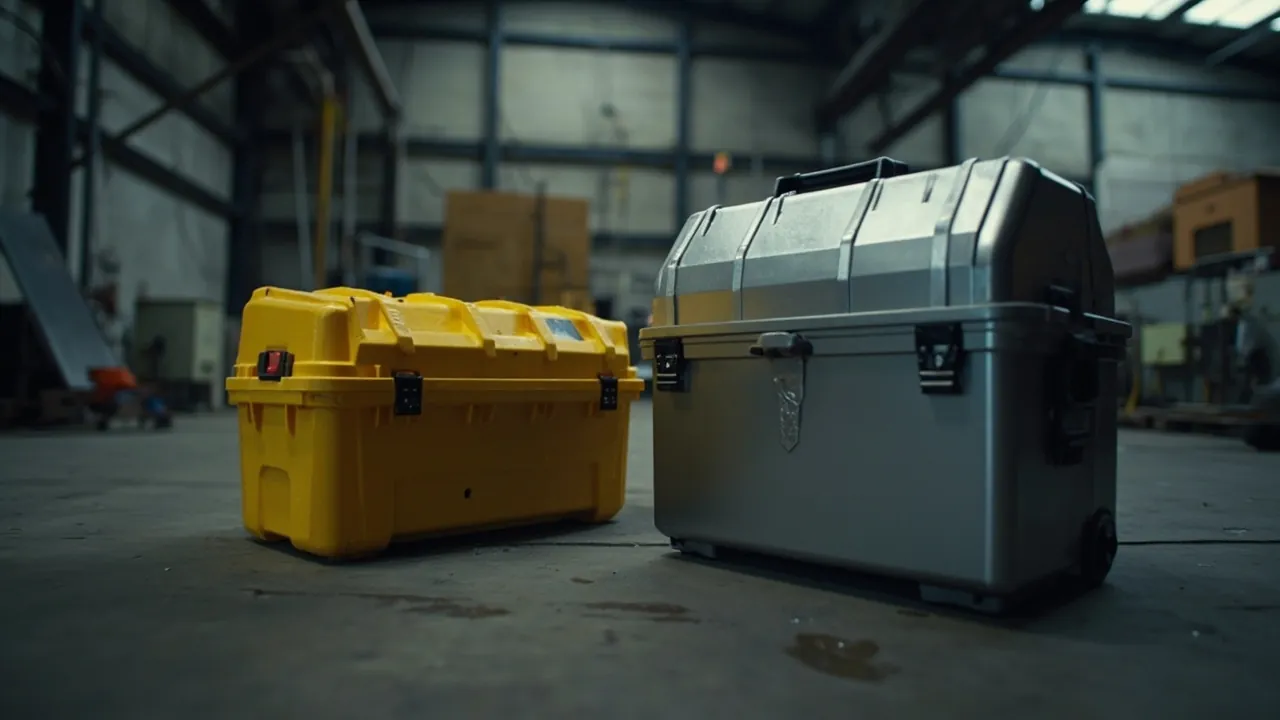
Start with the conclusion: neither material is universally better. The choice rests on three tests - whether the working environment involves live conductors or electrostatic-sensitive items, which determines the insulation requirement; how the case is carried and what impact risk it faces, which determines the impact and weight requirement; and whether the environment is corrosive, which determines weathering and corrosion resistance. On insulation, engineering plastics have volume resistivity typically in the order of ten to the power of more than ten ohm-centimetres (measured per GB/T 1410 / IEC 60093), making them excellent insulators, while steel and aluminium are good conductors - a fundamental safety difference around live work. On impact, the answer is more nuanced and runs the other way: metal has higher static strength and puncture resistance, but engineering plastics absorb a great deal of energy through large elastic deformation and spring back, and unlike metal they do not take a permanent dent. In standards language, a plastic shell is assessed by its IK rating (IEC 62262 / GB/T 20138) and by drop testing, while material toughness is assessed by Charpy notched impact strength (GB/T 1043.1 / ISO 179) - and the two must never be substituted for one another.
The industry saying that "metal is always stronger than plastic" needs correcting. Metal does have higher yield strength and stiffness - that part is true. But the failure mode that actually kills a toolbox is rarely "crushed by a static load"; it is "cracked or distorted after a drop, so the lid will not close." Under drop conditions, the large-deformation energy absorption of plastic often makes it survive better than a thin steel sheet of the same weight, while a dented metal box stays dented - and a dent that stops the lid closing or breaks gasket compression is fatal on a sealed case. Conversely, in puncture resistance, cut resistance, theft resistance and concentrated heavy loading, metal's advantages are hard for plastic to match. This article compares the two across ten dimensions - mechanical behaviour, insulation, impact, weight and ergonomics, corrosion, temperature, sealing, electromagnetic and electrostatic behaviour, manufacturing and customisation, and cost over the life cycle - then closes with a selection matrix for eight duty categories and the differences in purchase specification between the two materials.
Table of Contents
- The Short Answer: Three Tests, Not One Winner
- How the Two Materials Behave Mechanically: Elastic, Plastic, Energy Absorbing
- Electrical Insulation: Volume Resistivity, Dielectric Strength and Live Work
- Impact Resistance: IK Ratings, Charpy Impact and Real Drops
- Weight and Handling: Specific Strength, Specific Stiffness, Ergonomics
- Corrosion and Weathering: Rust, UV and Salt Spray
- Temperature: Deflection Temperature, Cold Embrittlement and Conductivity
- Sealing and Ingress Protection: Why Plastics Reach High IP More Easily
- Electromagnetic and Static: ESD Control, Shielding and Spark Risk
- Manufacturing and Customisation: Tooling Cost, Design Flexibility, Lead Time
- Cost Structure and Life Cycle: Price, Maintenance, Repair, Recycling
- Selection Matrix: Recommended Material for Eight Duty Categories
- Purchasing and Acceptance: How the Specifications Differ
- Frequently Asked Questions
- Conclusion and Further Reading
The Short Answer: Three Tests, Not One Winner
Compress the decision into three questions, answered in order, and almost every application resolves itself.
Test one: does the work involve live conductors or electrostatic-sensitive items? If the case will be used near energised equipment, come into contact with wiring, or serve the power, telecom or electronics industries, choose engineering plastic. The reason is intrinsic safety: an insulating shell cannot become live across its whole surface because it brushed against a conductor, and it cannot form a conductive path between a tool and a live part. That is not a matter of being slightly safer; it is the difference between having that risk path and not having it.
Test two: is the dominant failure mode dropping and knocking, or puncture, cutting and concentrated heavy loads? For the former - site handling, vehicle transport, frequent loading and unloading - engineering plastics generally do better, because they absorb energy, spring back and do not take permanent dents. For the latter - heavy tools, theft risk, sharp objects in the environment - metal is the better answer.
Test three: is there corrosion risk or long-term outdoor exposure? Where rain, mud, salt spray or chemicals are present - coastal, chemical plant, marine, municipal work - engineering plastics have a decisive advantage, because they do not rust. Metal depends on coatings and alloy choice (stainless, aluminium) to resist corrosion, which raises both cost and maintenance.
How the combinations resolve:
| Combination | Recommended material | Reasoning |
|---|---|---|
| --- | --- | --- |
| Live work plus drop risk plus damp | Engineering plastic (first choice) | Insulating, energy absorbing, does not rust |
| No electricity, concentrated heavy load, theft risk | Metal | Strength, puncture resistance, lockable |
| Live work but shielding or ESD control needed | Plastic with conductive or anti-static modification, or metal with insulating covering | Needs dedicated design |
| No electricity, long-term outdoor, no heavy load | Engineering plastic, UV-stabilised grade | Does not rust, light |
| No electricity, close to a heat source | Metal, or a high-temperature plastic | Plastics are limited by HDT |
It is worth noting that hybrid solutions exist: a plastic shell with a metal frame, corner protectors or latches, or a metal body with a plastic liner or covering. These try to capture both sets of advantages, and they also bring higher cost and weight plus corrosion and galvanic issues wherever dissimilar materials meet. Whether that is worth it depends entirely on the duty.
By "plastic" this article means the engineering thermoplastics commonly used for cases: PP (polypropylene, including copolymer and impact-modified grades), ABS (acrylonitrile butadiene styrene), PC (polycarbonate) and blends such as PC/ABS and PC/PBT. By "metal" it means cold-rolled steel sheet with a finish, aluminium alloys, and stainless steel. The material fundamentals are covered in plastic material selection for protective cases and plastic versus metal toolboxes in full.
How the Two Materials Behave Mechanically: Elastic, Plastic, Energy Absorbing
To understand the impact argument, start with how the two behave under load.
Metals - steel and aluminium: high elastic modulus, roughly an order of magnitude or more above plastics; after yielding they deform plastically, and that plastic deformation does not recover. Three consequences. Within the elastic range, a metal part is stiff and deflects little, which is where the "metal feels solid" impression comes from. Beyond yield, permanent deformation - a dent or a bend - appears and stays. And metals are sensitive to notches and cracks, so a sharp scratch or a stress concentration readily becomes a crack origin.
Engineering plastics: low elastic modulus, of the order of a few percent of steel, but a large recoverable elastic strain - of the order of a few percent strain against a fraction of a percent for metals - plus pronounced viscoelasticity, meaning deformation depends on time and temperature. Three consequences. Under impact, plastics absorb a great deal of energy through large deformation - the area under the stress-strain curve - and then recover most of it. Plastics are strongly strain-rate sensitive: the faster the load, the stiffer and more brittle they behave, which is why a case that shrugs off a drop at room temperature can crack under a fast, cold impact. And plastics are notch sensitive, ABS especially, so sharp corners and scratches markedly reduce impact strength - which is why the fillet radius at a rib root matters so much.
| Mechanical property | Steel | Aluminium | Engineering plastics (PP/ABS/PC) |
|---|---|---|---|
| --- | --- | --- | --- |
| Elastic modulus | Very high | High | Low (a few percent of steel) |
| Density | High | Medium | Low |
| Recoverable elastic strain | Small (fractions of a percent) | Small | Large (a few percent) |
| Behaviour past yield | Permanent plastic deformation | Permanent plastic deformation | Partial recovery, possible cracking |
| Strain-rate sensitivity | Weak | Weak | Strong (more brittle when fast) |
| Notch sensitivity | Medium | Medium | Strong, especially ABS |
| Typical failure appearance | Denting, bending, rust perforation | Denting, cracking | Cracking, stress whitening, creep |
One engineering conclusion follows directly: when you assess a toolbox, stiffness and toughness are different things. Metal wins on stiffness, the resistance to deflection. Toughness, the resistance to fracture, meaning the ability to absorb impact energy, depends on the specific material and structure - and PC and impact-modified PP are excellent, beating metal on some per-unit-mass measures. The commonest toolbox failure, "it cracked when it fell," is a toughness problem, not a stiffness problem.
That is why judging a case by pressing on it tests the wrong property: you are measuring stiffness while the property that decides service life is toughness. It is also why premium protective cases are usually PC or a PC/ABS blend - those balance toughness and stiffness best.
Electrical Insulation: Volume Resistivity, Dielectric Strength and Live Work
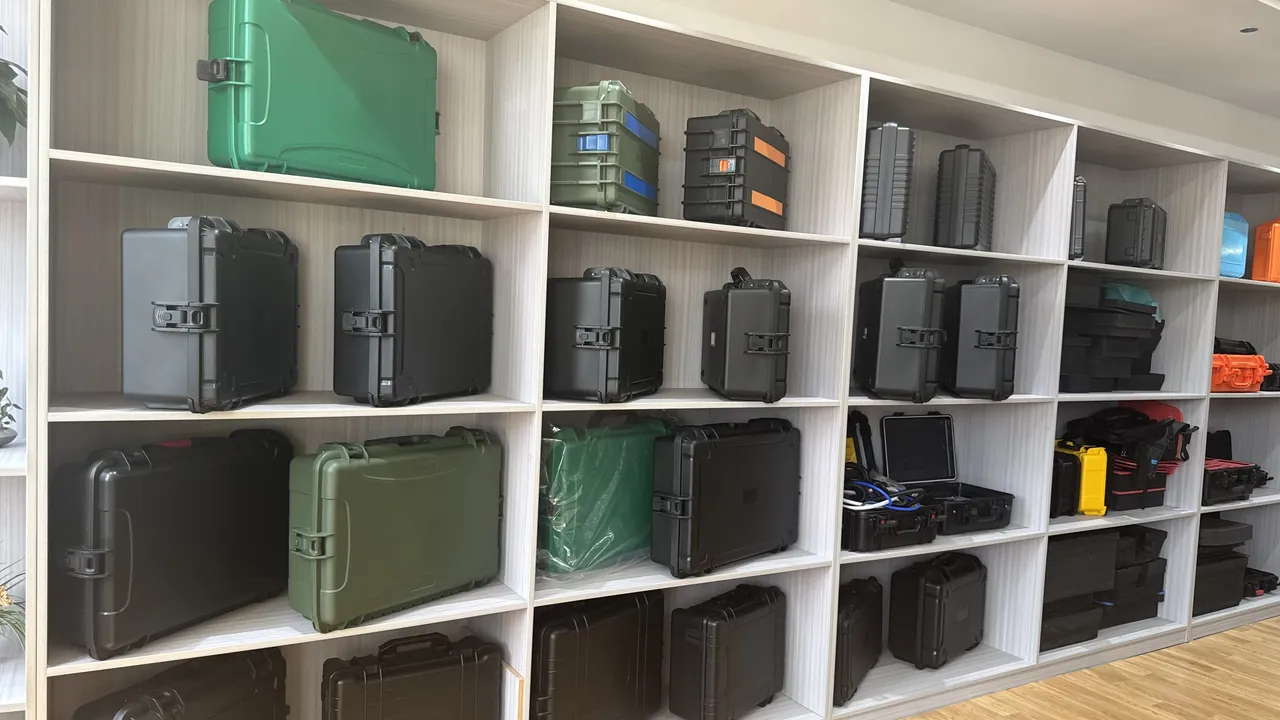
This is plastic's most fundamental and least replaceable advantage.
The parameters and their standards:
- Volume resistivity, which measures how strongly a material opposes current through its bulk, in ohm-centimetres, determined per GB/T 1410 (aligned with IEC 60093). Engineering plastics typically sit in the order of ten to the power of more than ten ohm-centimetres - excellent insulators - while metals sit around ten to the minus six, a gap of roughly twenty orders of magnitude.
- Surface resistivity, also per GB/T 1410, which governs surface conduction and matters greatly for anti-static design: too high and charge accumulates, too low and it conducts.
- Dielectric strength, the electric field a material withstands before breakdown, usually in kV per millimetre, determined per GB/T 1408.1 (aligned with IEC 60243). Engineering plastics commonly reach tens of kilovolts per millimetre.
- Comparative tracking index (CTI), which grades a material's resistance to surface tracking under electric field and contamination, used for classifying insulating materials.
Why does this matter for a toolbox? Three real situations.
- Secondary protection in live work. Working near energised equipment, a metal case that touches a live part - or picks up induced voltage - makes the entire shell a conductor, and anyone touching it is at risk. An engineering plastic shell removes that risk path entirely. That is why the power, telecom and rail industries routinely specify plastic cases.
- Accidental short circuits involving the case. Putting a live power tool, a battery pack or a bare wire end into a metal case can create a circuit through the shell, causing a short, sparking, or thermal runaway in a battery. A plastic body does not conduct, so that path does not exist.
- Loss of insulation in damp conditions. A metal case in a humid environment carries a surface water film - worse if there is salt or contamination - and its insulation degrades further. A plastic case does not depend on a surface coating to stay insulating.
Two misconceptions to clear up.
The first is "plastic insulates, so it is automatically safe." It is not. Insulation depends on the integrity and cleanliness of the material: heavy surface contamination, moisture absorption, ageing cracks, or conductive fillers - present in some anti-static and conductive grades - all reduce it substantially. Where there is a defined electrical safety requirement, ask for measured volume resistivity and dielectric strength data and write the values into the specification; do not assume "plastic equals insulating."
The second is "a metal case is just as safe if you earth it." Earthing helps - it clamps the shell at earth potential - but it needs a reliable connection and periodic checks, and on a portable case that is difficult to guarantee. Intrinsic safety - not conducting - beats engineering control - earthing - which beats administrative measures - procedures. That is a basic principle of safety engineering.
One addition: flame retardance. Electrically related applications should also consider flammability, commonly rated by UL94 (vertical classifications such as V-0, V-2 and HB) and by GB/T 2408. If a case will sit in a switchroom, a server room, or carry batteries, state the flame-retardance requirement explicitly.
Impact Resistance: IK Ratings, Charpy Impact and Real Drops
This is where confusion concentrates, so it needs splitting into three levels.
Level one: material toughness. Expressed as Charpy notched impact strength, measured per GB/T 1043.1 (aligned with ISO 179) in kJ per square metre. It uses a standard specimen - a bar with a defined notch - and reflects the ability of the material itself to resist crack propagation.
| Material | Charpy notched impact strength (relative, indicative) | Comment |
|---|---|---|
| --- | --- | --- |
| PC (polycarbonate) | Very high | Among the toughest engineering plastics |
| PC/ABS blend | High | Balance of toughness and processability |
| ABS | Medium to high | Varies greatly with grade and rubber content |
| Impact-modified / copolymer PP | Medium to high at room temperature | Low-temperature behaviour needs separate confirmation |
| PP homopolymer | Low to medium | Embrittles when cold |
| Steel sheet | High, but a different failure mode | Not assessed by this metric |
| Aluminium alloy | Medium | Not assessed by this metric |
Level two: enclosure impact rating. Expressed as the IK code under IEC 62262 (mirrored by GB/T 20138, the IK code for protection against external mechanical impacts). A hammer of defined energy strikes defined locations on the complete enclosure, and the result is graded IK00 to IK10, from under 1 joule to 20 joules.
| IK rating | Impact energy (J) | Typical application |
|---|---|---|
| --- | --- | --- |
| IK07 | 2 | Light knocks |
| IK08 | 5 | General industrial environments |
| IK09 | 10 | Rough handling, heavier drops |
| IK10 | 20 | High-intensity industrial and outdoor duty |
Level three: real drop behaviour, at the use-scenario level. A drop is a kinetic energy event determined by mass and height, with highly random impact points - corner, edge or face - and orientation. It is closer to reality than the IK test but much less repeatable.
How the three relate, and how they get misused:
- High material impact strength does not mean a high product IK rating. One tests a specimen, the other tests a finished product. Product behaviour also depends on structure - ribs, radii, wall thickness - on process, meaning where weld lines land - and on assembly state. Conflating them is a common piece of marketing misdirection.
- "Metal always achieves a higher IK rating" is not true. The IK test asks whether protection is retained after impact, and metal takes permanent dents; if a dent stops the lid closing or breaks the seal, that is also a fail. Plastic avoids permanent deformation through elastic recovery, metal avoids it through high yield strength - different routes, and the outcome depends on the specific design.
- Low temperature must be tested separately. Plastics lose toughness when cold, through strain-rate sensitivity and reduced molecular mobility, so passing an IK test at room temperature says nothing about cold-climate use. Metals also have a ductile-to-brittle transition - some steels noticeably so - but the transition usually sits far below the embrittlement range of plastics.
Practical recommendation: the technical agreement should state all three - material impact strength (GB/T 1043.1 / ISO 179), product IK rating (IEC 62262 / GB/T 20138), and drop testing at a defined height, orientation and temperature. They complement one another and none substitutes for another. Drop conditions can be structured along the lines of transport package test methods, such as the drop procedures in the GB/T 4857 series.
Weight and Handling: Specific Strength, Specific Stiffness, Ergonomics
Weight is the most underestimated factor in toolbox selection, because it never appears on a specification sheet yet affects the user every single day.
Density, indicatively: steel is several times denser than plastic, aluminium a little over twice. For the same volume, a steel case may weigh three to five times a plastic one, and an aluminium one two to three times.
Specific strength and specific stiffness - strength or modulus divided by density - are the fairer comparison.
| Material | Relative density | Specific stiffness | Specific strength (by yield) | Overall |
|---|---|---|---|---|
| --- | --- | --- | --- | --- |
| Cold-rolled steel | High | Medium | Medium | Highest absolute strength, large weight penalty |
| Aluminium alloy | Medium | Medium-high | Medium-high | Good weight-to-strength balance |
| Engineering plastics | Low | Medium (structure compensates) | Medium-high for toughened grades | Biggest weight advantage; stiffness from ribs |
The ability of plastic to recover stiffness through structure is the key point. On material modulus alone, plastics are far below metals; but with ribbing, a plastic part achieves adequate bending stiffness at very low weight - the principle is set out in toolbox durability and rib design. That is how a plastic case can be light and still stiff enough.
Three practical ergonomic consequences:
- Carrying fatigue. If one case weighs 2 kg empty and another 8 kg, a 15 kg load becomes 17 kg versus 23 kg - a 6 kg difference. For a job that involves lifting it in and out of a vehicle a dozen times a day, that difference accumulates directly into fatigue and injury risk.
- Handle and centre of gravity. A plastic shell's own weight is small, so the loaded centre of gravity sits close to that of the contents. A metal shell adds substantial distributed mass, so the empty and loaded balance differ and the feel in the hand changes. See portable toolbox handle balance.
- Whether wheels become necessary. Past a certain weight, carrying by hand stops being realistic and wheels become mandatory. A plastic case often stays hand-carryable with another layer of tools added; a metal case reaches the wheeled threshold much sooner. See wheeled versus standard toolboxes.
A fleet and fuel view: for vehicle-mounted cases, permanent extra load raises fuel consumption. Small per vehicle, but quantifiable across a fleet - one reason logistics and delivery operations generally prefer plastic.
Corrosion and Weathering: Rust, UV and Salt Spray
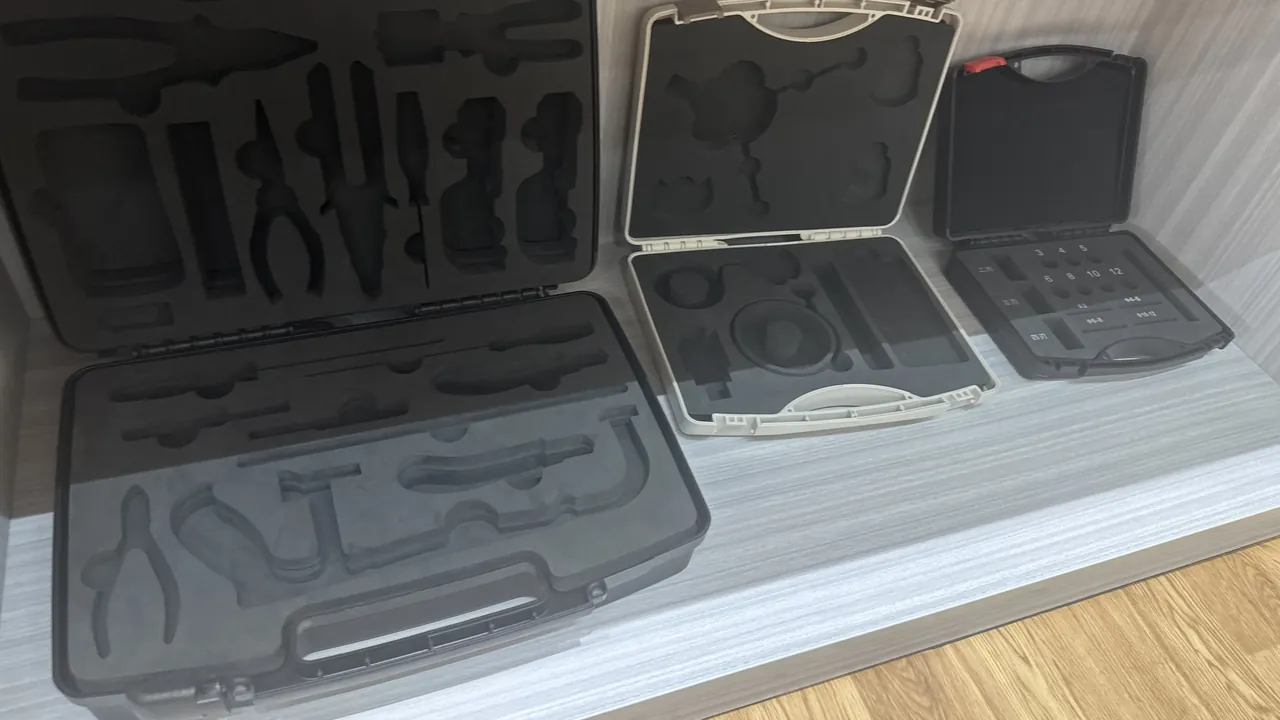
Here engineering plastics hold their clearest advantage.
How metals corrode, and how they are protected. Steel corrodes electrochemically, and the process accelerates in damp, salty, acidic or alkaline conditions; protection depends on coatings - powder coat, paint, plating - and on substrate choice such as galvanised sheet or stainless. Once the coating is breached by a scratch or a knock, that spot corrodes preferentially and creeps beneath the surrounding film. Aluminium forms a dense oxide film and resists better than steel, but in chloride environments - coastal air, de-icing salt - it is prone to pitting and crevice corrosion, and it risks galvanic corrosion when it contacts dissimilar metals. Stainless resists best, at higher cost, and can still pit or stress-corrosion crack in some chloride environments.
How corrosion is assessed. GB/T 10125 (aligned with ISO 9227) specifies accelerated corrosion tests in artificial atmospheres - the salt spray tests: neutral (NSS), acetic acid (AASS) and copper-accelerated acetic acid (CASS). When buying metal cases, ask for a salt spray report and look at both the duration and the acceptance criteria - rust area proportion, and time to white or red rust.
How plastics age, and how they are protected. Ultraviolet radiation breaks chains, producing discolouration, chalking, surface crazing and loss of strength, assessed per the GB/T 16422 series (aligned with ISO 4892, xenon-arc and fluorescent UV). Protection comes from light stabilisers and antioxidants and from weatherable grades - ASA, for example, weathers better than ABS. Thermal-oxidative ageing is accelerated by heat and can be assessed by methods such as GB/T 7141. Environmental stress cracking - cracking under combined stress and a specific chemical - matters because ABS is sensitive to some organic solvents, so compatibility needs checking wherever oils, solvents or cleaners are present. Moisture absorption is low for most case plastics - PP and PC both absorb little - but PC can hydrolyse in hot, humid conditions, which matters in high-temperature environments.
| Environmental factor | Cold-rolled steel | Aluminium | Stainless | Engineering plastics |
|---|---|---|---|---|
| --- | --- | --- | --- | --- |
| Rain and humidity | Rusts, depends on coating | Fairly good | Excellent | Excellent, does not corrode |
| Salt spray / coastal | Poor without heavy protection | Medium, pitting risk | Good to excellent by grade | Excellent |
| UV exposure | Coating chalks and fades | Surface oxidation | Good | Needs light stabilisers |
| Acids and alkalis | Poor | Medium | Depends on grade | Depends on grade, check compatibility |
| Organic solvents | Excellent | Excellent | Excellent | Check - ABS is sensitive |
The conclusion: in damp, coastal, chemical, marine and municipal environments, the corrosion advantage of engineering plastics is decisive and needs almost no maintenance. Metal in those environments either costs much more, as stainless does, or demands continuous upkeep - touch-up paint, rust treatment. The wider outdoor discussion is in stainless versus plastic toolboxes outdoors and aluminium versus stainless steel toolboxes.
Temperature: Deflection Temperature, Cold Embrittlement and Conductivity
Temperature is plastic's main weakness, and the item that must be checked in any selection.
At the hot end: deflection temperature under load (HDT). Determined per the GB/T 1634 series (aligned with ISO 75), HDT is the temperature at which a standard specimen reaches a defined deflection under a defined bending stress. It is a material comparison figure rather than a design limit - not a maximum service temperature - but it ranks materials well.
| Material | Relative HDT | Comment |
|---|---|---|
| --- | --- | --- |
| PP homopolymer | Lower | Risky where load coincides with heat |
| PP copolymer / impact modified | Medium | Slightly better than homopolymer |
| ABS | Medium-high | Above PP; one reason ABS behaves better under solar load |
| PC / PC blends | High | Best of the common choices at elevated temperature |
| Steel / aluminium | Not applicable, far higher | Metal strength also falls with heat, but at far higher temperatures |
Plastics also bring a difference metals do not: a coefficient of thermal expansion roughly an order of magnitude higher. In environments with large temperature swings, plastic parts change dimension more, so fits with metal inserts and fasteners need extra thought - clearance gaps, and avoiding over-constraint that leads to cracking.
At the cold end: embrittlement. Plastics lose toughness as temperature falls; this is common to them all, and GB/T 5470 covers determination of brittle temperature by impact. The practical approach is a cold drop test: condition at the lowest service temperature long enough, then drop from the specified height. Metals also embrittle when cold - the ductile-to-brittle transition - but for common steels and aluminium alloys the transition usually lies far below the embrittlement range of plastics, so in extreme cold metal is often the more reliable choice.
Thermal conductivity changes the user experience. Metal conducts quickly, so a metal case feels freezing to touch outdoors in winter and burning after sitting in the sun; plastic conducts slowly and feels moderate. In work where the case is handled constantly that is a real difference, and one reason outdoor crews generally prefer plastic. Conversely, if the contents need to shed heat - electronics running for long periods, for instance - metal's conductivity is an advantage.
Vehicles are a special case. A sealed cabin in summer reaches temperatures far above ambient, and in a northern winter falls to minus twenty or thirty degrees. In that duty, plastic needs a grade with higher HDT and good low-temperature toughness - see heat deformation of toolboxes stored in vehicles.
Fire and flame retardance. Where there is naked flame or a hot source, metal has the advantage of being non-combustible; plastics need their flame-retardance rating (UL94 / GB/T 2408) and long-term service temperature limit (RTI, relative temperature index) checked. Cases used on welding or cutting sites should be assessed on this point specifically.
Sealing and Ingress Protection: Why Plastics Reach High IP More Easily
If the case must keep out dust and water, engineering plastics have a clear structural advantage.
Reason one: the sealing features come out in one shot. Labyrinth grooves, gasket channels and flange faces can be moulded in a single operation with excellent dimensional consistency, no joints and no weld distortion. A metal case reaching the same geometry needs bending, welding and riveting, and every weld and joint is itself a potential leak path, with dimensional consistency harder to hold.
Reason two: flange flatness is easier to guarantee. Sealing depends on the flange being flat and compressed evenly. An injection moulding cools and sets inside the tool, so its shape is guaranteed by the tool. Sheet metal springs back and distorts after bending and welding, and flatness across a large flange is harder to control.
Reason three: how latch clamp force distributes. A plastic shell can spread the clamp load from a latch across the sealing face through local thickening and ribs. A metal shell needs additional stiffening, or the force concentrates near the latch and leaves the areas between latches under-compressed.
Reason four: no welds, no rivet holes. Every weld, every rivet and every screw hole is a potential water path. A plastic shell is formed in one piece and has no extra perforations beyond the necessary ones - latches, hinges, handles, and any optional pressure equalisation valve.
| Sealing factor | Engineering plastic shell | Metal shell |
|---|---|---|
| --- | --- | --- |
| Forming the gasket channel | Single injection operation, consistent | Bending and welding, consistency harder |
| Flange flatness | Guaranteed by the tool | Affected by springback and weld distortion |
| Potential leak points | Few, only necessary openings | Many - welds, rivets, screws |
| Difficulty reaching IP65 | Lower | Higher, needs extra sealing measures |
| Difficulty reaching IP67 | Medium | High |
| Maintenance | Periodic gasket replacement | Gasket plus corrosion maintenance |
That is not to say metal cannot reach a high rating - military and aerospace have plenty of high-performance metal cases. But for a given rating, the metal route usually costs more, weighs more, involves more process difficulty, and demands more in-service attention: weld inspection, coating touch-up, and checks for galvanic corrosion wherever dissimilar metals meet.
For the ratings themselves, see what the IP67 rating means and IP67 protective case applications; sealing detail is in toolbox hinges, latches and sealing structures.
Electromagnetic and Static: ESD Control, Shielding and Spark Risk
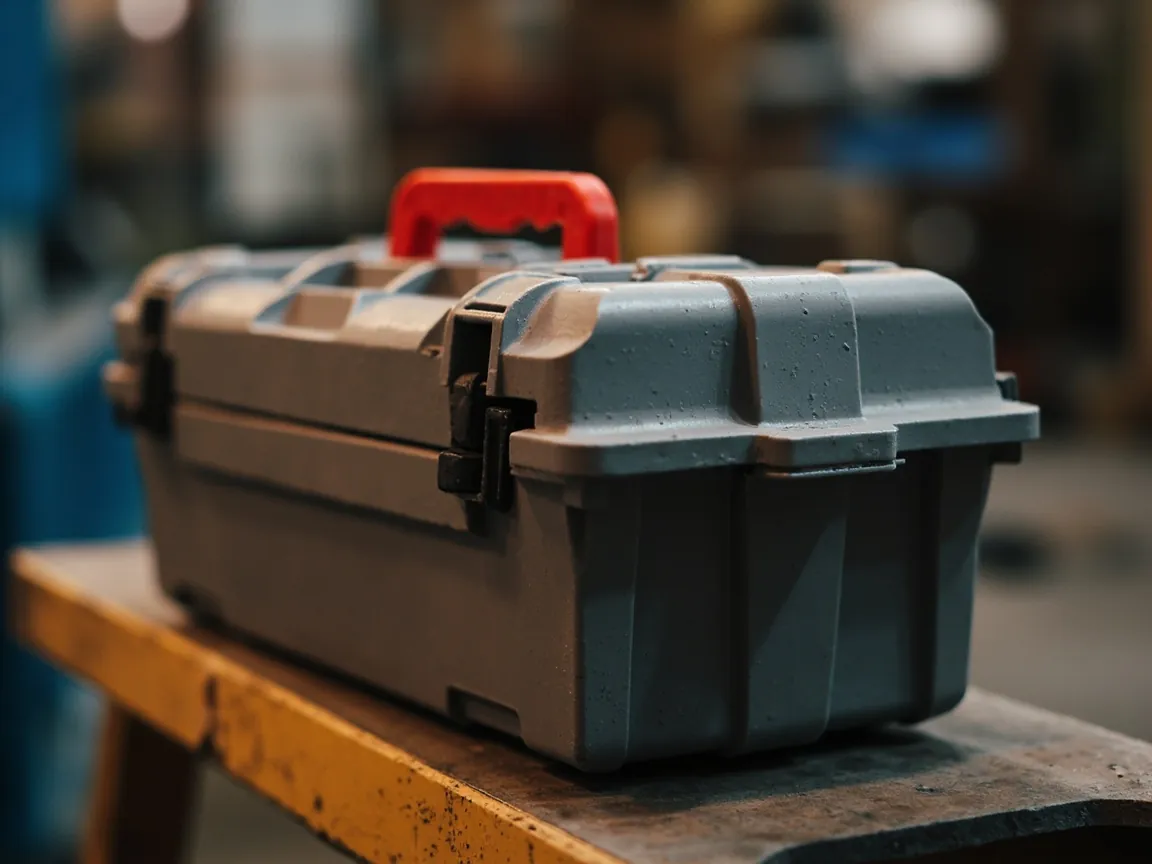
This section is about the other side of insulation, because the property cuts both ways.
Electrostatic risk. Plastics are excellent insulators, which also means they accumulate charge and do not readily bleed it away. In a dry environment, friction from carrying, wiping and handling tools generates static, and accumulated surface charge can reach thousands of volts. For a case carrying electronic components, circuit boards or sensors, that is a real risk: an electrostatic discharge can destroy sensitive devices.
The remedy is anti-static or conductive modification. Additives - anti-static agents, conductive carbon black, carbon nanotubes or metal fibres - lower surface resistivity into a target band:
| Material class | Surface resistivity, indicative (ohms per square) | Behaviour | Application |
|---|---|---|---|
| --- | --- | --- | --- |
| Standard insulating plastic | Very high, insulating | Accumulates charge | General tools |
| Anti-static grade | Medium, charge bleeds slowly | No sparking, does not attract dust | Electronics assembly |
| Conductive grade | Low | Rapid bleed, some shielding | Transporting sensitive devices |
| Metal | Very low, conductive | Natural shielding if earthed | Where shielding is needed |
Note: the actual figures vary widely between compounds, so specify a target surface resistivity band and ask for measured data rather than asking vaguely for "anti-static." Relevant standards include GB/T 1410 for resistivity measurement and the electronics industry's ESD control standards.
Electromagnetic shielding. If the contents need shielding from external interference, or if signals must not leak out, metal is the natural answer - the shell is a Faraday cage. Plastic can be shielded only with added measures: conductive coatings such as conductive paint or vacuum metallising, foil or mesh liners, or conductive plastics. Those options cost more and deliver limited shielding effectiveness, so where high shielding is required, metal remains the more reliable choice.
Spark risk. In flammable atmospheres - petrochemical plants, filling stations, dust environments - a metal case striking metal tools can spark, and that is an underestimated hazard. Engineering plastic shells do not spark - the same thinking behind non-sparking tools - but the plastic's own static accumulation has to be dealt with, so in explosive atmospheres use anti-static or conductive grades that bleed the charge away. Such environments must follow the applicable explosive-atmosphere standards; ordinary selection logic does not transfer.
The reverse side. A well-earthed metal case provides an excellent static bleed path and excellent shielding, which is an advantage in some applications. The point is to be clear about the direction you need - insulation, meaning protection against electric shock, or conduction and dissipation, meaning static control and shielding. Those point in opposite directions and one material cannot satisfy both; resolving them takes a composite approach, such as a plastic shell with a conductive liner and an earthing point.
Manufacturing and Customisation: Tooling Cost, Design Flexibility, Lead Time
This section is mainly for OEM/ODM and volume purchasing decisions.
Injection moulding, the plastic route. Tooling cost is high and piece cost is low: an injection tool, especially for a large case, represents a substantially higher up-front investment than sheet-metal tooling. That makes plastic the volume process - the more units, the lower the amortised cost. Design changes are expensive. Once the tool exists, altering the structure - moving ribs, adding an opening, changing insert recesses - means modifying the tool, which costs money and time, so design review before cutting steel is critical. The lead-time profile is a long first-article phase, tool design and build, followed by a short, fast, highly consistent production phase. And the structural freedom is exceptional: rib grids, labyrinth seal grooves, snap fits, living hinges, insert over-moulding and two-shot moulding - a hard shell with a soft-grip handle, for example - all in one part. Sheet metal cannot approach that.
Sheet metal, the metal route. Tooling and fixtures cost less, and for small runs or custom sizes the process is more flexible - laser cutting, bending and welding need no expensive tool. Design changes are cheap: a different size, another hole, a changed bend angle means a programme and fixture change, low cost and quick. The lead-time profile is a short first-article phase with no tooling to build, but a longer per-piece process time - cutting, bending, welding, grinding and finishing are separate operations - so capacity constrains large volumes. And structural freedom is limited: complex three-dimensional features need multiple operations, and some geometries, such as an integrally formed labyrinth groove, are expensive to produce.
| Dimension | Injection moulding | Sheet metal |
|---|---|---|
| --- | --- | --- |
| Up-front tooling | High | Low to medium |
| Piece cost at high volume | Low | Medium to high |
| Piece cost at low volume or custom | High, amortisation insufficient | Medium |
| First-article lead time | Long, tooling to build | Short |
| Production rate once running | Fast | Medium to slow |
| Cost of design change | High, tool modification | Low |
| Freedom of structural complexity | Very high | Medium |
| Dimensional consistency | Excellent, guaranteed by the tool | Medium, affected by accumulated process variation |
What this means for purchasing. Standard models in volume: plastic first, for cost, consistency and stable lead time. Non-standard sizes in small batches: metal may be cheaper, because there is no tooling to amortise. Complex internal features - insert recesses, labyrinth seals, snap fits: plastic has the advantage. Requirements that may change, needing frequent revision: metal is more flexible. High volume with a stable requirement: plastic's cost advantage grows with quantity.
On OEM/ODM programmes, JUNZHJIA generally advises along these lines: establish annual volume and requirement stability before settling material and process route, to avoid uneconomic choices such as cutting a tool for a small run.
Cost Structure and Life Cycle: Price, Maintenance, Repair, Recycling
Purchase price: at equal volume, an ordinary plastic toolbox is usually cheaper than a steel or aluminium one; but a premium protective case - PC material, high IP rating, custom insert - can cost more than an ordinary metal box. So comparisons only mean anything within the same tier and the same functional level.
In-service cost differences:
| Cost element | Engineering plastic | Metal |
|---|---|---|
| --- | --- | --- |
| Purchase price at equal tier | Usually lower | Medium to high |
| Transport cost, driven by weight | Low | High |
| Routine maintenance | Low - cleaning and gasket replacement | Medium-high - rust prevention, touch-up, coating checks |
| Corrosion repair | Not applicable | Possible - derusting, repainting, replacing corroded parts |
| Dent repair | Usually not repairable, replace | Can be panel-beaten, but affects appearance and sealing |
| Crack repair | Usually not repairable, replace | Can be welded, but affects coating and sealing |
| Gasket replacement | Required periodically | Required periodically |
| Expected life in normal duty | Years, limited by ageing | Years to longer, limited by corrosion |
Three cost points that get overlooked.
- The cost of losing the contents dwarfs the cost of the case. If the case carries instruments worth thousands, whatever you saved on the box is trivial next to one damage incident. So set the protection level from the value of the contents first, and only then compare material and price at equal protection.
- Transport and handling cost. Metal weighs more, so freight is higher and manual handling costs more; where air freight or long-distance shipping is involved, the weight difference shows up directly in the invoice.
- Downtime cost. A corroding metal case needs taking out of service for treatment and repainting; an ageing, cracked plastic case is usually simply replaced. Which is more manageable depends on your spares strategy - and because plastic cases are cheaper, a "keep one spare and swap it" policy is easier to justify.
Recycling and environment. Steel and aluminium have mature recycling streams and high scrap value. Plastics are more complicated: different resins have to be separated, and mixing or contamination sharply reduces recycling value. Metal wins on recyclability; plastics typically consume less energy to form than metals do to smelt and machine. Where an organisation reports on ESG or carbon footprint, this belongs in the assessment - using material carbon footprint data or recognised industry figures, and avoiding unverified precise numbers.
Selection Matrix: Recommended Material for Eight Duty Categories
Everything above, condensed into a table you can use directly.
| Duty | Key requirements | Recommended material | Main reason | Watch out for |
|---|---|---|---|---|
| --- | --- | --- | --- | --- |
| Live power and telecom work | Insulation, weathering, portability | Engineering plastic, ABS or PC | Intrinsic insulation safety | Confirm volume resistivity and flame rating |
| Construction site rotation | Drop resistance, dust, load capacity | Engineering plastic, toughened PP or PC | Energy absorption, light, no rust | Cold drop behaviour and UV ageing |
| Precision instrument transport | High protection, cushioning, sealing | Plastic protective case, IP65 or IP67 | Sealing easy, insert customisable | Custom EVA insert per instrument |
| Heavy tool storage | Load capacity, abrasion, theft | Metal, steel or aluminium | Strength, lockable | Rust prevention and coating upkeep |
| Coastal, marine, chemical | Corrosion and salt spray resistance | Engineering plastic, or 316 stainless | Plastic does not corrode | Metal option costs much more |
| Vehicle carried, including EVs | Light weight, insulation, temperature range | Engineering plastic | Light, insulating, no rust | Check HDT and low-temperature toughness |
| Electronic components, ESD areas | Static dissipative or conductive, shielding | Anti-static or conductive plastic, or metal | Set by the direction you need | Specify surface resistivity band |
| Near welding or heat sources | Flame retardance, heat resistance | Metal, or a high-temperature plastic | Plastics limited by temperature and flammability | Assess RTI and flame rating |
Some notes. In power and telecom, insulation is a hard requirement with almost no room to manoeuvre; beyond shell material, confirm the flame-retardance rating (UL94 / GB/T 2408) and get the insulation figures in writing. On construction sites, plastic wins on drop resistance and lightness, but choose a toughened grade and confirm low-temperature performance; where there is a lot of sharp rebar or cutting work, assess puncture resistance and consider metal, or plastic with metal corner protectors. For precision instrument transport, plastic protective cases are the outright home ground, because high IP plus a custom insert is easiest to achieve in plastic - see shockproof cases for precision tools. In coastal and chemical duty, plastic offers the best value by a wide margin; if strength forces metal, go straight to 316 stainless and accept the cost, because painted carbon steel has a short life there. And in ESD environments, be explicit about whether you need insulation or dissipation and conduction - they are opposites; electronics assembly usually needs anti-static behaviour to avoid dust attraction and discharge, while transporting sensitive devices may need conduction plus shielding.
Purchasing and Acceptance: How the Specifications Differ
Finally, clauses you can put into a technical agreement.
For a plastic shell, the essentials are:
- Material clause. Name the resin type and grade - PC/ABS blend, or copolymer or impact-modified PP - prohibit unapproved regrind in load-bearing parts, and require Charpy notched impact strength (GB/T 1043.1 / ISO 179), flexural properties (GB/T 9341) and deflection temperature under load (GB/T 1634 series) reports.
- Structural clause. State rib layout requirements, reinforcement at high-stress zones, and fillet radius requirements.
- Protection clause. State the IP rating (IEC 60529 / GB/T 4208, both digits) and the IK rating (IEC 62262 / GB/T 20138).
- Drop clause. State height, orientation, number of drops, thermal condition - ambient, cold, hot - and acceptance criteria.
- Weathering clause, for outdoor use. State the artificial weathering method and duration (GB/T 16422 series) with acceptance criteria, and confirm light stabilisers and antioxidants are present.
- Flammability clause, where applicable. State the UL94 or GB/T 2408 rating required.
- Electrical clause, where applicable. State volume resistivity and dielectric strength targets (GB/T 1410, GB/T 1408.1).
- Gasket clause. State the gasket material - EPDM or silicone for outdoor use - and that it is replaceable.
- Process and appearance clause. State acceptable sink, restrictions on weld line location, and prohibited defects.
For a metal shell, the essentials are:
- Material clause. State the grade - cold-rolled steel designation, aluminium alloy designation, or stainless designation such as 304 or 316 - and the sheet thickness.
- Finishing clause. State pre-treatment - degreasing, phosphating or passivation - coating type (powder or paint), coating thickness, adhesion (which can follow the cross-cut method in GB/T 9286), and colour with acceptable colour difference.
- Corrosion clause. State the salt spray method and duration (GB/T 10125, NSS/AASS/CASS) and acceptance criteria - rust grade and blister grade, which can follow rating methods such as GB/T 6461.
- Structural clause. State bending and welding requirements - weld quality, grinding - any stiffening, and edge treatment - deburring, rolled edges.
- Protection clause. State the IP rating, paying attention to sealing at welds and joints, plus gasket material and replaceability.
- Strength clause. State rated load, number of stacking layers and permitted deformation; where necessary, state a stiffness test method.
- Dissimilar metals clause. Where dissimilar metals meet - a steel body with aluminium rivets, for instance - state the galvanic corrosion protection measures.
- Earthing clause, where applicable. If the design relies on earthing, state earthing point locations, resistance requirements and inspection method.
Common to both: sampling plan and AQL, traceability marking (material code, lot number), the document list, and change control - notification and revalidation when material, process or tooling changes.
One universal purchasing recommendation: do not specify only the material. Specify "material plus performance target plus verification method." Writing "stainless steel" means little, because 304 and 316 differ enormously; writing "ABS" is not enough either, because virgin and regrind grades differ enormously. Convert every critical requirement into a measurable value and an executable test method. That is the step that turns purchasing from price comparison into engineering selection.
Frequently Asked Questions
Q: Is a metal toolbox always stronger than a plastic one? A: It depends what "stronger" means. If you mean static stiffness and puncture resistance, metal genuinely wins: steel's elastic modulus is tens of times that of an engineering plastic, so at equal thickness it is much harder to bend and much harder for a sharp object to pierce, which is decisive when carrying heavy tools or resisting theft. If you mean surviving drops and knocks, the answer is less clear-cut. Engineering plastics absorb impact energy through large elastic deformation and spring back, whereas metal takes a permanent dent once past yield. On a sealed case a dent is fatal: it stops the lid closing and makes gasket compression uneven, so the seal fails. Plastics also have pronounced strain-rate sensitivity and go brittle under fast loading, which is why cold drop testing has to be run separately. The correct engineering statement is: metal wins on stiffness and strength; plastic wins on energy absorption per unit mass and on recovery - and real behaviour depends on the specific grade, the structural design and the service temperature. The useful question is not "what material" but "which tests did it pass" - Charpy notched impact strength at material level (GB/T 1043.1 / ISO 179), the IK rating at product level (IEC 62262 / GB/T 20138), and drop testing at defined temperatures. Only the three together are persuasive.
Q: For live work, is a plastic-shell toolbox really safe? What should I watch for? A: A plastic shell's advantage around live work is intrinsic, but intrinsic safety is not unconditional safety. The advantage first: engineering plastics have volume resistivity typically in the order of ten to the power of more than ten ohm-centimetres (GB/T 1410 / IEC 60093), some twenty orders of magnitude away from metal. A plastic case does not become live across its whole surface because it touched a conductor, and it cannot form a conductive path between a tool and a live part. That is the primary reason the power, telecom and rail industries choose plastic. Four cautions. Insulation depends on material integrity and cleanliness - heavy contamination, moisture absorption, ageing cracks and conductive fillers in anti-static or conductive grades all lower it, so do not assume "plastic equals insulating"; ask for volume resistivity and dielectric strength data (GB/T 1408.1 / IEC 60243). Confirm the flame rating separately - for electrical environments, state the UL94 or GB/T 2408 requirement explicitly. Plastic does not substitute for certified insulating tools - the tools still have to meet the applicable live-working standards, and a plastic case does not lower that bar. And reinspect periodically - ageing, cracking and contamination all erode insulation, so cases used on live work belong in a regular inspection regime.
Q: Why do so many premium protective cases use plastic rather than metal? A: Three core reasons. First, high ingress ratings are easier and cheaper to achieve. Sealing depends on the gasket channel, flange flatness and clamp force distribution, all of which injection moulding produces in one operation with consistent dimensions; metal needs bending and welding, and every weld, rivet and screw hole is a potential leak path, while flatness across a large flange is harder to control. So for the same IP rating (IEC 60529 / GB/T 4208), the plastic route is usually much cheaper and less process-critical. Second, the weight advantage is worth a great deal wherever things are carried. At equal volume, a steel case may weigh three to five times a plastic one. Where cases are carried by hand, air-freighted or shipped long distances, that translates directly into freight cost and crew fatigue. Third, the insert can be tailored. A moulded part can carry complex mounting features, and combined with a routed EVA insert it delivers exact location and cushioning for each item - precisely what instrument transport needs. Add the extras: no rust, no sparking, and a moderate temperature to the touch. Metal still holds irreplaceable advantages in theft resistance, puncture resistance and electromagnetic shielding, which is why military and aerospace still use a great deal of metal - the difference is where the requirement sits, not which material is better.
Q: Do plastic toolboxes go brittle and crack in winter? What about metal? A: Plastics genuinely do embrittle when cold - that is common to thermoplastics. As temperature falls, molecular mobility drops and the material shifts from ductile to brittle, so cracks propagate more easily under impact. On top of that, plastics are markedly strain-rate sensitive - the faster the load, the more brittle they behave - and a drop is a fast load. So "survives fine at room temperature, cracks the moment it is dropped in winter" is a real field failure pattern. Assessment methods include GB/T 5470 for brittle temperature, and the more directly useful cold drop test: condition at the lowest service temperature long enough for the sample to equalise throughout, then drop from the specified height. Write that test into the technical agreement, particularly for northern markets, cold-chain surroundings and high-altitude work. Metals also have a ductile-to-brittle transition - some steels lose a lot of impact toughness when cold, which engineers must account for - but for common steels and aluminium alloys the transition usually sits far below the embrittlement range of plastics, so metal is often the more reliable choice in extreme cold. One more practical point about metal in the cold: it conducts heat quickly, so a metal case outdoors in winter feels painfully cold to touch, which is another reason outdoor crews prefer plastic.
Q: If I store electronic components, will a plastic case generate static? What do I do about it? A: Yes it will - and that is precisely the flip side of plastic's insulating advantage. Excellent insulation means charge does not readily bleed away. In a dry environment, friction from carrying, wiping and handling tools generates static, and accumulated surface charge can reach thousands of volts - enough on discharge to destroy sensitive semiconductor devices. That is not a theoretical concern; the electrostatic control standards of the electronics industry exist because of it. There are three routes. Anti-static modified plastics, which use an anti-static additive to bring surface resistivity into a band where charge bleeds slowly, without sparking and without attracting dust. Conductive modified plastics, using conductive carbon black, carbon nanotubes or metal fibres, which push resistivity lower for rapid bleed and a degree of shielding. Or a plastic shell with a conductive liner or anti-static bags, keeping insulation and protection on the outside while the sensitive parts are wrapped in static-safe material inside. The single most important purchasing point is not to ask vaguely for "anti-static" but to state a target surface resistivity band and require measured data (per GB/T 1410) - compounds vary widely, and a vague requirement cannot be verified. If you also need electromagnetic shielding, a metal shell is a natural Faraday cage, while plastic needs conductive coatings or foil liners, and both cost and effectiveness need separate assessment.
Q: For seaside or chemical plant use, which material is best? A: In these environments the central problem is corrosion, and engineering plastic is usually the best value. Look at what metals do: ordinary carbon steel rusts quickly in chloride environments, and even with a coating, a scratch rusts preferentially and creeps beneath the film. Aluminium suffers pitting and crevice corrosion in chlorides, and faces galvanic corrosion where it contacts dissimilar metals. 304 stainless can still pit in coastal atmospheres, and harsher conditions demand 316 or better at substantially higher cost. Engineering plastics, by contrast, do not corrode at all, and on that dimension need essentially no maintenance - a decisive advantage. Three supporting points. Confirm weatherability: coastal UV is intense, so choose a weatherable grade with light stabilisers - ASA generally outperforms ABS outdoors - and ask for the artificial weathering report (GB/T 16422 series). Confirm chemical compatibility: check the specific media present at the plant against the material, because ABS is sensitive to some organic solvents and can suffer environmental stress cracking. And manage salt crystallisation: after coastal use, salt crystallises on sealing faces and latches, so rinse with fresh water and dry - that one maintenance step markedly extends the life of both the gasket and the metal hardware such as latch pins and hinges. If strength or theft resistance forces metal, go straight to 316 stainless, accept the cost increase, and state the salt spray requirement (GB/T 10125) explicitly.
Q: For a small custom run, is plastic or metal better value? A: It comes down to quantity and requirement stability, and the core issue is tooling amortisation. Injection moulding carries a much higher tooling investment than sheet-metal fixtures but a very low piece cost; sheet metal - laser cutting, bending, welding - has low tooling cost but many operations and high labour per piece. So there is an economic crossover: below it, metal is better value because there is no expensive tool to amortise; above it, plastic wins on piece cost, cycle speed and consistency. Where that crossover sits depends on structural complexity and size, so it has to be calculated per project. Three further factors. Requirement stability: if the requirement may move - different size, extra hole, changed structure - metal's revision cost is far below plastic's, since tool modification is expensive and slow, and that can favour metal even at moderate volumes. Structural complexity: if you need labyrinth seal grooves, complex ribbing, snap fits or living hinges, injection moulding produces them in one operation in a way sheet metal cannot match, and plastic may be worth it even at low volume. First-article lead time: metal has no tooling stage, so the first article comes quickly; plastic needs a tool first, giving a longer first article but faster production afterwards. The practical recommendation is to establish annual volume, requirement stability and structural complexity before settling the process route. On OEM/ODM programmes, JUNZHJIA advises within this framework, to avoid uneconomic choices such as cutting a tool for a small run.
Q: Can the two be combined? Is a plastic shell with a metal frame practical? A: It is practical, and in some applications it is the best answer. Three hybrid patterns are common. Plastic shell with metal corner and edge protectors, fitting metal guards at the eight corners and along the edges to make up for plastic's weakness on puncture and abrasion while keeping light weight and insulation - a standard approach on sites and in transit. Plastic shell with a metal frame or internal chassis, where the metal carries the main load and the plastic provides protection and appearance, suited to duties needing higher load capacity without unacceptable weight. And metal body with a plastic liner or covering, where metal supplies strength and shielding while the plastic liner supplies cushioning and insulating separation - common for instruments and electronics. Three problems must be handled in any hybrid. Galvanic corrosion between dissimilar metals: steel with aluminium, or aluminium with stainless, forms a galvanic couple in the presence of an electrolyte - rain, salt spray - and the more negative material corrodes faster, so isolation by insulating gaskets, coatings or material choice is required. Mismatch in thermal expansion: plastics expand roughly an order of magnitude more than metals, so in environments with large temperature swings a rigid joint generates thermal stress and can crack, and the design needs clearance or a compliant connection. Cost and weight increase: a hybrid carries the advantages of both and the costs of both, so it only pays where a single material genuinely cannot meet the requirement. And if a plastic shell gains a lot of metal hardware, check whether the original insulation advantage has been eroded - in live-work environments any exposed metal part can become a conductive path, which needs specific assessment.
Conclusion and Further Reading
Back to the question: plastic or metal for a toolbox shell? The answer is "run the three tests" - live conductors or electrostatic sensitivity, which sets the insulation requirement; whether the failure mode is dropping and knocking or puncture and heavy loading, which sets impact and strength; and whether the environment is corrosive, which sets weathering.
Three conclusions worth carrying away.
First, choose engineering plastic where the work is live, the environment is damp or corrosive, people carry the case frequently, or a high IP rating is needed. Its insulation, freedom from corrosion, low weight and ability to form sealing geometry in one operation are things metal cannot match.
Second, choose metal where you need puncture resistance, theft resistance, electromagnetic shielding, or operation close to a heat source. Its absolute strength, shielding and heat tolerance are plastic's weak points.
Third, never compare material alone - compare "material plus performance target plus verification method." "Stainless steel" is meaningless on its own, because 304 and 316 differ enormously, and "ABS" is not enough either, because virgin and regrind differ enormously. Put the measurable values into the technical agreement - IK rating (IEC 62262 / GB/T 20138), impact strength (GB/T 1043.1 / ISO 179), HDT (GB/T 1634 series), IP rating (IEC 60529 / GB/T 4208), salt spray (GB/T 10125), artificial weathering (GB/T 16422 series) - and purchasing stops being price comparison and becomes engineering selection.
JUNZHJIA is manufactured by KeXin New Materials (Guangdong) Co., Ltd. at its Zhongshan facility, supplying protective cases, toolboxes, military and ammunition cases and IP67 waterproof enclosures to wholesale, distribution and OEM/ODM customers worldwide. Engineering thermoplastics are the principal process route, and material selection advice, custom inserts and test documentation can be provided against a stated duty. Where the requirement genuinely sits in metal's territory, the process route is reassessed from the requirement rather than the sale being pushed from existing capacity.
Further Reading