

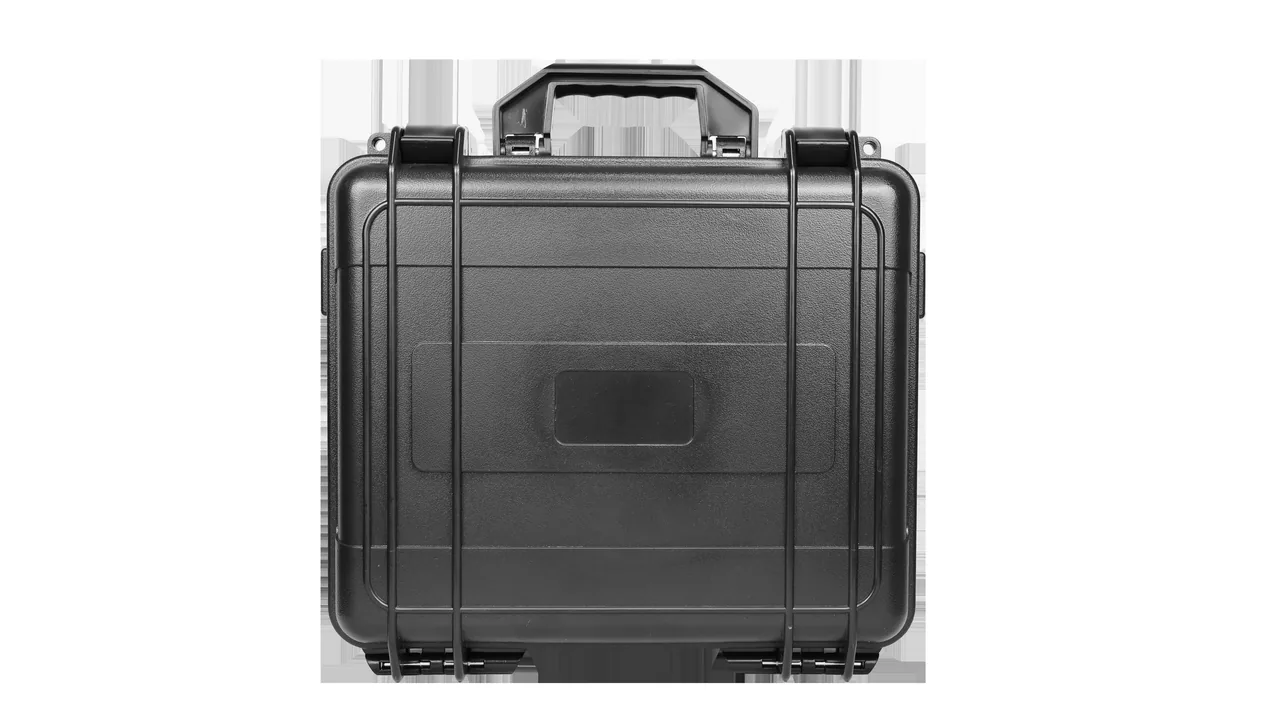
Corn harvesters endure relentless duty cycles during the short, high-pressure grain window. Their wear parts fail fast, and the cost of a stalled machine in the field is measured in lost tonnes per hour. Whether the concern is snapping-roll ribs, husking-rubber rollers, chopper blades, or drive sprockets, damage during transit or storage is exactly the kind of avoidable loss that a purpose-built protective case is designed to prevent. From the perspective of a case manufacturer, JUNZHIJIA builds corn-harvester parts cases around three engineering priorities: heavy-load support, rubber-roller surface protection, and rust prevention for bare metal components.
Why corn harvester spare parts need a dedicated protective case
Corn harvester components share a difficult trait: their individual weights span an extreme range. A sensor harness may weigh only a few hundred grams, while a husking-rubber roller assembly or a snapping-roll rib shaft can exceed twenty kilograms. Drop them together into a wooden crate or cardboard box and the heavy pieces will, under road vibration, repeatedly crush the light ones. Rubber roller surfaces get scored by metal edges, and sprocket teeth quietly rust in humid air. By the time the operator opens the box in the field, the critical part is already unusable.
A dedicated case is not merely about "fitting everything in." It begins by studying the failure mechanism of each part, then decides how the cavity layout, liner, load path, and seal should be engineered. That is the approach JUNZHIJIA applies across agricultural machinery protection. The logic for long-part cradles and rust control is closely related to the combine harvester parts case, where headers and threshing drums face similar transit risks.
Seen from the repair-chain perspective, the case also acts as a buffer-stock container. Cross-region crews often pre-position wear parts at temporary depots inside the operating radius, then draw them locally when a machine fails in the field. If those forward-stocked spares were already damaged in transit or storage, the so-called rapid response becomes empty talk. The reliability of the case therefore directly decides equipment availability during the rush harvest. Before production, JUNZHIJIA usually requests real samples or 3D models of the parts, builds a prototype to confirm liner fit and load behavior, then moves to batch manufacturing, avoiding the awkward outcome of "a pretty box that cannot hold the parts steady." For distributors, standardized cases also unify bin coding and in-out workflows, lowering manual mis-shipment rates.
Wear and deformation risks of snapping-roll ribs
The snapping rolls are the core components that strip the ear from the stalk. Their surface ribs, continuous spiral flanges welded to the roll body, determine snapping efficiency and stalk-breakage rate. The ribs are usually high-carbon steel or wear-alloy, hard but brittle. Without position control in transit, two rolls rolling against each other will chip the rib tips; even a tiny chip raises ear damage and kernel loss in the field.
A more hidden risk is weld deformation. The ribs rely on full-length welds to the roll body. If the roll is transported with both ends cantilevered and under pressure, bending stress travels through the weld into the rib root, forming micro-cracks invisible to the naked eye. These defects stay dormant through intake and only erupt after the machine goes to work. Therefore the snapping-roll ribs must rest on independent cradles supporting both ends, eliminating cantilever load, a central rule in our cavity design.
One further loss mode is easy to overlook: the protective coating on the rib surface. Some models specify a sprayed or plated finish on the spiral flanges to reduce friction, and that thin layer has very little resistance to rolling abrasion. If the case has no internal partition, two rolls can rotate against each other on a rough road, wearing the coating away exactly where it is thinnest. The exposed base steel then becomes the starting point for corrosion, and once rust creeps along the weld, repairing it properly is far more work than replacing the roll. Operators also cannot easily tell whether the discoloration is superficial flash rust or damage that has already reached the parent metal. We therefore give every snapping roll its own dedicated cavity with a rigid wall between cavities, removing the physical possibility of roll-to-roll rolling, and we wrap each rib tip in a thin foam sleeve so the most chip-prone area is individually shielded. That sleeve costs very little yet removes a large share of the scrap risk carried by the whole roll.
Surface crushing and scoring hazards of husking-rubber rollers
The husking rollers strip the husk from the ear by rubbing, and their surface is a rubber covering with spiral knurling. The rubber layer fears two things: permanent dents from hard pressure, and deep cuts from metal edges. A dent in the roller face causes local missed husking, letting husked ears enter the grain recovery system and degrading both quality and yield.
The roller is also awkwardly shaped and heavy. Stacked loosely in transit, the upper roller presses onto the knurling of the lower one, leaving impressions.
Temperature adds another variable that is often ignored. The rubber covering softens and hardens with the seasons: inside a closed trailer on a summer afternoon the temperature can pass sixty degrees Celsius, and rubber that soft, held under even modest continuous pressure, can take a shallow set that never fully springs back. In winter, the same rubber becomes stiff and brittle, and an impact against a metal edge cracks it rather than denting it. A liner that works at room temperature therefore proves nothing. We deliberately reject ordinary foam grades that soften and collapse when hot, specify closed-cell structures with more stable support, and re-check fit after cold-hot cycling before a design is released. JUNZHIJIA solves this with a custom-molded flexible liner cavity where each roller "lies" in its own slot, the face suspended, touching no hard object; an anti-stick treatment on the liner prevents rubber-foam migration over long contact. Similar roller protection logic applies to the rubber carrier wheels in the rotary tiller parts case.
Edge chipping and imbalance of chopper blades
The chopper blades cut and return the stalk to the field. Their edges are high-frequency quenched, extremely hard yet brittle. In transit, if an edge hits the case wall or another metal part, it chips; even a rice-grain-sized notch destroys rotational balance on the blade disc, causing violent vibration that accelerates bearing and shaft fatigue.
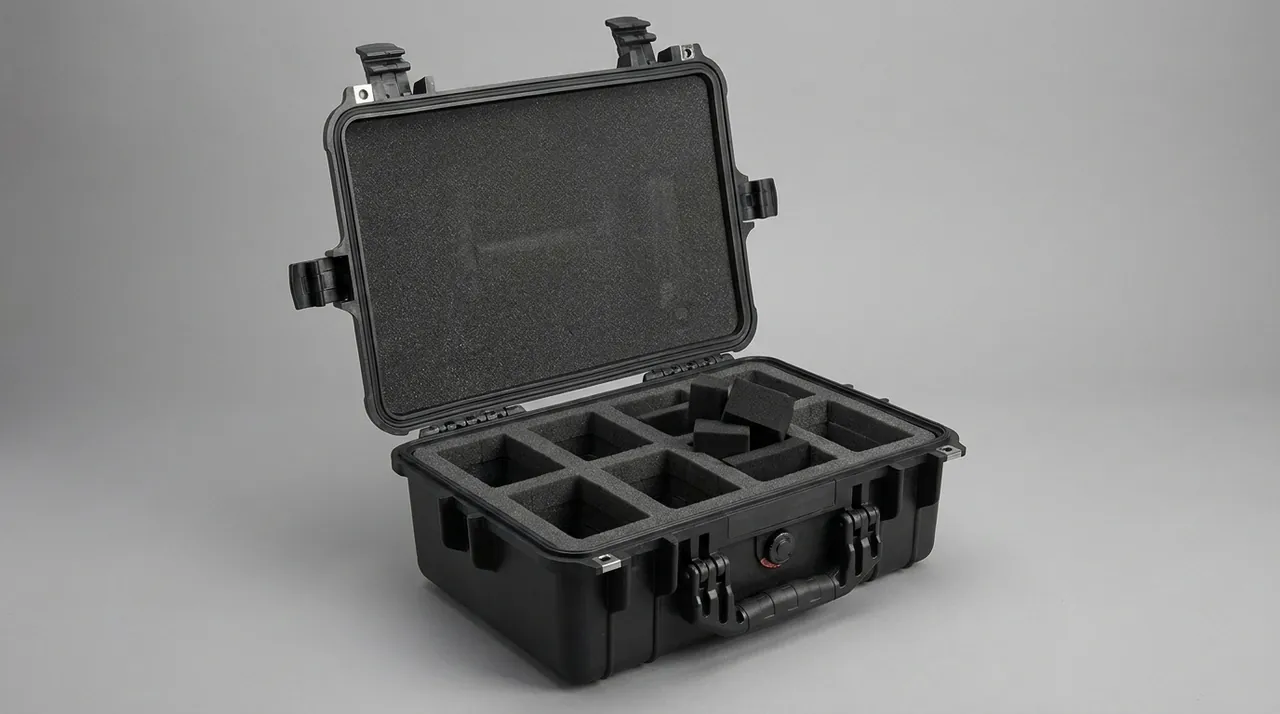
For blades we use a dual method of "edge isolation plus overall restraint": each blade's edge points inward, wrapped in an independent foam slot, while the blade back presses against the case reinforcement rib; the whole blade set is tied with positioning straps to forbid relative movement. Even on a rough trailer, blade edges never gnaw each other.
A second, quieter hazard for blades is flatness rather than the cutting edge itself. If one blade in a set takes a slight bend in transit, reinstalling it disturbs the weight distribution of the whole disc. The operator feels vibration at working speed but rarely traces it back to the transport phase, so the machine is run out of balance until a bearing fails. We therefore give the slot floor a stiffer support surface so the blade body bears load evenly across its area rather than being propped in the middle with both ends hanging free. Each blade set is also stored in its original disc assembly order, numbered, so the factory balance grouping is not broken up and mixed between trays. For vibration isolation of cutting tools, the anti-bend design in the mower-conditioner parts case is worth reading alongside this.
Transit rust on sprockets and drive components
Corn harvester drivetrains use many sprockets, chains, and spline shafts. These are mostly untreated carbon steel or only black-oxide finished, so during cross-region transit they meet dew, rain, and condensation from day-night temperature swings. Once case humidity runs out of control, tooth faces rust within days; installed, they raise mesh noise and wear, and in severe cases lock the drive entirely.
Sprockets have one further peculiarity: the tooth flank and the tooth root do not work the same way. The flank carries contact wear, while the root is a stress concentration zone, and corrosion there develops as pitting that drives inward and seeds fine stress cracks. Such damage is almost impossible to judge by eye and usually surfaces only when the chain starts jumping teeth or breaks outright. A sprocket is thus at higher risk than a plain steel plate, because it presents a large surface area with many concave corners where moisture lingers, out of reach of a rag or an air line. Chains are equally vulnerable: the pin-bushing clearance between links is tiny, so once rust seizes a chain it can only be replaced as a unit, never repaired link by link. We therefore recommend storing sprockets and chains in separate cavities, with the chain coiled and restrained so it cannot swing and hammer the tooth faces. Sprockets with protruding teeth go onto locating posts, suspended, with foam wrapped around the whole tooth circumference.
Rust is preventable. JUNZHIJIA places VCI vapor-phase rust-prevention paper and desiccants inside the metal cavity, paired with IP67 sealing to keep internal relative humidity in a safe band; for porous sprocket faces we add an extra rust-inhibitor wrapping layer to block water contact. More rust-control practice is detailed in metal toolbox rust prevention.
Why generic packing fails during the rush harvest
The rush-harvest window is brutally short, and parts flow fast between truck, field edge, and warehouse. A plain wooden crate carries weight but has no cushion and leaks water in rain. Cardboard is light yet cannot hold heavy parts, collapsing after two stack layers. Plastic totes breathe but cannot block dust or humidity, so roller surfaces collect grit that hurts grip friction.
The root failure is "generic packing for specific parts." Different parts need different restraint: heavy parts must survive stack pressure, rollers must avoid hard contact, blades must lock their edges, sprockets must control humidity. Handing all of this to one custom case is the real way to cut failure rates.
A second reason generic packing fails so reliably is the loading crew itself. Seasonal handlers hired for the rush window have no idea what is inside the boxes they are moving, so they throw and stack crates that look alike in the same posture: heavy cases end up inverted or leaning, and the "this way up" arrows printed on the carton go unread on a busy morning. The loads a part actually experiences therefore bear little relation to what the designer assumed. A custom case mitigates this by giving physical cues rather than instructions: a thickened base, corner guards, locating bosses on the top face, and a model-identification slot on the side all signal silently which way is down and how high the box may be stacked. During prototyping we ask customers to run a real-tonnage stacking trial, confirming that the case is positioned correctly even with no supervision, instead of depending on a printed sheet taped to the outside. This is the holistic protection idea long argued in the agricultural machinery parts case.
Many repair stations try a compromise of bubble wrap plus wooden crate, which looks cheap in the short term yet keeps causing trouble. Bubble wrap collapses under pressure and loses most of its cushion after repeated use; crate nails and splinters also tear the film during handling, exposing parts directly to moisture. Worse, wooden crates are hard to standardize, so the same part sits in a different position every batch, forcing the storekeeper to re-count each time, slow and error-prone. A purpose-built case removes these variables by fixing every part in a designed location, turning packing from a guessing game into a repeatable procedure that any handler can perform correctly.
Load-bearing skeleton design of the JUNZHIJIA case
To hold twenty-kilogram-class roller assemblies and snapping rolls, the case cannot be a hollow thin shell. JUNZHIJIA uses modified engineering-plastic rotomolded bodies with internal longitudinal and transverse reinforcement ribs; once the lid closes, the case becomes a rigid whole. The bottom support zone is thickened, and a high-density load plate sits under the liner, spreading heavy-part pressure evenly to the walls rather than concentrating it at one point.
Load design must also consider stacking. Field warehouses often pile several cases; the full weight of the upper case presses on the lower top. Our lid has a compression-strengthened ring with four-corner locating bosses, routing stacking load along the rigid "corner-to-wall" path so liner parts feel no vertical squeeze. For more on heavy-load architecture, see the heavy-duty case load structure notes.
On material choice, JUNZHIJIA prefers glass-fiber-reinforced modified polypropylene, balancing rigidity and impact resistance, more cold-resistant than ordinary ABS and less prone to brittle cracking at freezing field edges. Case corners use rounded transitions to reduce stress concentration, so drops are less likely to split from the edge. For especially heavy assemblies, we can embed a metal reinforcement frame at the base, guiding load further to the perimeter and avoiding the bottom bearing alone. This "plastic shell plus metal inner skeleton" composite lets a single case carry heavy loads without becoming too heavy to handle, balancing the contradiction between strength and portability for manual carrying and companion-vehicle loading.
Weight distribution matters as much as total strength. Roller assemblies and snapping rolls tend to concentrate on one side of the case, and without structural balancing the handler is left fighting an asymmetric moment that makes one-person lifting impossible. We lay out the load bay so the centre of gravity projects near the middle of the case, and we place carrying handles symmetrically so two people lift with equal effort. The same point governs stacking: a case whose centre of gravity sits off-centre will visibly lean by the third or fourth layer, and if it topples the full weight of the upper case lands on whatever is below, with consequences far worse than a scratched part. Besides reinforcement ribs, our bases are checked for flatness before shipment, so all four feet meet the ground together and a case never rocks in a stack because one corner hangs in the air.
Dedicated anti-crush, anti-scratch liner for rubber rollers
The roller liner is the most craft-intensive part of the whole case. We first 3D-scan the real roller shape, then mold by the "suspended clearance method": the slot is slightly larger than the roller OD, keeping at least three millimeters of air from any slot surface to the roller face, so during flips the face never touches bottom or wall. The slot wall uses closed-cell EVA foam with high rebound that recovers quickly and leaves no permanent dent.
For paired upper and lower husking rollers, liners are mirrored left-right so packing and unpacking order match, letting the operator reinstall without re-matching. The liner gets anti-static and anti-stick coating to avoid rubber bleed and reduce dust pickup. The foam-selection logic is also discussed in case foam material comparison.
To keep the liner in shape long term, we fix foam to the case wall with embedded snap tabs rather than simply gluing it. Glue ages with time and temperature swings, letting the liner shift inside and lose positioning accuracy; the snap structure can be repeatedly disassembled, so when foam gets dirty or worn it is replaced without affecting the case body. For users whose companion models change, this means only the liner module is swapped while the shell continues in service, saving cost and shortening lead time. We also mold the part name and quantity onto the foam surface per the customer's list, further cutting field mis-assembly probability.
VCI vapor-phase rust prevention and humidity control for metal parts
Sprockets, ribs, and blade shafts are extremely humidity-sensitive. JUNZHIJIA applies VCI vapor-phase inhibition inside the metal cavity: the rust-prevention paper releases inhibitor molecules in the sealed space, actively adsorbing onto metal surfaces to form a nano-scale protective film that needs no oil coating yet lasts months. Combined with silica desiccant packs, the cavity stays stably dry even in a humid outside environment.
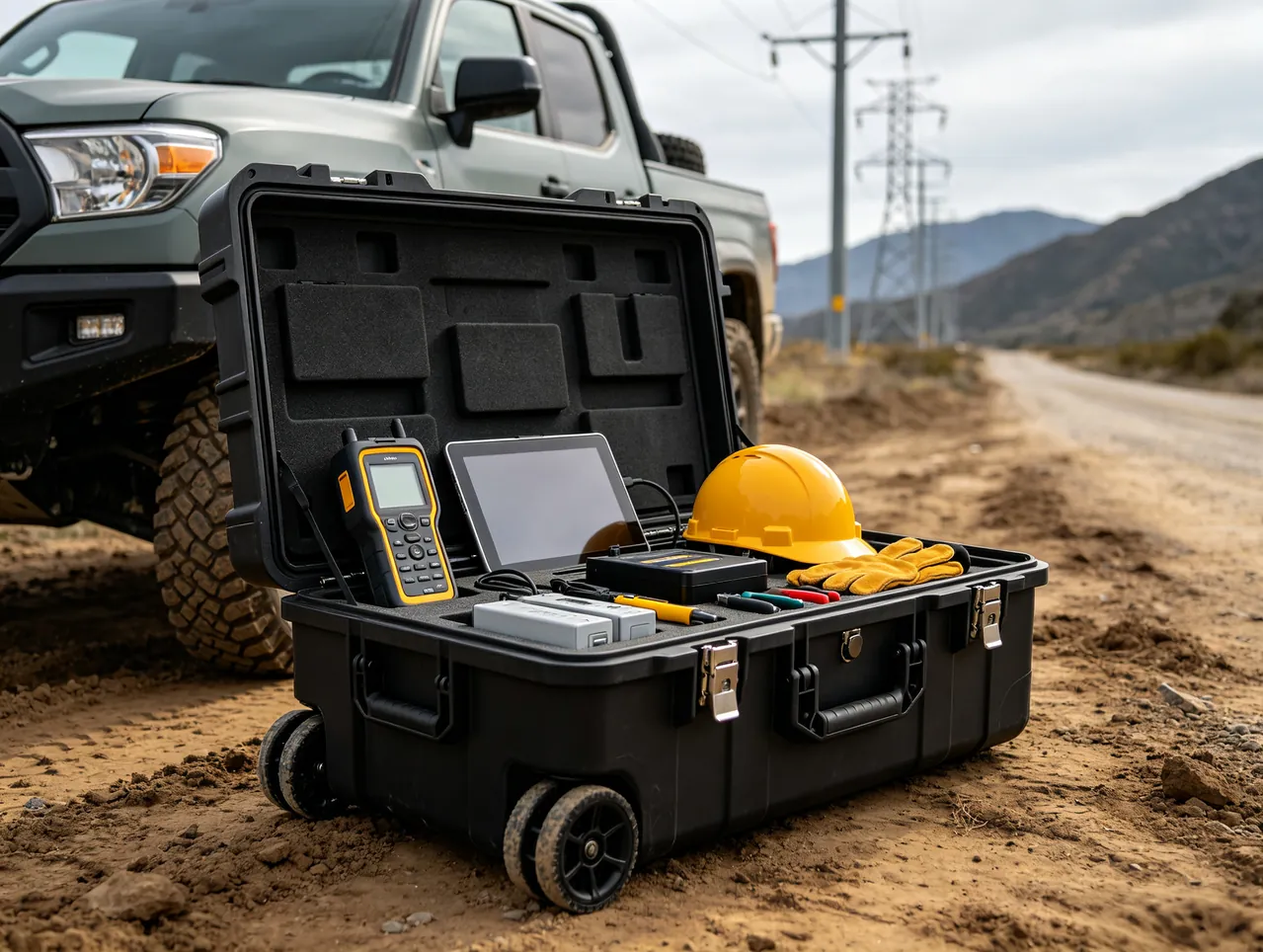
Crucially, VCI protection depends on sealing. Our lid uses a double gasket; once closed it reaches IP67, surviving brief submersion and resisting rain spray and muddy splash, vital for corn-harvester repair at open field edges. For the practical meaning of the rating, read IP67 protective case.
IP67 sealing and long-haul vibration isolation
Cross-region transit easily exceeds a thousand kilometers with complex vibration spectra. JUNZHIJIA sets an elastic damping layer between case and liner, absorbing and converting high-frequency jolts so parts never "walk" inside. Four corner compression blocks pre-load the liner slightly when closed, holding parts at zero clearance in any orientation.
Beyond waterproofing, IP67 also blocks dust and salt spray. For corn harvesters working on coastal or saline-alkali land, sprockets inside the case resist salt erosion; material and testing are covered in corrosion-resistant enclosure. We also recommend a humidity indicator card for sea freight or high-humidity storage, giving a quick read of cavity status on arrival.
One reminder: the sealing grade is a property of the closed state. After opening to take a part, if the lid stays open for a long time, outside humidity still slowly intrudes, so field operation should be quick to take and quick to close; during sustained heavy rain we still advise working under shelter. Once the lid is shut, the double gasket forms a continuous seal line under latch compression, and any single-point force will not break the overall airtightness, which matters on rough trailers. JUNZHIJIA conducts immersion and spray sampling on every batch before shipment, ensuring each delivered case meets the rated protection rather than only a sampled few passing at the factory.
Cavity layout: isolating heavy and light parts
A corn harvester repair kit often mixes many part types; loose mixing guarantees "heavy crushing light, hard hitting soft." JUNZHIJIA uses a vertical divided layout: the bottom is a load bay holding snapping-roll ribs and roller assemblies; the upper is a precision bay holding blades, sprockets, sensor harnesses, and standard bolts. A rigid partition fully isolates the two bays so upper weight never transfers to lower parts.
Division also boosts management efficiency. Each bay carries a part list and diagram; the storekeeper scans to verify contents. Different models and model years are cased separately to avoid mis-pick.
A partition is not better because it is thicker. An over-thick divider eats the cavity volume that matters, pushing heavy and light parts back into contact; an over-thin one bends under stacking load and stops isolating anything at all. We work backwards from the real part dimensions to set divider thickness, usually landing in a band that carries the full weight of the case above without meaningfully reducing usable volume, and we anchor both divider ends into the walls through reinforcing ribs of the same material so the partition cannot work loose on a rough road. The precision bay is subdivided again: loose fasteners such as bolts and washers go into lidded compartments so they cannot scatter into the load bay and act as an abrasive between heavy parts over months of transport. For users managing multiple machinery spares, the zoned loading idea in the tractor implement transport case is a useful parallel.
Positioning methods for sprockets and ribs
Sprockets are disc parts, thin at the edge and thick at the center, most vulnerable to sideways tipping and tooth-to-tooth impact. We designed a tapered locating post: the center hole slips onto the post and is locked by an elastic ring, keeping the sprocket vertical and suspended with foam around every tooth. Multiple sprockets are separated by interlayer plates, forbidding hard tooth contact.
Snapping-roll ribs use a long-part cradle: two parallel load rails support both roll ends, the ribs hanging between them, avoiding cantilever bend and preventing rib tips from scraping the wall. The cradle height is adjustable for different roll lengths. End-cap foam absorbs axial shock. This cradle idea also fits the digging-blade bar fixation in the potato harvester parts case.
Restraint design must also account for whether a part can be taken out comfortably. Some schemes chase maximum constraint and grip parts so tightly that removal needs a pry bar; a technician working in a hurry in the field is then more likely to slip and strike the part, or tear the foam, than if the fit had been moderate. We hold clamping force within the range a gloved hand can overcome: slot mouths are chamfered to guide the part into position on the way in, and it lifts out along a fixed angle on the way out. For heavy disc parts such as sprockets we leave a finger recess so the handler can get underneath rather than pulling on the teeth and deforming a tip, and for long parts such as snapping rolls the cradle leaves lift clearances at both ends so two people can raise them together. The goal is zero movement in transit, not an unopenable box at the field edge, and the right point between those two depends on trial unpacking by the people who actually use it during prototyping.
Independent buffer protection for blade edges
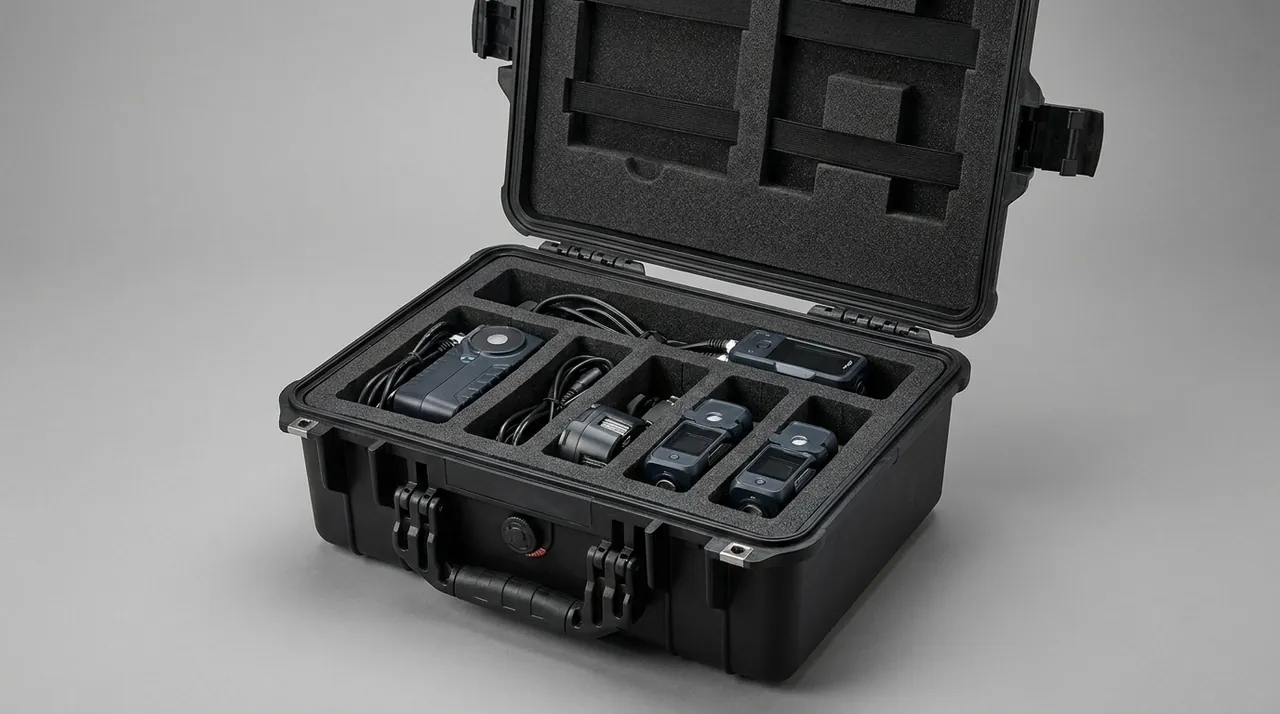
The chopper blade edge is the most delicate part of the whole spare set. We cut an independent slot in the liner for each blade; the edge points to the case central axis, wrapped in thickened foam, while the blade back rests on the case reinforcement rib for support. Walls between slots fully separate them, ensuring edges never touch under any jolt.
We also add error-proofing to the loading order: slots are numbered by disc installation sequence, so the operator assembles by number after opening, cutting field matching time. For blade backs with slight rust, we pre-place rust paper in the slot to maintain the part during transit. Blades and sprockets are both bare-metal rust risks; their combined care is mirrored in the fertilizer spreader parts case corrosion-resistant packing.
Field access and warehouse stacking efficiency
The case ultimately serves field-repair rhythm. JUNZHIJIA offers optional wheels and a pull handle on the standard case, so even a heavy box moves to the field edge by one person; the wide-opening lid gives a full view, no digging required. Wear-resistant corner guards survive repeated stacking and handling without cracking.
On the storage side, the top and bottom have interchangeable locating structures, staying vertically stable through seven or eight stack layers and saving warehouse area. The exterior reserves a label slot for model, year, and part-list cards, pairing with asset QR-code tracking for digital in-out management. This matters most for dealers who must stock long-term.
Over the full life cycle, JUNZHIJIA cases use recyclable modified engineering plastic; a worn shell can be regenerated, aligning better with the green-procurement preference of today's machinery service providers than single-use wooden crates. Joints and latches are replaceable standard parts, so daily knocks do not scrap the whole case; swapping a component restores use and further spreads the per-use cost. For cross-region crews, the lightweight case also lowers fuel and space consumption of companion vehicles, letting limited truck volume carry more spares and indirectly raising the service capacity of a single dispatch.
One aspect worth treating separately is how the case itself is secured on the vehicle. A case placed in a truck bed by its own weight alone will shift, and under hard braking the whole box slides forward and slams into its neighbour. However good the liner is, external impact can still damage the parts inside. We advise running strapping through the moulded tie-down channels for longitudinal restraint and inserting small battens between cases so load transfers along the walls instead of bearing directly on the neighbouring box; near the tailgate, empty or lightly loaded cases should be positioned as a buffer. Where a case must be opened repeatedly in the field, cam-buckle straps keep the load locked on the road without costing the crew minutes at every stop. These details look minor on their own, yet together they decide whether a protective system actually delivers its rated capability in daily use.
Ranking the three transit risk tiers
Not every risk in a spare-parts shipment is equal, and only by ranking them by likelihood and severity can a limited liner budget be spent where it changes the outcome. We group corn harvester transit risk into three tiers.
The first tier is high-frequency, high-loss deformation and crushing, concentrated in awkwardly shaped heavy parts such as rubber rollers and snapping-roll ribs. These parts carry stress on essentially every trip, so if the liner under-restrains them, failure is certain rather than probable, and tooling investment is justified first.
The second tier is lower-frequency but severe edge and balance damage, concentrated in chopper blades. A chipped edge is less likely than a dented roller face, yet the consequence is far heavier: one scrapped blade can put a whole machine out of action, which makes this a low-probability, unacceptable-outcome risk. The third tier is slow, low-frequency corrosion across sprockets, chains, and metal fasteners. It does not destroy a part immediately, but it advances quietly over weeks and frequently only becomes visible after assembly, which makes it expensive to correct. Once risk is tiered, the trade-offs become clear: deformation is solved by structure, edges by isolation, corrosion by sealing and vapour-phase chemistry, and no single liner logic can serve all three.
Q: What goes wrong most often with snapping-roll ribs in transit? A: The two most common transit problems for snapping-roll ribs are surface micro-chipping and weld-root micro-cracking. The ribs are spiral flanges, hard yet brittle; without in-case positioning, two rolls rolling against each other chip the rib tips, which then damage ears and raise kernel loss in the field. More hidden is cantilever-induced weld cracking: if the roll body is supported only at the ends under pressure, bending stress travels through the weld into the rib root, forming cracks invisible at intake that erupt only after the machine works. A dedicated case cradles both roll ends so the ribs hang free, eliminating both failure modes at the source rather than after the fact. We also apply end-cap foam at both roll ends to absorb axial shock from sudden stops, and we keep the ribs away from any hard wall so a single jolt cannot translate into a tip fracture. This is why the cradle, not the cushion, is the first thing we design for this part family.
Q: Can husking-rubber rollers be shipped in ordinary cardboard boxes? A: We do not recommend it. The roller face is a rubber covering with spiral knurling, most vulnerable to permanent dents from hard pressure and deep cuts from metal edges. A plain cardboard box has no individual slot and cannot resist the stack pressure of heavier parts above; the knurling gets impressed, causing local missed husking where husked ears enter the recovery system. Temperature makes the problem worse: in a closed trailer the rubber softens and takes a set under light continuous pressure, while in winter it stiffens and cracks on impact with a metal corner, so a liner that only passes a room-temperature test proves very little. JUNZHIJIA molds a custom flexible liner cavity where each roller lies suspended in its own slot, kept at least three millimetres from any hard surface, using closed-cell foam chosen for stable support after cold-hot cycling. We mirror the left and right rollers so packing and unpacking order match, and the liner surface carries an anti-static coating to reduce dust pickup, because grit on the roller face changes grip friction and hurts husking uniformity once the machine is back in the field.
Q: How do sprockets and drive parts avoid rust during transport? A: Sprockets are mostly carbon steel or only black-oxide finished, highly humidity-sensitive; meeting condensation or rain they rust within days, then raise mesh noise or even lock the drive once installed. The harder problem is that a sprocket does not corrode uniformly. The tooth flank takes contact wear while the tooth root is a stress concentration zone, so corrosion there pits inward and seeds fine stress cracks that nobody can spot by eye until the chain jumps teeth or snaps. A sprocket also holds moisture far longer than a flat plate, because its many concave corners stay damp where a rag or an air line cannot reach, and once a chain seizes at its pin joints it can only be replaced as a complete unit rather than repaired link by link. JUNZHIJIA places VCI vapour-phase rust-prevention paper and desiccants inside the metal cavity, paired with IP67 sealing to hold internal humidity in a safe band, and adds an extra inhibitor wrapping layer over porous tooth surfaces to block water contact. Chains travel coiled in their own separate cavity so they cannot swing against the teeth. For high-humidity or sea-freight scenarios we suggest a humidity indicator card, so cavity status is known on arrival and the workshop shifts from reactive de-rusting to active prevention, with parts arriving clean and ready to fit during a harvest window when every hour counts.
Q: How should chopper blade edges be protected in transit? A: Blade edges are high-frequency quenched, hard yet brittle, and a single impact with the wall or another metal part chips them; even a rice-grain notch destroys disc balance and causes violent vibration. The method is "edge isolation plus overall restraint": each blade edge points inward, wrapped in a thickened foam slot, while the back presses the case reinforcement rib; the whole set is tied with positioning straps forbidding relative movement. There is also a quieter hazard that rarely gets blamed on transport: flatness of the blade body. If one blade takes a slight bend, reinstalling it disturbs the weight distribution of the entire disc, and the operator feels vibration at working speed without ever tracing it back to the trip that caused it, so the machine runs out of balance until a bearing fails. We therefore give the slot floor a stiffer support surface so the blade bears load evenly across its area instead of being propped in the middle with both ends hanging. Slots are numbered by installation sequence, and each set stays in its original disc grouping, preserving factory balance and preventing the wrong installation that would otherwise waste precious harvest hours.
Q: How many layers can the JUNZHIJIA corn case be stacked, and will it crush the parts? A: The standard case has interchangeable top and bottom locating structures, staying vertically stable through seven or eight stack layers. The key is a compression-strengthened lid ring with four-corner bosses that routes stacking load along the rigid corner-to-wall path instead of into the liner; liner parts sit at zero clearance, so the upper case weight never reaches the heavy parts inside. That said, a case only stacks predictably if its own centre of gravity sits near the middle, which is why we balance the load bay layout and check base flatness before shipment so all four feet meet the ground together and nothing rocks by the third layer. Actual layer count should still respect single-case load and floor capacity, and we advise following the stack-height label on the case exterior. For long-term storage, keep cases off direct sun on the lid, because sustained heat ages the engineering plastic and shortens the life of the gasket that actually earns the IP67 rating day after day. For palletized shipment we recommend edge-protection boards so strap tension spreads evenly rather than crushing one corner on rough rural roads.
Q: Is the case itself waterproof, and is open-field opening safe? A: This JUNZHIJIA series uses a double gasket and reaches IP67 when closed, surviving brief submersion and resisting rain spray and muddy splash, well suited to corn-harvester repair at open field edges. IP67 also blocks dust and salt spray, friendly to sprockets working on coastal or saline-alkali land. Note that IP67 describes the closed state only: the lid should be closed promptly after use, and during sustained heavy rain we still advise working under a shelter while keeping desiccants inside to extend the dry period. A more overlooked point is that the case must survive the journey before it is ever opened, so strapping should run through the moulded tie-down channels for longitudinal restraint and small battens should sit between cases, letting braking load travel along the walls rather than bearing directly on a neighbouring box, with empty or light cases positioned near the tailgate as a buffer. Once the lid is shut, the double gasket forms one continuous seal line under latch compression, so a single point of force will not break the overall airtightness, which is exactly what you want on a bouncing trailer. We sample-test every batch by immersion and spray before shipment, so the rating is verified rather than merely claimed on a datasheet.
Q: Can one case hold both heavy parts and small precision parts together? A: Yes, and that is exactly what divided cavities are for. We use a vertical divided layout: the bottom load bay holds snapping-roll ribs and roller assemblies, the upper precision bay holds blades, sprockets, sensor harnesses, and standard parts, with a rigid partition fully isolating the two so upper weight never transfers down. Each bay carries a part list and diagram for scan verification. Division avoids heavy crushing light and hard hitting soft, while raising storekeeper and operator efficiency for mixed kits used by cross-region service teams and repair stations alike. Two details decide whether the partition truly works. Thickness is set by working back from real part dimensions rather than by habit, since an over-thick divider steals cavity volume and pushes parts back into contact while an over-thin one bends under stacking load and isolates nothing; both ends are anchored into the walls through same-material ribs so the divider cannot work loose on a rough road. Inside the precision bay, loose bolts and washers go into lidded compartments, because scattered small metal parts act as an abrasive between heavy components and can damage a roller face over months of transport. When several machine models share one depot, colour-coded external tags by year and model let a scan locate the right case in seconds.
Q: What information should I give the manufacturer before ordering a custom case? A: To get a fitting solution, provide four things: first, real 3D dimensions or a sample of the parts to be packed, used for liner molding; second, single and total weight, deciding the load plate and rib specification; third, transport mode and environment, since land, sea, or humid storage change sealing and rust configuration; fourth, management needs such as wheels, QR labels, or stack limits. As a manufacturer, JUNZHIJIA can then output a cavity layout and prototype, confirmed before batch production to lower rework risk and protect your schedule. One more input is usually forgotten and matters as much as the drawings: how the case will be handled. Who lifts it, how far, whether it rides in a truck bed for a thousand kilometres, whether it is stacked in a depot or opened repeatedly at the field edge, and whether the crew that moves it will ever read a label. Those answers determine weight distribution, handle placement, tie-down channels, and how obvious the stacking cues need to be. We treat the prototype as the contract between expectation and delivery, inviting the actual users to unpack it, so nobody is surprised by the finished case.
Q: Is a custom case worth the investment versus a wooden crate? A: On total cost of ownership, yes. A wooden crate looks cheap because its purchase price is low, but the liner that is not there has to be paid for somehow, and the bill arrives as dented roller faces, chipped blade edges, rusted sprockets, and machines standing idle in the field during the only week that matters. Cardboard collapses after two stack layers and wood leaks in rain, so neither is really a comparison at the same duty level. A custom case is bought once and used for years: a worn liner module is replaced rather than the whole box, joints and latches are standard replaceable parts, and the recyclable shell can eventually be regenerated rather than discarded. Set against those savings, the failure modes are not hypothetical. Deformation is the most common transit loss, edge damage is the most severe per incident, and corrosion is the slowest to surface and the most expensive to discover after assembly. For a crew losing even a few parts a season, dedicated cases usually return their cost within one or two harvests.
Related Reading: