

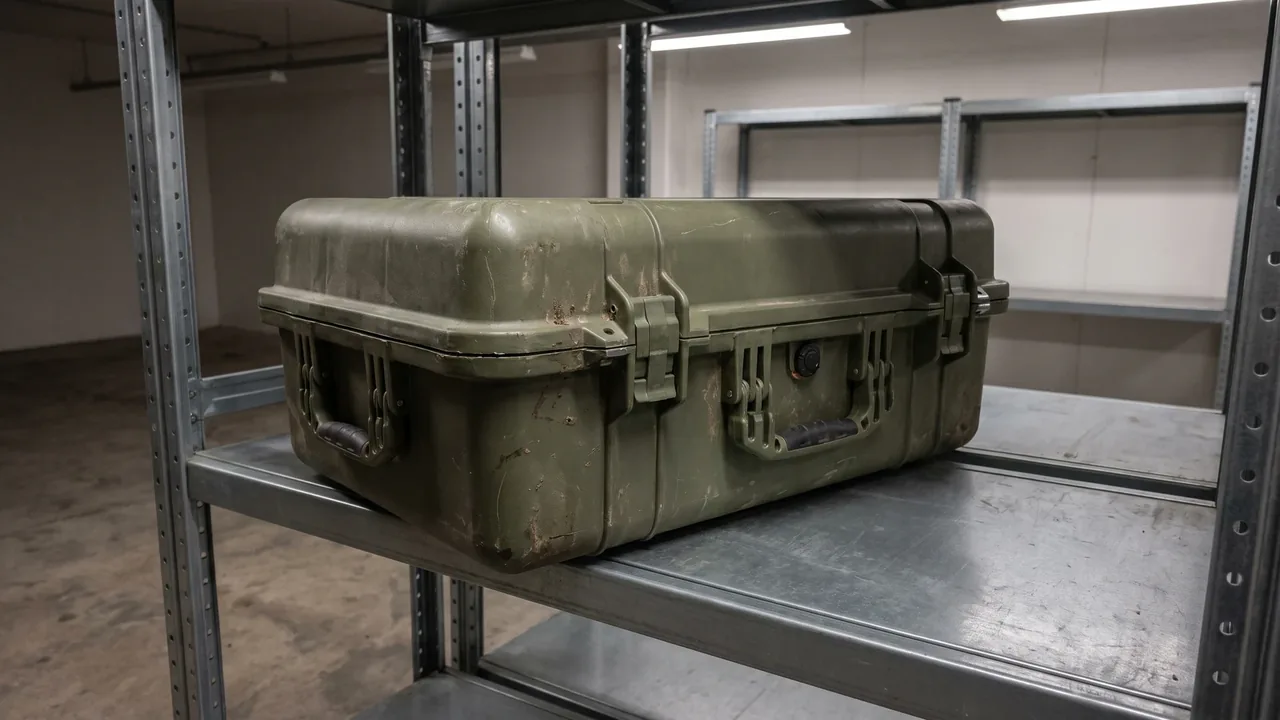
A fiber ammunition container is a packaging container whose primary load-bearing structure is made from fiber-reinforced composite, used to enclose and transport ammunition and its associated components. Its formal English designation follows the inverted order of military nomenclature — Container first, then Ammunition as the service category, then Fiber as the body material — which is why it is written "Container, Ammunition, Fiber" rather than in the ordinary word order of Fiber Ammunition Container. Reading that inversion correctly is the starting point for every technical figure that follows: the first position defines the item class as packaging, the second defines the category of contents it serves, and only the third defines the material of the load-bearing body. For ammunition packaging manufacturers and lightweight-procurement teams, the value of a fiber ammunition container concentrates in three places: lower self-weight per unit volume, higher specific stiffness, and better long-term dimensional stability in hot, humid and salt-laden environments.
Lightweighting is not simply a thinner wall. Fiber-reinforced composites are designable: the same outer envelope can be re-tuned across fiber type, ply angle, ply count and resin system to redistribute stiffness, toughness, corrosion resistance and mass. That freedom is also an obligation — get the layup wrong and the container can end up heavier and more brittle than a steel box. This article approaches the subject purely as packaging-container engineering: material selection, layup and wall thickness, molding routes, liner zoning, sealing and ingress protection, rust prevention and humidity control, lightweighting against load balance, cushioning and stacking, lifting and fork handling, locks and tamper seals, traceability labels, certification testing and palletisation. It discusses the container itself, never the physical or chemical properties of its contents. Local regulations and export-control requirements govern; this article addresses packaging containers only.
Table of Contents
- Naming and Positioning: The Inverted Logic of Container, Ammunition, Fiber
- Fiber Reinforcement Selection: Weighing Glass, Aramid and Carbon
- Layup Sequence and Wall Thickness: The Core of Container Structural Logic
- Compression Molding and Filament Winding: Where Each Process Fits
- Liners and Cavity Zoning: Keeping Precision Parts Out of the Load Path
- Sealing and Ingress Protection: IP Ratings and Pressure-Equalisation Valves
- VCI Rust Prevention and Internal Humidity Control
- Lightweighting and Load Balance: How to Allocate the Weight Budget
- Cushioning and Stacking: The Vertical Load Path
- Lifting, Fork Handling and Manual Carrying Interfaces
- Locks, Tamper Seals and RFID Traceability
- UN Packaging, Export Controls and MIL-STD-810H / GJB Testing
- Palletisation and Multi-Case Unitisation
- Frequently Asked Questions (FAQ)
- Conclusion and Related Reading
Naming and Positioning: The Inverted Logic of Container, Ammunition, Fiber
Military nomenclature tends to order its terms as class, then purpose, then distinguishing feature, so "fiber ammunition container" becomes Container, Ammunition, Fiber. The order is not a grammatical slip but a classification requirement: Container states that the item is packaging, Ammunition states the category of contents it serves, and Fiber states that the load-bearing body is fiber-reinforced composite. When procurement documents, drawing title blocks and technical agreements keep to that convention, the item cannot be confused with the contents themselves or with a storage facility in an ordered bill of materials. The everyday order Fiber Ammunition Container reads perfectly well in prose, but in a formalised military packaging list it disturbs an established sort order, so this article uses the inverted form as the formal name and shortens it to fiber ammunition container in running text.
In engineering terms, a fiber ammunition container solves the same class of problem as steel or timber containers: it isolates the contents from moisture, salt fog, shock, stacking load and careless handling during transport and storage. What changes is the load-bearing material. A metal container offers design freedom in two dimensions, grade and plate thickness. A composite offers freedom across hand layup, compression molding, filament winding and pultrusion, and lets fiber direction follow the load path. The direct benefit is that, at equal stacking and impact requirements, a composite container can normally be built considerably lighter than a metal box of the same internal volume, which reduces handling risk per unit and raises pallet and container utilisation.
Freedom brings new constraints. Composites are more sensitive to structural discontinuity than steel: holes, corners, overlaps and embedded fittings all interrupt the fiber path and become starting points for stress concentration and delamination. The structural logic of a fiber ammunition container is therefore not "pick a plate thickness and weld it up." It begins from the load path: decide which faces carry stacking and impact, which faces only seal and screen, and then keep the fiber running continuously along the load direction. Continuity of fiber buys the lightweighting, and structural zoning buys the reliability — the same designability logic that separates engineering-plastic cases from ordinary plastic boxes, as set out in case-engineering-vs-normal-plastic.
Fiber Reinforcement Selection: Weighing Glass, Aramid and Carbon
Three families of reinforcing fiber dominate fiber ammunition container work: glass (E-glass and S-glass), aramid and carbon. The differences are not about which is "better" but about the trade between stiffness, toughness, density, corrosion resistance and cost. Glass fiber is the cheapest, corrosion-resistant and electrically insulating, with relatively high elongation at break, so it is the mainstream choice for shells and load-bearing ribs; its weakness is low specific stiffness, so achieving high stiffness means adding thickness, and weight rises with it. Carbon fiber has the highest specific stiffness and the best dimensional stability, suited to cases sensitive to both mass and geometric accuracy, but it is expensive, relatively brittle under impact, and forms a galvanic couple when it touches metal hardware. Aramid fiber stands out for specific strength and impact toughness and is often placed where impact energy has to be absorbed locally.
Real structures rarely use one fiber alone. The common approach is a hybrid layup: glass for the shell to secure corrosion resistance, toughness and cost, with carbon or aramid fabric inserted locally at latch zones, hinge zones, floor ribs and other stress raisers. This captures most of the lightweighting benefit without paying the cost and brittleness of an all-carbon box. When selecting fiber, list four figures together — density, elastic modulus, elongation at break and cost per kilogram — rather than looking only at the single highest value, because a container is a member under several overlapping load cases and any one weak link will surface in transport testing.
The resin matrix has to be chosen as well. Unsaturated polyester is cheap and easy to process; vinyl ester resists corrosion and hydrolysis better than polyester and is common for outdoor and sea-freight use; epoxy gives the best mechanical performance and fiber-matrix bonding but demands tighter cure control and costs more. The resin determines whether the fiber can pass its load on — fiber carries, resin transfers and protects. If fiber is the rebar, resin is the concrete. For a broader cross-material comparison, protective-case-plastic-materials sets out how plastics and composites differ across corrosion resistance, temperature range and cost.
| Fiber type | Specific stiffness | Impact toughness | Corrosion resistance | Relative cost | Typical use |
|---|---|---|---|---|---|
| --- | --- | --- | --- | --- | --- |
| E-glass | Low | High | Good | Low | Shell body, ribs |
| S-glass | Medium | High | Good | Medium | High-stiffness panels |
| Aramid | Medium-high | Very high | Medium | High | Local impact reinforcement |
| Carbon | Very high | Medium-low | Good | Very high | Accuracy-critical panels, beams |
| Hybrid layup | Tunable | High | Good | Medium-high | Latch, hinge and floor zones |
Layup Sequence and Wall Thickness: The Core of Container Structural Logic
Layup sequence fixes how the container deforms under load. A workable approach splits the layup into skin, core and inner skin. The outer skin carries bending tension and resists external scratching; the inner skin works with the liner against local crushing by the contents; the core between them separates the two skins so that bending stiffness is gained at very little weight cost. This is the principle of a sandwich: bending stiffness rises roughly with the square of the skin separation, so a thicker core is a more efficient bending member — but local crush resistance falls, so core density and thickness must be checked against the stacking load.
Ply angles must not be placed arbitrarily. With 0 degrees along the primary load direction, 90 degrees across it and ±45 degrees taking shear, a common balanced layup follows a symmetric [0/±45/90] family. Symmetry matters because it cancels the uneven shrinkage that appears after cure, so the box does not emerge with built-in residual stress and warp. If adjacent plies differ too sharply in angle — 0 degrees directly against 90 degrees — interlaminar shear concentrates and promotes delamination, which is why ±45 degrees is used as a transition. Symmetric, balanced and gently graded: the three baselines of layup design.
Wall thickness is the macroscopic result of the layup and should never be set on its own. Under stacking, the sidewalls see in-plane compression combined with local buckling; under lifting and fork handling, the floor sees concentrated load; under drop, the corners see impact. The governing thickness may differ across all three. A thickness is adequate only if it keeps in-plane compression from buckling, keeps local bearing from collapsing and keeps corner impact from cracking — the same beam-and-plate reasoning used in case-wall-thickness-strength. For projects that must hold both low mass and a high stacking count in one box, JUNZHIJIA normally recommends moulding a flat coupon first, measuring flexural modulus and interlaminar shear strength, and back-calculating the thickness rather than scaling a steel box wall directly.
Compression Molding and Filament Winding: Where Each Process Fits
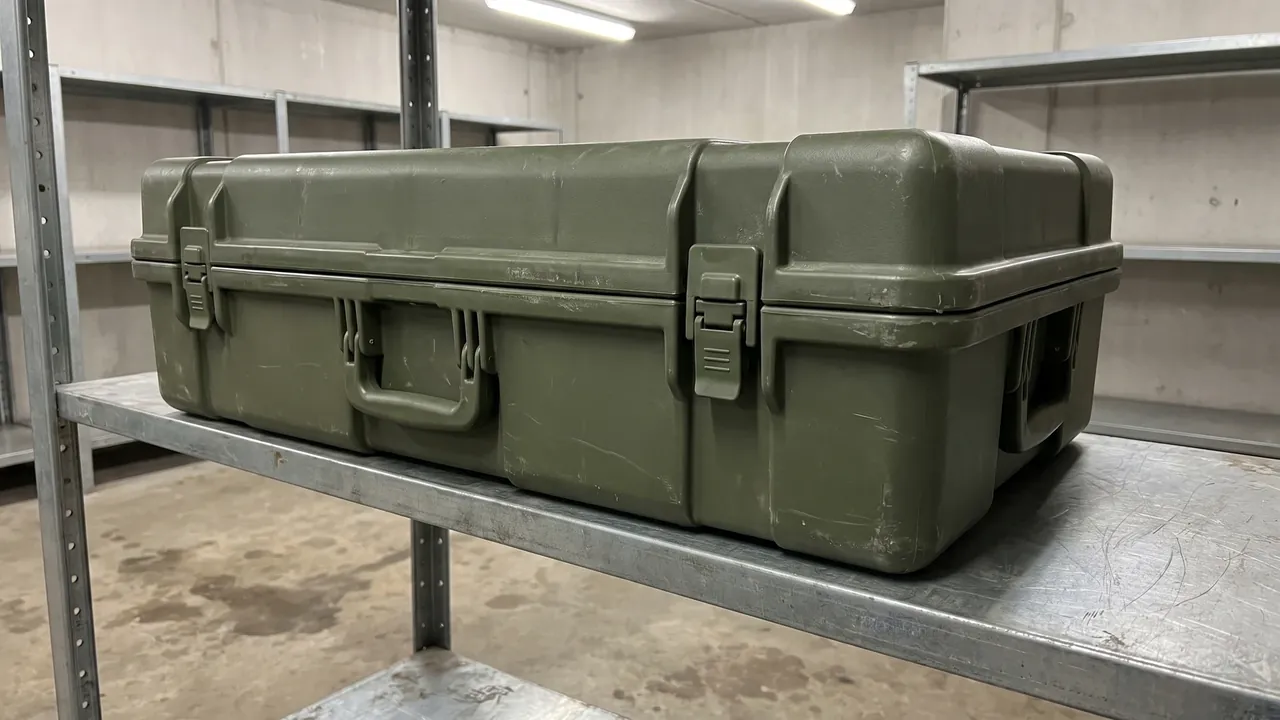
Compression molding places prepreg, or a chopped-fiber and resin compound, into a matched die set and cures it under heat and pressure. Its strengths are shape freedom, good surface finish, stable fiber content and suitability for volume production of shells with recesses, ribs and embedded fittings. A fiber ammunition container is usually a rectangular body with a lid, and features such as corners, latch seats, hinge seats and handle mounts are more economical when molded in one shot. The weakness is tooling: a metal die set is expensive and a geometry change means a die change, so compression molding suits a frozen design in steady volume.
Filament winding draws continuous resin-impregnated tow onto a mandrel at a set angle and cures before demoulding. Its strengths are continuous fiber, controllable direction and the highest utilisation of specific strength, which makes it ideal for pressure vessels and circumferentially loaded bodies. On a box, winding is usually applied to cylindrical or generously radiused transitions, or used to make wound tubes and beams that are later assembled. Its weakness is geometric restriction: a box with sharp corners and internal recesses cannot be wound directly and normally needs molded parts or metal inserts to complete the assembly.
The selection criterion is shape complexity times volume times load direction. A regular envelope, high volume and mainly in-plane compressive load point to compression molding; a circular or radiused form, circumferential load and maximum specific strength point to winding. Hybrid schemes are common too: a molded shell with wound load columns and wound corner guards, joined by structural adhesive and mechanical fasteners. Note that any assembly interface is a step change in stiffness, and the joint must be able to carry the load the fiber was handling, otherwise the lightweighting is cancelled by local reinforcement. On ageing and recycled content, virgin-vs-recycled-case-material covers the trade-offs in detail.
Liners and Cavity Zoning: Keeping Precision Parts Out of the Load Path
However strong the container, the contents must be isolated, not employed as structure. The aim of cavity zoning is to build a soft load chain: shock and vibration energy is first attenuated by the stiffness of the shell, then absorbed by elastic compression of the liner, and only then reaches the contents — and the path never passes through a precision mating face. In practice the rule is that no dimensionally sensitive surface may touch a hard body in the packed state, and none may serve as a support point.
Liners divide by cushioning mechanism. EVA and PE foams are closed-cell and resilient, good for long storage under repeated vibration; polyurethane foam tunes its load capacity through density and suits heavy parts; EPE is light with a flat cushioning curve and suits light parts and void fill. The selection basis is the mass, fragility and expected drop height of the contents, not the feel of the foam. On zoning, milled pockets beat loose fill: loose beads settle under vibration and let upper parts lose restraint, whereas pockets milled to the outline hold position over the long term. The liner-to-shell contact face should be continuous, with no unsupported spans, and zoning must leave working clearance for fingers, lifting points and labels, because otherwise operators will lever the liner out with a bar and damage the protection layer. Where one container must accept several variants, use swappable modular liner trays rather than cutting multiple pockets into one foam block, since unused pockets collapse in transit and loosen the restraint on used ones. Details on zoning and foam selection are in case-internal-foam-types. A liner earns its keep through controlled contact at every point, not through thickness.
Sealing and Ingress Protection: IP Ratings and Pressure-Equalisation Valves
Ingress protection is the basic language of a fiber ammunition container. Under IEC 60529 and GB/T 4208, IP6X means dust-tight, IPX7 means temporary immersion (1 m for 30 min) without water entry, and IPX8 is set by agreement between manufacturer and user on a stricter basis. Outdoor and sea-freight use usually calls for IP67 or IP68. It is important to be precise about what that means: an IP rating describes resistance to water entering from outside, not whether internal humidity rises. Even with a drop-tight shell, the air sealed inside expands and contracts with temperature and condenses on inner walls and metal surfaces. A good seal must therefore be paired with desiccant and humidity indication, a point covered in waterproof-case-ip.
A seal comprises groove, gasket and compression. Gaskets are commonly EPDM, silicone or nitrile; EPDM offers the best weather and ozone resistance for long outdoor exposure, silicone covers the widest temperature range, and nitrile resists oils best. Compression is normally held at 25 to 35 percent: too little and the seal leaks, too much and permanent set destroys its recovery. The groove section must match the gasket, with width slightly larger than the cord and depth setting the compression. The sealing face itself must be a continuous flat, because any moulding flash or exposed fiber end becomes a leak channel.
A pressure-equalisation valve is mandatory equipment on a sealed container. Through storage and transport a container sees temperature swings, and the enclosed air generates positive or negative differential pressure. In heat the internal pressure lifts the lid and drives the gasket to one side; in cold, or on rapid ascent, the vacuum pulls the gasket off its seat and creates a path that passes gas without showing damage. A valve with a waterproof breathable membrane lets gas through while blocking liquid water and holds the differential within a safe band. The gasket keeps water out; the valve keeps pressure from defeating the gasket. Parameters are discussed in case-pressure-equalization-valve.
VCI Rust Prevention and Internal Humidity Control
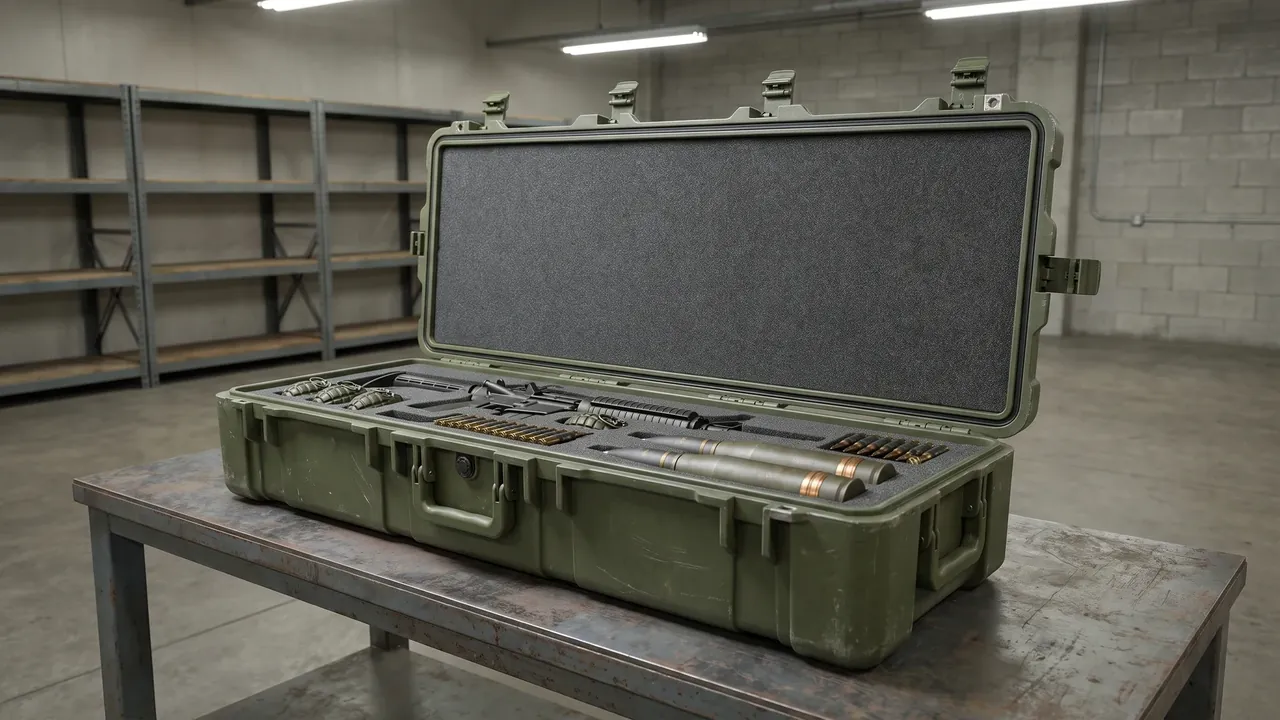
For the metal parts inside, the question during storage and transport is not whether corrosion will start, but when. Corrosion is decided by humidity, temperature, salt and time, and humidity is the only factor packaging can control directly. Volatile corrosion inhibitor works by letting inhibitor molecules evaporate within an enclosed space and adsorb onto metal surfaces as a molecular film, interrupting the electrochemical conditions that initiate corrosion. VCI suits complex metal parts that cannot easily be greased, because the vapour reaches crevices a grease film cannot.
Getting VCI right takes three things. The space must be reasonably enclosed, or the inhibitor molecules escape too quickly. Metal surfaces must be clean and dry, because oil, fingerprints and salt become corrosion nuclei. And the VCI grade must match the protected metal, since copper alloys and aluminium alloys are sensitive to inhibitor chemistry and the wrong choice can discolour them. VCI is usually supplied as a slow-release film or emitter, dosed by net internal volume and protection period. For stainless steel, use a dedicated formulation and avoid chloride-bearing solvents, because chloride ions break down the passive film.
Humidity control is VCI's partner. Desiccants are typically silica gel or molecular sieve, dosed by net volume — a working figure is 2 to 3 g/L, adjusted for period and seal quality. Whether the packaging works is proven by evidence, not by confidence: fit a humidity indicator card inside the lid and place a temperature and humidity logger in the case so the full storage and transport curve is recorded. A sealed package without humidity data cannot be shown to work. For sea freight and tropical storage, hold relative humidity below 40 percent RH and read the card before opening the case on arrival.
Lightweighting and Load Balance: How to Allocate the Weight Budget
Lightweighting is a budget-allocation problem. Fix the target total mass, then split it across shell structure, liner, hardware (latches, hinges, handles, lifting rings, valves) and label accessories. In practice the shell takes the largest share, while hardware is often underestimated: a heavy-duty latch and hinge set can take more than a fifth of total case weight. Real lightweighting therefore has to work both ends at once — optimise layup and thickness in the structure, and choose high-strength light alloy or fiber-reinforced engineering plastic in the hardware.
Load balance is about stiffness distribution. Under stacking, load travels down through corner posts and sidewalls; under lifting, it concentrates through lifting points and reinforcement beams; under fork handling, it passes through the pallet and floor reinforcement. If the three paths differ too much in stiffness, stress concentrates on the stiffest one and the others are effectively decorative. The aim is three paths of comparable stiffness so the load shares itself out. That requires lifting points placed directly over internal reinforcement and pallet supports covering the floor ribs, rather than fitting a ring wherever it is convenient.
One more variable is easily missed: the temperature dependence of stiffness in both material and structure. Ordinary engineering plastics embrittle when cold and soften when hot, whereas composites are more stable but still need validation across the target temperature band. Where a container is used over a wide range, list low-temperature impact and high-temperature stacking as separate governing cases and set thickness from the worst of them. The overall trade is explored in case-weight-strength-balance.
Cushioning and Stacking: The Vertical Load Path
Stacking is the most common long-term load. A bottom case may carry the weight of those above it for its whole service life, overlaid with warehouse vibration and temperature cycling, which makes it a combination of sustained static load and alternating load. The first rule of stacking design is that load travels through structure, not liner: the weight of the case above must be taken by corner posts, sidewall ribs or stacking registers, never by the liner or the contents. Stacking registers, the male-and-female features that locate one case on another, both stop sliding and steer horizontal shear and vertical load into the structure.
The second rule is staged energy absorption. In a drop or impact, energy should be absorbed in sequence by elastic deformation of the shell, then compression of the liner, then inertial displacement of the contents, rather than being taken by any single layer. A liner that is too soft lets the contents travel far enough to strike the wall; one that is too hard passes acceleration straight through. The sound method is to derive required liner thickness and bearing area from the fragility of the contents — the maximum acceleration they tolerate — and then verify by drop test rather than filling by feel.
Long-term stacking also involves creep. Foam and plastic compress slowly under sustained load, height is lost and the stack destabilises. Stacking counts should therefore be checked against long-term permitted compression, not initial compression, and a periodic restacking schedule should support the result. Stacking counts and pallet loading interact directly; the calculation is covered in case-stackability-pallet-planning.
Lifting, Fork Handling and Manual Carrying Interfaces
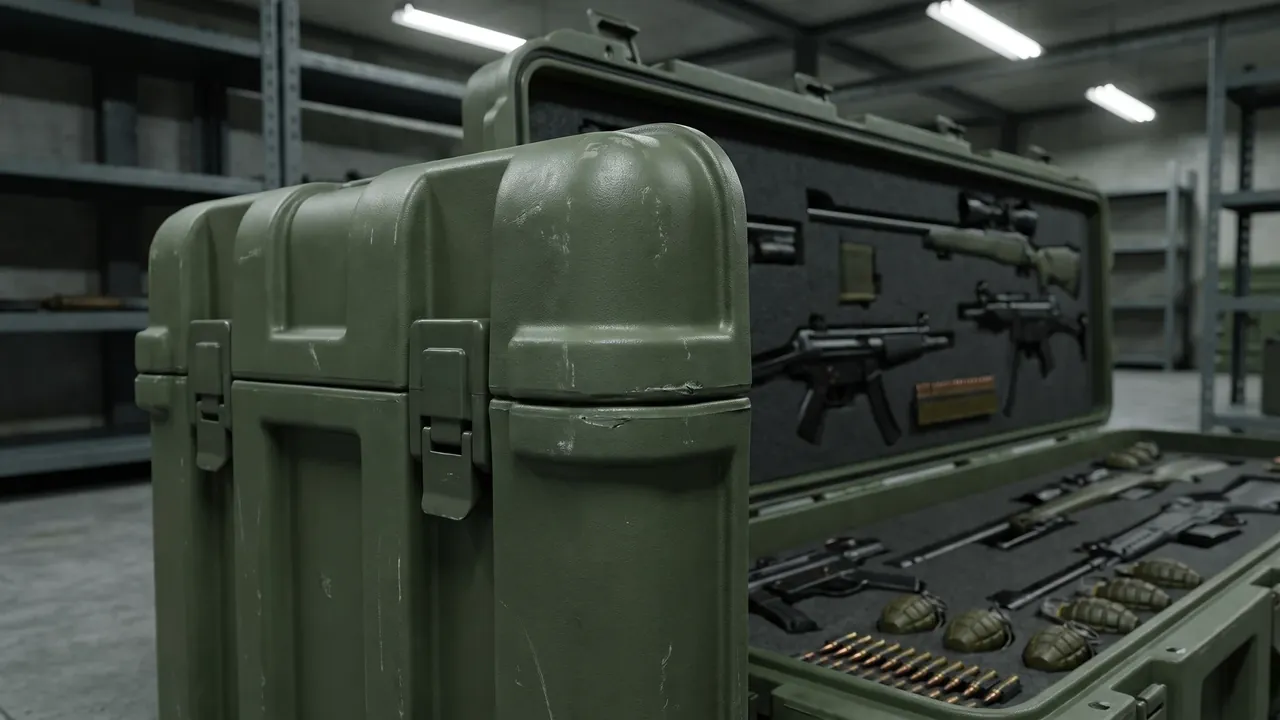
Handling interfaces decide whether a container gets mishandled in practice. Lifting points, fork pockets, handles and castors each suit a different weight band and working condition, and the design should make the correct method the easiest and most natural. Lifting rings or sling points must line up with internal load-bearing structure and spread the local load over enough area; each point should be rated with a safety factor, and with a four-point lift the uneven share must be accounted for, since a wider sling angle raises the load in each leg.
The key to a fork interface is an unambiguous entry direction. Fork insertion depth, spacing and floor structure must match, so the tines neither strike the liner nor punch through the floor. On a flat-bottom case, run two longitudinal fork-handling beams and mark the entry direction; on an integrated pallet base, rate the fork load to pallet standards. Manual carrying interfaces must keep the single-person lift within safe limits — above that, fit handles plus castors or a two-person carry structure rather than expecting a bare lift.
Every interface needs marking on the case itself. Load limits, lifting-point symbols, stacking count, centre of gravity, this-way-up and keep-dry marks should be moulded in or printed on the shell, not left only in the accompanying documents, which get lost on site while the case markings do not. The goal is to make the wrong handling method more awkward than the right one.
Locks, Tamper Seals and RFID Traceability
Locks serve two purposes: preventing accidental opening in transit and providing tamper evidence. Common types include draw latches, rotary locks, recessed locks and mechanical locks with padlock eyes. The governing figures are clamping force, resistance to vibration loosening and sealing compatibility — if clamping force is low, the lid works slightly open under vibration and the gasket compresses and recovers repeatedly, ageing faster and eventually leaking. On a heavy case the latch count should make gasket compression even around the perimeter, and four-sided placement is usually more reliable than concentrating latches on one edge. Hardware selection is covered in case-latch-selection.
Tamper seals provide an undeniable record of opening. Wire seals, plastic pull-tight seals and label seals each fit a different setting: wire seals are strong and hard to forge and suit high-value loads; plastic seals are cheap and easy to read; label seals can carry a QR code and serial number. Seal numbers must correspond one-to-one with transport documents and the packing list, and both parties should check and record them at handover. The value of a seal lies in matching numbers and a complete handover record, not in the thickness of the seal itself.
RFID and QR codes move traceability from manual recording to automatic identification. RFID tags divide by band into low frequency, high frequency and ultra-high frequency; UHF reads at long range and supports batch inventory, suiting warehouses and yards, while HF suits close-range item-by-item checks. Metal shells shield and reflect radio energy, whereas a composite shell passes it noticeably better — a genuine side benefit of a fiber container. Tags should sit in a non-metallic window or a dedicated recess, away from seams and stress raisers. Coding rules, asset ledgers and inventory routines are set out in case-asset-qr-code-tracking.
UN Packaging, Export Controls and MIL-STD-810H / GJB Testing
Packaging for dangerous goods follows the classification and test system built by the United Nations Recommendations on the Transport of Dangerous Goods, Model Regulations, commonly shortened to UN packaging requirements. Where a container serves a specific hazard class, it must pass the relevant drop, stack, airtightness and hydraulic tests for its packing group and carry the corresponding UN packaging mark, which records the packaging code, performance level, test conditions and year of manufacture. Note that a UN approval applies to a specific design type combined with a contents category; a change of model or use normally requires re-verification.
Beyond dangerous-goods transport, ammunition packaging draws heavily on military test standards. MIL-STD-810H provides a method framework for environmental testing — temperature, humidity, vibration, shock, rain, salt fog, low pressure and more — while the GJB series states the corresponding domestic military packaging requirements. The point of testing is not to collect a certificate but to expose weak points early: vibration reveals loose fasteners and resonance, shock reveals corner and latch strength, temperature and humidity cycling reveal gasket creep and internal condensation, and salt fog reveals corrosion of metal hardware and galvanic couples. Methods and acceptance criteria are discussed in mil-std-810h-case-compliance and gjb-military-standard-case.
Export adds export-control and destination-market compliance on top. Whether a container's material, structure, marking and paperwork satisfy the importing country directly affects clearance speed. Compliance must be judged against local regulations and export-control requirements; this article addresses the packaging container only. Define the target market, contents category and certification list at project kick-off and build certification lead time into the delivery plan, so the case is not finished while the paperwork is still open.
| Test | Main defect exposed | Structure of concern |
|---|---|---|
| --- | --- | --- |
| Vibration (random/sine) | Loose fasteners, resonance, liner shift | Latches, hinges, liner fit |
| Shock / drop | Corner cracking, latch failure | Corner guards, ribs, posts |
| Temperature-humidity cycling | Gasket creep, internal condensation | Gasket, equalisation valve, desiccant |
| Salt fog | Rusted hardware, galvanic corrosion | Hardware coating, isolating pads |
| Stacking | Long-term creep, sidewall buckling | Posts, sidewall ribs, floor |
Palletisation and Multi-Case Unitisation
Palletisation upgrades a case into a unit load, cutting the number of handling cycles, protecting the shell and raising container utilisation. The inputs are case dimensions, case weight, permitted stacking count and pallet size; the outputs are cases per layer, interlayer location method, stretch film and strapping layout, and unit total weight and height. More layers is not better: each added layer raises the centre of gravity, reduces transport stability and increases the long-term compression on the bottom case.
Unitisation also has to consider compatibility. Pallet size should match container internal width, rack span and fork attachments; the arrangement of cases on the pallet should align stacking registers vertically to form a continuous load path. Where upper and lower cases cannot be aligned, a divider must spread the load rather than letting it bear on the centre of the lid below. Strapping should cross structural members, not the middle of a lid, and stretch film is for dust and moisture control and unit cohesion, not as a load-bearing element.
Every multi-case unit should carry a loading card recording unit number, case list, total weight, layer count and stacking direction, travelling with the pallet. On arrival, check the card first, then verify seal numbers case by case, giving two-level traceability from pallet to case. The benefit of palletisation comes not just from handling efficiency but from turning scattered handling into controlled handling, which sharply reduces the chance of damage to both case and contents during manual work.
Frequently Asked Questions (FAQ)
Q: How much lighter is a fiber ammunition container than steel or timber, really? A: The saving depends entirely on structural design and load case, and no single figure applies. At equal envelope and equal stacking requirement, a composite container using a sandwich section and load-aligned layup can normally be built considerably lighter than a metal box, but the actual number must come from design verification rather than a quoted percentage. Distinguish light from weak: strength is resistance to failure, stiffness is resistance to deformation, and the two are governed by different factors. A composite can raise stiffness by thickening the core at little mass cost, or raise strength by increasing fiber volume fraction. The real risk is not the material but structural discontinuity — holes, corners and joints become failure origins unless continuous fiber crosses them. Judge a lightweighting scheme by whether it passes vibration, shock, stacking and thermal cycling, not by the weight of the empty box.
Ask for the weight breakdown rather than the headline number: shell, liner, hardware and pallet adapter each carry a share, and the honest comparison is achieved weight at equal stiffness and equal sealing class. A quote that is lighter only because the walls are thinner will surface later as a stacking or impact claim.
Q: Why does a fiber ammunition container need a pressure-equalisation valve as well as a gasket? A: No. The gasket deals with liquid water and dust entering from outside; the valve deals with differential pressure. Through storage and transport a case sees day-to-night temperature swings and altitude changes, so the enclosed air expands and contracts and creates positive or negative pressure. Positive pressure lifts the lid and distorts the gasket; negative pressure pulls it off its seat and opens a path that passes gas while showing no visible damage. Either way the seal has failed, and the failure is usually discovered only after opening. A valve with a waterproof breathable membrane passes gas molecules while blocking liquid water and holds the differential in a safe band. The correct relationship is that the gasket keeps water out and the valve stops pressure from defeating the gasket. They are a partnership, and either one alone is incomplete.
Specify the valve for the composite specifically, because a thin laminate panel is less forgiving of a rigid through-fitting than a moulded wall. Preferred details use a flanged, bonded or gasketed body with a backing plate that spreads the load, and the laminate around the cut-out should be locally thickened so the opening never becomes the origin of a crack.
Q: Can I use VCI film or desiccant on its own, and how do I prove the packaging works?
A: Use both, because their mechanisms differ. Desiccant lowers the absolute humidity inside and weakens the electrochemical conditions at the source; VCI forms a molecular corrosion-inhibiting film on the metal surface and keeps protecting even when humidity rises briefly. With desiccant alone, a shortfall in dose or a small leak lets humidity climb and the metal quickly loses protection. With VCI alone, a poorly enclosed space lets the vapour escape too fast to hold an effective concentration. Prove it with data rather than judgement: fit a humidity indicator card inside the lid and a temperature and humidity logger in the case, record the full storage and transport curve, and read both before opening on arrival. If the curve sits above 60 percent RH for long periods, the dose or the seal needs improvement. Without recorded data, a judgement that it should be fine cannot be verified, and responsibility cannot be separated if corrosion appears.
Q: Can one fiber ammunition container accept several content variants? A: Technically yes, but only with modular liners, not by cutting multiple pockets into a single foam block. With several pockets side by side, the unused ones lose support under transport vibration and collapse, which loosens the restraint on the loaded pockets and reduces protection. The sounder approach is a swappable liner tray: one common shell, liners supplied as a set per variant, replaced as a whole when the variant changes. Each liner is then optimised for one outline, with close-fitting pockets and unambiguous restraint. The changeover also needs marking, with the tray stating the applicable variant and the packing list, so nothing is loaded into the wrong liner. Where variants differ only slightly, a removable divider inside one liner can work, but its fixing must hold position under vibration. Verify fit with the actual contents at the design stage.
The practical route is a base tray with interchangeable top modules: the expensive, load-bearing elements stay constant while the task-specific pockets change. Keep the module fixings captive and toolless, label each variant clearly, and verify that every variant still meets the stacking and vibration cases, because a swapped liner can quietly invalidate an approval.
Q: Why does layup design insist on symmetry and balance, and what happens otherwise?
A: A symmetric layup mirrors angle and thickness about the mid-plane; a balanced layup has equal counts of positive and negative angle plies. Together they cancel the uneven shrinkage that occurs as resin cures. Because resin shrinks during cure, an asymmetric layup shrinks differently in different directions and the container warps and traps residual stress as soon as it leaves the mould. The consequences come in two layers. Geometric accuracy suffers directly, so lid and body sealing faces no longer meet and gasket compression varies around the perimeter. Residual stress also adds to the working load, lowering effective capacity and accelerating delamination under sustained load. Layup design therefore keeps to three baselines: symmetric, balanced and gently graded between adjacent plies, with ±45 degrees as the usual transition between 0 and 90 degrees. Where local reinforcement must break symmetry, restore it with balancing plies or confirm by analysis that warp stays within tolerance.
Q: How often should the gasket in a fiber ammunition container be replaced? A: There is no fixed interval; judge by condition, not by calendar. Ageing shows itself three ways: hardness rises and recovery slows, so the gasket springs back slowly after pressing; the surface cracks, chalks or takes a permanent set, especially at corners; and dimensions change, so the section no longer returns to its original thickness after long compression. The check is to remove the gasket, measure its free height against the original value and look for cracks. The dominant life factors are temperature, ozone, ultraviolet and compression — sustained compression above 35 percent accelerates permanent set, which is why generous groove capacity matters at the design stage. Put the gasket on the routine maintenance checklist and replace the whole loop when hardness rises markedly or cracks appear, rather than splicing a section, because a splice is itself a leak path.
Judge by measurement at each scheduled inspection: compare the free height of a used gasket sample against a new one, look for permanent flattening at the latch zones, and replace on result rather than on the calendar. Composite lids are rigid, so the gasket takes the full closure force and its condition shows early if you actually look.
Q: Why optimise hardware as well as the shell for lightweighting — is the hardware share really significant? A: Because the hardware share of total case weight is routinely underestimated. A heavy-duty latch, hinge and lifting-ring set sized with excessive safety factors can take a substantial part of total weight, so shell optimisation alone yields only a limited reduction. Conversely, thinning the wall while leaving the hardware untouched can upset load-path balance: the shell becomes more compliant while the hardware stays stiff, so load concentrates at the attachment points and tears locally. Work both ends together — optimise stiffness through section and layup in the structure, and select high-strength light alloy or fiber-reinforced engineering plastic for hardware, sizing its attachment stiffness to match the surrounding shell. Judge the result by whether the load path is continuous, the stiffness transition is smooth and the assembly passes stacking and shock testing.
Audit the hardware with the same discipline as the shell: weigh the latch set, hinge set and handle set separately, and ask what each is made of before accepting a metal fitting by default. Moulded-in features, reinforced latches and hollow hinge pins can remove kilogrammes that no amount of layup optimisation will recover.
Q: Which military test item is most often overlooked and most likely to cause trouble?
A: In vibration testing, loose fasteners and liner shift are the most often overlooked, because they are invisible in a static check. After assembly the latches look tight and the liner looks seated, but under sustained excitation from a random vibration spectrum, threads can loosen through micro-motion, liners can creep if friction is insufficient, the lid can work slightly, and the gasket is compressed repeatedly. The case usually looks normal on arrival, and the problem emerges only after a period of use. Three countermeasures help: use anti-loosening measures on threaded joints with a specified retightening torque; give the liner a mechanical stop rather than relying on friction alone; and measure gasket compression and record gasket position before and after the test, so displacement is judged from data. Writing these three into the verification plan saves far more effort than investigating afterwards.
Conclusion and Related Reading
The structural logic of a fiber ammunition container is one sentence: carry load through continuous fiber, protect contents through structural zoning, and prove it with verifiable data. JUNZHIJIA offers composite protective containers as an integrated service — layup and wall-thickness design, liners milled from 3D data, matched gaskets and equalisation valves — manufactured by Kexin New Materials (Guangdong) Co., Ltd.
Related Reading